Feeling uncertain about what to expect in your upcoming interview? We’ve got you covered! This blog highlights the most important Microwave Antenna Installation and Alignment interview questions and provides actionable advice to help you stand out as the ideal candidate. Let’s pave the way for your success.
Questions Asked in Microwave Antenna Installation and Alignment Interview
Q 1. Explain the concept of Fresnel Zone clearance in microwave antenna alignment.
Fresnel Zone clearance is crucial for optimal microwave antenna performance. Imagine throwing a ball – a straight line isn’t the only path it can take. Similarly, radio waves don’t travel strictly in a straight line; they diffract slightly. The Fresnel zones are a series of ellipsoids surrounding the direct path between two antennas. Maintaining clearance within the first Fresnel zone ensures minimal signal obstruction and interference. Obstructions within this zone, like trees or buildings, can cause significant signal loss and degradation, leading to weaker signals, higher bit error rates, and ultimately link failure.
The first Fresnel zone is the most critical. Calculations determine its radius at various points along the path. Ensuring sufficient clearance (typically 60% of the radius is recommended) is paramount during site surveys and installation. Failing to clear the Fresnel zone can lead to significant signal attenuation and multipath interference, affecting the reliability and quality of the microwave link. For example, a new building constructed within the Fresnel zone of an existing link could severely impact its performance, requiring costly realignment or even a complete system upgrade.
Q 2. Describe different types of microwave antennas and their applications.
Microwave antennas come in various types, each suited for specific applications. Some common types include:
- Parabolic Antennas (Dish Antennas): These are the most common type, using a parabolic reflector to focus the radio waves into a narrow beam, providing high gain and directivity. They’re ideal for long-distance point-to-point links.
- Horn Antennas: These antennas use a flared waveguide to radiate the radio waves. They are simpler to design and manufacture than parabolic antennas and are often used as feed antennas for larger parabolic reflectors.
- Microstrip Antennas: These antennas are printed on a dielectric substrate and are compact, lightweight, and low-cost. They are often used in mobile and satellite communication systems.
- Reflector Antennas (Cassegrain, Gregorian): These use a combination of reflectors (main and sub-reflectors) to focus the radio waves. They provide high gain and can be used in applications requiring a large aperture size.
The choice depends on factors like frequency, required gain, size constraints, and environmental conditions. A long-haul point-to-point link might use a large parabolic antenna for maximum gain and range, while a short-range link in a densely populated area might utilize a smaller, less directional antenna to minimize interference.
Q 3. What are the common causes of microwave link fading and how are they mitigated?
Microwave link fading, the temporary reduction in signal strength, can be caused by several factors:
- Multipath Fading: This occurs when the signal reaches the receiver via multiple paths, leading to constructive and destructive interference. Think of waves in a pond – they can interfere with each other.
- Atmospheric Attenuation: Rain, fog, and snow absorb and scatter microwave signals, reducing their strength.
- Atmospheric Scintillation: Variations in atmospheric temperature and pressure cause variations in the refractive index of the air, causing signal fluctuations.
- Earth Curvature and Diffraction Losses: The curvature of the Earth and obstacles in the Fresnel zone can cause signal loss.
Mitigation strategies include:
- Space Diversity: Using two antennas spaced apart to reduce the impact of multipath fading.
- Frequency Diversity: Using multiple frequencies to reduce the impact of selective fading.
- Adaptive Equalization: Using digital signal processing techniques to compensate for signal distortions.
- Careful Site Planning: Ensuring clear Fresnel zone clearance and minimizing potential obstructions.
For example, in areas with heavy rainfall, choosing antennas with lower attenuation characteristics at the operating frequency is crucial. Implementing space diversity further enhances the link’s resilience to fading.
Q 4. How do you perform a microwave antenna alignment using a spectrum analyzer?
Aligning microwave antennas using a spectrum analyzer involves precise adjustments to maximize signal strength and minimize interference. Here’s a step-by-step process:
- Connect the Spectrum Analyzer: Connect the spectrum analyzer to the receiver antenna output.
- Initial Alignment: Roughly align the antennas using visual aids. For this initial step, a simple alignment tool (like a laser pointer) is sometimes sufficient.
- Spectrum Analyzer Setup: Set the spectrum analyzer to the appropriate frequency and resolution bandwidth.
- Signal Detection: Observe the received signal level on the spectrum analyzer. The signal strength should be high when the antennas are correctly aligned.
- Fine Tuning: Make small adjustments to the antenna azimuth and elevation using precise adjustment mechanisms. Observe how the signal level on the spectrum analyzer changes with each adjustment. The goal is to maximize the received signal level.
- Optimization: Fine-tune until the signal level is maximized and the signal-to-noise ratio (SNR) is optimized.
- Documentation: Record the final azimuth and elevation angles.
The spectrum analyzer is invaluable because it provides a quantitative measure of signal strength. You can precisely adjust the antenna position to achieve optimal performance. It allows for a much more precise alignment than relying solely on visual indicators.
Q 5. Explain the significance of antenna polarization in microwave communication.
Antenna polarization refers to the orientation of the electric field in the electromagnetic wave. In microwave communication, antennas typically use either vertical or horizontal polarization. The significance lies in efficient signal transmission and reception. Antennas with matching polarization (e.g., both vertical) receive maximum signal strength. Mismatched polarizations (one vertical, one horizontal) result in significantly reduced signal strength, potentially leading to a complete signal loss.
Imagine two radio antennas that are perfectly aligned. Now imagine rotating one 90 degrees. The other antenna will effectively be “blind” to the signal, even if they are still pointed at each other. This illustrates the importance of correctly aligning polarization. Using the wrong polarization can significantly reduce the link margin and increase signal fading. Proper polarization matching is crucial for reliable communication and efficient use of the available bandwidth.
Q 6. What safety precautions are necessary when working at heights on antenna towers?
Safety is paramount when working at heights on antenna towers. Here are some crucial precautions:
- Proper Training and Certification: All personnel should be properly trained in fall protection, rescue techniques, and working at heights.
- Fall Protection Equipment: Use appropriate harnesses, lifelines, and anchor points. Regular inspection and maintenance of this equipment is essential.
- Appropriate Clothing and Footwear: Wear non-slip, insulated boots and appropriate clothing to protect against weather conditions and potential hazards.
- Use of Safety Nets and Barriers: Employ safety nets and barriers to minimize the risk of falls from the tower.
- Communication Systems: Use a two-way radio communication system to maintain constant contact with ground personnel.
- Weather Conditions: Never work in hazardous weather conditions, such as high winds, lightning, or ice.
- Permit-to-Work Systems: Implement permit-to-work systems to ensure all necessary safety checks are performed before commencing any work.
Neglecting these precautions can lead to serious injuries or fatalities. Adhering to safety regulations and utilizing proper safety equipment is non-negotiable when working on antenna towers.
Q 7. How do you troubleshoot a microwave link experiencing high bit error rate?
A high bit error rate (BER) in a microwave link indicates significant signal degradation. Troubleshooting involves a systematic approach:
- Check Signal Levels: Measure the received signal strength and quality using a spectrum analyzer or other monitoring tools.
- Verify Antenna Alignment: Inspect the antenna alignment for any misalignment. Re-alignment might be necessary.
- Examine Fresnel Zone Clearance: Ensure there are no obstructions within the Fresnel zone.
- Investigate Fading: Check for signs of multipath fading or atmospheric attenuation. Implement mitigating measures as described earlier.
- Test for Equipment Malfunctions: Verify the proper functioning of all equipment including antennas, transmitters, receivers, and any associated electronics.
- Assess Interference: Check for potential interference from other sources using a spectrum analyzer.
- Evaluate Environmental Factors: Consider the impact of weather conditions or other environmental factors.
- Analyze Error Patterns: Use error detection and correction techniques to pinpoint the source of the error.
Systematic troubleshooting helps pinpoint the problem. For instance, if the signal levels are weak, the problem likely lies with the alignment, Fresnel zone clearance, or equipment malfunction. If the error is intermittent, fading effects might be the culprit.
Q 8. Describe the process of installing a microwave antenna on a tower.
Installing a microwave antenna on a tower is a meticulous process requiring safety precautions and precise execution. It begins with thorough site preparation, including assessing structural integrity and ensuring safe access. Next, the antenna mounting hardware is installed securely to the tower, following the manufacturer’s specifications. This often involves bolting the antenna to a mounting bracket, which is itself affixed to the tower. The antenna is then carefully connected to the waveguide and RF cabling. Throughout the process, rigorous adherence to safety regulations, particularly regarding working at heights, is paramount. For example, harnesses and fall protection are essential. After the physical installation, initial alignment is performed using a compass and inclinometer to ensure rough orientation before final alignment using specialized equipment.
Imagine building a really tall, precise LEGO tower – each piece must be perfectly aligned and secured, or the whole structure becomes unstable. Antenna installation is similar; any slight misalignment can significantly impact signal quality.
Q 9. What tools and equipment are essential for microwave antenna installation and alignment?
Essential tools and equipment for microwave antenna installation and alignment include:
- Antenna Mounting Hardware: Brackets, bolts, nuts, and washers specific to the antenna and tower type.
- RF Cabling and Connectors: High-quality coaxial cables and connectors matched to the antenna frequency. Proper connectors are crucial for minimizing signal loss.
- Waveguide (if applicable): For higher frequency antennas, waveguides provide a low-loss transmission path.
- Test Equipment: Spectrum analyzer, power meter, and signal generator are essential for measuring signal strength and quality. A network analyzer is ideal for analyzing the entire RF path.
- Alignment Tools: A highly accurate inclinometer, compass, and potentially a sophisticated alignment system using GPS or laser technology.
- Safety Equipment: Harnesses, fall protection, and appropriate safety gear for working at heights.
- Lifting Equipment: A crane or hoist might be necessary depending on the antenna size and tower height.
- Tools for Cable Management: Cable ties, strain relief clamps, and grounding straps.
Using the wrong tools or neglecting safety equipment can result in damaged equipment, signal degradation, or, worst-case scenario, injury.
Q 10. Explain the importance of proper grounding in microwave antenna systems.
Proper grounding in microwave antenna systems is crucial for several reasons: it protects equipment from lightning strikes, suppresses electromagnetic interference (EMI), and ensures personnel safety. A lightning strike can easily damage expensive equipment if there’s no proper grounding path. EMI from other sources can degrade signal quality or cause interference. Furthermore, a good ground offers a safe path for stray currents to flow, reducing the risk of electric shock.
Think of grounding as a safety valve; it provides a low-resistance path to the earth for potentially dangerous electrical surges. Without proper grounding, the system is susceptible to damage and poses a risk to technicians.
Q 11. How do you interpret a microwave antenna pattern diagram?
A microwave antenna pattern diagram, also known as a radiation pattern, visually represents the antenna’s radiation intensity at various angles in the horizontal and vertical planes. The diagram typically uses polar coordinates, with the distance from the center representing the signal strength (often in dB relative to isotropic radiator). The diagram allows us to understand the antenna’s coverage area, beamwidth, and sidelobe levels. For example, a narrow beamwidth indicates high directivity and concentrated signal, while high sidelobes can result in interference or signal loss.
Interpreting the diagram involves understanding its axes (horizontal and vertical angles), the relative signal strength at each angle, and identifying key parameters like beamwidth and sidelobe levels. Understanding the pattern helps in optimal antenna placement to maximize signal strength and minimize interference.
Q 12. What are the effects of atmospheric conditions on microwave signal propagation?
Atmospheric conditions significantly impact microwave signal propagation. Factors like rain, fog, snow, and atmospheric gases (water vapor, oxygen) can cause signal attenuation and distortion. Rain, for example, causes significant signal loss at higher frequencies due to scattering and absorption. Fog and snow similarly cause attenuation, but their effect is less frequency-dependent. Temperature gradients in the atmosphere can lead to refraction, bending the signal path and potentially causing multipath interference.
Imagine trying to shine a laser pointer through a foggy room – the beam will be significantly weakened and scattered. Similarly, atmospheric conditions can weaken and distort microwave signals, affecting the quality and reliability of the link.
Q 13. Describe different methods for measuring signal strength in a microwave link.
Signal strength in a microwave link can be measured using several methods:
- Power Meter: Measures the received power level directly at the receiver antenna. This is a simple and direct way to assess signal strength.
- Spectrum Analyzer: Provides a more detailed view of the signal, revealing not only the strength but also the presence of noise and interference.
- Network Analyzer: Provides an even more comprehensive view of the RF link’s performance, allowing the identification of issues such as impedance mismatch and excessive signal loss.
- Signal Quality Indicators (SQI): Many microwave systems have built-in SQI metrics like bit error rate (BER) or error vector magnitude (EVM). These directly relate to the perceived signal quality.
The choice of method depends on the level of detail required. For simple checks, a power meter suffices. For troubleshooting complex issues, a spectrum or network analyzer is necessary.
Q 14. Explain the concept of path loss in microwave communication.
Path loss in microwave communication refers to the reduction in signal strength as it travels from the transmitting antenna to the receiving antenna. This loss is primarily due to the signal spreading out as it propagates through free space. The path loss increases with distance and frequency. Other factors, such as atmospheric attenuation and obstacles in the path, contribute to additional loss.
Think of a light bulb – the intensity of light decreases as you move further away. Similarly, the strength of a microwave signal decreases with distance, leading to path loss. This loss must be accounted for when designing a microwave link to ensure sufficient signal strength at the receiver.
Q 15. How do you calibrate microwave test equipment?
Calibrating microwave test equipment is crucial for accurate measurements. It involves using known standards to check and adjust the equipment’s readings to ensure they align with the actual values. This process often involves a multi-step approach.
- Reference Standard: You begin with a known, highly accurate reference standard, such as a precision attenuator or a calibrated power meter.
- Calibration Procedure: The specific calibration procedure varies depending on the type of equipment (e.g., network analyzer, spectrum analyzer, power meter). The manufacturer’s instructions are paramount. Generally, this involves connecting the reference standard and making adjustments within the equipment’s software until the readings match the known standard’s values.
- Verification: After calibration, it’s essential to verify the accuracy by repeating the process or using a second independent reference standard. This ensures that the calibration was successful and the equipment is now ready for reliable measurements.
- Traceability: Properly calibrated equipment needs traceable certification to demonstrate its accuracy and reliability. This certification links your equipment’s calibration to national or international standards.
For example, calibrating a power meter involves comparing its readings against a calibrated power sensor. Any deviations are then compensated for using internal adjustments within the power meter. Failure to calibrate leads to inaccurate measurements, potentially causing design flaws and performance issues in microwave systems.
Career Expert Tips:
- Ace those interviews! Prepare effectively by reviewing the Top 50 Most Common Interview Questions on ResumeGemini.
- Navigate your job search with confidence! Explore a wide range of Career Tips on ResumeGemini. Learn about common challenges and recommendations to overcome them.
- Craft the perfect resume! Master the Art of Resume Writing with ResumeGemini’s guide. Showcase your unique qualifications and achievements effectively.
- Don’t miss out on holiday savings! Build your dream resume with ResumeGemini’s ATS optimized templates.
Q 16. What are the different types of connectors used in microwave systems?
Microwave systems utilize a variety of connectors, each designed for specific frequency ranges and power handling capabilities. Choosing the right connector is vital for signal integrity and minimizing signal loss.
- SMA (SubMiniature version A): A common connector, widely used for its small size and good performance up to 18 GHz. It’s known for its robust construction and reliability.
- N-Type: A larger connector, offering better power handling capabilities and lower loss than SMA, typically used in higher-power applications and at lower frequencies.
- Type-K: Another high-power connector, often preferred for its high-frequency performance.
- 7-16 DIN (also known as 7mm or 0.25 inch): Popular in telecommunications and other applications where a robust and compact connector is needed.
- Waveguide Connectors: Used for high-power applications and at microwave frequencies where coaxial connectors are impractical or unsuitable. These connectors maintain the integrity of the waveguide structure.
Improper connector selection can lead to signal reflections, power loss, and mismatch problems, impacting the overall performance of the microwave link. Imagine trying to connect a garden hose to a fire hydrant with the wrong fitting – the connection is impossible or leaky and inefficient.
Q 17. Explain the concept of antenna gain and its importance.
Antenna gain is a measure of how well an antenna focuses its transmitted power in a specific direction. It represents the ratio of the power radiated in the desired direction to the power radiated by a theoretical isotropic radiator (a point source that radiates equally in all directions). Higher gain means a more focused beam and stronger signal in the desired direction.
Importance: Antenna gain is crucial for several reasons:
- Increased Range: Higher gain allows for longer communication distances, as the signal is concentrated in a specific direction, reducing signal attenuation over distance.
- Improved Signal-to-Noise Ratio: By focusing the power, a higher-gain antenna reduces interference from other signals and improves the overall signal quality.
- Reduced Interference: Concentrated signal transmission reduces the potential for interference with neighboring systems.
- Efficient Power Usage: By directing power effectively, the antenna optimizes power usage, making it more efficient.
For instance, a high-gain parabolic antenna used in satellite communication focuses the signal to the satellite, allowing for communication over vast distances. Conversely, a low-gain antenna in a cell phone needs to cover a larger area but requires higher transmit power and achieves a smaller communication range.
Q 18. How do you troubleshoot a faulty microwave antenna?
Troubleshooting a faulty microwave antenna involves a systematic approach to identify the problem. This often begins with visual inspection and progresses to more sophisticated testing.
- Visual Inspection: Start by visually inspecting the antenna for any physical damage, loose connections, corrosion, or debris. This can often reveal obvious problems.
- Signal Measurement: Use a spectrum analyzer or network analyzer to measure the signal strength at the antenna’s input and output. Compare the measured signal strength to expected values. Significant signal loss suggests a problem with the antenna or its connections.
- Return Loss Measurement: Measure the return loss (reflection coefficient) to check for impedance mismatches. High return loss indicates a significant mismatch that prevents proper signal transmission.
- Antenna Alignment: Verify the antenna’s alignment using specialized alignment tools, ensuring it’s correctly pointed towards the receiving antenna. Even a small misalignment can cause significant signal degradation.
- Environmental Factors: Consider environmental factors such as weather conditions, obstacles, and interference from other sources that could be affecting the signal.
For example, if you find a significant signal loss, checking the connectors for corrosion is a logical first step. If you notice a high return loss, you may need to adjust the impedance matching network on the antenna. Methodical troubleshooting ensures efficiency and pinpoints the issue quickly.
Q 19. What are the common types of microwave transmission impairments?
Microwave transmission is susceptible to various impairments that degrade signal quality and reduce the effectiveness of a microwave link. These impairments include:
- Multipath Propagation: Signals traveling via multiple paths (direct path, reflected paths, scattered paths) arrive at the receiver with varying delays and phases, resulting in constructive and destructive interference, leading to fading and distortion.
- Atmospheric Attenuation: Water vapor and oxygen in the atmosphere absorb microwave energy, causing signal loss. This loss is particularly pronounced at certain frequencies.
- Rain Attenuation: Rain droplets also absorb and scatter microwave signals, causing significant attenuation, especially at higher frequencies.
- Fading: Variations in signal strength due to multipath propagation and atmospheric conditions lead to signal fading, which can disrupt communication.
- Interference: Signals from other microwave systems or other electromagnetic sources can interfere with the desired signal, reducing signal quality.
Consider a scenario where a microwave link experiences significant fading during heavy rain. This is due to rain attenuation. Understanding these impairments is crucial for designing robust and reliable microwave links that can withstand these effects.
Q 20. How do you determine the optimal antenna height for a microwave link?
Determining the optimal antenna height for a microwave link involves balancing several factors to minimize signal obstruction and maximize signal strength.
Key Considerations:
- Fresnel Zone Clearance: The first Fresnel zone is the ellipsoid-shaped area around the direct path between the transmitting and receiving antennas. Obstructions within this zone cause significant signal degradation. The antenna height needs to provide sufficient clearance for this zone.
- Terrain Profile: The terrain between the antennas significantly impacts signal propagation. Hills, buildings, and trees can block the signal. The antenna height should be chosen to ensure a clear line-of-sight path that minimizes obstructions.
- Antenna Gain: Higher-gain antennas concentrate their signal better but require more precise alignment. The antenna height should be chosen to balance the gains of antenna height and antenna gain.
- Regulatory Requirements: Local regulations often dictate restrictions on antenna height.
Software tools using digital elevation models (DEMs) are commonly used to model the terrain and determine the optimal antenna height to provide sufficient Fresnel zone clearance. These simulations help in selecting optimal antenna heights before installation, ensuring a successful link setup. Ignoring this step could result in a weak signal or even a failed communication link.
Q 21. Describe the process of conducting a site survey for a microwave link.
A site survey for a microwave link is a critical step in ensuring reliable communication. It involves a detailed investigation of the proposed locations for the transmitting and receiving antennas.
Steps in a Site Survey:
- Preliminary Planning: Define the link requirements (bandwidth, distance, reliability). Obtain relevant maps and data (terrain profiles, building locations).
- Site Visits: Conduct physical site visits to assess the potential locations. Check for obstacles (buildings, trees, terrain) and possible sources of interference.
- Line-of-Sight Verification: Verify a clear line-of-sight path between the proposed antenna locations. Use tools like a theodolite or laser rangefinder to measure distances and angles. Additionally, specialized software tools are used to model the propagation path and to ensure Fresnel zone clearance.
- Environmental Assessment: Evaluate potential environmental factors that could affect the signal (rain, fog, snow, temperature). This factors into the design considerations.
- Regulatory Compliance: Check for any regulatory restrictions on antenna height, location, or power output.
- Interference Analysis: Identify potential sources of interference (other microwave links, radio towers, etc.) and assess their potential impact.
- Documentation: Create detailed reports including site maps, photos, measurements, and analysis of potential problems.
A thorough site survey minimizes the risk of problems later, saves time and money, and ensures a high-performing, reliable microwave link. Skipping this step can lead to costly redesigns and installation problems.
Q 22. What are the regulatory requirements for microwave antenna installations?
Microwave antenna installations are heavily regulated to ensure safe and efficient operation, minimizing interference and protecting public safety. Regulations vary by country and region but generally cover aspects like:
- Frequency allocation: Operating frequencies are strictly controlled and licensed. Unauthorized use or operation outside assigned frequencies is illegal and can result in hefty fines. For example, a company installing a point-to-point link needs to obtain the necessary licenses from the relevant regulatory body, such as the FCC in the US or Ofcom in the UK, specifying the exact frequencies they intend to use.
- Antenna height and location: Regulations dictate minimum clearances from obstacles and other structures to avoid signal blockage and ensure safe access for maintenance. These regulations often involve surveying surrounding buildings and terrain to ensure compliance, and may even require environmental impact assessments for significant installations.
- EIRP (Effective Isotropic Radiated Power): The maximum power allowed to be transmitted is carefully controlled to prevent interference with other services and avoid potential health risks. Calculating and complying with EIRP limits is critical and often requires specialized software and detailed calculations.
- Radiation patterns: The direction and intensity of radiated energy must be carefully planned to minimize unwanted emissions. Antenna design, orientation and shielding are crucial aspects to consider.
- Environmental considerations: Installations might need to adhere to environmental regulations, especially if located in sensitive areas like national parks or near residential zones. This might include considerations for avian safety, minimizing visual impact, and proper disposal of electronic waste.
Q 23. Explain the differences between parabolic and horn antennas.
Parabolic and horn antennas are both commonly used in microwave systems, but they differ significantly in their design and performance characteristics:
- Parabolic Antennas: These antennas use a parabolic reflector to focus the radio waves into a narrow beam. Think of it like a satellite dish – the curved surface reflects the signal from the feed horn to create a highly directional beam. They’re known for high gain (ability to focus power into a narrow beam), making them ideal for long-distance communication with less power. However, they are generally larger and more sensitive to misalignment.
- Horn Antennas: Horn antennas are simpler in design. They consist of a flared waveguide that radiates the signal directly. They have wider beamwidths (spread of signal) compared to parabolic antennas and are typically less efficient, resulting in lower gain. However, they’re more robust, less affected by minor misalignments, and are often preferred for applications needing broader coverage.
In essence: Parabolic antennas excel in long-range, high-gain applications where a narrow beam is crucial, while horn antennas are more versatile for applications requiring broader coverage and more tolerance for less-precise alignment. The choice depends heavily on the specific application.
Q 24. How do you ensure the integrity of coaxial cables during installation?
Maintaining the integrity of coaxial cables is paramount for reliable microwave links. Damage can lead to signal loss, increased noise, and even system failure. Key aspects of ensuring cable integrity during installation include:
- Proper handling: Avoid bending the cable excessively, especially at sharp angles, which can damage the inner conductor. Use cable trays and supports to ensure proper routing and strain relief.
- Connectors: Properly attaching connectors is crucial. Ensure clean connections free from debris and use the correct tools to avoid damaging the connectors or the cable. Improper crimping can lead to poor impedance matching and signal loss.
- Cable type selection: Choosing the right type of cable for the application is crucial. Consider factors like frequency, power handling capabilities, and environmental conditions (e.g., temperature, humidity). Using the wrong cable type can lead to signal degradation or complete failure.
- Grounding and shielding: Proper grounding and shielding are essential to minimize electromagnetic interference (EMI) and protect the signal from noise. Shielding failures can cause significant signal attenuation and interference.
- Testing: Before connecting the cable to the equipment, use a Time Domain Reflectometer (TDR) or a network analyzer to check for any impedance mismatches or cable faults. This helps to identify potential issues early on before they lead to system problems.
Q 25. What are the advantages and disadvantages of different types of waveguide?
Waveguides are metallic tubes used to transmit microwave signals. Different types offer varying advantages and disadvantages:
- Rectangular Waveguides: Most common, relatively simple to manufacture, and offer good performance over a limited frequency range (single mode operation). However, they can be bulky and have higher losses at higher frequencies.
- Circular Waveguides: Used in applications requiring rotationally symmetric transmission, useful for antenna feeds and rotating joints. They are generally more complex to design and manufacture, but offer better flexibility for certain applications.
- Flexible Waveguides: Essential for connecting fixed components in a system with limited flexibility. These waveguides have significantly higher losses compared to rigid waveguides, and are thus used sparingly.
Choosing the right waveguide depends on the specific application and desired performance. Higher frequencies often require smaller waveguides to maintain single mode operation while minimizing signal loss. Consider factors like frequency range, power handling, size constraints, and cost when selecting a waveguide type.
Q 26. Describe the importance of using proper cable routing techniques.
Proper cable routing is not just about aesthetics; it’s crucial for system performance and longevity. Poor cable management can lead to signal degradation, EMI, physical damage, and increased installation time. Best practices include:
- Organized cable trays and pathways: Use appropriately sized and labelled cable trays to separate different cable types and prevent tangling. Proper spacing and support reduce stress on the cables.
- Strain relief: Use proper strain relief mechanisms to prevent cable damage at connection points and areas where cables enter or exit enclosures. This minimizes tension and extends cable life.
- Bending radius compliance: Avoid sharp bends, which can damage the cable and cause signal attenuation. Adhere to the manufacturer’s specified minimum bending radius for each cable type.
- Labeling and documentation: Clearly label all cables to aid in maintenance and troubleshooting. Maintain accurate documentation of cable routes for future reference.
- Environmental protection: Protect cables from extreme temperatures, moisture, and chemicals. Use appropriate conduit and weatherproofing as needed.
Think of it like organizing a well-stocked kitchen: a messy, cluttered space is inefficient and prone to accidents, just as disorganized cables lead to problems in a microwave system.
Q 27. How would you handle an unexpected equipment failure during an installation?
Unexpected equipment failures during installation are a possibility. My approach involves:
- Safety first: Ensure the safety of myself and the team before attempting any troubleshooting. Power down equipment as needed and follow all relevant safety procedures.
- Troubleshooting: Systematically identify the source of the failure. Use available diagnostic tools (e.g., spectrum analyzers, signal generators, TDRs) to pinpoint the problem. Start with the most likely causes, such as loose connections, faulty components, or power issues.
- Documentation: Carefully document the steps taken, observations made, and any tests performed. This information is crucial for efficient troubleshooting and potential warranty claims.
- Communication: Maintain open communication with the client or supervisor. Clearly explain the situation, estimated time to resolution, and any potential impact on the project timeline.
- Repair or replacement: Depending on the nature of the failure, repair the faulty component or replace it with a new one. Ensure proper installation and testing of the replacement part before resuming the installation.
- Post-failure analysis: After resolving the issue, conduct a post-failure analysis to determine the root cause and prevent similar failures in the future. This may involve reporting the issue to the manufacturer for potential product improvement.
For example, once, during a remote tower installation, a faulty power supply caused a system failure. Using my knowledge of troubleshooting, I identified the issue within minutes. I replaced the faulty unit, performed thorough testing, and ensured the installation was completed successfully despite the unforeseen event.
Q 28. Explain your experience with different types of microwave antenna mounting hardware.
My experience encompasses a wide range of microwave antenna mounting hardware, including:
- Rooftop mounts: These mounts are designed for installation on building rooftops and require careful consideration of wind loading, structural integrity, and potential interference with other rooftop equipment. I have experience working with various types of rooftop mounts, from simple pole mounts to more complex structures designed to withstand extreme weather conditions. These often require specialized tools and safety precautions.
- Tower mounts: Tower mounts provide elevated positioning for antennas, crucial for maximizing signal range and minimizing interference. I’m familiar with different types of tower mounts, including those suitable for lattice towers, guyed towers, and self-supporting towers. Safety protocols for working at heights are critically important here.
- Wall mounts: Wall mounts offer a stable base for antennas, especially in situations where rooftop or tower access is limited. Selection needs to consider the building’s material and structural strength.
- Pole mounts: Simple and cost-effective, pole mounts are suitable for ground-based installations. Careful consideration of ground conditions and stability is crucial.
Selecting the appropriate mounting hardware is critical, as it directly impacts antenna alignment, stability, and longevity. I always assess the specific site conditions and choose hardware that meets safety standards and maximizes performance.
Key Topics to Learn for Microwave Antenna Installation and Alignment Interview
- Antenna Theory Fundamentals: Understanding radiation patterns, gain, beamwidth, polarization, and antenna types (e.g., parabolic, horn, waveguide).
- Site Survey and Planning: Practical application of surveying techniques to determine optimal antenna placement, considering factors like line-of-sight, terrain, and environmental interference.
- Installation Procedures: Safe and efficient installation techniques, including tower climbing safety, grounding procedures, and proper torque specifications for antenna components.
- Alignment Techniques: Mastering various alignment methods (e.g., using alignment tools, signal strength measurements, and spectrum analyzers) to achieve optimal signal quality.
- Troubleshooting and Problem-Solving: Diagnosing and resolving common issues such as signal loss, interference, and reflections. Practical application of troubleshooting methodologies.
- RF Safety Procedures: Understanding and adhering to safety regulations and best practices related to working with high-frequency radio waves.
- Documentation and Reporting: Maintaining accurate records of installation procedures, alignment data, and troubleshooting steps for future reference and compliance.
- Knowledge of relevant standards and regulations: Familiarity with industry best practices and compliance requirements (e.g., FCC regulations).
Next Steps
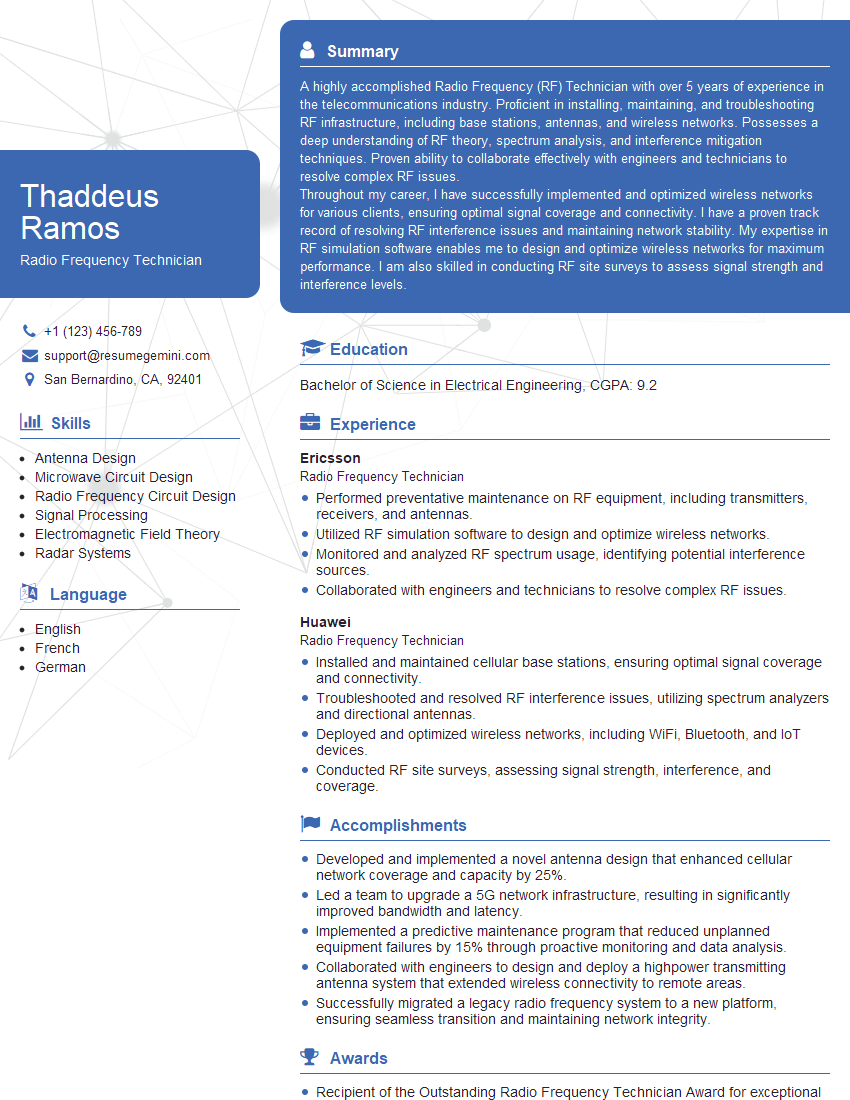
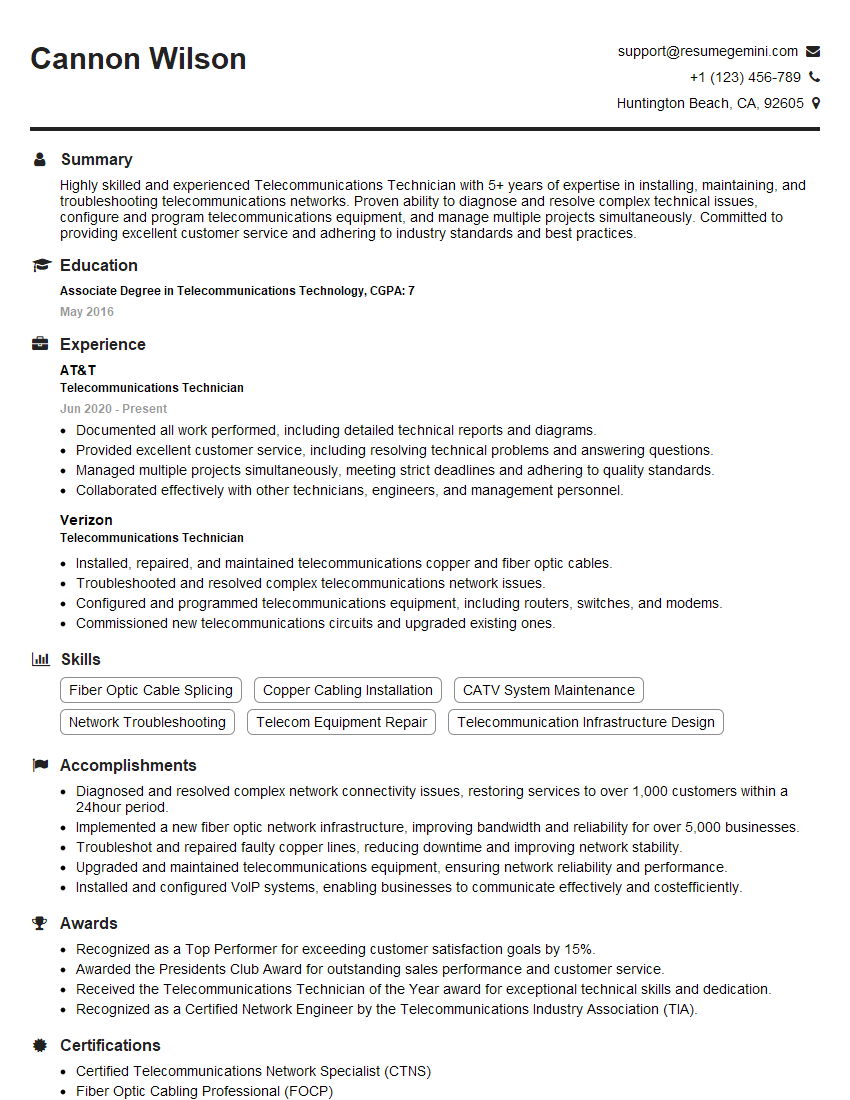
Mastering Microwave Antenna Installation and Alignment opens doors to exciting career opportunities in telecommunications, broadcasting, and aerospace. A strong foundation in these skills is highly valued by employers, leading to better job prospects and higher earning potential. To significantly increase your chances of landing your dream role, it’s crucial to present your skills effectively. Creating an ATS-friendly resume is essential for getting past applicant tracking systems and into the hands of hiring managers. We recommend using ResumeGemini, a trusted resource for building professional and impactful resumes. ResumeGemini provides examples of resumes tailored to Microwave Antenna Installation and Alignment to help you showcase your expertise and secure your next interview.





Explore more articles
Users Rating of Our Blogs
Share Your Experience
We value your feedback! Please rate our content and share your thoughts (optional).
What Readers Say About Our Blog
To the interviewgemini.com Webmaster.
Very helpful and content specific questions to help prepare me for my interview!
Thank you
To the interviewgemini.com Webmaster.
This was kind of a unique content I found around the specialized skills. Very helpful questions and good detailed answers.
Very Helpful blog, thank you Interviewgemini team.