Interviews are more than just a Q&A session—they’re a chance to prove your worth. This blog dives into essential Municipal Engineering interview questions and expert tips to help you align your answers with what hiring managers are looking for. Start preparing to shine!
Questions Asked in Municipal Engineering Interview
Q 1. Explain your experience with AutoCAD and other relevant design software.
AutoCAD is my primary design tool, and I’m proficient in its various functionalities, including drafting, annotation, and 3D modeling. I’ve used it extensively for creating detailed site plans, grading designs, utility layouts, and construction drawings for various municipal projects. Beyond AutoCAD, I have experience with Civil 3D, a specialized extension that streamlines the design process for civil engineering projects. This software allows for efficient surface modeling, drainage design, and the creation of detailed quantity takeoffs. I’m also familiar with GIS software like ArcGIS, which I utilize for spatial data analysis and integration with other project data. For example, in a recent project involving a new park, I used Civil 3D to design the grading and drainage system, AutoCAD to detail the playground structures, and ArcGIS to analyze the existing land use and potential environmental impacts.
Q 2. Describe your understanding of different pavement design types and their applications.
Pavement design selection depends critically on factors like traffic volume, soil conditions, and budget. Common types include flexible pavements, which use layers of asphalt and aggregate to distribute loads; and rigid pavements, typically concrete slabs which provide greater load-bearing capacity. Flexible pavements, like those used on many residential streets, are cost-effective for lower traffic volumes. They are designed with multiple layers – base, sub-base and asphalt surface – each performing a specific function. Conversely, rigid pavements are ideal for high-traffic areas like major roads and highways due to their strength and durability. The design process involves detailed analysis using software like AASHTOWare Pavement ME Design to determine optimal layer thicknesses and material properties. In a recent project, we opted for a flexible pavement design for a residential road network due to its cost-effectiveness, while a major arterial road required a more robust rigid pavement design.
Q 3. How do you approach stormwater management in municipal projects?
Stormwater management is crucial for preventing flooding and erosion. My approach focuses on a holistic, integrated strategy considering various aspects. It begins with site analysis to identify potential runoff sources and infiltration areas. Next, I design stormwater control measures such as bioretention cells, infiltration basins, and detention ponds to manage runoff volume and improve water quality. I use hydrological modeling software (like HEC-HMS) to simulate rainfall events and predict runoff volumes, ensuring that the chosen measures are sufficient. Green infrastructure solutions, like permeable pavements and rain gardens, are incorporated whenever feasible to promote natural water absorption and reduce the reliance on conventional grey infrastructure. For example, in a recent project, we integrated rain gardens into a new park design to manage stormwater runoff while creating aesthetically pleasing and environmentally beneficial features. All designs are compliant with relevant local and federal regulations.
Q 4. What are your experiences with water and wastewater treatment systems?
My experience encompasses both water and wastewater treatment systems. I’ve worked on projects involving the design and upgrades of water treatment plants, focusing on aspects such as water intake, clarification, filtration, and disinfection. For wastewater treatment, I’m familiar with various treatment processes, from conventional activated sludge systems to more advanced technologies like membrane bioreactors. These processes are designed to remove pollutants and ensure compliance with discharge permits. My work often involves hydraulic modeling (using programs like SWMM) to assess the performance of treatment facilities under various scenarios and to optimize their design. A challenging project involved upgrading an aging wastewater treatment plant, which required careful planning and coordination to minimize disruption to the community while implementing new, more efficient technologies.
Q 5. Explain your familiarity with various pipe materials and their suitability for different applications.
Pipe material selection is critical for long-term performance and cost-effectiveness. Common materials include ductile iron, PVC, HDPE, and concrete. Ductile iron pipes are strong and durable, suitable for high-pressure water mains and wastewater collection systems. PVC pipes are cost-effective for low-pressure applications and are resistant to corrosion. HDPE pipes are ideal for applications requiring flexibility, such as crossing streams or navigating tight spaces. Concrete pipes are robust and commonly used for large-diameter storm drains. The choice depends on factors such as pressure, soil conditions, chemical resistance requirements, and cost. For instance, a high-pressure water main would likely utilize ductile iron due to its strength, while a low-pressure drainage system might utilize PVC for its cost-effectiveness and ease of installation. I also consider the long-term maintenance implications of each material during the selection process.
Q 6. How do you manage and prioritize multiple projects simultaneously?
Managing multiple projects concurrently requires strong organizational skills and a structured approach. I utilize project management software to track tasks, deadlines, and resources effectively. I prioritize projects based on factors such as urgency, budget constraints, and potential impacts. A detailed work breakdown structure for each project helps me delegate tasks and monitor progress. Regular meetings with project teams help to identify and address potential challenges promptly. Moreover, maintaining clear and concise communication with stakeholders is essential to ensure that everyone is informed and aligned with project goals. I find that employing a Kanban-style workflow helps visualize progress and adjust priorities as needed.
Q 7. Describe your approach to risk assessment and mitigation in municipal projects.
Risk assessment is an integral part of my approach to municipal projects. It involves identifying potential hazards and evaluating their likelihood and potential consequences. This can include environmental risks, construction hazards, budget overruns, and schedule delays. Once risks are identified, I develop mitigation strategies to minimize their impact. These strategies might involve implementing safety protocols, contingency planning, obtaining necessary permits, and thorough site investigations. Regular monitoring and reporting are vital to track the effectiveness of mitigation measures and to make adjustments as needed. Using a risk matrix helps to prioritize risks and allocate resources effectively. For example, in a recent project involving a bridge repair, we assessed the risk of traffic disruption and developed a plan to minimize delays and ensure public safety.
Q 8. What are your experiences with construction cost estimating and budgeting?
Construction cost estimating and budgeting are critical for the success of any municipal project. It involves accurately predicting the total cost of a project, from initial design to final completion, and then managing those funds effectively. This process requires a deep understanding of material costs, labor rates, equipment rentals, and unforeseen contingencies.
My experience includes using various estimating methods, such as the unit-price method (where costs are calculated per unit of work), the quantity takeoff method (meticulously measuring quantities of materials needed), and parametric estimating (using statistical models based on historical data). I’m proficient in using specialized software like Primavera P6 or similar tools to create detailed cost breakdowns and track expenses throughout the project lifecycle. For example, during a recent water main replacement project, I utilized a bottom-up estimating approach, starting with individual tasks (excavation, pipe laying, backfilling) and summing up to the project total. This provided granular control and helped identify potential cost overruns early on. I also incorporate contingency planning to address unpredictable issues, like unforeseen ground conditions or material price fluctuations.
Budgeting involves allocating the estimated costs across different phases of the project, ensuring financial stability and adherence to the allocated resources. Regular monitoring and reporting are crucial to identify any deviations from the budget and take corrective actions promptly. In my previous role, I successfully managed a budget of $5 million for a large-scale road improvement project, completing the project under budget and ahead of schedule by actively monitoring expenditures and adjusting resource allocation as needed.
Q 9. Describe your understanding of the environmental regulations impacting municipal projects.
Environmental regulations significantly impact municipal projects, demanding careful planning and adherence to various laws and guidelines. These regulations are designed to protect our natural resources, public health, and the environment. My understanding encompasses a broad range of federal, state, and local regulations, including the Clean Water Act (CWA), the Clean Air Act (CAA), the Endangered Species Act (ESA), and numerous others specific to my region.
For instance, the CWA dictates stringent permits and mitigation strategies for projects involving waterways. Before commencing any construction near a stream or river, we must obtain necessary permits, conduct thorough environmental impact assessments (EIAs), and potentially implement erosion and sediment control measures. Similarly, the CAA influences emissions standards for construction equipment, requiring us to use low-emission vehicles and comply with air quality monitoring protocols. The ESA mandates careful consideration of endangered species and their habitats. We must conduct species surveys, implement habitat protection plans, and potentially modify project designs to avoid harm to protected species. Navigating these regulations necessitates collaboration with environmental consultants and regulatory agencies throughout the project’s lifespan.
Q 10. How do you ensure compliance with building codes and regulations?
Ensuring compliance with building codes and regulations is paramount to public safety and structural integrity. This process involves a multi-step approach, starting with thorough review of all applicable codes during the design phase. We utilize a combination of code books, online resources, and consultations with building inspectors to fully understand the requirements.
During construction, we maintain detailed records of all materials used, construction practices, and inspections conducted. Regular inspections are carried out by both our own quality control team and independent building inspectors. Any deviations from the codes are documented, and corrective actions are immediately implemented. We maintain meticulous documentation, including design drawings, specifications, inspection reports, and test results, to demonstrate compliance and support future maintenance and repairs. For instance, in a recent school renovation project, strict adherence to fire safety codes was ensured through regular inspections of fire suppression systems and emergency exits. Any non-compliance issues were addressed promptly to ensure a safe environment for students and staff. Proper documentation was maintained throughout the project, including certificates of compliance for all installed equipment.
Q 11. Explain your familiarity with Geographic Information Systems (GIS) and its application in municipal planning.
Geographic Information Systems (GIS) are powerful tools for managing and visualizing spatial data, which is crucial in municipal planning. GIS allows us to integrate various datasets, such as land use maps, utility networks, demographic information, and environmental data, onto a common platform.
In my work, I utilize GIS for tasks like site selection, infrastructure planning, and community engagement. For example, when planning a new park, we use GIS to analyze terrain, proximity to residential areas, and access to transportation. We can assess the feasibility of different locations, evaluate potential environmental impacts, and optimize the park’s design to maximize its usability and accessibility. Similarly, GIS is invaluable for managing utility networks, such as water mains, sewer lines, and power grids. We can use GIS to track asset locations, maintain records of repairs, and plan future upgrades. Furthermore, GIS plays a vital role in community engagement by allowing us to visualize projects and gather feedback from residents. Interactive maps can be used to present project proposals, solicit public input, and communicate project progress effectively. This visual engagement can be a real game changer in fostering transparency and community involvement.
Q 12. How do you handle conflicts between different stakeholders in a project?
Conflict resolution is an inevitable part of municipal projects, given the numerous stakeholders involved—residents, businesses, government agencies, and contractors. My approach focuses on proactive communication and collaborative problem-solving.
I begin by actively listening to all parties involved and understanding their perspectives. This involves scheduled meetings, open forums, and informal discussions. Then, I work to identify the root cause of the conflict, separating the issues from emotions. A structured approach, such as a facilitated negotiation, can be helpful. I emphasize finding mutually acceptable solutions that address the concerns of all stakeholders, fostering compromise and collaboration rather than confrontation. Transparency and clear communication are crucial throughout the process. For example, during a recent road construction project, a conflict arose between residents concerned about noise levels and the contractor’s need to maintain a schedule. By working collaboratively with both sides, we developed a compromise involving modified construction hours and noise mitigation strategies. This approach not only resolved the conflict but also strengthened relationships between the community and the project team.
Q 13. What are your experiences with public engagement and community participation in municipal projects?
Public engagement and community participation are integral to successful municipal projects. Meaningful engagement ensures that projects meet the needs of the community and build public support. My approach combines various strategies tailored to the specific project and community.
This starts with early and frequent communication, using methods like public meetings, surveys, online forums, and social media to share information and solicit input. I believe in active listening and incorporating feedback from community members into the project’s design and implementation. This could mean incorporating community preferences into park designs, adjusting road layouts based on resident feedback, or modifying project schedules to minimize disruptions. I find that building relationships with community leaders and engaging with neighborhood associations is equally important. In a recent park renovation project, we held multiple public forums, conducted online surveys, and created a dedicated website to keep the community informed and solicit their input on design features and amenities. This approach resulted in high levels of community satisfaction and strong support for the completed project.
Q 14. Describe your experience with project scheduling and monitoring.
Project scheduling and monitoring are essential for timely completion and efficient resource allocation. I use a combination of tools and techniques to ensure projects stay on track.
I typically start by developing a detailed project schedule using software like Microsoft Project or Primavera P6. This schedule outlines all tasks, their dependencies, durations, and resource requirements. Throughout the project, I regularly monitor progress, comparing actual performance against the planned schedule. This involves tracking milestones, identifying delays, and assessing potential risks. Regular progress meetings with the project team are crucial for early identification of potential problems and proactive mitigation. We use various performance indicators such as Earned Value Management (EVM) to track the project’s cost and schedule performance. For example, in a recent water infrastructure upgrade, we meticulously tracked the installation of each pipe section, updating the schedule daily and adjusting resource allocation as needed. This proactive monitoring helped us stay on schedule despite encountering some unforeseen ground conditions.
Q 15. How do you ensure the sustainability of municipal infrastructure projects?
Ensuring the sustainability of municipal infrastructure projects requires a holistic approach encompassing environmental, social, and economic considerations throughout the project lifecycle. It’s not just about building something that lasts; it’s about building something that benefits the community long-term without depleting resources or harming the environment.
- Environmental Sustainability: This involves minimizing the project’s environmental footprint. We achieve this through material selection (using recycled content, locally sourced materials to reduce transportation emissions), energy-efficient design (incorporating passive solar design, green roofs), and water conservation strategies (rainwater harvesting, greywater recycling). For example, in a recent park renovation project, we used permeable paving to reduce stormwater runoff and incorporated native plants to minimize irrigation needs.
- Social Sustainability: This focuses on the project’s impact on the community. We engage stakeholders early and often through public forums and feedback sessions to ensure the project aligns with community needs and values. We also prioritize creating jobs locally and ensuring the project benefits the community in terms of accessibility and improved quality of life. For instance, when designing a new community center, we incorporated accessible ramps and meeting spaces designed to accommodate diverse needs.
- Economic Sustainability: This aspect focuses on the long-term cost-effectiveness of the project. We choose durable, low-maintenance materials to minimize lifecycle costs. We also consider the project’s potential for generating revenue or saving money, such as through energy efficiency measures that reduce utility bills. A recent water treatment plant upgrade, for instance, incorporated advanced technologies that resulted in significant energy savings over its lifespan.
By carefully considering these three pillars – environmental, social, and economic – we can ensure that municipal infrastructure projects deliver sustainable benefits for generations to come.
Career Expert Tips:
- Ace those interviews! Prepare effectively by reviewing the Top 50 Most Common Interview Questions on ResumeGemini.
- Navigate your job search with confidence! Explore a wide range of Career Tips on ResumeGemini. Learn about common challenges and recommendations to overcome them.
- Craft the perfect resume! Master the Art of Resume Writing with ResumeGemini’s guide. Showcase your unique qualifications and achievements effectively.
- Don’t miss out on holiday savings! Build your dream resume with ResumeGemini’s ATS optimized templates.
Q 16. Explain your understanding of different traffic management strategies.
Traffic management strategies aim to optimize the flow of traffic, enhance safety, and improve overall transportation efficiency. Different strategies are employed depending on the specific context, such as road type, traffic volume, and the presence of pedestrians and cyclists.
- Signalized Intersections: These use traffic signals to control the flow of traffic at intersections. Proper timing and phasing of signals are crucial for efficiency. Adaptive traffic control systems can adjust signal timings in real-time based on traffic demand.
- Roundabouts: These offer a safer and more efficient alternative to traditional intersections, particularly in areas with moderate to high traffic volumes. They reduce conflict points and encourage slower speeds.
- Traffic Calming Measures: These strategies are used to slow down traffic in residential areas and improve pedestrian safety. Examples include speed bumps, chicanes, and narrowed roadways.
- Intelligent Transportation Systems (ITS): These use technology to monitor and manage traffic flow, such as using sensors to detect congestion and communicate information to drivers via variable message signs or mobile apps. This allows for proactive management of traffic incidents and improved response times.
- Public Transportation Prioritization: This involves giving priority to buses and other public transport vehicles, for instance, through dedicated bus lanes or signal priority systems. This promotes the use of public transport, reducing traffic congestion and greenhouse gas emissions.
Selecting the appropriate traffic management strategy requires careful analysis of the specific situation and consideration of various factors. A comprehensive traffic study, involving data collection and modeling, is typically conducted to inform decision-making.
Q 17. What are your experiences with designing and implementing accessible infrastructure?
Designing and implementing accessible infrastructure is paramount to ensuring that all members of the community can participate fully in society. It’s about creating an inclusive environment where people with disabilities can navigate their surroundings with ease and independence.
My experience involves applying the principles of universal design, which emphasizes creating environments that are usable by all people, to the greatest extent possible, without the need for adaptation or specialized design. This means considering accessibility from the initial planning stages of a project rather than as an afterthought.
- Ramps and Curb Cuts: Properly designed ramps with appropriate slopes and handrails ensure safe and convenient access for wheelchair users and those with mobility impairments. Curb cuts allow for smooth transitions between sidewalks and roadways.
- Accessible Parking: Designated accessible parking spaces, with adequate width and proximity to entrances, are essential for people with limited mobility.
- Accessible Restrooms: Restrooms must meet specific dimensions and include grab bars, accessible sinks, and appropriately sized stalls.
- Tactile Paving: Tactile paving, with textured surfaces, provides guidance for visually impaired individuals.
- Sensory Considerations: Designing for people with sensory sensitivities includes minimizing noise pollution and ensuring appropriate lighting levels.
In a recent project involving the renovation of a municipal building, we meticulously followed ADA (Americans with Disabilities Act) guidelines to ensure full accessibility, including providing audio announcements and signage, and ensuring clear wayfinding throughout the facility. This involved close collaboration with disability advocacy groups to gather feedback and ensure the design met the needs of the community.
Q 18. Describe your understanding of different types of soil and their properties.
Understanding different soil types and their properties is fundamental to successful municipal engineering projects. Soil properties significantly influence design decisions, construction methods, and the long-term performance of infrastructure.
- Gravelly Soils (Well-Graded): These soils are composed of larger particles (gravel and sand) and have good drainage and bearing capacity. They are suitable for foundation construction but can be susceptible to erosion.
- Sandy Soils: Composed of sand particles, these soils have good drainage but low bearing capacity, making them less suitable for heavy structures without proper foundation design. They are prone to liquefaction during earthquakes.
- Silty Soils: Silty soils are composed of fine-grained particles and have low permeability, leading to poor drainage. They can be susceptible to swelling and shrinking with changes in moisture content.
- Clayey Soils: Composed of very fine-grained particles, clay soils have extremely low permeability, high plasticity, and are susceptible to significant volume changes with variations in moisture content. They require careful consideration during foundation design.
- Organic Soils: These soils contain significant amounts of organic matter and have low bearing capacity and high compressibility. They often require extensive treatment or avoidance during construction.
Geotechnical investigations, involving soil sampling and laboratory testing, are essential to determine the specific properties of the soil at a project site. This information informs the design of foundations, retaining walls, and other structures, ensuring stability and preventing future problems.
For example, in a recent road construction project, we encountered expansive clay soils. Our geotechnical investigation helped us design a suitable foundation system that accounted for the soil’s swelling potential, preventing future pavement cracking and settlement.
Q 19. How do you handle unexpected challenges or changes during a project?
Handling unexpected challenges during a project is a critical skill in municipal engineering. My approach involves a proactive, problem-solving mindset and a collaborative team effort.
- Identify and Assess: The first step involves quickly identifying the nature and scope of the unexpected challenge. This may involve conducting further site investigations or consultations with specialists.
- Develop Solutions: Once the challenge is understood, we explore various solutions, evaluating their feasibility, cost-effectiveness, and potential impact on the project schedule. This often involves brainstorming sessions involving the project team and relevant stakeholders.
- Risk Assessment: Each potential solution is carefully assessed to identify potential risks and mitigation strategies. This may involve contingency planning and developing alternative approaches.
- Decision Making: A collaborative decision-making process is used to select the most appropriate solution, taking into account technical feasibility, cost implications, and schedule constraints.
- Implementation and Monitoring: The chosen solution is implemented, and its effectiveness is closely monitored. Regular progress updates and risk assessments are conducted to ensure the project remains on track.
- Documentation: Thorough documentation of the challenge, the proposed solutions, the decision-making process, and the final outcome is essential for future reference and learning.
For example, in a recent water main replacement project, we encountered an unforeseen underground utility line that wasn’t shown on existing maps. We quickly assessed the situation, contacted the utility company, developed a revised construction plan to avoid the line, and implemented the changes while minimizing disruption to the community. The project was completed successfully despite the unexpected challenge.
Q 20. What is your experience with designing and managing transportation infrastructure?
My experience in designing and managing transportation infrastructure spans various aspects, from road design and construction to traffic management and public transportation planning.
- Roadway Design: This involves the design of roadways, including geometric design (horizontal and vertical alignment), pavement design, drainage systems, and intersection design. I have experience utilizing various design software to create efficient and safe roadways. For example, I utilized software to model traffic flow and optimize signal timing in a recent intersection improvement project.
- Bridge Design: I have been involved in the design and construction of various types of bridges, considering structural, hydraulic, and geotechnical aspects. This involved structural analysis and design using specialized software and ensuring compliance with relevant building codes.
- Public Transportation Planning: I have participated in projects related to improving public transportation systems, including bus route optimization, the development of bus rapid transit (BRT) systems, and the integration of public transportation with other modes of transport.
- Traffic Engineering: I have extensive experience conducting traffic studies, analyzing traffic data, and developing traffic management plans for various scenarios, including special events and construction zones.
A recent project involved designing a new highway bypass to alleviate traffic congestion in a city. This involved conducting extensive traffic analysis, designing the highway alignment and pavement, incorporating sustainable drainage systems, and coordinating with various stakeholders, including environmental agencies and the local community.
Q 21. Describe your understanding of hydraulics and hydrology in municipal applications.
Hydraulics and hydrology are crucial in municipal applications, particularly in managing stormwater, designing water distribution systems, and ensuring flood control.
- Hydrology: This involves the study of the occurrence, circulation, distribution, and properties of the waters of the earth and their atmospheric influences. In municipal engineering, hydrological analysis is essential for designing drainage systems, estimating stormwater runoff, and assessing flood risk. This involves using hydrological models to predict rainfall events and the resulting runoff volumes.
- Hydraulics: This is the study of the mechanics of fluids, particularly water. In municipal engineering, hydraulic principles are applied in the design of water distribution networks, sewer systems, and stormwater management systems. This includes calculating pipe flows, pressures, and energy losses in the system.
- Stormwater Management: This involves the design and implementation of systems to manage stormwater runoff, preventing flooding and protecting water quality. This includes designing detention basins, infiltration systems, and green infrastructure elements.
- Water Distribution Systems: These systems deliver potable water to consumers. Hydraulic analysis is crucial to ensure adequate pressure and flow in the system, meeting the demands of the population.
- Sewer Systems: These systems collect and transport wastewater. Hydraulic analysis is crucial to ensure proper flow and prevent sewer backups. This includes calculating pipe slopes and diameters to maintain adequate flow velocities.
A recent project involved designing a new stormwater management system for a rapidly developing area. This included conducting hydrological analysis to estimate peak runoff volumes, designing a network of pipes, culverts, and detention basins, and ensuring the system met environmental regulations. This required expertise in both hydrological modeling and hydraulic design software.
Q 22. Explain your experience with the permitting process for municipal projects.
Navigating the municipal permitting process requires meticulous attention to detail and a thorough understanding of local regulations. My experience encompasses everything from initial application preparation – ensuring all required drawings, specifications, and impact assessments are complete and compliant – to managing revisions based on reviewer feedback and ultimately securing final approvals. For example, during a recent wastewater treatment plant upgrade, I successfully guided the project through a complex permitting process involving multiple agencies, including the Department of Environmental Quality and the Army Corps of Engineers. This involved anticipating potential challenges, proactively addressing concerns, and maintaining consistent communication with all stakeholders. The process required a deep understanding of regulations related to water discharge permits, construction permits, and environmental impact statements. Effective communication and a proactive approach were crucial to securing timely approvals and avoiding costly delays.
Q 23. How do you ensure quality control and quality assurance in municipal projects?
Quality control (QC) and quality assurance (QA) are integral to ensuring the successful completion of municipal projects. QA focuses on preventing defects through robust planning and proactive measures, while QC involves identifying and rectifying defects during the project lifecycle. My approach involves implementing a multi-layered system incorporating regular inspections, rigorous testing, and detailed documentation. For example, during a road reconstruction project, we implemented a comprehensive QA/QC plan that included daily site inspections to ensure adherence to specifications, independent laboratory testing of materials, and meticulous record-keeping. This resulted in a high-quality finished product that met or exceeded all expectations, and importantly, minimized future maintenance issues. We also utilized statistical process control (SPC) to monitor and adjust work processes in real-time, further enhancing quality and efficiency.
Q 24. What is your experience with structural design principles relevant to municipal structures?
My experience in structural design for municipal projects encompasses a wide range of structures, from bridges and retaining walls to municipal buildings and water towers. I’m proficient in applying relevant building codes and standards (e.g., AASHTO, ACI) and utilizing various design software packages such as SAP2000 and ETABS. For instance, during the design of a new pedestrian bridge, I utilized finite element analysis to model the bridge’s behavior under various load conditions, ensuring its structural integrity and safety. Understanding material properties, load calculations, and structural analysis is critical. Furthermore, I’m experienced in considering seismic design, scour protection, and other factors critical to ensuring longevity and resilience in municipal infrastructure.
Q 25. Describe your understanding of lifecycle costing for municipal infrastructure.
Lifecycle costing (LCC) is a crucial aspect of responsible municipal engineering, considering all costs associated with a project throughout its entire lifespan, from design and construction to operation, maintenance, and eventual decommissioning. A thorough LCC analysis helps in making informed decisions by comparing different design alternatives and selecting the most economically viable option. For example, during the selection of pavement materials for a road project, we performed an LCC analysis comparing asphalt concrete and concrete pavement, considering factors such as initial construction costs, maintenance costs, and expected service life. The analysis revealed that while concrete had a higher initial cost, its longer lifespan and lower maintenance requirements made it the more cost-effective option in the long run. This comprehensive analysis supported the decision-making process and ensured a fiscally responsible project.
Q 26. What are your experiences with using different project management methodologies?
I possess experience with various project management methodologies, including Agile, Waterfall, and Lean Construction. My selection of the appropriate methodology depends on the project’s specific characteristics and requirements. For instance, a large-scale water treatment plant expansion might best suit a phased Waterfall approach, allowing for structured planning and control. In contrast, a smaller-scale park renovation could benefit from the iterative nature of Agile, allowing for flexibility and incorporating feedback throughout the process. My experience allows me to adapt my management style to the project, choosing the methodology that optimizes efficiency and stakeholder satisfaction.
Q 27. Explain your experience with data analysis and its application in municipal engineering.
Data analysis plays a vital role in modern municipal engineering. I utilize data analysis techniques to optimize infrastructure design, improve operational efficiency, and enhance decision-making processes. For example, I’ve used GIS (Geographic Information Systems) to analyze traffic patterns and optimize traffic signal timing, reducing congestion and improving traffic flow. Furthermore, I’ve leveraged data from sensor networks and smart meters to improve water distribution system efficiency and reduce water loss. Statistical analysis methods are routinely used to evaluate the effectiveness of different approaches to mitigate flooding or other issues.
Q 28. How do you stay updated on the latest advancements in municipal engineering?
Staying current in municipal engineering requires continuous learning and engagement with the latest advancements. I actively participate in professional organizations like ASCE (American Society of Civil Engineers), attending conferences, webinars, and workshops. I also regularly review industry publications, journals, and online resources. Furthermore, I actively seek out opportunities for professional development through advanced training courses and certifications in areas such as sustainable infrastructure design and BIM (Building Information Modeling) applications. This ongoing commitment ensures I’m equipped with the most up-to-date knowledge and best practices to effectively tackle the challenges of modern municipal engineering.
Key Topics to Learn for Municipal Engineering Interview
- Water Resource Management: Understanding water supply systems, wastewater treatment, stormwater management, and water conservation strategies. Practical application includes designing efficient drainage systems or optimizing water distribution networks.
- Transportation Engineering: Road design, traffic engineering, pavement management, and public transportation planning. Practical application involves analyzing traffic flow to improve commute times or designing sustainable transportation solutions.
- Environmental Engineering: Waste management, air quality control, environmental impact assessment, and sustainability initiatives. Practical application includes developing a plan for reducing carbon emissions within a municipality or designing a robust recycling program.
- Infrastructure Planning and Management: Long-term planning for infrastructure development, budgeting, project management, and asset management. Practical application involves developing a multi-year plan for upgrading aging water pipes or creating a sustainable budget for road maintenance.
- Public Works Operations: Understanding the day-to-day operations of municipal services, including street maintenance, snow removal, and emergency response. Practical application includes developing a plan for improving response times to infrastructure failures or optimizing snow removal operations.
- Geographic Information Systems (GIS): Utilizing GIS technology for data analysis, mapping, and visualization in municipal engineering projects. Practical application includes using GIS to analyze the location of aging infrastructure or to visualize potential flood zones.
- Sustainable Infrastructure Design: Integrating principles of sustainability into municipal infrastructure projects to minimize environmental impact and promote resource efficiency. Practical application involves designing green infrastructure such as permeable pavements or green roofs.
Next Steps
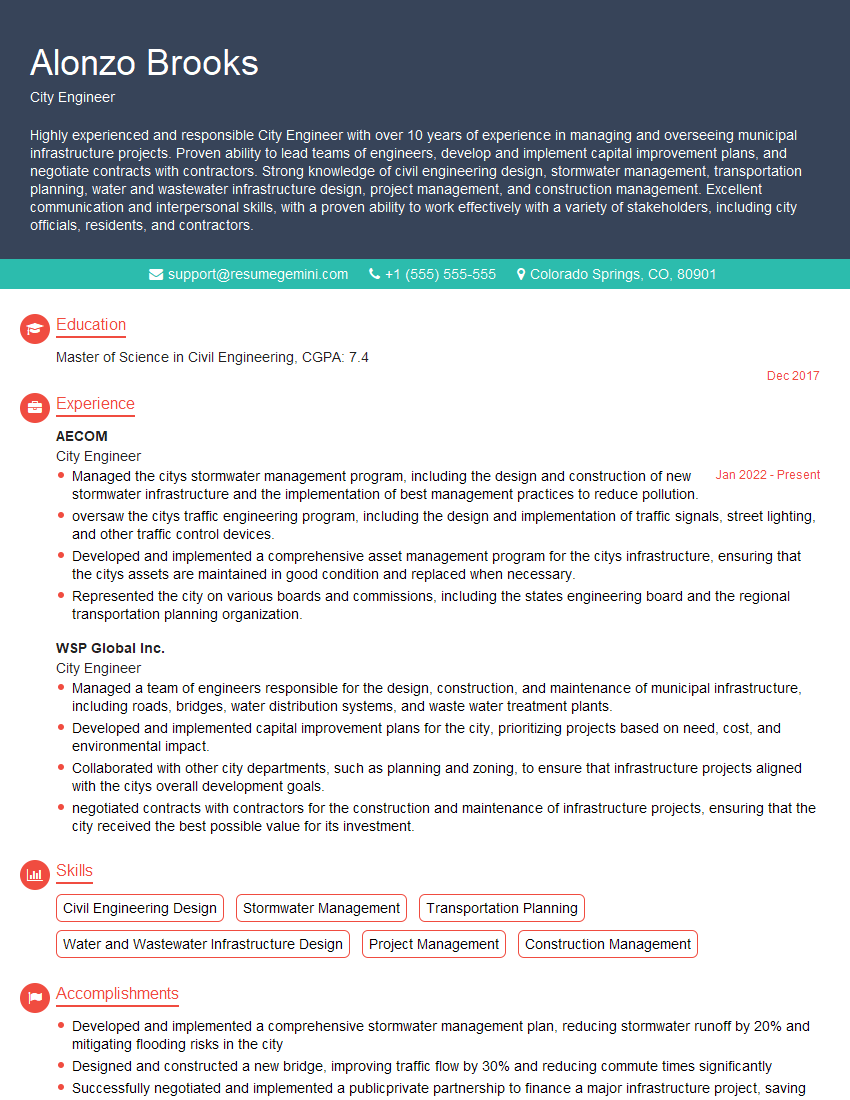
Mastering Municipal Engineering opens doors to a rewarding career with significant impact on communities. Your expertise in planning, designing, and managing vital infrastructure will be highly sought after. To maximize your job prospects, invest time in creating an ATS-friendly resume that highlights your skills and experience effectively. ResumeGemini is a trusted resource that can help you craft a professional and impactful resume tailored to the demands of the Municipal Engineering field. Examples of resumes specifically designed for Municipal Engineering professionals are available to guide you through the process.
Explore more articles
Users Rating of Our Blogs
Share Your Experience
We value your feedback! Please rate our content and share your thoughts (optional).
What Readers Say About Our Blog
To the interviewgemini.com Webmaster.
Very helpful and content specific questions to help prepare me for my interview!
Thank you
To the interviewgemini.com Webmaster.
This was kind of a unique content I found around the specialized skills. Very helpful questions and good detailed answers.
Very Helpful blog, thank you Interviewgemini team.