Unlock your full potential by mastering the most common Object-Based Image Analysis interview questions. This blog offers a deep dive into the critical topics, ensuring you’re not only prepared to answer but to excel. With these insights, you’ll approach your interview with clarity and confidence.
Questions Asked in Object-Based Image Analysis Interview
Q 1. Explain the fundamental principles of Object-Based Image Analysis (OBIA).
Object-Based Image Analysis (OBIA) is a powerful geospatial technique that moves beyond analyzing individual pixels to analyzing groups of pixels that form meaningful objects. Instead of treating an image as a collection of independent pixels, OBIA considers the image as a composition of objects with defined boundaries and characteristics. This object-oriented approach leverages spatial context and relationships between objects for improved accuracy and efficiency in image interpretation.
Fundamentally, OBIA involves three main steps: segmentation (grouping pixels into meaningful objects), classification (assigning class labels to the segmented objects), and analysis (extracting information and knowledge from the classified objects). This process mimics how humans naturally interpret images – we see objects, not just individual points of color.
Q 2. What are the key differences between pixel-based and object-based image analysis?
Pixel-based image analysis and object-based image analysis differ significantly in their approach to image interpretation. Pixel-based analysis treats each pixel independently, assigning it a class based solely on its spectral signature. This can lead to the ‘salt and pepper’ effect, where isolated pixels of different classes create noise and inaccuracies, especially in images with mixed pixels (pixels containing multiple land cover types).
In contrast, OBIA considers the spatial context. Pixels are grouped into objects based on spectral and spatial homogeneity. Classification is then performed on these objects, leveraging information like shape, texture, size, and neighboring objects. This context-aware approach significantly reduces the ‘salt and pepper’ effect and provides more robust and accurate results. Think of it like this: pixel-based analysis is like looking at individual grains of sand, while OBIA is like looking at the sandcastle they form – you understand the structure and meaning much better.
Q 3. Describe the segmentation process in OBIA. What algorithms are commonly used?
Segmentation in OBIA is the crucial first step, where the image is partitioned into meaningful objects. The goal is to create objects that correspond to real-world features like buildings, trees, or roads. This is achieved using segmentation algorithms that group pixels based on their similarity in spectral and spatial characteristics.
Commonly used algorithms include:
- Region Growing: Starts with a seed pixel and iteratively adds neighboring pixels that meet a specified similarity criterion.
- Watershed Segmentation: Treats the image as a topographic surface, identifying catchment basins that represent homogeneous regions.
- Multiresolution Segmentation: A hierarchical approach that segments the image at multiple scales, allowing for the identification of objects at various levels of detail. This is arguably the most popular algorithm in OBIA.
- Mean Shift Segmentation: A non-parametric algorithm that iteratively shifts data points toward the mode of their local density, effectively clustering similar pixels.
The choice of algorithm depends on the specific image characteristics and the desired object properties.
Q 4. How do you select appropriate segmentation parameters for different image types and applications?
Selecting appropriate segmentation parameters is crucial for successful OBIA. The parameters control the scale and detail of the segmentation, and incorrect choices can lead to over-segmentation (too many small objects) or under-segmentation (too few large objects). The optimal parameters depend on several factors:
- Image Resolution: Higher-resolution images require finer segmentation parameters to capture details.
- Image Content: Images with complex features may require more sophisticated segmentation algorithms and parameters.
- Application Goals: The desired object sizes and characteristics will influence the parameter selection. For example, detecting individual trees will require finer segmentation than detecting forest stands.
A common approach involves experimenting with different parameter combinations and visually inspecting the results. Metrics like the shape index and compactness of the segmented objects can also be used to evaluate the quality of the segmentation. Often, an iterative process involving visual assessment and parameter adjustment is necessary to find the optimal settings.
Q 5. Explain the concept of scale and its importance in OBIA.
Scale refers to the level of detail at which objects are identified and analyzed in OBIA. It’s a fundamental concept because the same image can be segmented into vastly different objects depending on the scale. A high-resolution image of a city might be segmented at a fine scale to identify individual buildings, while the same image segmented at a coarser scale might only distinguish between residential and commercial zones.
The importance of scale lies in its influence on the results. Choosing an inappropriate scale can lead to the omission of important details or the creation of objects that do not correspond to real-world features. Therefore, careful consideration must be given to the application’s objectives and the scale at which the relevant objects exist. For instance, analyzing deforestation requires a coarser scale than assessing individual tree health.
Q 6. What are the advantages and disadvantages of using OBIA compared to pixel-based analysis?
OBIA offers several advantages over pixel-based analysis, including:
- Improved Accuracy: The consideration of spatial context leads to more accurate classification and less noise.
- Reduced Salt and Pepper Effect: This is significantly minimized, resulting in cleaner and more interpretable results.
- Object-Level Information: OBIA provides information on object properties like shape, size, and texture, enhancing analysis capabilities.
- Easier Integration with GIS: Objects can be easily represented as vector features in a GIS for further analysis and visualization.
However, OBIA also has some disadvantages:
- Computational Cost: OBIA is generally more computationally expensive than pixel-based analysis, particularly for high-resolution images.
- Parameter Sensitivity: The accuracy of OBIA is highly sensitive to the selection of segmentation parameters.
- Algorithm Complexity: Understanding and implementing OBIA algorithms requires a higher level of expertise than pixel-based analysis.
Q 7. Discuss the role of image classification in OBIA. What classifiers are commonly employed?
Image classification in OBIA assigns class labels to the segmented objects. Unlike pixel-based classification, where each pixel is assigned a class independently, OBIA classifies entire objects. This process leverages object-level features, like size, shape, texture, and contextual information about neighboring objects.
Common classifiers used in OBIA include:
- Support Vector Machines (SVM): Effective for high-dimensional data and can handle non-linear relationships between features and classes.
- Random Forest: An ensemble method that combines multiple decision trees to improve classification accuracy and robustness.
- Maximum Likelihood Classification: A parametric classifier that assumes a Gaussian distribution for each class.
- Artificial Neural Networks (ANN): Can learn complex relationships between features and classes but require significant training data.
The choice of classifier depends on the data characteristics, the number of classes, and the desired accuracy. Often, a combination of classifiers or a multi-stage classification approach is employed to achieve optimal results.
Q 8. How do you evaluate the accuracy of OBIA results? What metrics are used?
Evaluating the accuracy of OBIA results is crucial for ensuring the reliability of our analysis. We primarily use quantitative metrics to assess the performance of our object-based classifications. These metrics compare the classified objects to a reference dataset, often a manually interpreted ground truth data set.
- Overall Accuracy: This simple metric represents the percentage of correctly classified objects compared to the total number of objects. It provides a general overview of the classification’s performance.
- Producer’s Accuracy (User’s Accuracy): This measures the accuracy of a specific class. Producer’s accuracy answers: ‘Of all the pixels I classified as class X, what percentage was actually class X?’ User’s accuracy, conversely, answers: ‘Of all the pixels that are actually class X, what percentage did I classify correctly as class X?’
- Kappa Coefficient (κ): This statistic accounts for the possibility of correct classifications occurring by chance. A higher Kappa value (closer to 1) indicates better agreement between the classification and the reference data, signifying higher accuracy that goes beyond simple chance agreement.
- F1-Score: The harmonic mean of precision and recall, providing a balanced measure of classification performance, especially useful when dealing with imbalanced datasets (where some classes have significantly fewer samples than others).
- Confusion Matrix: A table summarizing the counts of correctly and incorrectly classified objects for each class. It provides a detailed breakdown of classification errors, highlighting areas for improvement.
For example, in a land cover classification project, we might compare our OBIA-derived land cover map to a high-resolution reference map created by experts in the field. By calculating these metrics, we can quantify the accuracy of our OBIA workflow and identify potential areas for improvement, such as refining segmentation parameters or adjusting classification rules.
Q 9. Describe your experience with different OBIA software packages (e.g., eCognition, ENVI, ArcGIS).
My experience with OBIA software packages is extensive. I’ve worked extensively with eCognition, ENVI, and ArcGIS, each offering unique strengths and weaknesses depending on the project requirements.
- eCognition: A powerful tool specifically designed for OBIA, known for its intuitive rule-based classification engine. I’ve used it successfully for a range of applications, including urban mapping, forest inventory, and precision agriculture. Its object-based approach and powerful segmentation algorithms make it particularly well-suited for complex landscapes.
- ENVI: ENVI’s strength lies in its comprehensive image processing capabilities, coupled with robust tools for OBIA. I’ve integrated it with other workflows for pre-processing and post-processing of imagery. Its extensibility through Python scripting enables customized solutions for specific needs.
- ArcGIS: While not exclusively an OBIA platform, ArcGIS offers strong spatial analysis tools and integration with other geospatial data. I’ve utilized it for integrating OBIA results with existing GIS datasets and for visualization of outputs.
My choice of software depends heavily on the project scope, available data, and specific analytical needs. Often, I leverage the strengths of multiple packages in a single project, utilizing eCognition for segmentation and classification, ENVI for pre-processing, and ArcGIS for data management and visualization.
Q 10. Explain the concept of object features in OBIA and how they are used in classification.
Object features in OBIA are characteristics extracted from individual objects created during the image segmentation process. These features are crucial for classification because they provide much richer information than pixel-based approaches. Think of it like this: instead of classifying individual pixels, we’re classifying meaningful entities (objects) defined by their properties.
Examples of object features include:
- Spectral Features: Mean, standard deviation, variance, and other statistical measures of spectral values within an object. These reflect the object’s reflectance characteristics across different wavelengths.
- Shape Features: Area, perimeter, compactness, circularity, and other geometrical properties. These features capture the object’s spatial form.
- Textural Features: Measures of spatial heterogeneity within the object, like GLCM (Grey Level Co-occurrence Matrix) features. These reflect the arrangement and distribution of spectral values within an object.
- Spatial Features: Proximity to other objects, distance to edges, neighborhood characteristics. These features capture the object’s spatial context.
In classification, these features are used as input variables for machine learning algorithms (like Support Vector Machines, Random Forests, or Maximum Likelihood Classification). The algorithm learns the relationships between these features and ground truth data to create a classification model that predicts the class of new objects based on their features.
Q 11. How do you handle noisy or low-quality imagery in OBIA?
Handling noisy or low-quality imagery in OBIA requires a multi-pronged approach focusing on pre-processing and robust classification techniques.
- Pre-processing: This stage is crucial. Techniques like atmospheric correction (removing atmospheric effects), geometric correction (removing geometric distortions), and radiometric calibration (standardizing brightness across the image) improve data quality before segmentation. Noise reduction filters (e.g., median filter) can also help reduce random noise.
- Segmentation Parameter Optimization: Careful tuning of segmentation parameters (e.g., scale, shape, compactness) is critical. Inappropriate parameters can lead to over-segmentation (too many small objects) or under-segmentation (large objects combining different classes), particularly in noisy areas. Experimentation and visual inspection of segmentation results are key.
- Robust Classification Algorithms: Some classifiers are inherently more robust to noise and outliers than others. Random Forest classifiers are a great example. These algorithms are less sensitive to noise in the input features.
- Feature Selection: Selecting the most relevant and least noisy features for classification can significantly improve accuracy. Principal Component Analysis (PCA) can be used to reduce dimensionality and eliminate noisy components.
- Post-Classification Smoothing: If necessary, applying post-classification smoothing techniques can reduce isolated misclassifications, especially those stemming from noise.
For instance, working with remotely sensed imagery from a cloudy day, I might pre-process the data to correct for atmospheric effects and remove cloud shadows before segmentation and classification.
Q 12. What are the challenges associated with OBIA, and how can they be overcome?
OBIA, while powerful, faces several challenges.
- Computational Cost: Processing large datasets can be computationally intensive, especially for complex segmentation and classification algorithms. This necessitates powerful hardware and efficient algorithms.
- Parameter Sensitivity: Segmentation and classification results are often sensitive to parameter choices. Finding optimal parameters often involves extensive experimentation and trial-and-error, requiring significant expertise and time.
- Scale Dependency: The optimal scale for segmentation varies across different landscapes and objects. Finding the right scale can be challenging and may require multi-scale analysis.
- Reference Data Acquisition: Accurate reference data for model training and accuracy assessment can be expensive and time-consuming to obtain, particularly for high-resolution imagery.
Overcoming these challenges often involves:
- Using efficient algorithms and hardware: Employing optimized algorithms and parallelization techniques reduces processing time.
- Developing robust parameter optimization strategies: Utilizing automated parameter optimization methods and exploring sensitivity analysis.
- Implementing multi-scale analysis: Analyzing data at multiple scales can mitigate scale dependency issues.
- Leveraging automated data acquisition techniques and utilizing readily available open-source datasets: Using drones, crowdsourcing and available datasets to reduce the cost of obtaining reference data.
Q 13. How do you incorporate ancillary data (e.g., LiDAR, DEM) into your OBIA workflow?
Incorporating ancillary data significantly enhances the accuracy and detail of OBIA. LiDAR data, for example, provides detailed elevation information, while DEMs offer topographic context.
Here’s how I incorporate them:
- Pre-processing: LiDAR data can be used to create hillshade images, which provide visual context. DEMs can be used for generating slope, aspect, and curvature maps. These derived data layers can be used as additional features in the classification process.
- Segmentation: Some OBIA software packages allow the integration of elevation data directly into the segmentation process. This can improve object delineation, particularly in complex terrains.
- Feature Enhancement: Ancillary data provides valuable object features. For example, elevation and slope can be used to distinguish between different land cover types based on their topographic position. This increases the separability of different classes during classification.
- Post-classification refinement: Ancillary data can be used to refine the classification results. For example, a DEM can be used to remove unrealistic classifications based on elevation (e.g., forest on a cliff face).
For example, in a forest inventory project, I would incorporate LiDAR data to create a canopy height model (CHM), adding CHM as a feature to help distinguish between different tree species or forest density classes. This helps create a much more accurate and detailed forest map than using only spectral data.
Q 14. Describe your experience with different segmentation algorithms (e.g., region growing, watershed, etc.).
I have experience with various segmentation algorithms, each with its strengths and limitations. The choice depends on the specific application and image characteristics.
- Region Growing: A simple algorithm that starts with a seed pixel and iteratively expands the region by including neighboring pixels that meet a predefined similarity criterion. It’s relatively fast but can be sensitive to noise and may not perform well on complex images.
- Watershed Segmentation: This algorithm treats the image as a topographic surface, where pixels are considered as elevations. It identifies watershed boundaries, creating regions based on elevation differences. It is very effective in delineating objects with well-defined boundaries but can be overly fragmented in noisy regions.
- Mean Shift Segmentation: This algorithm iteratively shifts pixels towards the center of density clusters in the feature space, leading to a grouping of similar pixels. It is robust to noise and scale-adaptive, but it can be computationally intensive.
- Multiresolution Segmentation (MRS): This popular algorithm, often used in eCognition, is scale-parameterized, allowing for adaptive segmentation at different resolutions. It balances homogeneity within segments and heterogeneity between segments, offering excellent flexibility.
For example, in a project with relatively uniform imagery, region growing might suffice. But for a highly textured urban scene, multiresolution segmentation, which offers better adaptability to variability in scale, would likely yield better results. The choice of algorithm often involves experimentation and comparison of results to select the most suitable approach.
Q 15. Explain the concept of scale dependency in OBIA.
Scale dependency in OBIA refers to how the identified objects and their characteristics change depending on the scale or resolution of the imagery used. Imagine looking at a forest: from far away, you see a single green blob. Zoom in, and you see individual trees. Zoom in further, and you see leaves and branches. Each level reveals different objects and details. In OBIA, this means that the objects detected and the metrics derived from them (e.g., area, perimeter, shape) will vary dramatically depending on the spatial resolution of your input data. A high-resolution image will allow for the identification of smaller objects, while a lower-resolution image will group these small objects into larger, composite objects. This is crucial because the choice of scale directly impacts the validity and interpretability of your analysis. Using too coarse a resolution might mask important details, while using overly fine resolution might generate excessive noise and computational burden.
Career Expert Tips:
- Ace those interviews! Prepare effectively by reviewing the Top 50 Most Common Interview Questions on ResumeGemini.
- Navigate your job search with confidence! Explore a wide range of Career Tips on ResumeGemini. Learn about common challenges and recommendations to overcome them.
- Craft the perfect resume! Master the Art of Resume Writing with ResumeGemini’s guide. Showcase your unique qualifications and achievements effectively.
- Don’t miss out on holiday savings! Build your dream resume with ResumeGemini’s ATS optimized templates.
Q 16. How do you determine the optimal object size for your analysis?
Determining the optimal object size is a critical step and often requires an iterative approach. It depends heavily on the specific application and the research question. For example, in urban planning, you might be interested in individual buildings, so your object size needs to be small enough to delineate each one accurately. However, if your goal is to analyze urban sprawl, a larger object size representing neighbourhoods might be more suitable.
A good starting point is to analyze the spatial resolution of your imagery and the size of the features you are interested in. Consider using segmentation algorithms with adjustable parameters (scale, threshold) to experiment with different object sizes. Visual inspection of the results is key. Do the objects accurately represent the features of interest? Are there too many small, insignificant objects (over-segmentation) or too few, large, heterogeneous objects (under-segmentation)? Quantify object size using metrics like area or diameter and use accuracy assessment techniques to evaluate how well the segmented objects reflect ground truth data (if available). Finally, select the object size that delivers the best balance between accuracy and detail relevant to your goals.
Q 17. Discuss the use of OBIA in specific applications (e.g., urban planning, agriculture, forestry).
OBIA finds wide application in diverse fields. In urban planning, it’s used for building footprint extraction, urban growth monitoring, and infrastructure assessment. For instance, we can automatically identify and classify different types of buildings (residential, commercial, industrial) based on their size, shape, and spectral characteristics, leading to more efficient urban planning and resource allocation.
In agriculture, OBIA helps monitor crop health and yield, identify areas needing irrigation, and assess the impact of natural disasters. By classifying objects as healthy or unhealthy crops, we can create precise maps guiding targeted interventions.
In forestry, OBIA is used to monitor deforestation, assess forest cover change, and map tree species. By segmenting images into individual trees or tree crowns, we can accurately assess forest density, biomass, and biodiversity. We can even detect changes in forest health based on spectral signatures. Each application requires a tailored approach to object definition and classification, highlighting the flexibility of OBIA.
Q 18. How do you address the issue of over-segmentation or under-segmentation in OBIA?
Over-segmentation results in too many small, fragmented objects, while under-segmentation creates overly large objects that combine disparate features. Both hinder accurate analysis. To address these, we employ several strategies:
- Parameter Tuning: Segmentation algorithms often have parameters controlling the scale and threshold. Adjusting these parameters (e.g., increasing the scale parameter for fewer objects or decreasing for more) can help fine-tune the segmentation results.
- Multi-resolution Segmentation: Applying segmentation at multiple resolutions and then merging or splitting objects based on rules or further analysis can address both problems. This iterative approach allows for a more refined and accurate segmentation.
- Post-processing Techniques: This involves techniques such as merging adjacent objects that share similar characteristics (e.g., spectral signature, shape) or splitting objects based on predefined rules or identified boundaries. Morphological operations (like erosion and dilation) can also smooth and refine the object boundaries.
- Contextual Information: Using auxiliary data (e.g., elevation, land cover maps) helps constrain the segmentation and prevents unrealistic object boundaries.
The choice of method often depends on the data and the specific issue. For instance, if many small objects are merely noise, simple merging might suffice. If there is complex heterogeneity within an object, splitting might be needed to improve accuracy.
Q 19. Explain your experience with rule-based classification in OBIA.
Rule-based classification in OBIA involves assigning objects to classes based on a set of predefined rules. These rules typically use spectral indices, texture features, shape characteristics (e.g., circularity, elongation), and spatial relationships between objects. For example, a rule might classify an object as ‘urban’ if its spectral signature indicates high reflectance in the visible spectrum, its shape is highly irregular, and it is spatially adjacent to other urban objects.
I have extensive experience designing and implementing rule-based classifications. In one project involving mapping wetlands, we used a combination of spectral indices (NDWI) and shape parameters to distinguish between open water, emergent vegetation, and scrub-shrub wetlands. This approach allowed us to efficiently categorize wetlands based on easily interpretable rules, leading to a high level of accuracy for our specific application. The advantage of rule-based systems is their transparency and ease of understanding; however, their limitations become apparent when dealing with complex situations that require more sophisticated decision-making processes.
Q 20. How do you use machine learning techniques in OBIA workflows?
Machine learning techniques, particularly supervised and unsupervised methods, significantly enhance OBIA workflows. Supervised learning, such as support vector machines (SVMs) or random forests, is used to train classifiers on labeled object data. The classifier learns to map spectral and spatial features to object classes based on the training data. For example, we could train a classifier to distinguish different tree species based on their spectral reflectance and texture.
Unsupervised techniques, like k-means clustering, are used to group objects based on their inherent similarities in spectral or spatial characteristics without prior labeled data. This is helpful for exploratory data analysis or when labeled data is scarce.
My experience includes utilizing deep learning architectures like convolutional neural networks (CNNs) for semantic segmentation. These models directly learn to segment images into meaningful objects and classes, often outperforming traditional rule-based or machine learning methods. This leads to more accurate and robust object detection and classification, particularly in challenging scenarios with high variability in spectral and spatial features. The integration of these methods requires a good understanding of image processing, machine learning techniques, and the specific OBIA application.
Q 21. Describe your experience with object merging and splitting techniques.
Object merging and splitting techniques are essential for refining the results of initial segmentation. Merging combines adjacent objects that are likely part of the same feature. This is often based on similarity measures like spectral indices, texture, or shape characteristics. A simple approach would be to merge objects with similar average pixel values and a high degree of spatial adjacency.
Object splitting subdivides objects that are too heterogeneous. This might involve identifying internal boundaries based on changes in spectral or texture characteristics, shape discontinuities, or spatial context. In one project involving building extraction, we first segmented the image and then used a shape-based splitting algorithm to separate closely located buildings that had initially been grouped together.
Both techniques require careful consideration of the scales and contexts involved. We can use rule-based approaches or machine learning models to automate these procedures. The effectiveness depends largely on the quality of the initial segmentation and the appropriateness of the criteria used for merging and splitting.
Q 22. How do you handle spatial autocorrelation in OBIA?
Spatial autocorrelation, the tendency of nearby objects to be more similar than distant objects, is a significant issue in OBIA because it violates the independence assumption of many statistical analyses. Ignoring it can lead to inaccurate results and inflated significance levels. We handle this in several ways:
Geographically Weighted Regression (GWR): GWR allows us to model the relationship between variables while accounting for spatial non-stationarity. It essentially fits local regression models, allowing coefficients to vary across space, reflecting the impact of autocorrelation.
Spatial Lag and Spatial Error Models: These econometric techniques are used in conjunction with regression models to account for autocorrelation. A spatial lag model incorporates the spatial lag of the dependent variable, while a spatial error model incorporates spatially autocorrelated error terms. We choose the appropriate model depending on the nature of the autocorrelation.
Spatial Filtering: Techniques like moving averages or more sophisticated filters can smooth the data, reducing the impact of strong local autocorrelation before further analysis. However, caution is necessary to avoid over-smoothing, which can obscure real spatial patterns.
Sampling Strategies: Employing stratified random sampling or other spatially balanced sampling schemes can reduce the influence of autocorrelation on our sample, ensuring the sample is more representative of the population.
For example, in a land cover classification project, neighboring pixels often share similar characteristics. Failing to account for this can lead to an overestimation of classification accuracy. Employing GWR or a spatial error model helps provide a more realistic assessment.
Q 23. Explain the importance of data pre-processing in OBIA.
Data pre-processing in OBIA is crucial for obtaining accurate and reliable results. It’s akin to preparing ingredients before cooking – skipping this step compromises the final product. Poor pre-processing can lead to misinterpretations, inaccuracies, and ultimately, failed analyses.
Geometric Correction: This ensures that images are georeferenced accurately, aligning them with a common coordinate system. Without this, objects might appear in the wrong locations, affecting spatial analysis.
Atmospheric Correction: Removes atmospheric effects (e.g., haze, scattering) that can alter spectral signatures, leading to inaccurate classifications. This is particularly important for multispectral or hyperspectral data.
Radiometric Calibration: Corrects for sensor-specific variations in brightness and signal strength, ensuring consistent reflectance values across the entire image.
Data Cleaning: This step involves identifying and handling noisy pixels, artifacts (e.g., cloud shadows), or missing data. Common techniques include outlier removal, median filtering, or interpolation.
Data Transformation: Converting data to formats suitable for the OBIA workflow, like converting raster data into vector objects.
For instance, in a project analyzing deforestation, inaccurate georeferencing could result in misclassifying deforested areas. Similarly, atmospheric effects can mask the spectral signature of vegetation, leading to incorrect mapping of forest cover.
Q 24. How do you visualize and present your OBIA results?
Visualizing and presenting OBIA results effectively is key to communicating findings to both technical and non-technical audiences. We employ a multi-faceted approach:
Maps and thematic layers: These are fundamental for displaying spatial patterns. We use GIS software to create maps showing classified land cover, extracted objects, or other spatial variables.
Charts and graphs: These summarize key findings such as object area statistics, class frequencies, or attribute distributions. Bar charts, histograms, and scatter plots help provide a quantitative understanding.
Interactive dashboards: For complex projects, interactive dashboards allow users to explore the data dynamically, filtering and zooming in on specific areas of interest. These can be built using tools like Tableau or ArcGIS dashboards.
Tables and reports: Summarize data in an organized manner. This is particularly helpful for including descriptive statistics, providing context, and showcasing relationships between different aspects of the dataset.
3D visualizations: Useful for showcasing terrain or object attributes in three dimensions, facilitating a better spatial understanding, often using tools like ArcGIS Pro.
For example, in a biodiversity analysis project, a map illustrating the distribution of different species, combined with bar charts showing species richness in different areas, provides a clear and concise presentation of the results.
Q 25. Discuss the limitations of OBIA.
While OBIA offers many advantages, it’s crucial to acknowledge its limitations:
Computational intensity: Processing large datasets can be computationally expensive and time-consuming, especially for complex analyses requiring extensive object extraction and classification.
Parameter sensitivity: The outcome of OBIA workflows is often sensitive to parameter settings in image segmentation and classification. Choosing optimal parameters can be challenging and requires careful experimentation.
Subjectivity in object definition: Defining what constitutes an ‘object’ can be subjective, leading to potential inconsistencies in analysis and interpretation. Clear and well-defined criteria are crucial.
Scale dependency: The results of OBIA can be scale-dependent, meaning that different results might be obtained when using different image resolutions or spatial scales.
Data quality dependence: The accuracy of OBIA relies heavily on the quality of the input data. Noise, errors, or inconsistencies in the imagery can propagate through the analysis.
For instance, in urban planning, defining building objects might vary depending on the spatial resolution of the imagery used. A high-resolution image might allow for identifying individual buildings, while a lower-resolution image might only allow for classifying areas as built-up areas.
Q 26. How do you ensure the reproducibility of your OBIA workflows?
Reproducibility is paramount in scientific research and OBIA is no exception. We employ several strategies to ensure our workflows can be replicated:
Detailed documentation: We maintain comprehensive records of all steps involved, including data sources, pre-processing steps, parameter settings for segmentation and classification, and analysis procedures. This documentation can be written or use code comments.
Version control: Utilizing version control systems (e.g., Git) for code and data allows us to track changes, revert to previous versions, and share our work collaboratively. This ensures consistency and traceability throughout the workflow.
Scripting and automation: Automating OBIA workflows using scripting languages (e.g., Python with libraries like GDAL, OTB) minimizes human error and ensures that the same steps are performed consistently across different runs.
Metadata management: We meticulously track all metadata associated with the data, including acquisition parameters, processing history, and relevant contextual information. This contextual information is vital for reproducibility.
Open-source software: Employing open-source software ensures accessibility and avoids vendor lock-in, making it easier for others to reproduce the analysis.
This robust documentation and version control ensures that any individual can replicate the workflow and obtain comparable results.
Q 27. What are the future trends and advancements in OBIA?
OBIA is a rapidly evolving field. Future trends include:
Integration of Deep Learning: Deep learning techniques are increasingly used for object detection, classification, and segmentation, offering improved accuracy and automation compared to traditional methods.
3D OBIA: Analyzing 3D point cloud data derived from LiDAR or photogrammetry is gaining traction, providing richer spatial information compared to traditional 2D imagery. This leads to more detailed and accurate object extraction.
Big data analytics and cloud computing: Handling massive datasets from multiple sources (e.g., satellite imagery, LiDAR, sensor data) will necessitate the use of cloud-based computing platforms and big data analytics techniques for efficient processing and analysis.
Time-series analysis: Analyzing changes in objects over time (e.g., urban growth, deforestation) using time-series imagery is becoming more crucial, calling for sophisticated methods to track object evolution and change detection.
Enhanced data fusion techniques: Combining data from different sensors (e.g., multispectral, hyperspectral, LiDAR) to derive more robust and informative characterizations of objects is an active area of research and development.
These advancements will further enhance the capabilities of OBIA, enabling more accurate, efficient, and insightful analyses across a wider range of applications.
Q 28. Describe a challenging OBIA project you worked on and how you overcame the challenges.
One challenging project involved mapping individual trees in a dense, tropical rainforest using high-resolution aerial imagery. The main challenges were:
High density of objects: The extremely high density of trees made object segmentation extremely difficult, with many trees merging together in the imagery.
Shadowing effects: Dense canopy cover created significant shadowing effects, obscuring tree crowns and making accurate delineation challenging. This created variations in spectral signatures.
Computational cost: Processing the large volume of high-resolution imagery using traditional segmentation algorithms was incredibly computationally intensive.
To overcome these challenges, we adopted a multi-stage approach:
Pre-processing: We carefully pre-processed the imagery to correct for atmospheric effects and reduce noise. This improved the overall image quality and reduced the complexity of segmentation.
Advanced segmentation techniques: We employed advanced segmentation algorithms, such as the watershed algorithm coupled with a marker-controlled segmentation method, to effectively delineate individual trees. The markers provided a starting point to guide the algorithm and ensure delineation even in areas of high object density.
Object-based classification: To further improve accuracy, we employed a rule-based classification algorithm using spectral, textural, and shape features of tree crowns to better identify and classify tree objects in the high-density forest environment.
High-performance computing: To tackle the computational cost, we leveraged high-performance computing resources, which drastically reduced processing time.
This multi-faceted approach resulted in a significantly improved accuracy in tree mapping compared to using traditional methods.
Key Topics to Learn for Object-Based Image Analysis Interview
- Image Segmentation Techniques: Understand various segmentation methods (e.g., thresholding, region growing, watershed, edge detection) and their applicability in object-based analysis. Consider the strengths and weaknesses of each approach.
- Feature Extraction and Selection: Master techniques for extracting relevant features from segmented objects (e.g., shape, texture, spectral indices). Learn how to select the most informative features for classification and analysis.
- Object Classification and Machine Learning: Familiarize yourself with supervised and unsupervised classification methods (e.g., support vector machines, random forests, k-means clustering) for categorizing objects based on their features.
- Spatial Relationships and Contextual Information: Explore how to incorporate spatial relationships between objects into your analysis. Understand the importance of considering the context surrounding individual objects.
- Accuracy Assessment and Validation: Learn how to evaluate the accuracy of your object-based image analysis results using appropriate metrics (e.g., producer’s accuracy, user’s accuracy, overall accuracy). Understand error propagation and its implications.
- Software and Tools: Demonstrate familiarity with common software packages used for object-based image analysis (e.g., eCognition, ArcGIS, QGIS). Be prepared to discuss your experience with these tools.
- Practical Applications: Be ready to discuss real-world applications of object-based image analysis in your field of interest, such as urban planning, precision agriculture, or environmental monitoring. Highlight specific case studies if possible.
- Problem-Solving Approaches: Practice troubleshooting common challenges encountered in object-based image analysis, such as dealing with noisy data, handling overlapping objects, and optimizing processing time.
Next Steps
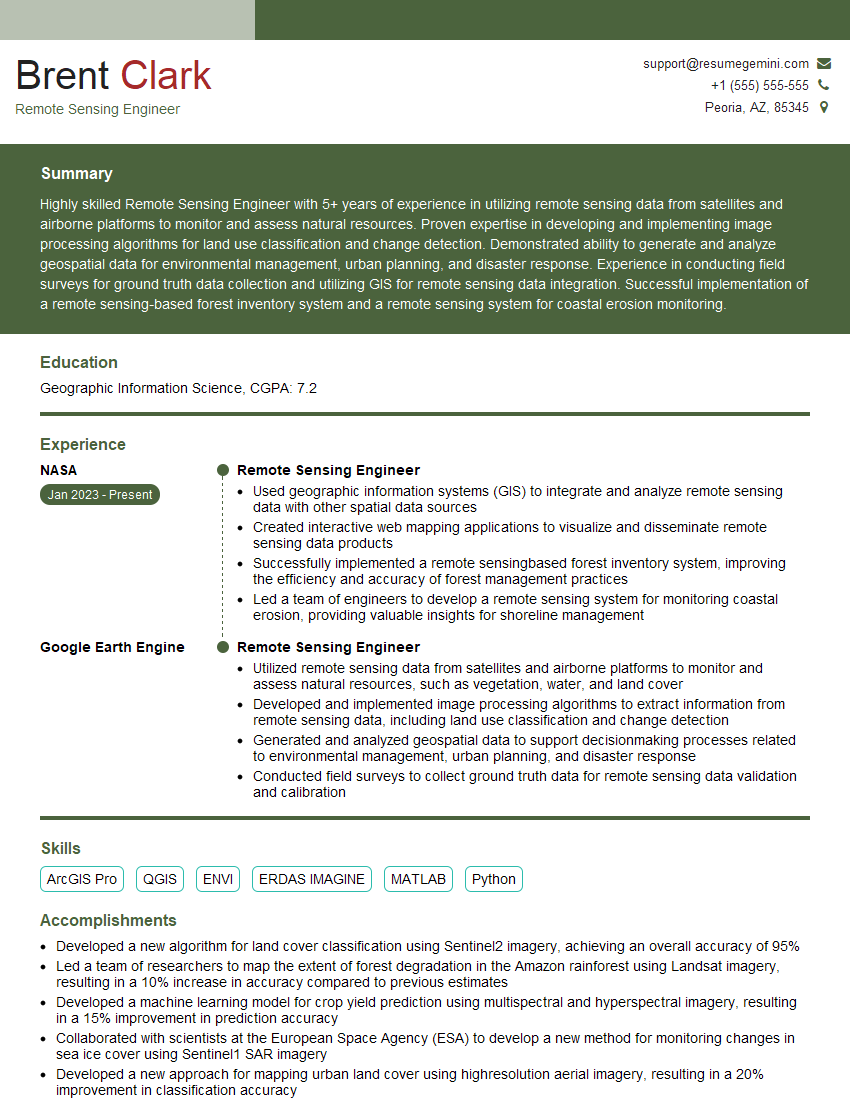
Mastering Object-Based Image Analysis significantly enhances your career prospects in various fields demanding advanced geospatial data processing skills. It demonstrates a high level of technical expertise and problem-solving abilities highly valued by employers. To maximize your chances of landing your dream role, focus on crafting an ATS-friendly resume that effectively showcases your skills and experience. ResumeGemini is a trusted resource that can help you build a professional and impactful resume. Take advantage of the examples of resumes tailored to Object-Based Image Analysis provided to help you build a compelling application.

Explore more articles
Users Rating of Our Blogs
Share Your Experience
We value your feedback! Please rate our content and share your thoughts (optional).
What Readers Say About Our Blog
To the interviewgemini.com Webmaster.
Very helpful and content specific questions to help prepare me for my interview!
Thank you
To the interviewgemini.com Webmaster.
This was kind of a unique content I found around the specialized skills. Very helpful questions and good detailed answers.
Very Helpful blog, thank you Interviewgemini team.