The thought of an interview can be nerve-wracking, but the right preparation can make all the difference. Explore this comprehensive guide to Pane Fabrication interview questions and gain the confidence you need to showcase your abilities and secure the role.
Questions Asked in Pane Fabrication Interview
Q 1. Describe the process of cutting glass panes to precise dimensions.
Cutting glass panes to precise dimensions requires precision and the right tools. The process typically involves using a glass cutter, a scoring tool that creates a clean, controlled fracture line. First, we carefully measure the glass using a calibrated measuring tape, ensuring accuracy to the millimeter. Next, we firmly score the glass along the measured line with the cutter, applying even pressure to create a consistent score. This score weakens the glass along that line. Then, using a pair of specially designed glass shears or a snapping tool, we apply controlled pressure to the scored line causing the glass to cleanly break along the score. For intricate shapes or very thin glass, a water-jet cutter offers a more precise and controlled cut with minimal risk of chipping.
Think of it like scoring a piece of paper before tearing it; the score weakens the material, allowing for a clean break. However, with glass, the process requires more precision and control to avoid accidental shattering.
Q 2. Explain the different types of glass and their applications in pane fabrication.
The world of glass for pane fabrication is vast. We commonly work with several types:
- Float Glass: This is the most common type, produced by floating molten glass on a bed of molten tin. It’s known for its flatness, clarity, and affordability. Used extensively in windows and doors.
- Annealed Glass: Standard float glass that has been cooled slowly to reduce internal stress. It’s relatively inexpensive but breaks into sharp shards when fractured.
- Tempered (or toughened) Glass: Heat-treated to increase strength. When broken, it crumbles into relatively small, blunt pieces, making it safer than annealed glass. Ideal for applications demanding high strength and safety, such as automotive windshields and shower doors.
- Laminated Glass: Composed of two or more layers of glass bonded together by an interlayer of polyvinyl butyral (PVB) or SentryGlas®. This interlayer holds the glass together even if it shatters, making it highly resistant to impact and penetration. Used in security applications, car windshields, and hurricane-resistant windows.
- Low-Emissivity (Low-E) Glass: Coated with microscopic metallic layers to reflect infrared radiation, reducing heat transfer and improving energy efficiency. Widely used in energy-efficient windows.
The choice of glass depends entirely on the application’s requirements. For instance, a storefront window might use laminated low-E glass for both safety and energy efficiency, while a simple interior partition might only require annealed float glass.
Q 3. How do you ensure the quality and accuracy of glass cuts?
Quality and accuracy are paramount in glass cutting. We achieve this through a combination of factors:
- Precise Measurement: Using calibrated measuring tools and double-checking measurements is crucial.
- Sharp Tools: A sharp glass cutter ensures a clean score. Dull cutters lead to uneven breaks and potential chipping.
- Proper Technique: Consistent pressure and a smooth, continuous score are essential for a clean break.
- Clean Work Surface: A clean, flat work surface ensures the glass doesn’t shift during cutting.
- Inspection: After cutting, we carefully inspect each pane for chips, cracks, or other defects. Even minor flaws can compromise the structural integrity or aesthetic appeal.
For high-volume or complex cuts, automated cutting systems with computer-aided design (CAD) integration help to guarantee consistent accuracy and minimize human error.
Q 4. What are the safety precautions you take when handling glass?
Safety is our top priority. We always:
- Wear safety glasses: Protecting our eyes from flying shards is non-negotiable.
- Use gloves: To prevent cuts from sharp edges.
- Handle glass carefully: Avoiding sudden movements or dropping the glass.
- Maintain a clean workspace: Preventing trips and falls over glass shards.
- Dispose of broken glass properly: Using special containers designed for sharp materials.
- Use appropriate personal protective equipment (PPE): Including cut-resistant gloves and safety footwear in certain tasks.
We also have emergency procedures in place to deal with any accidents, including immediate first aid and reporting to our safety officer.
Q 5. Describe your experience with different glass edging techniques.
Glass edging refines the raw cut edges, improving safety and aesthetics. Several techniques exist:
- Grinding: Uses abrasive wheels to smooth and round the edges. This is the most common method for creating a smooth, polished finish.
- Polishing: Follows grinding and creates a highly polished, almost mirror-like finish. Often used for high-end applications.
- Beveling: Creates an angled edge, adding a decorative touch and improving strength at the edge.
- Seaming: Creating a smooth, decorative edge with a joint of two or more glass elements.
The choice of edging technique depends on factors such as the type of glass, intended application, and aesthetic requirements. For example, a safety glass application might demand a ground and polished edge to reduce sharpness, whereas a decorative glass element might benefit from beveling.
Q 6. How do you handle defective glass panes during the fabrication process?
Defective panes are immediately identified during quality control checks. We have a rigorous inspection process after cutting and edging. If a pane is cracked, chipped, or otherwise flawed, it’s immediately rejected and set aside for proper disposal. We maintain detailed records of rejected panes to track potential issues in the supply chain or manufacturing process. This helps us to address any recurring problems and improve our quality control measures. Rejected panes are not reused. Instead, they are carefully packaged and disposed of in accordance with local regulations for hazardous waste.
Q 7. Explain the process of assembling an Insulated Glass Unit (IGU).
Assembling an Insulated Glass Unit (IGU), also known as a double- or triple-pane window, is a crucial part of the fabrication process. It involves creating an air or gas-filled cavity between two or more panes of glass to enhance energy efficiency and sound insulation. The process generally involves:
- Preparing the Glass Lites: This involves cleaning and inspecting the individual glass panes to be sure they are free from defects.
- Spacer Bar Application: A perimeter spacer bar, typically made of aluminum or stainless steel, is placed around the perimeter of one of the glass panes. These spacers contain desiccant, which absorbs moisture, preventing condensation within the IGU.
- Sealant Application: A butyl sealant is applied to the perimeter of the spacer bar and the edges of the glass lite. This creates an airtight and watertight seal. It acts as a primary sealant.
- Assembly: The second glass pane is carefully lowered onto the first to complete the unit.
- Secondary Sealant Application: A secondary sealant, such as polysulfide or silicone, is applied around the perimeter of the unit to enhance the airtight seal and provide added protection against moisture ingress. This sealant provides a weather barrier.
- Quality Control: Each assembled IGU is inspected for leaks or other defects. There are various testing methodologies, like vacuum testing, to ensure airtightness.
The precision and attention to detail during IGU assembly are vital to prevent air leaks and ensure long-term performance and efficiency. Think of it as building a tiny, perfectly sealed room between two panes of glass.
Q 8. What are the critical factors to consider when sealing an IGU?
Sealing an Insulating Glass Unit (IGU) is crucial for its performance and longevity. A properly sealed IGU prevents moisture ingress, maintains the insulating gas fill (typically Argon or Krypton), and ensures the unit’s structural integrity. Several critical factors must be considered:
- Sealant Selection: The type of sealant is paramount. Butyl sealant forms the primary seal, providing a strong, flexible bond. A secondary sealant, often polysulfide or polyurethane, offers additional protection and weather resistance. The choice depends on the application, climate, and desired performance characteristics. For example, polysulfide is known for its superior UV resistance, making it ideal for sun-exposed windows.
- Spacer Bar Quality: The spacer bar, which houses the desiccant and maintains the gap between the panes, must be of high quality and properly sealed to prevent gas leakage. Poor quality spacers or improper sealing can compromise the entire IGU.
- Cleanliness: Impurities, dust, or debris on the glass surfaces or spacer bar can prevent proper sealant adhesion, leading to weaknesses in the seal. Thorough cleaning is essential before assembly.
- Application Technique: The sealant must be applied evenly and consistently, avoiding gaps or thin spots. Proper tooling and application techniques are crucial to ensure a strong, reliable seal. Improper application can lead to premature failure, often manifesting as air leaks.
- Environmental Conditions: Temperature and humidity during both sealant application and curing significantly impact the final seal quality. Extreme temperatures or high humidity can compromise the bonding process. Manufacturers usually provide guidelines regarding optimal application conditions.
- Quality Control: Regular quality control checks throughout the fabrication process, including inspection of the sealant application and overall IGU construction, are vital to ensure consistent quality.
A poorly sealed IGU can lead to fogging, thermal performance degradation, and even structural failure. Therefore, adherence to best practices and rigorous quality control measures are non-negotiable.
Q 9. How do you identify and address air leaks in an IGU?
Identifying air leaks in an IGU is important for maintaining its energy efficiency and preventing damage. Several methods can be employed:
- Visual Inspection: Careful visual examination can reveal obvious signs of leakage, such as fogging or discoloration within the unit. Air leaks often manifest as bubbles or discolored areas within the sealant line.
- Pressure Testing: IGUs can be subjected to pressure testing, where the unit is pressurized, and the rate of pressure drop is measured. A rapid pressure drop indicates leakage.
- Dye Penetration Testing: A dye solution can be injected into the IGU under pressure. If leaks are present, the dye will penetrate the seal and be visible. This is particularly helpful in pinpointing the location of the leak.
- Infrared (IR) Thermography: IR cameras detect temperature differences. Air leaks are usually associated with cooler areas because of convection currents.
Addressing air leaks often requires replacing the faulty IGU. However, if the leak is minor and easily accessible, a localized sealant repair might be possible. This is typically a highly specialized repair and requires careful consideration to prevent further damage.
In my experience, a systematic approach to air leak detection, starting with a visual inspection and progressing to more advanced techniques as needed, provides the most efficient and effective solution.
Q 10. Describe your experience with laminated glass fabrication.
I have extensive experience in laminated glass fabrication, spanning various applications from architectural projects to automotive safety glass. My expertise includes the selection of appropriate interlayers, optimizing the lamination process for different glass types and thicknesses, and troubleshooting potential issues throughout fabrication.
One particularly challenging project involved the creation of large-format laminated glass panels for a museum skylight. The panels required exceptional strength and resistance to UV degradation. This necessitated careful selection of a high-performance interlayer and precise control of the lamination process parameters to ensure the final product met the stringent requirements.
I’m proficient in using various lamination techniques, including autoclave and oven curing methods, and understand the impact of different processing parameters such as pressure, temperature, and time on the final product’s quality and performance. I’ve consistently delivered high-quality laminated glass, exceeding client expectations on numerous projects.
Q 11. Explain the process of applying interlayers in laminated glass.
Applying interlayers in laminated glass involves several key steps:
- Glass Cleaning: The glass sheets are thoroughly cleaned to remove any dust, debris, or contaminants that could affect the adhesion of the interlayer.
- Interlayer Application: The interlayer is carefully placed onto one of the glass sheets, ensuring proper alignment and avoiding air bubbles or wrinkles. This often involves using a cleanroom environment to minimize contamination.
- Assembly: The second glass sheet is carefully placed onto the interlayer, ensuring complete contact across the entire surface area. This often requires specific tools and techniques to avoid air entrapment.
- Lamination: The assembled unit is then placed into a laminating oven or autoclave, where it undergoes a high-temperature and pressure cycle. The heat and pressure activate the interlayer, bonding it securely to the glass sheets. The precise temperature and pressure conditions depend on the type of interlayer and glass used.
- Cooling and Finishing: After the lamination cycle, the unit is allowed to cool slowly and uniformly to prevent stress cracking. Once cooled, any excess interlayer material is removed, and the laminated glass is inspected for defects.
This process requires precision and attention to detail. Improper application of the interlayer can lead to delamination, weakened strength, or optical defects in the final product.
Q 12. What are the different types of interlayers used in laminated glass?
A wide variety of interlayers are available for laminated glass, each with its own properties and applications:
- Polyvinyl Butyral (PVB): This is the most common interlayer, offering excellent clarity, impact resistance, and sound insulation. It’s widely used in architectural and automotive applications.
- SentryGlas® (ionoplast): A high-strength ionoplast interlayer providing superior impact resistance and exceptional load-bearing capacity. It’s frequently specified in high-security applications and hurricane-resistant glazing.
- ethylene-vinyl acetate (EVA): EVA interlayers offer a good balance of properties and cost-effectiveness, making them suitable for a wide range of applications. While less impact-resistant than PVB, they offer other advantages in certain situations.
- Specialty Interlayers: Many specialty interlayers are available, offering added features such as acoustic damping, UV filtration, and decorative effects.
The choice of interlayer depends on the specific requirements of the application. Factors to consider include required strength, optical clarity, acoustic performance, UV protection, and cost.
Q 13. How do you ensure the proper adhesion of interlayers?
Ensuring proper adhesion of interlayers is critical for the performance and durability of laminated glass. This requires attention to several factors:
- Surface Preparation: The glass surfaces must be meticulously clean and free of any contaminants. Specialized cleaning agents and procedures are often employed to achieve optimal cleanliness.
- Environmental Conditions: The temperature and humidity during the interlayer application and lamination processes must be carefully controlled to optimize adhesion. Manufacturers’ guidelines regarding optimal conditions should be strictly followed.
- Proper Pressure and Temperature: The autoclave or oven process must apply the correct pressure and temperature for the specific interlayer and glass type. This ensures the interlayer flows and bonds effectively to the glass surfaces.
- Quality Control: Regular quality control checks are vital to ensure consistent adhesion. This includes inspecting the laminated glass for any signs of delamination or voids.
In my experience, meticulous attention to detail in each step of the lamination process, from cleaning to post-lamination inspection, is crucial to achieve reliable and long-lasting adhesion.
Q 14. Describe your experience with different types of sealant used in pane fabrication.
My experience encompasses a range of sealants used in pane fabrication, each with specific properties and applications:
- Butyl Sealant: This is the most common primary sealant in IGU fabrication. It provides a strong, durable, and flexible seal that is resistant to many environmental factors.
- Polysulfide Sealant: Often used as a secondary sealant, polysulfide offers excellent weather resistance and UV stability, providing long-term protection.
- Polyurethane Sealant: Another popular secondary sealant, polyurethane offers good adhesion, flexibility, and fast curing times. It’s often preferred for its ease of application.
- Silicone Sealant: While less commonly used as a primary sealant in IGUs, silicone can be used in certain applications, offering excellent resistance to weathering and chemicals. However, its adhesion can be a concern.
The selection of sealant depends heavily on the specific application and desired performance characteristics. For example, in a coastal climate, I would prioritize sealants with high UV resistance and water resistance. Understanding the strengths and limitations of each sealant type allows me to select the best option for the job, ensuring long-term performance and minimizing the risk of failure.
Q 15. What are the common challenges faced during pane fabrication?
Pane fabrication, while precise, faces several challenges. One major hurdle is maintaining consistent quality across a large batch of panes. Slight variations in temperature, humidity, or even the pressure applied during cutting can lead to inconsistencies in dimensions and surface finish. Another significant challenge is handling the inherent fragility of glass. Chipping, cracking, and breakage during processing are constant risks, demanding careful handling and robust safety procedures. Furthermore, achieving the desired level of precision in edgework, like grinding and polishing, requires skilled operators and finely tuned machinery. Finally, the efficient management of material waste is a considerable challenge, demanding optimizing cutting patterns and implementing recycling programs.
- Inconsistency in Material Properties: Even within the same batch, glass can exhibit slight variations in thickness and composition, affecting the final product.
- Breakage and Damage: Glass is susceptible to damage throughout the fabrication process, from cutting to handling.
- Precision Requirements: Tight tolerances are crucial for many applications, necessitating highly accurate cutting and finishing techniques.
- Waste Management: Efficiently managing glass waste is environmentally and economically important.
Career Expert Tips:
- Ace those interviews! Prepare effectively by reviewing the Top 50 Most Common Interview Questions on ResumeGemini.
- Navigate your job search with confidence! Explore a wide range of Career Tips on ResumeGemini. Learn about common challenges and recommendations to overcome them.
- Craft the perfect resume! Master the Art of Resume Writing with ResumeGemini’s guide. Showcase your unique qualifications and achievements effectively.
- Don’t miss out on holiday savings! Build your dream resume with ResumeGemini’s ATS optimized templates.
Q 16. How do you troubleshoot common problems encountered during the fabrication process?
Troubleshooting in pane fabrication often involves a systematic approach. I start by carefully examining the defective pane, noting the type and location of the defect. This could range from surface scratches to dimensional inaccuracies or internal flaws. Based on the observed defects, I trace back the process. For example, if a pane is chipped, I’d investigate the cutting process – was the blade dull, was the scoring depth insufficient, or was the breakage due to mishandling after cutting? If the edges are uneven, I’d examine the grinding and polishing stages. I always check the machine settings, looking for misalignment, wear, or malfunction. Maintaining detailed records of the process parameters and regular maintenance of the equipment are crucial in identifying recurring problems and preventing future occurrences. Sometimes, the root cause might even lie in the initial glass sheet itself; in such cases, I’d work with the supplier to address material quality issues.
For instance, if I consistently encounter chipping during the cutting phase, I’d first examine the blade for wear and replace it if necessary. If the problem persists, I’d check the scoring mechanism to ensure that the correct pressure and depth are maintained. If everything checks out, I’d carefully review the handling procedures.
Q 17. What is your experience with quality control procedures in pane fabrication?
Quality control in pane fabrication is paramount. My experience involves implementing a multi-stage quality control process, starting with incoming material inspection. We verify the glass sheets for imperfections like bubbles, scratches, or deviations in thickness. During the fabrication process, I employ regular in-process checks at each stage—cutting, grinding, polishing, and cleaning—to ensure conformance to specifications. We use precision measuring instruments to verify dimensions and surface flatness. Visual inspection for defects is also a critical step. Finally, a thorough final inspection verifies that each pane meets the required standards before packaging and shipment. We maintain detailed records of all inspections and any corrective actions taken. This meticulous approach ensures a high-quality, defect-free product and helps maintain client satisfaction and trust.
Q 18. How do you maintain the cleanliness and organization of your workspace?
Maintaining a clean and organized workspace is crucial for efficiency and safety in pane fabrication. We utilize a 5S methodology (Sort, Set in Order, Shine, Standardize, Sustain). This involves regularly clearing unnecessary materials and tools, arranging tools and equipment strategically for easy access, ensuring cleanliness and tidiness of the work area, standardizing our processes for consistency, and sustaining these improvements through regular checks and training. Designated storage areas for materials, tools, and finished products reduce clutter and prevent accidental damage. Regular cleaning of machinery and work surfaces prevents contamination and buildup, especially with glass dust. Clear labeling and color-coding of materials and tools further improve organization and efficiency.
Q 19. Describe your experience using different types of glass cutting tools.
My experience encompasses a range of glass cutting tools, from traditional hand-held tools like glass cutters and scoring wheels to automated cutting machines. Hand-held tools require skill and precision to achieve clean, straight cuts, and I’m proficient in using various types and understanding their applications. Automated machines, like CNC water jet cutters and laser cutters, offer greater precision, speed, and repeatability, particularly for complex shapes and large production volumes. I understand the operating parameters, safety protocols, and maintenance requirements of each tool, ensuring consistent results and maximizing operational efficiency. For example, I’ve used water jet cutters for intricate designs, and laser cutters for high-volume production runs, selecting the appropriate tool for each job.
Q 20. What are the different types of glass grinding and polishing techniques?
Glass grinding and polishing involves multiple techniques aiming to achieve smooth, precise edges and surfaces. Grinding uses abrasive materials to remove material and shape the edges, typically beginning with coarser grits and progressively moving to finer grits. Polishing, on the other hand, uses finer abrasives and polishing compounds to refine the surface, enhancing its smoothness and clarity. Techniques vary based on the desired finish. For instance, we might use a rotary grinding machine with progressively finer diamond wheels for flat edges, and specialized polishing wheels with cerium oxide for highly polished surfaces. The choice of technique depends on the type of glass, desired edge profile, and the level of surface finish required.
Q 21. Describe your experience with automated glass fabrication equipment.
I have extensive experience with automated glass fabrication equipment, including CNC cutting machines, automated grinding and polishing lines, and automated handling systems. My experience covers both operation and maintenance of these systems. I’m familiar with programming CNC machines to execute complex cutting patterns, optimizing parameters to minimize material waste and maximize efficiency. I can also troubleshoot malfunctions, conduct preventative maintenance, and ensure the equipment’s safe and efficient operation. Furthermore, I’m experienced with integrating automated handling systems to minimize manual handling and reduce the risk of damage or breakage during processing. Automated systems allow for increased throughput, improved precision, and enhanced safety compared to manual methods.
Q 22. How do you interpret and follow technical drawings and specifications?
Interpreting technical drawings and specifications for pane fabrication requires a meticulous approach. It’s like reading a recipe for a complex dish – each instruction is critical for the final outcome. I begin by thoroughly reviewing the entire drawing, noting dimensions, material specifications (type of glass, thickness, coatings), and any special instructions or tolerances. I then break down the drawing into manageable steps, focusing on individual components and their relationships to the whole pane. This includes checking for inconsistencies or potential conflicts early on. For example, if the drawing specifies a certain type of sealant incompatible with a specified glass type, I’d immediately flag this for clarification with the engineers. I utilize specialized software like AutoCAD to digitally review the plans, verifying dimensions and ensuring everything aligns perfectly. Finally, I create a detailed fabrication plan outlining each step, including material requirements, cutting and grinding procedures, assembly sequences, and quality checks at each stage.
For instance, I once worked on a project involving curved glass panes for a museum skylight. The drawings included intricate details on the bending radius and the specialized heat-treating process required. By carefully analyzing the specifications and creating a detailed process plan, we successfully fabricated the panes to meet the exacting requirements, avoiding potential cracking or distortion.
Q 23. How do you ensure compliance with safety regulations during pane fabrication?
Safety is paramount in pane fabrication. We adhere to a strict set of safety regulations, including OSHA standards and company-specific protocols. This involves regular safety training, proper use of Personal Protective Equipment (PPE), such as safety glasses, gloves, and hearing protection, and maintaining a clean and organized workspace to minimize trip hazards. We also regularly inspect equipment for any malfunctions or potential safety issues. Before starting any fabrication process, we perform thorough risk assessments, identifying potential hazards and implementing appropriate control measures. For example, when working with sharp tools like glass cutters, we utilize safety guards and follow precise cutting techniques to prevent accidents. We also have specific procedures for handling heavy glass panes using appropriate lifting equipment, thereby eliminating the risk of manual handling injuries. Our team conducts regular safety briefings to reinforce safe working practices and address any emerging concerns. Failure to follow these procedures results in immediate corrective action and retraining.
Q 24. Describe your experience with troubleshooting equipment malfunctions.
Troubleshooting equipment malfunctions requires a systematic and logical approach. My experience involves identifying the problem, isolating the cause, and implementing the appropriate solution. I start by carefully observing the malfunctioning equipment, noting any unusual sounds, vibrations, or error messages. Then, I consult the equipment’s manual and diagnostic tools to identify potential causes. I often start with the simplest explanations and move to more complex ones. Sometimes, the problem is as simple as a loose connection or a depleted power supply. Other times, it might involve more complex issues requiring deeper technical knowledge. For example, I once encountered a malfunction in a CNC glass cutting machine that resulted in inaccurate cuts. By systematically checking the machine’s programming, its calibration, and its internal components, we identified a faulty sensor responsible for the inaccurate readings. Replacing the sensor quickly resolved the issue.
I am proficient in preventative maintenance which significantly reduces the occurrences of equipment malfunction. By regularly inspecting and cleaning equipment, we ensure optimal performance and extend its lifespan, reducing downtime and costs.
Q 25. How do you prioritize tasks and manage your time effectively?
Effective task prioritization and time management are critical in a fast-paced fabrication environment. I use a combination of techniques to ensure all tasks are completed efficiently and on time. I begin by creating a detailed task list, outlining all activities required for each project. I then prioritize tasks based on their urgency and importance, using methods like the Eisenhower Matrix (urgent/important). This helps me focus on the most critical tasks first, preventing delays and ensuring timely project completion. I also allocate specific time slots for each task, ensuring realistic deadlines. I utilize project management software to track progress, identify potential bottlenecks, and adjust my schedule as needed. I regularly review my schedule and make necessary adjustments to adapt to changing priorities. Proactive communication with the team and management is key to addressing potential delays and managing expectations.
Q 26. What are your strengths and weaknesses in relation to pane fabrication?
My strengths lie in my meticulous attention to detail, my problem-solving abilities, and my experience with a variety of fabrication techniques and materials. I’m adept at working with complex designs and specifications, ensuring precise execution. I’m also a quick learner, readily adapting to new technologies and processes. One of my recent achievements involved successfully implementing a new automated glass handling system, which increased our efficiency significantly.
My area for improvement is delegating tasks more effectively. While I am comfortable taking ownership of projects, I strive to empower my team members by providing them with more opportunities to develop their skills and take on greater responsibilities. I am actively working on improving my delegation skills through workshops and mentorship opportunities within the company.
Q 27. How do you handle pressure and meet tight deadlines?
Handling pressure and meeting tight deadlines involves a structured approach. First, I maintain clear communication with the team and project managers, ensuring everyone understands deadlines and potential challenges. I break down large tasks into smaller, more manageable units. This allows for better tracking of progress and helps us identify potential roadblocks early on. I also prioritize efficiency and avoid multitasking, focusing on completing one task before moving to the next. Utilizing project management tools and techniques allows for better visibility into project timelines and resource allocation. In situations with unexpected delays, I promptly communicate with relevant stakeholders, proposing alternative solutions or adjustments to the timeline, ensuring transparency and collaboration. I also take short breaks to avoid burnout, maintaining focus and clarity. Staying organized and composed enables me to manage pressure effectively and consistently deliver quality work.
Q 28. Describe your experience working as part of a team in a manufacturing environment.
My experience working in a team environment within a manufacturing setting has been extensive. I’ve collaborated with engineers, designers, and other technicians to deliver complex projects. I’ve consistently demonstrated the ability to work effectively as part of a team, sharing my knowledge and experience with colleagues, and collaborating efficiently to achieve shared goals. Effective communication and teamwork are essential in pane fabrication to ensure a smooth and safe workflow. I value open communication, constructive feedback, and mutual respect within the team. I’ve participated in team problem-solving sessions where we collaboratively identified and resolved challenges in fabrication processes. For instance, in one project involving the installation of large, custom-designed glass panels, we worked together as a team to determine the optimal transportation and installation method to prevent any damage to the panels. This required careful coordination between the fabrication team, the logistics team, and the installation crew.
Key Topics to Learn for Pane Fabrication Interview
- Materials Science & Selection: Understanding the properties of various glass types (float glass, tempered glass, laminated glass), coatings, and interlayers. Knowing how these properties influence pane fabrication processes and final product performance.
- Fabrication Processes: Detailed knowledge of cutting, edging, drilling, and other processes used to shape and prepare glass panes. Understanding the equipment involved (e.g., CNC machines, automated cutting lines) and their operational parameters.
- Quality Control & Inspection: Proficiency in identifying defects, applying quality control measures throughout the fabrication process, and ensuring compliance with industry standards and customer specifications. This includes understanding relevant testing methods.
- Safety Procedures & Regulations: Familiarity with workplace safety protocols specific to glass handling, machinery operation, and the use of personal protective equipment (PPE) in a pane fabrication environment.
- Assembly & Laminating: Understanding the processes involved in assembling insulated glass units (IGUs), including the application of sealants and spacers, and the principles of laminated glass production.
- Problem-Solving & Troubleshooting: Ability to identify and resolve issues related to material defects, equipment malfunctions, or process inefficiencies during pane fabrication. Experience in implementing corrective actions and preventative maintenance.
- Lean Manufacturing Principles: Understanding the application of lean manufacturing principles to optimize efficiency, reduce waste, and improve overall productivity in a pane fabrication setting.
Next Steps
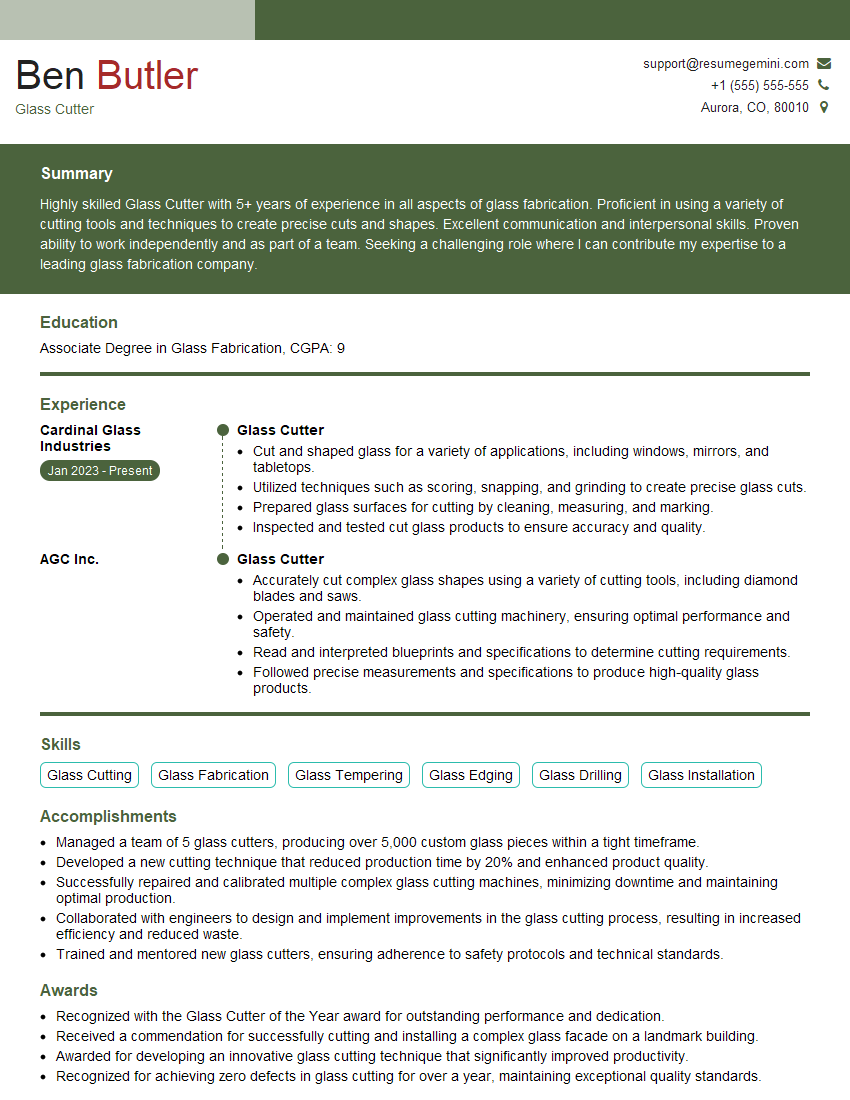
Mastering pane fabrication opens doors to exciting career opportunities in a growing industry. Demand for skilled professionals in this field is high, offering excellent prospects for advancement and competitive compensation. To maximize your chances of landing your dream job, it’s crucial to present yourself effectively. Creating an ATS-friendly resume is paramount in ensuring your application gets noticed by recruiters. ResumeGemini is a trusted resource that can help you build a professional and impactful resume tailored to the specific requirements of pane fabrication roles. Examples of resumes optimized for this field are available to guide you.



Explore more articles
Users Rating of Our Blogs
Share Your Experience
We value your feedback! Please rate our content and share your thoughts (optional).
What Readers Say About Our Blog
To the interviewgemini.com Webmaster.
Very helpful and content specific questions to help prepare me for my interview!
Thank you
To the interviewgemini.com Webmaster.
This was kind of a unique content I found around the specialized skills. Very helpful questions and good detailed answers.
Very Helpful blog, thank you Interviewgemini team.