Cracking a skill-specific interview, like one for PLC and DCS Operation, requires understanding the nuances of the role. In this blog, we present the questions you’re most likely to encounter, along with insights into how to answer them effectively. Let’s ensure you’re ready to make a strong impression.
Questions Asked in PLC and DCS Operation Interview
Q 1. Explain the difference between a PLC and a DCS.
PLCs (Programmable Logic Controllers) and DCSs (Distributed Control Systems) are both industrial automation systems, but they differ significantly in scale, complexity, and application. Think of a PLC as a powerful, versatile brain for a single machine or a small process, while a DCS is a sophisticated, interconnected network controlling an entire plant or facility.
- Scale: PLCs typically control smaller, localized processes, like a single packaging machine or a small section of a production line. DCSs manage large, complex processes across vast geographical areas, such as an entire refinery or chemical plant.
- Complexity: PLC programming is generally simpler, often using ladder logic. DCSs utilize more advanced control strategies and often involve complex control algorithms, advanced process control (APC), and sophisticated data handling.
- Redundancy & Safety: DCS systems often incorporate advanced redundancy and safety features crucial for critical applications. While PLCs can have redundancy, it’s typically less sophisticated than in a DCS environment.
- Cost: PLCs tend to be more cost-effective for smaller applications. DCS systems are significantly more expensive due to their complexity and extensive infrastructure.
In short: PLCs are the workhorses for individual machines, while DCSs orchestrate the entire factory.
Q 2. Describe your experience with ladder logic programming.
I have extensive experience with ladder logic programming, having used it extensively throughout my career for various industrial automation projects. I’m proficient in several PLC brands, including Allen-Bradley (RSLogix 5000), Siemens TIA Portal, and Schneider Electric Unity Pro.
My experience encompasses everything from simple on/off control to complex sequential control programs involving timers, counters, and math functions. For instance, I once developed a ladder logic program to control a complex automated assembly line, incorporating safety interlocks, production monitoring, and data logging. This involved managing multiple input/output (I/O) points, coordinating various motor drives, and implementing sophisticated error handling routines.
I am also comfortable with advanced ladder logic techniques such as function blocks, structured text, and sequential function charts (SFCs), allowing for highly organized and maintainable code.
// Example Ladder Logic snippet (Illustrative): // ---[Input 1]---( )---[Output 1]--- // ---[Timer T1]---( )---[Output 2]--- // T1: PT 10sThis simple example shows an input triggering an output, and a timer controlling another output. Real-world applications are, of course, far more intricate.
Q 3. How do you troubleshoot a PLC program?
Troubleshooting a PLC program involves a systematic approach. My strategy usually follows these steps:
- Gather Information: Identify the problem precisely. What is malfunctioning? When did it start? Are there any error codes?
- Review the Program: Carefully examine the relevant sections of the ladder logic code. Look for obvious errors like incorrect logic, typos in addresses, or missing rungs.
- Check I/O: Verify that the inputs and outputs are functioning correctly. Use the PLC’s diagnostic tools to check for faults in the field devices (sensors, actuators, etc.).
- Utilize PLC Diagnostics: Leverage the built-in diagnostics of the PLC. Most PLCs offer tools to monitor I/O states, process variables, and internal registers, which can pinpoint the source of problems.
- Force Inputs/Outputs: Carefully use the PLC’s forcing capabilities to simulate inputs or outputs to test the program’s logic and identify problematic areas.
- Simulation: If possible, use a PLC simulation software to test modifications to the program before deploying them to the actual hardware.
- Documentation: Thorough documentation is crucial. A well-documented program makes troubleshooting significantly easier.
For instance, if a conveyor belt isn’t starting, I’d first check the input signals from the start button and safety sensors, then verify the output to the motor drive. I’d utilize the PLC’s diagnostic tools to check for any faults before considering more complex issues in the program logic.
Q 4. What are the different types of PLC communication protocols?
PLCs utilize various communication protocols to interact with other devices and systems. These protocols facilitate data exchange, configuration, and monitoring.
- Proprietary Protocols: Each PLC manufacturer often has its own proprietary protocols. For example, Allen-Bradley uses Ethernet/IP, while Siemens uses Profinet.
- Ethernet-based Protocols: Ethernet is a widely used industrial communication standard. Examples include Modbus TCP, EtherCAT, and PROFINET.
- Serial Protocols: These older protocols are still used in some applications, including Modbus RTU and ASCII.
- Fieldbus Protocols: Fieldbuses are designed for real-time communication in industrial settings. Examples include PROFIBUS and Foundation Fieldbus.
The choice of protocol depends on factors like speed requirements, distance, the number of devices, and the specific needs of the application. For instance, high-speed applications might favor EtherCAT, while a simple remote monitoring setup might use Modbus TCP.
Q 5. Explain the concept of PID control.
PID control (Proportional-Integral-Derivative control) is a widely used feedback control loop mechanism that maintains a desired process variable at a setpoint. Imagine it as a thermostat maintaining a room’s temperature. It continuously adjusts the control element (like a heater) based on the error between the setpoint and the actual value.
- Proportional (P): This term adjusts the output proportionally to the error. A larger error results in a larger corrective action.
- Integral (I): This term addresses persistent errors or offsets. It accumulates the error over time, ensuring that the system eventually reaches the setpoint even if there are slow-acting disturbances.
- Derivative (D): This term anticipates future errors based on the rate of change of the error. It helps to dampen oscillations and speed up the response to changes.
The PID controller uses a combination of these three terms (with adjustable gains) to achieve optimal control. Tuning the PID gains (Kp, Ki, Kd) is critical to achieve desired performance: stability, speed of response, and minimal overshoot. Incorrect tuning can lead to oscillations, slow response, or even instability.
Example: In a temperature control system, the PID controller adjusts the valve opening of a heating element based on the temperature difference from the desired setpoint. The proportional term provides immediate correction, the integral term eliminates steady-state error, and the derivative term prevents overshooting and oscillations.
Q 6. How do you handle alarms and events in a DCS system?
Handling alarms and events in a DCS system is crucial for maintaining safe and efficient operation. A robust alarm management system is essential.
- Alarm Prioritization: The system must effectively prioritize alarms based on severity and urgency. Critical alarms should immediately grab the operator’s attention.
- Alarm Suppression: The ability to temporarily suppress non-critical alarms during planned maintenance or upsets is important to prevent alarm flooding.
- Alarm Acknowledgement: Operators must acknowledge alarms to confirm they have been noticed and addressed. This creates a historical record of alarm events.
- Alarm Reporting and Trending: The system should provide detailed reports on alarm history, frequency, and causes. Trending data helps identify patterns and potential issues.
- Alarm Reduction Strategies: A key part of DCS management involves proactively reducing nuisance alarms through proper system configuration and tuning. This includes root cause analysis of frequent alarms to improve processes and instrumentation.
- Integration with other Systems: Alarms may need to be integrated with other systems like safety instrumented systems (SIS) or external notification systems.
Effective alarm management minimizes downtime, improves operator awareness, and contributes to overall safety.
Q 7. Describe your experience with HMI (Human Machine Interface) design.
My HMI design experience involves creating user-friendly interfaces for monitoring and controlling industrial processes. I understand the importance of clear visuals, intuitive navigation, and effective information presentation. I’ve worked with various HMI software packages including Wonderware InTouch, Siemens WinCC, and Rockwell FactoryTalk.
My approach emphasizes the following:
- User-Centered Design: The HMI should be tailored to the specific needs and skill levels of the operators. This involves careful consideration of layout, color schemes, and alarm management strategies.
- Clear Visualizations: Effective use of graphics, charts, and trend displays helps operators quickly understand process status.
- Intuitive Navigation: Easy access to key information and controls is vital to minimize operator confusion and reaction times.
- Data Integrity: The HMI should present accurate and reliable data to prevent errors or misinterpretations.
- Alarm Management: Integration with the DCS alarm system is paramount to ensure timely and effective alarm handling. This includes prioritizing alarms and minimizing nuisance alarms.
For example, I once designed an HMI for a water treatment plant, integrating data from various sensors and instruments to provide a comprehensive overview of the process. The design prioritized clear alarm displays, easy navigation, and trend analysis tools, enabling operators to quickly detect and respond to critical events.
Q 8. What are the safety considerations when working with PLCs and DCSs?
Safety is paramount when working with PLCs and DCSs, as they often control critical processes in industrial settings. A single malfunction can lead to equipment damage, production downtime, or even serious injury or fatality. Key safety considerations include:
- Lockout/Tagout (LOTO): Before any maintenance or repair, always follow strict LOTO procedures to isolate power and prevent accidental energization. This involves physically locking out the power source and tagging it to indicate that work is in progress. Imagine working on a conveyor belt; LOTO prevents unexpected restarts that could cause injury.
- Proper grounding and earthing: Ensuring proper grounding and earthing prevents electrical shocks and protects equipment from voltage surges. This is essential to avoid electrical hazards and equipment damage.
- Risk assessment and hazard identification: A thorough risk assessment is crucial before starting any task. This helps identify potential hazards and develop appropriate safety measures. For instance, working near high-pressure systems requires specific safety protocols and personal protective equipment (PPE).
- Emergency shutdown procedures: Knowing and practicing emergency shutdown procedures is vital in case of unexpected events. Understanding how to quickly and safely shut down the system in an emergency is crucial for preventing accidents.
- Personal Protective Equipment (PPE): Always use appropriate PPE, such as safety glasses, gloves, and steel-toed boots, to protect against potential hazards.
- Regular training and competency assessment: Ongoing training on safe work practices, including emergency procedures, is necessary to maintain competency and minimize risks.
These are just some of the many safety considerations. The specific safety measures will vary depending on the application, the specific equipment involved, and relevant industry standards and regulations.
Q 9. Explain your experience with SCADA systems.
I have extensive experience with SCADA (Supervisory Control and Data Acquisition) systems, having worked with various platforms including Wonderware, Siemens WinCC, and Rockwell FactoryTalk. My experience encompasses the entire lifecycle, from design and configuration to implementation, testing, and ongoing maintenance.
In one project, I was responsible for designing and implementing a SCADA system for a large water treatment plant. This involved integrating data from various PLCs and sensors to provide real-time monitoring and control of the entire treatment process. We used Wonderware to create user-friendly interfaces for operators to monitor water quality parameters, control chemical dosing, and manage the overall plant operation. I was also responsible for developing alarm management strategies to ensure timely notification of any abnormal conditions. The project’s success demonstrated the power of SCADA in optimizing operations and improving efficiency, resulting in substantial cost savings and improved water quality.
Another significant project involved troubleshooting and upgrading an existing SCADA system in a manufacturing facility. This required extensive knowledge of the underlying hardware and software, as well as a deep understanding of the industrial processes being controlled. Through systematic analysis and problem-solving, we successfully identified and resolved numerous issues, resulting in improved system stability and reliability.
Q 10. How do you perform a backup and restore of a PLC program?
Backing up and restoring a PLC program is crucial for maintaining system integrity and ensuring business continuity. The exact procedure varies depending on the PLC manufacturer and model, but the general principles remain the same.
- Backup: Most PLCs allow you to download the entire program, including the configuration and I/O mapping, to a computer. This is typically done using programming software specific to the PLC. For example, using TIA Portal for Siemens PLCs or RSLogix 5000 for Allen-Bradley PLCs. It’s best practice to store backups in multiple, secure locations (e.g., network drive, external hard drive, cloud storage) to prevent data loss.
- Storage and Version Control: It’s crucial to maintain a version control system for your PLC programs. This allows you to easily revert to previous versions if needed and track changes made over time. This is especially important for larger and more complex projects. Consider using a proper version control system like Git (though potentially requires some adaptation for binary PLC files).
- Restore: If the PLC program needs to be restored, you upload the saved backup file from your computer to the PLC using the programming software. Before uploading, it’s always essential to verify the backup’s integrity and compatibility with the PLC hardware. The upload process is similar to the download process, but in reverse. Often, you have to set parameters like PLC communication port and network address before the upload can begin.
Example (Conceptual): Let’s say you’re using Allen-Bradley’s RSLogix 5000 software. You would use the ‘Go Online’ function to connect to the PLC, then use the ‘Download’ function to save the program to your computer. To restore, you’d ‘Go Online’, select the backup file, and use the ‘Upload’ function. Always ensure the PLC is in program mode before uploading.
Q 11. Describe your experience with different types of sensors and actuators.
My experience with sensors and actuators spans a wide range of technologies used in various industrial applications. I’ve worked with:
- Temperature sensors: Thermocouples, RTDs (Resistance Temperature Detectors), and thermistors for measuring temperature in processes like ovens, reactors, and HVAC systems.
- Pressure sensors: Various types of pressure transducers and pressure switches, used for monitoring pressure in pipelines, vessels, and hydraulic systems.
- Flow sensors: Differential pressure flow meters, ultrasonic flow meters, and turbine flow meters for measuring fluid flow rates.
- Level sensors: Ultrasonic level sensors, radar level sensors, and float switches for measuring the level of liquids or solids in tanks and vessels.
- Proximity sensors: Inductive, capacitive, and photoelectric sensors for detecting the presence or absence of objects. These are widely used in automation and robotics for positioning and object detection.
- Actuators: Solenoid valves, pneumatic actuators, hydraulic actuators, and servo motors for controlling valves, cylinders, and other mechanical devices. I have experience working with various control strategies for optimizing their performance.
For example, in a chemical process control project, I worked extensively with pressure and temperature sensors to maintain precise process parameters, while using solenoid valves as actuators to regulate fluid flow and pressure. Understanding the characteristics and limitations of each sensor and actuator is critical for designing reliable and effective control systems.
Q 12. What are the different types of analog and digital I/O modules?
PLCs and DCSs utilize a variety of analog and digital I/O modules to interface with the process. The choice of module depends on the type of signal and the specific application.
Digital I/O Modules: These modules handle discrete signals, typically representing on/off states.
- Input modules: Receive signals from switches, push buttons, limit switches, and other devices that generate digital signals (e.g., 0V/24V).
- Output modules: Send signals to devices such as solenoids, contactors, indicator lights, and other equipment that require digital control.
Analog I/O Modules: These modules handle continuous signals, representing variables such as temperature, pressure, flow, and level.
- Input modules: Receive signals from analog sensors (e.g., 4-20mA, 0-10V) and convert them into digital values that the PLC can process.
- Output modules: Convert digital values from the PLC into analog signals (e.g., 4-20mA, 0-10V) to control actuators and other analog devices.
Different modules exist for different voltage ranges, signal types, and communication protocols. For example, a 4-20mA input module would be used to receive a signal from a pressure transmitter, while a 0-10V output module might be used to control the speed of a motor.
Q 13. How do you perform a system upgrade or migration?
System upgrades and migrations require careful planning and execution to minimize downtime and ensure a smooth transition. The process generally involves these steps:
- Needs Assessment: Determine the reasons for the upgrade (e.g., improved performance, enhanced functionality, obsolescence of existing hardware/software).
- Planning and Design: Develop a detailed plan, including timelines, resources, and risk mitigation strategies. This will involve selecting compatible hardware and software, and designing the new system architecture.
- Testing: Thoroughly test the new system in a simulated environment before deploying it to the production environment. This helps identify and resolve any potential issues before they impact operations. This might involve creating a test environment that closely mirrors the production environment.
- Implementation: Deploy the new system in a phased approach to minimize disruption. A phased approach would allow for testing in different sections, allowing for incremental improvements and easier problem solving.
- Verification and Validation: Verify that the upgraded system meets the original requirements and validate its performance under real-world conditions.
- Training: Train operators and maintenance personnel on the new system to ensure they can effectively operate and maintain it. This might include classroom training and hands-on practice.
- Documentation: Update all relevant documentation, including system diagrams, operating procedures, and maintenance manuals.
A successful upgrade requires close collaboration between engineers, technicians, and operators to ensure a smooth and efficient transition. Careful consideration should be given to data migration, system compatibility, and user training to avoid problems down the line.
Q 14. Explain your experience with process control loops.
I have significant experience designing, implementing, and troubleshooting process control loops. These loops are the foundation of automated process control, using feedback to maintain a process variable at a desired setpoint.
My experience includes working with various control strategies, including:
- PID (Proportional-Integral-Derivative) control: This is the most common control algorithm, adjusting the output based on the error between the setpoint and the measured value. I have tuned PID controllers for various processes, optimizing their performance for stability and responsiveness.
- Cascade control: Using multiple control loops to regulate a process variable with increased precision and efficiency. For instance, using a master loop to control temperature, and a slave loop controlling the flow rate of a heating medium.
- Feedforward control: Using measurements of disturbances to predict and compensate for their effect on the process variable, enhancing performance and reducing overshoot.
- Ratio control: Maintaining a constant ratio between two process variables, frequently used in chemical processes.
In one project, I was tasked with optimizing the temperature control loop in a chemical reactor. By carefully tuning the PID controller and implementing feedforward control to compensate for variations in feedstock temperature, we significantly improved the consistency of the product quality and reduced energy consumption. Understanding the process dynamics and selecting the appropriate control strategy is critical for achieving optimal results. Often, simulations and modeling are used to anticipate how different control strategies will perform before applying them to the physical system.
Q 15. Describe your experience with fault detection and diagnostics.
Fault detection and diagnostics in PLC and DCS systems are crucial for maintaining operational efficiency and safety. My approach involves a multi-layered strategy combining preventative measures, real-time monitoring, and systematic troubleshooting.
Preventative measures include regular equipment inspections, firmware updates, and proactive testing of safety systems. Real-time monitoring utilizes alarm systems and trend analysis to identify deviations from normal operating parameters. For instance, an unexpected spike in temperature or pressure could indicate a developing fault.
When a fault occurs, I use a systematic approach, starting with reviewing alarm logs and historical data to understand the sequence of events. I leverage the system’s diagnostic tools, such as ladder logic analysis in PLCs or advanced diagnostics in DCS systems. This often involves checking input/output signals, analyzing process variables, and inspecting communication logs. Let’s say a conveyor belt stops unexpectedly. I’d systematically check the motor’s power supply, the proximity sensors, and the PLC program logic related to the belt’s operation to pinpoint the root cause. This might involve using a simulator to isolate the problem without impacting live operations.
Beyond hardware and software, operator training and clear operating procedures are vital in preventing and detecting faults. A well-trained operator can often recognize abnormal behavior early on, minimizing downtime and preventing escalation.
Career Expert Tips:
- Ace those interviews! Prepare effectively by reviewing the Top 50 Most Common Interview Questions on ResumeGemini.
- Navigate your job search with confidence! Explore a wide range of Career Tips on ResumeGemini. Learn about common challenges and recommendations to overcome them.
- Craft the perfect resume! Master the Art of Resume Writing with ResumeGemini’s guide. Showcase your unique qualifications and achievements effectively.
- Don’t miss out on holiday savings! Build your dream resume with ResumeGemini’s ATS optimized templates.
Q 16. How do you ensure data integrity in a DCS system?
Data integrity in a DCS system is paramount for accurate process control and decision-making. It’s achieved through a combination of techniques focused on preventing errors, detecting inconsistencies, and ensuring data recovery if necessary.
Firstly, robust data acquisition systems are essential. This involves using high-quality sensors with regular calibration and redundant measurement points. This redundancy provides backup data if one sensor fails. Data validation checks are implemented at various stages, from sensor readings to the historian database. This includes range checks, plausibility checks, and consistency checks against other data points. For example, a temperature reading outside the expected range might trigger an alert.
Secondly, a secure network architecture with strong access controls and data encryption prevents unauthorized modification or deletion of data. Regular database backups are crucial for disaster recovery and business continuity. Data logging protocols and historian systems ensure data is stored in a structured and accessible format, complying with industry standards and regulations. Finally, rigorous testing, including unit and integration tests during software development, is crucial to verify the accuracy of data handling procedures.
Q 17. Explain your understanding of cybersecurity in industrial automation.
Cybersecurity in industrial automation is increasingly critical given the interconnected nature of modern systems. My understanding encompasses a multi-layered defense-in-depth strategy encompassing network security, device security, and personnel security.
Network security involves implementing firewalls, intrusion detection systems, and network segmentation to isolate critical control systems from less secure networks. Device security focuses on securing individual PLCs, DCS controllers, and other devices using strong passwords, regular firmware updates, and disabling unnecessary ports and services. Regular vulnerability scans and penetration testing are essential to identify and address security weaknesses proactively.
Personnel security involves strict access controls, role-based permissions, and regular security awareness training for all personnel. Strong authentication mechanisms, such as multi-factor authentication, are crucial to prevent unauthorized access. Incident response plans are critical, outlining procedures to address security breaches and minimize their impact. For example, if a ransomware attack occurs, a carefully rehearsed recovery plan helps to get the system back online swiftly and safely.
Q 18. Describe your experience with different PLC programming software.
My experience spans several PLC programming software packages. I’m proficient in Rockwell Automation’s RSLogix 5000, Siemens TIA Portal, and Schneider Electric’s Unity Pro. Each platform has its own strengths and weaknesses depending on the application and industry.
RSLogix 5000 is a robust platform known for its reliability and extensive library of functions, commonly used in larger-scale industrial applications. Siemens TIA Portal offers a more integrated environment, encompassing hardware configuration, programming, and simulation. Schneider Electric’s Unity Pro is particularly well-suited for smaller to mid-sized projects. I’ve successfully used each platform to program PLCs for various applications, including process control, motion control, and safety systems. My expertise extends to troubleshooting and optimizing existing PLC programs written in these various environments.
Q 19. How do you manage multiple concurrent tasks in a PLC program?
Managing multiple concurrent tasks in a PLC program requires careful consideration of timing and resource allocation. PLCs utilize various methods to achieve this, primarily through cyclic scanning and task scheduling.
In cyclic scanning, the PLC sequentially executes the program instructions within a fixed scan cycle time. Tasks are organized in blocks of code. While this is simple, its real-time capabilities are limited. For more complex applications, task scheduling allows assigning priorities to different tasks, ensuring critical tasks are executed first. This is often implemented using structured programming techniques and function blocks within the PLC’s programming software. For example, a critical safety function might be assigned a higher priority to prevent hazardous situations.
Another approach is to employ interrupt handling. Interrupts are triggered by external events, like sensor inputs, interrupting the normal program execution to handle time-critical events. Proper design of the interrupt service routines is vital to prevent conflicts with cyclic tasks. Properly employing these methods, alongside effective code optimization and well-defined task structures, ensures efficient and reliable execution of concurrent processes in a PLC program.
Q 20. What is your experience with network configuration in industrial automation?
Network configuration in industrial automation requires a deep understanding of industrial communication protocols and network topologies. My experience encompasses various protocols, including Ethernet/IP, Profinet, Modbus TCP/IP, and Profibus. I understand the importance of selecting the right protocol based on factors such as speed, reliability, and distance.
I’m experienced in designing and implementing both simple and complex industrial networks, taking into consideration factors such as network redundancy and security. For example, I might implement a redundant network architecture using dual Ethernet switches to prevent single points of failure. I have hands-on experience configuring industrial switches and routers, implementing network segmentation to isolate control systems from other networks, and setting up virtual private networks (VPNs) to secure communication between different sites. Understanding the different network topologies (star, ring, bus) and their implications for performance and maintainability is also a crucial part of my expertise.
Q 21. Explain your experience with data logging and historical trending.
Data logging and historical trending are crucial for process optimization, troubleshooting, and regulatory compliance. My experience involves working with various data historians and logging systems, configuring them to collect, store, and retrieve process data.
I’m proficient in configuring data logging parameters such as sampling rates, data types, and retention policies. I understand the importance of data compression and archiving strategies to efficiently manage large datasets. I’ve used data historians to create historical trends and reports, which are essential for analyzing process performance, identifying patterns, and detecting potential problems. This includes analyzing data using tools provided by the historian to visualize trends, generate reports, and perform statistical analysis. For example, I might use historical data to identify trends in energy consumption to optimize efficiency or to analyze the root cause of a production bottleneck.
Furthermore, I’m familiar with various data formats and standards used for data exchange and archiving, ensuring compatibility between different systems and facilitating data analysis using external software.
Q 22. How do you handle process upsets and deviations?
Handling process upsets and deviations requires a systematic approach combining immediate corrective actions with root cause analysis to prevent recurrence. Think of it like a doctor treating a patient: you need to address the immediate symptoms (the upset) and then diagnose the underlying cause (the deviation) to prevent future problems.
Immediate Actions: First, I prioritize safety. This might involve shutting down a section of the process or engaging emergency shutdown systems (ESD) if necessary. Then, I use the available control systems (PLC or DCS) to adjust setpoints or manipulate valves to bring the process back to a stable state. This often involves using the process control loops built into the system, adjusting controllers to improve response, or using override mechanisms. For example, if a pressure vessel is over-pressurizing, I’d immediately open a relief valve while investigating the root cause of the pressure buildup.
Root Cause Analysis: After stabilizing the process, I conduct a thorough investigation using data logging from the PLC/DCS, operator logs, and any available sensor information. This analysis helps pinpoint the source of the upset, whether it’s a sensor malfunction, a faulty actuator, a change in feedstock quality, or an operator error. Tools like trend analysis and historical data review within the DCS are crucial here. If the root cause analysis reveals a problem with a control algorithm, I might modify the PID parameters for better response and stability.
Corrective Actions: Once the root cause is identified, appropriate corrective actions are implemented. These might involve replacing faulty components, modifying control strategies, improving operator training, or updating process parameters. Proper documentation of the incident, corrective actions, and lessons learned is also vital to prevent similar events in the future. For instance, if a sensor fault was identified, I would replace the sensor, recalibrate other sensors, and document the whole process for auditing purposes.
Q 23. Describe your experience with different types of industrial networks (e.g., Profibus, Ethernet/IP).
I have extensive experience with various industrial networks, crucial for seamless data exchange within industrial automation systems. Each network has its strengths and weaknesses, and selecting the right one depends on the specific application requirements.
Profibus: This is a widely adopted fieldbus system known for its reliability and robust performance in harsh industrial environments. I’ve used it extensively in projects involving distributed I/O, connecting various field devices like sensors, actuators, and drives to the PLC. Its master-slave architecture ensures deterministic communication, crucial for real-time process control applications. I worked on a project where Profibus was vital for synchronizing multiple robots in a high-speed packaging line.
Ethernet/IP: This network offers high bandwidth and flexibility, making it suitable for applications requiring large amounts of data transfer, such as video monitoring or advanced process analytics. The open standard nature of Ethernet/IP facilitates integration with different vendor equipment, promoting interoperability. I’ve used it in modern DCS systems that integrate multiple sub-systems, allowing for better data visualization and improved remote access capabilities.
Other Networks: My experience also extends to other networks like Modbus, CANopen, and Foundation Fieldbus. I understand the specific capabilities and limitations of each and can select the most appropriate network based on factors such as cost, performance requirements, and available infrastructure.
Q 24. What are your experience with PLC simulation and testing?
PLC simulation and testing are integral to ensuring the correct functioning of automation systems before deployment. It allows for thorough testing of code, validation of control logic, and identification of potential problems without risking costly downtime on the actual production line. Think of it as a virtual testing ground before you take the actual car for a test drive.
Simulation Software: I am proficient in using various PLC simulation software packages like Siemens TIA Portal PLCSIM, Rockwell Automation RSLogix Emulate 5000, and others. These tools allow me to create virtual representations of the PLC and the controlled process, enabling comprehensive testing of the control program.
Testing Procedures: My approach involves creating a comprehensive test plan that covers all aspects of the system’s functionality, including normal operation, emergency shutdown procedures, and handling of process upsets. I utilize both functional and performance testing to ensure the system meets the specified requirements. For instance, I might simulate sensor failures to verify the response of the safety systems.
Benefits of Simulation: Simulation significantly reduces the risk of errors during commissioning, speeds up the development cycle, and enables thorough operator training. It allows for the identification of design flaws early in the process, leading to cost savings and increased operational efficiency. I can even integrate virtual sensors and actuators to simulate different process conditions, resulting in robust and reliable automated systems.
Q 25. Explain your understanding of different control strategies (e.g., feedforward, feedback).
Understanding different control strategies is fundamental to designing effective automation systems. Each strategy has its own advantages and disadvantages, making the choice dependent on the specific process requirements.
Feedback Control: This is the most common control strategy, using a closed-loop system where the output is measured and compared to the desired setpoint. The error signal is then used to adjust the control action to minimize the difference. A classic example is a thermostat controlling room temperature. Think of it as a self-correcting system, constantly adjusting to maintain the target value.
Feedforward Control: This strategy anticipates disturbances and adjusts the control action proactively, reducing the impact of disturbances on the controlled variable. For example, in a process where feedstock flow rate affects the product quality, feedforward control can adjust the control parameters based on predicted changes in feedstock flow. It’s like planning ahead, anticipating and correcting before a problem arises.
Combined Strategies: In many industrial processes, a combination of feedback and feedforward control is used to achieve optimal performance. Feedback control handles unexpected disturbances, while feedforward control minimizes the impact of predictable changes. A complex chemical reactor, for instance, might use feedforward control based on feedstock composition and feedback control to maintain temperature and pressure.
Q 26. How do you ensure compliance with industry standards and regulations?
Compliance with industry standards and regulations is paramount in industrial automation. This involves understanding and adhering to relevant safety standards, functional safety requirements, and data security protocols. It’s not just about meeting the minimum requirements, but ensuring the safety and reliability of the system and processes.
Safety Standards: I’m familiar with standards such as IEC 61131-3 (PLC programming), IEC 61508 (functional safety), and relevant industry-specific standards for the particular industry and application. This ensures the PLC or DCS program is designed and implemented in a safe and reliable manner.
Data Security: I understand the importance of implementing appropriate cybersecurity measures to protect industrial control systems from unauthorized access, cyberattacks, and data breaches. This involves applying network security protocols, using strong passwords, and implementing regular security audits.
Documentation: Maintaining comprehensive documentation throughout the entire lifecycle of the automation system is essential for demonstrating compliance. This includes design specifications, test reports, maintenance logs, and safety assessments.
Regular Audits: I actively participate in internal and external audits to verify compliance with relevant standards and regulations. Addressing any identified gaps promptly ensures ongoing compliance.
Q 27. Describe a challenging PLC or DCS project you worked on and how you overcame the challenges.
One challenging project involved upgrading the control system of an aging chemical plant. The existing system was outdated and unreliable, leading to frequent production downtime and safety concerns. The challenge wasn’t just upgrading the hardware, but migrating the entire process control logic to a new platform without causing disruption.
Challenges: The primary challenges included migrating legacy code, ensuring compatibility with the new hardware, maintaining production during the upgrade, and thoroughly testing the new system before commissioning. The old system lacked proper documentation, making the migration process even more complex. We had to reverse-engineer parts of the logic to understand how it functioned.
Solutions: We addressed the code migration challenge by using a phased approach. We first simulated the new system using the existing control logic to identify and fix any compatibility issues. We then implemented the new system in stages, upgrading individual sections of the plant while maintaining production in the remaining sections. We created extensive documentation of the new system to improve maintainability. We also implemented rigorous testing procedures, including simulation and real-world testing to verify the system’s reliability and safety.
Outcome: Through careful planning and execution, we successfully upgraded the control system without significant production downtime. The new system improved efficiency, reduced downtime, and enhanced safety. The project showcased the importance of thorough planning, a phased approach to implementation, and the use of simulation tools in tackling complex upgrade projects.
Key Topics to Learn for PLC and DCS Operation Interview
- PLC Programming Fundamentals: Understanding ladder logic, function blocks, and structured text programming. Practical application includes troubleshooting existing PLC programs and implementing modifications for improved efficiency.
- DCS System Architecture: Familiarize yourself with the components of a Distributed Control System, including PLCs, HMIs, and communication networks. Practical application involves understanding the data flow between different system components and troubleshooting network issues.
- Process Control Strategies: Mastering PID control loops, cascade control, and advanced control strategies. Practical application includes tuning PID controllers for optimal process performance and identifying control loop issues.
- Safety and Security in Automation: Understanding safety instrumented systems (SIS) and cybersecurity protocols within PLC and DCS environments. Practical application includes implementing safety measures and recognizing potential vulnerabilities.
- Troubleshooting and Diagnostics: Developing strong problem-solving skills to effectively diagnose and resolve issues in PLC and DCS systems. Practical application includes using diagnostic tools and interpreting error messages.
- HMI Design and Operation: Understanding the design and operation of Human-Machine Interfaces (HMIs) and their role in process monitoring and control. Practical application includes designing effective HMIs for operators and understanding the importance of user-friendliness.
- Networking and Communication Protocols: Familiarity with industrial communication protocols like Ethernet/IP, Modbus TCP, and Profibus. Practical application involves understanding how PLCs and DCS communicate with each other and other devices in the system.
Next Steps
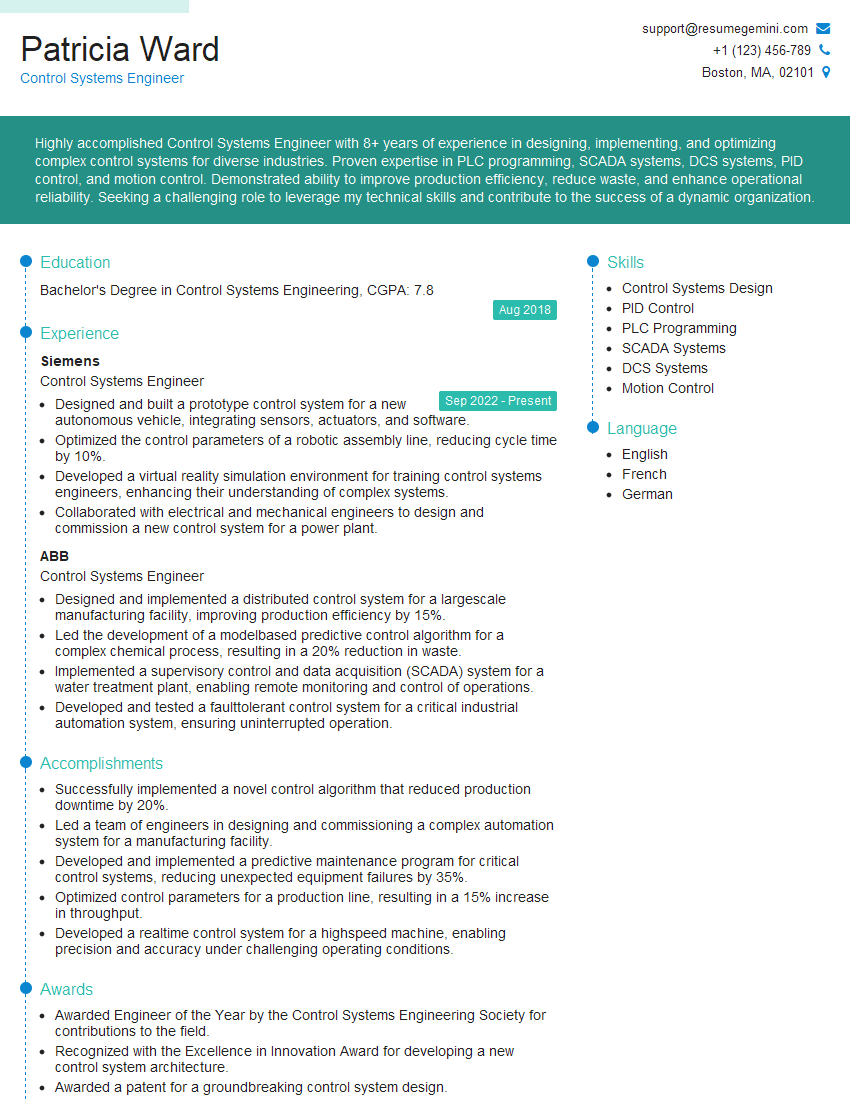
Mastering PLC and DCS operation opens doors to exciting and rewarding careers in process automation, offering opportunities for continuous learning and professional growth. A strong resume is crucial for showcasing your skills and experience to potential employers. Crafting an ATS-friendly resume significantly increases your chances of getting noticed by recruiters. We highly recommend using ResumeGemini to build a professional and impactful resume. ResumeGemini provides valuable tools and resources to help you present your qualifications effectively. Examples of resumes tailored to PLC and DCS Operation are available to further assist you in creating a compelling application.

Explore more articles
Users Rating of Our Blogs
Share Your Experience
We value your feedback! Please rate our content and share your thoughts (optional).
What Readers Say About Our Blog
To the interviewgemini.com Webmaster.
Very helpful and content specific questions to help prepare me for my interview!
Thank you
To the interviewgemini.com Webmaster.
This was kind of a unique content I found around the specialized skills. Very helpful questions and good detailed answers.
Very Helpful blog, thank you Interviewgemini team.