The right preparation can turn an interview into an opportunity to showcase your expertise. This guide to Precise Measurement and Leveling interview questions is your ultimate resource, providing key insights and tips to help you ace your responses and stand out as a top candidate.
Questions Asked in Precise Measurement and Leveling Interview
Q 1. Explain the principle of differential leveling.
Differential leveling is a surveying technique used to determine the elevation difference between two points. It works by establishing a series of level lines, essentially creating a series of horizontal planes. The process involves taking readings from a level instrument (like a theodolite or automatic level) onto a leveling staff held at each point. The difference between the readings directly gives us the difference in elevation between the points. Think of it like carefully measuring the height difference between two steps on a staircase, but over longer distances and with higher precision.
For instance, imagine surveying a roadway. We might establish a benchmark (a point of known elevation) and then use differential leveling to determine the elevations of various points along the road, enabling us to calculate gradients and design the road’s profile accurately.
The principle relies on the line of sight from the level being horizontal. By consistently maintaining this horizontal line of sight and taking accurate staff readings, the elevation differences are calculated with minimal error.
Q 2. Describe the different types of levels used in surveying.
Several types of levels are used in surveying, each with its own strengths and weaknesses:
- Dumpy Level: A classic, robust instrument with a telescope mounted on a vertical axis. It’s simple to use but requires careful leveling of the instrument itself.
- Tilting Level: Similar to a dumpy level, but features a tilting screw mechanism, making the leveling process faster and less precise. These are good for intermediate-level precision.
- Automatic Level (self-leveling): These incorporate a compensator that automatically levels the line of sight, significantly speeding up the process and reducing operator error. They’re popular for most surveying tasks demanding high speed and reasonable precision.
- Digital Level: These combine the speed of an automatic level with electronic measurement and data recording, which simplifies calculations and reduces errors involved in manual readings.
- Precise Level (high-precision level): These are designed for tasks requiring very high accuracy, such as monitoring subsidence or deformation. They have sophisticated compensators and refined optical systems.
The choice of level depends heavily on the project’s required accuracy, budget, and the surveyor’s experience level.
Q 3. How do you correct for curvature and refraction in leveling?
Curvature and refraction of the Earth affect leveling measurements because the line of sight is not truly horizontal over long distances. The Earth’s curvature causes the line of sight to fall below the true horizontal, while atmospheric refraction bends the line of sight upwards. These effects are additive, meaning they both contribute to an error in the elevation determination.
Corrections are usually applied using formulas which take into account the distance between the instrument and the staff. These formulas are readily available in surveying handbooks and software packages.
For example, the correction for curvature and refraction can be calculated approximately as C = 0.0673d2 where ‘C’ is the correction in millimeters and ‘d’ is the distance in kilometers. The correction is then added to the backsight and subtracted from the foresight to account for this systematic error. This is a simplified formula, and more precise formulas may consider varying atmospheric conditions.
Q 4. What are the sources of error in precise leveling?
Precise leveling is susceptible to various sources of error. These errors can be broadly categorized into instrumental, personal, and natural errors:
- Instrumental Errors: These include collimation error (the line of sight not being perfectly parallel to the bubble tube), imperfect leveling of the instrument, and errors in the leveling staff graduation.
- Personal Errors: These stem from the surveyor, such as incorrect reading of the leveling staff, improper centering of the instrument, and inaccurate booking of observations.
- Natural Errors: These are caused by environmental factors like temperature changes affecting the instrument and staff, wind affecting the leveling staff’s stability, and ground settlement.
Minimizing these errors requires meticulous attention to detail, proper instrument calibration, and using appropriate techniques like double-running the level line. Regular instrument maintenance is also critical in reducing instrumental errors.
Q 5. Explain the process of calibrating a level.
Calibrating a level ensures its accuracy and reliability. The process typically involves checking the instrument’s collimation and ensuring the level bubble is correctly centered. This is usually done in a two-step process.
1. Two-Peg Test: This test checks the collimation error. Two pegs are set up a considerable distance apart (e.g., 50-100m). The level is set up approximately midway between the pegs, and readings are taken on the leveling staff at each peg. The level is then moved closer to one of the pegs, and readings are taken again. By comparing the differences in readings, the collimation error can be determined.
2. Bubble Adjustment: If the collimation error is significant, adjustments are made to the instrument’s optical system or the level bubble’s position to rectify the error. This typically involves using adjusting screws on the instrument.
It’s important to note that the specifics of the calibration procedure will vary depending on the type of level being used. The manufacturer’s instructions should always be consulted for detailed guidance.
Q 6. What are the different types of measuring tapes and their applications?
Several types of measuring tapes are used in surveying and construction, each suitable for different applications:
- Steel Tapes: These are highly accurate and durable, commonly used for precise linear measurements in surveying. They are less prone to stretching or shrinking compared to other materials and come in various lengths.
- Fiberglass Tapes: Lighter and less prone to damage than steel tapes, fiberglass tapes are a good all-around option for general construction work. They are less accurate than steel tapes.
- Cloth Tapes: These are the least accurate type of tape, but they’re inexpensive and convenient for quick, less-precise measurements. They are prone to stretching and should not be used for precision work.
- Electronic Distance Measurement (EDM) Tapes: EDM devices use lasers or infrared light to measure distances with high accuracy. They are much faster than traditional tapes but are more expensive.
The choice of tape depends on factors such as required accuracy, the length of measurement, site conditions, and budget constraints. Steel tapes are preferred for high-precision work, while fiberglass or cloth tapes suffice for rough estimations.
Q 7. How do you choose the appropriate measuring instrument for a specific task?
Selecting the right measuring instrument for a specific task depends on several factors:
- Required Accuracy: High-precision leveling requires a precise level and steel tape; rough estimations may only need a cloth tape and simple level.
- Distance to be Measured: Short distances can be measured accurately with a steel tape, while longer distances require EDM or more advanced methods.
- Terrain Conditions: Difficult terrain may necessitate more robust and versatile instruments.
- Budget: The cost of the instrument is a significant factor. High-accuracy, automated instruments are more expensive but provide greater efficiency and accuracy.
- Time Constraints: Automated instruments like digital levels and EDM devices reduce measurement time significantly.
For example, setting out a building foundation necessitates high precision; steel tapes and a precise level would be ideal. In contrast, measuring a large area of land for a feasibility study may justify the use of an EDM device to save time and ensure adequate accuracy.
Q 8. Describe the method for determining the accuracy of a measurement.
Determining the accuracy of a measurement involves comparing the measured value to a known, true value. This true value is often difficult to obtain directly, so we rely on established standards and statistical analysis. Accuracy is typically expressed as the difference between the measured value and the true value, often represented as an error. We assess accuracy through several methods:
- Calibration: Comparing our measuring instrument to a traceable standard with a known higher accuracy. This process reveals systematic errors inherent in the instrument.
- Repeated Measurements: Taking multiple measurements of the same quantity and analyzing the results statistically. The spread of the measurements indicates precision (how close measurements are to each other), but doesn’t directly indicate accuracy. A small spread might mean high precision but poor accuracy if the instrument is consistently off. We can calculate the mean and standard deviation to understand the data distribution.
- Error Analysis: Identifying and quantifying various error sources, such as random errors (due to unpredictable fluctuations) and systematic errors (consistent deviations caused by faulty equipment or technique). This helps in improving measurement techniques and correcting for errors.
Example: Let’s say we’re measuring the length of a steel bar. We use a calibrated measuring tape as our instrument. By comparing our repeated measurements to a known standard length (a certified reference bar), we can determine the accuracy of our measurements. Discrepancies might reveal inaccuracies in the measuring tape or highlight inconsistencies in our measurement technique.
Q 9. Explain the concept of least squares adjustment.
Least squares adjustment is a powerful mathematical technique used in surveying and precise measurement to find the best-fitting solution when there are multiple measurements that are subject to error. It minimizes the sum of the squares of the residuals—the differences between the observed values and the values predicted by a mathematical model. Imagine trying to fit a straight line to a set of scattered data points; least squares would find the line that best minimizes the vertical distances from the points to the line.
In surveying, this is crucial because we often have redundant measurements (more measurements than strictly necessary to solve for unknowns). These redundant measurements provide an opportunity to improve accuracy and detect errors. The least squares method mathematically weights these measurements based on their precision to arrive at the most probable solution.
Example: Consider a level loop. We measure the elevation differences between several points. Due to observational errors, the loop may not close perfectly (the sum of elevation changes shouldn’t be zero in a closed loop). Least squares adjustment distributes the error among the individual measurements to find the most probable elevations, considering the precision of each individual measurement.
Q 10. How do you account for temperature variations in precise measurements?
Temperature variations significantly affect precise measurements, particularly length measurements, due to thermal expansion and contraction of materials. To account for this, we employ several strategies:
- Temperature Compensation: Using instruments with built-in temperature compensation mechanisms that automatically adjust for temperature fluctuations. This is common in electronic distance meters (EDMs).
- Temperature Measurement: Recording the temperature during the measurement process and applying appropriate corrections using known thermal expansion coefficients of the materials involved (e.g., steel tape, invar rod). This requires knowing the material’s properties and utilizing correction formulas.
- Maintaining Constant Temperature: Wherever possible, conducting measurements under controlled temperature conditions (e.g., using a climate-controlled lab environment). This minimizes temperature-related errors.
- Averaging: Performing measurements at different times of the day to average out temperature fluctuations.
Example: When using a steel tape for measurements, you need to account for thermal expansion. A standard steel tape’s expansion coefficient is typically around 11.7 x 10⁻⁶ per degree Celsius. If the temperature is significantly higher than the standard temperature at which the tape was calibrated (often 20°C), the measured length will be longer than the true length, necessitating a correction.
Q 11. What are the common units used in precise measurement and leveling?
The common units used in precise measurement and leveling are:
- Meters (m): The standard unit of length in the International System of Units (SI).
- Millimeters (mm): Often used for smaller distances and representing higher precision. 1 meter = 1000 millimeters.
- Parts per million (ppm): This is a unit of relative error used to express accuracy. For instance, an accuracy of 1 ppm indicates an error of 1 millimeter per kilometer.
- Radians: Used to express angles, particularly when dealing with trigonometric calculations in surveying.
- Degrees, Minutes, and Seconds: Another common unit for angles.
Q 12. Describe the process of establishing a benchmark.
Establishing a benchmark involves creating a permanent, stable reference point with a precisely known elevation. This serves as a foundational point for future leveling work and surveying activities. The process involves several steps:
- Site Selection: Choosing a stable, accessible, and protected location free from potential disturbances.
- Marking the Point: Permanently marking the benchmark using a durable material such as a brass plate or a concrete monument. This mark should be clearly identifiable and resistant to damage.
- Precise Leveling: Accurately determining the elevation of the benchmark through precise leveling techniques, often connecting it to a known national or regional geodetic network. This often involves multiple measurements and least squares adjustment.
- Documentation: Thoroughly documenting the benchmark’s location, elevation, and any relevant information. This documentation should be stored safely and be easily accessible.
Benchmarks are essential for long-term monitoring of land subsidence, vertical movements, and construction projects.
Q 13. How do you handle obstructions during leveling?
Obstructions during leveling can be a significant challenge. Several techniques can be employed to overcome these hurdles:
- Reciprocal Leveling: Setting up the level at both sides of the obstruction and taking measurements from each station to a common point on both sides of the obstacle. This technique helps to minimize errors due to curvature of the Earth and atmospheric refraction.
- Using Intermediate Points: Setting up intermediate points around the obstruction and establishing their elevations. This creates a series of shorter level runs, enabling the determination of the elevation on the other side of the obstruction.
- Trigonometric Leveling: Using angles and distances to determine the difference in elevation between points, which is particularly useful when there are significant obstacles like a large building or a valley.
- Alternative Routes: If feasible, choosing an alternative route that avoids the obstruction completely.
The choice of method depends on the type of obstruction and the available equipment.
Q 14. What are the safety precautions to be taken during leveling?
Safety is paramount during leveling. Key precautions include:
- Proper Site Selection: Avoid working in unstable areas, near traffic, or in hazardous environments.
- Safe Equipment Handling: Properly handling and transporting leveling equipment to prevent accidents or damage.
- Stable Setups: Ensuring stable instrument and rod setups to prevent instrument tipping or accidental injury.
- Protective Clothing: Wearing appropriate clothing and safety gear, especially safety shoes, and avoiding loose clothing that could get caught in equipment.
- Awareness of Surroundings: Being mindful of the surrounding environment, other workers, and potential hazards.
- Weather Conditions: Avoiding work in extreme weather conditions (high winds, rain, etc.) that could compromise safety or equipment.
- Teamwork and Communication: Working as a team and maintaining effective communication to ensure safety.
A thorough risk assessment before commencing any leveling work is highly recommended.
Q 15. Explain the use of a theodolite in surveying.
A theodolite is a fundamental instrument in surveying, used for measuring horizontal and vertical angles with high precision. Imagine it as a highly accurate protractor and level combined. It consists of a telescope mounted on two perpendicular axes, allowing for precise aiming at distant points. The horizontal axis allows for measuring horizontal angles (azimuths), while the vertical axis allows for measuring vertical angles (zenith angles or elevations).
In practice, we use the theodolite to establish control points, determine the relative positions of points, and create topographic maps. For example, to measure the angle between two points, we would set up the theodolite over a known point, sight the telescope at the first point, and record the reading. Then, we would sight the telescope at the second point and record the reading. The difference between these two readings gives us the horizontal angle between the two points. This is crucial for tasks like setting out building foundations, creating contour lines, or conducting route surveys.
Career Expert Tips:
- Ace those interviews! Prepare effectively by reviewing the Top 50 Most Common Interview Questions on ResumeGemini.
- Navigate your job search with confidence! Explore a wide range of Career Tips on ResumeGemini. Learn about common challenges and recommendations to overcome them.
- Craft the perfect resume! Master the Art of Resume Writing with ResumeGemini’s guide. Showcase your unique qualifications and achievements effectively.
- Don’t miss out on holiday savings! Build your dream resume with ResumeGemini’s ATS optimized templates.
Q 16. What are the different types of surveying equipment and their applications?
Surveying employs a variety of equipment, each suited to specific tasks. Here are a few key examples:
- Theodolite: As discussed earlier, used for measuring horizontal and vertical angles.
- Total Station: A sophisticated instrument combining the functions of a theodolite, an electronic distance meter (EDM), and a data recorder. It measures angles and distances electronically, significantly increasing efficiency and accuracy.
- Electronic Distance Meter (EDM): Measures the distance between two points using electromagnetic waves. EDMs are often integrated into total stations but can also be used independently.
- Level: Used for determining elevations and establishing level lines. They ensure accurate height measurements across a survey area.
- GPS/GNSS Receivers: Utilize satellite signals to determine precise coordinates. These are essential for large-scale projects and mapping.
- Prism Poles/Targets: Used as reflective targets for EDMs and total stations, aiding in distance measurement.
The choice of equipment depends heavily on project scope, accuracy requirements, and budget. For instance, a small-scale site survey might only need a level and tape measure, while a large infrastructure project would necessitate a total station and GNSS receivers.
Q 17. How do you ensure the accuracy of your measurements using electronic instruments?
Ensuring accuracy with electronic instruments involves a multi-step process. First, thorough instrument calibration is paramount. This involves checking the instrument’s internal settings and adjustments, often using specialized calibration equipment. This process is usually done before each survey or regularly as per manufacturer’s recommendations.
Secondly, proper instrument setup is critical. This includes leveling the instrument precisely using built-in levels and ensuring that the instrument is stable and free from vibrations. We also account for environmental factors, like temperature and atmospheric pressure, which can affect EDM measurements. These corrections are often automatically applied by modern instruments.
Thirdly, robust data processing techniques are essential. This includes applying corrections for atmospheric refraction, instrument collimation errors, and other systematic errors. Using appropriate software, we can detect and remove outliers or blunders from the collected data. Finally, redundant measurements, taken multiple times from different positions, are a cornerstone of good practice in precisely determining accurate results. Comparing and analyzing multiple measurements allow us to identify and correct errors.
Q 18. Describe your experience with total station instruments.
I have extensive experience with total station instruments, having used them on numerous projects, ranging from building construction layouts to large-scale topographic surveys. I am proficient in operating various brands and models, and understand the intricacies of their data acquisition and processing capabilities. For example, I’ve used total stations to accurately set out the foundation points for a large industrial building, ensuring precise alignment and dimensions. The speed and accuracy offered by total stations significantly improved efficiency and reduced errors compared to traditional methods.
My experience includes using total stations with various accessories, such as prisms and robotic systems. I’m familiar with the various measurement modes, such as free stationing and resection, and understand how to choose the appropriate method depending on the project requirements. I also have experience in utilizing data logging and post-processing software for comprehensive data analysis and report generation.
Q 19. How do you perform a precise measurement of a complex shape?
Measuring a complex shape precisely requires a methodical approach. We typically break down the shape into smaller, simpler geometric components, like triangles, rectangles, or curves. For instance, if we’re surveying an irregular building footprint, we’d establish a network of control points around the perimeter and then take measurements to define the shape’s outline.
Total stations are highly effective for this. By taking numerous measurements from multiple setups, we collect a large dataset representing the shape’s coordinates. This data is then processed using specialized surveying software. The software employs coordinate geometry techniques to calculate areas, volumes, and other geometric properties of the complex shape, accurately reflecting its true dimensions.
For even more complex shapes like freeform surfaces, 3D scanning techniques might be employed, providing a point cloud dataset that can be used to create a digital model of the surface. The accuracy of the measurement depends on the density of the point cloud and the accuracy of the scanning equipment.
Q 20. What software packages are you familiar with for data processing in surveying?
I am proficient in several surveying software packages, including AutoCAD Civil 3D, Bentley MicroStation, and Leica Geo Office. These packages allow for importing, processing, and analyzing survey data, including both traditional and digital data formats. I’m comfortable using these programs to create detailed drawings, perform calculations, and generate reports.
AutoCAD Civil 3D, for example, excels at managing large datasets, performing surface modeling, and creating detailed design drawings. Bentley MicroStation provides a robust platform for managing and visualizing 3D models. Leica Geo Office is specifically designed for processing data acquired from Leica total stations and GPS receivers, offering powerful tools for data adjustment and error analysis.
My familiarity with these software packages extends beyond basic usage; I am adept at utilizing their advanced features to enhance the accuracy and efficiency of data processing and analysis, producing high-quality and reliable deliverables.
Q 21. How do you interpret survey data and create drawings?
Interpreting survey data and creating drawings involves several steps. First, the raw data—angles, distances, and coordinates—needs to be processed and adjusted to account for errors and environmental factors. This often involves using sophisticated adjustment techniques to minimize discrepancies between measurements. Software packages like those mentioned earlier are invaluable for this.
Once the data is adjusted, it can be used to create a variety of drawings. For example, a plan view might show the horizontal layout of features, while a section view displays the vertical profile. Contour lines, representing lines of equal elevation, can be generated to create topographic maps. Cross-sections are created to show profiles across specific areas.
I use my experience in surveying principles and drafting standards to translate the numerical data into clear and easily understandable drawings. This includes correctly representing the scale, labeling features clearly, and using standard symbols and conventions. The final drawings provide a visual representation of the surveyed area, crucial for clients, engineers, and construction teams.
Q 22. Explain the importance of proper data recording and documentation.
Proper data recording and documentation are paramount in precise measurement and leveling. Think of it like building a skyscraper – a tiny error in the foundation calculations can lead to catastrophic consequences. Similarly, flawed records can invalidate an entire survey, leading to costly rework or even safety hazards.
- Accuracy: Meticulous records ensure the data’s integrity, minimizing errors during analysis and preventing misinterpretations.
- Traceability: Detailed logs allow us to trace measurements back to their origin, facilitating error identification and correction. This is crucial for auditing and quality control.
- Legal Compliance: In many projects, particularly construction and land surveying, precise records are legally required for documentation and dispute resolution.
- Project Continuity: Well-maintained records ensure seamless handover between project personnel, even if team members change. Imagine a survey interrupted by unforeseen circumstances; clear notes will allow the next surveyor to seamlessly resume operations.
For instance, I always include date, time, weather conditions, instrument used, serial number of instrument, and the names of the personnel involved in the measurement process. Each measurement point is identified using a unique identifier and accompanied by a detailed description of the location. This comprehensive approach assures accuracy and allows for later scrutiny.
Q 23. Describe your experience working in different terrain conditions.
My experience spans diverse terrain conditions, from flat, stable urban areas to challenging mountainous regions and even offshore platforms. Each environment presents unique challenges.
- Urban Environments: These present challenges related to obstructions (buildings, traffic), limited access, and the need for extreme precision in densely packed areas. Techniques such as three-dimensional modeling and highly precise GPS are essential.
- Mountainous Regions: Steep slopes, unstable ground, and adverse weather conditions require specialized equipment and safety protocols. I’ve used robotic total stations and even employed techniques involving trigonometric leveling to overcome line-of-sight limitations.
- Offshore Platforms: These environments demand robust equipment resistant to saltwater corrosion and wave action. Careful consideration of tidal effects and platform movement is critical for accurate measurements.
Adaptability is key. I’m proficient in utilizing various techniques and equipment to ensure accurate measurements regardless of the environmental constraints. I always prioritize safety and employ appropriate risk mitigation strategies for each situation.
Q 24. How do you handle unexpected issues or challenges during a survey?
Unexpected issues are part of the job. My approach focuses on systematic troubleshooting and problem-solving. I don’t panic; I analyze, adapt, and find a solution.
- Identify the Problem: First, I pinpoint the precise nature of the issue: faulty instrument, unexpected environmental factors, or a procedural error.
- Analyze Potential Causes: I systematically investigate possible causes, using my experience and knowledge to eliminate unlikely possibilities.
- Implement Corrective Actions: Based on my analysis, I implement the necessary corrective measures. This might involve recalibrating the instrument, adjusting measurement techniques, or seeking additional resources.
- Document Everything: Thorough documentation of the issue, analysis, and solution is essential for future reference and to prevent similar problems.
For example, once I experienced a sudden power surge that affected my total station during a critical survey. After verifying the instrument was unharmed, I switched to a backup instrument, carefully documented the event and adjusted my schedule to compensate for the delay.
Q 25. Explain your understanding of coordinate systems and datums.
Coordinate systems and datums are fundamental to precise measurement. A coordinate system is a mathematical framework defining the location of points on a surface, while a datum is a reference surface used to establish the coordinates. Think of it like building a house; the coordinate system is the blueprint’s grid, and the datum is the foundation level.
- Coordinate Systems: Common systems include UTM (Universal Transverse Mercator) and geographic coordinates (latitude and longitude). The choice depends on the project’s scale and location.
- Datums: These are reference ellipsoids or surfaces approximating the Earth’s shape. Examples include WGS84 (used by GPS) and NAD83 (North American Datum of 1983). Using the wrong datum can lead to significant errors over long distances.
Understanding these concepts is crucial for transforming coordinates between different systems, ensuring seamless integration of data from multiple sources, and accurately representing spatial relationships.
Q 26. How do you ensure the quality control of your measurements?
Quality control is integrated into every step of my work. It’s not an afterthought but a proactive process.
- Instrument Calibration: I regularly calibrate my instruments, using traceable standards to ensure accuracy. This includes checking levels, angles, and distances.
- Redundant Measurements: I routinely take redundant measurements to detect and quantify errors. This involves repeating measurements and comparing the results.
- Data Validation: I rigorously check for outliers and inconsistencies in my data, using statistical methods to identify and address anomalies.
- Independent Checks: Wherever possible, I incorporate independent checks, such as comparing measurements with existing data or using different measurement techniques.
These measures help to identify and minimize errors, increasing the reliability and accuracy of the final results. It’s far better to identify an error early in the process than to discover it after completion, necessitating costly revisions.
Q 27. Describe a situation where you had to troubleshoot a measuring instrument.
During a large-scale construction project, our laser level started providing erratic readings. After initial checks, I suspected an internal component failure.
- Visual Inspection: First, I carefully inspected the instrument for any obvious signs of damage or misalignment.
- Systematic Testing: I conducted a series of tests using known reference points to pinpoint the source of the problem. I discovered the internal compensation mechanism was malfunctioning.
- Troubleshooting and Repair: Since I couldn’t repair the internal component myself, I promptly contacted the manufacturer for support, detailing the problem and providing relevant data from the tests.
- Alternative Approach: In the meantime, to avoid project delays, we employed an alternative leveling method until the instrument was repaired, carefully documenting this temporary solution and its potential impact on accuracy.
The manufacturer quickly identified the problem and provided a timely solution, demonstrating the importance of having a reliable support network for specialized instruments.
Q 28. Explain the concept of error propagation in measurements.
Error propagation describes how uncertainties in individual measurements accumulate and affect the overall result. It’s like a chain – if one link is weak, it affects the whole chain’s strength.
Imagine calculating the area of a rectangular plot of land. If you have small errors in measuring the length and width, these errors will propagate into a larger error in the calculated area. The larger the individual errors, the greater the propagation.
Understanding error propagation is crucial for determining the overall uncertainty of a measurement result. We use statistical methods and error analysis techniques to estimate and quantify these uncertainties, allowing us to express the final result with an associated margin of error. This ensures transparency and provides a realistic representation of measurement precision.
Key Topics to Learn for Precise Measurement and Leveling Interview
- Fundamentals of Surveying: Understanding basic surveying principles, coordinate systems (e.g., Cartesian, Geographic), and map projections.
- Leveling Techniques: Mastering different leveling methods (e.g., differential leveling, trigonometric leveling), error analysis, and instrument calibration.
- Precise Measurement Instruments: Familiarize yourself with the operation and limitations of various instruments like theodolites, total stations, electronic distance meters (EDMs), and levels. Understand their accuracy and precision specifications.
- Data Collection and Processing: Learn about data recording methods, field notes, data processing software, and error detection/correction techniques. Understanding data quality control is crucial.
- Practical Applications: Explore real-world applications in construction, engineering, land surveying, and other relevant fields. Be prepared to discuss specific projects or scenarios where precise measurement and leveling are critical.
- Error Propagation and Analysis: Understand how errors accumulate in measurement chains and how to minimize their impact. Be familiar with statistical methods for analyzing measurement uncertainties.
- Legal and Regulatory Aspects: Depending on the role, familiarity with relevant regulations and standards (e.g., related to land surveying or construction) may be beneficial.
- Problem-Solving and Troubleshooting: Practice identifying and resolving common problems encountered during measurement and leveling operations. Demonstrate your analytical skills.
Next Steps
Mastering precise measurement and leveling opens doors to exciting career opportunities in various high-demand sectors. A strong foundation in these skills significantly enhances your employability and sets you apart from other candidates. To maximize your job prospects, it’s vital to present your skills effectively through a well-crafted, ATS-friendly resume.
ResumeGemini is a trusted resource for building professional resumes that highlight your skills and experience in the best possible light. Using ResumeGemini, you can create a compelling document tailored to the specific requirements of each job application. We provide examples of resumes tailored to Precise Measurement and Leveling positions to help you get started.

Geospatial Analyst Resume Sample

Drafting Technician Resume Sample

Photogrammetrist Resume Sample

Surveyor Resume Sample

Engineering Technician Resume Sample

Land Surveyor Resume Sample

Manufacturing Engineer Resume Sample

Metrologist Resume Sample

Quality Assurance Engineer Resume Sample
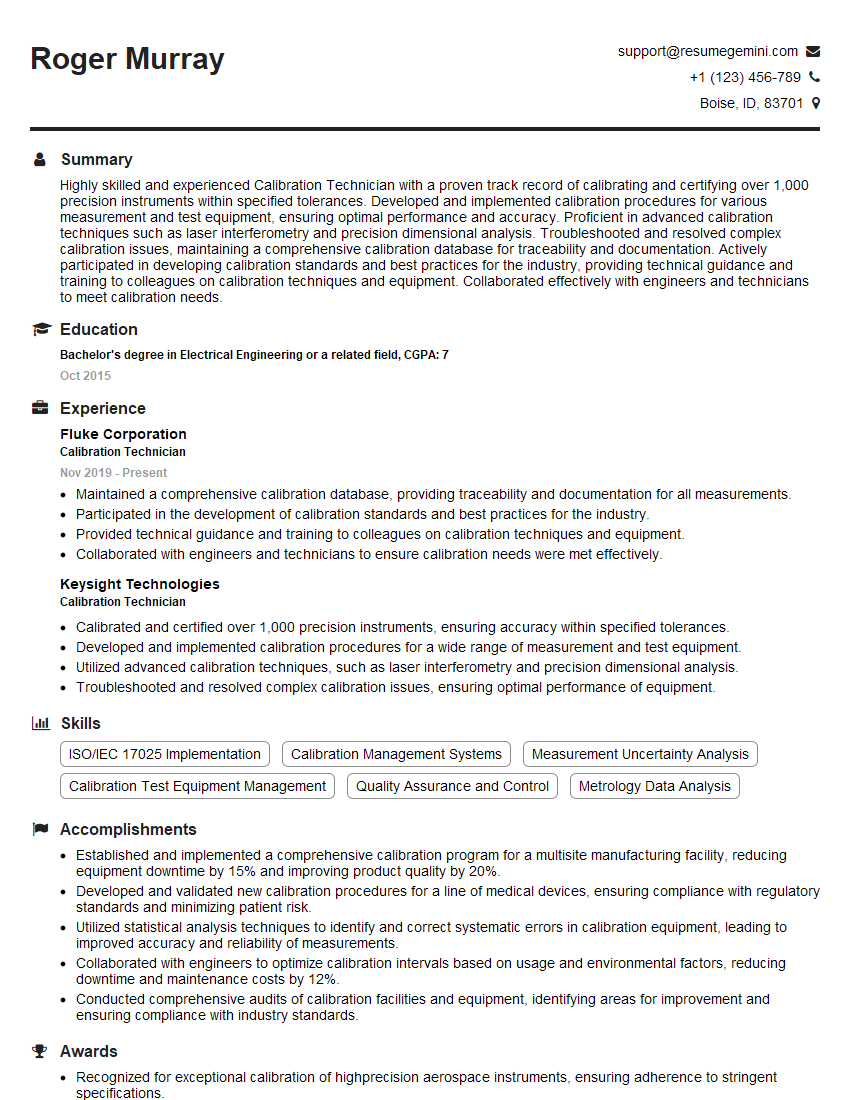
Calibration Technician Resume Sample

Instrumentation Technician Resume Sample

Civil Engineering Technician Resume Sample

Construction Inspector Resume Sample

Survey Crew Chief Resume Sample

Remote Sensing Specialist Resume Sample

Alignment Technician Resume Sample

Leveler Resume Sample

Precision Machinist Resume Sample

Toolmaker Resume Sample

Quality Control Inspector Resume Sample
- Geospatial Analyst
- Drafting Technician
- Photogrammetrist
- Surveyor
- Engineering Technician
- Land Surveyor
- Manufacturing Engineer
- Metrologist
- Quality Assurance Engineer
- Calibration Technician
- Instrumentation Technician
- Civil Engineering Technician
- Construction Inspector
- Survey Crew Chief
- Remote Sensing Specialist
- Alignment Technician
- Leveler
- Precision Machinist
- Toolmaker
- Quality Control Inspector
Explore more articles
Users Rating of Our Blogs
Share Your Experience
We value your feedback! Please rate our content and share your thoughts (optional).
What Readers Say About Our Blog
To the interviewgemini.com Webmaster.
Very helpful and content specific questions to help prepare me for my interview!
Thank you
To the interviewgemini.com Webmaster.
This was kind of a unique content I found around the specialized skills. Very helpful questions and good detailed answers.
Very Helpful blog, thank you Interviewgemini team.