Are you ready to stand out in your next interview? Understanding and preparing for Radar Interferometry interview questions is a game-changer. In this blog, we’ve compiled key questions and expert advice to help you showcase your skills with confidence and precision. Let’s get started on your journey to acing the interview.
Questions Asked in Radar Interferometry Interview
Q 1. Explain the principle of radar interferometry.
Radar Interferometry (InSAR) is a powerful geospatial technique that uses the phase differences between two or more radar images to create highly accurate measurements of surface deformation, elevation, and three-dimensional (3D) surface motion. Imagine throwing two pebbles into a still pond – the ripples they create interfere with each other. Similarly, InSAR uses the interference patterns created by radar waves reflected from the Earth’s surface to extract information. It leverages the fact that the phase of a radar signal is directly related to the distance between the satellite and the target. By comparing the phases of two or more radar images acquired from slightly different positions or times, subtle changes in that distance – caused by surface movement or change in elevation – are detected.
Specifically, a radar satellite transmits microwaves that penetrate clouds and vegetation, reflecting off the Earth’s surface. The reflected signals are received and processed. When two such signals are compared, the difference in their phase provides information on the range change between the radar and the target. This change can be due to several factors, including ground deformation (e.g., caused by earthquakes or landslides), changes in surface elevation, or atmospheric effects. This phase difference is then converted into displacement or elevation values using sophisticated processing techniques.
Q 2. Describe the difference between single-pass and repeat-pass interferometry.
The key difference between single-pass and repeat-pass interferometry lies in when the radar images are acquired. In single-pass interferometry, two antennas on the same satellite simultaneously transmit and receive radar signals, generating a pair of slightly offset images during a single satellite pass. This technique is particularly useful for measuring surface deformations that are occurring rapidly, as the images are acquired almost simultaneously, minimizing the effects of temporal decorrelation. However, it’s more demanding technically and requires sophisticated satellite instrumentation.
Repeat-pass interferometry, on the other hand, uses two or more radar images acquired at different times, usually from separate satellite passes. This approach is much more commonly used because it relies on readily available data from existing archives, reducing the demand for specific instrumentation. However, this approach is more susceptible to temporal decorrelation – the loss of coherence due to changes in the surface between acquisitions – and atmospheric effects because the time gap between acquisitions can be several days to several years. This makes it better suited to observe slower changes on the earth’s surface.
Q 3. What are the limitations of radar interferometry?
Despite its power, InSAR has several limitations. One major limitation is temporal and spatial decorrelation. Temporal decorrelation results from changes at the surface between acquisitions, such as vegetation growth, wind-induced changes in vegetation, or snow cover. Spatial decorrelation arises from changes in the radar signal’s backscatter due to surface roughness or layover/shadowing effects. This loss of coherence makes it impossible to obtain reliable phase measurements.
Atmospheric effects, such as water vapor and ionospheric disturbances, can introduce significant phase delays that mimic ground deformation. Geometric distortions, such as layover (where sloping surfaces appear compressed) and shadowing (where areas are not illuminated), can make interpretation difficult. Flat-Earth assumption is a common simplification in processing; significant deviations from this assumption can introduce errors in the results. Lastly, the cost and computational requirements for InSAR processing can be significant.
Q 4. How do atmospheric effects influence InSAR measurements?
Atmospheric effects significantly influence InSAR measurements by introducing additional phase delays in the radar signal. These delays are primarily caused by variations in the atmospheric water vapor content and ionospheric electron density. Water vapor is particularly problematic as it can cause significant phase delays, especially at longer wavelengths. These atmospheric-induced phase delays can mimic ground deformation, leading to inaccurate measurements. For instance, a high concentration of water vapor in the atmosphere along the radar path will introduce a positive phase shift, leading to an overestimation of ground displacement or uplift, while a low concentration would lead to an underestimation.
Mitigation strategies exist to address these effects. These include using atmospheric correction models, employing advanced processing techniques (such as atmospheric phase screen removal), and using multiple wavelengths to separate atmospheric and ground deformation signals. In practice, ignoring atmospheric effects can result in significant errors, especially in precise deformation monitoring.
Q 5. Explain the concept of coherence in InSAR.
Coherence in InSAR is a measure of the similarity between two or more radar images. It quantifies how well the phase information is preserved between acquisitions. A coherence value of 1 indicates perfect correlation, meaning the phase information is identical in both images, while a coherence of 0 signifies no correlation. High coherence is essential for reliable interferogram generation and subsequent interpretation.
Coherence is affected by various factors, primarily the temporal and spatial decorrelation mentioned earlier. High coherence is typically observed in stable, smooth surfaces with low backscatter variations between image acquisitions. Low coherence, on the other hand, is associated with rough surfaces, areas with significant vegetation changes, or highly dynamic areas. For instance, a forested region may exhibit low coherence because of changes in tree canopies over time while a concrete parking lot would generally exhibit high coherence. The coherence value provides a quality assessment of InSAR data, and helps identify areas where the measurements might be unreliable.
Q 6. What are the different types of interferometric fringes?
Interferometric fringes are contour lines of equal phase difference between two radar images. These fringes represent lines of equal range change or height difference. The spacing and orientation of the fringes reveal information about the type and magnitude of the displacement or elevation changes.
Different types of interferometric fringes can be categorized as:
- Topographic fringes: These fringes are caused by elevation changes in the terrain, revealing the topography of the area. They are typically curved and their spacing is related to the terrain slope.
- Deformation fringes: These fringes show ground deformation caused by events such as earthquakes, landslides, or volcanic activity. They may be localized to specific areas or spread over a large region depending on the extent of the deformation.
- Atmospheric fringes: These fringes are artifacts caused by atmospheric delays in the radar signal. They can mimic deformation fringes and need to be carefully distinguished and removed through atmospheric correction techniques.
Identifying the source of fringes requires careful analysis of the interferogram, considering factors such as the spatial pattern of the fringes, and any auxiliary information, such as geological maps or seismic data.
Q 7. How is the digital elevation model (DEM) generated from InSAR data?
A Digital Elevation Model (DEM) is a 3D representation of the Earth’s surface, showing elevation values at various points. InSAR is a powerful tool for generating high-resolution DEMs. The process typically involves several steps:
- Interferogram generation: Two or more radar images are processed to create an interferogram, which shows the phase differences between the images.
- Phase unwrapping: The phase differences in the interferogram are often wrapped (values between -π and π) due to the nature of phase measurements. The phase unwrapping process aims to recover the true, continuous phase values, eliminating the modulo-2π ambiguities.
- Georeferencing: The unwrapped phase is georeferenced using accurate control points (e.g., GPS coordinates) and other geospatial data to accurately position the elevation data.
- Elevation extraction: Knowing the wavelength of the radar signal, the range distance to each point, and the phase difference, the relative elevation is calculated using simple geometric relations. An absolute elevation is derived once a vertical datum is defined.
- DEM generation: Finally, the elevation values are interpolated to create a gridded DEM, representing the terrain surface. The resolution of the DEM depends on the radar parameters and processing techniques.
The accuracy of the InSAR-derived DEM depends on several factors, including the coherence of the data, atmospheric effects, and the accuracy of the processing steps. However, InSAR can provide very high-resolution DEMs, especially in challenging areas where traditional surveying methods are difficult or expensive to implement.
Q 8. Describe the process of InSAR data processing.
InSAR data processing is a multi-step procedure that transforms raw satellite radar data into meaningful measurements of surface deformation. Think of it like developing a photo: you start with a negative (the raw data) and need several steps to get a clear, usable image (the deformation map).
- Data Preprocessing: This involves removing noise and correcting for various geometric distortions. This is crucial, as even small errors can drastically affect the final results. We might apply corrections for sensor noise, atmospheric effects (like water vapor), and variations in the satellite’s orbit.
- Coregistration: Two or more radar images acquired at different times are precisely aligned. This is like superimposing two slightly different photos to identify the changed areas. Sub-pixel accuracy is essential here.
- Interferogram Generation: This step involves subtracting the phases of the two coregistered images. The resulting interferogram is a map of phase differences, which directly relate to surface displacement. Think of it as finding the subtle shifts between those superimposed photos.
- Phase Unwrapping: This crucial step addresses the 2π ambiguity inherent in interferometric phase measurements (explained in the next question). It’s like reassembling a torn map, carefully connecting all the pieces.
- Geometrical and Atmospheric Corrections: This involves removing any remaining errors in the data due to the Earth’s curvature, atmospheric effects, and orbital inaccuracies.
- Deformation Mapping: Finally, the unwrapped phase is converted into measurements of displacement (e.g., in millimeters) using the radar wavelength and geometric parameters. This is where we get the final, usable map of how the Earth’s surface has moved.
Each of these steps involves specialized software and algorithms, and careful attention to detail is critical to ensure accurate results.
Q 9. What is the role of phase unwrapping in InSAR?
Phase unwrapping in InSAR is vital because the measured phase is only known modulo 2π (i.e., the phase wraps around every 2π radians). Imagine a clock: you can’t tell the difference between 11 pm and 1 am just by looking at the hour hand – you need additional context. Similarly, the radar phase wraps around every 2π, creating ambiguity. Phase unwrapping is the process of determining the true, continuous phase from these ambiguous measurements.
Without phase unwrapping, the interferogram would show a series of repeating fringes that don’t reflect the actual displacement. The unwrapped phase then allows us to calculate the actual displacement using the known radar wavelength.
Q 10. Explain different phase unwrapping techniques.
Several phase unwrapping techniques exist, each with its strengths and weaknesses. The choice depends on the characteristics of the interferogram (e.g., density of fringes, noise level).
- Path-following algorithms: These algorithms start at a point with known phase and follow the phase gradient across the image. They’re relatively simple but sensitive to noise and discontinuities. Think of it like tracing a path on a mountainous terrain, trying to avoid sudden jumps.
- Minimum cost flow algorithms: These algorithms formulate the unwrapping problem as a network flow problem, finding the path that minimizes the overall cost (i.e., phase jumps). They’re robust against noise but can be computationally expensive.
- Least-squares methods: These algorithms treat the unwrapping problem as a least-squares estimation problem, using sophisticated mathematical techniques to find the best fit. These are often combined with other methods for better results.
- Branch-cut methods: These identify regions of phase ambiguity and introduce ‘branch cuts’ to separate them. It’s like drawing lines on the map to delineate different regions that are easier to unwrap individually.
Often, a combination of techniques or iterative refinement strategies is used to achieve optimal results. The choice of algorithm depends heavily on the quality of the data and the specific application.
Q 11. How do you handle temporal decorrelation in InSAR?
Temporal decorrelation in InSAR refers to the loss of coherence between two radar images acquired at different times. This happens due to changes in the surface between acquisitions, such as vegetation growth, changes in water content in the soil, or human activity. This is like comparing two pictures of a forest: if significant changes occurred, they won’t match perfectly.
Several strategies are used to mitigate temporal decorrelation:
- Short temporal baseline: Acquiring images closer together in time minimizes changes in the surface and preserves coherence. This is the simplest and often most effective approach.
- Stacking multiple interferograms: Averaging multiple interferograms improves signal-to-noise ratio and reduces the impact of temporal decorrelation. This improves the confidence in the measurement, much like taking multiple photos of the same scene to ensure a better image.
- Filtering techniques: Applying spatial filters to the interferograms can reduce noise and improve coherence. This is like smoothing the image to enhance details.
- Using advanced coherence estimation methods: Sophisticated algorithms can better estimate the coherence between images, even in the presence of significant temporal decorrelation.
The best approach often involves a combination of these techniques tailored to the specific study area and its characteristics.
Q 12. How do you correct for orbital errors in InSAR data?
Orbital errors are inaccuracies in the satellite’s position and velocity that affect the radar measurements. These errors can cause significant distortions in the interferograms, leading to incorrect deformation estimates. Think of this like taking a photo while the camera is shaking – the image will be blurry and not represent the reality.
Several techniques are used to correct for orbital errors:
- Precise Orbit Determination (POD): Using GPS or other precise positioning techniques, the satellite’s orbit is determined with high accuracy. This directly corrects the errors in measurements.
- Using ground control points (GCPs): Identifying points on the ground with known coordinates in the images allows us to refine the geometric corrections and remove residual orbital errors.
- InSAR-based orbit refinement: Using the InSAR data itself, it’s possible to iteratively refine the orbit to minimize the residual phase errors. This is akin to refining the camera calibration parameters based on the actual photo.
- Atmospheric correction: While not directly related to orbital errors, atmospheric effects can introduce phase distortions that mimic orbital errors, hence, careful atmospheric corrections are necessary.
The effectiveness of these corrections depends on the accuracy of the reference data (e.g., GPS data) and the quality of the InSAR data itself. Often, a combination of these techniques is applied.
Q 13. What are the applications of InSAR in geological hazard monitoring?
InSAR has become an indispensable tool for monitoring geological hazards due to its ability to measure ground deformation with high spatial resolution and accuracy. It provides a synoptic view of large areas, allowing us to identify areas at risk and track changes over time.
- Volcano monitoring: InSAR allows us to monitor the inflation and deflation of volcanoes, providing early warning signs of potential eruptions. The subtle ground swelling provides valuable data for risk assessment.
- Earthquake monitoring: InSAR can measure the coseismic (co-occurring with an earthquake) and post-seismic deformation associated with earthquakes, providing information about fault slip and the potential for aftershocks.
- Landslide monitoring: InSAR can detect subtle ground movements that precede landslides, allowing for timely warnings and potentially saving lives. Early detection is key to preventing disaster.
- Glacier movement monitoring: The high spatial resolution of InSAR allows us to monitor the movement of glaciers and their contribution to sea-level rise. This contributes to climate change research.
- Subsidence monitoring: InSAR can detect ground subsidence due to groundwater extraction, which can cause significant damage to infrastructure.
By providing a detailed picture of deformation, InSAR empowers scientists and engineers to develop effective mitigation strategies and improve our understanding of geological processes.
Q 14. How is InSAR used for deformation measurement?
InSAR is ideally suited for deformation measurement because it can measure extremely small changes in surface elevation (millimeters to centimeters) over large areas. It leverages the phase shift in the radar signal caused by this movement.
The process involves acquiring two or more radar images of the same area at different times. The difference in the phase of the radar signal between these images is directly related to the displacement of the surface. By carefully processing the data (as discussed in question 1), we can convert this phase difference into actual displacement measurements. This allows us to map the deformation field in detail, identifying areas of uplift, subsidence, or lateral movement.
The accuracy of InSAR deformation measurements depends on several factors, including the quality of the radar data, the processing techniques used, and the temporal and spatial baseline of the acquisitions. Nevertheless, its ability to provide high-resolution, wide-area deformation maps makes it an incredibly valuable tool in a variety of applications, including those mentioned in the previous question.
Q 15. Explain the concept of Persistent Scatterer Interferometry (PSI).
Persistent Scatterer Interferometry (PSI) is a powerful technique derived from Interferometric Synthetic Aperture Radar (InSAR) that focuses on identifying and analyzing stable scattering points within a radar image sequence. Unlike conventional InSAR, which measures the average deformation across a pixel, PSI isolates highly coherent targets, known as persistent scatterers (PS), that maintain a consistent radar backscatter signature over multiple acquisitions. Think of it like this: imagine a field of sunflowers. Conventional InSAR might measure the average movement of the entire field, including the swaying sunflowers. PSI, on the other hand, identifies individual, firmly planted objects (like a fence post or a large rock) and tracks their movements precisely.
These PS are usually man-made structures (buildings, roads) or natural features (rocks) with strong, stable backscattering properties. By tracking the phase changes of these PS over time, PSI can measure ground deformation with millimeter-level accuracy, providing detailed insights into subtle movements that would be masked by noise in conventional InSAR.
Career Expert Tips:
- Ace those interviews! Prepare effectively by reviewing the Top 50 Most Common Interview Questions on ResumeGemini.
- Navigate your job search with confidence! Explore a wide range of Career Tips on ResumeGemini. Learn about common challenges and recommendations to overcome them.
- Craft the perfect resume! Master the Art of Resume Writing with ResumeGemini’s guide. Showcase your unique qualifications and achievements effectively.
- Don’t miss out on holiday savings! Build your dream resume with ResumeGemini’s ATS optimized templates.
Q 16. What are the advantages and disadvantages of PSI compared to conventional InSAR?
PSI offers several advantages over conventional InSAR. Its main strength is its significantly improved spatial resolution and accuracy in measuring deformation. It can detect subtle movements (even millimeters) that would be lost in the noise of conventional InSAR. This precision makes it ideal for monitoring slow-moving deformation processes.
- Higher Accuracy: Millimeter-level accuracy in measuring deformation.
- Improved Spatial Resolution: Focuses on individual points instead of averaging across pixels.
- Detection of Subtle Movements: Able to monitor slow deformation processes like subsidence or creep.
However, PSI also has limitations:
- Limited Number of Scatterers: Only a small fraction of pixels in an image will be identified as PS, limiting spatial coverage.
- Computational Cost: The processing of PSI data is computationally intensive and requires sophisticated algorithms.
- Sensitivity to Atmospheric Effects: While more robust than conventional InSAR, it remains susceptible to atmospheric artifacts.
In essence, the choice between PSI and conventional InSAR depends on the specific application and the required level of accuracy and spatial resolution. If high precision and the detection of subtle movements are paramount, PSI is the better choice, despite its higher computational costs and limited spatial coverage. Conventional InSAR is preferable when a broader area coverage is needed, even if at the cost of lower accuracy.
Q 17. Describe the use of InSAR in precision agriculture.
InSAR plays a growing role in precision agriculture by providing valuable information about the Earth’s surface that can inform better agricultural practices. For instance, by monitoring changes in ground elevation over time, InSAR can detect subtle shifts in soil moisture content. This is crucial for irrigation management – farmers can precisely determine where water is needed, optimizing water usage and minimizing waste. Likewise, InSAR can identify areas experiencing soil subsidence or compaction, allowing for targeted adjustments to tillage practices to improve soil health and crop yields.
Furthermore, InSAR can be used to create high-resolution digital elevation models (DEMs) of agricultural fields. These DEMs can be integrated with other sensor data (e.g., multispectral imagery) to develop more accurate crop growth models and identify areas requiring specific attention. Ultimately, InSAR data contributes to data-driven decision-making, leading to increased efficiency and sustainability in agriculture.
Q 18. How is InSAR applied in urban area monitoring?
InSAR is exceptionally well-suited for urban area monitoring due to the abundance of persistent scatterers (buildings, roads, infrastructure). It can track the subtle movements of buildings over time, detecting signs of structural instability, subsidence, or earthquake-related damage. This information is vital for urban planning, risk assessment, and infrastructure management. Imagine monitoring a large city’s infrastructure for settlement or deformation after a major earthquake – InSAR can provide a detailed map showing where critical structures require immediate attention.
Moreover, InSAR can be used to monitor the growth and expansion of urban areas, facilitating urban planning and monitoring land-use changes. It can also assist in the detection of illegal construction or changes in the landscape that might violate zoning regulations.
Q 19. Explain the role of InSAR in infrastructure monitoring.
InSAR plays a critical role in infrastructure monitoring by providing high-precision measurements of deformation in various structures. This includes bridges, dams, buildings, and pipelines. By tracking millimetric movements over time, InSAR can detect early warning signs of structural distress before visible damage appears. For example, subtle movements in a bridge’s support structure could indicate fatigue or damage long before a visual inspection reveals a problem.
This proactive monitoring capability allows for timely maintenance and repairs, preventing catastrophic failures and reducing the risk of accidents. The cost savings from preventing major infrastructure failures far outweigh the cost of regular InSAR monitoring. This makes InSAR a crucial tool for ensuring the safety and longevity of critical infrastructure assets.
Q 20. What are the challenges in processing InSAR data from complex terrain?
Processing InSAR data from complex terrain presents significant challenges due to the effects of topography on the radar signal. The main issue is the geometrical distortion caused by the varying distances between the satellite and the ground surface. This leads to phase errors that can obscure the true deformation signal. Techniques like range migration and phase unwrapping become significantly more difficult in mountainous areas.
Other challenges include:
- Layover and Shadowing: Steep slopes can cause parts of the terrain to be obscured or overlapped in the radar image, making it difficult to extract reliable measurements.
- Increased Atmospheric Effects: Complex terrain can amplify the effects of atmospheric water vapor, further corrupting the phase signal.
- Vegetation Effects: Dense vegetation can scatter and absorb the radar signal, reducing coherence and making it hard to identify persistent scatterers.
Addressing these challenges requires sophisticated processing techniques, including advanced geometric correction algorithms, atmospheric correction models, and specialized filtering methods. Often, advanced techniques like the use of multiple passes and integrating auxiliary datasets (such as high-resolution optical imagery) are employed to minimize these errors.
Q 21. How do you assess the quality of InSAR data?
Assessing the quality of InSAR data involves evaluating several key parameters. Coherence is a crucial indicator, representing the similarity of the radar signal backscattered from the same location in different acquisitions. High coherence indicates a stable target suitable for deformation measurement, while low coherence often suggests unstable targets or atmospheric noise. A coherence map visually represents the spatial distribution of coherent targets, providing valuable insights into data quality.
Other important factors include:
- Spatial Resolution: Higher spatial resolution provides more detail but might be limited by the acquisition parameters.
- Temporal Resolution: Frequent acquisitions allow for better monitoring of dynamic processes but might be limited by satellite availability and costs.
- Noise Level: The presence of noise (e.g., thermal noise, atmospheric effects) reduces the accuracy of measurements. Several statistical metrics can be used to quantify the noise levels.
- Geometric Accuracy: The accuracy of the geolocation and the geometric correction applied to the data are vital for precise deformation measurements.
By carefully examining these factors, along with visual inspection of the data, a comprehensive assessment of InSAR data quality can be made. Understanding the limitations of the data is crucial for interpreting the results accurately and avoiding misinterpretations. Any outliers or inconsistencies should be carefully investigated.
Q 22. What are the different types of radar satellites used for InSAR?
Several types of radar satellites are employed for Interferometric Synthetic Aperture Radar (InSAR). The choice depends on the specific application and required spatial and temporal resolution. Key distinctions lie in their orbit type, sensor characteristics, and wavelength.
- C-band satellites: These are the most common, offering a balance between penetration depth and spatial resolution. Examples include Sentinel-1A/B and ERS-1/2. Their longer wavelength allows for penetration through vegetation and some thin layers of dry soil, making them useful for various applications.
- L-band satellites: L-band satellites, such as ALOS-2 (PALSAR-2) and JERS-1, have longer wavelengths providing superior penetration capabilities. This is particularly valuable for monitoring ground deformation in heavily vegetated areas or under dense canopies. However, their spatial resolution is typically lower than C-band.
- X-band satellites: X-band satellites offer very high spatial resolution, ideal for mapping small-scale features. However, they have limited penetration capabilities and are highly sensitive to atmospheric conditions. TerraSAR-X and Cosmo-SkyMed are examples.
The selection process often involves considering the trade-offs between spatial resolution, penetration depth, temporal resolution (how often the satellite revisits the area), and cost.
Q 23. What software packages are commonly used for InSAR processing?
Numerous software packages facilitate InSAR processing, each offering unique capabilities and strengths. The choice depends on factors like the user’s experience, project requirements, and available computational resources. Popular choices include:
- SARscape (ENVI): A comprehensive and user-friendly commercial package offering a wide array of InSAR processing tools, from data preprocessing to deformation mapping and visualization.
- GMT (Generic Mapping Tools): A powerful open-source suite for geospatial data processing, including many tools useful for InSAR post-processing and visualization. It requires more technical expertise than commercial options.
- ISCE (InSAR Scientific Computing Environment): An open-source platform focused on providing advanced algorithms and flexibility for experienced InSAR users. It requires significant programming experience.
- SNAP (Sentinel Application Platform): Developed by ESA, this open-source platform is specifically designed for processing Sentinel satellite data, including InSAR applications. It’s relatively user-friendly compared to ISCE.
Many researchers also develop customized pipelines using languages like Python, often leveraging libraries like NumPy and SciPy for numerical computation and data manipulation.
Q 24. Explain the concept of ground deformation measurement using InSAR.
InSAR measures ground deformation by exploiting the phase information contained in radar signals. Two radar images of the same area acquired at different times are compared. Any change in the distance between the satellite and the ground surface between acquisitions—due to ground movement—causes a measurable phase shift in the radar signal.
Imagine sending a wave to a wall and measuring how long it takes to bounce back. If the wall moves closer or farther, the time (and thus the phase) of the returning wave changes. InSAR does this on a massive scale, comparing phase changes pixel by pixel across two or more images.
The phase difference is then converted into a displacement map, showing the movement of the ground surface in the line-of-sight (LOS) direction—the direction of the radar signal. Advanced techniques like Persistent Scatterer Interferometry (PSI) and Small Baseline Subset (SBAS) can be employed to improve the accuracy and spatial resolution of the measurements, reducing atmospheric and other noise.
This LOS displacement can then be decomposed into its vertical and horizontal components using multiple viewing angles or other datasets. The result is a detailed map of ground deformation, invaluable for monitoring phenomena such as landslides, earthquakes, subsidence, and volcanic activity.
Q 25. Describe your experience in using InSAR for a specific application.
I recently worked on a project using InSAR to monitor subsidence in a rapidly developing coastal region. We used Sentinel-1 data spanning three years to detect areas experiencing significant ground settlement due to groundwater extraction and urbanization. The study area posed significant challenges due to the presence of dense vegetation and a relatively high level of atmospheric noise.
To overcome these issues, we employed an advanced SBAS processing technique incorporating atmospheric phase screen corrections, and carefully selected persistent scatterers (PS) to minimize errors due to decorrelation. The results revealed spatially localized areas of subsidence exceeding 2 centimeters per year, providing critical information to local authorities for urban planning and infrastructure management.
The project was successful in its implementation of sophisticated InSAR techniques to deliver valuable insight for sustainable development. This experience highlighted the critical importance of careful data pre-processing and the selection of appropriate processing algorithms to deal with challenging data conditions.
Q 26. How would you approach a problem with low coherence in InSAR data?
Low coherence in InSAR data means that the radar signal is not consistently reflected back from the same surface features over time. This leads to noisy phase measurements and unreliable displacement estimates. Several strategies can be employed to mitigate this problem:
- Improved atmospheric correction: Atmospheric effects can severely reduce coherence. Using sophisticated atmospheric correction techniques, such as those that utilize meteorological data, can significantly improve the quality of InSAR measurements.
- Temporal and spatial filtering: Applying filters to the InSAR data can help to smooth out noise and enhance the signal-to-noise ratio, which improves the coherence.
- Persistent Scatterer Interferometry (PSI): This technique focuses on stable scatterers, such as man-made structures, that maintain high coherence over time. By selecting stable features, one is less affected by decorrelation due to changes in the surface’s scattering properties.
- Selection of appropriate processing parameters: Careful optimization of parameters such as the window size for coherence estimation can significantly impact results. Experimentation is often necessary.
- Data acquisition strategy: High temporal resolution and suitable incidence angles are important. More frequent acquisitions reduce the impact of temporal decorrelation.
A multi-pronged approach, often tailored to the specifics of the data and the region, is generally most effective.
Q 27. What are the future trends in Radar Interferometry?
The future of Radar Interferometry looks bright, driven by several key trends:
- Increased use of AI/ML: Artificial intelligence and machine learning techniques are being increasingly used to improve various aspects of InSAR processing, such as automating data processing workflows, enhancing coherence estimation, and improving the accuracy of deformation measurements.
- Improved sensor technologies: Advances in sensor technology, such as the development of higher-resolution sensors with increased sensitivity, are improving the quality and spatial resolution of InSAR data.
- Integration with other datasets: The fusion of InSAR data with other geospatial data sources, such as optical imagery, GPS measurements, and geological data, is providing a more comprehensive understanding of ground deformation processes.
- Development of new processing techniques: Researchers are continuously developing new and improved InSAR processing techniques to address specific challenges, such as dealing with low coherence data and improving the accuracy of deformation measurements in complex environments.
- Wider application areas: InSAR technology is expanding into new application areas, such as precision agriculture, infrastructure monitoring, and natural hazard early warning systems.
These advancements promise to make InSAR even more powerful and versatile in the years to come, furthering its capabilities in various domains.
Q 28. Explain your understanding of the limitations and uncertainties associated with InSAR data.
InSAR data, while powerful, is subject to several limitations and uncertainties:
- Line-of-sight (LOS) measurement: InSAR only measures displacement in the LOS direction, which needs further processing to resolve the vertical and horizontal components. The accuracy of this decomposition depends on several factors.
- Atmospheric effects: Atmospheric water vapor and other atmospheric conditions can introduce significant errors in phase measurements, requiring atmospheric correction techniques which can be computationally intensive and may introduce additional uncertainty.
- Decorrelation: Changes in the ground surface over time (e.g., vegetation growth) can lead to decorrelation, which reduces the coherence of the radar signal and limits the reliability of displacement measurements.
- Spatial resolution limitations: The spatial resolution of InSAR data is limited by the characteristics of the radar sensor and the processing techniques used. This can be particularly challenging in densely vegetated areas or urban environments.
- Data gaps and noise: InSAR data can contain gaps or noisy areas due to various factors, such as shadowing, layover, and ionospheric effects.
It’s crucial to be aware of these limitations and to employ appropriate techniques to mitigate their effects when interpreting and analyzing InSAR data. Detailed error analyses are essential for any credible results. The use of multiple datasets and complementary techniques often improves overall data confidence.
Key Topics to Learn for Radar Interferometry Interview
- Fundamentals of Radar: Understand basic radar principles, including signal propagation, scattering, and backscattering mechanisms. Explore different radar types and their applications.
- Interferometric Principles: Grasp the concept of phase coherence and its role in interferometry. Learn about the formation of interferograms and the extraction of useful information from them.
- Data Processing Techniques: Familiarize yourself with common interferometric processing steps, including phase unwrapping, atmospheric correction, and geocoding. Understand the challenges and limitations of these techniques.
- Applications in Geodesy and Geophysics: Explore how InSAR is used for measuring ground deformation (e.g., landslides, subsidence), monitoring volcanic activity, and studying glacial dynamics. Be ready to discuss specific case studies.
- Error Sources and Mitigation Strategies: Understand the various sources of error in InSAR measurements (e.g., atmospheric effects, geometric distortions) and the techniques used to minimize their impact on the results.
- Advanced Topics (Optional): Depending on the seniority of the role, you might want to explore advanced topics like Persistent Scatterer Interferometry (PSI), Small Baseline Subset (SBAS) processing, or polarimetric InSAR.
- Problem-Solving & Interpretation: Practice interpreting interferograms and extracting meaningful insights. Be prepared to discuss the limitations and uncertainties associated with InSAR data.
Next Steps
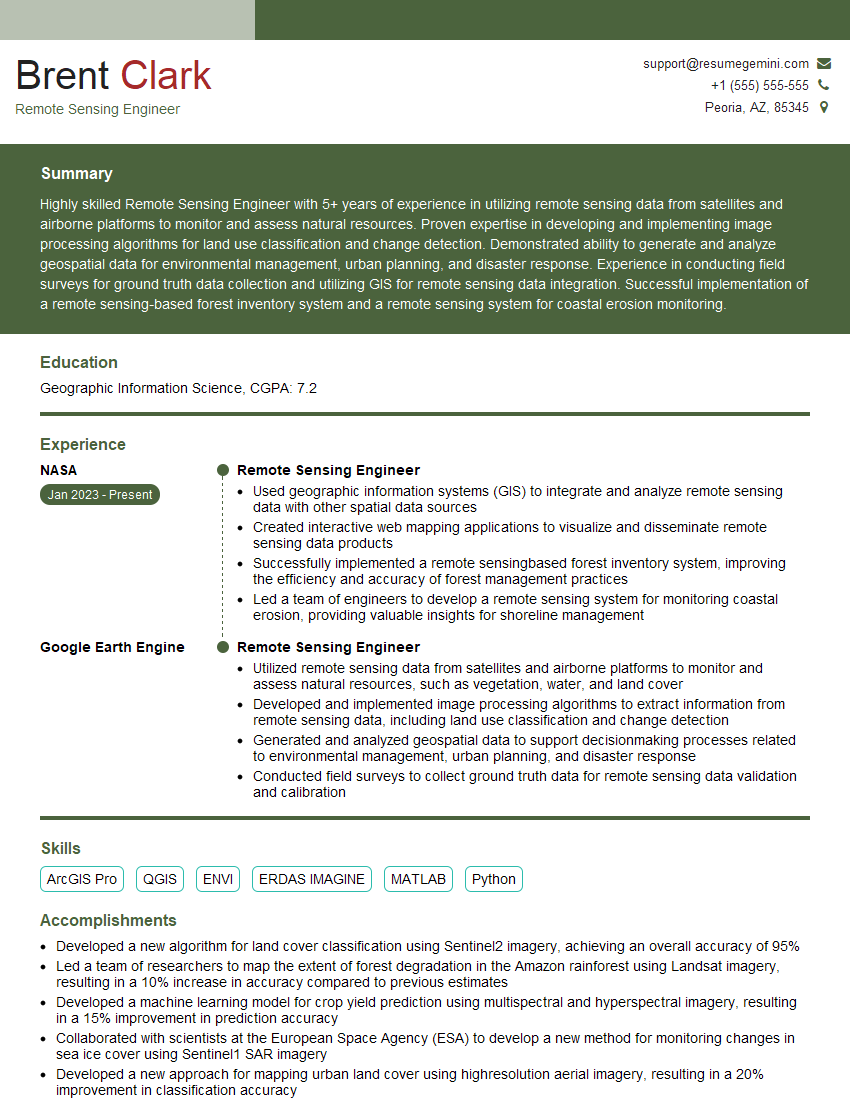
Mastering Radar Interferometry opens doors to exciting career opportunities in diverse fields like remote sensing, geophysics, and civil engineering. To stand out from the competition, a strong resume is crucial. Building an ATS-friendly resume is key to ensuring your application is seen by recruiters. We highly recommend using ResumeGemini to create a professional and impactful resume that highlights your skills and experience effectively. ResumeGemini provides examples of resumes tailored specifically to Radar Interferometry roles, helping you craft a compelling application that showcases your expertise.


Explore more articles
Users Rating of Our Blogs
Share Your Experience
We value your feedback! Please rate our content and share your thoughts (optional).
What Readers Say About Our Blog
To the interviewgemini.com Webmaster.
Very helpful and content specific questions to help prepare me for my interview!
Thank you
To the interviewgemini.com Webmaster.
This was kind of a unique content I found around the specialized skills. Very helpful questions and good detailed answers.
Very Helpful blog, thank you Interviewgemini team.