Unlock your full potential by mastering the most common Rigging Inspection and Setup interview questions. This blog offers a deep dive into the critical topics, ensuring you’re not only prepared to answer but to excel. With these insights, you’ll approach your interview with clarity and confidence.
Questions Asked in Rigging Inspection and Setup Interview
Q 1. Explain the different types of rigging hardware and their applications.
Rigging hardware encompasses a wide array of components crucial for safely lifting and moving loads. Understanding their specific applications is paramount for preventing accidents.
- Shackles: These are U-shaped metal pieces with a pin or screw, used to connect different rigging components. They come in various strengths and types (bow, D-ring, etc.), each suited for different applications. For example, a bow shackle is ideal for connecting a sling to a hook due to its smooth curve which reduces wear and tear on the sling.
- Hooks: Used for connecting slings to cranes or other lifting devices. Different hook types (e.g., grab hooks, safety hooks) offer varying levels of safety and suitability for diverse loads. Safety hooks have a latch that prevents accidental disengagement.
- Slings: These are the primary load-bearing components, available in chain, wire rope, and synthetic materials (nylon, polyester). The choice depends on the load’s characteristics, environment, and required flexibility. For instance, synthetic slings are often preferred for their lighter weight and resistance to corrosion.
- Eye Bolts: Bolts with an eye at the end, used for attaching slings or other rigging components to lifting points on an object.
- Turnbuckles: Allow for adjustment of sling length and tension. Essential for achieving proper alignment and load distribution.
- Spreader Beams: Distribute the load of heavy objects across multiple slings, preventing excessive stress on a single point and improving stability.
Selecting the appropriate hardware is critical and depends on factors like the load weight, shape, and environment. Using the wrong hardware can lead to catastrophic failures.
Q 2. Describe the process of conducting a pre-lift inspection.
A pre-lift inspection is a crucial safety step that ensures all components are in perfect working order before any lifting operation begins. It’s a systematic process, and neglecting it can have severe consequences.
- Visual Inspection: Carefully examine all rigging components (slings, shackles, hooks, etc.) for any signs of damage, wear, corrosion, distortion, or defects. This includes checking for broken wires, kinks, cracks, or excessive wear on the components’ surfaces.
- Component Verification: Confirm that the equipment’s rated capacity meets or exceeds the weight of the load. Ensure that all components are correctly identified with their respective SWL clearly visible and legible.
- Attachment Points Inspection: Verify that the attachment points on both the load and the lifting device are sound and capable of withstanding the stresses involved. This includes checking for any structural weaknesses or damage around the attachment points.
- Environmental Assessment: Check for factors that could negatively affect the lift, such as inclement weather (high winds, rain, etc.), or obstructions that may hinder the lift.
- Documentation: Record the inspection findings, including any deficiencies identified. This documentation serves as a crucial record should any incidents arise.
Think of it as a thorough health check for your lifting equipment – a small problem ignored before the lift can easily become a major catastrophe during the lift itself.
Q 3. What are the key safety regulations and standards you adhere to in rigging?
Rigging safety is paramount, and I adhere strictly to a range of regulations and standards. These guidelines ensure that all lifting operations are performed safely and efficiently, minimizing risks to personnel and equipment.
- OSHA (Occupational Safety and Health Administration): I follow all relevant OSHA regulations pertaining to crane and rigging operations, including proper training, equipment inspection, and safe work practices.
- ASME (American Society of Mechanical Engineers): I am familiar with ASME standards for rigging equipment, ensuring that all components meet or exceed the required strength and safety factors.
- ANSI (American National Standards Institute): I follow ANSI standards for slings and other lifting devices, ensuring proper selection and usage based on load capacity and material.
- Manufacturer’s Instructions: It’s crucial to adhere strictly to the manufacturer’s recommendations regarding the use, inspection, and maintenance of all rigging equipment.
Beyond these formal standards, I always prioritize a proactive safety approach, emphasizing safe work practices and thorough risk assessments on every job.
Q 4. How do you calculate the safe working load (SWL) of a rigging assembly?
Calculating the Safe Working Load (SWL) of a rigging assembly isn’t simply adding up the individual SWLs of each component. It’s a more nuanced process that considers factors affecting the entire assembly.
The SWL of the entire assembly is determined by the weakest link. This means you must consider:
- SWL of individual components: Identify the SWL of each component (sling, shackle, hook, etc.) using manufacturer’s data plates or certifications.
- Angle of lift: Lifting loads at angles reduces the effective SWL of the slings. Consult angle correction factors provided by the sling manufacturer to adjust the SWL accordingly. For example, a sling carrying a load at a 30-degree angle will have a reduced SWL compared to a vertical lift.
- Number of legs: Using multiple legs to support a load distributes the weight, but the SWL is still limited by the weakest leg and the angle of the legs.
- Type of sling: Chain slings have different SWL calculations than wire rope or synthetic slings. Consult the specific manufacturer’s documentation for the correct calculations.
- Environmental Factors: Extreme temperatures, corrosion, or other environmental factors can affect the SWL, potentially reducing it.
Using a safety factor is crucial. A common practice is to apply a safety factor of 5 or even higher, depending on the application and risk assessment. This means that the SWL should be five times the actual load. This additional margin protects against unexpected forces and ensures a wide margin of safety.
Q 5. What are the common causes of rigging failures?
Rigging failures can have devastating consequences, stemming from various causes that need careful consideration and preventive measures.
- Overloading: Exceeding the SWL of any component in the rigging assembly is a primary cause of failure. This can happen due to miscalculation, negligence, or improper load distribution.
- Improper Use: Incorrect usage of equipment, such as using slings with kinks, knots, or damaged parts, can lead to catastrophic failures. Using the wrong type of sling for the job also falls under this category.
- Lack of Maintenance: Regular inspection and maintenance are vital for preventing failures. Ignoring signs of wear, corrosion, or damage increases the risk of failure significantly.
- Environmental Factors: Exposure to harsh environments (extreme temperatures, chemicals, etc.) can degrade rigging components, weakening their structure and reducing their SWL.
- Poor Inspection: Inadequate pre-lift inspections can fail to identify critical defects, resulting in failure during operation.
- Incorrect Hitches: Incorrect sling hitches (the method of attaching the sling to the load) can result in an uneven distribution of load, leading to premature failure of the sling or other components.
A proactive approach to safety, including thorough inspections, proper training, and a strong safety culture, is the best defense against rigging failures.
Q 6. Explain the importance of load charts and how to interpret them.
Load charts are essential documents that provide critical information regarding the safe working loads (SWLs) for various rigging configurations. They visually represent the SWL based on different factors.
The importance of load charts cannot be overstated. They are critical for:
- Safe Load Determination: Load charts provide clear guidelines on the maximum load that can be safely lifted using a specific sling configuration, taking into account angles, number of legs, and type of sling.
- Risk Mitigation: By using load charts, potential hazards can be identified and mitigated before a lift begins, preventing accidents.
- Compliance: Load charts demonstrate adherence to safety regulations and standards, ensuring legal compliance.
- Training: They are excellent tools for training riggers on proper load calculations and safe lifting techniques.
Interpreting a load chart requires understanding its components. Typical charts illustrate SWL variations based on the sling angle and the number of legs. For example, a chart might show that a 2-leg sling configuration with a 60-degree angle has a significantly reduced SWL compared to a vertical lift (0-degree angle). Always use the most conservative SWL value from the chart that is relevant to the specific lift parameters.
Q 7. Describe your experience with different types of slings (e.g., chain, wire rope, synthetic).
My experience encompasses working with various types of slings, each with its own strengths and limitations.
- Chain Slings: I have extensive experience with chain slings, appreciating their high strength and durability. They are particularly suitable for heavy, rough loads and harsh environments. However, they are heavier than other sling types and can be more prone to damage from impacts.
- Wire Rope Slings: I am proficient in using wire rope slings, understanding their flexibility and suitability for lifting awkward shapes and loads. However, careful inspection for broken wires and kinks is critical, as these can severely weaken the sling.
- Synthetic Slings (Nylon, Polyester): Synthetic slings are increasingly common due to their lighter weight, high strength-to-weight ratio, and resistance to corrosion. They are ideal for handling loads that could be damaged by metal slings. However, they can be susceptible to damage from UV exposure, chemicals, and sharp edges.
In practice, selecting the right sling type depends on factors such as the load’s weight, shape, and environment, as well as the required flexibility and strength.
For instance, I once worked on a project where we needed to lift delicate components for a manufacturing plant. Due to the risk of scratching or denting the components, synthetic slings were the logical choice. In contrast, when lifting extremely heavy and rugged equipment on a construction site, chain slings offered the required strength and durability. Choosing the right sling is about understanding the properties of each type and selecting the one that best fits the circumstances of the lift.
Q 8. How do you ensure the proper attachment of rigging hardware to the load?
Ensuring proper attachment of rigging hardware to the load is paramount for safety and successful lifting operations. It involves a multi-step process focusing on both the hardware selection and its secure connection to the load.
First, we must select the appropriate hardware based on the load’s weight, shape, and material. This might include shackles, slings (chain, wire rope, or synthetic), hooks, and other specialized attachments. The Working Load Limit (WLL) of each component must be clearly identified and checked to ensure it exceeds the load weight with a significant safety factor (often 5:1 or higher).
Next, the attachment itself needs careful attention. For example, when using slings, the load should be distributed evenly across all legs to prevent overloading or slippage. Proper hitching methods are crucial; we avoid sharp bends in slings which can weaken them. Shackles should be properly closed and pinned, ensuring the pin is secured and not bent. Hooks should be inspected for cracks, deformations, or wear and tear, and properly seated on the load or lifting point.
Finally, a thorough visual inspection is conducted to verify secure attachment before any lifting begins. This involves checking for any signs of slippage, improper seating, or damaged hardware. The whole rigging process is documented, including types of equipment used and the load weight, for future reference and auditing.
Q 9. What are the different types of knots used in rigging and when are they appropriate?
Many knots find use in rigging, each suited for specific applications. The choice depends on factors such as the type of rope, load weight, and the required security. Improper knot selection can lead to catastrophic failure.
- Bowline: Forms a fixed loop that doesn’t tighten under load and is easy to untie. Ideal for attaching a rope to a ring or hook. Think of it as a reliable ‘non-slip loop’ in your rigging toolbox.
- Clove Hitch: A simple knot used for temporary attachments to a ring or post. Easy to tie and adjust, but not as secure as a bowline under heavy loads and therefore not suited for critical lifts.
- Figure Eight: A stopper knot used to prevent a rope from running through a pulley or other device. Useful for keeping the rope in a certain position, however, it should not be used as a primary attachment knot.
- Running Bowline: A variation of the bowline that allows for easy adjustment of the loop size. A great option when you might need some flexibility.
It’s crucial to know that even well-tied knots can weaken rope fibers, especially when used repeatedly or under heavy strain. Regular inspection and knot replacement are necessary to ensure safety.
Q 10. Explain the concept of load distribution in rigging.
Load distribution in rigging focuses on evenly spreading the weight of the load across all supporting components to prevent overloading any single point. Uneven load distribution can cause structural failure of slings, lifting points, or even the load itself.
Imagine lifting a heavy rectangular object with two slings. If the slings are attached at opposite corners, the weight is distributed across the two slings appropriately. However, if the slings are attached to one side, it will create significant stress on that side and potentially lead to the failure of the sling.
Effective load distribution requires careful planning and execution. Factors to consider include the load’s center of gravity, the sling type and angle, and the lifting equipment’s capacity. Using multiple slings at appropriate angles, along with proper attachment points, ensures that the force is distributed uniformly and safely.
Using spreader beams is another way to distribute the load. It helps to distribute the load from a single point to multiple slings, preventing stress concentration and ensuring even distribution.
Q 11. Describe your experience with different types of lifting equipment (e.g., cranes, forklifts).
My experience with lifting equipment spans various types, including cranes (tower, mobile, overhead), forklifts (both rough terrain and standard), and specialized lifting devices such as gantry cranes. I’m proficient in operating and inspecting these machines, understanding their limitations and safety protocols.
For example, I have extensive experience with mobile crane operation, including pre-lift inspections (checking hydraulics, brakes, and load charts), load calculations, and understanding wind speed limitations. With forklifts, I am familiar with safe load capacity, weight distribution, and proper maneuvering techniques in varied environments.
Beyond operation, I can perform detailed inspections to identify potential defects. This includes checking certification, hydraulic leakages, structural integrity, and safety features. Knowledge of relevant regulations and standards (e.g., OSHA, ASME) is critical for safe and compliant operation.
Q 12. How do you handle unexpected situations or emergencies during a rigging operation?
Handling unexpected situations requires quick thinking, experience, and a strong emphasis on safety. My approach involves a structured process:
- Immediate Assessment: Identify the nature of the emergency (e.g., sling failure, equipment malfunction, environmental hazard).
- Emergency Stop: Immediately halt the operation and secure the load if possible.
- Safety First: Evacuate personnel from the immediate danger zone.
- Damage Control: Assess the damage and the situation’s severity. If safe to do so, implement measures to stabilize the load or equipment.
- Communication: Notify relevant personnel (supervisors, emergency services) and follow established emergency protocols.
- Investigation: Once the situation is under control, conduct a thorough investigation to determine the root cause of the incident, ensuring preventive measures are taken to avoid recurrence.
For instance, if a sling fails, we must immediately lower the load slowly and carefully, if possible. We will then assess the damage and replace the defective sling. A thorough investigation will follow, examining the sling for wear and tear, improper use, or overloading to prevent future incidents.
Q 13. How do you communicate effectively with the rigging crew and other personnel?
Effective communication is crucial in rigging, involving clear, concise, and respectful interactions with the team and other personnel. This includes both verbal and non-verbal communication.
Before starting any operation, a pre-job briefing ensures everyone understands the plan, including load details, lifting techniques, and safety protocols. I use clear, unambiguous instructions and actively listen to concerns raised by the crew. Non-verbal cues, such as hand signals, are also critical to maintain safety during the lift itself.
During the lift, constant communication is maintained. Clear hand signals are used to direct crane operators, and verbal communication is employed for any changes or updates. After the lift, a debriefing session reviews the operation, highlighting any issues or areas for improvement.
Documentation plays a vital role. Rigging plans, checklists, and incident reports ensure clear records are maintained for audit trails and lessons learned from past operations.
Q 14. What are your experience with different types of rigging plans (e.g., engineering drawings).
My experience encompasses various rigging plans, ranging from simple hand-drawn sketches to complex engineering drawings that incorporate detailed calculations, 3D models, and finite element analysis.
I can interpret and work with engineering drawings detailing load paths, sling angles, lifting points, and equipment specifications. I understand the significance of critical dimensions and calculations shown in these plans and know how to verify they align with the on-site reality. This ensures the lift will meet safety standards and the job requirements.
I’m also familiar with the use of software for creating and reviewing rigging plans, allowing for better visualization, analysis, and collaboration amongst the rigging team. The software provides tools for simulating different load conditions and helps in identifying potential risks before the actual lift commences.
Q 15. How do you ensure the stability and balance of the load during lifting and movement?
Ensuring load stability and balance during lifting and movement is paramount for safety and efficiency. It involves a meticulous process starting with a thorough assessment of the load’s weight, center of gravity, and dimensions. This information guides the selection of appropriate rigging equipment and the planning of the lift.
We must calculate the load’s center of gravity precisely. Imagine lifting a long, heavy steel beam – if the sling points aren’t positioned correctly, the beam could swing wildly, causing damage or injury. Proper placement ensures the load hangs vertically, minimizing sway. This requires careful consideration of the load’s shape and weight distribution. For example, using multiple slings, properly positioned and secured, can distribute the weight evenly, preventing undue stress on any single point.
Furthermore, we use load-monitoring devices, like load cells, to track weight in real-time. These ensure the load stays within the crane’s capacity throughout the lift. Experienced riggers also consider wind conditions, which can affect load stability, and use appropriate countermeasures, such as windbreaks or postponing the lift if necessary. The final step is a detailed risk assessment that covers every aspect of the lift, helping anticipate and address potential hazards.
Career Expert Tips:
- Ace those interviews! Prepare effectively by reviewing the Top 50 Most Common Interview Questions on ResumeGemini.
- Navigate your job search with confidence! Explore a wide range of Career Tips on ResumeGemini. Learn about common challenges and recommendations to overcome them.
- Craft the perfect resume! Master the Art of Resume Writing with ResumeGemini’s guide. Showcase your unique qualifications and achievements effectively.
- Don’t miss out on holiday savings! Build your dream resume with ResumeGemini’s ATS optimized templates.
Q 16. Explain your experience with risk assessment and mitigation in rigging operations.
Risk assessment and mitigation are fundamental to my rigging approach. I utilize a systematic process, often employing a Job Safety Analysis (JSA) or similar method. This involves identifying potential hazards like equipment failure, environmental factors (wind, rain, ground conditions), human error, and inadequate communication. For each hazard, I determine the likelihood and severity of potential consequences. For instance, a failing sling could lead to a dropped load and serious injury.
Mitigation strategies are then developed and implemented based on the risk assessment. These range from using redundant equipment (e.g., two slings instead of one) to implementing strict communication protocols among the rigging crew and crane operator. Regular inspections, training programs, and the use of Personal Protective Equipment (PPE) are also key elements of risk mitigation. I meticulously document the risk assessment, mitigation strategies, and any deviations during the operation. This documentation serves as a record of the safety measures taken and aids in continuous improvement of our practices.
For example, in a recent project involving a confined space lift, the risk of equipment damage during maneuvering led us to implement a comprehensive spotter system and use specialized, smaller rigging equipment. This careful planning ensured that the lift was conducted safely and efficiently despite the challenging work environment.
Q 17. Describe your method for inspecting and maintaining rigging equipment.
My rigging equipment inspection and maintenance method adheres to strict industry standards and best practices. A pre-lift inspection is mandatory. This involves visually examining all equipment for any signs of wear, damage, or corrosion. We also check for correct certifications and test dates. We don’t just look; we feel for fraying or stiffness in the ropes and check for cracks or deformities in shackles and hooks. The inspection process uses checklists and documentation to ensure a thorough review.
Beyond pre-lift inspections, regular scheduled maintenance is crucial. This includes thorough inspections, cleaning, and lubrication as needed. Worn or damaged equipment is immediately removed from service and replaced. Detailed records are kept of all inspections, maintenance activities, and repairs, ensuring complete traceability. Equipment that requires specialized testing, like load testing of slings, is sent to certified facilities for evaluation according to specific regulations. Our maintenance schedule aligns with manufacturer’s recommendations and regulatory requirements, ensuring the longevity and reliability of the equipment.
Q 18. What are the signs of rigging equipment wear and tear?
Recognizing signs of wear and tear on rigging equipment is essential for preventing accidents. Several key indicators signal a need for immediate action or replacement. These include:
- Visible damage: Kinks, cuts, gouges, or abrasions on ropes, slings, or chains indicate weakening and potential failure.
- Corrosion: Rust or pitting on metallic components reduces their strength and increases the risk of breakage.
- Deformation: Bent hooks, shackles, or other components may be weakened and unreliable.
- Fraying or broken strands: In ropes or wire slings, broken or frayed strands show significant wear and should be immediately replaced.
- Excessive wear: Even without visible damage, excessive use can degrade material strength. Regular inspections are vital to detect this.
- Missing or damaged components: Missing cotter pins, damaged swivels, or other essential parts indicate a compromised safety margin.
Any of these signs necessitates immediate removal of the equipment from service and a thorough assessment before reuse. Ignoring these signs poses a significant safety risk.
Q 19. How do you determine the appropriate rigging equipment for a specific lift?
Determining the appropriate rigging equipment requires a comprehensive understanding of the lift parameters. The process begins with a careful assessment of the load’s characteristics – weight, dimensions, center of gravity, and material. Then, we consider the environment – including weather conditions, ground stability, and any obstructions. Finally, we account for the lifting equipment’s capabilities, including the crane’s lifting capacity and the available rigging points on the load.
For example, lifting a heavy, irregularly shaped object might require multiple slings strategically positioned to distribute the load evenly and prevent damage. A delicate load may need specialized rigging equipment like soft slings or webbing to minimize the risk of damage. Using load calculation software or engineering tables ensures the selected equipment is rated for the weight and type of lift. Safety factors are always considered, often exceeding minimum requirements based on risk assessment. Ultimately, the choice of rigging equipment is never taken lightly; it’s a critical decision that directly impacts the safety of personnel and equipment.
Q 20. Explain your understanding of different types of hitches and their uses.
Different hitches serve distinct purposes in rigging, optimizing load distribution and securing points. Understanding these hitches is vital for safe and efficient lifting operations. Here are a few common examples:
- Basket Hitch: Uses two slings wrapped around the load, creating a cradle. Ideal for symmetrical loads and provides excellent stability.
- Choker Hitch: A single sling wrapped around the load, creating a loop. Offers a simple solution, but care must be taken to distribute the load evenly to avoid damage or slippage.
- Bridle Hitch: Employs two or more slings attached to a single point on the load, spreading the weight and ensuring vertical lift.
- Running Hitch: A knot used to adjust the length of a rope or sling, useful for precise load positioning.
The choice of hitch depends heavily on the load’s shape, weight, and the desired lifting method. Incorrect hitch selection can lead to unstable loads, equipment damage, and accidents. Proper training and experience are essential to mastering these hitches and ensuring their safe application.
Q 21. Describe your experience with working at heights and confined spaces during rigging.
Working at heights and in confined spaces during rigging operations presents unique challenges requiring stringent safety protocols. For working at heights, we always employ fall protection systems, like harnesses and lanyards, connected to suitable anchor points. Rigorous inspection of these systems before each use is mandatory. The use of appropriate access equipment, such as scaffolding or elevated work platforms, reduces the risks associated with heights.
Confined space entry requires following strict procedures, including atmospheric testing to ensure a safe environment. Suitable respiratory protection and other PPE are employed based on the specific hazards identified within the confined space. Communication systems are essential to maintain contact with personnel inside and outside the space. Rescue plans must be developed and practiced in advance, ensuring a swift and safe response in case of an emergency. Detailed documentation of all confined space entries is crucial for compliance and future reference.
For instance, during a recent project involving rigging in a confined, elevated tank, we implemented a comprehensive entry and rescue plan, complete with atmospheric monitoring and specialized fall arrest systems. This ensured that personnel could perform their tasks safely and efficiently despite the challenging environment.
Q 22. How do you ensure compliance with company safety policies and procedures?
Company safety is paramount. My approach to ensuring compliance begins with a thorough understanding of all applicable policies and procedures, from pre-job briefings to post-job debriefings. This involves regularly reviewing the company’s safety manual and attending all mandatory training sessions. I actively participate in safety meetings, contributing to discussions and offering suggestions for improvement. I meticulously follow all safety protocols during every rigging operation, including the correct use of personal protective equipment (PPE) like harnesses and helmets. If I ever encounter a situation where I’m unsure of the correct procedure, I always seek clarification from my supervisor or a qualified safety officer before proceeding. Safety isn’t just a checklist; it’s a mindset. For instance, on a recent project involving a particularly heavy load, I insisted on a second pre-lift inspection, even though it wasn’t explicitly mandated in the written procedure. My proactive approach prevented a potential incident caused by a previously undetected worn sling.
Q 23. What is your experience with documenting rigging inspections and procedures?
Documentation is crucial for accountability and continuous improvement in rigging. I’m experienced with creating and maintaining comprehensive inspection reports, including pre- and post-lift checks. These reports detail the equipment used (type, capacity, serial number, date of last inspection), the condition of the equipment (any wear, tear, or damage noted), the rigging configuration, the load weight and dimensions, and any relevant observations or concerns. I use both digital and physical documentation methods, depending on project requirements. Digital forms help to streamline data collection and reporting, and I’m proficient in using various software platforms for this purpose. I maintain detailed records of all procedures undertaken, including any modifications or deviations from standard practice, which is essential for traceability. A well-maintained documentation system allows for efficient problem-solving and risk mitigation, fostering a safer work environment.
Q 24. Explain your knowledge of different types of load indicators (e.g., load cells).
Load indicators are essential for ensuring safe lifting operations. Load cells are electronic devices that measure the force applied to them, providing accurate load readings. They come in various types, including shear beam, strain gauge, and hydraulic load cells, each with specific applications and advantages. Shear beam load cells are commonly used for their high accuracy and capacity. Strain gauge load cells offer good versatility, while hydraulic load cells are suitable for very high capacities. The choice of load cell depends on factors like the load’s magnitude, the environment (e.g., temperature, humidity), and the required accuracy. I’m experienced in using and calibrating different types of load cells and understand their limitations. For example, I know that environmental factors like extreme temperatures can affect the accuracy of readings; therefore, I always check the load cell’s calibration certificate and operating parameters before use. Proper calibration and regular maintenance are key to their reliable performance. In one project, using a load cell with a high-resolution display prevented an overload situation by accurately indicating the weight of the lifted component. This avoided potential damage to equipment and injury to personnel.
Q 25. How do you manage and address rigging-related incidents or accidents?
Rigging incidents must be managed swiftly and effectively. My immediate response to any rigging-related incident, however minor, is to ensure the safety of all personnel. I would secure the area, report the incident immediately to my supervisor, and provide first aid if needed. Then, I follow a structured investigation process, gathering information such as witness statements, photographic evidence, and equipment inspection reports. I meticulously document every detail of the incident, including the sequence of events leading to it. This information is used to conduct a thorough root cause analysis to determine the contributing factors and implement corrective actions to prevent recurrence. We use a formal incident reporting system that tracks the incident, the investigation’s findings, corrective actions, and the effectiveness of those actions. For instance, if a sling failure occurred, the investigation would look into the sling’s material, age, and maintenance history, along with the load it was carrying and the rigging techniques employed. This helps us continuously improve our safety procedures and equipment maintenance practices.
Q 26. Describe your experience with using rigging software or planning tools.
I have extensive experience utilizing rigging software and planning tools. This includes software for creating detailed rigging plans, calculating lift capacities, and simulating lifting operations. Such tools allow for meticulous planning and risk assessment before any actual lifting takes place. I’m familiar with software that can analyze the forces acting on the load and the rigging components, helping to identify potential points of failure. This proactive approach is crucial for complex lifts, where a detailed plan is essential for ensuring safety and efficiency. For example, on a recent project involving the installation of a large industrial component, I used specialized rigging software to design a safe and efficient lifting plan. The software helped to determine the appropriate rigging hardware, calculate the required crane capacity, and identify potential hazards such as swing radius and ground conditions. The detailed plan, generated by the software, not only minimized risks but also streamlined the entire process.
Q 27. What are your strengths and weaknesses regarding rigging inspection and setup?
My strengths lie in my meticulous attention to detail, my proactive approach to safety, and my ability to quickly assess and solve problems on the job site. I’m proficient in identifying potential hazards, understanding the principles of load distribution, and selecting appropriate rigging hardware for various lifting situations. My experience with diverse projects has broadened my knowledge and problem-solving abilities. A weakness is my tendency to be overly cautious, sometimes leading to slower-than-necessary project completion. However, I’m actively working on balancing this by improving my efficiency while maintaining the highest safety standards. I’ve learned to effectively communicate my concerns to my team so that we can find a balance between safety and speed without compromising on either aspect.
Q 28. Describe your experience with training or mentoring others in safe rigging practices.
I have significant experience training and mentoring others in safe rigging practices. This includes conducting both theoretical and hands-on training sessions, emphasizing practical application. I often use real-world examples, case studies, and interactive exercises to ensure effective knowledge transfer. I tailor the training to the participants’ skill levels and experience, ensuring everyone understands the concepts and can perform the tasks safely. I also regularly monitor and provide feedback on their performance to reinforce their learning and address any gaps in their knowledge. Mentoring involves guiding individuals on complex rigging challenges, offering support and sharing best practices. For instance, I recently mentored a junior rigger on a project involving a complex multi-point lift. Through step-by-step guidance, demonstration, and regular feedback, I helped him build his confidence and develop his skills, ensuring a safe and successful lift operation. I believe the investment in training and mentoring is crucial for creating a culture of safety on any project.
Key Topics to Learn for Rigging Inspection and Setup Interview
- Rigging Hardware: Understanding different types of shackles, slings, wire ropes, hooks, and their limitations. Knowing when to choose the correct equipment for specific loads and working environments.
- Inspection Procedures: Mastering the thorough inspection process – identifying wear and tear, damage, and potential hazards in rigging equipment. Understanding relevant safety standards and regulations.
- Load Calculations and Capacity: Accurately calculating safe working loads (SWL) based on equipment specifications, angles, and environmental factors. Demonstrating proficiency in load distribution and balancing.
- Setup and Assembly Techniques: Safe and efficient rigging setup practices, including proper knotting, hitching, and securing techniques. Understanding different rigging configurations and their applications.
- Safety Regulations and Best Practices: Demonstrating a strong understanding of relevant safety regulations (OSHA, etc.) and adherence to best practices for risk mitigation. Knowing emergency procedures and response protocols.
- Problem-Solving and Troubleshooting: Ability to identify and resolve rigging-related problems on-site, adapting to unexpected challenges and maintaining safety under pressure.
- Communication and Teamwork: Effective communication skills to collaborate with other crew members, supervisors, and clients. Demonstrating a commitment to teamwork and safety.
Next Steps
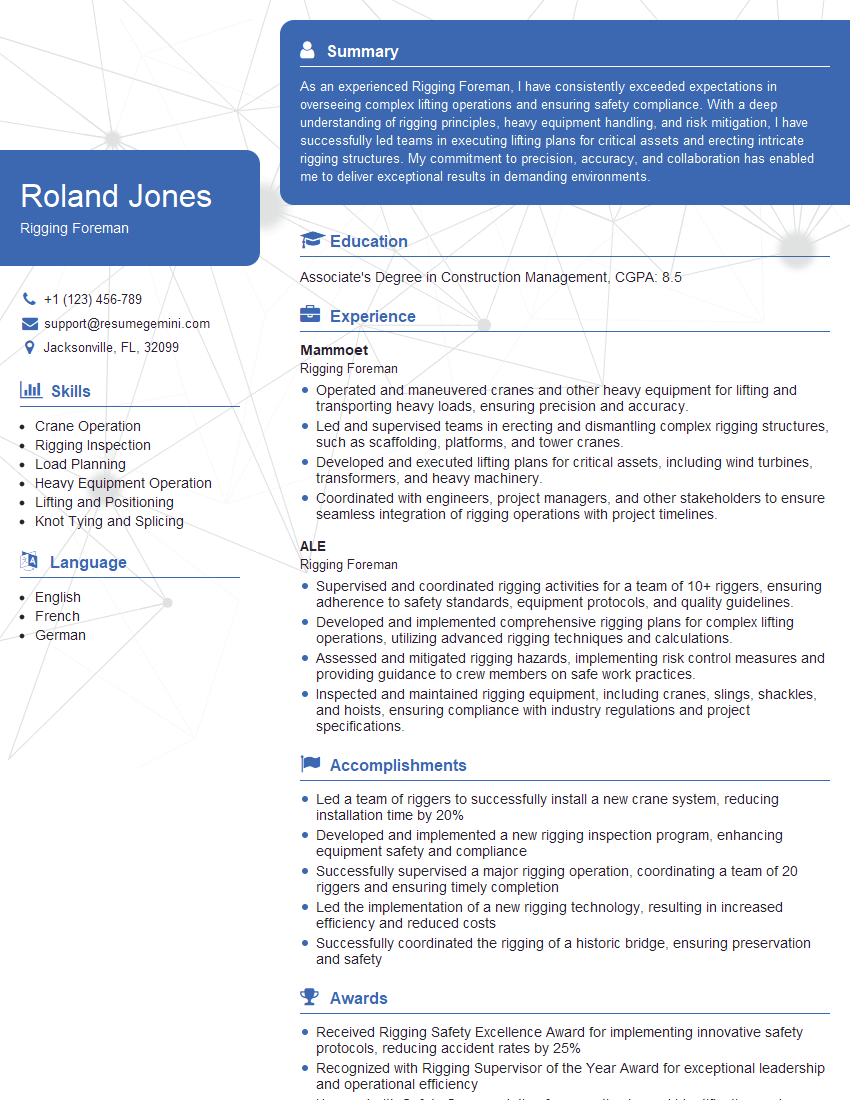
Mastering Rigging Inspection and Setup is crucial for career advancement in the field, offering higher earning potential and increased responsibility. A strong understanding of these skills demonstrates your commitment to safety and efficiency, making you a highly valuable asset to any team. To enhance your job prospects, create an ATS-friendly resume that highlights your qualifications effectively. ResumeGemini is a trusted resource that can help you build a professional and impactful resume. Examples of resumes tailored to Rigging Inspection and Setup are available to guide you, showcasing how to present your skills and experience to prospective employers. Take the next step towards your dream career today!

Explore more articles
Users Rating of Our Blogs
Share Your Experience
We value your feedback! Please rate our content and share your thoughts (optional).
What Readers Say About Our Blog
To the interviewgemini.com Webmaster.
Very helpful and content specific questions to help prepare me for my interview!
Thank you
To the interviewgemini.com Webmaster.
This was kind of a unique content I found around the specialized skills. Very helpful questions and good detailed answers.
Very Helpful blog, thank you Interviewgemini team.