Unlock your full potential by mastering the most common Robotics Certification interview questions. This blog offers a deep dive into the critical topics, ensuring you’re not only prepared to answer but to excel. With these insights, you’ll approach your interview with clarity and confidence.
Questions Asked in Robotics Certification Interview
Q 1. Explain the different types of robotic manipulators and their applications.
Robotic manipulators are the robotic arms that perform tasks. They come in various types, each suited for specific applications. Think of them as the robot’s hands, capable of intricate movements.
- Cartesian Robots: These robots move along three linear axes (X, Y, Z), like a printer head. They’re ideal for pick-and-place operations where precision and repeatability are crucial, such as in assembly lines.
- Cylindrical Robots: These robots have one rotary joint and two linear joints. Their workspace is cylindrical. They’re useful in applications requiring a combination of linear and rotational movements, like machine tending or spot welding.
- Spherical Robots (Polar Robots): These have two rotary joints and one linear joint, resulting in a spherical workspace. They are effective in applications that need to cover a wide area, such as spray painting or arc welding.
- Articulated Robots (Revolute Robots): These robots are most commonly used, featuring multiple rotary joints, similar to a human arm. Their flexibility allows them to reach a wide range of positions and orientations, making them suitable for numerous applications such as material handling, assembly, and painting. Think of a factory robot arm.
- SCARA Robots (Selective Compliance Assembly Robot Arm): These robots are specialized for assembly tasks and are characterized by two parallel rotary joints providing compliance in the horizontal plane. They are very efficient for high-speed assembly operations.
Choosing the right manipulator depends entirely on the specific task. For instance, a Cartesian robot is perfect for precise component placement, while an articulated robot excels in versatile applications requiring reach and dexterity.
Q 2. Describe the concept of forward and inverse kinematics in robotics.
Forward and inverse kinematics are fundamental concepts in robotics that deal with the relationship between the robot’s joint angles and its end-effector position and orientation. Imagine trying to reach a specific location with your arm – that’s kinematics in action.
Forward Kinematics: This involves calculating the end-effector’s pose (position and orientation) given the joint angles. It’s relatively straightforward – if you know the joint angles, you can use geometry and trigonometry to find the end-effector’s location. Think of it as the ‘forward’ process: joint angles to end-effector pose.
Inverse Kinematics: This is more complex, involving finding the joint angles required to achieve a desired end-effector pose. This is like the ‘reverse’ process: end-effector pose to joint angles. It often involves solving a system of nonlinear equations, and multiple solutions can exist.
Example: Imagine a simple robotic arm with two joints. Forward kinematics would tell you where the end of the arm is if you know the angles of the two joints. Inverse kinematics would tell you what angles you need to set the joints to in order to reach a specific target location.
Q 3. What are the key components of a robotic control system?
A robotic control system is the brain of a robot, responsible for making it move and perform tasks as instructed. It comprises several essential components working together harmoniously.
- Controller: This is the central processing unit (CPU) of the system, executing control algorithms and managing communication with other components. Think of it as the robot’s brain.
- Sensors: These provide feedback about the robot’s state and environment, including encoders for joint angles, force/torque sensors, cameras for vision, and proximity sensors. This is the robot’s sense of touch and sight.
- Actuators: These are the muscles of the robot, converting electrical signals from the controller into physical motion. Examples include electric motors, hydraulic actuators, or pneumatic cylinders.
- Power Supply: This provides the energy for the actuators and the control system. Essential for keeping the robot running.
- Software: This includes control algorithms, motion planning software, and user interfaces. It’s the ‘programming’ of the robot’s actions.
- Communication Interface: This enables communication between the controller, sensors, actuators, and other external devices.
These components work together seamlessly to achieve precise and controlled robot movements and actions.
Q 4. Explain the differences between PID and other control algorithms.
PID (Proportional-Integral-Derivative) control is a widely used feedback control algorithm that adjusts a control variable to reduce the error between a desired setpoint and a measured value. Think of a thermostat – it uses feedback to maintain a desired temperature.
PID Controller: The PID controller uses three terms to achieve precise control:
- Proportional (P): This term is proportional to the current error. A larger error leads to a larger corrective action. It addresses the current error.
- Integral (I): This term accumulates the error over time, correcting for persistent deviations. It helps eliminate steady-state error.
- Derivative (D): This term anticipates future error by considering the rate of change of the error. It dampens oscillations and improves the response speed.
Other Control Algorithms: Other algorithms, such as predictive control, adaptive control, and fuzzy logic control, offer advantages in specific situations. Predictive control anticipates future disturbances; adaptive control adjusts parameters based on changing conditions; and fuzzy logic control uses linguistic rules to manage uncertain systems.
Comparison: PID is simple to implement and tune, making it suitable for many applications. However, other algorithms may offer superior performance in situations with significant disturbances, complex dynamics, or uncertainty. The choice depends on the specific application’s requirements and constraints.
Q 5. How do you calibrate a robotic arm?
Calibrating a robotic arm ensures its accuracy and repeatability. It involves establishing a precise relationship between the robot’s joint angles and the end-effector’s position and orientation in the workspace.
Steps in Calibration:
- Establish a Reference Frame: Define a fixed coordinate system within the robot’s workspace. This will serve as the reference for all measurements.
- Measure Joint Angles: Use encoders or other sensors to determine the precise angle of each joint.
- Measure End-Effector Pose: Use a measurement device (e.g., laser tracker, CMM) to precisely determine the end-effector’s position and orientation. This could involve placing the end-effector at multiple points within its workspace.
- Develop a Transformation Matrix: Use the data collected in steps 2 and 3 to build a mathematical transformation matrix that maps the joint angles to the end-effector pose.
- Refine the Model: Compare the measured data with the model’s predictions and refine the model’s parameters to minimize the discrepancies. This often involves iterative measurements and adjustments.
- Verify Calibration: Test the robot’s performance at various points in its workspace to verify that the calibration is accurate.
Calibration is crucial for ensuring the robot performs tasks reliably and accurately. Errors in calibration can lead to inaccurate movements, collisions, and product defects.
Q 6. Describe your experience with robot programming languages (e.g., ROS, RAPID).
I have extensive experience in robot programming languages, particularly ROS (Robot Operating System) and RAPID (ABB’s proprietary language). Both are powerful but serve different purposes.
ROS (Robot Operating System): ROS is a highly flexible and modular open-source framework widely used in robotics research and development. It provides a collection of tools and libraries for various aspects of robot control, including communication, perception, motion planning, and control algorithms. I have used ROS extensively to develop complex robotic systems, including navigation and manipulation tasks. A project I worked on used ROS to integrate a multi-robot system for warehouse automation, which involved coordinating multiple robots to efficiently move and store inventory. Writing custom ROS nodes and packages to accomplish specific tasks is my bread and butter.
RAPID (ABB RobotStudio): RAPID is a powerful and structured programming language specifically designed for ABB robots. It provides a high-level interface for programming complex motion sequences, sensor integration, and process control. My experience with RAPID involves creating programs for industrial applications using ABB robots, such as welding and painting. The precision and efficiency demanded by industrial applications are precisely where RAPID shines.
In summary, ROS provides the flexibility and modularity needed for research and development, while RAPID allows for efficient and robust programming of specific industrial robots. Both languages have a place in the field, and familiarity with both makes me a versatile programmer.
Q 7. Explain the concept of path planning in robotics.
Path planning in robotics is the process of determining a collision-free trajectory for a robot to move from a starting point to a goal location. Imagine a self-driving car navigating a city; that’s path planning in action.
Key Considerations:
- Collision Avoidance: The path must avoid obstacles in the robot’s environment. This is often achieved using sensor data (e.g., LiDAR, cameras).
- Smoothness: The path should be smooth to avoid jerky movements that could damage the robot or its surroundings. This involves generating trajectories with continuous velocity and acceleration profiles.
- Optimality: The path should ideally be optimal in terms of distance, time, or energy consumption. Various algorithms aim to find the shortest or fastest path, depending on the application.
- Constraints: The path planning process must consider any constraints on the robot’s movement, such as joint limits, velocity limits, and workspace boundaries.
Common Algorithms: Many algorithms are used for path planning, including A*, RRT (Rapidly-exploring Random Tree), and potential field methods. The choice of algorithm depends on factors like the environment’s complexity, the robot’s kinematic constraints, and the required performance characteristics.
Real-world Application: Path planning is crucial in various applications, such as autonomous vehicle navigation, warehouse automation, and robotic surgery. In warehouse automation, a robot needs to navigate amongst shelves and pallets efficiently without collision, while in surgery, a robot arm needs a smooth and precise path for surgical movements.
Q 8. What are some common sensor technologies used in robotics and their applications?
Robotics relies heavily on various sensor technologies to perceive its environment and interact effectively. Think of sensors as a robot’s senses – they provide the crucial data needed for decision-making and action.
LiDAR (Light Detection and Ranging): Uses lasers to create a 3D point cloud map of the surroundings. Imagine it like a robot’s ‘eyes’ that see depth and distance. This is vital for autonomous navigation, particularly in self-driving cars and warehouse robots.
Camera (Vision Systems): Provides visual input, allowing robots to ‘see’ their environment. Different types exist, from simple grayscale cameras to sophisticated RGB-D cameras that provide both color and depth information. Applications include object recognition, visual servoing (controlling robot movements based on visual feedback), and quality inspection in manufacturing.
Ultrasonic Sensors: Emit sound waves and measure the time it takes for them to bounce back. This gives the robot a sense of proximity to objects. Think of it like a robot’s ‘echolocation’. Commonly used for obstacle avoidance in cleaning robots and automated guided vehicles (AGVs).
IMU (Inertial Measurement Unit): Measures acceleration and angular velocity. This helps the robot understand its own movement and orientation, essential for balance and stable motion, particularly in drones and humanoid robots.
Force/Torque Sensors: These sensors measure the forces and torques applied to the robot’s end-effector. They enable robots to perform delicate tasks requiring precise force control, such as assembly operations or surgery.
Q 9. How do you handle robot singularities?
Robot singularities are configurations where the robot loses one or more degrees of freedom, essentially becoming ‘stuck’. Imagine trying to extend your arm straight out – there’s a point where you can’t rotate your forearm at the elbow anymore. That’s analogous to a singularity. The robot’s Jacobian matrix, which relates joint velocities to end-effector velocities, becomes singular at these points, leading to unpredictable or infinite velocities.
Handling singularities requires careful planning and control strategies. Some common approaches include:
Singularity avoidance: Programming the robot to avoid these configurations altogether by carefully planning its trajectory. This is often done through path planning algorithms that explicitly consider the robot’s kinematic limitations.
Redundant robots: Using robots with more degrees of freedom than necessary. The extra degrees of freedom provide flexibility to circumvent singularities.
Pseudoinverse control: Using a pseudoinverse of the Jacobian matrix to compute joint velocities even at or near singularities. This helps to minimize the effects of the singularity but may not completely eliminate them. It involves finding the least-squares solution to a system of equations which is not unique at a singularity.
Singularity robust control: Developing control algorithms that are less sensitive to singularities, often employing techniques like damping or filtering.
Q 10. Describe your experience with robotic vision systems.
I have extensive experience with robotic vision systems, integrating them into various robotic applications. This involves using cameras and sophisticated algorithms to enable robots to ‘see’ and interpret their surroundings. My work has included:
Object Recognition: Using convolutional neural networks (CNNs) to identify and classify objects in images, allowing robots to pick and place specific items in a bin-picking application, for instance.
Pose Estimation: Determining the position and orientation of objects in 3D space, critical for precise manipulation tasks like robotic surgery or assembly line operations. This often uses techniques like Structure from Motion (SfM).
Visual Servoing: Controlling robot movements based on visual feedback. For example, a robot arm might use a camera to guide its movements to accurately assemble a product.
Image Processing and Feature Extraction: Developing algorithms to extract relevant features from images, such as edges, corners, or textures, for object detection and tracking.
In one project, I developed a vision system for a robotic arm used in a fruit-picking application. The system used a combination of cameras and deep learning algorithms to identify ripe fruits and then precisely pick them, while avoiding stems and leaves. This significantly improved the efficiency and accuracy compared to manual picking.
Q 11. Explain different types of robot end-effectors and their selection criteria.
Robot end-effectors are the tools at the end of a robotic arm, responsible for interacting with the environment. The choice of end-effector depends heavily on the specific application.
Grippers: These are the most common type, used for grasping and manipulating objects. They can range from simple two-finger grippers to complex multi-fingered hands capable of dexterous manipulation.
Vacuum Cups: Used for picking up smooth, flat objects. They are very efficient and widely used in applications like packaging and material handling.
Magnetic Grippers: Ideal for handling ferromagnetic materials.
Welding Torches: Used for robotic welding operations.
Spray Painting Nozzles: For automated painting applications.
Specialized Tools: Other customized tools can be designed for tasks such as drilling, grinding, or cutting.
Selection Criteria: The selection of an appropriate end-effector is based on several factors, including the:
Type of object being handled: Shape, size, weight, surface texture, material.
Task requirements: Precise manipulation, speed, force, range of motion.
Environmental conditions: Temperature, humidity, presence of dust or other contaminants.
Cost and maintainability: Balancing performance with cost considerations.
Q 12. What are some safety considerations when working with robots?
Safety is paramount when working with robots. Failing to prioritize safety can lead to serious injury or damage. Key considerations include:
Emergency Stop Systems: Ensuring readily accessible and reliable emergency stop buttons and systems. These should be tested regularly.
Safety Fencing and Light Curtains: Physical barriers and non-contact sensors to prevent unauthorized access to the robot’s workspace. These create safe zones around the robot.
Risk Assessment and Mitigation: Conducting thorough risk assessments to identify potential hazards and implementing appropriate safety measures. This is crucial in the design phase and throughout operation.
Proper Training and Certification: Ensuring that all personnel working with robots receive adequate training and certification on safe operating procedures.
Robot Programming and Control: Using safe programming practices to avoid unexpected robot movements or collisions. This includes incorporating collision detection and avoidance algorithms.
Regular Maintenance and Inspection: Maintaining the robot and its safety systems in optimal working condition through regular inspection and maintenance. This is to avoid malfunctions.
Compliance with Safety Standards: Adhering to relevant safety standards and regulations (e.g., ISO 10218, ISO 13849).
Q 13. How do you troubleshoot robotic system malfunctions?
Troubleshooting robotic system malfunctions requires a systematic and methodical approach. It’s like detective work, systematically eliminating possibilities.
Identify the problem: Clearly define the malfunction. Is the robot not moving? Is it moving incorrectly? Are there error messages? Gather all relevant data.
Check for obvious issues: Inspect for physical damage, loose connections, power supply problems, or any visible signs of malfunction.
Review the robot’s logs and error messages: Most robots have diagnostic systems that log errors and provide clues about the malfunction. Examine these carefully.
Check the robot’s program: Review the robot’s code for any errors or logical inconsistencies that might be causing the problem.
Isolate the faulty component: Systematically test different components (sensors, actuators, controllers) to identify the source of the failure. This might involve swapping out components.
Consult documentation and manuals: Refer to the robot’s technical documentation, manuals, and troubleshooting guides for potential solutions.
Seek expert assistance if necessary: If the problem cannot be resolved internally, contact the robot manufacturer or a qualified robotics technician.
A methodical approach and a strong understanding of the robotic system’s architecture are key to effective troubleshooting.
Q 14. Describe your experience with robotic simulation software.
I have extensive experience using various robotic simulation software packages, including Gazebo, ROS (Robot Operating System), and V-REP. Simulation is invaluable for robot design, testing, and programming. It allows for testing and debugging in a safe, controlled environment before deploying the robot in the real world, saving time and money, and minimizing risk.
My experience includes:
Creating realistic robot models and environments: Building accurate 3D models of robots and their surroundings, including obstacles, sensors, and other relevant objects.
Developing and testing robot control algorithms: Simulating robot movements and interactions within the simulated environment to validate control algorithms before deployment. This allows for iterative testing of algorithms.
Sensor simulation: Simulating sensor data to train and evaluate robot perception algorithms, without needing to physically interact with real sensors.
Path planning and navigation simulation: Testing various path planning algorithms in a simulated environment to evaluate their performance and optimize trajectories.
Hardware-in-the-loop (HIL) simulation: Connecting real hardware components to the simulation environment for more realistic testing.
For example, in a recent project, I used Gazebo to simulate a warehouse robot tasked with picking and placing items. This allowed me to thoroughly test the robot’s navigation and grasping algorithms before deploying it in the actual warehouse. The simulation uncovered several issues with the path planning algorithm which were resolved in simulation and only then tested in a real-world setup. This significantly reduced deployment time.
Q 15. What are the advantages and disadvantages of different robot configurations (e.g., Cartesian, SCARA, articulated)?
Robot configurations significantly impact a robot’s capabilities and suitability for specific tasks. Let’s compare three common types: Cartesian, SCARA, and Articulated.
- Cartesian Robots: These robots move along three linear axes (X, Y, Z), like a gantry crane.
- Advantages: Simple design, high precision, large workspace, easy to program.
- Disadvantages: Limited reach in certain directions, slower movements compared to articulated robots.
- Example: CNC milling machines, 3D printers.
- SCARA Robots: Selective Compliance Assembly Robot Arm. These robots have two parallel rotating joints and one linear joint.
- Advantages: Fast and accurate, excellent for assembly tasks requiring vertical motion, relatively compact.
- Disadvantages: Limited reach, workspace is somewhat restricted, not ideal for tasks requiring complex 3D movements.
- Example: Pick and place operations in electronics manufacturing.
- Articulated Robots: These robots have rotary joints, mimicking a human arm. They offer the most flexibility.
- Advantages: High dexterity, large workspace, capable of complex movements in 3D space.
- Disadvantages: More complex design and control, higher cost, potential for greater mechanical complexity leading to increased maintenance.
- Example: Welding, painting, material handling in automotive manufacturing.
Choosing the right configuration hinges on the specific application requirements. Factors like the size of the workspace, required speed and accuracy, and the complexity of the task are key considerations.
Career Expert Tips:
- Ace those interviews! Prepare effectively by reviewing the Top 50 Most Common Interview Questions on ResumeGemini.
- Navigate your job search with confidence! Explore a wide range of Career Tips on ResumeGemini. Learn about common challenges and recommendations to overcome them.
- Craft the perfect resume! Master the Art of Resume Writing with ResumeGemini’s guide. Showcase your unique qualifications and achievements effectively.
- Don’t miss out on holiday savings! Build your dream resume with ResumeGemini’s ATS optimized templates.
Q 16. Explain the concept of workspace and its importance in robot design.
The workspace of a robot refers to the three-dimensional volume within which the robot’s end-effector (the tool at the end of the arm) can reach. Defining this workspace is crucial in robot design because it directly impacts the robot’s capability and usefulness. Imagine a painter robot – if its workspace doesn’t encompass the entire car body, it won’t be able to paint the whole vehicle!
Importance:
- Task Planning: The workspace dictates the tasks a robot can perform. A small workspace limits the robot’s capabilities.
- Design Optimization: Engineers must optimize the robot’s design – including arm length, joint ranges, and base placement – to achieve the desired workspace.
- Safety: Understanding the workspace helps in designing safety measures, preventing the robot from colliding with obstacles or people.
- Integration: The workspace must be carefully considered when integrating the robot into the production environment to ensure it can access all necessary work areas.
In short, the robot’s workspace dictates its operational envelope, and understanding it thoroughly is critical for effective design and successful implementation.
Q 17. How do you ensure the accuracy and repeatability of a robotic system?
Accuracy and repeatability are paramount in robotic systems. Accuracy refers to how close the robot’s actual position is to the programmed position. Repeatability refers to how consistently the robot can return to the same position multiple times. To ensure both, we employ several strategies:
- Calibration: Regular calibration is crucial. This involves precisely measuring and adjusting the robot’s joints and sensors to minimize positional errors. This often includes using laser trackers or other high-precision metrology equipment.
- High-Precision Components: Using high-quality motors, encoders, and reducers ensures accurate movement and minimizes drift.
- Control Algorithms: Advanced control algorithms like PID (Proportional-Integral-Derivative) controllers help regulate the robot’s movements, reducing errors and jitter.
- Environmental Factors: Temperature changes, vibrations, and other environmental factors can affect accuracy. Mitigation strategies include temperature control and vibration dampening.
- Regular Maintenance: Preventative maintenance, such as lubrication and inspection, extends the robot’s operational life and preserves its accuracy.
- Sensor Fusion: Combining data from multiple sensors (e.g., encoders, cameras, force sensors) improves positional accuracy and allows for adaptive control.
For instance, in a precision assembly line, consistent accuracy and repeatability are critical for preventing costly errors and ensuring high-quality output. We might use vision systems to verify the robot’s positioning during a crucial assembly step, ensuring consistently high precision.
Q 18. Describe your experience with robotic integration projects.
I have extensive experience with robotic integration projects across various industries. In one project, we integrated a fleet of SCARA robots into a high-speed electronics assembly line. This involved:
- Needs Assessment: Identifying specific assembly tasks and determining the required robot capabilities.
- Robot Selection: Choosing the appropriate robot model based on speed, payload, and workspace requirements.
- Programming and Simulation: Developing the robot programs using off-line programming software to simulate and optimize the process before deployment.
- Integration with Peripherals: Connecting the robots to vision systems, conveyor belts, and other equipment for seamless operation.
- Safety Systems: Implementing safety features such as light curtains and emergency stops to ensure worker safety.
- Testing and Commissioning: Thoroughly testing the integrated system and making any necessary adjustments to optimize performance and reliability.
This project resulted in a significant increase in production efficiency and a reduction in assembly errors. In another project, I oversaw the integration of a large articulated robot for welding applications in the automotive industry, focusing heavily on minimizing weld spatter and maximizing consistency in weld quality.
Q 19. What are some common challenges in deploying robotic systems in industrial settings?
Deploying robotic systems in industrial settings presents several challenges:
- Integration Complexity: Integrating robots with existing equipment and systems can be complex and time-consuming, requiring specialized expertise.
- Programming and Training: Robot programming can be challenging, requiring skilled programmers. Training personnel to operate and maintain robots is also essential.
- Cost: The initial investment in robots and related equipment can be significant.
- Safety Concerns: Ensuring the safety of human workers in the vicinity of robots is paramount, requiring careful planning and implementation of safety features.
- Maintenance and Repair: Robots require regular maintenance and repairs, which can be costly if not properly managed.
- Adaptability to Change: Production processes may change over time. Robots need to be adaptable to new tasks and processes.
- Return on Investment (ROI): Demonstrating a clear ROI for robotic automation is crucial for justifying the initial investment.
For example, unforeseen variations in parts or unexpected production line disruptions can require quick adaptations in robot programming and operations, posing a significant challenge to maintaining efficiency and output.
Q 20. Explain your understanding of different robot communication protocols.
Robots use various communication protocols to interact with other devices and systems. Common protocols include:
- Ethernet/IP: A widely used industrial Ethernet protocol offering high bandwidth and robust communication.
- PROFINET: Another popular industrial Ethernet protocol known for its real-time capabilities.
- Modbus TCP/IP: A widely adopted standard for communication between industrial devices, known for its simplicity.
- Profibus: A fieldbus protocol commonly used in industrial automation, providing real-time communication.
- CAN bus: Controller Area Network, often used in automotive and robotics applications for reliable communication in harsh environments.
Understanding these protocols is critical for effectively integrating robots into industrial automation systems. For example, if a robot needs to communicate with a vision system to receive part location data, choosing a compatible protocol is crucial for real-time data transfer and precise operation.
Choosing the right protocol often depends on the specific needs of the application, considering factors like speed, reliability, and the compatibility of other devices in the system. For example, in high-speed applications requiring precise timing, protocols like PROFINET or Ethernet/IP are preferred. For simpler applications where speed is less critical, Modbus TCP/IP might be sufficient.
Q 21. How do you perform risk assessment for robotic systems?
Risk assessment for robotic systems is a systematic process aimed at identifying, analyzing, and mitigating potential hazards. A common framework involves:
- Hazard Identification: This step involves identifying all potential hazards associated with the robot, such as collisions, crushing, entanglement, or electrical hazards. This often includes a detailed review of the robot’s operation, its environment, and any potential interactions with human workers.
- Risk Analysis: This involves assessing the likelihood and severity of each identified hazard. This assessment might utilize a risk matrix, considering factors such as the frequency of exposure, the severity of potential injuries, and the effectiveness of existing control measures.
- Risk Reduction: After identifying high-risk hazards, strategies for risk reduction are developed and implemented. This might involve engineering controls (e.g., safety fences, light curtains), administrative controls (e.g., safety procedures, training programs), or personal protective equipment (PPE) (e.g., safety glasses, gloves).
- Risk Evaluation: After implementing risk reduction measures, the residual risk is evaluated to determine if it is acceptable. If the residual risk is still unacceptable, further risk reduction measures must be implemented.
- Documentation: All aspects of the risk assessment process, including identified hazards, risk analysis results, and risk reduction measures, should be thoroughly documented.
A comprehensive risk assessment is essential for ensuring the safe and reliable operation of robotic systems, protecting both workers and equipment. Ignoring risk assessment can lead to serious accidents and significant financial losses.
Q 22. Describe your experience with robotic maintenance and repair.
Robotic maintenance and repair is a crucial aspect of ensuring the smooth operation and longevity of robotic systems. My experience spans various robotic platforms, from industrial manipulators to collaborative robots (cobots). It involves a systematic approach encompassing preventative maintenance, troubleshooting, and repair.
Preventative maintenance includes regular inspections, lubrication of moving parts, and cleaning of sensors and other components. This helps prevent malfunctions and extends the lifespan of the robot. For instance, I’ve developed and implemented a preventative maintenance schedule for a fleet of industrial robotic arms in a manufacturing plant, significantly reducing downtime due to unexpected failures.
Troubleshooting involves identifying and resolving malfunctions. This often requires a deep understanding of the robot’s mechanical, electrical, and software components. I’ve successfully diagnosed and repaired issues ranging from faulty motor controllers to software glitches, often utilizing diagnostic tools and schematics. A recent example involved a malfunctioning vision system on a robotic welding cell; I traced the problem to a loose connection, a simple fix that prevented significant production delays.
Repair work can range from replacing individual components to performing more complex repairs requiring specialized tools and expertise. I’m proficient in replacing actuators, sensors, and other mechanical parts, as well as in repairing or replacing electronic and software components. My skills encompass both hardware and software troubleshooting, allowing for comprehensive solutions.
Q 23. Explain your understanding of artificial intelligence and machine learning in robotics.
Artificial intelligence (AI) and machine learning (ML) are transforming robotics, enabling robots to perform more complex tasks autonomously and adapt to dynamic environments. AI provides the ‘intelligence’ that allows robots to perceive, reason, and act, while ML provides the mechanism for the robot to learn from data and improve its performance over time.
In robotics, AI is used for tasks like object recognition, path planning, and decision-making. For example, a robot equipped with computer vision AI can identify and pick specific objects from a bin, even if they’re slightly different in orientation or appearance. Machine learning algorithms can be used to train a robot to perform complex tasks through repetition and feedback, adapting its actions based on past experiences. This is particularly important for robots working in unstructured environments.
Consider a robot tasked with navigating a warehouse. AI-powered path planning algorithms help it find the most efficient route, avoiding obstacles. Simultaneously, ML can be used to improve the accuracy of the path planning based on the robot’s past experience navigating the warehouse, resulting in quicker and safer movements. This symbiotic relationship between AI and ML is essential for creating advanced, autonomous robotic systems.
Q 24. What are some ethical considerations related to the use of robots?
The ethical considerations surrounding the use of robots are multifaceted and growing in importance as robots become more prevalent in our lives. Key concerns include:
- Job displacement: Automation through robotics can lead to job losses in certain sectors, requiring strategies for workforce retraining and adaptation.
- Bias and fairness: AI algorithms used in robots can inherit biases from the data they are trained on, leading to unfair or discriminatory outcomes. Careful attention needs to be paid to data selection and algorithm design to mitigate this.
- Privacy and surveillance: Robots equipped with sensors can collect vast amounts of data, raising concerns about privacy and potential misuse of information.
- Safety and accountability: Ensuring the safe operation of robots, particularly autonomous ones, is paramount. Clear guidelines for accountability in case of accidents or malfunctions are necessary.
- Autonomous weapons systems: The development of lethal autonomous weapons systems raises significant ethical questions about human control and potential for unintended consequences.
Addressing these ethical concerns requires a collaborative effort between roboticists, policymakers, and the public to establish guidelines, regulations, and best practices that ensure the responsible development and deployment of robots.
Q 25. Describe your experience with different types of robotic actuators.
Robotic actuators are the ‘muscles’ of a robot, converting energy into motion. My experience encompasses several types:
- Electric motors: These are widely used due to their precision, controllability, and relatively low maintenance. I have extensive experience with DC motors, servo motors, and stepper motors, each offering different performance characteristics.
- Hydraulic actuators: These provide high force and power, ideal for heavy-duty applications like construction or manufacturing heavy machinery. I’ve worked with hydraulic cylinders and rotary hydraulic motors, understanding the need for careful pressure regulation and leak prevention.
- Pneumatic actuators: These use compressed air to generate motion, offering a good balance between force and speed. They’re commonly used in applications requiring quick movements and simpler control systems. I have experience with pneumatic cylinders and valves, understanding the importance of proper air filtration and pressure regulation.
The choice of actuator depends on the specific application’s requirements. For example, precise positioning might favor electric motors, while heavy lifting might require hydraulic actuators. My expertise lies in selecting and integrating the appropriate actuator based on factors such as load capacity, speed, accuracy, and environmental conditions.
Q 26. Explain the concept of impedance control in robotics.
Impedance control is a sophisticated control strategy that allows a robot to interact with its environment in a compliant manner. Unlike traditional position control, which focuses on precisely achieving a desired position, impedance control focuses on controlling the robot’s impedance, which describes the relationship between force and position.
Imagine trying to push a heavy object. A rigid object (high impedance) is difficult to move, while a flexible object (low impedance) is easier to manipulate. Impedance control allows a robot to emulate this behavior. By adjusting its impedance, a robot can react appropriately to unexpected forces or contact with its environment. For instance, a robot interacting with a human might have a low impedance, allowing it to yield to the human’s movement and avoid causing injury. In contrast, a robot performing a precise welding task might have a higher impedance to maintain its position accurately despite small disturbances.
Mathematically, impedance control involves defining a desired impedance model (e.g., stiffness, damping) and a control law that regulates the robot’s interaction forces. This typically involves measuring the robot’s position and force sensors and using feedback control to achieve the desired impedance. This allows for robust and adaptable interaction with uncertain or unpredictable environments.
Q 27. How do you ensure the safety and reliability of autonomous robotic systems?
Ensuring the safety and reliability of autonomous robotic systems requires a multi-layered approach. It involves:
- Robust software design: Employing rigorous software engineering practices, including thorough testing and validation, to minimize software bugs and errors. This includes using techniques like formal verification to mathematically prove the correctness of critical parts of the software.
- Redundancy and fault tolerance: Incorporating redundancy in hardware and software components to handle failures gracefully. This might involve using multiple sensors, actuators, or processors, ensuring that the system can continue to operate even if one component fails.
- Safety protocols and emergency stops: Implementing safety protocols and emergency stop mechanisms to quickly halt the robot in case of hazardous situations. This could include physical emergency stops, software-based safety checks, and sensor-based obstacle detection.
- Regular maintenance and testing: Regularly inspecting and maintaining the robot’s hardware and software to identify and address potential problems before they escalate. This includes rigorous testing in simulated and real-world environments to validate the system’s performance and safety.
- Human oversight and intervention: While aiming for autonomy, maintaining a degree of human oversight or the ability for human intervention is crucial for safety. This allows human operators to monitor the robot’s actions and intervene if needed.
Safety and reliability are not merely afterthoughts but integral parts of the design process from the very beginning. By systematically addressing these aspects, we can ensure autonomous robots operate reliably and safely, fostering trust and acceptance.
Key Topics to Learn for Robotics Certification Interview
- Robotics Fundamentals: Understanding basic robotic components (sensors, actuators, controllers), kinematics, and dynamics. Practical application: Troubleshooting robotic arm malfunctions by analyzing sensor readings and actuator performance.
- Programming for Robotics: Proficiency in relevant programming languages (e.g., Python, C++, ROS). Practical application: Developing control algorithms for autonomous navigation or manipulation tasks.
- Computer Vision and Image Processing: Implementing object recognition, path planning, and visual servoing. Practical application: Designing a robotic system capable of picking and placing objects based on visual input.
- Control Systems: Designing and implementing feedback control systems for robotic manipulators and mobile robots. Practical application: Tuning PID controllers to achieve precise and stable robot movements.
- Artificial Intelligence (AI) in Robotics: Integrating machine learning algorithms for tasks like path planning, object recognition, and decision-making. Practical application: Training a neural network for object classification to improve robotic grasping capabilities.
- Robot Safety and Ethics: Understanding safety protocols and ethical considerations in robotics design and deployment. Practical application: Implementing safety features to prevent collisions or other hazards.
- Specific Robot Platforms & Architectures: Familiarity with common robotic platforms and architectures relevant to your certification. Practical application: Demonstrating hands-on experience with specific hardware and software platforms.
Next Steps
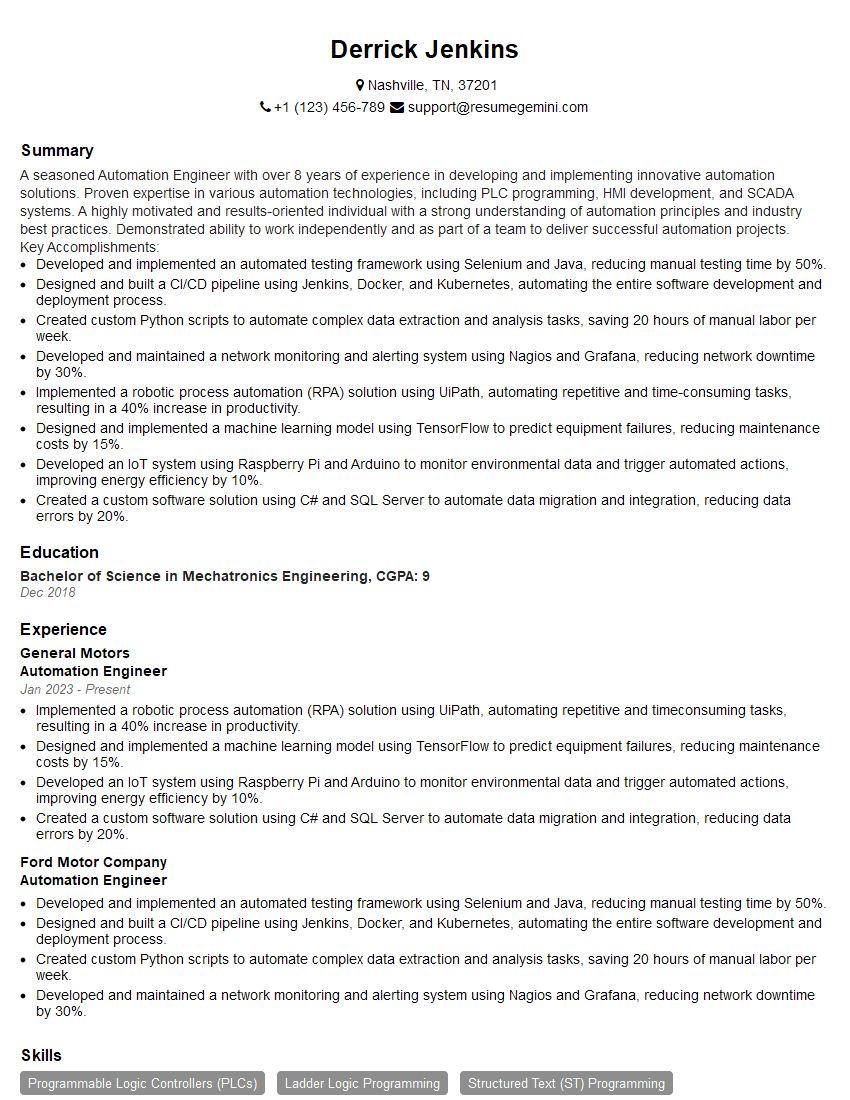
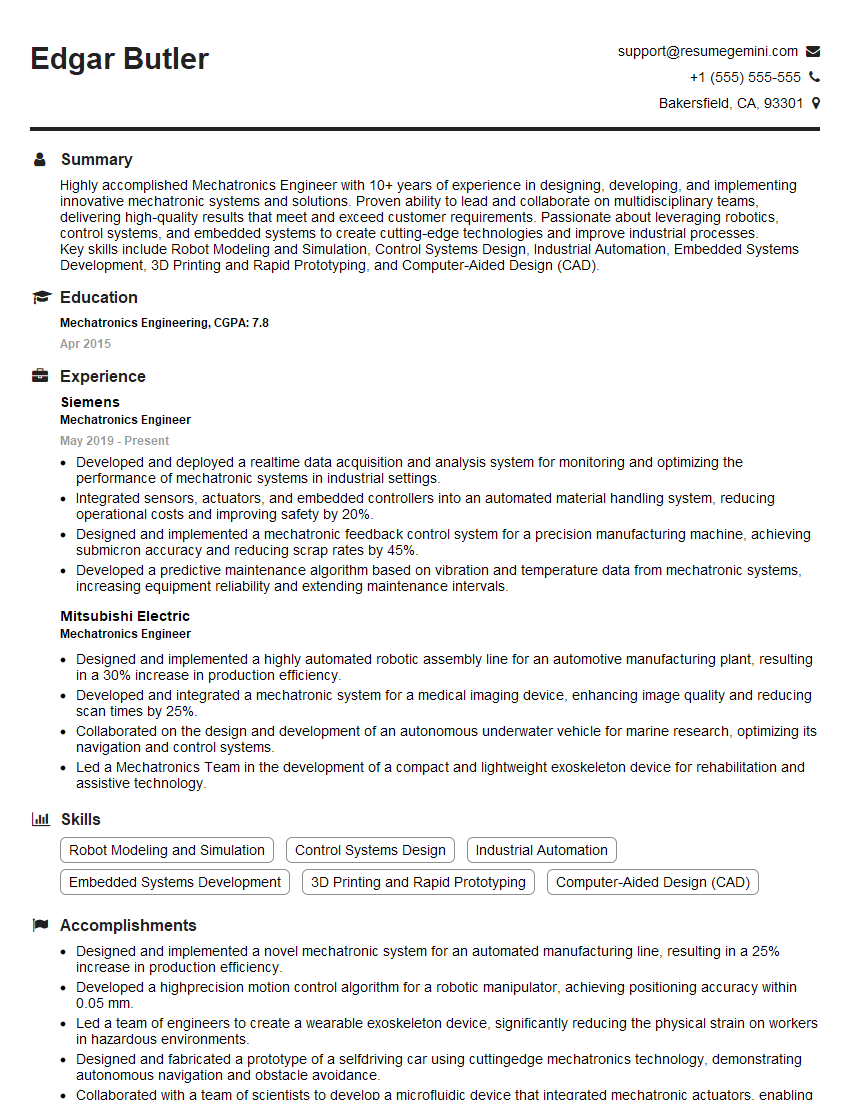
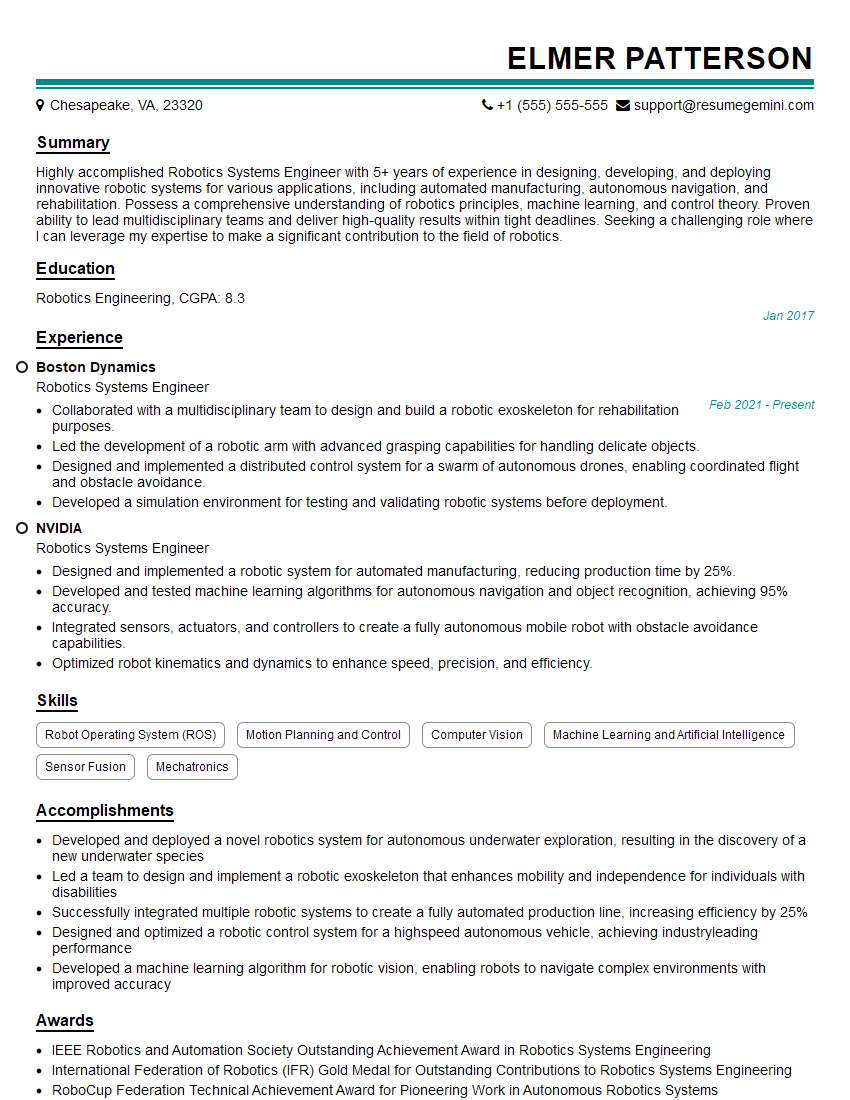
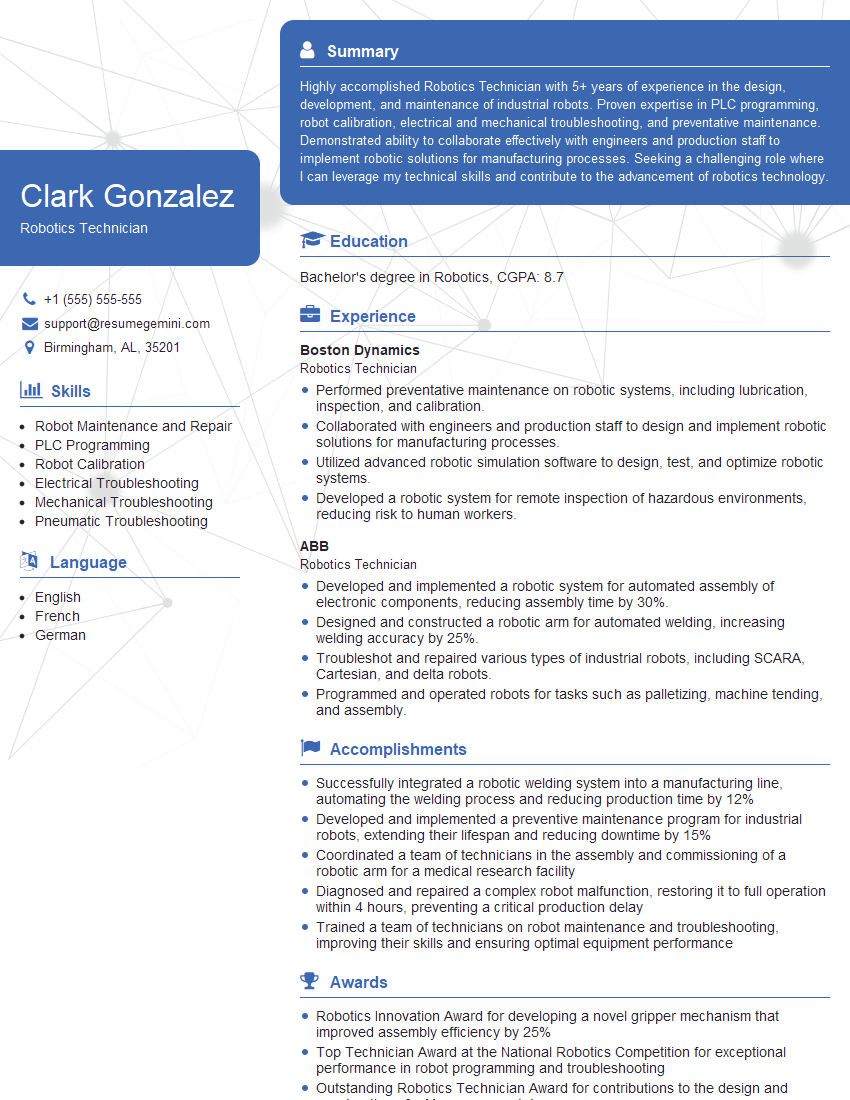
Mastering Robotics Certification significantly enhances your career prospects, opening doors to exciting roles in automation, research, and development. A strong, ATS-friendly resume is crucial for getting your application noticed. To make your resume stand out and effectively highlight your skills and experience, we strongly recommend using ResumeGemini. ResumeGemini provides a user-friendly platform to craft a professional resume tailored to the demands of the Robotics field. Examples of resumes specifically designed for Robotics Certification candidates are available to help you get started.


Explore more articles
Users Rating of Our Blogs
Share Your Experience
We value your feedback! Please rate our content and share your thoughts (optional).
What Readers Say About Our Blog
To the interviewgemini.com Webmaster.
Very helpful and content specific questions to help prepare me for my interview!
Thank you
To the interviewgemini.com Webmaster.
This was kind of a unique content I found around the specialized skills. Very helpful questions and good detailed answers.
Very Helpful blog, thank you Interviewgemini team.