The thought of an interview can be nerve-wracking, but the right preparation can make all the difference. Explore this comprehensive guide to Slab Design interview questions and gain the confidence you need to showcase your abilities and secure the role.
Questions Asked in Slab Design Interview
Q 1. Explain the different types of concrete slabs and their applications.
Concrete slabs are categorized based on their structural behavior and application. Here are some key types:
- One-way slabs: These slabs primarily bend in one direction, typically supported along two opposite edges. Think of a long, narrow balcony or a corridor slab. The primary reinforcement runs in the shorter direction to resist bending.
- Two-way slabs: These slabs bend in two directions, typically supported along all four edges. A common example is a floor slab in a building, where loads are distributed across the entire surface. Reinforcement is provided in both directions.
- Flat slabs: These are two-way slabs without beams or girders, with direct support from columns. They offer a clear, unobstructed ceiling space, often seen in modern buildings. They typically employ drop panels (thicker sections around columns) and column capitals (enlarged column heads) to enhance strength and reduce stress concentrations.
- Waffle slabs: These are two-way slabs with a grid of recesses or voids formed during casting. The voids reduce the self-weight and concrete volume, making them cost-effective, while still providing adequate strength. Common in larger structures like warehouses or parking garages.
- Precast concrete slabs: These slabs are cast off-site in a controlled environment, offering improved quality control and faster construction. They can be solid, hollow-core, or other types and are used for floors, roofs, and walls.
The choice of slab type depends on several factors, including span length, loading conditions, architectural requirements, and cost considerations. For instance, a long-span floor might require a post-tensioned slab or a waffle slab for optimal cost and efficiency.
Q 2. Describe the process of designing a reinforced concrete slab.
Designing a reinforced concrete slab involves a systematic process encompassing several steps:
- Load Determination: Identify all permanent (self-weight, finishes) and imposed (live loads, furniture, equipment) loads acting on the slab.
- Span and Support Conditions: Determine the dimensions and support conditions (simply supported, continuous, cantilever) of the slab. Accurate measurements are critical.
- Strength Calculations: Perform structural analysis to calculate the bending moments and shear forces in the slab under the determined loads. This often involves using structural analysis software or design aids to account for two-way actions in slabs.
- Material Selection: Select appropriate concrete strength (compressive strength) and reinforcement steel grade, complying with relevant building codes.
- Reinforcement Design: Determine the required amount and arrangement of reinforcement steel (bars or mesh) to resist bending moments and shear forces, using design formulas or software. Consider factors like crack control and durability.
- Detailing: Create detailed drawings showing the dimensions, reinforcement layout, and bar sizes. These drawings guide the construction process.
- Check for Deflection: Verify that the slab’s deflection under service loads meets the allowable limits specified in building codes to prevent excessive sagging.
- Check for Serviceability: Assess the slab’s performance under service loads, ensuring it meets requirements for crack widths, vibration, and other serviceability criteria.
Throughout the process, adherence to relevant building codes and standards is crucial to ensure the safety and stability of the structure. Software aids in the calculations, but a thorough understanding of the principles is essential for accurate and efficient design.
Q 3. How do you determine the required thickness of a concrete slab?
Determining the required thickness of a concrete slab depends on several key factors:
- Span Length: Longer spans require thicker slabs to handle increased bending moments. Imagine a longer plank – it bends more easily.
- Loads: Heavier loads necessitate thicker slabs to resist the increased stresses. A warehouse floor carrying heavy machinery will require a thicker slab than a residential floor.
- Concrete Strength: Higher strength concrete allows for thinner slabs while maintaining adequate strength. The higher the compressive strength, the less concrete is needed for a given strength.
- Reinforcement: While reinforcement primarily controls cracking and tensile stresses, the amount and arrangement influence the overall slab thickness.
- Deflection Limits: Building codes specify allowable deflections. Calculations must ensure the slab does not deflect excessively, which can cause cracks and damage to finishes.
- Environmental Considerations: Exposure to chemicals or extreme temperatures might necessitate a thicker slab to enhance durability.
Design codes and standards provide empirical formulas or tables to estimate minimum thicknesses based on these factors. However, detailed structural analysis is often necessary for accurate determination, especially for complex slab geometries or loading conditions. Software is routinely used to optimize thickness and reinforcement.
Q 4. What are the factors influencing the design of a post-tensioned slab?
Post-tensioned slabs utilize high-strength steel tendons to create compression within the slab, increasing its load-carrying capacity. Several factors are key to their design:
- Tendons Layout and Force: The location, number, and tensioning force of the tendons are crucial parameters that influence the stress distribution and bending moment capacity. Sophisticated analysis is needed to optimize this.
- Prestressing Losses: Losses due to friction, anchorage slip, elastic shortening, and creep of concrete must be carefully accounted for during design to ensure sufficient post-tensioning force remains after tensioning.
- Concrete Strength: High-strength concrete is commonly used for post-tensioned slabs to better withstand the high stresses generated during tensioning and to minimize cracking.
- Crack Control: While post-tensioning minimizes cracking, design needs to ensure that the resulting cracks are within acceptable limits for durability and serviceability. This often involves detailed analysis and design iterations.
- Anchorage Details: The design of the anchorages is critical to ensure that the tendons remain securely in place and transmit the prestressing force effectively. Failure here compromises the entire structure.
- Construction Sequence: The order of construction and the methods of tensioning must be carefully planned to minimize cracking and ensure that the prestressing force is effectively transferred to the slab.
Design of post-tensioned slabs involves sophisticated analysis using specialized software and a strong understanding of the behavior of prestressed concrete.
Q 5. Explain the concept of effective depth in slab design.
Effective depth (d) in slab design is the distance from the extreme compression fiber (top of the slab) to the centroid of the tensile reinforcement (bottom of the slab). It’s a crucial dimension used in flexural calculations.
Imagine a simple beam bending under load. The top is in compression, and the bottom is in tension. The effective depth, ‘d’, is the distance from the topmost compressed fiber to the center of the steel reinforcement providing tension resistance. Knowing ‘d’ is essential for determining the moment resistance of the slab using the standard flexural strength equations.
The effective depth isn’t simply the total slab thickness. It accounts for the concrete cover (protection layer) over the reinforcing bars and the diameter of the bars themselves. Precise calculation of ‘d’ is crucial for accurate design calculations and ensures that the reinforcement is placed at the optimal position to resist bending forces effectively.
d = total thickness - concrete cover - (diameter of bar / 2)
For example, with a 150mm thick slab, 25mm concrete cover, and 12mm diameter bars, the effective depth would be approximately: 150mm – 25mm – (12mm/2) = 119mm.
Q 6. How do you account for shrinkage and creep in slab design?
Shrinkage and creep are time-dependent phenomena in concrete that affect slab performance. Shrinkage is the reduction in volume due to moisture loss, while creep is the continued deformation under sustained stress.
These effects can lead to cracking, deflections, and stresses within the slab, particularly in long spans. To account for them in design:
- Shrinkage Reinforcement: Additional reinforcement is often provided to control shrinkage cracks. This is particularly important in large slabs or those with restrained edges.
- Creep Analysis: In critical situations, sophisticated analysis is performed to predict the magnitude of creep-induced deflections and stresses. This ensures adequate safety margins and limits excessive sagging.
- Loss of Prestress: For post-tensioned slabs, shrinkage and creep reduce the effectiveness of the prestressing force. Design accounts for these losses to ensure sufficient residual prestress remains for long-term performance.
- Time-Dependent Analysis: Modern design codes often incorporate time-dependent analysis methods to simulate the long-term behavior of concrete slabs under shrinkage and creep.
Ignoring shrinkage and creep can lead to significant discrepancies between the predicted and actual behavior of the slab, resulting in structural problems. Accurate modeling and proper reinforcement design are crucial to manage these effects.
Q 7. Describe the different types of reinforcement used in concrete slabs.
Several types of reinforcement are used in concrete slabs, each with its advantages and applications:
- Deformed Bars (Rebar): These are the most common type, made from steel with deformations to enhance bond with the concrete. They provide tensile strength and are available in various sizes and grades.
- Welded Wire Fabric (WWF): This consists of a grid of smaller diameter wires welded together. It’s often used in thinner slabs or as temperature reinforcement to control shrinkage cracking.
- Fiber Reinforcement: Fibers (steel, polypropylene, glass) are added to the concrete mix to enhance its tensile strength and toughness. This can reduce the need for traditional reinforcement in some cases, especially for crack control.
- Post-Tensioning Tendons: High-strength steel tendons are used in post-tensioned slabs to create compression within the slab, resulting in a significant increase in load-carrying capacity. These are stressed after the concrete has hardened.
The choice of reinforcement depends on factors such as the slab thickness, span length, loading conditions, and project budget. Sometimes, a combination of these reinforcement types is used to optimize the design.
Q 8. How do you design for deflection in concrete slabs?
Deflection control in concrete slabs is crucial to prevent excessive sagging and ensure serviceability. We aim to limit deflection to acceptable levels, usually expressed as a fraction of the span. This prevents cracking of finishes (like tiles or paint), damage to non-structural elements, and ensures the slab feels structurally sound.
The design process involves calculating the expected deflection under anticipated loads (live and dead loads) using structural analysis techniques. We utilize equations or software like SAP2000 or ETABS. If the calculated deflection exceeds the allowable limit (often L/360 for floors, where L is the span, or stricter limits based on codes and finish sensitivities), we increase the slab thickness, use higher-strength concrete, or add post-tensioning.
Example: Imagine a 20-foot span slab. The allowable deflection might be 20ft/360 = 0.056ft or roughly 0.67 inches. If our analysis shows a larger deflection, we’d adjust the design to bring it below the limit.
Q 9. What are the common failure modes of concrete slabs?
Concrete slabs can fail in several ways:
- Excessive Deflection: As discussed previously, excessive sagging due to insufficient stiffness.
- Punching Shear Failure: A sudden collapse around a concentrated load like a column, where the concrete shears off. This is particularly critical near columns in two-way slabs.
- Flexural Cracking: Cracks due to bending stresses exceeding the tensile strength of the concrete. These often occur at mid-span for one-way slabs and around supports in two-way slabs.
- Shear Failure: A sudden fracture along a plane due to shear stresses exceeding the concrete’s shear capacity. This is more common in beams but can happen in heavily loaded slabs.
- Corrosion of Reinforcement: If the steel reinforcement corrodes (due to chloride ingress, for instance), it loses its strength, weakening the entire slab.
Effective design considers all these failure modes, employing appropriate reinforcement and detailing to prevent them.
Q 10. Explain the design considerations for slabs on grade.
Slabs-on-grade, unlike elevated slabs, rest directly on the ground. Their design presents unique challenges:
- Subgrade Support: The soil’s bearing capacity must be assessed. Poor soil conditions require improvements like compaction, fill, or geotechnical solutions.
- Moisture Control: Preventing moisture from the ground entering the slab is crucial to avoid cracking and deterioration. Vapor barriers and proper drainage are vital.
- Shrinkage and Temperature Effects: Concrete shrinks as it cures and expands/contracts with temperature changes. Control joints are necessary to accommodate these movements and prevent cracking. Reinforcement helps mitigate some of these effects.
- Load Distribution: The slab’s thickness and reinforcement must distribute loads effectively to the subgrade.
- Frost Heave: In cold climates, freezing and thawing of moisture in the soil can cause uplift and damage. Proper insulation and drainage are essential.
A successful design involves careful consideration of these factors, often requiring geotechnical input and adherence to specific building codes.
Q 11. How do you design for edge effects in concrete slabs?
Edge effects refer to higher stresses and deflections near the slab’s edges compared to the interior. This is because the edges have less support.
Proper design techniques include:
- Increased edge support: Using thicker slab edges or adding beams or walls along the perimeter.
- Edge beams: Edge beams provide extra support and distribute loads more evenly.
- Additional reinforcement at edges: Adding more reinforcement near the edges increases the slab’s flexural strength in these critical areas.
- Careful detailing of edge conditions: Proper connection of the slab to walls or other structural members is essential.
Ignoring edge effects can lead to premature cracking and failure at the slab perimeter.
Q 12. What are the requirements for fire resistance in concrete slabs?
Fire resistance requirements for concrete slabs depend on the building’s occupancy and local building codes. These codes specify the required fire resistance rating, often measured in hours (e.g., 2-hour rating).
To achieve a desired fire resistance rating, we consider:
- Concrete Cover: Sufficient concrete cover over the reinforcement is crucial to protect the steel from excessive heat and maintain its strength during a fire.
- Reinforcement Type and Spacing: The type and spacing of reinforcement influence the slab’s strength and its ability to withstand fire.
- Concrete Strength: Higher-strength concrete offers better fire resistance.
- Addition of fire-resistant materials: In some cases, incorporating fire-resistant materials may be necessary to meet the required rating.
Fire resistance design is a critical safety aspect, and compliance with codes is mandatory.
Q 13. Explain the difference between one-way and two-way slabs.
The difference lies in how the slabs are supported and how they distribute loads:
- One-Way Slabs: Supported along two opposite edges. Loads primarily travel in one direction, making them suitable for narrow spans or where beams run in one direction. They are generally simpler to design and analyze.
- Two-Way Slabs: Supported along all four edges or on multiple supports in two directions. Loads are distributed in two directions, making them more efficient for square or rectangular areas. Design is more complex, often requiring more sophisticated analysis techniques.
Example: A typical balcony might use a one-way slab supported by the building structure and the balcony’s edge wall. A typical interior floor might be a two-way slab supported by beams in two orthogonal directions.
Q 14. How do you design a slab for support at different heights?
Designing a slab for supports at different heights requires careful consideration of the resulting geometry and stress distribution. The slab will behave differently than a slab with uniform support height.
Solutions include:
- Stepped Slab: Creating a stepped slab, physically adjusting the slab thickness to accommodate the height difference. This method adds complexity in formwork and reinforcement detailing.
- Haunched Slab: Increasing the slab thickness gradually to transition between different support heights. The haunch acts as a transition member.
- Using beams or drop panels: Incorporating beams or drop panels at the supports to effectively transfer loads and accommodate the height difference. This is a common solution for two-way slabs.
- Finite Element Analysis (FEA): For complex scenarios with significant height variations, FEA is essential for accurate stress analysis and ensuring the design meets structural requirements.
The choice depends on the magnitude of the height differences, the overall geometry of the slab, and cost considerations.
Q 15. What are the benefits and drawbacks of using post-tensioning in slabs?
Post-tensioning in slabs involves stressing steel tendons after the concrete has cured, significantly increasing the slab’s strength and span capabilities. Think of it like tightening guitar strings to increase tension and improve sound; similarly, post-tensioning improves the slab’s load-bearing capacity.
- Benefits: Increased span lengths, reduced slab thickness, higher strength, improved crack control, and suitability for long-span structures and heavy loads.
- Drawbacks: Higher initial cost compared to conventionally reinforced slabs, specialized equipment and expertise needed for installation, potential for tendon corrosion if not properly protected, and more complex detailing.
For instance, a post-tensioned slab might be ideal for a large parking garage, allowing for longer spans between columns, resulting in more usable space and potentially lower construction costs overall. However, for smaller residential projects, the additional expense might outweigh the benefits.
Career Expert Tips:
- Ace those interviews! Prepare effectively by reviewing the Top 50 Most Common Interview Questions on ResumeGemini.
- Navigate your job search with confidence! Explore a wide range of Career Tips on ResumeGemini. Learn about common challenges and recommendations to overcome them.
- Craft the perfect resume! Master the Art of Resume Writing with ResumeGemini’s guide. Showcase your unique qualifications and achievements effectively.
- Don’t miss out on holiday savings! Build your dream resume with ResumeGemini’s ATS optimized templates.
Q 16. How do you account for temperature and humidity changes in slab design?
Temperature and humidity variations induce stresses in concrete slabs due to thermal expansion and contraction. Ignoring these effects can lead to cracking and premature failure. We account for this in design through several methods:
- Temperature Gradients: We consider the temperature difference between the top and bottom of the slab, particularly during sun exposure. This gradient creates differential expansion, causing stresses. Design calculations account for this using appropriate coefficients of thermal expansion and material properties.
- Shrinkage: Concrete shrinks as it cures, introducing tensile stresses. We incorporate shrinkage stresses in our design calculations, often by providing additional reinforcement or considering shrinkage-compensating concrete.
- Humidity Changes: Changes in humidity affect the moisture content of the concrete, influencing its volume and causing stresses. These effects are usually less significant than temperature changes but are still considered, particularly in environments with significant humidity fluctuations.
In practice, design codes provide guidance on calculating these effects. We use specialized software to model the slab’s behavior under various temperature and humidity conditions to ensure it remains structurally sound.
Q 17. Explain the process of checking the structural adequacy of an existing slab.
Assessing an existing slab’s structural adequacy involves a multi-step process:
- Visual Inspection: Begin with a thorough visual survey to identify cracks, deflections, spalling, or other signs of distress. Note the location, size, and pattern of any damage.
- Non-destructive Testing (NDT): Employ methods like ground-penetrating radar (GPR) to assess the slab’s thickness and identify any internal voids or delaminations. Core sampling might be necessary to determine the concrete’s compressive strength.
- Load Testing: For critical slabs, load tests are performed to determine the slab’s actual load-carrying capacity. This involves applying controlled loads and monitoring the deflection.
- Structural Analysis: Based on the inspection and test results, we perform a structural analysis using appropriate software, considering the slab’s geometry, material properties, and existing reinforcement. The analysis determines whether the slab can safely support its current and anticipated loads.
- Recommendations: Finally, based on the analysis, we provide recommendations for repairs, strengthening, or load restrictions if necessary.
For example, a cracked warehouse floor might require a combination of crack repair, localized strengthening, and possibly load restrictions until comprehensive strengthening work can be undertaken.
Q 18. How do you handle unsupported corners in slab design?
Unsupported corners in slabs are vulnerable to excessive deflection and cracking. Several strategies mitigate this:
- Providing adequate support: The most effective approach is to provide support at the corners, perhaps through extending the supporting walls or adding columns. This eliminates the unsupported condition.
- Increasing slab thickness: Increasing the slab thickness increases its stiffness and reduces deflection. This is a simpler solution if support modification is impractical.
- Reinforcement detailing: Special reinforcement detailing at the corners helps distribute stresses and prevents cracking. This usually involves increased reinforcement concentration near the unsupported corners.
- Corner detailing: Using special detailing techniques, like chamfering or providing fillets at the corner, helps mitigate stress concentrations.
Imagine a cantilevered shelf; an unsupported corner is analogous to the free end of the shelf, prone to bending. Supporting it directly, or making the shelf thicker and stronger, prevents it from breaking under load.
Q 19. What are the considerations for designing slabs subjected to heavy loads?
Designing slabs for heavy loads requires careful consideration of several factors:
- Increased thickness: Thicker slabs are essential to withstand the higher stresses imposed by heavy loads.
- Reinforcement: Increased and appropriately positioned reinforcement is crucial to handle tensile stresses. This might involve using larger diameter bars or a denser reinforcement pattern.
- Material properties: High-strength concrete might be necessary to achieve the required compressive strength. The selection of appropriate materials is essential for long-term durability under heavy loads.
- Deflection control: Heavy loads can cause excessive deflections, potentially leading to cracking and functional issues. Careful design is needed to ensure deflections remain within acceptable limits.
- Punching shear: Heavy loads increase the risk of punching shear failure around columns and walls. Special detailing, such as increased reinforcement or shear studs, is often needed.
For example, a warehouse floor designed to support heavy machinery requires a thicker slab, higher strength concrete, and significantly more reinforcement than a residential floor.
Q 20. Describe the design process for a slab-on-metal deck.
Designing a slab-on-metal deck involves considering the unique properties of the composite system formed by the concrete slab and the underlying metal deck.
- Deck selection: Choose a metal deck profile appropriate for the span, load, and fire rating requirements. Different deck profiles have varying stiffness and load-carrying capacities.
- Composite action: Ensure the concrete slab and the metal deck act compositely, transferring shear forces effectively between them. This usually involves employing shear studs or connectors embedded in the concrete slab that bond with the metal deck.
- Concrete placement: Proper concrete placement techniques are critical to ensure full contact between the concrete and the metal deck. This prevents voids and ensures composite action.
- Structural analysis: Carry out a structural analysis using appropriate software, considering the composite behavior of the system. This determines the required slab thickness and reinforcement.
- Fire protection: Provide appropriate fire protection for the metal deck, typically using sprayed fire-resistant materials or fire-rated gypsum boards.
The metal deck acts as formwork and composite tensile reinforcement, reducing the overall slab thickness compared to a conventionally reinforced slab. Proper consideration of composite action is key to a successful design.
Q 21. How do you design for punching shear in concrete slabs?
Punching shear is the failure of a concrete slab around a concentrated load, such as a column or wall, causing a cone-shaped failure. It’s like pushing a thumb into a sandcastle; the sand collapses around the thumb.
We design for punching shear by:
- Increased thickness: A thicker slab increases its resistance to punching shear.
- Shear reinforcement: Adding shear reinforcement, such as stirrups or shear studs, significantly enhances punching shear capacity. The design involves calculating the required amount and spacing of reinforcement.
- Column capitals or drop panels: Increasing the column’s effective support area by adding capitals or drop panels reduces the shear stress concentration around the column.
- Finite element analysis (FEA): For complex cases or high loads, FEA can provide a detailed analysis of the stress distribution around columns, helping to optimize the design.
The design process involves calculating the critical shear perimeter and verifying that the shear capacity exceeds the applied shear force. Design codes provide detailed guidance on calculating punching shear capacity and specifying required reinforcement.
Q 22. What software packages are you proficient in for slab design?
For slab design, I’m proficient in several software packages, each offering unique strengths. My primary software is ETABS, which I use extensively for complex structural analysis and design, including finite element analysis of slabs. I’m also highly skilled in SAP2000, another powerful finite element analysis program, especially useful for visualizing results and optimizing designs. For detailing and drafting, I utilize AutoCAD and Revit. AutoCAD is great for precision drawings, while Revit allows for Building Information Modeling (BIM) integration, facilitating better collaboration and coordination across disciplines. Finally, I have experience with specialized slab design software like SAFE, which simplifies the design process for more standard slab types.
Q 23. Explain your experience with different types of analysis methods for slab design.
My experience encompasses a range of analysis methods for slab design, tailored to the project’s complexity and requirements. For simpler slabs with regular geometry and uniform loading, I often employ Simplified Methods, utilizing code-prescribed formulas. This approach offers efficiency for common scenarios. However, for more intricate geometries, varying support conditions, or complex loading patterns, Finite Element Analysis (FEA) is indispensable. FEA allows me to model the slab’s behavior with high fidelity, capturing stress concentrations, deflections, and other critical parameters. I’ve used both linear and non-linear FEA techniques, choosing the appropriate approach based on the project’s specific demands. For instance, I’ve employed non-linear analysis to study the behavior of slabs under large deflections or cracking. In practice, I frequently compare results from simplified methods with FEA to validate the simplified approach or refine the FEA model.
Q 24. How do you deal with irregularities in the foundation or supporting structure when designing a slab?
Irregularities in the foundation or supporting structure pose significant challenges in slab design. My approach involves a multi-step process. First, I thoroughly investigate the nature and extent of the irregularity. This involves reviewing site investigations, geotechnical reports, and architectural drawings. Next, I model these irregularities accurately within my chosen analysis software (typically ETABS or SAP2000). This might involve creating detailed 3D models with precise geometry and material properties. I then carefully assess the impact of these irregularities on the slab’s structural behavior. This includes analyzing stress concentrations, increased deflections, and potential cracking. Finally, I implement appropriate design modifications to mitigate the adverse effects of these irregularities. These modifications might include: adjusting the slab thickness, adding supplemental support, or using reinforcement strategies to counter stress concentrations. For example, if a foundation settlement is anticipated, I might design the slab with increased flexural reinforcement in the areas susceptible to cracking.
Q 25. What are the design considerations for slabs with openings or cutouts?
Slabs with openings or cutouts require careful consideration to ensure structural integrity. The design must account for the loss of effective area and the resulting stress concentrations around the openings. My approach includes several key steps. First, I determine the critical dimensions and location of the openings. Then, I model these openings accurately in my structural analysis software. I use FEA to analyze the stress distribution around the opening. To compensate for the stress concentrations, I typically increase reinforcement around the openings. The amount of reinforcement depends on the size and location of the opening, as well as the overall loading conditions. For larger openings, I might also consider using special detailing techniques, like adding supplementary beams or shear walls. Additionally, I check for local shear failures near the openings. Imagine designing a slab with a large opening for a staircase; I’d meticulously analyze the stresses and add extra reinforcement to prevent cracking or collapse near the staircase opening. Codes like ACI 318 provide guidance on reinforcement detailing around openings.
Q 26. Describe your experience with detailing and documentation of slab designs.
Detailing and documentation are crucial aspects of slab design, ensuring effective construction. My approach utilizes a combination of software and manual checking. For drawings, I rely heavily on AutoCAD and Revit. Revit’s BIM capabilities are particularly useful for coordinating with other disciplines, such as architectural and MEP engineers. My detailing includes precise dimensions, reinforcement layouts (including bar sizes, spacing, and detailing around openings), and connections to columns and walls. The documentation includes detailed calculations, analysis reports, and design assumptions. I strive for clarity and completeness in my drawings and reports, including clear annotation and legends. For example, reinforcement details are meticulously drawn with all necessary dimensions and bar numbers clearly labeled. This ensures the contractors can easily understand and build the slab according to the specifications.
Q 27. How do you ensure compliance with relevant building codes and standards in your slab designs?
Compliance with relevant building codes and standards is paramount in my design process. I meticulously follow codes such as ACI 318 (Building Code Requirements for Structural Concrete) and local building ordinances. I begin by identifying all applicable codes and standards. Throughout the design process, I ensure that all design criteria (strength, serviceability, deflection limits, etc.) are met according to the applicable code requirements. My analysis and design reports explicitly reference the code sections used. I also use design software that includes built-in code checks, which helps to streamline the compliance process. Furthermore, I conduct peer reviews of my designs to further ensure code compliance and identify any potential oversights. This comprehensive approach ensures that the slab design not only meets but exceeds code requirements, resulting in a safe and reliable structure.
Q 28. Explain your approach to solving a complex slab design problem.
Tackling a complex slab design problem requires a systematic approach. First, I thoroughly understand the project requirements, considering the geometry, loading conditions, soil properties, and any unusual constraints. I then develop a conceptual design, sketching potential solutions and selecting the most promising approach. This is followed by a detailed analysis using appropriate software, often involving FEA to capture the complex behavior. Iterative refinement is key; I evaluate the analysis results, identify critical areas, and modify the design until all performance requirements are met. Throughout this process, I maintain clear documentation, meticulously recording assumptions, calculations, and design decisions. Communication is crucial. I regularly interact with other engineers and stakeholders to ensure everyone understands the design rationale and potential challenges. For example, if faced with a highly irregular shape, I might start with a simplified model to get a basic understanding before progressing to more refined FEA modeling. Finally, I always prioritize safety and reliability. This iterative approach, combined with strong communication, ensures that even the most complex challenges are effectively addressed.
Key Topics to Learn for Slab Design Interview
- Structural Design Principles: Understanding load transfer, material properties (concrete, reinforcement), and code compliance (relevant building codes).
- Slab Types and Applications: Familiarity with various slab types (one-way, two-way, flat slabs, waffle slabs) and their suitability for different building projects and loading conditions.
- Analysis Techniques: Proficiency in using analysis methods (hand calculations, software like ETABS, SAP2000) to determine bending moments, shear forces, and deflections in slabs.
- Detailing and Drawings: Ability to interpret and create detailed construction drawings for slab reinforcement, including bar sizes, spacing, and placement.
- Construction Practices: Knowledge of practical aspects of slab construction, including formwork, concrete placement, curing, and quality control.
- Sustainability and Optimization: Understanding sustainable design principles and strategies for optimizing slab design for material efficiency and reduced environmental impact.
- Problem-Solving and Troubleshooting: Ability to identify and address potential problems in slab design, such as cracking, deflection issues, and constructability challenges.
- Software Proficiency (if applicable): Demonstrate competency in relevant software used for slab design and analysis within your experience level.
Next Steps
Mastering Slab Design opens doors to exciting career opportunities in structural engineering, offering diverse project involvement and continuous learning. A strong understanding of these principles is highly valued by employers. To significantly boost your job prospects, create an ATS-friendly resume that effectively highlights your skills and experience. We highly recommend using ResumeGemini, a trusted resource for building professional resumes. Examples of resumes tailored to Slab Design are available below to help you get started.
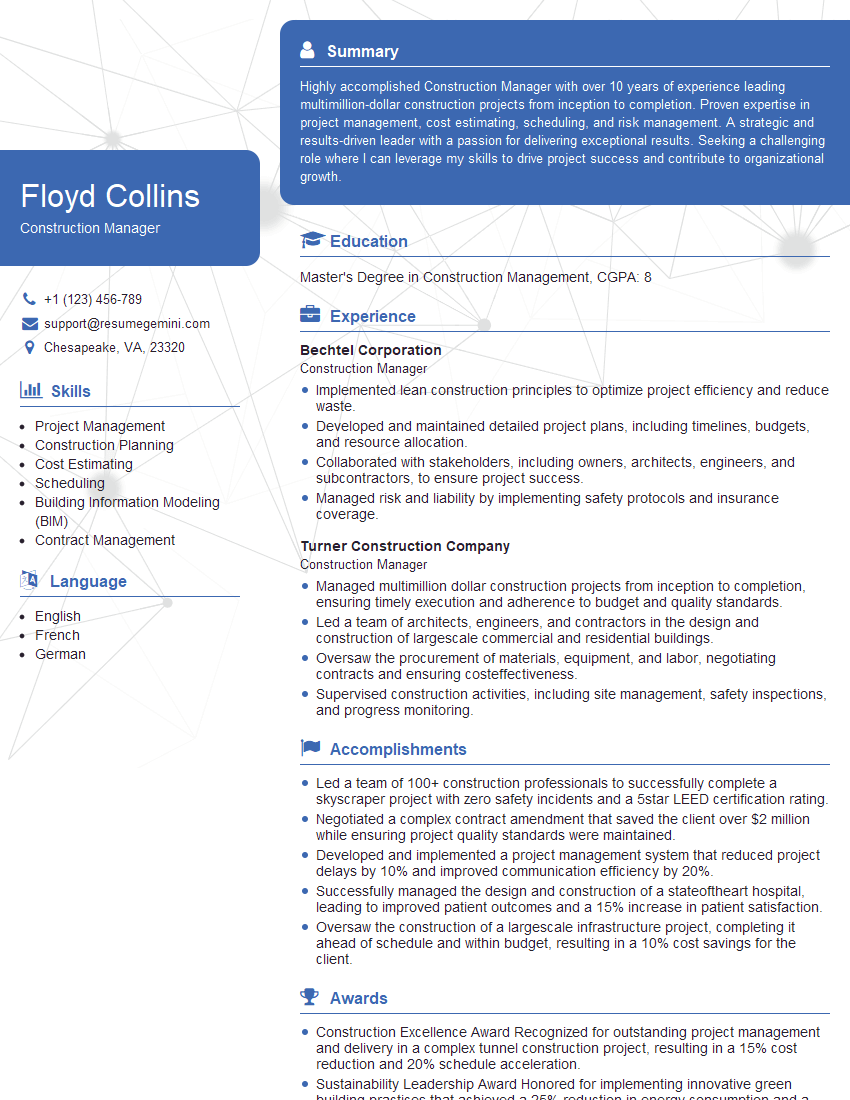
Construction Manager Resume Sample

Project Manager Resume Sample

Project Engineer Resume Sample

Design Engineer Resume Sample
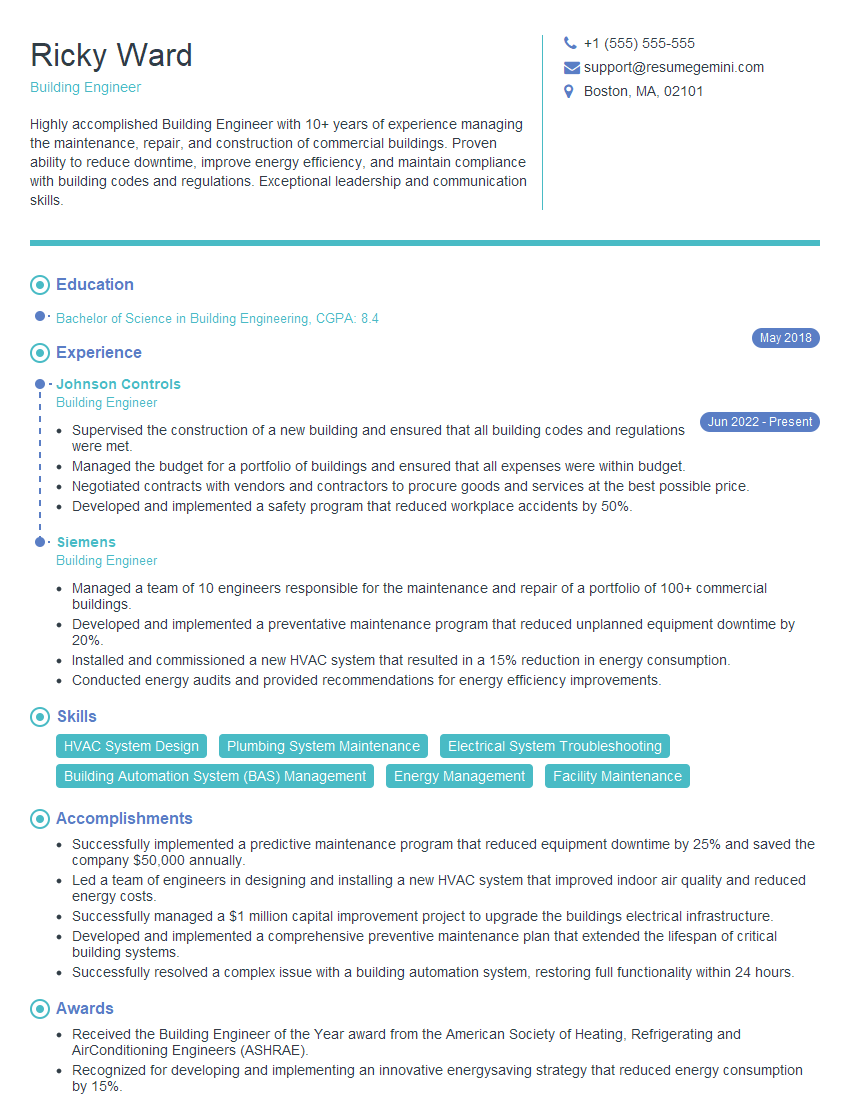
Building Engineer Resume Sample

Civil Engineer Resume Sample

Concrete Engineer Resume Sample

Geotechnical Engineer Resume Sample
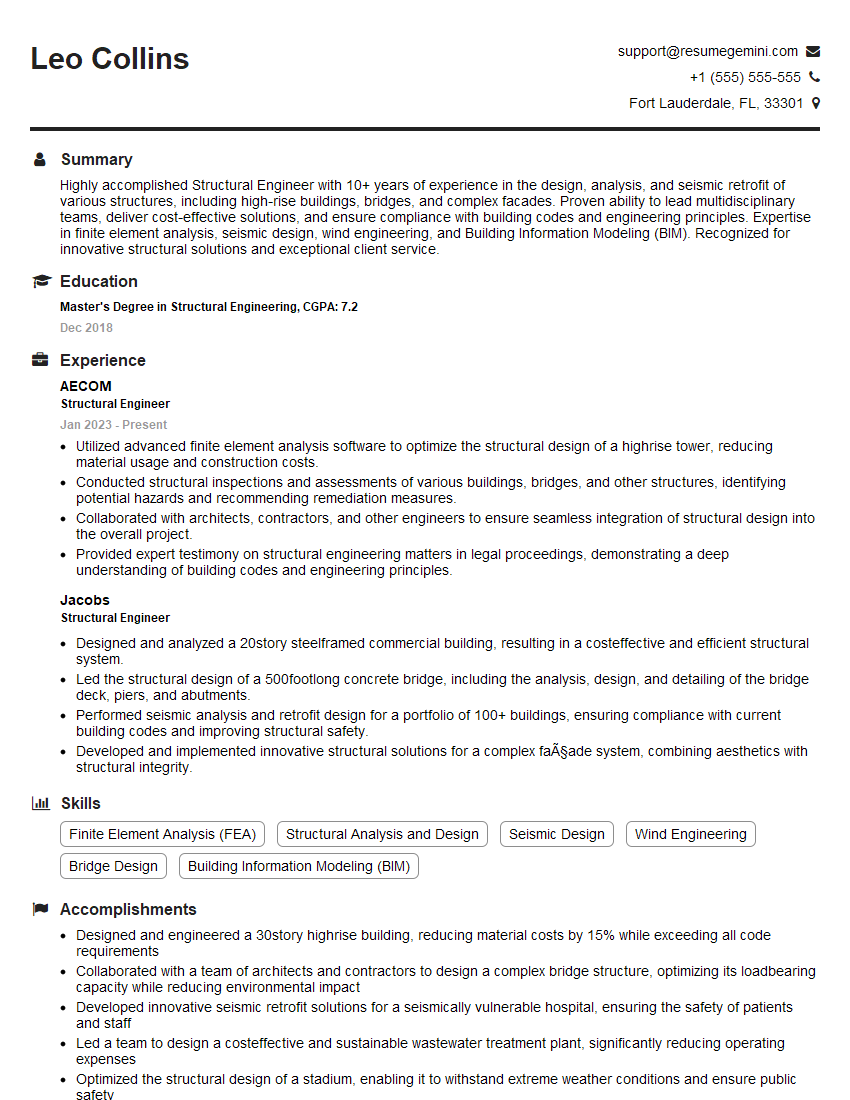
Structural Engineer Resume Sample

Quality Control Engineer Resume Sample

Seismic Engineer Resume Sample
Explore more articles
Users Rating of Our Blogs
Share Your Experience
We value your feedback! Please rate our content and share your thoughts (optional).
What Readers Say About Our Blog
To the interviewgemini.com Webmaster.
Very helpful and content specific questions to help prepare me for my interview!
Thank you
To the interviewgemini.com Webmaster.
This was kind of a unique content I found around the specialized skills. Very helpful questions and good detailed answers.
Very Helpful blog, thank you Interviewgemini team.