Interviews are more than just a Q&A session—they’re a chance to prove your worth. This blog dives into essential Stressing interview questions and expert tips to help you align your answers with what hiring managers are looking for. Start preparing to shine!
Questions Asked in Stressing Interview
Q 1. Explain the difference between static and dynamic stress analysis.
The key difference between static and dynamic stress analysis lies in how they handle the applied loads. Static analysis assumes that the loads are applied slowly and remain constant over time, resulting in a steady-state stress distribution. Think of it like gently placing a weight on a table – the stress on the table remains relatively constant. In contrast, dynamic analysis considers loads that vary with time, such as impacts, vibrations, or rapidly applied forces. Imagine hitting the table with a hammer; the stress will fluctuate dramatically and change over time. This requires more sophisticated techniques to account for inertia and other time-dependent effects.
Practically, static analysis is simpler and computationally cheaper, making it suitable for many engineering problems. However, if your system is subjected to shock, impact, or rapid changes in loading, then a dynamic analysis is necessary to accurately predict the response and ensure safety.
For example, designing a bridge under a constant traffic load would use static analysis, while designing a car bumper to withstand a collision would need dynamic analysis.
Q 2. Describe your experience with Finite Element Analysis (FEA) software.
I have extensive experience using several FEA software packages, including ANSYS, Abaqus, and COMSOL. My proficiency spans the entire workflow, from model creation and meshing to solving the analysis and post-processing the results. In my previous role at [Previous Company Name], I used ANSYS to analyze the stress distribution in a complex aerospace component, successfully identifying potential failure points and optimizing the design for improved strength and weight reduction. I am also familiar with utilizing various element types and material models within these platforms, selecting the most appropriate based on the specific application and desired accuracy. For instance, I’ve used shell elements for thin-walled structures and solid elements for thicker components, and selected appropriate material models like linear elastic, plastic, or hyperelastic based on the material behavior.
Beyond the software itself, I possess a strong understanding of the underlying FEA principles – ensuring I can effectively interpret the results and identify potential inaccuracies or limitations in the modeling process.
Q 3. What are the common failure modes associated with stress?
Common failure modes associated with stress are intricately linked to the type of stress (tensile, compressive, shear), the material properties, and the presence of flaws. Some of the most prevalent failure modes include:
- Yielding: Permanent deformation of the material due to exceeding its yield strength. Think of bending a paperclip – it yields and permanently changes shape.
- Fracture: Complete separation of the material due to excessive stress. A broken bone is a clear example.
- Fatigue: Failure under cyclic loading, even if the maximum stress is below the yield strength. Repeated bending of a metal wire eventually leads to fatigue failure.
- Buckling: Sudden collapse of a structural member under compressive stress. A slender column under heavy load may buckle.
- Creep: Time-dependent deformation under sustained stress at elevated temperatures. Think of a plastic slowly sagging over time under its own weight.
Understanding these failure modes is crucial in designing safe and reliable structures and components.
Q 4. How do you determine the appropriate material properties for stress analysis?
Determining the appropriate material properties is a critical step in stress analysis. The accuracy of your analysis directly depends on how well you represent the material’s behavior under load. This involves several steps:
- Material Selection: The first step is choosing the correct material based on the application. For example, steel might be chosen for its high strength, while aluminum might be preferred for its lightweight properties.
- Literature Review: Once the material is selected, I would consult material property databases and technical literature (like material datasheets) to find relevant properties such as Young’s modulus (elasticity), Poisson’s ratio, yield strength, ultimate tensile strength, etc. This often involves looking up values for the specific material grade and considering the effects of temperature.
- Experimental Testing: In some cases, experimental testing may be required to determine material properties specific to the particular batch or condition of the material. This could involve tensile testing, compression testing, or other relevant experimental methods.
- Material Model Selection: Choosing the appropriate constitutive model (e.g., linear elastic, elastoplastic, viscoelastic) is crucial for accurately representing the material’s behavior. This choice depends on the material’s behavior under various load conditions.
For example, in analyzing a plastic component, one might use a nonlinear material model accounting for plastic deformation and potentially creep at elevated temperatures. A proper selection of material properties is crucial for obtaining accurate stress analysis predictions.
Q 5. Explain the concept of stress concentration.
Stress concentration refers to the localized increase in stress that occurs at geometric discontinuities, such as holes, fillets, or abrupt changes in cross-section. Imagine pulling on a piece of paper with a small hole punched in it. The stress will be significantly higher around the hole than in the rest of the paper. This is stress concentration.
Stress concentration factors (Kt) quantify this increase in stress. A Kt value of 2 indicates that the stress at the discontinuity is twice the nominal stress (average stress calculated without considering the discontinuity). Stress concentrations are a significant concern in design, as they can lead to premature failure, even when the average stress is well below the material’s yield strength.
To mitigate stress concentration, designers often employ techniques like: smoothing sharp corners (using fillets), using reinforced holes, optimizing component geometry to minimize stress risers, and careful selection of materials with superior fracture toughness.
Q 6. How do you validate your FEA results?
Validating FEA results is essential to ensure the accuracy and reliability of the analysis. This involves a multi-pronged approach:
- Mesh Sensitivity Study: Refining the mesh to ensure the solution is independent of mesh density. This means that further refinement doesn’t significantly change the results. It’s like increasing the resolution of a picture – at some point, increasing it further won’t make a noticeable difference.
- Comparison with Analytical Solutions: For simpler geometries, comparing the FEA results with known analytical solutions can provide a benchmark for accuracy. This is an excellent way to validate fundamental aspects of the solver.
- Experimental Validation: Conducting physical experiments (e.g., strain gauge measurements, photoelasticity) to compare the FEA predicted stresses and strains with measured values. This helps bridge the gap between the simulation and real-world behavior. This is often the most reliable method for validating FEA results.
- Code Verification: Ensuring the FEA software is used correctly through appropriate checks and code verifications. This may involve review of input data, solver settings, and the post-processing of results to validate appropriate values and settings.
- Engineering Judgement: Using engineering judgment to assess the plausibility of the results. Do the results make sense in the context of the problem? Are there any obvious errors or inconsistencies?
By combining these approaches, you can establish a high degree of confidence in the accuracy and reliability of your FEA results.
Q 7. Describe your experience with fatigue and fracture analysis.
My experience with fatigue and fracture analysis is extensive. I understand the complexities of cyclic loading and its effects on material behavior. I’m proficient in using various fatigue analysis methods, including stress-life (S-N) curves, strain-life (ε-N) curves, and fracture mechanics approaches. In a previous project involving the design of a wind turbine blade, I employed fatigue analysis to predict the blade’s lifespan under cyclic loading conditions. This involved considering various factors, such as the amplitude and frequency of the loading, the material’s fatigue properties, and the presence of any stress concentrations. My work successfully ensured that the design would meet the required fatigue life.
Furthermore, I am experienced in applying fracture mechanics concepts like stress intensity factors (K) and crack propagation models to assess the integrity of structures containing flaws or cracks. This involves using various software tools and techniques to predict crack growth under various loading conditions.
Q 8. Explain the significance of safety factors in stress analysis.
Safety factors are crucial in stress analysis because they account for uncertainties and variations in material properties, manufacturing processes, and loading conditions. Essentially, it’s a buffer built into the design to ensure the component doesn’t fail even if the real-world conditions are more demanding than predicted. A higher safety factor means a more conservative design, less likely to fail, but often at the cost of higher material usage and weight.
For instance, imagine designing a bridge. We’ll use FEA to predict the stresses on the bridge under expected loads. However, we don’t know the precise strength of the steel used, or whether the load might be unexpectedly higher due to an unforeseen event. A safety factor of, say, 2, means the bridge is designed to withstand twice the predicted load. This provides a margin of safety against unexpected events or variations in material properties.
The choice of safety factor depends on various factors including the criticality of the component, the consequences of failure, and the level of uncertainty in the analysis. A higher safety factor is typically employed in situations where failure has severe consequences, such as in aerospace or medical devices.
Q 9. What are the different types of boundary conditions used in FEA?
Boundary conditions in Finite Element Analysis (FEA) define how a structure interacts with its surroundings. They are essential for solving the governing equations and obtaining meaningful results. Different types of boundary conditions simulate different physical constraints.
- Fixed Support/Clamp: Restricts all degrees of freedom (translation and rotation) at a point or surface. Think of a component welded to a rigid surface.
- Pinned Support: Allows rotation but restricts translation. Imagine a hinge.
- Roller Support: Restricts translation in one direction but allows translation in another and rotation. Think of a wheel rolling along a track.
- Symmetric Boundary Condition: Exploits symmetry in the geometry and loading to reduce the computational cost. Only half the model needs to be analyzed.
- Pressure Load: Simulates pressure acting on a surface, like water pressure on a dam.
- Force Load: Simulates a concentrated or distributed force acting on a surface or point, like a weight on a beam.
Properly defining boundary conditions is paramount for accurate FEA results. Incorrect boundary conditions can lead to erroneous stress and displacement predictions.
Q 10. How do you handle non-linear material behavior in stress analysis?
Many real-world materials exhibit non-linear behavior, meaning their stress-strain relationship is not linear. This can be due to plasticity (permanent deformation), creep (time-dependent deformation), or other factors. Handling this in stress analysis requires sophisticated techniques.
One common approach is to use non-linear material models within the FEA software. These models often involve constitutive equations that describe the material’s behavior under various loading conditions. For instance, a plasticity model like von Mises might be used to simulate yielding and permanent deformation. Another example is hyperelasticity models to simulate materials like rubbers.
The FEA software then iteratively solves the governing equations, accounting for the changing material properties as the stress levels change. This iterative process is computationally more expensive than linear analysis. It is essential to choose the right non-linear material model for accurate representation of the material behaviour.
A practical example might be analyzing a metal component undergoing significant plastic deformation during a crash test, for which a plasticity model is critical.
Q 11. Describe your experience with meshing techniques in FEA.
Meshing is the process of dividing the geometry into smaller elements to create a finite element model. The quality of the mesh directly impacts the accuracy and efficiency of the FEA analysis. I have extensive experience with various meshing techniques, including:
- Structured meshing: Creates a regular pattern of elements, often used for simple geometries. It’s computationally efficient but can be less accurate for complex shapes.
- Unstructured meshing: Uses elements of varying shapes and sizes, allowing for better adaptation to complex geometries. It generally provides better accuracy but is computationally more expensive.
- Adaptive meshing: Refines the mesh in areas of high stress gradients to improve accuracy where it is most needed. This enhances efficiency by concentrating computational resources where needed.
My experience includes generating meshes using both manual techniques and automated mesh generation tools. I understand the importance of mesh density, element type selection (e.g., tetrahedral, hexahedral), and aspect ratio to ensure mesh quality and avoid convergence issues.
In one project involving a turbine blade, using adaptive meshing around the critical areas of stress concentration significantly improved the accuracy of the stress prediction compared to a uniform mesh, leading to a more efficient and reliable design.
Q 12. What are the limitations of FEA?
While FEA is a powerful tool, it has limitations:
- Idealizations and Simplifications: FEA relies on simplifications of the real-world problem. Material properties, boundary conditions, and loads are often idealized. This can lead to inaccuracies in the results.
- Computational Cost: Complex models with fine meshes can be computationally expensive, requiring significant computing resources and time.
- Mesh Dependency: Results can be sensitive to the mesh quality and density. A poorly constructed mesh can lead to inaccurate or even erroneous results.
- Accuracy Limitations: FEA results are approximations, not exact solutions. The accuracy depends on the model’s complexity, the quality of the input data, and the chosen analysis settings.
- User Expertise Required: FEA requires significant expertise in both software usage and engineering principles to obtain reliable results. Misinterpretation of results is possible without proper expertise.
It’s crucial to understand these limitations and interpret the results with caution, considering the assumptions and simplifications made during the modeling process.
Q 13. How do you interpret stress results from FEA software?
Interpreting FEA stress results involves carefully examining several key aspects:
- Stress Contours: Visualizing stress distribution using color contours helps identify areas of high stress concentration. This allows for focusing design improvements on these critical areas.
- Stress Values: Examining the numerical stress values at critical points allows for comparison with material yield strength and other relevant criteria to determine safety margins.
- Principal Stresses: Principal stresses represent the maximum and minimum normal stresses at a point. Understanding these helps determine if yielding or failure is likely.
- Von Mises Stress: This is a combined stress criterion frequently used for ductile materials to predict yielding. Exceeding the yield strength in Von Mises stress signifies potential yielding.
- Stress Concentrations: FEA highlights stress concentrations that may occur at sharp corners, holes, or other geometric discontinuities, allowing for design modifications to mitigate these.
It is essential to compare the calculated stresses with appropriate material properties and failure criteria to assess the component’s structural integrity. The results should always be interpreted considering the limitations of the FEA model and the assumptions made during the analysis.
Q 14. Explain the concept of creep and its impact on stress analysis.
Creep is a time-dependent deformation of a material under sustained stress at elevated temperatures. It’s a gradual, permanent deformation that accumulates over time, even if the applied stress is below the material’s yield strength. This is different from elastic deformation, which is instantaneous and recoverable.
In stress analysis, creep significantly impacts the long-term performance of components operating at high temperatures. For example, turbine blades in gas turbines experience high temperatures and stresses. Creep can lead to gradual elongation and eventual failure of these components over their operational lifetime.
To account for creep in stress analysis, creep constitutive models are incorporated into FEA software. These models use material-specific data to predict creep strain as a function of time, temperature, and stress. Analyzing the creep behavior allows engineers to assess the long-term durability and reliability of the components. neglecting creep can lead to significant underestimation of deformation and premature failure, particularly in high-temperature applications.
Q 15. How do you account for thermal effects in stress analysis?
Thermal effects significantly influence stress analysis because temperature changes cause material expansion or contraction, leading to additional stresses. Imagine heating a metal bar – it expands. If constrained, this expansion generates compressive stress. Conversely, cooling creates tensile stress. Accounting for these effects requires considering material properties like the coefficient of thermal expansion (CTE).
In practice, we use finite element analysis (FEA) software to model this. We input the temperature distribution across the component and the material’s CTE. The software then calculates the thermally induced stresses, which are subsequently superimposed on the mechanically induced stresses to get the total stress state. For instance, in designing a turbine blade, we need to account for the extreme temperature variations the blade will experience during operation to avoid failure due to thermal stress cracking.
Furthermore, we sometimes use simplified analytical methods for basic geometries, like calculating the thermal stress in a simple bar using the formula: σth = EαΔT, where σth is thermal stress, E is Young’s modulus, α is the coefficient of thermal expansion, and ΔT is the temperature change. However, for complex geometries and loading conditions, FEA is crucial for accuracy.
Career Expert Tips:
- Ace those interviews! Prepare effectively by reviewing the Top 50 Most Common Interview Questions on ResumeGemini.
- Navigate your job search with confidence! Explore a wide range of Career Tips on ResumeGemini. Learn about common challenges and recommendations to overcome them.
- Craft the perfect resume! Master the Art of Resume Writing with ResumeGemini’s guide. Showcase your unique qualifications and achievements effectively.
- Don’t miss out on holiday savings! Build your dream resume with ResumeGemini’s ATS optimized templates.
Q 16. Describe your experience with experimental stress analysis techniques.
My experience encompasses various experimental techniques, primarily focused on strain gauge measurements and photoelasticity. Strain gauges are small, adhesive sensors that measure surface strain. I’ve extensively used them on components undergoing different load scenarios. The strain data provides direct information on the deformation, from which stress can be calculated using material properties and stress-strain relationships. For example, I used strain gauges to analyze the stress distribution in a connecting rod under cyclic loading.
Photoelasticity is another technique I’m familiar with. This method uses transparent materials with birefringent properties (meaning their refractive index changes with stress). When a stressed photoelastic model is placed between polarizers, colored fringes appear, with the fringe order directly related to the stress magnitude. I used this technique in a project assessing stress concentrations around a hole in a plate under tension. It provides a visual representation of stress distribution, invaluable for identifying high-stress regions.
Beyond these, I have some familiarity with digital image correlation (DIC), a non-contact optical method that tracks surface displacements to determine strain fields. This is particularly useful for complex geometries or situations where attaching gauges is impractical.
Q 17. Explain the concept of stress intensity factor.
The stress intensity factor (K) quantifies the stress field at the tip of a crack. Imagine a crack in a material under load. The stress doesn’t just stop at the crack edge; instead, it concentrates at the crack tip, creating a highly stressed region that’s prone to propagation. K describes the magnitude of this stress concentration, and it depends on the crack geometry, the applied load, and the material properties.
Different modes of crack loading (opening, sliding, tearing) have corresponding stress intensity factors (KI, KII, KIII). The value of K is crucial in fracture mechanics because it dictates whether a crack will propagate or remain stable. A critical stress intensity factor, Kc (fracture toughness), represents the value of K at which crack propagation initiates. If K exceeds Kc, the crack will grow, potentially leading to catastrophic failure. Engineers use K to assess the remaining life of cracked components and to design for fracture resistance.
Q 18. How do you determine the fatigue life of a component?
Determining fatigue life involves understanding how a component behaves under repeated cyclic loading. Unlike static loading, fatigue failure occurs at stress levels far below the material’s yield strength. The process involves several steps:
- Stress-Life (S-N) Curve: This curve, obtained from fatigue testing, relates stress amplitude (S) to the number of cycles to failure (N). Different materials have different S-N curves.
- Stress Analysis: We need to determine the stress range experienced by the component during its operation. FEA is commonly used for complex geometries.
- Life Prediction: Using the S-N curve and the stress range from the analysis, we can estimate the number of cycles to failure. This may involve modifying the basic S-N curve to account for factors such as mean stress and surface finish.
- Safety Factor: A safety factor is usually applied to account for uncertainties and variations in material properties and loading conditions.
For example, in designing an aircraft wing, we would conduct extensive fatigue testing to establish the S-N curve for the wing material. We’d then use FEA to simulate the stress cycles during flight and predict the wing’s fatigue life, ensuring a sufficient safety margin. Methods like Miner’s rule can be used to estimate the fatigue life under variable amplitude loading.
Q 19. What are the different types of stress testing?
Stress testing encompasses various techniques aimed at evaluating a component’s strength and durability under different conditions. The choice of method depends on the specific application and desired outcome:
- Tensile Testing: A fundamental test that measures the material’s response to uniaxial tensile loading, providing yield strength, ultimate tensile strength, and ductility.
- Compression Testing: Similar to tensile testing, but applies compressive load, determining compressive strength and buckling behavior.
- Shear Testing: Measures the material’s resistance to shear forces.
- Fatigue Testing: As discussed earlier, assesses the material’s endurance under cyclic loading.
- Creep Testing: Evaluates the material’s deformation under sustained high-temperature loading.
- Impact Testing: Measures the material’s ability to absorb sudden impacts, such as Charpy or Izod tests.
Each test provides valuable insights into the material’s behavior, allowing engineers to select the most suitable material for a given application and predict its performance under anticipated loading conditions.
Q 20. Describe your experience with different failure criteria.
My experience includes working with various failure criteria, each tailored to different material behaviors and loading conditions. These criteria predict when a material will fail, and selecting the appropriate one depends on the situation.
- Maximum Principal Stress (Rankine) Criterion: This criterion states that failure occurs when the maximum principal stress exceeds the material’s tensile strength. Simple, but less accurate for ductile materials.
- Maximum Shear Stress (Tresca) Criterion: Failure occurs when the maximum shear stress reaches half the material’s yield strength. More accurate than Rankine for ductile materials.
- von Mises Criterion (Distortion Energy): This criterion considers the combined effect of all stress components, and it’s generally the most accurate for ductile materials, particularly under multiaxial stress states.
- Mohr-Coulomb Criterion: Specifically tailored for brittle materials and considers both normal and shear stresses. It’s commonly used in geotechnical engineering.
The choice of criterion significantly influences design decisions. For example, in designing a pressure vessel, we might use the von Mises criterion to ensure safety under complex loading scenarios. For brittle ceramics, the Mohr-Coulomb criterion would be more appropriate.
Q 21. Explain the concept of buckling.
Buckling is a sudden, large deformation of a slender structural member under compressive loading. Think of a long, thin column: if you apply enough compressive force along its axis, it will suddenly bend or buckle rather than just compress. The load at which this occurs is called the critical buckling load.
Several factors influence buckling, including the member’s length, cross-sectional geometry, material properties (Young’s modulus and moment of inertia), and end conditions (how the column is supported). Euler’s formula provides an estimate for the critical buckling load for a simple column with ideal conditions. However, for more complex geometries and boundary conditions, numerical methods such as FEA are employed.
Buckling is a critical consideration in structural design. For example, when designing tall buildings or long bridge beams, engineers carefully assess the potential for buckling and incorporate appropriate design measures to prevent it, such as using materials with higher stiffness or adding lateral bracing.
Q 22. How do you perform a modal analysis?
Modal analysis is a crucial technique in stress analysis that determines the natural frequencies and mode shapes of a structure. Think of it like finding the ‘musical notes’ a structure can resonate at. Each note corresponds to a natural frequency, and its associated vibration pattern is the mode shape. These frequencies are vital because if an external force (like wind or an earthquake) excites a structure at one of its natural frequencies, it can lead to excessive vibrations and potential failure – a phenomenon known as resonance.
Performing a modal analysis typically involves using Finite Element Analysis (FEA) software. The process generally follows these steps:
- Geometry Creation: Defining the structure’s geometry using CAD software or directly within the FEA pre-processor.
- Meshing: Discretizing the geometry into a finite number of elements. The mesh density impacts accuracy; finer meshes are more accurate but computationally expensive.
- Material Property Assignment: Defining the material properties (Young’s modulus, Poisson’s ratio, density) for each element.
- Boundary Condition Definition: Specifying how the structure is supported (fixed, hinged, etc.).
- Solver Execution: Running the FEA solver to calculate the natural frequencies and corresponding mode shapes.
- Result Visualization: Reviewing the results, typically by visualizing mode shapes and their associated frequencies. This helps identify potential weak points or areas of high vibration.
For instance, in analyzing a tall building, modal analysis helps engineers understand how the structure will respond to wind loads. By identifying the natural frequencies, they can ensure the building’s design avoids resonance with typical wind frequencies.
Q 23. What are your experiences with various material models (e.g., linear elastic, plastic, viscoelastic)?
My experience encompasses a wide range of material models, each suited for different applications and material behaviors.
- Linear Elastic: This is the simplest model, assuming a linear relationship between stress and strain. It’s suitable for materials like steel under relatively low stress levels. It’s computationally efficient but might not capture real-world behavior accurately at higher stresses.
- Plastic: This model accounts for permanent deformation after the yield point is reached. Materials like many metals exhibit plastic behavior. Different plasticity models exist (e.g., von Mises, Tresca) that govern the yield criteria and subsequent plastic flow. I’ve extensively used these models to simulate forming processes and predict permanent deformation in components under severe loading.
- Viscoelastic: This model considers both elastic and viscous properties, meaning the material’s response to load depends on time. Polymers and rubbers are classic examples. These models are more complex, often requiring time-dependent parameters such as relaxation moduli or creep functions. I’ve used viscoelastic models in analyzing the long-term creep behavior of polymeric seals and dampers.
Selecting the appropriate material model is critical for accurate simulation. A mismatched model can lead to erroneous predictions. For instance, using a linear elastic model to analyze a highly ductile material under impact loading could significantly underestimate the deformation and failure mode.
Q 24. Explain your experience in using different FEA solvers.
I’m proficient in several FEA solvers, including ANSYS, Abaqus, and Nastran. Each solver has its strengths and weaknesses depending on the application.
- ANSYS: Excellent for a wide range of simulations, known for its user-friendly interface and extensive library of elements and material models. I’ve used ANSYS extensively for linear and nonlinear static and dynamic analyses.
- Abaqus: Powerful for complex nonlinear simulations, particularly in the area of material nonlinearity and contact mechanics. Its explicit solver is particularly useful for high-speed impact events. I’ve utilized Abaqus for simulations involving large plastic deformations and contact interactions.
- Nastran: A robust solver commonly used in the aerospace industry for linear and modal analysis. It excels at handling large models with high fidelity. I have experience using Nastran for structural analysis of aircraft components.
My choice of solver depends on the problem’s specific requirements. For example, I would use Abaqus for a detailed simulation of a crash test due to its capability for handling large deformations and contact but might opt for ANSYS for a simpler linear static analysis of a machine component.
Q 25. Describe your experience with post-processing and visualization of FEA results.
Post-processing and visualization of FEA results are essential steps for interpreting simulation data and drawing meaningful conclusions. I typically use the built-in post-processing capabilities of the FEA solvers alongside dedicated visualization software.
My post-processing workflow typically involves:
- Stress and Strain Visualization: Creating contour plots, deformed shapes, and vector plots to identify areas of high stress, strain, and displacement.
- Data Extraction: Extracting specific data points or creating graphs to analyze stress and strain variations over time or across different sections of the model.
- Animation: Generating animations to visualize dynamic responses, such as mode shapes in modal analysis or deformation under impact loading.
For example, during post-processing of a weld analysis, I would visualize stress contours to identify potential stress concentrations near the weld joint, enabling design improvements to mitigate the risk of failure.
Software such as Tecplot or ParaView can further enhance visualization, allowing for more complex data representation and analysis.
Q 26. How do you identify and troubleshoot convergence issues in FEA?
Convergence issues in FEA are common and usually stem from numerical limitations or modeling errors. Troubleshooting requires a systematic approach.
Here’s a step-by-step strategy:
- Mesh Refinement: Insufficient mesh density is a frequent culprit. Refining the mesh in critical areas (high stress gradients) often resolves convergence problems. I’ve often encountered convergence problems that disappeared with a simple mesh refinement.
- Element Type Selection: Using inappropriate element types for the problem can lead to convergence difficulties. Selecting elements that are appropriate for the type of analysis (e.g., shell elements for thin-walled structures) is important.
- Nonlinear Solution Control: For nonlinear analyses, appropriate solver settings are crucial. Adjusting parameters such as load steps, time increments, and convergence tolerances might be necessary.
- Boundary Condition Review: Incorrectly defined boundary conditions can introduce numerical instabilities. Carefully review boundary conditions for any inconsistencies or unrealistic constraints.
- Material Model Verification: Errors in material properties or inappropriate material models can impede convergence. Verify material models and parameters for accuracy.
If all else fails, simplifying the model or breaking it down into smaller parts can help pinpoint the source of the convergence problem.
Q 27. How do you handle uncertainties and variability in material properties?
Uncertainties and variability in material properties are inherent in real-world applications. Ignoring these variations can lead to inaccurate and unreliable results. Here’s how I handle this:
- Probabilistic Methods: I use probabilistic methods like Monte Carlo simulations. This technique involves running multiple FEA analyses with material properties randomly sampled from their probability distributions. The results provide a statistical representation of the response, including the mean, variance, and confidence intervals of stress, strain and displacement.
- Sensitivity Analysis: This helps identify the material properties that most significantly influence the results. This information can guide the selection of the most critical material properties requiring precise measurements or tighter tolerances. I have employed sensitivity analyses on numerous occasions to help engineers optimize material specifications and control costs.
- Design of Experiments (DoE): DoE techniques (e.g., Taguchi method) can be used to efficiently explore the design space and identify optimal combinations of material properties that minimize variability and meet design constraints.
For instance, when analyzing a composite material, I would incorporate the statistical variation of the fiber orientation, fiber volume fraction, and matrix properties into the analysis using a Monte Carlo simulation to estimate the range of possible structural responses.
Q 28. Explain your experience in using optimization techniques in stress analysis.
Optimization techniques are increasingly employed in stress analysis to improve design efficiency and achieve optimal performance. My experience includes utilizing several optimization methods:
- Topology Optimization: This powerful technique removes material from a design, leading to lighter but equally strong structures. I’ve used it to create lightweight components for aerospace applications.
- Shape Optimization: This method modifies the geometry of a component to improve performance by minimizing stress concentrations or maximizing stiffness. I’ve successfully employed shape optimization to improve the fatigue life of critical components.
- Size Optimization: This involves adjusting the dimensions of structural members to meet stress constraints and weight limits. I’ve used it to optimize the dimensions of beams and columns.
These optimizations are often coupled with FEA to iteratively refine the design until the objective function (e.g., minimum weight, maximum stiffness) is achieved. Software like OptiStruct or ANSYS DesignXplorer are commonly used for these tasks. For instance, I once used topology optimization to redesign a bracket, resulting in a 30% weight reduction without compromising structural integrity.
Key Topics to Learn for Stressing Interview
Successfully navigating a Stressing interview requires a multifaceted approach. Mastering the following key areas will significantly boost your confidence and preparedness.
- Fundamentals of Stressing: Understand the core principles and definitions related to Stressing. This includes exploring its theoretical underpinnings and common terminology.
- Practical Application of Stressing Techniques: Focus on real-world scenarios and case studies where Stressing methodologies are applied. Practice analyzing these scenarios and identifying optimal solutions.
- Problem-Solving with Stressing: Develop your ability to approach complex problems using Stressing frameworks. Practice breaking down problems into manageable components and developing effective strategies for resolution.
- Advanced Stressing Concepts: Explore more advanced topics within Stressing, depending on the specific role and company. This might involve specialized techniques or applications relevant to the industry.
- Ethical Considerations in Stressing: Understand the ethical implications of using Stressing techniques and how to ensure responsible and ethical application in various contexts.
Next Steps
Proficiency in Stressing is highly valuable in today’s competitive job market, opening doors to exciting career opportunities and professional growth. To maximize your chances of success, crafting a compelling and ATS-friendly resume is crucial. This ensures your application is effectively screened and reaches the right hiring managers.
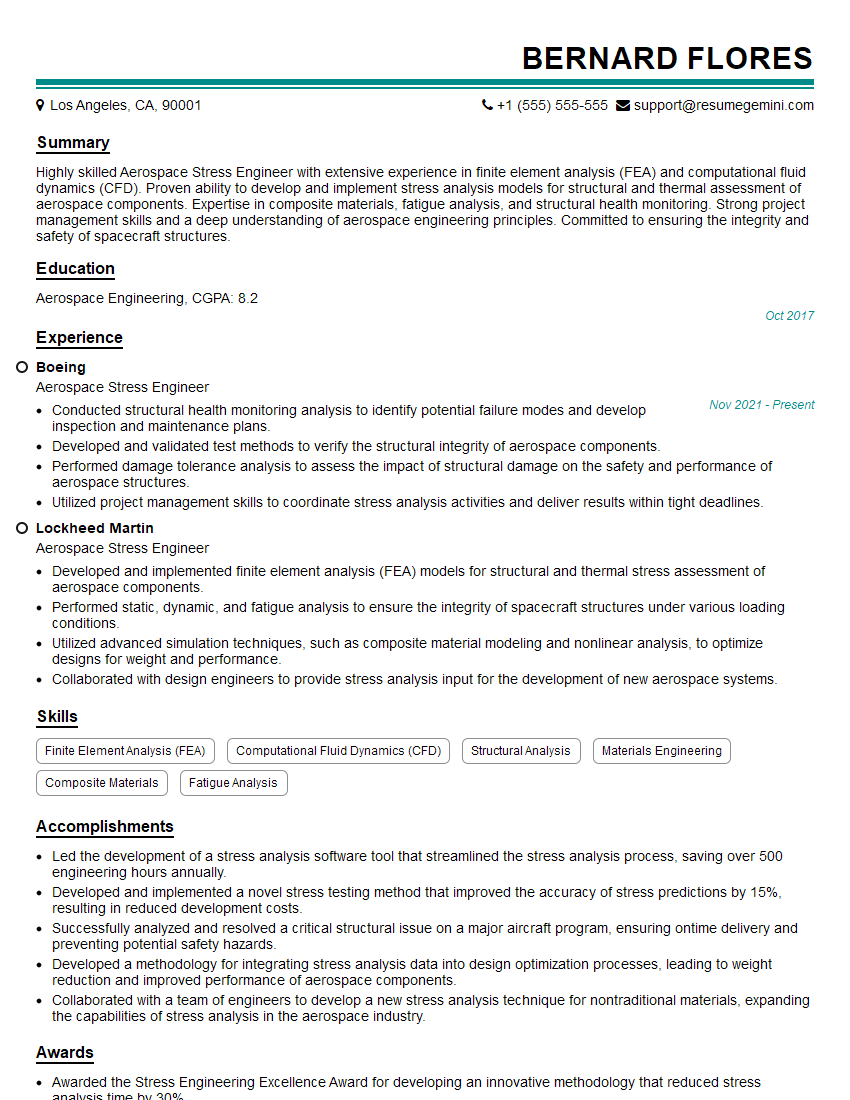
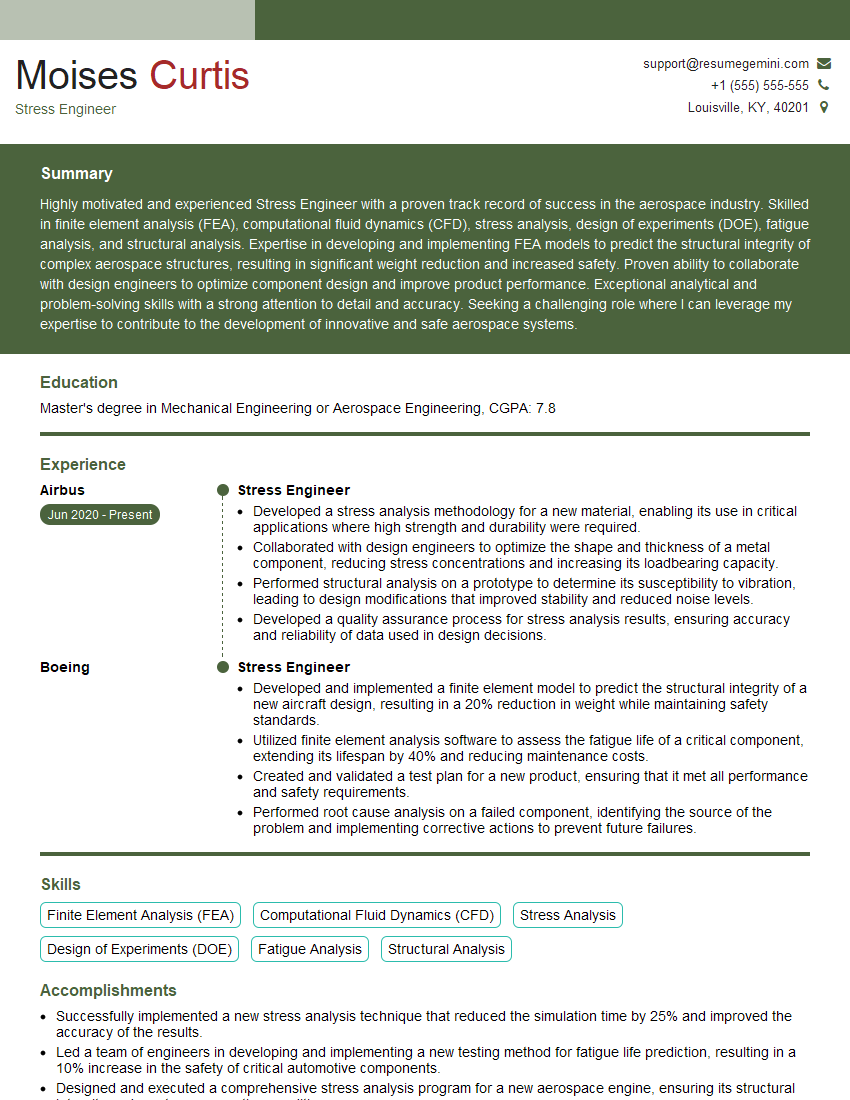
We strongly encourage you to utilize ResumeGemini to build a professional and impactful resume. ResumeGemini provides the tools and resources to create a resume that effectively highlights your Stressing skills and experience. Examples of resumes tailored specifically to Stressing are available to guide you.
Explore more articles
Users Rating of Our Blogs
Share Your Experience
We value your feedback! Please rate our content and share your thoughts (optional).
What Readers Say About Our Blog
To the interviewgemini.com Webmaster.
Very helpful and content specific questions to help prepare me for my interview!
Thank you
To the interviewgemini.com Webmaster.
This was kind of a unique content I found around the specialized skills. Very helpful questions and good detailed answers.
Very Helpful blog, thank you Interviewgemini team.