Interviews are more than just a Q&A session—they’re a chance to prove your worth. This blog dives into essential Textile Product Innovation interview questions and expert tips to help you align your answers with what hiring managers are looking for. Start preparing to shine!
Questions Asked in Textile Product Innovation Interview
Q 1. Explain the difference between woven and knitted fabrics.
Woven and knitted fabrics are fundamentally different in their construction, leading to distinct properties. Think of weaving as creating a fabric by interlacing two sets of yarns at right angles – like a warp and weft on a loom. This creates a strong, stable structure with a distinct grain. Knitted fabrics, on the other hand, are made by interlooping a single yarn, creating a more flexible and stretchy material. Imagine knitting a sweater – that’s essentially the process on a much larger scale.
- Woven Fabrics: Stronger, more durable, less stretch, tend to wrinkle more, usually have a more structured drape. Examples include denim, twill, and linen.
- Knitted Fabrics: More flexible, stretchy, comfortable, drape softly, prone to snagging, can be more breathable in some constructions. Examples include jersey, rib knit, and double knit.
The choice between woven and knitted fabrics depends heavily on the end use. For instance, sturdy denim is ideal for jeans due to its woven structure’s strength, while the stretch and comfort of a jersey knit are perfect for t-shirts.
Q 2. Describe your experience with various textile finishing techniques.
My experience encompasses a wide range of textile finishing techniques, crucial for enhancing the aesthetic and functional properties of fabrics. I’ve worked extensively with dyeing processes, from basic vat dyeing for deep, durable colors to reactive dyeing for brighter shades on cellulosic fibers. I’m also proficient in printing techniques, including screen printing for bold graphics and digital printing for intricate designs and high-volume production.
Beyond color and design, I have experience with finishing techniques that improve performance. This includes treatments for wrinkle resistance (e.g., resin finishes), water repellency (e.g., Durable Water Repellent or DWR coatings), and stain resistance. I’ve also worked with softening agents to enhance the hand feel of fabrics, making them more comfortable against the skin. Each technique requires a deep understanding of fiber chemistry and the desired outcome.
For example, I once worked on a project to develop a durable, water-resistant fabric for outdoor clothing. This involved optimizing a DWR coating to ensure it maintained its performance after multiple washes, without compromising the fabric’s breathability.
Q 3. How do you stay updated on the latest textile trends and innovations?
Staying current in the dynamic textile industry requires a multi-faceted approach. I regularly subscribe to industry publications like Textile World and other specialized journals. I also attend international textile trade shows like Première Vision and Intertextile, where I can see firsthand the latest innovations and meet with key players in the field.
Online resources play a vital role. I actively follow influential textile blogs, research papers, and participate in online forums and communities dedicated to textile innovation. Furthermore, I network extensively with colleagues and attend conferences and workshops to exchange information and stay abreast of emerging trends.
A key aspect is to be aware of broader societal shifts that impact textile production and consumer demand, such as sustainability concerns and changes in fashion trends. I believe in being a proactive learner, always curious and eager to discover new techniques and materials.
Q 4. What are some sustainable textile production practices you’re familiar with?
Sustainability is paramount in modern textile production, and I’m deeply involved in several eco-conscious practices. This includes utilizing organic cotton, which reduces reliance on pesticides and fertilizers, promoting healthier farming practices and environmental protection.
I’m familiar with recycled fibers, like recycled polyester from plastic bottles, significantly reducing waste and our environmental footprint. Closed-loop systems, where textile waste is collected, processed, and transformed into new products are also within my sphere of knowledge.
Beyond material selection, I work with sustainable dyeing and finishing techniques. This means employing low-impact dyes and minimizing water and energy consumption throughout the production process. The focus is always on minimizing environmental impact while maintaining high-quality standards.
For example, I’ve helped develop a collection of garments using Tencel, a sustainable fiber derived from sustainably sourced eucalyptus trees, and dyes with lower chemical impact.
Q 5. Explain your understanding of textile testing and quality control processes.
Textile testing and quality control are crucial to ensuring consistent product quality and meeting customer specifications. My understanding encompasses a range of tests assessing various fabric properties. These include:
- Strength tests: Tensile strength, tear strength, and bursting strength to determine fabric durability.
- Dimensional stability tests: Shrinkage, elongation, and dimensional changes after washing to ensure consistent sizing.
- Colorfastness tests: Assessing color retention after washing, dry cleaning, and exposure to light and perspiration.
- Abrasion resistance tests: Evaluating the fabric’s ability to withstand wear and tear.
- Hand feel testing: Subjective assessment of fabric texture and drape.
Quality control involves implementing checks at various stages of production, from raw material inspection to finished product evaluation. This includes regularly monitoring machinery, maintaining accurate records, and using statistical process control (SPC) to identify and address potential issues proactively.
A real-world example is a situation where a batch of fabric failed a colorfastness test. By using SPC and thoroughly investigating the issue, we were able to trace it to a slight variation in dye concentration, correcting the problem and preventing further defects.
Q 6. Describe your experience with CAD software for textile design.
I’m proficient in various CAD software packages for textile design, including Adobe Illustrator, CorelDRAW, and specialized textile design software. These tools are essential for creating intricate patterns, simulating fabric draping, and generating technical designs for manufacturing.
Using CAD, I can efficiently create repeat patterns, explore different color palettes, and manipulate designs to achieve specific visual effects. The software allows me to create detailed technical drawings that include dimensions, seam allowances, and other crucial manufacturing specifications. Furthermore, it helps streamline the communication between designers and manufacturers.
For example, I recently used CAD software to create a complex jacquard weave pattern. The software’s simulation tools allowed me to visualize the fabric’s final appearance before production, greatly reducing the risk of errors and saving time and resources.
Q 7. How would you approach designing a new fabric for a specific application?
Designing a new fabric for a specific application is a systematic process that requires a thorough understanding of both the desired end-use and the properties of various fibers and construction techniques. I typically follow these steps:
- Define the application and requirements: This involves understanding the fabric’s intended use (e.g., sportswear, upholstery, medical textiles), its required performance characteristics (e.g., breathability, water resistance, durability), and the target market.
- Fiber selection: Choosing appropriate fibers based on their properties (e.g., strength, elasticity, moisture-wicking). This also includes consideration of sustainability aspects.
- Construction method: Deciding on the best construction method (woven, knitted, non-woven) depending on the desired properties and cost-effectiveness.
- Design and prototyping: Using CAD software to create designs and generate prototypes for evaluation. This phase involves iterative testing and refinement.
- Testing and refinement: Conducting thorough testing to evaluate the fabric’s performance against the established requirements. This may involve multiple iterations of design and construction adjustments.
- Manufacturing and quality control: Finalizing the design and ensuring quality control throughout the manufacturing process.
For example, if I were designing a fabric for high-performance sportswear, I might choose a blend of polyester and elastane for its strength, elasticity, and moisture-wicking capabilities, then opt for a knitted construction to maximize comfort and breathability. Throughout the process, rigorous testing ensures the final fabric meets the performance standards of the intended application.
Q 8. How do you manage the challenges of balancing cost, quality, and sustainability in textile production?
Balancing cost, quality, and sustainability in textile production is a complex, three-legged stool. If one leg is weak, the whole system collapses. It requires a holistic approach, integrating sustainable practices throughout the entire supply chain.
Cost Optimization: This involves efficient sourcing of raw materials, optimizing production processes to minimize waste, and negotiating favorable contracts with suppliers. For example, choosing recycled fibers can reduce material costs while promoting sustainability. Implementing lean manufacturing principles can streamline production and minimize waste.
Quality Assurance: Rigorous quality control at each stage – from fiber selection to final product inspection – is crucial. Investing in advanced testing equipment and employing skilled personnel ensures consistent quality. For example, using precision dyeing techniques minimizes fabric defects and improves color consistency.
Sustainability Initiatives: This includes using eco-friendly materials (organic cotton, recycled polyester), reducing water and energy consumption in production, and implementing waste management programs. Choosing suppliers committed to ethical labor practices is also paramount. For example, adopting closed-loop water systems in dyeing minimizes water pollution.
Ultimately, it’s about finding innovative solutions that don’t compromise quality or sustainability while remaining cost-effective. This often involves strategic partnerships with suppliers who share the same commitment to responsible production.
Q 9. Discuss your experience with different textile fiber types and their properties.
My experience encompasses a wide range of textile fibers, each with unique properties impacting the final product’s performance and feel.
Natural Fibers: Cotton remains a dominant player, prized for its breathability and softness, but its cultivation can be water-intensive. Linen, known for its strength and durability, is increasingly popular for sustainable apparel. Silk, with its luxurious drape and sheen, requires careful processing. Wool provides warmth and insulation, its properties varying depending on the sheep breed.
Synthetic Fibers: Polyester offers excellent durability and wrinkle resistance, making it a cost-effective choice for many applications. Nylon is strong and elastic, suitable for sportswear. Acrylic mimics the feel of wool at a lower cost but can lack breathability. Rayon, a semi-synthetic fiber, offers a soft drape and is often blended with other fibers.
Innovative Fibers: The industry is constantly evolving. I have worked with recycled fibers (e.g., recycled polyester from plastic bottles), bio-based fibers (e.g., Tencel from wood pulp), and high-performance fibers (e.g., specialized fabrics for sportswear or protective gear).
Understanding these fiber properties is essential for selecting the right material for a specific application, considering factors like drape, strength, durability, absorbency, and cost.
Q 10. Explain your understanding of colorfastness and its importance in textile manufacturing.
Colorfastness refers to a fabric’s ability to retain its color despite exposure to various factors like washing, sunlight, and rubbing. It’s a critical aspect of textile manufacturing, influencing both the product’s quality and its longevity.
Poor colorfastness leads to fading, bleeding, or discoloration, significantly reducing the garment’s aesthetic appeal and value. Imagine a vibrant red shirt fading to pink after a few washes—this is a clear indication of poor colorfastness.
In manufacturing, we assess colorfastness using standardized testing methods, such as the AATCC (American Association of Textile Chemists and Colorists) test methods. These tests simulate real-world conditions, evaluating the color’s resistance to washing, light exposure, perspiration, and rubbing. The results are expressed as numerical ratings, providing a quantifiable measure of colorfastness.
Maintaining high colorfastness involves careful selection of dyes, efficient dyeing processes, and appropriate after-treatment techniques. For example, using reactive dyes that bind strongly to the fiber ensures superior colorfastness compared to using direct dyes.
Q 11. Describe your problem-solving approach when faced with a textile production issue.
My problem-solving approach is systematic and data-driven. When faced with a textile production issue, I follow these steps:
Identify and Define the Problem: Thoroughly analyze the issue, gathering data from various sources (production records, quality control reports, customer feedback). For example, if fabric is consistently breaking during weaving, I would examine the yarn quality, weaving parameters, and machine settings.
Analyze the Root Cause: Investigate potential causes using a structured approach, such as a fishbone diagram (Ishikawa diagram), to identify contributing factors. This might involve testing the raw materials, analyzing the manufacturing process, and evaluating equipment performance.
Develop and Evaluate Solutions: Brainstorm potential solutions and evaluate their feasibility, cost-effectiveness, and impact on quality and sustainability. This could involve adjustments to the manufacturing process, sourcing alternative materials, or investing in new equipment.
Implement the Solution and Monitor Results: Implement the chosen solution and closely monitor its effectiveness. Collect data to track progress and make any necessary adjustments.
Document Findings and Lessons Learned: Document the entire process, including the problem, root causes, solutions implemented, and the outcomes. This creates a valuable knowledge base for future problem-solving.
This structured approach ensures that problems are addressed effectively and efficiently, minimizing disruptions and maximizing productivity.
Q 12. How familiar are you with global textile supply chains?
I am very familiar with global textile supply chains. I understand the complexities involved, from raw material sourcing to finished product distribution, encompassing various stages and geographical locations.
My understanding extends to the challenges inherent in global supply chains, including ethical sourcing, transportation logistics, geopolitical factors, and environmental concerns. For example, I’m aware of the challenges in ensuring fair labor practices in countries with less stringent regulations. I also understand the impact of transportation on carbon emissions and the importance of efficient logistics in reducing environmental footprint.
I have experience working with suppliers across different continents and possess a strong understanding of trade agreements, compliance regulations, and international standards related to textile production and trade.
I am proficient in evaluating the risks and opportunities associated with different sourcing strategies and can develop resilient supply chains capable of adapting to unforeseen circumstances.
Q 13. How would you evaluate the performance of a new textile material?
Evaluating a new textile material requires a comprehensive approach, assessing its performance across multiple dimensions.
Physical Properties: This includes testing tensile strength, tear strength, abrasion resistance, elongation, and shrinkage. These tests determine the material’s durability and suitability for specific applications.
Chemical Properties: Assessing colorfastness, water resistance, stain resistance, and chemical resistance is vital. Understanding how the material reacts to different chemicals and environmental factors is critical.
Aesthetic Properties: Evaluating drape, hand feel, luster, and texture is essential, as these factors influence the material’s overall appeal and suitability for the intended use.
Environmental Impact: Assessing the material’s sustainability aspects, including its lifecycle analysis (LCA), is important. This includes evaluating its production process’s environmental impact and its potential for recycling or biodegradability.
Cost Analysis: Evaluating the material’s cost per unit, considering the raw material costs, manufacturing processes, and transportation, is crucial for determining its economic viability.
A combination of laboratory testing, simulations, and practical evaluations provides a comprehensive assessment of a new textile material’s performance and suitability for its intended use.
Q 14. Describe your experience with different dyeing and printing methods.
My experience covers a variety of dyeing and printing methods, each with its own advantages and disadvantages.
Dyeing Methods: I’m familiar with various dyeing methods, including reactive dyeing (for cellulosic fibers), disperse dyeing (for synthetic fibers), acid dyeing (for wool and silk), and vat dyeing (for deep, durable colors). Each method differs in its chemical process, resulting in diverse color properties and fastness levels.
Printing Methods: My experience encompasses various printing methods like screen printing (versatile and cost-effective for smaller runs), rotary screen printing (high-speed production for large orders), digital printing (highly versatile, ideal for customization and short runs), and inkjet printing (allowing for intricate designs and photorealistic images).
The choice of dyeing or printing method depends on factors like the fabric type, desired colorfastness, design complexity, production volume, and cost considerations. For example, reactive dyeing is preferred for cotton fabrics requiring excellent wash fastness, while digital printing offers greater flexibility for personalized designs.
I understand the environmental impact of different methods and am committed to using processes that minimize water and energy consumption and reduce the use of harmful chemicals.
Q 15. What are some common challenges faced in textile product development, and how have you overcome them?
Textile product development faces numerous challenges, often intertwined. One major hurdle is balancing innovation with manufacturing feasibility. A revolutionary fabric might be technically brilliant but impossible to produce at scale with existing machinery or within a reasonable budget. Another common challenge is meeting consumer expectations for quality, sustainability, and affordability, all simultaneously. For example, the demand for eco-friendly materials increases costs, which can impact pricing and competitiveness. Finally, managing supply chain complexities, including material sourcing, logistics, and ethical production practices, presents significant ongoing challenges.
I’ve overcome these challenges by employing a multifaceted approach. Firstly, I advocate for early and thorough feasibility studies, involving engineers and manufacturers from the outset. This helps weed out impractical designs early in the process, saving time and resources. Secondly, I employ a data-driven design approach, utilizing market research and consumer insights to guide design choices and ensure products resonate with the target audience. Thirdly, I champion collaborative partnerships with ethical and reliable suppliers, fostering transparency and accountability across the entire supply chain. For instance, on a recent project aiming for a sustainable, high-performance athletic wear line, we partnered with a B Corp certified supplier to source recycled polyester yarn, achieving both performance targets and ethical standards.
Career Expert Tips:
- Ace those interviews! Prepare effectively by reviewing the Top 50 Most Common Interview Questions on ResumeGemini.
- Navigate your job search with confidence! Explore a wide range of Career Tips on ResumeGemini. Learn about common challenges and recommendations to overcome them.
- Craft the perfect resume! Master the Art of Resume Writing with ResumeGemini’s guide. Showcase your unique qualifications and achievements effectively.
- Don’t miss out on holiday savings! Build your dream resume with ResumeGemini’s ATS optimized templates.
Q 16. How do you incorporate customer feedback into the textile product development process?
Customer feedback is integral to successful textile product development. It’s not merely an afterthought but a continuous feedback loop throughout the entire process. We incorporate customer feedback through various channels. We utilize online surveys, focus groups, and social media monitoring to gather feedback on existing products and gauge interest in new concepts. We also conduct wear testing with target consumers, allowing us to gather qualitative data on comfort, durability, and overall satisfaction. The insights collected inform design iterations, material selections, and even marketing strategies.
For example, during the development of a new line of children’s clothing, feedback from wear testing highlighted the need for more robust stitching in high-stress areas, resulting in a significant improvement to durability. This iterative process ensures the final product aligns with customer needs and expectations.
Q 17. Describe your experience with textile prototyping and sampling.
My experience with textile prototyping and sampling is extensive. I’ve been involved in countless projects, from initial concept sketches to final production samples. The process typically involves creating small-scale prototypes using various methods, such as hand-knitting, CAD-assisted digital design, and 3D printing, depending on the complexity of the design. These prototypes allow for evaluating the feasibility of the design, experimenting with different materials, and refining the aesthetics. Following prototype evaluation, we create pre-production samples, which are more refined versions produced using industrial methods and materials. These samples are thoroughly tested for quality and consistency before mass production is initiated.
One memorable project involved developing a new type of performance fabric for sportswear. We went through several iterations of prototypes, experimenting with different yarn blends and weaving techniques, before arriving at a fabric that met all our performance and aesthetic requirements. The pre-production sampling phase allowed us to fine-tune the manufacturing process, minimizing potential issues during large-scale production.
Q 18. What are some key metrics you use to measure the success of a textile product?
Measuring the success of a textile product requires a holistic approach, considering various factors beyond simply sales figures. Key metrics I use include:
- Sales figures and market share: These provide a clear indication of market acceptance and profitability.
- Customer satisfaction ratings (CSAT): Surveys and reviews help gauge customer happiness and identify areas for improvement.
- Return rates and warranty claims: These metrics reveal product durability and quality issues.
- Production efficiency and cost: Tracking these ensures optimal manufacturing processes and cost-effectiveness.
- Sustainability metrics: This includes things like water usage, energy consumption, and the environmental impact of materials used.
By analyzing these metrics, we can gain a comprehensive understanding of the product’s success and identify areas for optimization.
Q 19. How familiar are you with various textile certifications (e.g., OEKO-TEX, GOTS)?
I’m very familiar with various textile certifications, such as OEKO-TEX Standard 100, Global Organic Textile Standard (GOTS), and others, including bluesign®. Understanding these certifications is crucial for ensuring the ethical and sustainable sourcing and production of textiles. OEKO-TEX Standard 100 certifies that textiles are free from harmful substances, guaranteeing consumer safety. GOTS ensures the organic status of textiles, from fiber production to manufacturing. bluesign® is a system that aims to minimize the environmental impact of textile production by managing resource use and waste from the beginning of the supply chain.
Knowledge of these certifications helps us select appropriate materials and suppliers and communicate the sustainability credentials of our products to environmentally conscious consumers. It’s a critical element in building trust and brand reputation. For example, choosing GOTS-certified cotton allows us to offer a product that appeals to the growing market of consumers seeking organic and sustainable options.
Q 20. How do you balance innovation with the practical constraints of textile manufacturing?
Balancing innovation with the practical constraints of textile manufacturing is a constant tightrope walk. The most innovative ideas are often the most challenging to implement. I approach this challenge by prioritizing a collaborative and iterative approach. Firstly, early engagement with manufacturers is crucial. Their expertise in production capabilities and limitations helps shape the design to make it manufacturable without compromising the core innovative concept. Secondly, exploring alternative materials and techniques can open up new avenues. For instance, if a particularly innovative weave is too complex or expensive, exploring a simpler, yet still effective, alternative can be a viable solution. Finally, embracing incremental innovation can be more effective than aiming for radical changes all at once. Gradually implementing innovative features allows for testing and refinement within the existing manufacturing framework.
In a recent project, we wanted to incorporate a novel, highly technical fabric into a jacket. Initial prototypes proved too costly and time-consuming to produce at scale. By collaborating closely with our manufacturer, we identified a simpler, yet still advanced, alternative fabric that met most of the design requirements and could be produced within the existing framework. This resulted in a successful product launch without compromising the core innovation of the project.
Q 21. Explain your understanding of intellectual property rights related to textile designs.
Intellectual property rights (IPR) related to textile designs are critical for protecting creative work and securing market advantages. These rights are primarily protected through design patents, copyrights, and trademarks. Design patents protect the overall visual appearance of a textile product, while copyrights protect the original artistic expression embedded in the design. Trademarks protect brand names and logos associated with textile products. It is important to understand that different jurisdictions have different regulations and procedures for protecting IPR. Hence, understanding the legal framework and seeking proper legal advice is essential.
It’s crucial to register designs and trademarks to safeguard intellectual property and prevent unauthorized copying. This involves carefully documenting designs and filing applications with the relevant authorities. Furthermore, actively monitoring the market for infringements is a vital step in protecting your intellectual property and taking action against counterfeiters.
Q 22. Discuss your experience with textile costing and budgeting.
Textile costing and budgeting are critical for successful product development. It involves a meticulous breakdown of all costs associated with bringing a textile product from concept to market. This includes raw materials (fibers, yarns, dyes), manufacturing processes (spinning, weaving, knitting, dyeing, finishing), labor, machinery, overhead, and marketing & distribution. I approach this in a phased manner.
- Initial Cost Estimation: I start with rough estimates based on similar projects and market prices to establish a preliminary budget. This helps secure initial funding and scope definition.
- Detailed Cost Breakdown: Once the design is finalized, I create a detailed breakdown, factoring in specific materials, quantities, and manufacturing processes. I use specialized software and spreadsheets to manage this. For example, if we’re using a premium organic cotton, I’ll account for the higher raw material cost compared to conventional cotton. Similarly, intricate embroidery will add significantly to the labor costs.
- Contingency Planning: I always include a contingency buffer (typically 5-10%) to account for unforeseen circumstances like material price fluctuations or production delays. This ensures the project stays within budget.
- Regular Monitoring and Adjustments: Throughout the production cycle, I continuously monitor actual costs against the budget. If significant discrepancies arise, I work with the team to identify the root causes and implement corrective actions, perhaps by exploring alternative materials or streamlining processes.
This systematic approach ensures that we develop products within the allocated budget without compromising quality or innovation.
Q 23. How do you handle conflicts between design and production feasibility?
Balancing design aesthetics with production feasibility is a constant challenge in textile product development. My approach involves open communication, compromise, and a collaborative problem-solving framework.
- Early Collaboration: I ensure designers are involved from the initial stages of the production planning process. This allows them to understand limitations and constraints early on, preventing costly design revisions later.
- Material Exploration: If the designer’s vision necessitates a specific fabric, but its sourcing or production proves challenging, I work to identify viable alternatives that maintain the design’s essence while being cost-effective and feasible to produce. Perhaps a different weave structure or yarn type can replicate the desired look and feel.
- Prototyping and Testing: We create prototypes to test the feasibility of the design in production. This helps identify potential issues early on, such as draping problems, pattern inconsistencies, or difficulty in manufacturing. We iterate on the design based on feedback from prototyping.
- Data-driven Decision Making: I often utilize data-driven tools and analysis. For instance, if a particular pattern is causing complications, we might analyze its complexity and potentially simplify it, ensuring production efficiency without dramatically altering the design.
- Compromise and Negotiation: Ultimately, compromise is sometimes necessary. This requires clear communication, a thorough explanation of limitations, and exploration of various options to reach a mutually agreeable solution that retains the design’s key elements.
This approach ensures that both aesthetic and practical aspects of the design are taken into account, resulting in a product that is both beautiful and manufacturable.
Q 24. Describe your experience with different textile manufacturing processes.
My experience encompasses a wide range of textile manufacturing processes, from the initial fiber production to the final finishing stages. I’m familiar with both traditional and advanced techniques.
- Fiber Production: I have worked with various natural fibers (cotton, silk, wool, linen) and synthetic fibers (polyester, nylon, acrylic). I understand the different properties of each fiber and how they impact the final fabric’s characteristics.
- Yarn Manufacturing: I have experience with spinning processes, including ring spinning, open-end spinning, and air-jet spinning. Each process produces yarns with different qualities, affecting the fabric’s strength, texture, and appearance. For example, ring-spun yarns are generally stronger and smoother than open-end yarns.
- Fabric Manufacturing: I’m proficient in weaving (plain, twill, satin), knitting (weft, warp), and non-woven techniques. Each technique offers distinct possibilities for fabric structure, drape, and hand-feel. Understanding these nuances is essential for choosing the appropriate method for a particular product.
- Dyeing and Finishing: I am knowledgeable about various dyeing techniques (reactive, acid, disperse) and finishing processes (calendering, sanforizing, mercerizing) that enhance the fabric’s properties, such as colorfastness, wrinkle resistance, and softness. For instance, mercerization improves cotton’s luster and dye affinity.
This broad knowledge allows me to make informed decisions regarding material selection, manufacturing methods, and quality control at every stage of the production process.
Q 25. Explain your understanding of the lifecycle assessment of textiles.
A lifecycle assessment (LCA) of textiles considers the environmental impact of a textile product throughout its entire lifespan, from raw material extraction to disposal. It’s a crucial aspect of sustainable textile production.
- Raw Material Extraction: This stage includes the environmental impacts associated with cultivating cotton, raising sheep for wool, or producing synthetic fibers. Water usage, pesticide use, and land degradation are key factors.
- Manufacturing: This encompasses the energy consumption and water pollution associated with spinning, weaving, knitting, dyeing, and finishing. The use of harmful chemicals and the generation of wastewater are major concerns.
- Transportation and Distribution: Transportation of raw materials and finished goods contributes significantly to carbon emissions. Optimizing logistics and using eco-friendly transportation modes are essential.
- Use and Care: Consumers’ washing, drying, and care practices influence the product’s longevity and environmental impact. Promoting eco-friendly care instructions is important.
- End-of-Life: The final stage covers waste management, recycling, and disposal. Strategies for reducing textile waste, promoting recycling, and developing biodegradable materials are crucial.
By conducting an LCA, we can identify ‘hotspots’ of environmental impact and implement strategies for mitigation. For example, we might switch to organic cotton, utilize water-saving dyeing techniques, or explore options for textile recycling to minimize the environmental footprint of our products.
Q 26. How do you identify and address potential risks in the textile supply chain?
Identifying and mitigating risks in the textile supply chain is paramount. This requires a proactive approach combining due diligence, supplier relationship management, and robust risk assessment.
- Supplier Audits: Conducting regular audits of suppliers to evaluate their compliance with ethical and environmental standards, including labor practices, environmental regulations, and chemical safety. This helps ensure responsible sourcing.
- Risk Assessment: We use a structured risk assessment framework to identify potential risks, such as political instability in sourcing regions, natural disasters, supply chain disruptions, and quality control issues. For each risk, we develop mitigation strategies.
- Diversification of Suppliers: Relying on multiple suppliers reduces dependence on a single source, mitigating the risk of disruptions caused by a supplier’s failure or natural disasters.
- Contractual Agreements: Clear and comprehensive contractual agreements with suppliers help define responsibilities, quality standards, and performance expectations. This creates accountability and reduces disputes.
- Traceability and Transparency: Implementing systems to track materials and products throughout the supply chain enhances transparency and improves the ability to respond quickly to any issues.
For example, during the COVID-19 pandemic, we proactively diversified our sourcing, secured alternative suppliers, and implemented robust communication channels to ensure a continuous supply of materials, even with significant disruptions in global trade.
Q 27. How do you contribute to team collaboration within a textile product development setting?
Team collaboration is crucial in textile product development. I foster a collaborative environment through effective communication, shared decision-making, and mutual respect.
- Open Communication: I encourage open and transparent communication channels, facilitating regular meetings, sharing updates, and actively soliciting input from all team members. This ensures everyone is informed and aligned.
- Shared Decision-Making: I believe in involving the entire team in decision-making processes, leveraging everyone’s expertise to reach the best possible outcome. This fosters a sense of ownership and accountability.
- Respectful Collaboration: I prioritize a culture of mutual respect, appreciating diverse perspectives and valuing the contributions of each team member. Constructive feedback and open discussions are encouraged.
- Project Management Tools: Utilizing project management tools like collaborative platforms and shared databases to ensure efficient workflow, facilitate information sharing, and track progress towards project milestones.
- Conflict Resolution: Addressing any conflicts proactively and fairly, facilitating constructive discussions and finding mutually agreeable solutions. This maintains a positive and productive work environment.
For instance, in a recent project, we faced a challenge in sourcing a specific dye. By collaborating closely with the design, sourcing, and production teams, we successfully identified a suitable alternative, minimizing delays and maintaining the design integrity.
Q 28. Describe a time you had to innovate a solution to a challenging textile production problem.
In a previous project, we encountered a significant challenge with fabric shrinkage during the finishing process. The final product exhibited unacceptable shrinkage levels, jeopardizing the project’s success.
Our initial approach focused on adjusting the finishing parameters, but the problem persisted. I decided to take a different approach, focusing on understanding the root cause of the shrinkage. We conducted detailed material analysis, examining fiber properties, yarn construction, and fabric weave structure. We discovered that the combination of the specific fiber blend and the dyeing process was contributing to excessive shrinkage.
The innovative solution involved a two-pronged approach: First, we adjusted the dyeing process to reduce the chemical stress on the fibers, minimizing shrinkage. Second, we implemented a pre-treatment process to stabilize the fiber structure before dyeing. This involved using a specialized chemical treatment to enhance fiber resilience and reduce shrinkage potential.
This combined solution effectively resolved the problem, minimizing fabric shrinkage to acceptable levels. The project was ultimately successful, demonstrating the value of systematic problem-solving and innovative thinking in overcoming production challenges.
Key Topics to Learn for Textile Product Innovation Interview
- Sustainable Textile Practices: Understanding eco-friendly materials, production methods, and lifecycle assessments. Practical application includes analyzing the environmental impact of different fabrics and proposing sustainable alternatives.
- Textile Material Science: Deep knowledge of fiber properties (natural and synthetic), yarn construction, fabric structures, and their impact on performance (e.g., breathability, durability, water resistance). Practical application includes selecting appropriate materials for specific end-use applications based on performance requirements.
- Design & Development Process: Understanding the stages of textile product development, from concept to market launch, including trend analysis, prototyping, testing, and manufacturing. Practical application includes describing your experience managing projects and problem-solving during the development process.
- Textile Manufacturing & Technology: Familiarity with various textile manufacturing processes, including knitting, weaving, dyeing, finishing, and printing. Understanding advancements in textile technology, such as 3D printing and smart textiles. Practical application includes discussing experience with specific manufacturing techniques and their advantages/disadvantages.
- Innovation in Textile Finishes: Knowledge of different finishes and their impact on textile properties (e.g., water repellency, wrinkle resistance, stain resistance). Practical application includes discussing innovative finishes that enhance performance and functionality.
- Product Testing & Quality Control: Understanding standard testing methods for evaluating textile quality and performance. Practical application includes describing your experience with quality control procedures and problem-solving related to product defects.
- Market Analysis & Trend Forecasting: Ability to analyze market trends and predict future demands in the textile industry. Practical application includes showcasing your ability to identify emerging trends and suggest innovative product concepts based on those trends.
Next Steps
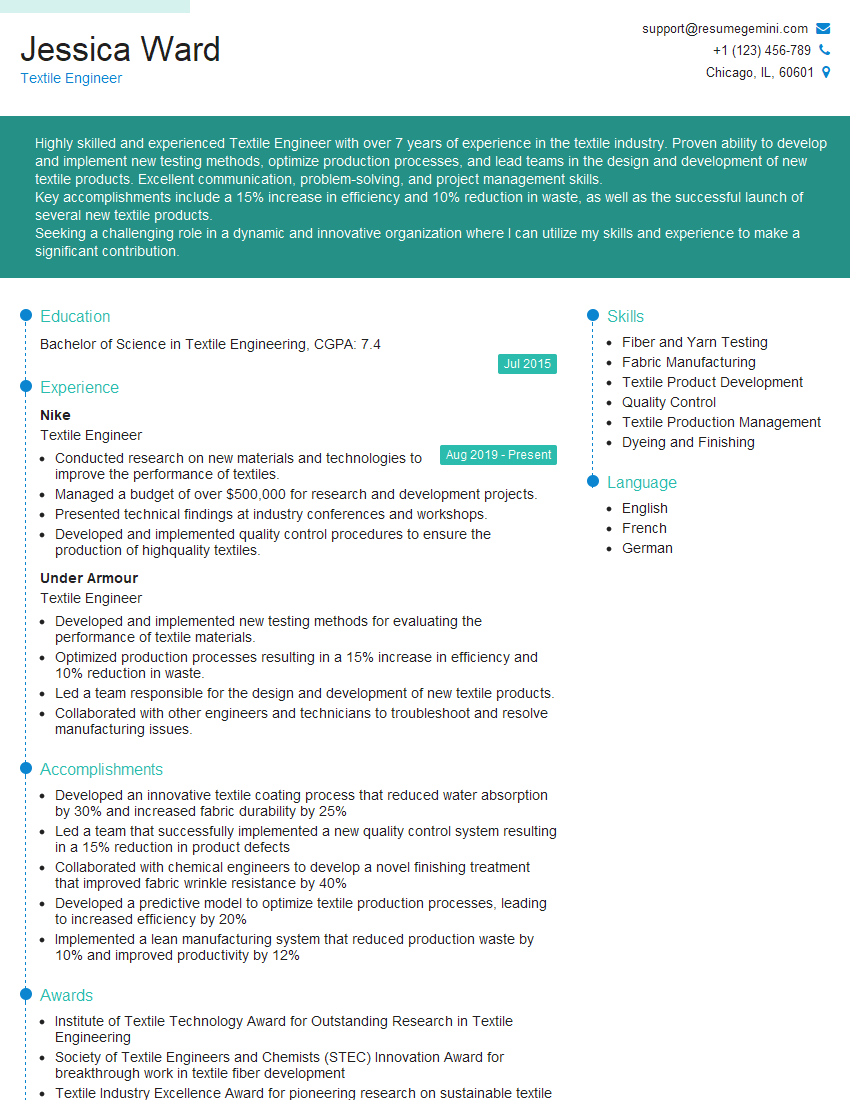
Mastering Textile Product Innovation is crucial for a thriving career in this dynamic industry. It demonstrates your ability to create innovative, sustainable, and high-performing textile products that meet evolving market demands. To significantly boost your job prospects, it’s essential to create a strong, ATS-friendly resume that highlights your skills and experience effectively. We highly recommend using ResumeGemini to build a professional and impactful resume. ResumeGemini provides tools and resources to create a resume that stands out, and we offer examples of resumes tailored specifically to Textile Product Innovation to help you get started.
Explore more articles
Users Rating of Our Blogs
Share Your Experience
We value your feedback! Please rate our content and share your thoughts (optional).
What Readers Say About Our Blog
To the interviewgemini.com Webmaster.
Very helpful and content specific questions to help prepare me for my interview!
Thank you
To the interviewgemini.com Webmaster.
This was kind of a unique content I found around the specialized skills. Very helpful questions and good detailed answers.
Very Helpful blog, thank you Interviewgemini team.