The right preparation can turn an interview into an opportunity to showcase your expertise. This guide to Tile Trimming and Cutting Techniques interview questions is your ultimate resource, providing key insights and tips to help you ace your responses and stand out as a top candidate.
Questions Asked in Tile Trimming and Cutting Techniques Interview
Q 1. What types of tile cutters are you familiar with?
As a seasoned tile professional, I’m proficient with a variety of tile cutters, each suited for different materials and cutting needs. These include:
- Manual Tile Cutters: These are great for straight cuts on smaller tiles, offering a cost-effective solution for DIY projects or small jobs. They involve scoring the tile and snapping it along the score line.
- Wet Saws: Essential for cutting porcelain, ceramic, and natural stone tiles. The water cools the blade, preventing overheating and chipping, and creates a cleaner, more precise cut, especially for intricate designs or angled cuts.
- Angle Grinders with Diamond Blades: These powerful tools are ideal for rough cuts, demolition work, and cutting through particularly dense materials. They require more skill and safety precautions, but offer excellent versatility.
- Electric Tile Cutters (with Scoring Wheels): Combining the ease of use of a manual cutter with the power of electric scoring, these are good for frequent straight cuts on various tile types.
- Laser Tile Cutters: These high precision machines offer extremely accurate cuts, perfect for complex designs and mosaics.
My experience allows me to select the most appropriate tool for the job, maximizing efficiency and minimizing waste.
Q 2. Explain the process of wet cutting porcelain tile.
Wet cutting porcelain tile is crucial for achieving clean, precise cuts and preventing chipping, especially given its hardness. The process is as follows:
- Choose the right saw: A wet saw with a diamond blade specifically designed for porcelain is essential. The blade’s grit should match the tile’s hardness.
- Secure the tile: Position the tile firmly against the saw’s fence, ensuring it’s properly aligned with your desired cut line.
- Start the saw and make the cut: Slowly and steadily guide the tile through the blade. Avoid forcing the cut. The water keeps the blade cool, reducing friction and preventing chipping.
- Clean up: After cutting, rinse the tile and blade to remove excess debris.
Remember, consistent pressure and a slow, controlled pace are key to achieving a clean, precise cut. Rushing the process often leads to errors.
Q 3. How do you accurately measure and cut tiles for intricate designs?
Accurate measurement is paramount for intricate designs. I typically start by sketching the design to scale, calculating the exact dimensions of each tile piece needed. I then:
- Use precision measuring tools: A steel ruler, tape measure, and a good quality square are essential for accurate measurements. For very fine details, calipers are invaluable.
- Create templates: For complex shapes, I’ll create cardboard or plastic templates to ensure precise cutting. This minimizes errors and ensures consistency between identical pieces.
- Utilize a wet saw for complex cuts: The wet saw provides the control and precision needed to execute angled, curved, and other intricate cuts.
- Test cuts: Especially for valuable materials or intricate designs, I make test cuts on scrap tile to fine-tune the cut before working on the actual tiles.
Careful planning and methodical execution are key to successfully handling intricate tile designs.
Q 4. Describe your experience with different tile materials (e.g., ceramic, porcelain, natural stone).
My experience spans a wide range of tile materials:
- Ceramic: Relatively easy to cut with various tools; less prone to chipping than porcelain.
- Porcelain: Much harder and denser than ceramic, requiring a wet saw and specialized diamond blades for optimal results. Chipping can be a common issue if not handled correctly.
- Natural Stone (Marble, Granite, etc.): Requires specialized blades and tools due to their varying hardness and potential for cracking. Wet cutting is almost always necessary. Some stones require specific techniques to avoid damage to their surface.
Understanding the unique properties of each material is crucial for selecting the correct tools and techniques to avoid damage and ensure a high-quality finish. For example, I might use a different blade for cutting granite versus marble, adjusting the cutting speed and water flow accordingly.
Q 5. What safety precautions do you take when using tile cutting tools?
Safety is my top priority. When using tile cutting tools, I always:
- Wear appropriate safety gear: This includes safety glasses, dust mask (especially when cutting natural stone), hearing protection, and work gloves.
- Use the right tool for the job: Avoid using tools beyond their capabilities or intended purpose.
- Secure the workpiece: Ensure the tile is firmly held in place during cutting to avoid kickback or accidents.
- Maintain tools properly: Regularly inspect and maintain tools to ensure they are in good working order.
- Work in a well-ventilated area: Dust from cutting can be harmful, so adequate ventilation is vital, particularly when working with stone.
I believe that safety is not just a protocol, it’s a mindset; preventing accidents starts with preparation and awareness.
Q 6. How do you handle uneven surfaces when installing tiles?
Uneven surfaces require careful preparation before tile installation. I use several methods to address this:
- Self-leveling compound: For significant variations in the substrate, a self-leveling compound creates a smooth, even surface for tile installation.
- Backer board: Provides a stable and even base over uneven subfloors. This is crucial for preventing future cracking and ensuring a long-lasting installation.
- Thin-set mortar: Applying thin-set mortar correctly compensates for minor imperfections. It acts as an adhesive and provides flexibility.
- Checking level throughout the process: Frequent level checks are done to ensure a flat, level surface.
Proper preparation of the subfloor is vital for a successful tile installation; overlooking unevenness will almost certainly lead to problems down the line.
Q 7. What methods do you use for trimming tiles around corners and curves?
Trimming tiles around corners and curves requires precision and specialized techniques:
- Angle grinder with diamond blade: For precise cuts on curves, a small angle grinder offers maneuverability. The process often needs to be done in small increments.
- Wet saw with flexible blade: Although challenging, a wet saw with a specialized flexible blade can negotiate gentler curves.
- Nibblers: Used for small adjustments and trimming tiles to fit snugly in tight spaces.
- Template method: Creating a template from cardboard or flexible material and using it to guide the cutting helps with complex curves.
Patience and attention to detail are key to successful corner and curve trimming. Often, these areas require multiple cuts and adjustments to fit perfectly.
Q 8. How do you ensure consistent tile spacing and alignment?
Consistent tile spacing and alignment are crucial for a professional-looking finish. Think of it like building with LEGOs – if the bricks aren’t aligned, the whole structure looks sloppy. I achieve this through a combination of techniques. First, I use spacers of consistent thickness, usually plastic crosses, placed between each tile during installation. These ensure uniform grout lines. Secondly, I meticulously check alignment using a level and a straight edge frequently throughout the process. For larger areas, I establish a perfectly straight baseline using a laser level or a long straight edge and string line. This baseline serves as a reference point for all subsequent tile placement. Finally, I always double-check my work before grouting, making minor adjustments as needed. Any inconsistencies caught early are much easier to fix than after the grout has set.
Q 9. What techniques do you employ for cutting mitered edges?
Mitering tile edges, creating a 45-degree angle where two tiles meet, requires precision. I primarily use a wet saw for this, as it offers the cleanest and most accurate cuts. The key is to make two precise cuts at exactly 45 degrees, one on each tile, ensuring the cut faces are perfectly flat and clean. This often involves multiple passes with the saw, using a slow and steady feed rate to avoid chipping. Before making the cuts, I carefully measure and mark the tiles. It’s crucial to understand the tile material, as harder tiles require different blade types and speeds. Sometimes, for intricate designs or smaller tiles, a tile nipper can be used, though achieving the perfect 45-degree miter with this tool requires experience and practice.
Q 10. Explain your process for dealing with broken or damaged tiles during installation.
Broken or damaged tiles are unfortunately a reality. My approach is to always order extra tiles, anticipating potential breakage during transport or installation. When a tile does break, I assess the damage. If it’s a small chip and the tile is in an inconspicuous area, I might be able to carefully fill the chip using a specialized epoxy resin and matching pigment. However, if the damage is significant or in a prominent location, I’ll replace the tile completely. It’s always better to replace a damaged tile rather than compromise the overall aesthetic appeal of the finished job. Before replacing, I carefully remove the broken tile, ensuring that no damage occurs to surrounding tiles or the substrate.
Q 11. How do you handle different tile thicknesses during installation?
Varying tile thicknesses can present challenges. Inconsistent thicknesses lead to uneven surfaces and difficulties in grouting. To address this, I carefully check the thickness of each tile batch before installation, especially if using tiles from different manufacturers or collections. If thickness variations are significant, I might need to adjust the thinset mortar bed to ensure an even surface. A thicker bed can compensate for thinner tiles, while a thinner bed can be used for thicker tiles. This process requires careful attention to detail and may involve using a level or straightedge to check for inconsistencies throughout the installation process. Using a consistent thinset application across the board helps to level out any minor differences in tile thickness.
Q 12. Describe your experience with using a tile nipper.
A tile nipper is a great tool, especially for making quick, precise cuts on smaller tiles, or for snapping off small pieces to create intricate designs. I use it regularly for trimming edge tiles, making curved cuts or adjustments, and for creating small notches for pipes and fixtures. It is a manual tool so precision is very important, especially while making the initial score. The benefit of a nipper is its portability and ease of use for smaller jobs where a wet saw might be overkill. However, it’s not ideal for straight cuts on larger tiles or for tiles of high hardness, and it may cause more chipping than a wet saw. Using a nipper successfully involves making a clean score across the tile before snapping. A clean score reduces the risk of breakage and ensures a straight cut. Years of experience with a nipper give me great control.
Q 13. What are the advantages and disadvantages of using a wet saw versus a dry cutter?
Wet saws and dry cutters each have their pros and cons. A wet saw, which uses water to cool the blade and reduce dust, is ideal for precise cuts, especially on ceramic and porcelain tiles. The water helps prevent chipping and creates a cleaner, smoother edge. However, they are more expensive, require more setup time, and need a water source. Dry cutters are portable, less expensive, and require less setup, making them suitable for smaller jobs and quick cuts. However, they produce considerably more dust and are more likely to chip hard tiles. The choice depends on the project scope, tile type, and desired level of precision. For large, intricate jobs with hard tiles, a wet saw is preferred, while a dry cutter might suffice for a smaller, less demanding project.
Q 14. How do you select the appropriate cutting tool for a specific tile type?
Selecting the right cutting tool depends entirely on the tile type and the type of cut required. For example, delicate mosaic tiles would benefit from a tile nipper. Porcelain or ceramic tiles, especially those that are large and need precise cuts, are best cut with a wet saw using a diamond blade suitable for the material’s hardness. Glass tiles might require a specialized glass cutter. Natural stone tiles, like marble or granite, often benefit from a wet saw with a diamond blade specifically designed for stone, as these materials can be more brittle and prone to chipping. Always consult the manufacturer’s recommendations or a tile professional for guidance when working with unique tile materials.
Q 15. Explain your experience with scoring and snapping tiles.
Scoring and snapping is a technique primarily used for straight cuts on ceramic and porcelain tiles, especially thinner ones. It’s a less abrasive method than wet sawing, resulting in cleaner breaks and minimizing dust. The process involves scoring the tile’s surface with a scoring tool, creating a controlled fracture point. Then, applying even pressure on either side of the score line, the tile snaps cleanly along the score.
My experience spans years of working with various tile types and sizes. I’ve refined my technique to account for tile thickness and material hardness. For example, harder porcelain tiles require a deeper, more precise score compared to softer ceramic tiles. I always ensure the scoring tool is sharp to prevent chipping or uneven breaks. A firm, even pressure during the snapping process is crucial; jerky movements can lead to messy breaks. I often use tile nippers for smaller, more intricate snapping tasks.
For instance, recently I needed to cut several 12×24 inch ceramic tiles to fit around a doorway. Using a tile scorer and snapping method, I consistently achieved clean, precise cuts, minimizing waste and saving time compared to wet sawing each piece. This was particularly efficient given the quantity needed.
Career Expert Tips:
- Ace those interviews! Prepare effectively by reviewing the Top 50 Most Common Interview Questions on ResumeGemini.
- Navigate your job search with confidence! Explore a wide range of Career Tips on ResumeGemini. Learn about common challenges and recommendations to overcome them.
- Craft the perfect resume! Master the Art of Resume Writing with ResumeGemini’s guide. Showcase your unique qualifications and achievements effectively.
- Don’t miss out on holiday savings! Build your dream resume with ResumeGemini’s ATS optimized templates.
Q 16. Describe your method for cutting tiles for bullnose applications.
Cutting tiles for bullnose applications requires precision to create a smoothly rounded edge. While a wet saw can achieve this, for smaller radii or specific designs, I prefer a combination of techniques. First, I use a wet saw to cut the tile to the desired length. Then, I utilize a tile bullnose molding bit on an angle grinder or a specialized bullnose grinder, carefully shaping the edge to the required curve. The key is to use multiple passes with light pressure to avoid chipping and ensure a smooth finish.
The choice of tools depends on the tile material and the radius of the bullnose. For harder porcelain tiles, a diamond-tipped bit on a wet saw is preferable for initial shaping before using the bullnose bit. With softer ceramic tiles, a careful approach with the bullnose bit can achieve the desired outcome. Safety is paramount here – always wear appropriate safety equipment, including eye protection and dust masks.
I remember a recent project where I needed bullnose tiles to finish a shower. By using this method, I was able to create a consistently smooth and attractive finish, matching the curve of the shower’s design precisely. It required patience and a steady hand but resulted in a professional look that the client was thrilled with.
Q 17. How do you manage waste and disposal of tile materials?
Waste management and disposal of tile materials are critical aspects of responsible tiling practices. My approach starts with careful planning and accurate cutting to minimize waste. I always measure twice and cut once! For larger projects, I create detailed cutting layouts to optimize material usage.
Leftover tile pieces, even small ones, are often reusable for creating mosaics or patching small areas. For disposal, I segregate materials appropriately. Waste tile is typically disposed of in designated construction and demolition waste containers. This follows local regulations and environmental considerations. Packaging materials are recycled whenever possible. I also take care to minimize dust generation during cutting, using wet saws or vacuum attachments to control airborne particles.
During a recent large-scale renovation, I implemented a meticulous waste management plan, resulting in minimal waste sent to landfills and high client satisfaction due to my environmentally conscious approach.
Q 18. What are some common problems encountered when cutting tiles, and how do you solve them?
Common problems encountered when cutting tiles include chipping, cracking, and uneven cuts. Chipping often results from dull blades, improper scoring, or excessive pressure. Cracking can be caused by applying uneven pressure during snapping or using an inappropriate cutting method for the tile type. Uneven cuts are usually due to a lack of precision in guiding the cutting tool.
To solve these problems, I ensure my blades are sharp and regularly inspected. For chipping, I use a wet saw with appropriate blades for the tile type, and apply consistent pressure. To prevent cracking, I use proper scoring techniques and apply even pressure when snapping. To achieve clean, precise cuts, I use appropriate jigs, guides, or templates, especially when cutting curves or angles. If problems persist, I may use a different cutting method altogether – for example switching to a wet saw for intricate cuts.
In one instance, I experienced significant chipping when working with a particularly brittle porcelain tile. By switching to a diamond-tipped blade and reducing cutting speed, I was able to eliminate the problem and achieve the desired results.
Q 19. How do you ensure accurate cuts when working with large format tiles?
Cutting large-format tiles requires specialized equipment and a precise approach. I typically utilize a large-format wet saw equipped with a diamond blade designed for the specific tile type. Before making any cuts, I meticulously measure and mark the tile, using a precise measuring tape and a sharp pencil or marker. I also ensure the tile is securely clamped to the saw’s bed to prevent movement during cutting.
For accurate cuts, I often use a straight edge or a laser level to guide the blade along the cut line. Slow and steady cuts are essential, allowing the blade to do the work. Avoiding excessive pressure prevents chipping or cracking. I may also utilize a jig for repetitive cuts to ensure consistency. Post-cutting, I carefully inspect the edges for any imperfections and make minor adjustments if necessary.
Recently, I was tasked with cutting several large-format marble tiles for a kitchen backsplash. By utilizing a large-format wet saw and paying meticulous attention to detail, I was able to make precise cuts, resulting in a stunning and perfectly aligned backsplash installation.
Q 20. What is your experience with using angle grinders for tile cutting?
Angle grinders with diamond blades are versatile tools for tile cutting, particularly for curved cuts, intricate shapes, and on-site modifications. My experience includes using angle grinders for both wet and dry cutting, although I prefer wet cutting to minimize dust and extend blade life. For wet cutting, I typically use a water-fed attachment to supply a constant stream of water to the blade, keeping it cool and reducing dust.
Angle grinders require a steady hand and careful control to avoid accidents. Safety precautions are crucial – protective eyewear, hearing protection, and a dust mask are essential regardless of wet or dry cutting. The blade selection is critical; different blades are designed for different tile materials and cutting applications. I always select the appropriate blade based on the hardness of the tile.
I recall using an angle grinder to cut intricate curves in mosaic tiles for a bathroom floor. With the correct technique and safety measures, the grinder enabled me to create the precise shapes required for this design, a task that would have been difficult or impossible with other tools.
Q 21. Describe your approach to cutting tiles around plumbing fixtures.
Cutting tiles around plumbing fixtures requires a precise and patient approach. I start by carefully measuring and marking the tile around the fixture, leaving enough space for the fixture to fit properly. I prefer using a wet saw with a blade appropriate for the tile type. For tight spaces or curves, I may use an angle grinder with a diamond blade or specialized tile nippers.
The key is to make several small cuts rather than one large cut, allowing for adjustments along the way. I frequently use a combination of straight cuts and curved cuts to accurately fit the tile around the fixture. Patience and accuracy are key, ensuring a clean and precise fit without damage to the tile or fixture. Template creation can be highly beneficial for consistent results on multiple fixtures.
In one instance, I had to cut tiles around a complex shower valve. By making several small, controlled cuts and taking my time, I was able to create a perfect fit, ensuring a professional, watertight installation.
Q 22. How do you maintain your tile cutting tools?
Maintaining tile cutting tools is crucial for precision and longevity. Think of your tools as precision instruments – the sharper they are, the cleaner the cut, and the less effort you need. My routine involves a multi-step process:
- Cleaning: After each use, I thoroughly clean all tools, removing dust, grout, and any adhesive residue. A stiff brush and compressed air are invaluable for this. For wet saws, I flush the blade and water reservoir with clean water.
- Sharpening: Diamond blades, while durable, eventually dull. I regularly sharpen wet saw blades using a dedicated sharpening tool, following the manufacturer’s instructions precisely. For hand tools like nippers, I use a sharpening stone, keeping a consistent angle for optimal performance.
- Storage: Proper storage prevents damage and corrosion. I keep my tools in a dry, secure location, away from moisture and extreme temperatures. Blades are stored individually to prevent chipping.
- Regular Inspection: Before each project, I inspect all tools for damage, cracks, or wear and tear. A damaged tool can lead to inaccurate cuts and potential injury.
This meticulous approach ensures my tools remain in top condition, leading to consistent, high-quality work on every project.
Q 23. What are the best practices for storing tiles before and during installation?
Proper tile storage is paramount to avoid damage and ensure a smooth installation. Think of it as protecting your investment before you even start tiling. My approach focuses on two key phases:
- Before Installation: Tiles should be stored flat on a clean, level surface, preferably in their original packaging. This prevents warping or cracking. Avoid stacking tiles too high to prevent pressure damage. I also acclimate tiles to the room temperature for at least 24 hours before installation to minimize expansion and contraction issues.
- During Installation: Once opened, tiles should be organized in a way that allows easy access during installation. I often use a combination of staging areas close to the work area and clearly labeled containers to keep different types or sizes separated. This ensures I’m not searching for the right tile mid-installation, leading to delays and potential mistakes.
This two-pronged approach minimises waste and ensures that the tiles arrive in perfect condition for installation, resulting in a beautiful and durable finished product.
Q 24. Explain your understanding of different tile patterns and layouts.
Understanding tile patterns and layouts is essential for creating visually appealing and functional spaces. It’s like creating a beautiful mosaic. I’m proficient in various patterns, including:
- Running Bond: The simplest, with tiles laid in parallel rows, offsetting each subsequent row for a classic look.
- Stack Bond: Tiles laid in straight rows, ideal for a modern, clean aesthetic.
- Herringbone: Tiles arranged in a V-shape, creating a sophisticated pattern.
- Diagonal: Tiles laid at a 45-degree angle, adding dynamism to a space.
- Basketweave: Two tiles arranged to resemble a woven basket, offering visual interest.
I can adapt these basic layouts to more complex designs, taking into account factors like room dimensions, tile size, and the client’s aesthetic preferences. I always create a detailed layout plan before starting any project to ensure the pattern is balanced and aesthetically pleasing. This is crucial to avoid miscalculations and to anticipate any required cuts.
Q 25. How do you ensure the longevity and durability of your tile installations?
Ensuring the longevity and durability of tile installations involves attention to detail at every stage. It’s about building a strong foundation, both literally and figuratively. Key aspects include:
- Proper Substrate Preparation: A level and stable substrate is paramount. Any imperfections can lead to cracking or uneven settling. This often involves using a self-leveling compound to create a perfectly smooth surface before installation.
- Appropriate Adhesive: Using the right adhesive for the substrate and tile type is crucial. I always consult the manufacturer’s recommendations to ensure proper bonding.
- Correct Grouting: Grout selection should consider factors like water resistance and durability. Proper grouting technique is essential to prevent water penetration and ensure the long-term integrity of the installation. I always use proper tools for grouting, ensuring thorough filling and removal of excess grout.
- Expansion Joints: Including expansion joints accounts for tile movement due to temperature changes and prevents cracking. These joints are crucial for larger installations.
By following these steps diligently, I ensure my installations are resilient, beautiful, and built to last for years to come.
Q 26. What are some common mistakes to avoid when cutting tiles?
Avoiding common mistakes when cutting tiles is essential for preventing waste and ensuring a professional finish. Some common pitfalls include:
- Using Dull Blades: A dull blade leads to chipping and inaccurate cuts. Regular sharpening is crucial.
- Incorrect Scoring Depth: For manual scoring, ensuring a complete score line is important. An incomplete score can lead to a jagged break.
- Applying Too Much Pressure: Excessive force can cause cracks and breakage, particularly with delicate tiles.
- Ignoring Safety Precautions: Always wear safety glasses and a dust mask when cutting tiles.
- Improper Tile Support: Always ensure the tile is securely supported during cutting to prevent breakage.
By avoiding these issues, I ensure clean, precise cuts and minimal waste, leading to a superior end result.
Q 27. Describe your experience with using a laser level for accurate tile installation.
A laser level is an invaluable tool for ensuring accurate tile installation, particularly for larger projects or installations requiring perfectly level surfaces. It’s like having a highly precise guide for every tile. I use it to:
- Establish a Level Baseline: The laser level helps establish a perfectly level starting point for the entire installation, ensuring consistent height throughout the project.
- Check for Plumbness: It aids in creating vertical lines for wall installations, ensuring tiles are perfectly aligned.
- Verify Tile Placement: It helps ensure tiles are placed at the correct height and alignment, minimizing errors and ensuring a visually pleasing result.
The increased accuracy offered by a laser level significantly enhances the professionalism and quality of the final installation. It’s a significant time-saver, and minimizes the need for corrections later on.
Q 28. How do you handle customer requests or changes during a tile installation project?
Handling customer requests or changes during a project requires clear communication and flexibility. It’s about finding solutions that meet both the project’s requirements and the client’s vision. My approach involves:
- Open Communication: I maintain constant communication with clients, proactively discussing potential issues and addressing concerns promptly.
- Assessing Feasibility: I carefully evaluate the feasibility of any requested changes, considering factors like cost, time, and the impact on the overall design.
- Providing Alternatives: If a change isn’t feasible, I propose alternative solutions that achieve a similar aesthetic or functional outcome.
- Documenting Changes: All changes are documented in writing, updating the project plan and ensuring both myself and the client are on the same page.
- Managing Expectations: I transparently discuss any potential delays or cost implications associated with the changes.
This proactive and transparent approach ensures a smooth project completion while maintaining a positive client relationship.
Key Topics to Learn for Tile Trimming and Cutting Techniques Interview
- Understanding Tile Materials: Different tile types (ceramic, porcelain, natural stone) and their specific cutting requirements. Knowing the properties of each material is crucial for selecting the right tools and techniques.
- Choosing the Right Tools: Mastering the use of various cutting tools, including wet saws, tile nippers, angle grinders, and hand-held scoring tools. Understanding the strengths and limitations of each tool is essential for efficient and precise cuts.
- Accurate Measurement and Marking: Precise measurement techniques to ensure accurate cuts and minimal waste. Understanding how to mark tiles for straight cuts, angled cuts, and intricate designs.
- Cutting Techniques: Proper techniques for straight cuts, miter cuts, curves, and coping. This includes understanding blade selection, water usage (where applicable), and speed control for optimal results.
- Safety Procedures: Safe handling of cutting tools, appropriate personal protective equipment (PPE), and workplace safety regulations. Demonstrating a commitment to safety is paramount in this field.
- Troubleshooting Common Issues: Identifying and resolving common problems encountered during tile cutting, such as chipping, cracking, or inaccurate cuts. This demonstrates practical problem-solving skills.
- Finishing Techniques: Understanding methods for achieving a polished and professional finish, including edge finishing and dealing with imperfections.
- Tile Layout and Planning: Understanding how to plan tile layouts to minimize cuts and waste, including considerations for patterns and transitions.
Next Steps
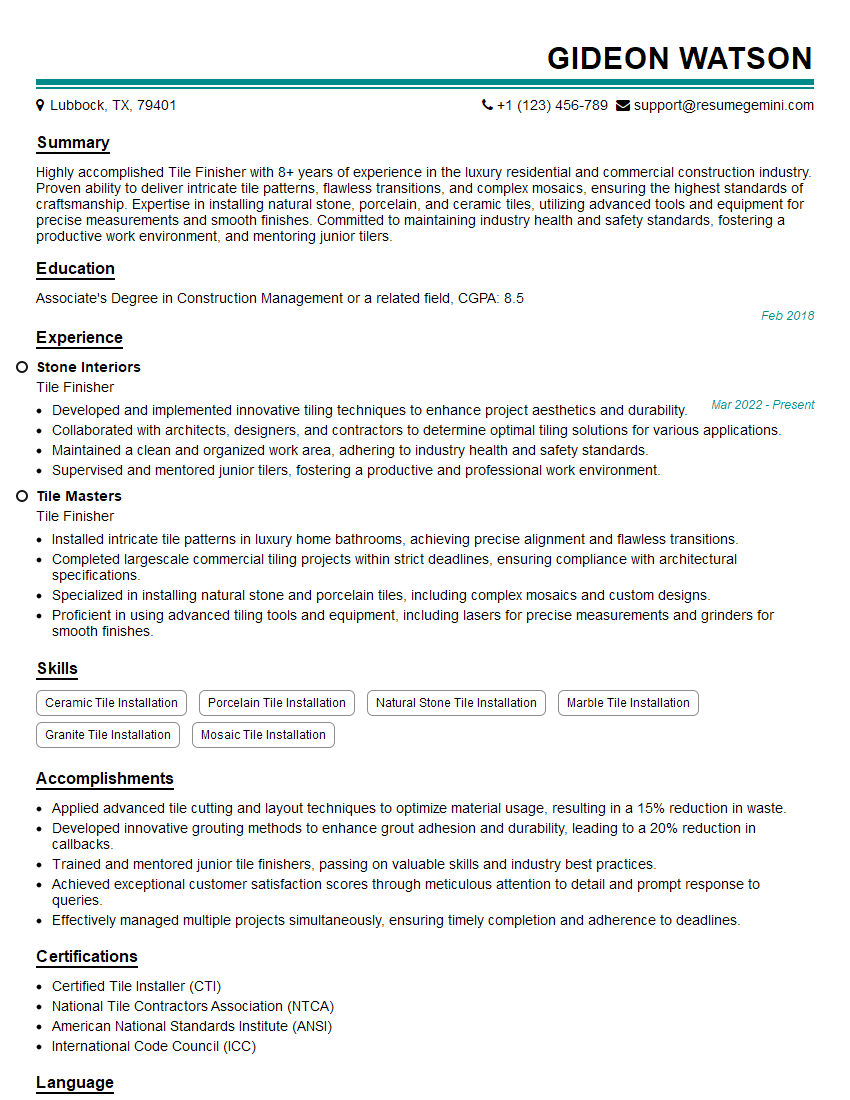
Mastering tile trimming and cutting techniques is vital for career advancement in the tiling industry. Proficiency in these skills demonstrates your expertise and commitment to quality workmanship, opening doors to higher-paying positions and more challenging projects. To increase your job prospects, it’s crucial to have an ATS-friendly resume that highlights your skills and experience effectively. ResumeGemini is a trusted resource that can help you craft a professional and impactful resume tailored to the tiling industry. Examples of resumes specifically tailored to showcasing expertise in Tile Trimming and Cutting Techniques are available to help you get started.
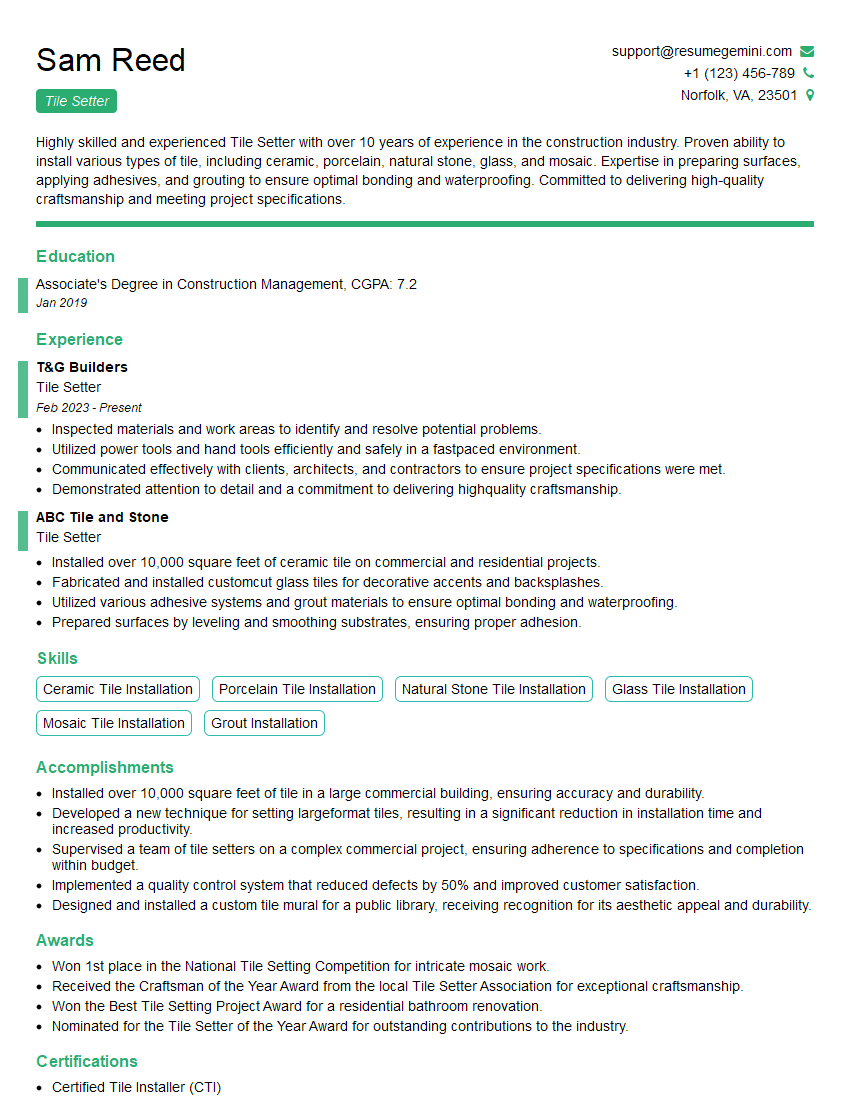
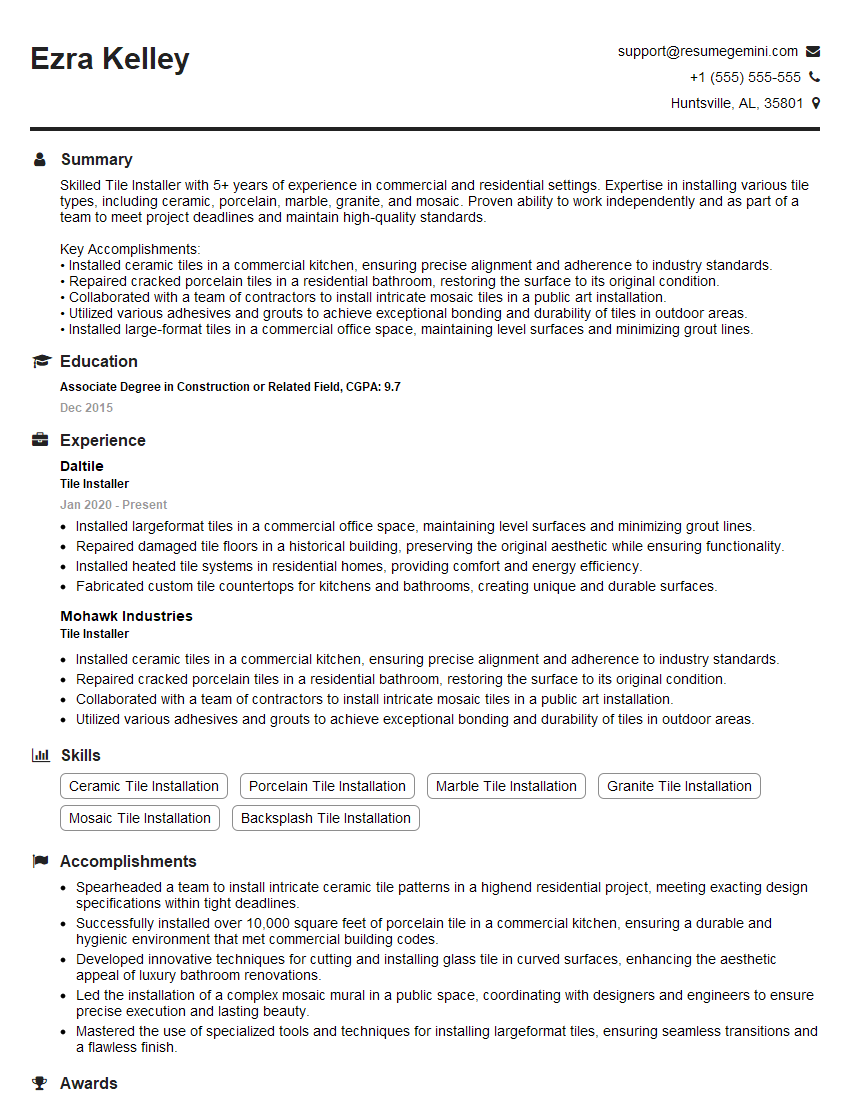
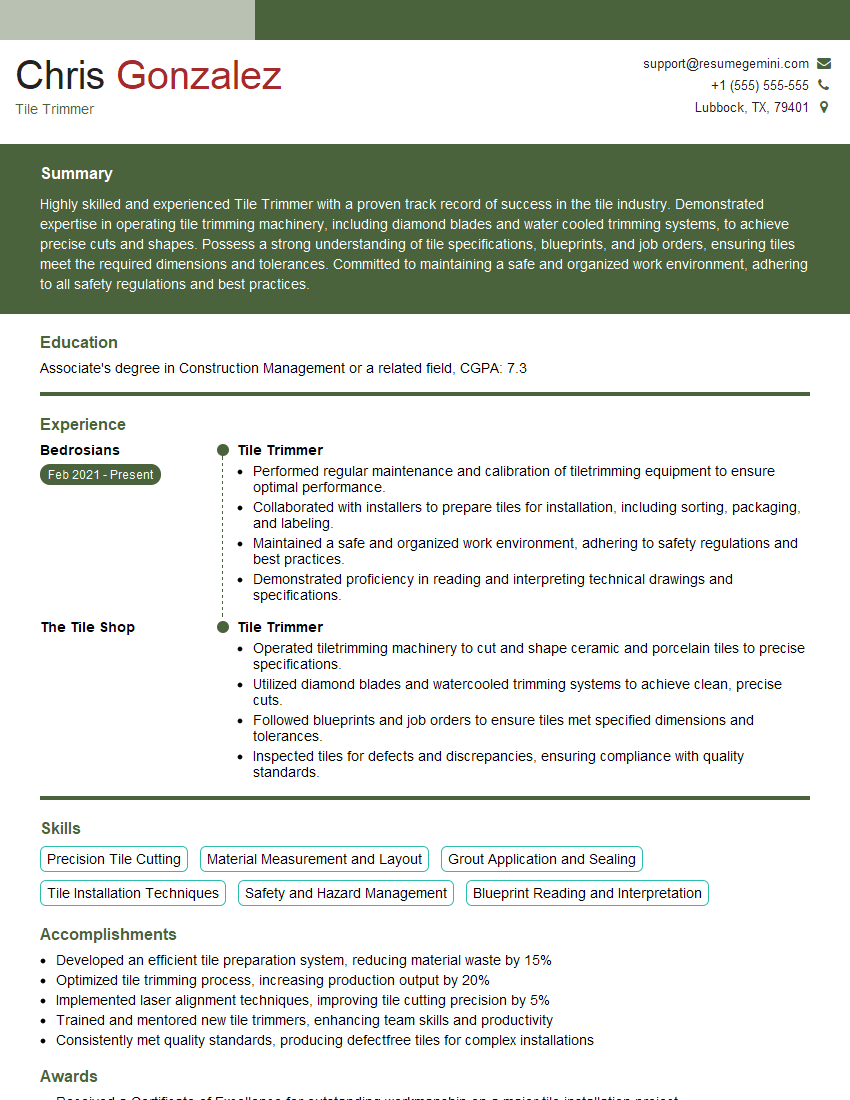

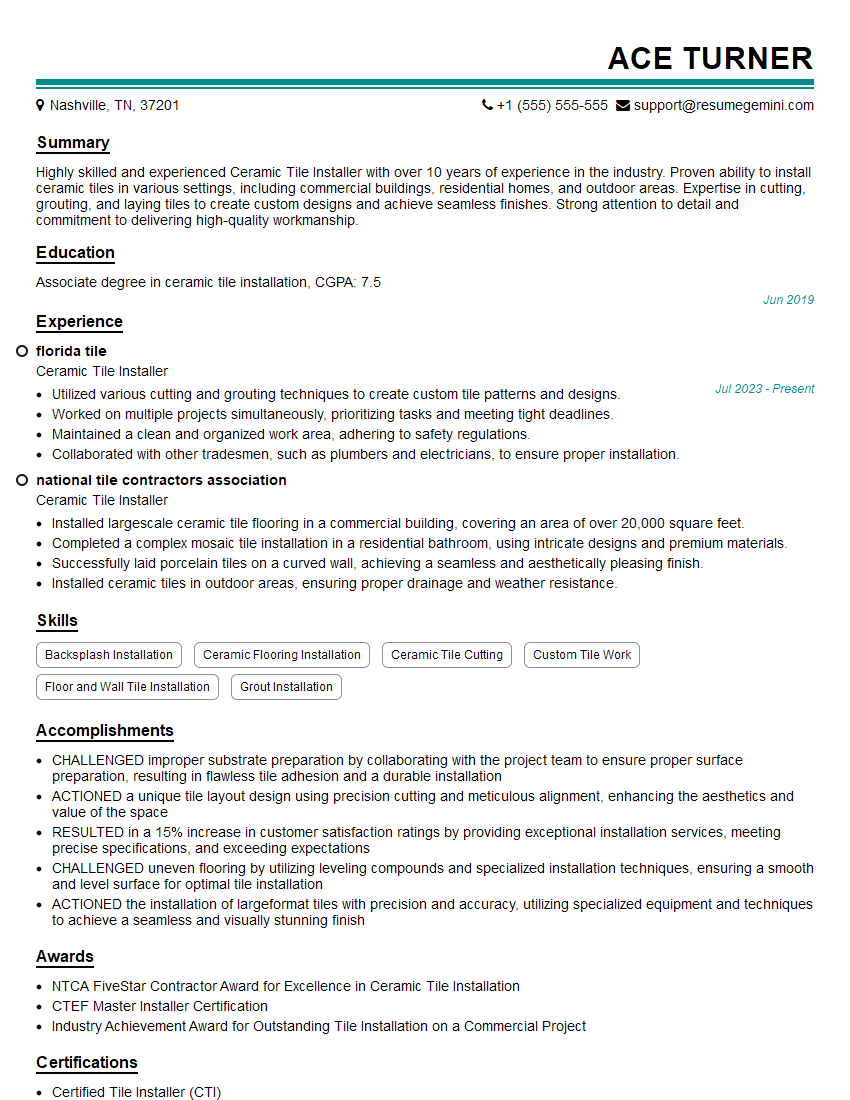
Explore more articles
Users Rating of Our Blogs
Share Your Experience
We value your feedback! Please rate our content and share your thoughts (optional).
What Readers Say About Our Blog
To the interviewgemini.com Webmaster.
Very helpful and content specific questions to help prepare me for my interview!
Thank you
To the interviewgemini.com Webmaster.
This was kind of a unique content I found around the specialized skills. Very helpful questions and good detailed answers.
Very Helpful blog, thank you Interviewgemini team.