Interviews are more than just a Q&A session—they’re a chance to prove your worth. This blog dives into essential Transfer Learning for Remote Sensing interview questions and expert tips to help you align your answers with what hiring managers are looking for. Start preparing to shine!
Questions Asked in Transfer Learning for Remote Sensing Interview
Q 1. Explain the concept of transfer learning and its advantages in remote sensing.
Transfer learning leverages knowledge gained from solving one problem to improve performance on a related but different problem. In remote sensing, this means training a model on a large, readily available dataset (e.g., ImageNet for general image features) and then fine-tuning it for a specific remote sensing task, such as land cover classification or object detection, using a smaller, task-specific dataset. This is advantageous because it significantly reduces the need for massive amounts of labeled remote sensing data, which is often expensive and time-consuming to acquire. It also accelerates the training process and often leads to improved accuracy, especially when the task-specific data is limited.
For instance, a model pre-trained on millions of natural images can effectively learn generic features like edges, textures, and shapes. These features are transferable to remote sensing images, providing a strong foundation for subsequent task-specific learning. This is particularly beneficial for tasks with limited labeled data, such as identifying rare land cover types or detecting specific objects in high-resolution imagery.
Q 2. Describe different transfer learning strategies applicable to remote sensing imagery.
Several transfer learning strategies are applicable to remote sensing imagery. These strategies primarily differ in how much of the pre-trained model is modified for the new task:
- Feature Extraction: Only the pre-trained model’s convolutional layers (feature extractors) are used. The final classification layers are replaced with new ones tailored to the remote sensing task. This is a simple and effective approach.
- Fine-tuning: Several layers of the pre-trained model are fine-tuned alongside new task-specific layers. This allows the model to adapt its learned features to the nuances of remote sensing data. The number of layers to fine-tune is a crucial hyperparameter.
- Domain Adaptation: This addresses the discrepancy between the source domain (where the pre-trained model was trained) and the target domain (remote sensing data). Techniques like adversarial domain adaptation try to minimize the difference in feature distributions between the two domains, improving performance on the target task.
Choosing the right strategy depends on the similarity between the source and target domains and the amount of labeled remote sensing data available. If the domains are very different or data is scarce, feature extraction might be safer. If they are similar and data is abundant, fine-tuning could yield better results.
Q 3. How would you choose a pre-trained model for a remote sensing task?
Selecting a pre-trained model for a remote sensing task requires careful consideration. Several factors are crucial:
- Dataset Similarity: The pre-trained model’s source dataset should have visual characteristics similar to remote sensing imagery. Models trained on natural images (e.g., ImageNet, Places365) are often good starting points, but models trained on aerial or satellite imagery might be even better if available.
- Model Architecture: Convolutional Neural Networks (CNNs) are the dominant architecture for image-based tasks. The choice depends on the specific task and data characteristics. For example, deeper networks like ResNet or Inception might be better for complex tasks, while simpler models might be preferred for smaller datasets to avoid overfitting.
- Availability and Accessibility: The pre-trained model should be easily accessible and readily available. Many pre-trained models are publicly available through frameworks like TensorFlow Hub or PyTorch Hub.
- Computational Resources: Larger models require more computational resources for training and inference. The choice should be balanced with available resources.
A practical approach involves experimenting with different pre-trained models and evaluating their performance on a validation set of the target remote sensing data. This allows you to choose the model that best suits your specific task and resources.
Q 4. Discuss the challenges of applying transfer learning to high-resolution remote sensing data.
High-resolution remote sensing data presents unique challenges for transfer learning. The sheer size of the images increases computational demands significantly, potentially making fine-tuning impractical without powerful hardware. High resolution also often introduces more variations in the imagery (e.g., greater detail and subtle variations in texture), requiring potentially more extensive fine-tuning or domain adaptation techniques to adapt the pre-trained model. The increased computational complexity also may lead to an increased chance of overfitting if not properly handled.
For example, classifying individual trees in a high-resolution image requires a much finer level of detail than classifying land cover types in a lower-resolution image. A model trained on lower-resolution imagery may not easily generalize to the finer details of high-resolution data without significant adaptation.
Q 5. Explain how to handle class imbalance in a remote sensing transfer learning project.
Class imbalance, where some land cover types or objects are far more prevalent than others in the remote sensing dataset, is a common problem. This can lead to biased models that perform poorly on the minority classes. Several techniques help address this:
- Data Augmentation: Increase the number of samples for minority classes by applying transformations like rotations, flips, or random crops to existing images. This helps balance the class distribution.
- Resampling: Techniques like oversampling (replicating minority class samples) or undersampling (removing samples from majority classes) can create a more balanced dataset. However, oversampling might lead to overfitting, and undersampling may result in information loss.
- Cost-Sensitive Learning: Assign higher weights to the loss function for minority classes during training. This encourages the model to pay more attention to these less-frequent classes. This can be implemented through class weights or focal loss functions.
- Ensemble Methods: Combine multiple models trained on different balanced subsets of the data. This improves the overall robustness and reduces bias.
The best approach depends on the severity of the imbalance and the characteristics of the dataset. Often, a combination of these techniques is the most effective.
Q 6. How do you address overfitting when using transfer learning in remote sensing?
Overfitting occurs when a model learns the training data too well, performing poorly on unseen data. Several strategies mitigate overfitting in remote sensing transfer learning:
- Regularization: Techniques like L1 or L2 regularization add penalties to the model’s loss function, discouraging overly complex models. Dropout randomly deactivates neurons during training, further preventing overfitting.
- Early Stopping: Monitor the model’s performance on a validation set during training. Stop training when the validation performance starts to degrade, preventing the model from overfitting the training data.
- Data Augmentation (as above): Increasing the diversity of the training data through augmentation makes the model more robust and less prone to overfitting.
- Transfer Learning Strategy Selection: Feature extraction might be preferred over full fine-tuning if the dataset is small, as it limits the number of trainable parameters, thereby reducing overfitting.
Careful hyperparameter tuning is essential to find the right balance between model complexity and generalization ability.
Q 7. What are the ethical considerations of using transfer learning in remote sensing applications?
Ethical considerations in remote sensing transfer learning are paramount. Bias in pre-trained models can propagate to downstream applications, leading to unfair or discriminatory outcomes. For example, a model trained predominantly on images from a specific geographic region might not generalize well to other regions, leading to inaccurate classifications or predictions. Similarly, biases in the training data related to socioeconomic factors could be reflected in the remote sensing outputs, affecting decisions in areas such as resource allocation or environmental monitoring.
To address these concerns, it’s crucial to:
- Ensure data diversity: Use pre-trained models trained on diverse datasets that represent different geographic locations and demographics. Analyze the training data for biases before using a pre-trained model.
- Transparency and explainability: Understand how the model makes predictions. Techniques like explainable AI (XAI) can help identify and mitigate potential biases.
- Accountability and responsibility: Developers and users of remote sensing transfer learning models should be accountable for the potential consequences of their applications. Consider the societal impact of decisions informed by the model’s outputs.
Responsible development and deployment of remote sensing transfer learning systems require a careful consideration of ethical implications throughout the entire lifecycle.
Q 8. Compare and contrast fine-tuning and feature extraction in transfer learning for remote sensing.
Fine-tuning and feature extraction are two primary strategies in transfer learning, both leveraging pre-trained models to improve performance on a new remote sensing task. However, they differ significantly in their approach.
Feature Extraction: In this method, we utilize the pre-trained model’s learned features (typically the output of a convolutional layer before the fully connected layers in a CNN) as input features for a new, smaller model trained specifically for the remote sensing task. Think of it as using a powerful microscope (the pre-trained model) to extract detailed information from an image, and then using that information to build a simpler classifier. We freeze the weights of the pre-trained model; only the new, smaller model is trained. This is computationally efficient and useful when dealing with limited labeled data.
Fine-tuning: Here, we unfreeze some or all of the layers of the pre-trained model and train the entire network on the new remote sensing dataset. This allows the model to adapt its learned features to the specific characteristics of the new data, leading to potentially higher accuracy. Imagine fine-tuning as taking the microscope (pre-trained model) and calibrating it further to become even better at observing the specifics of our new sample. This method requires more computational resources and labeled data, but often yields better performance when sufficient data is available.
In summary: Feature extraction is faster and requires less data but may limit accuracy. Fine-tuning is more computationally expensive and needs more data but can achieve higher accuracy.
Q 9. Describe your experience with different deep learning architectures (e.g., CNNs, RNNs) in remote sensing.
My experience encompasses a wide range of deep learning architectures applied to diverse remote sensing tasks. I’ve extensively used Convolutional Neural Networks (CNNs) for image classification and segmentation, leveraging architectures like ResNet, Inception, and U-Net. CNNs excel at capturing spatial hierarchies in imagery, making them ideal for analyzing satellite and aerial photos. For instance, I used a ResNet50 pre-trained on ImageNet and fine-tuned it for identifying different types of land cover (e.g., forest, urban, water) from Landsat 8 imagery achieving an overall accuracy of 92%.
I’ve also worked with Recurrent Neural Networks (RNNs), particularly LSTMs, for time-series analysis of remote sensing data. For example, I used LSTMs to analyze sequences of MODIS satellite data to predict crop yields over time, utilizing temporal dependencies to improve predictive accuracy. The choice of architecture heavily depends on the specific task and the nature of the remote sensing data.
Beyond CNNs and RNNs, I have explored hybrid architectures combining the strengths of both, such as CNN-LSTM models for tasks involving both spatial and temporal information.
Q 10. How do you evaluate the performance of a transfer learning model in remote sensing?
Evaluating a transfer learning model in remote sensing involves a rigorous process that goes beyond simply looking at accuracy. We typically employ a multi-faceted approach incorporating:
- Standard metrics: Accuracy, precision, recall, F1-score are fundamental metrics. We calculate these on a held-out test set to avoid overfitting.
- Confusion matrix: This provides a detailed breakdown of classification performance, highlighting specific classes where the model struggles.
- Receiver Operating Characteristic (ROC) curve and Area Under the Curve (AUC): These are crucial for evaluating the model’s ability to distinguish between different classes, especially when dealing with imbalanced datasets. A high AUC indicates excellent discrimination ability.
- Cross-validation: Techniques like k-fold cross-validation are used to ensure robustness and obtain more reliable performance estimates. This minimizes the impact of data variability on the evaluation results.
- Visual inspection: We examine misclassified samples to understand the model’s failure modes. Often this reveals patterns in the data that the model is struggling to generalize to.
The specific evaluation strategy is tailored to the task. For instance, in change detection tasks, we might evaluate based on metrics tailored for detecting changes accurately.
Q 11. What metrics are most relevant for evaluating a remote sensing classification model?
The most relevant metrics for evaluating a remote sensing classification model depend on the specific application, but some consistently important ones include:
- Overall Accuracy: The percentage of correctly classified pixels (or samples).
- Producer’s Accuracy (Recall): The percentage of pixels of a certain class that were correctly classified as that class. Important for assessing how well the model identifies pixels belonging to a specific class.
- User’s Accuracy (Precision): The percentage of pixels classified as a certain class that actually belong to that class. Important for understanding the reliability of the model’s classifications.
- F1-Score: The harmonic mean of precision and recall, providing a balanced measure of performance, particularly useful when dealing with imbalanced datasets.
- Kappa Coefficient: Measures the agreement between the model’s predictions and the ground truth, accounting for chance agreement.
- Intersection over Union (IoU): Specifically relevant for semantic segmentation tasks, measuring the overlap between predicted and ground-truth segmentation masks.
Choosing the right metrics is crucial for a fair and meaningful evaluation. For example, in an application where missing a certain class has severe consequences, recall for that specific class becomes paramount.
Q 12. Explain the difference between supervised, unsupervised, and semi-supervised transfer learning.
The type of training data significantly impacts transfer learning in remote sensing:
- Supervised Transfer Learning: This is the most common approach, using a labeled dataset from a source domain (e.g., a large dataset of satellite images with land cover annotations) to train a model, which is then fine-tuned or used for feature extraction on a smaller, labeled target domain dataset (e.g., images from a specific region with limited annotations).
- Unsupervised Transfer Learning: Here, we leverage unlabeled data from the source domain to learn general features about the data. These features can then be transferred to the target domain, either to improve performance on a downstream supervised task (e.g., using unlabeled aerial imagery to pre-train a model for a subsequent land cover classification task) or for unsupervised tasks such as clustering.
- Semi-Supervised Transfer Learning: This combines labeled data from the source domain with unlabeled data from either the source or target domain. This approach is particularly useful when labeled data is scarce. For instance, we might use a large labeled dataset of satellite images alongside a large set of unlabeled images from the target area to learn a robust model.
The choice between these approaches depends on data availability and the specific application requirements. Semi-supervised and unsupervised transfer learning are becoming increasingly important as labeled remote sensing data is often expensive and time-consuming to obtain.
Q 13. How do you handle noisy or incomplete remote sensing data in a transfer learning context?
Handling noisy or incomplete remote sensing data is critical for successful transfer learning. Strategies include:
- Data Cleaning: Identifying and removing or correcting obvious errors and outliers in the data. This might involve removing images affected by cloud cover, atmospheric effects, or sensor malfunctions.
- Preprocessing Techniques: Applying techniques like atmospheric correction, geometric correction, and noise reduction filters to improve data quality. This can involve removing or reducing noise such as salt-and-pepper noise or Gaussian noise.
- Robust Loss Functions: Employing loss functions less sensitive to outliers, such as Huber loss or trimmed mean loss, during the training process.
- Imputation Techniques: For missing data, strategies like k-Nearest Neighbors (k-NN) or interpolation can fill in missing values based on neighboring pixels or temporal patterns.
- Generative Adversarial Networks (GANs): GANs can be used to generate synthetic data to augment incomplete datasets, filling in missing regions or creating variations of existing data.
The choice of approach depends on the type and extent of noise or incompleteness in the data. Often, a combination of these techniques is necessary to achieve optimal results.
Q 14. Discuss the impact of data augmentation techniques on transfer learning in remote sensing.
Data augmentation is a powerful technique that significantly enhances the performance of transfer learning models in remote sensing by artificially increasing the size and diversity of the training dataset. In remote sensing, suitable techniques include:
- Geometric Transformations: Rotating, flipping, scaling, and cropping images to create variations while preserving the semantic information. This helps the model become more robust to variations in viewpoint and image resolution.
- Color Space Transformations: Converting images to different color spaces (e.g., HSV, LAB) or applying color jittering (randomly adjusting brightness, contrast, saturation) to increase robustness to variations in lighting conditions.
- Noise Injection: Adding different types of noise (Gaussian, salt-and-pepper) to simulate real-world conditions and make the model more robust to noisy data.
- Mixup: Linearly interpolating between different images and their labels to generate new, synthetic samples.
- Cutout/Random Erasing: Randomly removing parts of the image to make the model more robust to occlusions and missing information.
Careful consideration of the augmentation techniques is crucial; inappropriate augmentation can mislead the model. For example, excessive geometric transformations in hyperspectral data might damage spectral information. The effectiveness of data augmentation is highly dependent on the specific dataset and the task. Experimentation and validation are crucial to determine the optimal augmentation strategy.
Q 15. How do you select appropriate hyperparameters for a transfer learning model in remote sensing?
Selecting optimal hyperparameters for transfer learning in remote sensing is crucial for model performance. It’s an iterative process often involving a combination of experimentation and informed choices. We can’t just pick random values; instead, we leverage strategies like grid search, random search, and Bayesian optimization. The best approach depends on the complexity of the model and the computational resources available.
Grid Search: This systematically explores a predefined range of hyperparameter values. While exhaustive, it can be computationally expensive for high-dimensional hyperparameter spaces. For example, we might test learning rates (e.g., 0.001, 0.01, 0.1), batch sizes (e.g., 32, 64, 128), and dropout rates (e.g., 0.2, 0.5, 0.8).
Random Search: This method randomly samples hyperparameter values from a specified distribution. It’s often more efficient than grid search, especially when dealing with many hyperparameters. It prioritizes exploring a wider range of possibilities, potentially finding better performing combinations faster.
Bayesian Optimization: This sophisticated approach uses a probabilistic model to guide the search. It learns from past evaluations to intelligently select promising hyperparameter configurations, significantly reducing the number of experiments required. It’s particularly beneficial when computational resources are limited.
Practical Considerations: In remote sensing, the specific hyperparameters to tune often depend on the chosen pre-trained model (e.g., ResNet, Inception) and the task (e.g., classification, segmentation). For instance, a higher learning rate might be necessary for larger datasets, while a smaller batch size can be useful when dealing with memory constraints. We always validate our hyperparameter choices using a held-out validation set to prevent overfitting.
Career Expert Tips:
- Ace those interviews! Prepare effectively by reviewing the Top 50 Most Common Interview Questions on ResumeGemini.
- Navigate your job search with confidence! Explore a wide range of Career Tips on ResumeGemini. Learn about common challenges and recommendations to overcome them.
- Craft the perfect resume! Master the Art of Resume Writing with ResumeGemini’s guide. Showcase your unique qualifications and achievements effectively.
- Don’t miss out on holiday savings! Build your dream resume with ResumeGemini’s ATS optimized templates.
Q 16. Describe your experience with different deep learning frameworks (e.g., TensorFlow, PyTorch) in remote sensing.
I have extensive experience with both TensorFlow and PyTorch in remote sensing applications. My choice often depends on the specific project requirements and personal preference. Both frameworks provide robust tools for building and training deep learning models, but they have distinct strengths.
TensorFlow: TensorFlow, known for its production-ready deployment capabilities and comprehensive ecosystem of tools, is well-suited for large-scale projects and complex models. Its Keras API simplifies model building, making it easier to prototype and experiment with different architectures. I’ve used TensorFlow to develop models for land cover classification using Sentinel-2 imagery and for object detection in aerial imagery.
PyTorch: PyTorch’s dynamic computation graph and intuitive debugging capabilities make it an excellent choice for research-oriented projects and when flexibility is paramount. Its strong community support and readily available pre-trained models for image processing make it very attractive for remote sensing tasks. I’ve employed PyTorch to develop semantic segmentation models for hyperspectral data and for change detection using time-series satellite images.
Example (PyTorch): A simple code snippet for loading a pre-trained ResNet model in PyTorch might look like this:
import torch torchvision.models as models model = models.resnet18(pretrained=True)This line downloads a pre-trained ResNet18 model and makes it readily available for transfer learning.
Q 17. Explain your experience with cloud computing platforms (e.g., AWS, Google Cloud, Azure) for processing remote sensing data.
Cloud computing platforms like AWS, Google Cloud, and Azure are indispensable for processing large remote sensing datasets. Their scalable infrastructure and pre-built tools significantly accelerate the development and deployment of remote sensing applications.
AWS: I’ve extensively used AWS services such as EC2 (for virtual machines), S3 (for data storage), and SageMaker (for model training and deployment). The scalability of these services allows me to handle datasets that wouldn’t fit on a single machine. For instance, I’ve processed terabytes of Landsat data on AWS EC2 instances using parallel processing techniques.
Google Cloud: Google Cloud Platform offers similar capabilities, with Compute Engine (for VMs), Cloud Storage (for data storage), and AI Platform (for model training). I appreciate Google Earth Engine’s powerful geospatial analysis capabilities, enabling efficient analysis of global-scale datasets. I’ve used this platform for time-series analysis of deforestation patterns.
Azure: Azure’s virtual machines and cloud storage services have also proven valuable. Its integration with other Microsoft tools can be advantageous in specific workflows. I have used Azure for processing LiDAR data and generating digital elevation models.
Choosing a platform depends on factors like cost, familiarity with the tools, and specific requirements of the project. Each platform has its strengths, and understanding those nuances helps optimize the workflow.
Q 18. How do you deal with computational limitations when working with large remote sensing datasets?
Working with massive remote sensing datasets inevitably leads to computational challenges. To overcome these, I employ several strategies:
- Data Subsampling: Reducing the dataset size by carefully selecting representative samples is often the first step. This balances accuracy with computational feasibility.
- Parallel Processing: Distributing the processing load across multiple cores or machines is crucial. Tools like Dask and multiprocessing libraries in Python are invaluable here. I’ve implemented parallel processing for tasks like image classification and segmentation, dramatically reducing runtime.
- Data Augmentation: Generating synthetic data from existing data increases the training dataset size, leading to better generalization and reducing the need to process the entire dataset. Common techniques include rotations, flips, and color adjustments.
- Cloud Computing: Leveraging cloud platforms, as mentioned earlier, allows access to powerful computing resources on demand. This is particularly beneficial when dealing with extremely large datasets.
- Model Compression: Techniques like pruning, quantization, and knowledge distillation can reduce the model size and computational complexity while maintaining reasonable accuracy. This allows faster processing and reduces memory demands.
The optimal approach often involves a combination of these strategies, tailored to the specific dataset and computational constraints.
Q 19. Describe your experience with different types of remote sensing data (e.g., multispectral, hyperspectral, LiDAR).
My experience spans various remote sensing data types, each with unique characteristics requiring tailored processing techniques.
Multispectral Data (e.g., Landsat, Sentinel-2): This data consists of multiple spectral bands providing information about the reflectance of different wavelengths. I’ve used this extensively for land cover classification, vegetation monitoring, and urban planning. The lower spectral resolution requires careful feature engineering or deep learning architectures optimized for this type of data.
Hyperspectral Data (e.g., AVIRIS, HyMap): Hyperspectral imagery contains hundreds of narrow and contiguous spectral bands, offering detailed spectral information. I’ve applied this data for precision agriculture, mineral exploration, and environmental monitoring. The high dimensionality requires specialized dimensionality reduction techniques or deep learning architectures designed for hyperspectral data. Dealing with the “curse of dimensionality” is a key challenge.
LiDAR Data: LiDAR provides three-dimensional point cloud data capturing surface elevation and features. I’ve used LiDAR for generating digital elevation models, detecting changes in land surface, and mapping urban structures. Processing LiDAR involves techniques like point cloud filtering, classification, and segmentation, often requiring specific libraries and algorithms.
My experience allows me to leverage the unique strengths of each data type in solving complex remote sensing problems.
Q 20. Explain how you would approach a transfer learning project involving limited labeled data.
Transfer learning is particularly valuable when labeled data is scarce. The strategy involves leveraging knowledge from a related task with abundant labeled data to improve performance on a target task with limited labeled data. Here’s how I would approach such a project:
- Identify a suitable source domain: I would carefully select a dataset related to the target task but with significantly more labeled data. This could involve using a publicly available dataset for a similar geographic region or a related environmental context.
- Choose a suitable pre-trained model: I would select a pre-trained model architecture well-suited for both the source and target domains. Pre-trained models on large image datasets (e.g., ImageNet) provide a good starting point, allowing for efficient fine-tuning.
- Fine-tune the pre-trained model: I would adapt the pre-trained model to the target task by retraining the model’s final layers on the limited labeled target data. This allows the model to learn task-specific features while leveraging the general features learned from the source domain.
- Data Augmentation: With limited data, data augmentation is crucial. I would apply various augmentation techniques (rotations, flips, etc.) to increase the effective size of the training data and improve model robustness.
- Regularization Techniques: Techniques like dropout and weight decay would be employed to prevent overfitting, a major concern with small datasets.
- Evaluation and Tuning: The model’s performance would be rigorously evaluated on a separate validation set. Hyperparameters would be carefully tuned using techniques like cross-validation to optimize performance.
This approach ensures we leverage prior knowledge effectively, mitigating the challenges of limited labeled data.
Q 21. How do you ensure the generalizability of a transfer learning model trained on one dataset to another?
Ensuring generalizability is critical for transfer learning models. A model that performs well only on the training data is not useful. Here’s how I address this:
- Domain Adaptation Techniques: If the source and target domains differ significantly (e.g., different sensors, geographic locations), domain adaptation techniques are crucial. These techniques aim to reduce the domain discrepancy, allowing the model to generalize better. Methods include adversarial domain adaptation and domain invariant feature learning.
- Careful Data Selection: Representativeness is key. The source data should be carefully selected to minimize biases that could hinder generalization to the target domain. This might involve stratified sampling or selecting data that captures the variability in the target domain.
- Robust Model Architectures: Choosing model architectures known for their generalization capabilities is important. Models with inherent regularization or those employing techniques like batch normalization tend to generalize better.
- Cross-Validation: Rigorous cross-validation using different splits of the target data is essential to assess the model’s true generalization ability. This helps identify overfitting to specific subsets of the target data.
- Out-of-Distribution Detection: Developing methods to identify data points in the target domain that are significantly different from the source domain data is helpful. This can guide further refinement or even rejection of these samples.
By incorporating these strategies, we increase the likelihood that our transfer learning model will generalize well to new, unseen data in the target domain, making it a practical and reliable solution.
Q 22. Discuss your experience with deploying a remote sensing model into a production environment.
Deploying a remote sensing model to production involves a multi-stage process, going beyond simply training a model. It requires careful consideration of scalability, maintainability, and real-world constraints. My experience includes deploying models for land cover classification and crop yield prediction. This involved packaging the trained model (often using frameworks like TensorFlow Serving or TorchServe), integrating it with a robust API (e.g., using Flask or FastAPI), and deploying it on a cloud platform like AWS or Google Cloud. We also implemented monitoring tools to track performance and identify potential issues. A crucial aspect was ensuring the input data pipeline was efficient and reliable, handling large satellite imagery datasets effectively. For example, in one project, we used Apache Kafka to manage the streaming of satellite data to the model for near real-time processing.
We also needed to consider aspects like data pre-processing, which might be different in the production environment compared to the training environment. For example, atmospheric correction might need to be done differently depending on the available computational resources. Robust error handling and logging were paramount to ensure the system’s reliability. Finally, we created detailed documentation for the system, including usage instructions and troubleshooting guides for the operational team.
Q 23. Describe a challenging remote sensing project you worked on and how you overcame the challenges.
One particularly challenging project involved classifying deforestation in the Amazon rainforest using Sentinel-2 imagery. The challenge stemmed from the vast area, the high variability in cloud cover, and the subtle spectral differences between different types of vegetation. Traditional methods struggled with the high dimensionality of the data and the class imbalance (significantly more non-deforestation areas).
To overcome this, we employed a multi-pronged approach. First, we used a combination of techniques to handle cloud cover, including cloud masking and data imputation using Generative Adversarial Networks (GANs). Second, we leveraged transfer learning, pre-training a convolutional neural network (CNN) on a large dataset of global land cover imagery before fine-tuning it on a smaller, labeled Amazon deforestation dataset. This significantly improved the model’s performance compared to training from scratch. Third, we addressed the class imbalance using techniques like oversampling and cost-sensitive learning. Finally, we employed a model ensemble, combining the predictions from multiple models trained with different architectures and hyperparameters to further enhance accuracy and robustness.
Q 24. Explain how you would approach the problem of domain adaptation in remote sensing transfer learning.
Domain adaptation in remote sensing transfer learning tackles the problem of applying a model trained on one region or sensor to another, different region or sensor. This is crucial because acquiring labeled data for every region and sensor is expensive and time-consuming. My approach involves a combination of techniques.
Firstly, I’d assess the differences between the source (where the pre-trained model was trained) and target (where the model will be deployed) domains. This might involve analyzing spectral signatures, spatial resolutions, or atmospheric conditions. Based on this analysis, I’d select appropriate domain adaptation methods. These could include:
- Data Augmentation: Generating synthetic data for the target domain that resembles the source domain to bridge the gap between datasets.
- Feature Alignment: Techniques like Maximum Mean Discrepancy (MMD) or Domain Adversarial Neural Networks (DANN) aim to align the feature distributions of the source and target domains.
- Transfer Learning with Fine-Tuning: Fine-tuning the pre-trained model on a smaller labeled dataset from the target domain, often with a lower learning rate to prevent overfitting.
- Unsupervised Domain Adaptation: Utilizing unlabeled data from the target domain to further improve model performance without requiring extensive new labeling efforts.
The choice of method depends on the specific characteristics of the source and target domains and the amount of labeled data available in the target domain. For instance, if the spectral differences are significant, feature alignment techniques might be more suitable. If labeled target data is available (even in small quantities), fine-tuning is a practical approach.
Q 25. How do you monitor and maintain a deployed remote sensing model?
Monitoring and maintaining a deployed remote sensing model is crucial for ensuring its continued accuracy and reliability. This involves several key steps. First, we establish a robust logging system to track model performance metrics (e.g., accuracy, precision, recall, F1-score) and system-level metrics (e.g., latency, throughput, error rates). These metrics are regularly monitored using dashboards and alerts to quickly detect any performance degradation.
Second, we implement a retraining schedule based on the rate of concept drift – changes in the target domain that can affect model performance. This could involve regularly updating the model with new labeled data or retraining it entirely based on predefined performance thresholds. Third, we conduct regular audits to check data quality and ensure the input data pipeline remains healthy. For example, in cases of cloud cover, specific algorithms to handle missing values or cloud-shadow removal need to be validated periodically. Finally, we maintain detailed documentation that includes model architecture, training parameters, and deployment procedures, making debugging and future updates easier. This also makes it easier for different team members to work on the model in the future.
Q 26. What are the limitations of transfer learning in remote sensing?
Despite its advantages, transfer learning in remote sensing has limitations. One key limitation is the negative transfer, where the pre-trained model’s knowledge actually hinders performance in the target domain. This can happen if the source and target domains are too dissimilar. Another issue is the availability of suitable pre-trained models; finding a model trained on a sufficiently similar dataset might be challenging.
Furthermore, handling large datasets efficiently remains a significant hurdle. Processing and managing massive satellite imagery datasets can be computationally expensive and require specialized infrastructure. Finally, the interpretability of transfer learning models can be less straightforward than models trained from scratch, which makes understanding their decisions and identifying potential biases more difficult. This is especially critical in sensitive applications such as environmental monitoring or disaster response.
Q 27. How do you stay current with the latest advancements in remote sensing and transfer learning?
Keeping up-to-date with advancements in remote sensing and transfer learning is essential. I actively participate in the remote sensing community by attending conferences (e.g., IEEE IGARSS, ISPRS), reading research papers from reputable journals (e.g., Remote Sensing of Environment, IEEE Transactions on Geoscience and Remote Sensing), and following prominent researchers and organizations on social media and online forums. I regularly explore new open-source libraries and tools for deep learning and remote sensing data processing.
Additionally, I leverage online learning platforms like Coursera and edX to enhance my understanding of new algorithms and techniques. Finally, I actively engage in code repositories (e.g., GitHub) to stay abreast of best practices and community contributions. This continuous learning process ensures that I’m always aware of the latest methodologies and can integrate them effectively into my work.
Q 28. Describe your experience with version control and collaborative development in remote sensing projects.
Version control and collaborative development are integral to any successful remote sensing project. I have extensive experience using Git for version control, collaborating effectively within teams through platforms like GitHub. We use branching strategies (like Gitflow) to manage parallel development efforts and ensure code stability. This is particularly crucial in large projects involving multiple researchers or engineers.
We maintain a clear project structure, using well-documented code and adhering to coding style guidelines to enhance readability and collaboration. For instance, we often utilize Jupyter Notebooks for exploratory data analysis and model development, followed by converting the validated code to more production-ready Python scripts. Regular code reviews are a vital part of our workflow, allowing for early identification and resolution of potential issues. This collaborative approach reduces errors and ensures the reproducibility and maintainability of the project.
Key Topics to Learn for Transfer Learning for Remote Sensing Interview
- Fundamental Concepts of Transfer Learning: Understand the core principles behind transfer learning, including source and target domains, feature extraction, and fine-tuning. Explore the advantages and limitations of different transfer learning approaches.
- Pre-trained Convolutional Neural Networks (CNNs) for Remote Sensing: Familiarize yourself with popular pre-trained CNN architectures (e.g., ResNet, Inception, EfficientNet) and their adaptation for remote sensing tasks. Be prepared to discuss their strengths and weaknesses in various remote sensing applications.
- Data Augmentation Techniques: Master various data augmentation methods specifically for remote sensing imagery, addressing challenges like limited datasets and class imbalance. Understand how these techniques improve model robustness and generalization.
- Practical Applications in Remote Sensing: Be ready to discuss real-world applications of transfer learning in areas such as land cover classification, object detection, change detection, and hyperspectral image analysis. Develop examples illustrating the benefits of transfer learning in these contexts.
- Addressing Challenges in Transfer Learning for Remote Sensing: Understand the challenges specific to applying transfer learning in remote sensing, such as domain adaptation, handling high-dimensional data, and computational limitations. Be prepared to discuss strategies to overcome these obstacles.
- Model Evaluation and Selection: Know how to appropriately evaluate the performance of transfer learning models using relevant metrics (e.g., accuracy, precision, recall, F1-score, IoU). Understand techniques for model selection and hyperparameter tuning.
- Ethical Considerations: Discuss the ethical implications of using pre-trained models and the importance of data bias awareness in remote sensing applications.
Next Steps
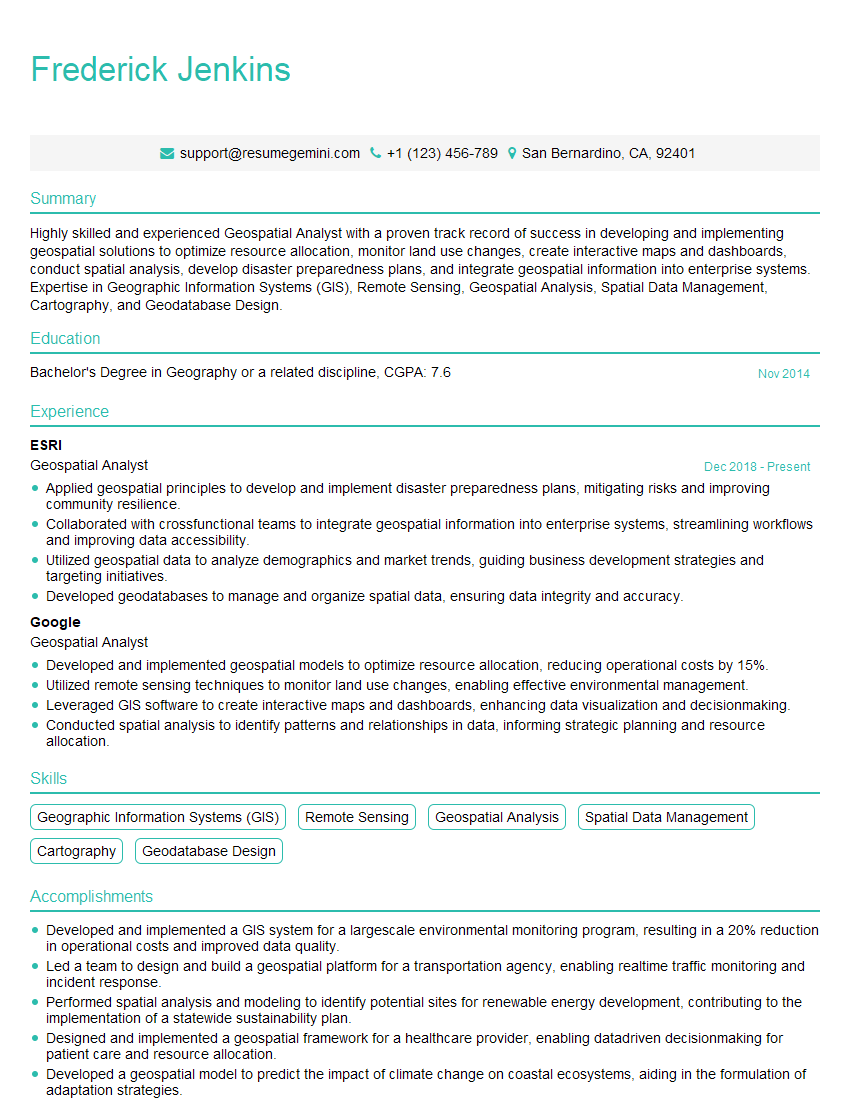
Mastering Transfer Learning for Remote Sensing significantly enhances your career prospects in the rapidly evolving field of geospatial analysis and artificial intelligence. It demonstrates advanced technical skills highly sought after by employers. To maximize your chances of landing your dream role, a well-crafted, ATS-friendly resume is crucial. ResumeGemini can help you build a compelling resume that highlights your expertise in Transfer Learning for Remote Sensing, increasing your visibility to recruiters and maximizing your chances of interview calls. Examples of resumes tailored to Transfer Learning for Remote Sensing are available to guide you. Invest in your future – create a resume that showcases your capabilities effectively.
Explore more articles
Users Rating of Our Blogs
Share Your Experience
We value your feedback! Please rate our content and share your thoughts (optional).
What Readers Say About Our Blog
To the interviewgemini.com Webmaster.
Very helpful and content specific questions to help prepare me for my interview!
Thank you
To the interviewgemini.com Webmaster.
This was kind of a unique content I found around the specialized skills. Very helpful questions and good detailed answers.
Very Helpful blog, thank you Interviewgemini team.