The right preparation can turn an interview into an opportunity to showcase your expertise. This guide to Using hydrologic and hydraulic modeling tools interview questions is your ultimate resource, providing key insights and tips to help you ace your responses and stand out as a top candidate.
Questions Asked in Using hydrologic and hydraulic modeling tools Interview
Q 1. Explain the difference between hydrologic and hydraulic modeling.
Hydrologic and hydraulic modeling are closely related but distinct disciplines used in water resource management. Hydrologic modeling focuses on the water budget of a catchment area – predicting rainfall, runoff, infiltration, evapotranspiration, and groundwater recharge. Think of it as understanding the big picture of water movement. Hydraulic modeling, on the other hand, focuses on the flow characteristics of water within a specific channel or system, such as rivers, pipes, or canals. It deals with the details of water depth, velocity, and energy. Imagine a hydrologic model predicting the total runoff from a watershed after a storm, while a hydraulic model simulates the precise water levels and flow speeds in a river downstream of that watershed.
In essence: Hydrology deals with quantities of water, while hydraulics deals with the movement of water.
Q 2. Describe the limitations of the kinematic wave approximation.
The kinematic wave approximation simplifies the St. Venant equations, governing unsteady open channel flow, by neglecting the pressure gradient and inertial terms. This simplification makes the model computationally efficient, but it comes with limitations:
- Accuracy limitations: It’s only accurate for steep slopes and relatively uniform channels where inertial and pressure effects are negligible. In gentle slopes or channels with complex geometry, the approximation breaks down, leading to inaccurate predictions of water depth and flow velocity.
- Inability to handle backwater effects: The kinematic wave cannot accurately model backwater conditions, where downstream flow conditions influence upstream flow. This is common in reservoirs or areas with constrictions in the channel.
- Limited applicability to unsteady flows: While it handles unsteady flows better than the simpler Manning’s equation, it struggles with rapidly changing flow conditions, such as those caused by dam breaks or intense rainfall events.
- Difficulty in modeling subcritical flow: It works best for supercritical flow but faces challenges when the flow transitions between subcritical and supercritical regimes.
For example, applying the kinematic wave to model flow in a meandering river with varying cross-sections and low slopes would likely result in significant errors. A more sophisticated model, like the full St. Venant equations, would be necessary for accurate results.
Q 3. What are the key assumptions of the Muskingum method?
The Muskingum method is a hydrological routing technique used to predict downstream hydrographs given an upstream hydrograph. Its key assumptions are:
- Linear storage relationship: The storage in the reach is linearly related to the inflow and outflow. This is represented by a storage coefficient, K.
- Linear outflow relationship: The outflow is linearly related to the inflow and storage. This is represented by a weighting factor, x (ranging from 0 to 0.5).
- Uniform channel characteristics: The channel properties (slope, roughness, cross-section) are assumed to be constant along the reach. This simplifies the routing process but can reduce accuracy in reaches with significant variations.
- Instantaneous response: The changes in inflow are assumed to instantaneously affect the outflow. This assumption simplifies the calculation but can be inaccurate for longer reaches or slow-responding systems.
Q2 = Kx * I2 + K(1-x) * I1 + (1-K) * Q1
Where:
Q1andQ2are the outflows at time steps 1 and 2.I1andI2are the inflows at time steps 1 and 2.Kandxare the Muskingum parameters.
The accuracy of the Muskingum method depends heavily on the accurate calibration of the K and x parameters.
Q 4. How do you calibrate and validate a hydrologic model?
Calibration and validation are crucial steps in ensuring a hydrologic model accurately represents the real-world system.
Calibration involves adjusting model parameters (e.g., soil parameters, infiltration rates, channel roughness) to minimize the difference between simulated and observed outputs (e.g., streamflow). This is usually done using an optimization technique like least squares fitting or manual adjustment. It’s an iterative process of model runs and adjustments until a satisfactory level of agreement is reached. The calibration should be performed using a subset of the available data, typically a period of historical data.
Validation follows calibration. It involves using a separate, independent data set (not used in calibration) to test the model’s predictive capabilities. The model’s performance is evaluated using statistical metrics like Nash-Sutcliffe efficiency (NSE), Root Mean Squared Error (RMSE), and percent bias. A successful validation shows that the model can accurately predict streamflow for conditions not used during calibration.
For example, a model could be calibrated using 10 years of streamflow data and then validated using a separate 5 years of data. A high NSE close to 1 indicates a good model fit and successful validation.
Q 5. What are the common sources of uncertainty in hydrologic modeling?
Hydrologic modeling is inherently uncertain due to various factors:
- Data limitations: Rainfall, streamflow, and other input data often have spatial and temporal limitations and inaccuracies. Missing data points or sparsely distributed rain gauges can introduce significant errors.
- Model structure uncertainty: The choice of hydrologic model itself impacts the results. Different models have different underlying assumptions and simplifications.
- Parameter uncertainty: Many model parameters (e.g., infiltration rates, Manning’s roughness coefficient) are difficult to measure directly and are often estimated, introducing uncertainty.
- Spatial variability: The spatial distribution of rainfall, soil types, and land use can vary significantly within a catchment, making it challenging to accurately represent the system in a model.
- Conceptual uncertainty: Our understanding of hydrological processes is incomplete, and some processes are difficult to represent accurately in a model (e.g., subsurface flow).
Addressing these uncertainties often involves using techniques like sensitivity analysis, Monte Carlo simulations, and ensemble forecasting, which allow for assessing model outputs range and confidence.
Q 6. Explain the concept of rainfall-runoff modeling.
Rainfall-runoff modeling is the process of simulating the transformation of rainfall into runoff. It’s a fundamental task in hydrology and water resource management, aiming to predict the quantity and timing of runoff generated by a rainfall event. This prediction is crucial for flood forecasting, reservoir operation, and water infrastructure design.
The process involves several steps:
- Rainfall input: Data from rain gauges or radar are used to estimate rainfall intensity and distribution over the catchment area.
- Loss estimation: This step determines the amount of rainfall that is lost through infiltration, evaporation, and interception. Various methods exist, including the SCS curve number method or Green-Ampt method.
- Runoff generation: The excess rainfall (after accounting for losses) is converted into surface runoff using models such as the unit hydrograph method or the kinematic wave approach.
- Routing: The generated runoff is routed through the channel network to predict flow at specific locations (like downstream gauging stations). Techniques like the Muskingum method or more complex hydraulic routing methods are used.
- Output: The model produces a hydrograph (a graph of flow rate versus time) at selected locations, providing insights into the runoff’s temporal variation and peak flow.
The choice of method for each step depends on data availability, model complexity, and desired accuracy.
Q 7. What are the advantages and disadvantages of using HEC-RAS?
HEC-RAS (Hydrologic Engineering Center’s River Analysis System) is a widely used hydraulic modeling software developed by the US Army Corps of Engineers.
Advantages:
- Widely accepted and validated: It’s extensively used globally and has undergone rigorous testing and validation.
- Comprehensive capabilities: It can model steady and unsteady flow in rivers, canals, and other open channels, considering various factors like channel geometry, roughness, and boundary conditions.
- User-friendly interface: Despite its complexity, HEC-RAS has a relatively user-friendly interface, making it accessible to a wider range of users.
- Extensive documentation and support: Comprehensive documentation and a large user community provide ample support for users.
- Ability to handle complex geometries: Can model complex channel networks, including junctions and bifurcations.
Disadvantages:
- Computational intensity: Modeling large and complex systems can be computationally intensive and time-consuming.
- Data requirements: Accurate results require high-quality input data, including detailed topographic data, cross-sections, and roughness coefficients.
- Learning curve: While user-friendly, mastering its capabilities requires time and effort.
- Licensing costs: Although the basic version is free, advanced features might require additional licenses.
In practice, HEC-RAS is excellent for detailed hydraulic modeling of rivers and other water bodies, but users should be aware of its data requirements and computational demands.
Q 8. How do you model unsteady flow in open channels?
Unsteady flow in open channels, unlike steady flow, involves changes in water depth and velocity over time. Think of a flash flood – the water level rises rapidly, then gradually recedes. Modeling this requires solving the Saint-Venant equations, which are a set of partial differential equations describing conservation of mass and momentum.
Several numerical methods are used to solve these equations. The most common are:
- Finite Difference Method: This discretizes the channel into segments and solves the equations at each point. It’s relatively simple to implement but can be less accurate for complex channel geometries.
- Finite Volume Method: Similar to finite difference, but focuses on conserving quantities within control volumes. This generally leads to better conservation of mass and momentum.
- Finite Element Method: This uses elements of varying shapes and sizes to approximate the solution, providing flexibility for complex geometries and boundary conditions. It’s computationally more intensive but offers high accuracy.
Software packages like HEC-RAS, MIKE 11, and SWMM employ these numerical techniques to simulate unsteady flow. The choice of method depends on factors like channel complexity, required accuracy, and computational resources available.
For example, simulating the flow in a river during a major storm event would likely require an unsteady flow model to capture the rapid changes in discharge and water levels. A steady-state model would be inadequate for this scenario.
Q 9. Describe different methods for estimating Manning’s roughness coefficient.
Manning’s roughness coefficient (n) represents the resistance to flow in an open channel. It’s an empirical parameter, meaning it’s determined through observation and experimentation, not derived from fundamental principles. Several methods exist for estimating n:
- From tables and charts: Numerous resources provide values of n based on channel characteristics (e.g., material, vegetation, channel condition). These tables offer a starting point but often require judgment and adjustment based on site-specific conditions.
- From field measurements: The most reliable method involves measuring flow and water surface profile in the channel, then using Manning’s equation (Q = (A^ (2/3) * S^(1/2))/n) to back-calculate n. This requires accurate flow measurements (e.g., using velocity meters or flow gauging techniques).
- From empirical formulas: Several formulas relate n to channel characteristics. For instance, some formulas relate n to the average particle size in a gravel-bed river. These formulas often provide only an approximation.
- Using remote sensing data: Advanced techniques utilize high-resolution imagery from drones or satellites to derive information about channel morphology and vegetation, which can then be used to estimate n. This approach is becoming increasingly common.
The accuracy of the estimated n significantly affects the hydraulic model results. It’s crucial to select the most appropriate method and consider the uncertainties associated with the chosen approach.
Q 10. How do you handle boundary conditions in hydraulic modeling?
Boundary conditions define the flow characteristics at the start and end points of the modeled reach, significantly influencing the overall solution. They typically include:
- Upstream boundary: This can be a specified flow rate (discharge), water level (head), or a rating curve (relating discharge to water level).
- Downstream boundary: Similar to upstream, this can be a specified flow rate, water level, or a rating curve. A common downstream boundary condition is a normal depth condition, where the flow is assumed to be at its normal depth (a depth that satisfies the energy equation for uniform flow).
- Lateral inflow/outflow: These represent flow entering or leaving the channel from tributaries or other sources. They may be specified as constant flow rates, time-varying hydrographs, or derived from rainfall-runoff models.
Proper boundary condition selection is critical. Incorrect boundary conditions can lead to inaccurate or unrealistic simulation results. For instance, specifying a water level at the downstream boundary that’s unrealistically high might cause backwater effects that don’t reflect reality. Calibration and verification of the model against field data are important steps to validate the boundary conditions.
Q 11. Explain the concept of water surface profile.
The water surface profile is the graphical representation of the water surface elevation along the length of a channel. It shows how the water surface varies in response to changes in flow, channel geometry, and boundary conditions. Understanding water surface profiles is essential for designing and managing open channel systems.
Different types of water surface profiles exist, categorized by their relationship to the energy grade line and critical depth (the depth at which the specific energy is minimized):
- Mild slope: The normal depth is greater than the critical depth. Water surface profiles on mild slopes are typically subcritical, meaning the flow velocity is less than the wave velocity.
- Critical slope: The normal depth is equal to the critical depth. This is a rare situation.
- Steep slope: The normal depth is less than the critical depth. Water surface profiles on steep slopes are typically supercritical, meaning the flow velocity is greater than the wave velocity.
Analyzing water surface profiles helps determine areas prone to flooding, erosion, or scour. For example, a rapidly changing water surface profile might indicate a potential hazard requiring mitigation measures.
Q 12. What are the different types of hydraulic structures you can model?
Hydraulic modeling software can simulate a wide array of hydraulic structures:
- Weirs: Structures used to measure or control flow, with different types like rectangular, triangular, and trapezoidal weirs.
- Culverts: Pipes or conduits that allow water to flow under roads, railways, or other obstacles. Modeling considers their shape, length, and roughness.
- Spillways: Structures designed to safely release excess water from dams or reservoirs.
- Gates: Various types of gates (e.g., radial, sluice, roller) control flow in canals and dams. Their opening and closing can be simulated dynamically.
- Pumping stations: These actively move water and can be modeled considering their pumping capacity and operational characteristics.
- Bridge crossings: The impact of bridge piers on flow constriction and water level elevation can be accurately simulated.
Accurately modeling these structures requires detailed geometric data and appropriate hydraulic relationships specific to the structure’s type. For instance, modeling a spillway necessitates considering the complex flow patterns and energy dissipation at the outlet.
Q 13. How do you model sediment transport in rivers?
Sediment transport in rivers is a complex process influenced by flow velocity, sediment size, and channel morphology. Modeling sediment transport usually involves:
- Selecting a suitable sediment transport model: Numerous empirical and physically-based models exist, such as the Ackers-White, Engelund-Hansen, and Yang models. The choice depends on the sediment characteristics and the level of detail required.
- Defining sediment properties: This includes particle size distribution, density, and shape. Accurate characterization is crucial for reliable predictions.
- Simulating sediment transport processes: This involves calculating sediment transport rates using the chosen model and tracking sediment movement through the river system. This often requires coupling the sediment transport model with a hydrodynamic model.
- Considering morphological changes: Sediment transport can cause significant changes to channel geometry over time (e.g., erosion, deposition). Advanced models can simulate these morphological changes, leading to more realistic long-term predictions.
Sediment transport modeling is vital for managing river systems, particularly for designing stable channels, mitigating erosion and deposition, and assessing the impact of dams and other structures on downstream sediment regimes. For example, predicting sediment deposition in reservoirs is crucial for managing their lifespan and operational efficiency.
Q 14. What are the key parameters in a stormwater management model (e.g., SWMM)?
Stormwater Management Model (SWMM) is a widely used software for simulating urban drainage systems. Key parameters include:
- Rainfall data: Rainfall intensity and duration are crucial inputs, often obtained from weather stations or rainfall-runoff models.
- Subcatchment characteristics: This includes area, slope, land use, and infiltration characteristics. These parameters define how rainfall transforms into runoff.
- Conveyance system properties: This includes the geometry (diameter, slope) and roughness of pipes, channels, and other drainage infrastructure.
- Infiltration parameters: These define how much water infiltrates into the ground, affecting the amount of runoff generated.
- Storage elements: This includes detention basins, wetlands, and other storage features that temporarily hold stormwater, reducing peak flows.
- Boundary conditions: These define the upstream and downstream conditions of the drainage system.
Proper calibration and verification of the model are essential using observed flow data to ensure the accuracy of simulated results. This involves adjusting model parameters until the simulated outputs match observed data. SWMM is valuable for planning and managing urban drainage systems, designing stormwater control measures, and evaluating the impact of development on water quality.
Q 15. How do you account for infiltration in your models?
Infiltration, the process of water entering the soil, is a crucial component of hydrologic modeling. Ignoring it leads to inaccurate runoff estimations. I account for infiltration using various methods depending on data availability and model complexity.
- Simple Infiltration Models: For preliminary assessments or when data is scarce, I might use the Horton, Philip, or Green-Ampt infiltration models. These empirical equations estimate infiltration rates based on soil properties and rainfall intensity. For instance, the Green-Ampt model considers the soil’s suction head and hydraulic conductivity.
- More Sophisticated Approaches: In projects requiring higher accuracy, I incorporate infiltration models within physically-based hydrological models like SWAT (Soil and Water Assessment Tool) or MIKE SHE. These models utilize more detailed soil parameters (like texture and moisture content) obtained from soil surveys or measurements, leading to more realistic simulations.
- Calibration and Validation: Regardless of the chosen method, meticulous calibration and validation against observed infiltration data are essential. This ensures the model’s infiltration component accurately reflects the real-world conditions. I typically use observed soil moisture data or streamflow records to refine model parameters. For example, I might adjust the saturated hydraulic conductivity parameter in the Green-Ampt model to match measured infiltration rates.
Imagine trying to predict a river’s flood level without considering how much rain soaks into the ground – you’d significantly overestimate the flood! Accurate infiltration modeling is vital for reliable hydrological predictions.
Career Expert Tips:
- Ace those interviews! Prepare effectively by reviewing the Top 50 Most Common Interview Questions on ResumeGemini.
- Navigate your job search with confidence! Explore a wide range of Career Tips on ResumeGemini. Learn about common challenges and recommendations to overcome them.
- Craft the perfect resume! Master the Art of Resume Writing with ResumeGemini’s guide. Showcase your unique qualifications and achievements effectively.
- Don’t miss out on holiday savings! Build your dream resume with ResumeGemini’s ATS optimized templates.
Q 16. Describe your experience with different hydrologic model software packages.
My experience encompasses a range of hydrologic modeling software packages, each with its strengths and weaknesses.
- HEC-HMS (Hydrologic Modeling System): I’ve extensively used HEC-HMS for rainfall-runoff modeling, particularly for flood forecasting and water resources management projects. Its user-friendly interface and comprehensive functionality make it ideal for various applications. I’ve used it to simulate the impact of land-use changes on watershed runoff.
- SWAT (Soil and Water Assessment Tool): For larger, more complex watersheds where detailed spatial data is available, I rely on SWAT. Its physically-based approach allows for a comprehensive representation of hydrologic processes, including water flow, sediment transport, and nutrient cycling. I’ve used SWAT to analyze the effect of agricultural practices on water quality in a large river basin.
- MIKE SHE: This integrated hydrological model is particularly useful for simulating groundwater interactions. I’ve employed MIKE SHE in projects requiring detailed groundwater modeling, often coupled with surface water simulations for a holistic approach. For example, I used it to assess the impact of groundwater pumping on streamflow.
- MATLAB with specialized toolboxes: For customized modeling and advanced analysis, I utilize MATLAB with toolboxes like the Hydrolink toolbox. This allows for greater flexibility in incorporating specific algorithms or developing unique model components. This is particularly helpful when working with unconventional datasets or exploring research-oriented models.
The choice of software always depends on the project’s scope, available data, and required level of detail. My expertise allows me to select and effectively utilize the best tool for the job.
Q 17. Explain your approach to model verification and validation.
Model verification and validation are critical steps to ensure the model’s reliability and accuracy. They are distinct processes, yet equally important.
- Verification: This involves checking if the model is internally consistent and correctly implements the governing equations. It’s a process of ensuring the model code functions as intended. I often use code review and unit testing to confirm the mathematical formulations and algorithms are accurate. For example, I might compare the model’s predicted runoff from a simple event (like a known rainfall input) to a theoretical solution.
- Validation: This is about assessing how well the model represents the real-world system. I use observed data (e.g., streamflow, water levels, soil moisture) to compare with model predictions. Various statistical metrics like Nash-Sutcliffe Efficiency (NSE), R-squared, and percent bias are used to quantify the agreement. A high NSE value (close to 1) indicates a good model fit.
- Sensitivity Analysis: Before validation, a sensitivity analysis is crucial to understand how variations in model parameters affect the results. This guides the calibration process and informs uncertainties in model predictions. For example, determining how sensitive streamflow predictions are to changes in soil infiltration parameters.
A validated model gives us confidence that it can be used to make reliable predictions and inform decision-making, like designing effective flood control measures or managing water resources sustainably.
Q 18. How do you deal with missing data in hydrologic modeling?
Missing data is a common challenge in hydrologic modeling. Addressing it effectively is essential for accurate results. My approach involves a multi-pronged strategy:
- Data Filling Techniques: For relatively short gaps in data, I often use interpolation methods. Linear interpolation is a straightforward method, while more sophisticated techniques like spline interpolation or kriging can be used for spatially distributed data. I select the method based on the nature of the data and the gap size.
- Homogeneous Regions: If data is missing for a specific region, I might use data from similar, nearby regions with complete records. I make sure the regions are hydrologically similar before employing this approach to avoid introducing bias.
- Stochastic Methods: For larger or more erratic data gaps, stochastic methods are employed. These methods use statistical distributions to generate synthetic data based on the available information. For example, I might use a Markov chain to simulate the sequence of daily rainfall values based on historical data.
- Model Calibration and Parameter Sensitivity: The impact of missing data on model results should be evaluated through model calibration and sensitivity analysis. This helps to assess the uncertainty introduced by data gaps.
It’s crucial to document how missing data was handled, including the methods used and the resulting uncertainties. Transparency in dealing with data limitations is vital for the credibility of the model results.
Q 19. What are the different methods for estimating evapotranspiration?
Evapotranspiration (ET), the combined process of evaporation and transpiration, is a significant component of the hydrological cycle. Estimating ET accurately is crucial for water resource management and irrigation scheduling.
- Empirical Methods: These methods use readily available weather data (temperature, humidity, solar radiation) to estimate ET. Popular methods include the Penman-Monteith equation, which is considered a physically-based approach, and simpler methods like the Blaney-Criddle equation, which are suitable for locations with limited data.
- Remote Sensing: Satellite imagery provides spatially distributed ET estimates across large areas. Methods like the Surface Energy Balance System (SEBS) use satellite data to estimate surface energy fluxes and subsequently estimate ET.
- Lysimeters: These are in-situ measurements that directly measure ET from a small plot of land. While accurate, they are expensive and cannot be deployed across large areas.
- Water Balance Methods: This involves calculating ET as a residual term in the water balance equation, after accounting for precipitation, runoff, and changes in soil moisture. It’s particularly useful when direct ET measurements are unavailable.
The best method depends on the project’s specific needs, data availability, and spatial scale. Often, a combination of methods is used to improve accuracy and reduce uncertainty.
Q 20. How do you handle rainfall intensity-duration-frequency curves?
Rainfall intensity-duration-frequency (IDF) curves represent the relationship between rainfall intensity, duration, and its frequency of occurrence. They are fundamental for designing hydraulic structures and managing flood risk.
- Data Acquisition: The first step is to obtain historical rainfall data with sufficient length and quality. Ideally, data from multiple rain gauges across the area of interest would be beneficial.
- Frequency Analysis: Statistical methods, such as the log-Pearson type III or Gumbel distribution, are used to analyze the rainfall data and estimate the probability of exceeding certain rainfall intensities for given durations.
- Curve Fitting: The estimated rainfall intensities are then plotted against their corresponding durations and return periods (e.g., 2-year, 10-year, 100-year flood events), generating the IDF curves.
- Software Tools: Specialized software packages can facilitate IDF curve development. HEC-SSP (Statistical Summary Program) from the US Army Corps of Engineers is commonly used.
IDF curves are critical for determining design rainfall intensities for drainage systems, culverts, and other hydraulic structures. The selection of an appropriate return period depends on the risk tolerance associated with the design.
Q 21. Describe your experience with GIS applications in hydrologic and hydraulic modeling.
GIS (Geographic Information System) plays a pivotal role in hydrologic and hydraulic modeling. It provides the framework for integrating and managing spatial data, enabling efficient model setup and analysis.
- Data Preprocessing: GIS is used to pre-process spatial data like elevation, land use, soil type, and rainfall data. This involves creating digital elevation models (DEMs), delineating watersheds, and generating spatial layers for model input.
- Model Input Preparation: GIS facilitates the creation of input datasets for hydrologic and hydraulic models. For example, I would use GIS to delineate the watershed boundaries, determine sub-basin areas, and derive parameters for the model based on the spatial distribution of land use and soil types.
- Model Calibration and Validation: GIS assists in the visualization and spatial analysis of model results. For example, I would use GIS to map flood inundation areas, compare model predictions to observed data, and identify areas with significant discrepancies.
- Post-Processing and Visualization: GIS is essential for visualizing and interpreting model outputs, generating maps of flow paths, flood depths, and other relevant parameters. The spatial representation of results facilitates communication and decision-making.
In essence, GIS is not just a tool; it’s the backbone of many hydrologic and hydraulic modeling projects. The integration of GIS strengthens the efficiency and accuracy of my workflows and enhances the visualization of complex hydro-spatial data.
Q 22. How do you analyze model results and interpret the findings?
Analyzing hydrologic and hydraulic model results involves a systematic approach combining quantitative and qualitative assessments. It’s not just about looking at numbers; it’s about understanding what those numbers *mean* in the context of the real-world system you’re modeling.
First, I visually inspect the output. Graphs and charts of water levels, flows, and velocities provide a quick overview. I look for anomalies – spikes, unexpected drops, or patterns that deviate from expectations. This visual inspection helps identify potential issues early on.
Next, I perform a quantitative analysis. This involves comparing model predictions to observed data (if available). Statistical metrics like Nash-Sutcliffe efficiency (NSE), Root Mean Square Error (RMSE), and R-squared help quantify the model’s accuracy. A high NSE (closer to 1) indicates a good fit, while low RMSE implies small prediction errors. I also analyze the model’s sensitivity to different input parameters. This helps determine which parameters have the most significant influence on the results and where further calibration or data collection might be needed.
Finally, the interpretation stage. I consider the limitations of the model, the quality of the input data, and any simplifying assumptions made during the modeling process. For example, if my model underestimates peak flows during a flood event, I’d investigate whether the rainfall data was insufficient, if the model’s representation of the watershed was too simplified, or if the model didn’t properly account for channel roughness.
Think of it like diagnosing a patient. The model outputs are the symptoms, and my analysis is the process of identifying the underlying cause.
Q 23. Explain the concept of backwater curves.
A backwater curve describes the profile of the water surface in an open channel where the flow is controlled by downstream conditions. Imagine a dam or a bridge constriction; the water level upstream of such an obstruction will rise significantly above the normal water surface elevation. This upward curve in the water surface is the backwater curve.
Backwater curves are essentially caused by flow restrictions. The water backs up upstream because the flow cannot readily pass through the restriction. The extent of the backwater curve depends on the magnitude of the flow restriction, the channel geometry, and the discharge. Steeper channel slopes result in shorter backwater curves, while flatter slopes cause them to extend further upstream.
We use specialized software (like HEC-RAS or MIKE 11) to calculate backwater curves. These programs solve the gradually varied flow equations, considering factors like channel shape, roughness, and downstream water levels. This is crucial for designing structures like bridges or culverts to ensure that they have sufficient capacity to accommodate the increased water levels and avoid flooding.
For example, during bridge design, engineers use backwater calculations to determine the required bridge deck elevation to ensure that floodwaters won’t submerge the roadway. Without accounting for backwater, the bridge design could be severely under-designed leading to significant flood risks.
Q 24. How do you model the effects of urbanization on runoff?
Urbanization dramatically alters runoff processes. Increased impervious surfaces (roads, buildings, parking lots) reduce infiltration, leading to significantly higher runoff volumes and faster runoff rates. This increased runoff can overwhelm drainage systems, causing more frequent and severe flooding.
To model these effects, we modify the model’s input parameters. This typically involves using land use/land cover data to represent the proportion of impervious surfaces within the watershed. Many hydrologic models use curve numbers (CN) from the Soil Conservation Service (SCS) method to estimate runoff based on land use characteristics. A higher CN value indicates more imperviousness and therefore greater runoff.
We also adjust parameters that represent the soil’s infiltration capacity. Impervious surfaces essentially eliminate infiltration, so we often reduce or eliminate the infiltration component in urban areas within the model. Some models even incorporate detailed representations of drainage networks to explicitly simulate the flow through pipes, storm drains, and other urban infrastructure.
Furthermore, we account for the effect of changes in the watershed’s hydraulic geometry. For example, channelization – straightening or lining of natural streams – can increase the conveyance capacity and thus affect the downstream flows. These changes should be incorporated into the hydraulic model’s geometry data.
For instance, I once worked on a project where a new housing development was planned in a previously rural watershed. By adjusting the CN values in a HEC-HMS model to reflect the increased imperviousness, we predicted a substantial increase in peak flows and identified the need for upgraded drainage infrastructure to avoid potential flooding downstream.
Q 25. What are the considerations for modeling extreme events (e.g., floods)?
Modeling extreme events like floods demands special considerations. The accuracy and reliability of the model become paramount because the consequences of errors can be severe. We must go beyond average conditions and accurately represent the variability and uncertainty inherent in these events.
Firstly, data availability is critical. We need high-quality historical data on rainfall intensity, duration, and frequency. Often, this requires using statistical methods to analyze limited historical data and generate rainfall design events that capture the probability of different magnitude events.
Secondly, the model needs to be robust. Simplified models might not capture the complexities of extreme events. We may need more sophisticated models that account for factors like dam failure, levee breaches, and complex interactions between different parts of the watershed. Using higher resolution DEMs (digital elevation models) is also important to accurately represent the topography in flood plain modeling.
Thirdly, we should incorporate uncertainty analysis. Given the inherent uncertainties in input data and model parameters, we use Monte Carlo simulations or other probabilistic methods to estimate the range of possible flood levels and associated risks. This helps to better understand the level of uncertainty in our predictions.
Finally, verification and validation are essential. We compare model predictions to historical flood events, if available, and seek expert reviews to ensure that the model reasonably represents the physical processes and potential failure mechanisms. Using a combination of deterministic and probabilistic approaches provides a comprehensive understanding of potential flood risks.
Q 26. Describe your experience in using data assimilation techniques in hydrologic modeling.
Data assimilation techniques are crucial for improving the accuracy and reliability of hydrologic models. These techniques integrate observed data into the model, correcting for biases and improving predictions. I’ve used several data assimilation methods, including the Ensemble Kalman Filter (EnKF) and the particle filter.
In a project involving real-time flood forecasting, we used an EnKF to assimilate streamflow measurements from various gauging stations. The EnKF generates an ensemble of model states, which represent the uncertainty in the model parameters. By incorporating streamflow observations, the filter updates the ensemble, reducing the uncertainty and leading to more accurate flow predictions. This improved our flood warnings, allowing for better preparedness and reduced risks.
The choice of the data assimilation method depends on various factors such as the model complexity, the type and frequency of available observations, and computational resources. For instance, particle filters are known for their ability to handle nonlinear systems, while the EnKF is computationally more efficient for large systems.
My experience with data assimilation has significantly improved my ability to calibrate and validate hydrologic models. By incorporating real-time data, the model can adaptively adjust to the changing conditions, resulting in more reliable and accurate forecasts.
Q 27. How do you incorporate uncertainty in your model predictions?
Incorporating uncertainty is fundamental to responsible hydrologic modeling. Ignoring uncertainty can lead to overly confident predictions and potentially catastrophic consequences, particularly when dealing with extreme events.
We address uncertainty through several approaches. One is using probabilistic methods, such as Monte Carlo simulations. We vary the input parameters (e.g., rainfall intensity, soil properties) within their range of uncertainty and run the model multiple times. This generates a distribution of model outputs, providing a range of possible outcomes rather than a single deterministic prediction.
Another approach involves sensitivity analysis. We systematically vary each parameter and assess the impact on the model outputs. This helps identify the most influential parameters and focus uncertainty quantification efforts where they’ll have the most significant impact.
We also incorporate uncertainty in the model structure itself. Hydrologic models are simplifications of complex natural systems, so we acknowledge that the model structure itself may have uncertainties. This can be addressed by comparing results from different models, each with different levels of complexity.
Finally, we clearly communicate uncertainty in our findings. We present results not as single values but as ranges or probability distributions, accompanied by explanations of the sources and magnitudes of uncertainty. This transparency ensures responsible and informed decision-making based on the model outputs.
Q 28. What are your strategies for troubleshooting problems in hydrologic and hydraulic models?
Troubleshooting hydrologic and hydraulic models is a crucial part of the modeling process. It requires a methodical approach and a deep understanding of both the model and the underlying hydrology and hydraulics.
My troubleshooting strategy starts with checking the input data. Are there any errors in the data? Are the data units consistent? Are the data adequately representing the watershed characteristics? Frequently, a seemingly complex model problem is rooted in an elementary error in data input.
Next, I meticulously examine the model setup. Are the boundary conditions correctly defined? Are the model parameters appropriately calibrated? Is the model grid resolution appropriate for the scale of the problem? Are there any conflicts between model components?
If the issue persists, I perform a step-by-step analysis. I check intermediate model outputs to see where the problem originates. I might break the model down into smaller components and run them individually to identify the faulty component.
If the problem is still unresolved, I consult the model documentation, online forums, or experts. There are countless resources available, and collaboration is often invaluable for identifying solutions.
Consider a scenario where a model predicts unreasonably high flows. I would systematically check the rainfall data, then the land use data, then the model’s infiltration parameters and hydraulic geometry. This iterative process of elimination is crucial to pinpointing the error.
Key Topics to Learn for Using Hydrologic and Hydraulic Modeling Tools Interview
- Hydrologic Modeling Fundamentals: Understanding the water cycle, rainfall-runoff processes, infiltration, evapotranspiration, and their representation in models.
- Hydraulic Modeling Principles: Grasping concepts like flow routing, energy equations, open channel flow, and pipe flow calculations within modeling software.
- Software Proficiency: Demonstrating practical experience with widely used hydrologic and hydraulic modeling software (e.g., HEC-RAS, MIKE FLOOD, SWMM). This includes data input, model calibration, and result interpretation.
- Data Management and Analysis: Understanding data sources (rain gauges, streamflow data, topographic maps), data preprocessing techniques, and quality control measures essential for accurate modeling.
- Model Calibration and Validation: Knowing the methods used to adjust model parameters and compare simulated results with observed data to ensure model accuracy and reliability.
- Uncertainty Analysis: Discussing the inherent uncertainties in hydrologic and hydraulic modeling and methods for quantifying and mitigating these uncertainties.
- Practical Applications: Being able to explain how these models are used in real-world scenarios, such as flood forecasting, water resources management, drainage design, and environmental impact assessments.
- Problem-Solving Approaches: Demonstrating your ability to troubleshoot model issues, interpret results, and draw meaningful conclusions from simulations.
- Model Limitations: Understanding the assumptions and limitations of different modeling approaches and their implications for the accuracy and applicability of results.
Next Steps
Mastering hydrologic and hydraulic modeling tools is crucial for a successful career in water resources engineering, environmental science, and related fields. These skills are highly sought after, leading to exciting opportunities and career advancement. To maximize your job prospects, it’s vital to present your skills effectively. Creating an ATS-friendly resume is key to getting your application noticed by recruiters. We strongly encourage you to use ResumeGemini to build a professional and impactful resume. ResumeGemini offers tools and resources, including examples of resumes tailored to showcasing expertise in using hydrologic and hydraulic modeling tools, to help you create a resume that stands out from the competition.

Hydrogeologist Resume Sample

Civil Engineer Resume Sample

Drainage Engineer Resume Sample

Hydraulic Engineer Resume Sample

Irrigation Engineer Resume Sample

Reservoir Engineer Resume Sample

Environmental Engineer Resume Sample
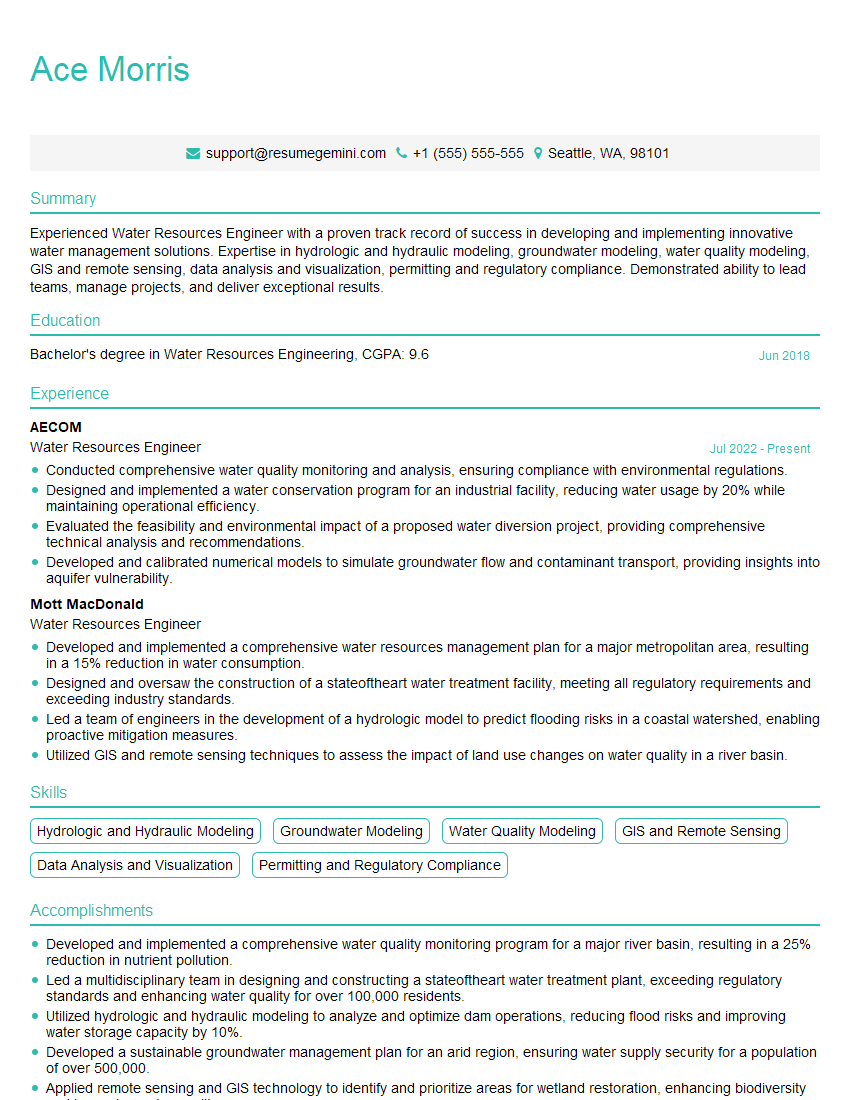
Water Resources Engineer Resume Sample

Floodplain Manager Resume Sample

Hydrologic Modeler Resume Sample

Hydrologist Resume Sample
Explore more articles
Users Rating of Our Blogs
Share Your Experience
We value your feedback! Please rate our content and share your thoughts (optional).
What Readers Say About Our Blog
To the interviewgemini.com Webmaster.
Very helpful and content specific questions to help prepare me for my interview!
Thank you
To the interviewgemini.com Webmaster.
This was kind of a unique content I found around the specialized skills. Very helpful questions and good detailed answers.
Very Helpful blog, thank you Interviewgemini team.