Feeling uncertain about what to expect in your upcoming interview? We’ve got you covered! This blog highlights the most important Veneer Clipping interview questions and provides actionable advice to help you stand out as the ideal candidate. Let’s pave the way for your success.
Questions Asked in Veneer Clipping Interview
Q 1. Explain the different types of veneer clippers and their applications.
Veneer clippers come in various types, each suited for specific applications. The primary distinction lies in the cutting mechanism: guillotine, rotary, and shear.
Guillotine Clippers: These are the most common type, using a straight blade that descends to cut the veneer. They’re ideal for straight cuts and are relatively simple to operate and maintain. Think of them like a giant paper cutter, but much more precise.
Rotary Clippers: These utilize a rotating blade to cut the veneer, allowing for more intricate cuts and curves. They are often faster than guillotine clippers, particularly for high-volume production. Imagine a very precise circular saw designed for delicate materials.
Shear Clippers: These use two blades that slide past each other to cut the veneer. They provide a very clean cut and are often preferred for delicate veneers that are prone to chipping or tearing with other methods. They work similarly to fabric shears, but on a much larger scale and with exceptional precision.
The choice of clipper depends heavily on the type of veneer being processed, the desired cut shape, and the production volume. A furniture maker might prefer a guillotine clipper for simple cuts, while a high-end cabinetry shop might opt for a rotary clipper for more complex designs. A specialized shop dealing with extremely fragile veneers might utilize a shear clipper.
Q 2. Describe the process of setting up a veneer clipper for optimal performance.
Setting up a veneer clipper for optimal performance involves several crucial steps. Proper setup ensures accurate cuts, minimizes material waste, and prolongs the life of the machine.
Blade Alignment: This is paramount. Ensure the blades are perfectly aligned and sharp. Misaligned blades result in uneven cuts and potential damage to the veneer. Regular checks and adjustments are crucial.
Cutting Height Adjustment: Adjust the cutting height according to the veneer thickness. Too high, and the cut might be uneven; too low, and you risk damaging the blade or the material. The manufacturer’s instructions usually provide a detailed explanation of this process.
Feed Rate Adjustment: The speed at which the veneer passes through the clipper affects the quality of the cut. A slower feed rate usually results in a cleaner cut, especially with delicate veneers, but it reduces productivity. Finding the optimal balance is key.
Safety Mechanisms: Ensure all safety features, such as guards and emergency stops, are correctly installed and functioning. Never operate a malfunctioning machine.
Regular calibration and testing using scrap veneer are essential for maintaining optimal performance. Remember, practice and experience play a significant role in mastering the fine art of veneer clipper setup.
Q 3. How do you ensure the accuracy and precision of veneer cuts?
Accuracy and precision in veneer cutting are achieved through a combination of factors.
Sharp Blades: Dull blades lead to uneven cuts, tearing, and splintering. Regular sharpening or blade replacement is essential. Think of it like using a dull knife to cut a tomato – it’s messy and inefficient.
Proper Blade Alignment: As mentioned earlier, meticulous blade alignment is critical for precise cuts. Even a slight misalignment can lead to noticeable errors, particularly on longer cuts.
Consistent Feed Rate: Maintaining a steady feed rate prevents uneven cuts and reduces the risk of damaging the veneer. A consistent speed ensures uniform pressure on the material, leading to accurate cuts.
Material Handling: Proper handling of the veneer before cutting is crucial. Ensure the veneer is properly supported to prevent warping or movement during the cutting process. This means using appropriate backing and supports.
Clipper Calibration: Regular calibration using precision measuring tools ensures the clipper remains accurate and consistent over time.
Experience and skill also play a significant role. An experienced operator can anticipate and compensate for minor variations in veneer thickness and consistency.
Q 4. What are the common causes of veneer clipper malfunctions and how do you troubleshoot them?
Veneer clipper malfunctions can stem from several sources. Proper troubleshooting requires a systematic approach.
Blade Issues: Dull, chipped, or misaligned blades are the most common cause. Inspection and replacement are usually the solution.
Mechanical Problems: Problems with the feed mechanism, motor, or other moving parts can affect performance. This might require professional repair or maintenance.
Electrical Issues: Faulty wiring, blown fuses, or other electrical problems can prevent the clipper from operating correctly. A qualified electrician should address these issues.
Calibration Issues: The clipper might require recalibration if cuts are consistently inaccurate. This often involves adjusting various settings and using precision measuring tools.
Troubleshooting should always begin with a visual inspection, checking for obvious problems like loose connections or damaged components. If the issue persists, consult the machine’s manual or seek professional assistance.
Q 5. Explain the safety procedures involved in operating a veneer clipper.
Safety is paramount when operating a veneer clipper. Several procedures must be followed to prevent accidents.
Proper Training: Operators should receive thorough training on the safe operation and maintenance of the specific clipper model. This should include instruction on emergency procedures.
Personal Protective Equipment (PPE): Always wear appropriate PPE, including safety glasses, gloves, and hearing protection. Depending on the machine’s power, a face shield might also be necessary.
Machine Guards: Ensure all safety guards are in place and functioning correctly before operating the machine. Never attempt to bypass safety features.
Clear Work Area: Maintain a clean and clutter-free work area to prevent tripping hazards and ensure safe movement around the machine.
Emergency Stop: Familiarize yourself with the location and operation of the emergency stop button. Know how to safely shut down the machine in case of an emergency.
Lockout/Tagout: Always follow lockout/tagout procedures when performing maintenance or repairs on the machine to prevent accidental startup.
Regular safety checks and adherence to established procedures are vital in maintaining a safe working environment.
Q 6. How do you maintain and clean a veneer clipper to ensure its longevity?
Regular maintenance and cleaning are crucial for extending the lifespan of a veneer clipper and ensuring its continued accuracy and performance. This involves several key steps.
Daily Cleaning: Remove wood chips and dust from the machine after each use. Compressed air can be helpful for cleaning hard-to-reach areas. This prevents build-up that can interfere with the machine’s operation.
Blade Maintenance: Regularly inspect the blades for sharpness and alignment. Sharpen or replace blades as needed. Dull blades lead to poor cuts and can damage the veneer.
Lubrication: Lubricate moving parts according to the manufacturer’s recommendations. This reduces friction and wear, extending the life of the machine.
A regular maintenance schedule, perhaps monthly or quarterly depending on usage, should include a more thorough inspection of all components and adjustments as needed. Always refer to the manufacturer’s instructions for specific maintenance recommendations.
Q 7. What are the different types of veneer and how do their properties affect clipping techniques?
Veneer comes in various types, each with unique properties that influence clipping techniques.
Wood Species: Hardwoods like oak and walnut are more dense and require sharper blades and potentially slower feed rates compared to softer woods like pine or poplar. The grain direction also affects cutting – cutting against the grain can lead to splintering.
Veneer Thickness: Thinner veneers are more delicate and prone to damage. They necessitate careful handling and adjustments to the cutting height and feed rate. Thicker veneers might require more power or a different blade type.
Veneer Type: Different types of veneer, such as sliced, rotary cut, or sawn, have distinct characteristics that affect how they cut. Rotary-cut veneers, for example, tend to be more prone to tearing than sliced veneers.
Surface Treatment: Pre-treated veneers might require different cutting techniques to avoid damaging the surface. Some finishes could clog blades if not accounted for.
Understanding these properties allows for the selection of the appropriate clipper type, blade, and cutting parameters, resulting in clean, precise, and efficient cutting. Experience and experimentation will refine this process further.
Q 8. How do you handle variations in veneer thickness during clipping?
Handling veneer thickness variations during clipping is crucial for consistent quality. Veneer thickness can fluctuate due to factors like the wood species, drying process, and manufacturing inconsistencies. We use a combination of techniques to address this. First, we carefully inspect each sheet before clipping, measuring thickness at multiple points using a digital caliper. This allows us to sort veneers into groups of similar thickness. Then, we adjust the clipping machine’s settings, specifically the cutting depth, accordingly. For instance, thinner veneers require a shallower cut to avoid cutting through completely. We also employ advanced machines equipped with automated thickness sensors that can dynamically adjust the cutting depth on the fly, ensuring consistent cuts even with variations within a single sheet.
Imagine trying to cut several slices of bread, some thick, some thin, with a single knife. You’d adjust your hand pressure to avoid cutting the thin slices all the way through, right? It’s the same principle with veneer clipping. The combination of pre-sorting and adaptive machine settings allows for efficient and precise cutting, regardless of initial thickness variations.
Q 9. Describe the process of matching veneer pieces for seamless application.
Matching veneer pieces for seamless application is an art and a science. The process starts with careful selection and book-matching. Book-matching involves mirroring two adjacent veneers to create a symmetrical grain pattern. This is particularly important for large panels where a continuous grain flow is desired. After clipping, we meticulously arrange the pieces based on grain direction, color, and figure. We often use digital imaging to preview the final arrangement before the pieces are glued. If we’re working with figured veneers that have unique patterns, like burl or quilted wood, careful planning is essential. For extremely demanding projects, we may even create mock-ups to ensure perfect visual continuity.
Think of it like assembling a jigsaw puzzle where each piece is unique and needs to fit perfectly with the others. We meticulously examine each veneer, paying attention to the nuances of its grain, color, and any natural imperfections that might influence the match. The goal is to create an aesthetically pleasing, seamless surface that maximizes the beauty of the natural wood.
Q 10. How do you identify and address defects in veneer during clipping?
Defect identification is critical. We use a multi-stage process starting with a visual inspection of each veneer sheet. Common defects include knots, splits, discoloration, and insect damage. Magnification tools are used to identify smaller imperfections. We then use a process of careful trimming and selection. Minor defects are often trimmed away during clipping. Severe defects can result in the rejection of the entire veneer sheet. For example, a large knot might compromise the structural integrity of the panel, while discoloration might render a piece unusable if it’s visible in the final application. The location and severity of the defect determine the course of action—trimming, rejection, or even repurposing as a less visible component. We document all defects and the actions taken to ensure traceability and maintain consistent quality standards.
Think of a skilled tailor inspecting fabric before cutting a garment. They carefully examine it for imperfections, choosing the best sections for prominent areas while strategically concealing minor flaws. We do the same with veneer, aiming for flawless results whenever possible and managing imperfections strategically.
Q 11. What are the quality control measures you take to ensure consistently accurate cuts?
Quality control is paramount in veneer clipping. We use calibrated measuring tools at every stage, from sheet inspection to final cut verification. We maintain detailed records of machine settings for each batch to ensure consistency. Regular maintenance of our equipment, particularly blade sharpness and alignment, is a critical aspect. We also perform regular calibration checks of our cutting machines to maintain accuracy. A crucial element is our skilled team; our operators are highly trained and experienced in recognizing and addressing potential issues. Finally, we conduct random inspections of finished veneer pieces to verify compliance with quality standards. This multi-layered approach ensures consistently accurate cuts across all our projects.
It’s similar to a chef maintaining a spotless and well-organized kitchen. Precise measurements, top-notch equipment, and rigorous adherence to standards all contribute to the final product’s quality. Consistency, accuracy, and attention to detail at every stage are essential.
Q 12. Explain the importance of blade sharpness and how to maintain it.
Blade sharpness is paramount for clean, accurate cuts and minimal veneer waste. A dull blade creates ragged edges, increases the risk of tear-out (when fibers break instead of cleanly cutting), and can even damage the veneer. We use high-quality carbide-tipped blades specifically designed for veneer clipping. These are frequently honed using specialized sharpening equipment to maintain their cutting edge. The sharpening process involves carefully adjusting the blade’s angle and removing small amounts of material to restore sharpness. We monitor blade sharpness throughout the clipping process and replace them regularly, often before they become visibly dull, to prevent significant quality issues.
Imagine cutting paper with a dull pair of scissors. You’d get ragged edges, right? A sharp blade is analogous to precision and efficiency in veneer clipping. Regular sharpening and timely replacement ensure smooth, clean cuts, reducing waste and maintaining high-quality results.
Q 13. How do you handle waste material generated during veneer clipping?
Waste material management is an important aspect of responsible veneer clipping. We categorize waste by material type (e.g., scrap veneer, blade shavings) for optimal disposal or recycling. Scrap veneers that are still usable, even if they have smaller defects, are often repurposed for smaller projects or used in composite materials. We recycle wood shavings, using them as fuel for our boilers or supplying them to companies that utilize them in various applications. We have strict protocols for waste disposal to ensure compliance with environmental regulations. We continually explore ways to minimize waste generation through improved cutting techniques and optimized material usage.
We are committed to sustainable practices and reducing our environmental footprint. Efficient waste management is a crucial part of that commitment.
Q 14. What are the environmental considerations related to veneer clipping?
Environmental considerations are central to our veneer clipping operations. We strive to minimize waste generation through efficient cutting techniques and process optimization. We utilize low-emission equipment, prioritizing energy efficiency and reducing our carbon footprint. We recycle and repurpose waste materials wherever possible, diverting them from landfills. Our choice of blade materials and lubricants also reflects our commitment to minimizing environmental impact. We comply with all relevant environmental regulations and engage in continuous improvement efforts to reduce our overall environmental footprint. We believe that sustainable practices are not just good for the environment but also contribute to long-term business success.
Our commitment to environmental responsibility ensures we’re not only producing high-quality veneer but are also doing so in a way that protects our planet for future generations. It’s about balancing economic viability with environmental stewardship.
Q 15. Describe your experience working with different types of veneer cutting machines.
My experience with veneer cutting machines spans a wide range of technologies, from traditional manual guillotines to sophisticated CNC-controlled automated systems. I’m proficient with both rotary and straight-knife cutting machines, understanding their strengths and limitations for different veneer types and project requirements. For example, I’ve extensively used guillotines for smaller-scale projects and quick cuts where precision isn’t paramount, appreciating their simplicity and ease of maintenance. Conversely, I’ve worked extensively with CNC routers for high-volume production runs and intricate designs, leveraging their capacity for programmable accuracy and repeatability. My experience also includes working with fly-knife cutters, ideal for slicing large rolls of veneer with minimal waste. Each machine requires a different skillset regarding blade maintenance, speed adjustment, and material handling.
- Guillotines: Excellent for smaller batches, quick cuts, and simple shapes. Requires less technical skill initially but precision is limited.
- Rotary Cutters: Efficient for high-volume production of rotary-cut veneers. Requires expertise in blade sharpening and maintaining consistent feed rates.
- CNC Routers: Ideal for complex designs and precise cuts, particularly with sliced veneers, offering programmable cutting paths and high accuracy. Requires programming skills and regular maintenance.
- Fly-Knife Cutters: Specialized for efficient slicing of large veneer rolls, minimizing waste.
Career Expert Tips:
- Ace those interviews! Prepare effectively by reviewing the Top 50 Most Common Interview Questions on ResumeGemini.
- Navigate your job search with confidence! Explore a wide range of Career Tips on ResumeGemini. Learn about common challenges and recommendations to overcome them.
- Craft the perfect resume! Master the Art of Resume Writing with ResumeGemini’s guide. Showcase your unique qualifications and achievements effectively.
- Don’t miss out on holiday savings! Build your dream resume with ResumeGemini’s ATS optimized templates.
Q 16. How do you adapt your clipping techniques to different types of wood veneer?
Adapting clipping techniques to different veneer types is crucial for achieving optimal results. The key is understanding the unique properties of each wood species. For instance, softer woods like poplar are more susceptible to chipping and require a sharper blade and gentler cutting pressure compared to harder woods like oak or walnut, which can tolerate more aggressive cuts. The grain direction is another critical factor. Clipping against the grain can cause splitting, while clipping with the grain usually produces cleaner cuts. Veneer thickness also impacts the approach; thinner veneers are more delicate and require precision, while thicker veneers allow for slightly more aggressive clipping. I often pre-test cutting parameters on scrap pieces of the same veneer type and thickness to fine-tune the settings before working on the actual project. This approach minimizes waste and ensures a consistent high-quality finish.
For example, with highly figured veneers like burlwood, I will adjust the speed and pressure to ensure I don’t damage the unique pattern. Conversely, with plain veneers like maple, I can prioritize speed without significantly compromising quality.
Q 17. What is your experience with automated veneer clipping systems?
My experience with automated veneer clipping systems is extensive. I’ve worked with several systems integrating vision systems for automatic defect detection and high-speed cutting mechanisms. These systems are invaluable for high-volume production, ensuring consistency and minimizing human error. However, they also require a deep understanding of their programming, maintenance, and troubleshooting. For example, I’ve worked with systems using barcode scanners to track and manage veneer batches and integrated software to optimize cutting patterns, minimizing waste. These automated systems provide significant advantages in terms of productivity and efficiency, particularly for large-scale projects or repetitive tasks. However, the initial investment cost is considerably higher than manual systems, and expert maintenance and programming skills are crucial for smooth operation.
Q 18. How do you prioritize speed and accuracy when clipping veneer?
Balancing speed and accuracy in veneer clipping is a constant challenge. It’s not simply a matter of going as fast as possible; the goal is to achieve the highest quality output at the fastest sustainable speed. I approach this by carefully selecting the right tools and techniques for the job, starting with using sharp blades and correctly adjusted equipment. With automated systems, I optimize the cutting parameters within the software to achieve the required balance. I also employ meticulous quality control measures; regular inspections during the process are vital to identify and correct any deviations from the desired quality standards. Finally, training and experience are indispensable—developing a keen eye for identifying potential problems and rectifying them promptly. A skilled veneer clipper anticipates and prevents issues rather than simply reacting to them.
Q 19. Describe a time when you had to troubleshoot a veneer clipping problem.
During a high-pressure production run of figured mahogany veneer, we experienced an unusually high rate of veneer splitting. After systematic investigation, ruling out blade dullness and machine misalignment, we discovered the issue was related to the humidity level in the workshop. The veneer was absorbing moisture, causing it to become more brittle and prone to splitting during clipping. The solution involved installing a dehumidifier to regulate the workshop environment and meticulously controlling the veneer’s humidity before cutting. This incident highlighted the importance of environmental factors, especially temperature and humidity, on the behavior of wood veneer during processing.
Q 20. How do you stay up-to-date with the latest advancements in veneer clipping technology?
Staying current in veneer clipping technology requires continuous learning and engagement with the industry. I actively participate in woodworking trade shows and conferences, attending seminars and workshops to learn about the latest innovations. I also subscribe to relevant industry publications and online forums, participating in discussions and sharing knowledge with other professionals. Regular interaction with equipment suppliers and manufacturers keeps me abreast of new machine developments and best practices. Moreover, I routinely review technical documentation and manuals to understand the capabilities of the equipment I use, and I actively seek training opportunities to improve my skills and stay at the forefront of the industry’s evolution.
Q 21. What are the key performance indicators (KPIs) you track in veneer clipping?
The key performance indicators (KPIs) I track in veneer clipping include:
- Yield: The percentage of usable veneer produced from the raw material, minimizing waste.
- Speed: Measured in square meters or linear meters of veneer clipped per hour, indicating productivity.
- Defect Rate: The percentage of clipped veneer pieces with defects like splits, chips, or scratches, reflecting quality control.
- Machine Uptime: The percentage of time the clipping machine is operational, minimizing downtime.
- Labor Cost per Unit: The cost of labor involved in clipping per unit of veneer produced, optimizing resource allocation.
Q 22. How do you collaborate with other team members in a veneer clipping operation?
Collaboration in veneer clipping is crucial for efficiency and quality. We typically work in a team, often with a lead clipper, a helper, and sometimes a quality control specialist. The lead clipper usually plans the layout, optimizing veneer usage and minimizing waste. The helper assists with feeding veneer sheets and clearing away scraps. Open communication is key; we constantly discuss challenges like complex patterns or difficult grain orientations, ensuring everyone understands the plan and potential issues. For example, if we encounter a particularly intricate design, we’ll work together to determine the best cutting strategy to avoid errors. Regular check-ins maintain a consistent workflow and guarantee high-quality results. We also actively share knowledge and skills; senior team members train newer members on techniques like precise blade adjustments or identifying defects.
Q 23. Describe your experience with different types of adhesives used in veneer applications.
My experience encompasses a range of adhesives, each with its own properties and applications. For example, PVA (polyvinyl acetate) glues are widely used due to their water-based nature, making them environmentally friendly and relatively easy to clean. However, they might not be suitable for all veneer types or high-humidity environments. Urea-formaldehyde resins offer superior strength and water resistance but require more stringent safety protocols due to their chemical composition. Contact adhesives, applied to both surfaces before joining, offer quick bonding and are particularly useful for large panels or curved surfaces. The choice of adhesive depends on many factors including the veneer species, the substrate, the intended use of the finished product (indoor vs. outdoor), and environmental considerations. I’ve worked extensively with all three types and can select the appropriate adhesive based on project specifications.
Q 24. How do you handle challenging veneer patterns or designs?
Handling challenging veneer patterns and designs requires careful planning and precision. I start by studying the pattern thoroughly, identifying areas that might require special attention. This includes areas with intricate curves, sharp angles, or complex grain orientations. I then plan the cutting path meticulously, perhaps using a pilot cut to ensure accuracy, especially when dealing with high-value veneer. For extremely complex designs, I may use a combination of cutting techniques, including hand-clipping for delicate parts and machine cutting for larger, more consistent sections. A digital template, created from the original design, can aid in accurate positioning and cutting, minimizing waste. For example, a veneer with a complex floral pattern might require multiple cuts to achieve precise placement of each element. Using multiple smaller pieces to construct the larger pattern can ensure that the overall design maintains its integrity and aesthetic appeal.
Q 25. Explain your understanding of veneer grain orientation and its impact on clipping.
Understanding veneer grain orientation is paramount in clipping. The grain direction significantly influences the veneer’s strength, stability, and appearance. Clipping against the grain (across the fibers) can lead to splitting and tearing, while cutting with the grain (parallel to the fibers) results in cleaner cuts and stronger edges. In clipping, we always aim to cut with the grain whenever possible. This requires careful consideration of the veneer sheet’s layout before starting the process. This minimizes waste, enhances the finished product’s durability, and prevents potentially costly mistakes. For example, when working with a figured veneer, like birdseye maple, knowing the grain direction is critical for maintaining the pattern’s integrity and preventing undesirable distortion.
Q 26. How do you calculate the required amount of veneer for a specific project?
Calculating veneer requirements involves careful measurement and consideration of waste. First, I determine the total surface area to be veneered. This might involve detailed drawings and measurements of the project. Then, I factor in the veneer’s dimensions (width and length of each sheet) and any expected waste from cutting patterns and irregular shapes. We typically add a percentage (usually between 10-20%, depending on the complexity of the design) to the calculated area to account for this waste. For example, if I need 10 square meters of veneered surface and expect 15% waste, I would order 10 + (10 * 0.15) = 11.5 square meters of veneer. Accurate calculations prevent material shortages and reduce unnecessary costs by minimizing leftover materials.
Q 27. Describe your experience with different types of cutting blades and their applications.
Different cutting blades cater to specific veneer types and applications. We use a variety of blades, including those with different tooth configurations (e.g., fine-toothed for delicate veneers, coarse-toothed for thicker ones), and materials (high-speed steel or carbide for durability). For example, a very fine-toothed blade might be ideal for cutting thin slices of highly figured veneers, minimizing chipping and maintaining the delicate pattern. Conversely, a coarser blade can be used for thicker, more robust veneers. We also use specialized blades for specific cutting techniques such as plunge cuts or following complex curves. The choice of blade significantly affects the quality and precision of the cut. Regular blade sharpening and maintenance are crucial for maintaining the cutting edge and preventing defects.
Q 28. How do you ensure the safety and well-being of yourself and others during the clipping process?
Safety is paramount. We always adhere to strict safety protocols, including wearing appropriate personal protective equipment (PPE) such as safety glasses, gloves, and hearing protection, particularly with power tools. The workplace is kept clean and organized, with sharp objects stored securely. We avoid distractions and maintain focus during the clipping process. Before operating any machinery, we ensure that it is properly maintained and functioning correctly. We undergo regular safety training to refresh our knowledge of safe practices and emergency procedures. The use of proper lifting techniques for handling heavy veneer sheets is also crucial for preventing injuries. Regular safety inspections and adherence to company protocols are essential to minimizing risks and fostering a safe work environment.
Key Topics to Learn for Veneer Clipping Interview
- Understanding Veneer Types and Properties: Explore different veneer materials (wood species, manufactured veneers), their grain patterns, and how these properties influence clipping techniques and final product quality.
- Clipping Techniques and Equipment: Master various clipping methods (e.g., hand clipping, automated systems), understand the functionality of different clipping tools, and their maintenance.
- Quality Control and Defect Identification: Learn to identify common veneer defects (e.g., splits, knots, discoloration) and how to address them during the clipping process to ensure consistent high quality.
- Production Efficiency and Optimization: Understand how to maximize clipping speed while maintaining quality. Explore strategies for minimizing waste and improving overall production efficiency.
- Safety Procedures and Regulations: Familiarize yourself with relevant safety protocols and industry regulations concerning machinery operation and handling of sharp tools.
- Troubleshooting and Problem Solving: Develop your ability to diagnose and resolve common issues encountered during the clipping process, such as equipment malfunctions or veneer defects.
- Understanding the downstream processes: How does your work with veneer clipping impact subsequent stages of furniture manufacturing or other applications?
Next Steps
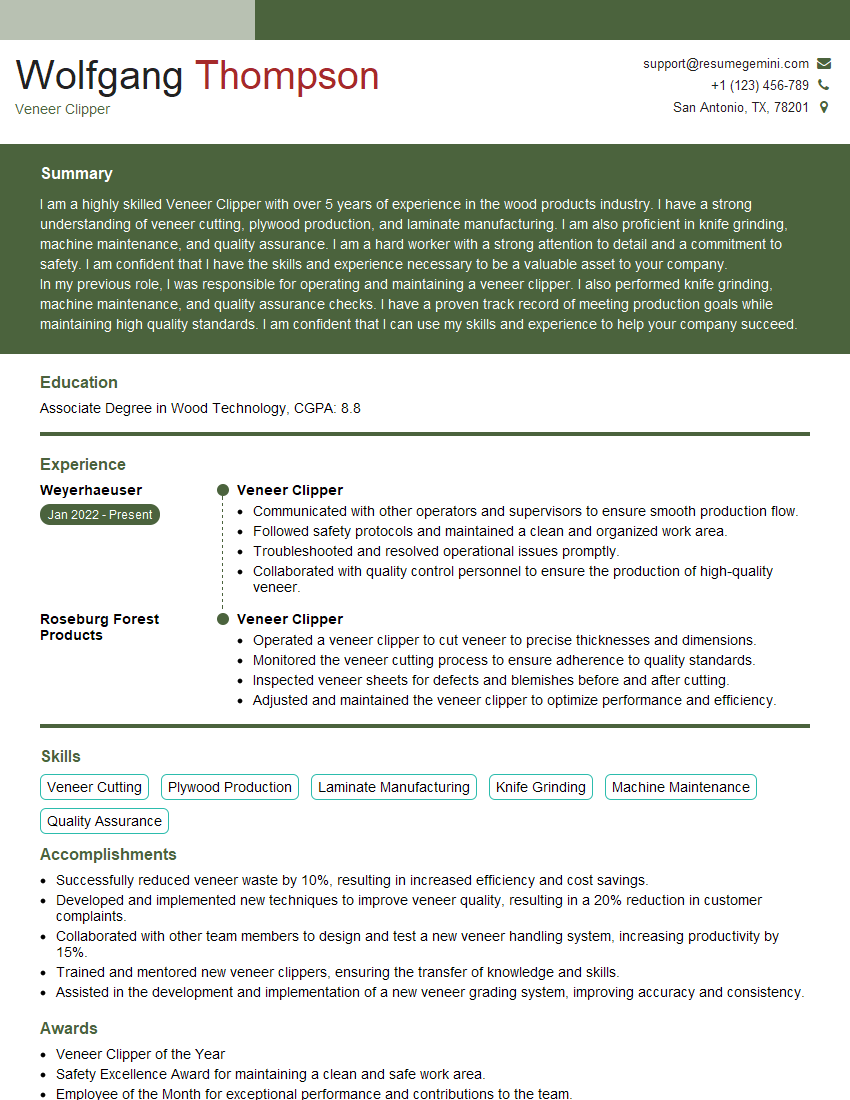
Mastering Veneer Clipping opens doors to rewarding careers in the woodworking and manufacturing industries. Your expertise in precise and efficient clipping translates directly into high-quality products and streamlined production. To significantly boost your job prospects, creating an ATS-friendly resume is crucial. This ensures your application gets noticed by recruiters and hiring managers. We highly recommend using ResumeGemini to build a professional and effective resume that highlights your Veneer Clipping skills. ResumeGemini provides valuable tools and resources to craft a compelling narrative, and we offer examples of resumes tailored specifically to Veneer Clipping positions to guide you.
Explore more articles
Users Rating of Our Blogs
Share Your Experience
We value your feedback! Please rate our content and share your thoughts (optional).
What Readers Say About Our Blog
To the interviewgemini.com Webmaster.
Very helpful and content specific questions to help prepare me for my interview!
Thank you
To the interviewgemini.com Webmaster.
This was kind of a unique content I found around the specialized skills. Very helpful questions and good detailed answers.
Very Helpful blog, thank you Interviewgemini team.