Preparation is the key to success in any interview. In this post, we’ll explore crucial Veneer Layup Machine Operation interview questions and equip you with strategies to craft impactful answers. Whether you’re a beginner or a pro, these tips will elevate your preparation.
Questions Asked in Veneer Layup Machine Operation Interview
Q 1. Describe your experience operating veneer layup machines.
My experience with veneer layup machines spans over eight years, encompassing various machine types and veneer materials. I’ve worked in high-volume production environments as well as smaller, specialized shops. This experience has given me a comprehensive understanding of the entire process, from initial setup and material handling to troubleshooting and quality control. I’m proficient in optimizing machine parameters for different veneer types and thicknesses, resulting in consistently high-quality layups. For example, I was instrumental in reducing waste by 15% on a recent project by fine-tuning the machine settings for a particularly delicate cherry veneer.
Q 2. What types of veneer layup machines are you familiar with?
I’m familiar with a range of veneer layup machines, including:
- Automatic Roll-to-Roll Layup Machines: These are high-speed machines ideal for large-scale production, automatically feeding and laying veneer sheets onto a core.
- Manual Layup Machines: These offer greater control and flexibility, typically used for smaller runs and intricate designs. They often involve a combination of manual placement and mechanical assistance.
- CNC-controlled Layup Machines: These machines provide the highest precision and repeatability, allowing for complex patterns and customized veneer layouts. They often incorporate digital design software for programming.
- Flat Layup Machines: These are used for assembling veneers onto flat core materials.
My experience encompasses both operating and maintaining these different types. The choice of machine depends heavily on the project requirements—production volume, veneer type, and design complexity all play a crucial role.
Q 3. Explain the process of setting up a veneer layup machine for a specific job.
Setting up a veneer layup machine for a specific job is a meticulous process that requires careful planning and attention to detail. It begins with a thorough review of the job specifications, including the type and dimensions of the core material, the veneer species, thickness, and the desired layup pattern.
- Machine Calibration: Precise calibration of the rollers, feed mechanisms, and cutting tools is crucial to ensure consistent veneer placement and accurate cuts. This often involves using precision measuring tools and adjusting machine settings based on the veneer’s characteristics.
- Material Preparation: The veneer needs to be carefully inspected for defects and properly conditioned for the optimal moisture content. This ensures that the veneer lays flat and prevents warping during the layup process.
- Software Programming (for CNC Machines): For CNC-controlled machines, a digital design file of the desired layup pattern is inputted and verified. This requires specialized software knowledge and understanding of the machine’s capabilities.
- Test Run: Before starting the full production run, a test layup is typically performed to check the accuracy of the settings and identify any potential issues. This allows for adjustments before committing to the entire project.
For instance, when working with highly figured veneers, I would adjust the feed speed to minimize stretching and ensure that the figure aligns perfectly across the panels. This attention to detail ensures the final product meets the highest quality standards.
Q 4. How do you ensure the quality and consistency of the veneer layup?
Ensuring quality and consistency in veneer layup relies on several key factors:
- Consistent Veneer Quality: Using veneer with uniform thickness and moisture content is essential. Variations can lead to uneven layups and defects.
- Precise Machine Settings: Regular calibration and maintenance of the machine are crucial for maintaining accurate feed rates and cutting precision.
- Careful Material Handling: Proper handling of the veneer, avoiding damage or bending, contributes to a flawless layup.
- Regular Inspections: Frequent visual inspection during the layup process helps to identify and correct any anomalies early on. This proactive approach minimizes waste and maximizes efficiency.
- Glue Application Consistency: (if applicable) Using a consistent and appropriate amount of adhesive ensures proper bonding throughout the layup.
I regularly monitor the layup process, checking for any gaps, overlaps, or inconsistencies. My experience allows me to quickly identify potential problems and make the necessary adjustments to maintain the high standards required. I use specialized measuring instruments to verify thickness and ensure conformity throughout.
Q 5. What are the common causes of defects in veneer layup, and how do you address them?
Common defects in veneer layup include:
- Gaps and Overlaps: Inconsistent feeding or machine malfunction can lead to gaps or overlaps in the veneer sheets.
- Wrinkles and Buckles: These are often caused by improper moisture content in the veneer or incorrect machine settings.
- Uneven Glue Distribution: (if applicable) This can result in weak bonds or delamination.
- Scratches and Damages: Careless handling during the process can cause scratches or other damage to the veneer.
- Misalignment: Incorrect alignment of veneer sheets can lead to an aesthetically unappealing finish.
Addressing these defects requires a systematic approach. It starts with identifying the root cause – is it a machine malfunction, a problem with the veneer, or an issue with the operating procedure? Once identified, the problem is addressed—this might involve recalibrating the machine, adjusting feed rates, replacing damaged veneer sheets, or even refining the operating procedures. Through preventative maintenance and proactive monitoring, many of these defects can be avoided altogether.
Q 6. Describe your experience with different types of veneer materials.
My experience encompasses a wide variety of veneer materials, including:
- Hardwoods: Oak, Walnut, Maple, Cherry—each with unique properties requiring specific machine settings and handling techniques.
- Softwoods: Pine, Fir, etc.—often used for less demanding applications.
- Exotic Veneers: Ebony, Rosewood, Zebrawood—these high-value materials require extra care and precision during handling and layup.
- Manufactured Veneers: These offer consistent quality and are often used for cost-effective solutions.
Working with different veneer species has taught me the importance of adapting my approach based on the material’s properties. For example, working with highly figured veneers like burl requires extra attention to detail to ensure that the figure is consistently displayed across the panel. I also understand the impact of moisture content on various species and how this needs to be accounted for in the layup process. A burl veneer, for instance, requires a much more careful and precise approach than a standard oak veneer.
Q 7. How do you maintain and troubleshoot a veneer layup machine?
Maintaining and troubleshooting a veneer layup machine requires a combination of preventative maintenance and problem-solving skills.
- Preventative Maintenance: This includes regular cleaning, lubrication, and inspection of all moving parts. This helps to prevent breakdowns and extends the lifespan of the machine. I adhere to a strict preventative maintenance schedule, documenting all checks and servicing.
- Troubleshooting: Problems can range from simple issues like jammed rollers to more complex mechanical or electrical faults. My experience allows me to quickly diagnose the issue, using appropriate tools and techniques for repair. I have a strong understanding of both mechanical and electrical systems common to these machines.
- Documentation: Keeping detailed records of maintenance tasks and troubleshooting procedures is crucial for efficient operation and problem-solving.
For example, I recently diagnosed a recurring jam in the feed rollers by systematically checking each roller for wear and tear and ultimately replacing a worn bearing. The detailed records I maintain made it possible to quickly pinpoint and rectify the problem, minimizing production downtime. My ability to proactively address maintenance needs helps to prevent costly production delays.
Q 8. What safety precautions do you follow when operating a veneer layup machine?
Safety is paramount when operating a veneer layup machine. My routine begins with a thorough machine inspection, checking for loose parts, damaged components, and ensuring all safety guards are in place and functioning correctly. I always wear appropriate personal protective equipment (PPE), including safety glasses, gloves, and hearing protection. The machine itself is operated only after confirming that the area is clear of obstructions and personnel. Furthermore, I meticulously follow the manufacturer’s safety guidelines, which include specific procedures for handling sharp tools and potentially hazardous materials. Regular maintenance checks are also crucial to prevent malfunctions that could lead to accidents. For instance, I regularly inspect the rollers to ensure they’re clean and functioning correctly, preventing material jams or unexpected stops that could cause injuries.
Think of it like driving a car; you wouldn’t drive without checking your mirrors and seatbelt, right? Similarly, safety checks are essential before operating any machinery, especially one handling sharp materials like veneer.
Q 9. What is your experience with pre-preg materials?
I have extensive experience working with pre-preg materials, which are pre-impregnated fabrics with resin already applied. This requires a precise and careful approach. My experience encompasses handling various types of pre-preg, including those with different resin systems (epoxy, phenolic, etc.), fiber orientations (unidirectional, woven, etc.), and thicknesses. Knowing the specific characteristics of each material is crucial for achieving optimal layup quality and avoiding issues like resin bleed or poor consolidation during curing. For instance, with some pre-preg materials, I need to account for their specific temperature and humidity sensitivity, ensuring proper storage and handling to prevent degradation. I’m also experienced in using specialized tools and techniques for handling delicate pre-preg materials, minimizing potential damage during the layup process.
One memorable project involved working with a high-performance carbon fiber pre-preg. The material’s sensitivity to moisture meant we had to maintain extremely strict environmental controls throughout the process, from storage to layup. This extra care ensured that we achieved the required strength and performance characteristics for the final product.
Q 10. Explain your understanding of layup schedules and their importance.
Layup schedules are detailed instructions outlining the sequence and placement of each layer of veneer or pre-preg material in a composite structure. They’re vital for controlling the final product’s properties, such as strength, stiffness, and weight distribution. A layup schedule specifies the type of material, its orientation (e.g., 0°, 45°, 90°), and the number of plies in each layer. Improper layup can lead to significant flaws, including reduced strength, delamination, or uneven stress distribution.
- Importance: Precise adherence to the layup schedule is paramount to ensure the composite structure meets its design requirements. Deviations can compromise structural integrity, performance, and potentially lead to failure.
- Example: A layup schedule for a simple laminate might specify: ‘2 plies of 0° unidirectional carbon fiber, followed by 2 plies of 90° unidirectional carbon fiber.’ This symmetrical arrangement ensures balanced strength in both directions.
Imagine building a house – you wouldn’t randomly stack bricks; you’d follow a blueprint. Layup schedules are the blueprints for composite structures, guiding the process to build a strong and reliable final product.
Q 11. How do you manage material waste during the layup process?
Minimizing material waste during layup is crucial for both economic and environmental reasons. My approach combines careful planning and practical techniques. I begin by accurately calculating the required material quantities based on the layup schedule. This minimizes over-ordering and consequent waste. During the layup process, I use precision cutting tools and techniques to minimize offcuts. Any usable scraps are carefully saved and used for smaller parts or test pieces, wherever possible. I also collaborate with the team to optimize material usage, sharing leftover pieces for projects with less stringent requirements. Regular monitoring and adjustments help in refining our approach and reduce waste even further. Furthermore, we work to ensure we have the correct materials in the correct quantities before beginning to reduce errors and waste from the start.
For instance, we developed a system for tracking material usage, allowing us to identify areas where waste is particularly high and implement targeted improvements.
Q 12. Describe your experience with different types of adhesives used in veneer layup.
My experience encompasses various adhesives used in veneer layup, including different types of contact adhesives, polyurethane glues, and epoxy resins. The choice of adhesive depends on the specific application, substrate materials, and required bond strength. Each adhesive type has unique properties and application methods that require specialized knowledge. Contact adhesives, for instance, require a specific open time and application pressure for optimal adhesion. I’m proficient in handling each type, ensuring proper mixing ratios, application techniques, and curing processes for different projects.
For instance, when working with sensitive wood veneers, I’d choose an adhesive that minimizes the risk of discoloration or damage, selecting a suitable contact adhesive. For stronger bonds in structural applications, I might opt for a high-strength epoxy system.
Q 13. How do you ensure the proper cure cycle for the laid-up veneer?
Ensuring the proper cure cycle is critical for achieving the desired strength and performance of the laid-up veneer. This process varies depending on the type of adhesive or resin used, the thickness of the layup, and the desired final properties. I use temperature-controlled ovens or autoclaves to regulate the curing process, precisely following the manufacturer’s recommended curing schedules for the specific materials involved. This often involves specific temperature ramps, dwell times, and cooling cycles. I use temperature and pressure monitoring equipment to accurately track the curing process and verify that the correct conditions have been met. Insufficient curing can lead to weak bonds, while excessive curing can cause material degradation.
An example is when working with epoxy systems; we carefully adhere to the manufacturer’s guidelines for exothermic reactions, ensuring that the heat generated during curing remains within safe and effective limits. In the case of a deviation in curing temperatures and pressure, I would immediately investigate for possible causes and report to a supervisor.
Q 14. What is your experience with quality control procedures in veneer layup?
Quality control is an integral part of the veneer layup process. My approach incorporates several checkpoints throughout the process, beginning with verifying the quality of the incoming materials (veneer, pre-preg, adhesives). During layup, I visually inspect each layer for proper alignment, ensuring there are no voids or inconsistencies. Post-cure, I conduct detailed visual inspections and, depending on the project requirements, non-destructive testing (NDT) methods such as ultrasonic inspection to detect internal flaws or delaminations. Any deviations from the specifications are meticulously documented and addressed. This process helps ensure that the final product meets the specified quality standards and performance requirements. The data collected from these checks are crucial for continuous improvement of our processes.
Imagine baking a cake. You wouldn’t serve it without checking if it’s cooked correctly, right? Similar quality control procedures are essential to ensure that the layup process yields a high-quality final product.
Q 15. Describe your experience using CNC controlled layup machines.
My experience with CNC-controlled veneer layup machines spans over eight years. I’ve worked extensively with various models, from simpler, single-axis machines to sophisticated, multi-axis systems capable of handling complex curves and intricate designs. I’m proficient in programming these machines using CAM software, generating G-code to precisely control the placement and cutting of veneer sheets. For example, I recently used a five-axis CNC machine to create a curved veneer panel for a luxury yacht interior, a task requiring meticulous programming and precise machine control. This involved optimizing cutting paths to minimize waste and ensure seamless veneer alignment. My expertise extends to troubleshooting and maintaining these machines, ensuring optimal performance and minimal downtime.
I’m familiar with various CNC control systems, including Fanuc and Siemens, and I understand the importance of safety protocols when operating these powerful machines. This includes regular machine inspections, adhering to lockout/tagout procedures during maintenance, and ensuring proper operator training for all personnel.
Career Expert Tips:
- Ace those interviews! Prepare effectively by reviewing the Top 50 Most Common Interview Questions on ResumeGemini.
- Navigate your job search with confidence! Explore a wide range of Career Tips on ResumeGemini. Learn about common challenges and recommendations to overcome them.
- Craft the perfect resume! Master the Art of Resume Writing with ResumeGemini’s guide. Showcase your unique qualifications and achievements effectively.
- Don’t miss out on holiday savings! Build your dream resume with ResumeGemini’s ATS optimized templates.
Q 16. How do you handle unexpected machine malfunctions?
Handling unexpected machine malfunctions requires a systematic approach. My first step is always safety—ensuring the machine is powered down and secured before any troubleshooting begins. Then, I systematically diagnose the problem. This often starts with checking the error logs provided by the machine’s control system. These logs often pinpoint the source of the problem, such as a sensor malfunction, a mechanical issue (like a jammed roller), or a software glitch.
For example, during a recent project, the machine suddenly stopped mid-layup due to a sensor error. By consulting the error logs and using a multimeter, I quickly identified a faulty proximity sensor. Replacing the sensor resolved the issue. If I can’t immediately identify the problem, I refer to the machine’s technical manuals, contact the manufacturer’s support, or consult with experienced colleagues. Detailed documentation of these malfunctions and their solutions is crucial for future reference and preventative maintenance.
Q 17. How do you document your work and maintain accurate records?
Accurate record-keeping is essential in veneer layup. I maintain detailed logs for every project, including material specifications (type of veneer, thickness, quantity), machine settings (feed rate, cutting depth, pressure), and any modifications made to the process. This information is crucial for quality control and for reproducing successful layups. I use a combination of digital and physical methods. Digital records are kept in a dedicated database, which allows for easy searching and analysis. Physical records, such as material receipts and inspection reports, are securely archived.
Furthermore, I document all maintenance procedures performed on the machines, including the date, time, and details of the work. This helps in tracking the machine’s performance and predicting potential future problems. This comprehensive documentation ensures traceability and transparency, crucial for any quality management system (e.g., ISO 9001).
Q 18. Describe your experience working with different types of tooling.
My experience encompasses a wide range of tooling used in veneer layup. This includes various cutting tools (such as router bits and knives), different types of rollers (pressure rollers, guiding rollers), vacuum systems for holding the veneer in place, and specialized jigs and fixtures for complex shapes. I’m familiar with the properties of various materials used in tooling and how to choose the appropriate tool for a specific task. For instance, I’ve used diamond-tipped router bits for precise cutting of hard veneers and carbide-tipped tools for softer woods. Proper tool maintenance, including regular sharpening and replacement, is paramount to ensuring precision and efficiency.
I also understand the importance of safety when working with tooling. This includes using appropriate personal protective equipment (PPE) like safety glasses and gloves and performing regular checks for tool wear and tear.
Q 19. Explain your understanding of the different types of layup techniques (e.g., hand layup, automated layup).
Hand layup is a manual process where veneer sheets are manually placed and positioned on a substrate. It’s labor-intensive but suitable for small-scale projects or intricate designs where precise control is crucial. Automated layup, on the other hand, uses CNC-controlled machines for precise and efficient veneer placement. Automated systems significantly improve speed, consistency, and reduce material waste, making it ideal for high-volume production.
There are several variations of automated layup, such as tape laying, which uses pre-impregnated tapes and robotic arms, and automated cutting and placing systems with advanced software for intricate patterns. The choice between these methods depends on the project’s complexity, scale, and budget. A balance of both methods is often optimal; for instance, manual work might be used to create specific parts, and then integrated into an automated process for mass production.
Q 20. How do you calculate the required amount of veneer for a specific job?
Calculating the required amount of veneer involves a few key steps. First, I obtain precise dimensions of the final product. Then, I account for waste during the cutting and layup process, which varies depending on the complexity of the design and the cutting method employed. This usually involves adding a percentage to the net material required, anywhere from 5% to 20%, depending on the intricacy of the project.
For example, if the net veneer area required is 10 square meters, adding a 10% waste factor results in a total material order of 11 square meters. Accurate measurements are critical; I use sophisticated measuring tools to ensure precision. The type of veneer also matters, as the sheet size varies among species and suppliers.
Q 21. What is your experience with different types of resins used in veneer layup?
My experience encompasses a variety of resins used in veneer layup, each with its unique properties. Epoxy resins are known for their strength, durability, and excellent adhesion, making them suitable for high-performance applications. Polyester resins are more cost-effective but often less durable than epoxies. Urethane resins offer good flexibility and impact resistance. The choice of resin depends on factors such as the end-use of the product, the type of veneer, and the required environmental resistance.
I’m also familiar with the health and safety implications associated with handling different resins, including proper ventilation, use of personal protective equipment, and safe disposal procedures. Understanding the curing process of each resin is crucial to ensure proper adhesion and avoid defects in the finished product. This also includes understanding how different factors (temperature, humidity) can affect the resin’s curing time and final properties.
Q 22. How do you ensure proper alignment and orientation of veneer plies?
Ensuring proper alignment and orientation of veneer plies is crucial for achieving the desired strength and aesthetic qualities in the final product. This involves a multi-step process, beginning with careful planning. We use digital design software to create precise layup plans, specifying the orientation and position of each ply. This plan is then transferred to the layup machine, often using automated systems or precise alignment guides.
During the actual layup, we employ several techniques. For example, we use alignment pins or laser guides to ensure each ply is placed accurately relative to the previous one. Visual inspection is also vital, and experienced operators can quickly identify even minor misalignments. Vacuum pressure, applied after layup, further helps to hold the plies in place and prevent shifting. Finally, post-layup inspection, often using specialized cameras or software, confirms that the alignment is acceptable before proceeding to the curing stage. For example, on a recent project building a curved aircraft component, using laser guidance was critical to achieve the necessary precision along the complex curvature.
Q 23. What are your experience with vacuum bagging techniques?
Vacuum bagging is a fundamental technique in veneer layup, especially for complex shapes or when high-quality surface finishes are required. It involves encapsulating the layup within a flexible bag, removing air through a vacuum pump. This process compresses the plies, removes air bubbles, and ensures a uniform resin distribution. My experience encompasses various vacuum bagging systems, from simple hand-laid setups to automated systems with integrated vacuum pumps and pressure monitoring. I’m proficient in selecting appropriate bagging materials (e.g., peel-ply, breather fabric) based on the resin system and part geometry to prevent resin bleed and achieve optimal consolidation. For instance, I once resolved a production bottleneck by optimizing the vacuum bagging parameters, leading to a 15% reduction in cycle time.
Q 24. Explain your understanding of the relationship between fiber orientation and material properties.
The relationship between fiber orientation and material properties is paramount in veneer layup. The strength and stiffness of the final composite are directly influenced by how the wood fibers are arranged. Imagine a single strand of wood – it’s much stronger along the grain than across it. Similarly, a veneer layup with fibers predominantly aligned in one direction (unidirectional) will be strongest along that axis. This is often utilized in structural applications where high strength in a specific direction is needed. Conversely, a cross-ply layup (alternating fiber orientations at 90 degrees) provides more balanced strength and stiffness in multiple directions. This principle is applied frequently when building products requiring strength and stability in multiple planes like boat hulls or furniture components. Understanding this allows us to tailor the layup to meet specific performance requirements.
Q 25. What is your experience with automated inspection systems?
My experience with automated inspection systems includes working with both optical and digital imaging systems. These systems play a critical role in ensuring quality control during the layup process, detecting flaws such as voids, delaminations, or misalignments that might be missed by visual inspection alone. I’m proficient in using software to analyze the images produced by these systems to identify defects and determine whether a layup meets the specified quality standards. Furthermore, I have experience with systems that integrate directly with the layup machine, providing real-time feedback and allowing for immediate corrective action. One example was using a vision system to automate the detection and removal of knots in veneer sheets before layup, significantly reducing waste and improving the consistency of the final product.
Q 26. Describe your experience working in a team environment.
I thrive in team environments. My experience includes working as part of a cross-functional team comprising engineers, technicians, and production personnel. I believe effective communication is key, and I actively participate in team meetings, sharing my expertise and contributing to problem-solving. I’m comfortable mentoring junior team members and readily assist colleagues to ensure project success. A specific example involved coordinating with our engineering team to troubleshoot a recurring delamination issue in a high-volume production run. By working collaboratively and sharing data, we identified the root cause (a slight inconsistency in the resin curing process) and implemented corrective measures, resolving the issue and preventing significant production losses.
Q 27. How do you stay up-to-date on the latest advancements in veneer layup technology?
Staying current with advancements in veneer layup technology requires a multi-pronged approach. I regularly attend industry conferences and trade shows, networking with peers and learning about the latest innovations. I subscribe to industry journals and publications, keeping abreast of research and developments in materials science and automation. Online resources and professional organizations also provide valuable information. Furthermore, I actively seek opportunities for continuing education and professional development, often participating in workshops and training sessions to enhance my skills in areas such as advanced materials characterization or automated systems programming. This continuous learning ensures that my skills remain sharp and relevant.
Q 28. What are your salary expectations for this role?
My salary expectations for this role are commensurate with my experience and expertise in veneer layup machine operation, coupled with my proven track record of successfully delivering high-quality results in demanding production environments. Based on my research of similar roles and my own contributions, I am targeting a salary range of [Insert Salary Range Here]. I am, however, open to discussing this further based on the specifics of the role and the overall compensation package.
Key Topics to Learn for Veneer Layup Machine Operation Interview
- Machine Operation & Maintenance: Understanding the mechanics of the veneer layup machine, including its various components, functionalities, and routine maintenance procedures. This includes preventative maintenance schedules and troubleshooting common malfunctions.
- Veneer Handling & Quality Control: Proper techniques for handling veneer sheets to avoid damage, recognizing defects in veneer, and ensuring consistent quality throughout the layup process. This involves understanding different veneer types and their properties.
- Layup Techniques & Patterns: Mastering various layup techniques for different applications and understanding the creation of complex veneer patterns. This includes knowledge of different adhesive types and their application.
- Safety Procedures & Regulations: Familiarity with all relevant safety protocols and regulations pertaining to veneer layup machine operation, including PPE usage and emergency procedures.
- Production Efficiency & Optimization: Understanding how to optimize the machine’s performance for maximum efficiency, minimizing downtime, and meeting production targets. This includes identifying bottlenecks and suggesting improvements.
- Troubleshooting & Problem Solving: Developing effective problem-solving skills to diagnose and resolve common issues encountered during machine operation. This includes understanding error codes and performing basic repairs.
- Data Recording & Reporting: Accurately recording production data, maintaining logs, and preparing reports on machine performance and any identified issues.
Next Steps
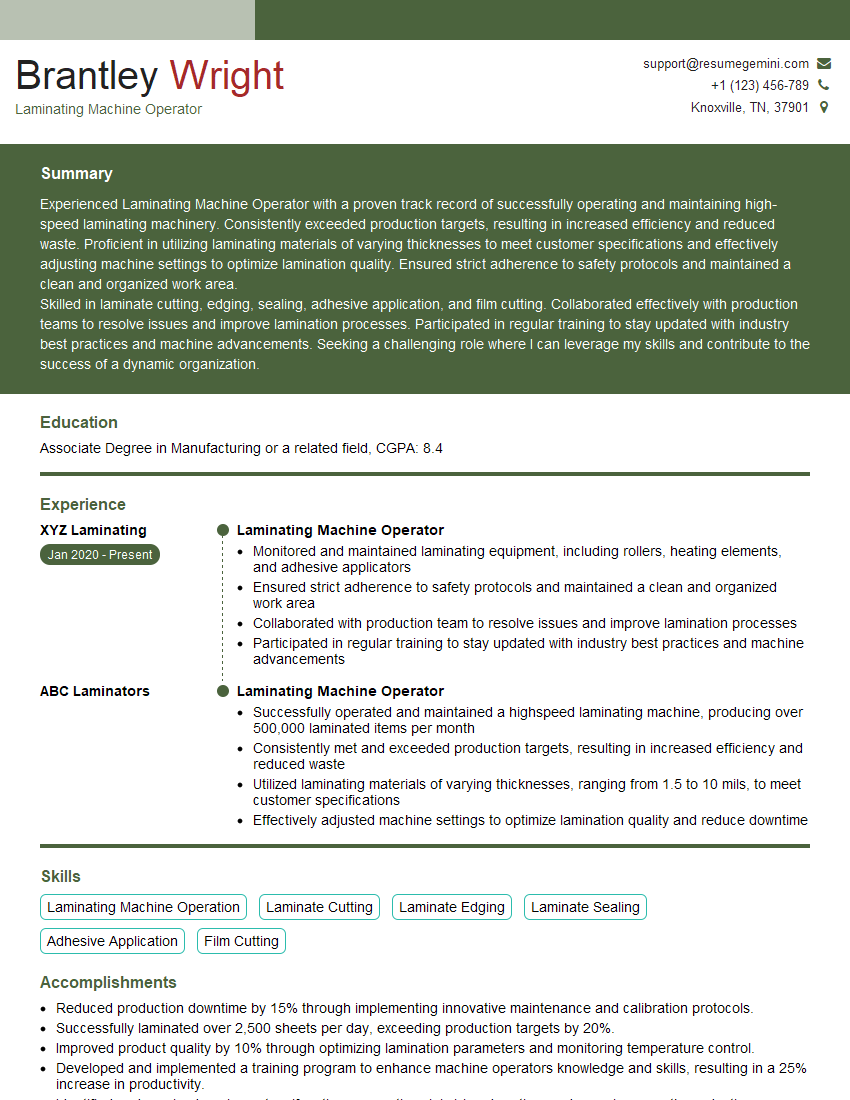
Mastering Veneer Layup Machine Operation opens doors to a rewarding career with opportunities for advancement and specialization within the manufacturing industry. To significantly improve your job prospects, focus on creating a strong, ATS-friendly resume that highlights your skills and experience effectively. ResumeGemini is a trusted resource that can help you build a professional and impactful resume. We provide examples of resumes tailored to Veneer Layup Machine Operation to guide you through the process. Take the next step towards your dream career today!
Explore more articles
Users Rating of Our Blogs
Share Your Experience
We value your feedback! Please rate our content and share your thoughts (optional).
What Readers Say About Our Blog
To the interviewgemini.com Webmaster.
Very helpful and content specific questions to help prepare me for my interview!
Thank you
To the interviewgemini.com Webmaster.
This was kind of a unique content I found around the specialized skills. Very helpful questions and good detailed answers.
Very Helpful blog, thank you Interviewgemini team.