The thought of an interview can be nerve-wracking, but the right preparation can make all the difference. Explore this comprehensive guide to Winemaker interview questions and gain the confidence you need to showcase your abilities and secure the role.
Questions Asked in Winemaker Interview
Q 1. Describe your experience with different grape varietals and their unique characteristics.
My experience spans a wide range of grape varietals, each possessing unique characteristics that profoundly impact the final wine. For instance, Cabernet Sauvignon, known for its robust tannins and dark fruit flavors, requires meticulous vineyard management and careful oak aging to achieve its full potential. Contrast this with Pinot Noir, a notoriously finicky grape, demanding precise viticultural practices and gentle winemaking to retain its delicate aromas of red cherry and earthy undertones. Working with Chardonnay allows exploration of diverse winemaking styles; from unoaked, crisp expressions showcasing vibrant acidity, to rich, buttery styles resulting from malolactic fermentation and barrel aging. Similarly, Sauvignon Blanc’s versatility allows for wines ranging from herbaceous and grassy to tropical and fruit-forward, depending on the terroir and winemaking approach. Each varietal presents a unique puzzle, requiring a deep understanding of its specific needs to produce a high-quality wine.
- Cabernet Sauvignon: Full-bodied, high tannins, dark fruit flavors (blackcurrant, blackberry).
- Pinot Noir: Light to medium-bodied, delicate, red fruit and earthy notes.
- Chardonnay: Versatile, can range from crisp and acidic to rich and buttery.
- Sauvignon Blanc: High acidity, herbaceous or tropical fruit notes.
Q 2. Explain the process of fermentation, including the role of yeast and temperature control.
Fermentation is the heart of winemaking, the process where yeast consumes sugars in grape juice, converting them into alcohol, carbon dioxide, and other byproducts. This crucial transformation requires careful management. We primarily use *Saccharomyces cerevisiae*, a specific yeast strain selected for its reliability and desirable flavor profiles. Temperature control is paramount during fermentation. For example, cooler temperatures (around 18-20°C) are often preferred for white wines to retain delicate aromas and maintain freshness. Conversely, red wine fermentation may involve warmer temperatures (25-30°C) to extract more color and tannin from the grape skins. Monitoring temperature prevents off-flavors and ensures a clean, desirable fermentation. We use temperature-controlled tanks equipped with precise monitoring systems, allowing for adjustments as needed. Think of it like baking a cake – the precise temperature ensures the desired outcome.
Q 3. How do you monitor and control the malolactic fermentation process?
Malolactic fermentation (MLF) is a secondary fermentation where malic acid, a harsh acid, is converted into lactic acid, a softer, rounder acid. This conversion significantly impacts a wine’s mouthfeel and overall balance, particularly in red wines and some white wines like Chardonnay. We monitor MLF through regular taste tests and analysis of malic and lactic acid levels. We might use techniques like inoculating with selected MLF bacteria to ensure a controlled and timely fermentation. Factors like temperature and pH are closely monitored and adjusted to promote or inhibit MLF as desired. For example, if we want a crisper Chardonnay, we’d prevent MLF. But for a fuller-bodied Chardonnay, we would encourage it. In essence, we’re fine-tuning the wine’s character by carefully managing this secondary fermentation. It’s like adding a dash of salt to a dish; the right amount brings out the flavor, too much ruins it.
Q 4. Describe your experience with different winemaking techniques, such as oak aging and cold stabilization.
My experience encompasses a wide array of winemaking techniques. Oak aging, for example, imparts distinct flavors and aromas to wines, depending on the type of oak (French, American, etc.), its level of toast, and the length of aging. Oak contributes vanilla, spice, and toasty notes, often complementing the fruit characteristics of the wine. Cold stabilization is another technique used to prevent unwanted crystal formation (tartrate crystals) in the bottled wine. This involves chilling the wine to a low temperature, which causes these crystals to precipitate out of solution, ultimately resulting in a clearer, more stable product. Other techniques include the use of filtration, fining agents, and various methods of clarification. These are tools to carefully refine the wine based on the desired style and the character of the grapes.
Q 5. How do you ensure the quality and consistency of your wines from vintage to vintage?
Maintaining quality and consistency across vintages is a constant challenge. It involves meticulous record-keeping, from vineyard practices to fermentation parameters. We employ detailed protocols for each stage of winemaking, ensuring that all processes are meticulously controlled and consistently applied. For instance, we track data like grape maturity levels, fermentation temperatures, and aging timelines. We also use analytical tools like chromatography to consistently evaluate the chemical profile of our wines. A strong understanding of the vineyard and consistent quality grapes are crucial to ensure consistency. It’s like following a precise recipe, adapting to seasonal changes while sticking to the core principles for consistent results.
Q 6. What are the common challenges faced during wine production, and how have you overcome them?
Winemaking presents numerous challenges, including vineyard issues like frost, hail, or disease, which can significantly affect grape yield and quality. In the cellar, we might encounter stuck fermentations, where yeast activity ceases prematurely, or bacterial spoilage. Managing these challenges requires quick thinking and problem-solving skills. For instance, a stuck fermentation might be addressed by adding fresh yeast, adjusting temperature, or supplementing nutrients. Bacterial spoilage is minimized by maintaining strict sanitation practices and by using appropriate filtration techniques. Each challenge presents a unique learning opportunity, enhancing our ability to anticipate and resolve future issues.
Q 7. How do you handle vineyard issues that could negatively affect grape quality?
Addressing vineyard issues that impact grape quality is a critical aspect of our work. This includes proactive measures like proper canopy management to optimize sunlight exposure and air circulation, minimizing the risk of fungal diseases like powdery mildew. We regularly monitor vines for pests and diseases, implementing integrated pest management strategies that prioritize sustainable practices. This might involve using beneficial insects or employing biological controls to minimize the need for chemical interventions. Our approach is always preventative, prioritizing vineyard health to ensure the highest quality grapes reach the winery. We consider the vineyard a living organism that requires constant care and attention.
Q 8. Explain your understanding of wine chemistry and its impact on wine quality.
Wine chemistry is the bedrock of quality winemaking. It’s the understanding of the chemical reactions that occur throughout the winemaking process, from grape growth to bottle aging. These reactions influence everything from the aroma and flavor profile to the wine’s stability and longevity. Key areas include understanding the sugars and acids in grapes, fermentation kinetics (how yeast converts sugars to alcohol and CO2), phenolic compounds (responsible for color, tannins, and mouthfeel), and the impact of oxidation and reduction reactions.
For example, the balance of malic acid (tart, green apple-like) and lactic acid (softer, creamier) profoundly impacts a wine’s acidity and taste. Malolactic fermentation, a bacterial process that converts malic acid to lactic acid, is often employed to soften the acidity of high-acid wines, like Chardonnay. Similarly, the management of phenolic compounds, particularly tannins (polyphenols responsible for astringency and mouthfeel), is crucial. Too many harsh tannins can lead to a bitter, unenjoyable wine, while too few can result in a flabby, unstructured wine. A winemaker’s ability to control these chemical processes and achieve optimal balance determines the wine’s quality and character.
Q 9. Describe your experience with wine blending and the rationale behind your decisions.
Wine blending is an art form and a science. It’s about combining different wines – often from different vineyards, varietals, or even vintages – to create a final product that is superior to its individual components. My approach is iterative, always driven by a clear vision for the final blend. I start by assessing the individual wines, noting their sensory attributes (aroma, flavor, acidity, tannins, etc.) and chemical composition (pH, alcohol, TA, etc.). I then experiment with different ratios, meticulously documenting each blend. I often utilize a structured tasting sheet to track my sensory analysis and record my notes, which allows me to look for specific components in each wine to use as a building block.
For instance, in crafting a Cabernet Sauvignon, I might blend a wine with intense fruit flavors from one vineyard with another offering more structure and tannin from a cooler site. This process requires extensive sensory evaluation and analytical testing, constantly refining the blend until the desired flavor profile, balance, and complexity are achieved. The ultimate rationale is to create a harmonious and expressive wine that showcases the best qualities of its constituent parts while mitigating any undesirable characteristics. A software like WineMaker’s blending software can aid greatly in tracking this process.
Q 10. How do you manage inventory and track production costs efficiently?
Efficient inventory and cost tracking are crucial for profitability in winemaking. I utilize a combination of computerized inventory management systems and meticulous manual record-keeping. The software tracks every aspect, from grape procurement and processing to bottling and labeling. It automatically calculates the costs associated with each stage of production, providing a real-time overview of profitability. Barcodes are used at every stage to track batches and individual products which are logged in the software.
This system helps in forecasting inventory needs, minimizing waste, and identifying areas for cost optimization. For example, by analyzing historical data, we can predict the yield of specific grape varieties and adjust our purchases accordingly. Regular reconciliation between the software and physical inventory ensures accuracy and mitigates discrepancies. This data-driven approach allows for informed decision-making, maximizing efficiency and minimizing losses throughout the entire production cycle.
Q 11. What are your preferred methods for evaluating wine quality and identifying defects?
Evaluating wine quality is both subjective and objective. I employ a multi-faceted approach combining sensory evaluation with laboratory analysis. Sensory evaluation involves a systematic tasting process that considers aroma, flavor, acidity, tannins, body, and finish. This is often conducted in a blind tasting setting to minimize bias, allowing for an unbiased evaluation. The evaluation is guided by a score sheet designed to rate components of the wine separately before assessing the complete sensory experience.
Laboratory analysis provides objective data on factors like pH, alcohol content, volatile acidity (VA), and total acidity (TA). Elevated VA, for example, can indicate spoilage or an off-flavor. Visual examination checks for clarity, color, and the presence of sediment or cloudiness. Identifying defects often requires a combination of sensory assessment and lab results. For instance, a ‘corked’ wine (TCA contamination) might exhibit a musty or damp aroma, detectable by smell, and may be validated through chemical analysis. This combination of both sensory testing and laboratory analysis provides a comprehensive assessment of wine quality and the detection of any defects.
Q 12. What are some of the latest technologies you use in your winemaking process?
Modern winemaking leverages many advanced technologies to enhance quality, efficiency, and consistency. We use precision fermentation monitoring systems that provide real-time data on temperature, pH, and dissolved oxygen levels throughout fermentation. This enables precise control over the process, resulting in a more predictable and desirable outcome. This precision helps us prevent issues such as stuck or sluggish fermentations, preventing spoilage or off-flavors.
Spectroscopy techniques are utilized for rapid analysis of grape composition and wine quality parameters. This reduces the time spent waiting for results from traditional laboratory analysis. Automated bottling and labeling systems ensure consistent filling and labeling, minimizing human error and improving efficiency. We also employ advanced temperature-controlled storage and aging systems to optimize the aging process and maintain the quality of the wine over time. These technologies ensure a more precise, efficient, and ultimately better final product.
Q 13. What are your preferred methods of fining and filtering wines?
Fining and filtering are employed to clarify and stabilize wine, removing unwanted particles and improving its appearance and shelf life. My approach is selective, always considering the impact on the wine’s overall character. I don’t believe in aggressive fining and filtering that strips away desirable components. I prefer to use fining agents sparingly, often selecting them based on the specific wine’s needs.
For example, bentonite clay is commonly used to remove proteins that can cause haze, but excessive use can strip the wine of desirable tannins and mouthfeel. I often opt for gentler fining agents, such as egg whites, which can selectively remove certain particles while preserving the wine’s complexity. Filtering is employed as a final step to ensure clarity and stability, but the choice of filter type (e.g., membrane filter vs. diatomaceous earth) depends on the desired level of clarification. The goal is to achieve the desired clarity without sacrificing the wine’s delicate nuances and flavor profile.
Q 14. How do you ensure the sanitation and hygiene of the winery equipment?
Sanitation and hygiene are paramount in winemaking to prevent microbial spoilage and ensure the safety and quality of the final product. We adhere to a strict sanitation protocol at every stage of the process, from grape reception to bottling. All winery equipment is thoroughly cleaned and sanitized using appropriate cleaning and sanitizing agents according to rigorous schedules. This involves a combination of physical cleaning, chemical sanitization, and monitoring to prevent contamination.
We regularly monitor the effectiveness of our sanitation protocols through microbiological testing. These tests examine the levels of bacteria and yeast in the different processing areas to assess the efficiency of our sanitation process and pinpoint any areas requiring further attention. Training all staff on proper sanitation procedures ensures everyone understands their responsibilities in maintaining a clean and sterile environment for the sake of superior wine production.
Q 15. How do you develop and maintain relationships with suppliers and distributors?
Building and maintaining strong relationships with suppliers and distributors is crucial for a successful winery. It’s not just about securing the best grapes or getting your wine on shelves; it’s about fostering partnerships based on mutual respect, trust, and shared goals.
My approach is multifaceted. First, I prioritize open communication. Regular meetings, both formal and informal, are key to understanding their needs and challenges. For grape suppliers, this includes visits to their vineyards to assess the health of the vines and discuss the upcoming harvest. For distributors, this means discussing market trends, consumer preferences, and sales strategies.
- Supplier Relationship Management (SRM): I leverage technology to track orders, deliveries, and quality assessments, ensuring transparency and accountability throughout the supply chain.
- Negotiation & Contracts: Fair and mutually beneficial contracts are paramount. We negotiate prices and delivery terms based on market conditions and long-term projections, ensuring stability and predictability.
- Building Personal Connections: I believe in building strong personal relationships. Attending industry events, sharing a meal, or simply having a casual conversation helps foster rapport and builds trust.
For example, during a particularly challenging harvest affected by unpredictable weather, I worked closely with my grape suppliers, offering technical assistance and adjusting our contract terms to ensure fairness despite the lower yields. This proactive approach strengthened our relationship and secured our supply for the following years.
Career Expert Tips:
- Ace those interviews! Prepare effectively by reviewing the Top 50 Most Common Interview Questions on ResumeGemini.
- Navigate your job search with confidence! Explore a wide range of Career Tips on ResumeGemini. Learn about common challenges and recommendations to overcome them.
- Craft the perfect resume! Master the Art of Resume Writing with ResumeGemini’s guide. Showcase your unique qualifications and achievements effectively.
- Don’t miss out on holiday savings! Build your dream resume with ResumeGemini’s ATS optimized templates.
Q 16. Explain your understanding of wine laws and regulations.
Wine laws and regulations are complex and vary significantly by region and country. Understanding them is paramount for legal compliance and avoiding costly penalties. My knowledge encompasses areas such as labeling requirements, alcohol content regulations, appellation designations (like AOC in France or DOCG in Italy), and environmental regulations related to water usage and waste disposal.
I stay updated on these regulations through ongoing professional development, memberships in relevant industry associations, and consultations with legal experts specializing in wine law. For example, I meticulously ensure that all our labels accurately reflect the origin, varietal composition, alcohol content, and any added sulfites, complying with both national and international regulations. This includes understanding the nuances of labeling requirements for organic or biodynamic wines, which often have stricter rules.
Beyond labeling, I’m knowledgeable about tax regulations, import/export laws, and health and safety standards relating to wine production and distribution. Failure to comply with these regulations can result in significant fines, product recalls, and damage to the winery’s reputation. Therefore, proactive compliance is crucial to the long-term health of the business.
Q 17. What are your strategies for marketing and selling your wines?
Marketing and selling wine requires a multi-pronged approach tailored to the target audience and the unique characteristics of the wine. It’s not just about selling a bottle; it’s about building a brand and a story.
- Direct-to-Consumer (DTC) Sales: We actively promote our wines through our winery website, email marketing, and social media engagement. We also offer wine club memberships and organize tasting events to cultivate customer loyalty.
- Distribution Partnerships: Strategic partnerships with distributors are vital for reaching a wider market. This involves careful selection of distributors who align with our brand image and target market.
- Public Relations (PR): Securing positive press coverage through media outreach and participation in wine competitions is crucial for building brand recognition.
- Experiential Marketing: We create memorable experiences for consumers through winery tours, tastings, and special events, fostering a sense of community and brand loyalty.
For instance, we recently launched a successful social media campaign highlighting the unique terroir of our vineyards, appealing to consumers interested in sustainability and authentic regional wines. This strategy boosted online sales and increased brand awareness.
Q 18. How do you manage a team and assign tasks effectively?
Effective team management in a winery involves fostering collaboration, clear communication, and assigning tasks based on individual strengths and expertise. I believe in empowering my team and creating a positive and supportive work environment.
My approach starts with clear roles and responsibilities. I use project management tools to assign tasks, track progress, and manage deadlines. Regular team meetings provide opportunities for open communication, problem-solving, and feedback. I also delegate authority appropriately, empowering team members to make decisions within their areas of expertise.
I strongly believe in providing regular feedback and training opportunities for team members to develop their skills. For example, I’ve implemented a mentorship program where experienced team members guide newer employees, facilitating knowledge transfer and fostering team cohesion. Regular performance evaluations provide constructive feedback and opportunities for professional growth.
Q 19. How do you handle unexpected challenges during the winemaking process?
Winemaking is inherently unpredictable. Unexpected challenges such as equipment malfunctions, adverse weather conditions, or unexpected diseases in the vineyard are common. My approach to handling these challenges is based on proactive planning, rapid assessment, and decisive action.
- Risk Assessment: We conduct regular risk assessments to identify potential problems and develop contingency plans. This includes having backup equipment and contingency strategies for dealing with extreme weather events.
- Problem-Solving: When unexpected issues arise, I encourage a collaborative problem-solving approach, bringing together relevant team members to brainstorm solutions. For instance, a sudden power outage during fermentation was swiftly addressed by utilizing backup generators, minimizing the impact on the wine.
- Adaptability: Flexibility is crucial. We must be prepared to adapt our processes and strategies as needed to overcome challenges and minimize losses. During a vineyard frost, we were able to salvage a portion of the harvest by using specialized techniques to protect the remaining grapes.
Ultimately, successful handling of unexpected challenges relies on a combination of well-defined protocols, a capable team, and a willingness to adapt quickly and decisively.
Q 20. Describe your experience with different wine styles and production methods.
My experience encompasses a wide range of wine styles and production methods. I’ve worked with various grape varietals, from classic Bordeaux blends to aromatic whites and sparkling wines. I’m proficient in both traditional and modern winemaking techniques.
- Traditional Methods: I have extensive experience with traditional methods like extended maceration for red wines, malolactic fermentation, and aging in oak barrels. This includes understanding the impact of different oak types and toast levels on the final product.
- Modern Techniques: I also incorporate modern techniques such as temperature-controlled fermentation, precision winemaking, and advanced analytical tools to optimize wine quality and consistency. This includes using spectroscopy to monitor fermentation progress and ensuring precise control over the wine’s chemical composition.
- Wine Styles: I’ve been involved in the production of various wine styles, from delicate Rieslings to robust Cabernet Sauvignons, sparkling wines produced by both the traditional (méthode champenoise) and Charmat methods, and fortified wines. This diverse experience allows me to understand the specific requirements of each style and adjust my approach accordingly.
For example, in producing a specific Pinot Noir, I utilized extended maceration to achieve a full-bodied, complex wine with ripe tannins, while for a crisp Sauvignon Blanc, I employed low-temperature fermentation to preserve its fresh fruit aromas.
Q 21. How do you ensure the sustainability of your winemaking practices?
Sustainability is not just a trend; it’s a core value integral to our winemaking practices. It involves minimizing our environmental footprint while maximizing resource efficiency and ensuring the long-term health of our vineyards and the surrounding ecosystem.
- Water Conservation: We employ water-efficient irrigation techniques and monitor water usage meticulously to conserve this precious resource. This includes using drip irrigation and soil moisture sensors.
- Pest and Disease Management: We prioritize integrated pest management (IPM) strategies, minimizing reliance on synthetic pesticides and herbicides. This involves using beneficial insects and organic treatments wherever possible.
- Energy Efficiency: We constantly seek ways to improve energy efficiency in our winery, from using energy-efficient equipment to harnessing renewable energy sources like solar power.
- Waste Reduction: We implement strategies to minimize waste throughout the winemaking process, from recycling materials to composting grape pomace and other organic byproducts. This generates valuable compost for our vineyards, promoting healthy soil and reducing reliance on external fertilizers.
For instance, our commitment to sustainability has earned us certification under a recognized organic winemaking standard, demonstrating our dedication to environmentally responsible practices and providing consumers with transparency about our production methods.
Q 22. What are your strategies for reducing waste and increasing efficiency in the winery?
Reducing waste and increasing efficiency in winemaking is crucial for both environmental responsibility and profitability. My strategies focus on several key areas:
- Precision Viticulture: Utilizing data-driven techniques like yield monitoring and soil analysis to optimize grape production. This minimizes unnecessary vine material and ensures optimal grape quality from the outset, reducing waste later in the process.
- Optimized Fermentation: Employing precise temperature control and efficient yeast strains minimizes losses during fermentation. For instance, using selected yeast strains that produce higher yields and reduce the risk of stuck fermentations.
- Wastewater Management: Implementing closed-loop systems to recycle and reuse water throughout the winemaking process. This includes capturing and treating wastewater from cleaning and processing to minimize environmental impact and reduce water costs.
- Pomace Management: Exploring creative uses for grape pomace (the skins, seeds, and stems left after pressing). This can include selling it for animal feed, compost, or even extracting valuable compounds for other products, thus creating additional revenue streams.
- Energy Efficiency: Investing in energy-efficient equipment, such as solar panels or heat pumps, to reduce reliance on fossil fuels and lower operational costs. This also contributes to a smaller carbon footprint.
For example, in a recent vintage, we implemented a new system for capturing and reusing water from our cleaning processes. This resulted in a 15% reduction in our overall water consumption.
Q 23. How do you utilize sensory evaluation techniques in your winemaking process?
Sensory evaluation is fundamental to quality winemaking. It’s a multi-sensory approach that relies on sight, smell, taste, and even touch to assess the wine at each stage.
- Visual Assessment: We examine the wine’s clarity, color intensity, and viscosity. This gives clues about its age, potential flaws, and overall health.
- Olfactory Analysis: The aroma profile is crucial. We identify primary aromas (from the grape variety), secondary aromas (from fermentation), and tertiary aromas (from aging). This informs decisions about oak aging or other interventions.
- Gustatory Evaluation: Tasting is essential. We assess the wine’s sweetness, acidity, tannins, alcohol, and body. We also look for balance and harmony between these elements.
- Tactile Assessment: The mouthfeel, including the texture and weight of the wine, contributes to its overall impression.
Think of it like creating a perfect recipe. We use our senses to check the ingredients, taste-test along the way, and make adjustments for the best possible final product.
Q 24. Explain your understanding of wine aging and its effects on wine quality.
Wine aging is a complex process involving chemical and physical changes that impact the wine’s quality. It occurs both in the bottle and, often, in oak barrels before bottling.
- Oak Aging: Oak barrels contribute tannins, vanillin, and other compounds that influence the wine’s color, aroma, and flavor. Different types of oak (French, American, etc.) offer unique characteristics.
- Bottle Aging: This involves further chemical reactions, including the softening of tannins and the development of more complex aromas and flavors. However, aging in the bottle can also lead to oxidation, which can negatively impact quality.
- Effects on Quality: Proper aging can lead to improved complexity, integration of flavors, and smoother tannins. However, aging can also lead to negative changes such as oxidation, volatile acidity, and the loss of fruitiness if it’s not managed properly.
For example, a Cabernet Sauvignon might benefit from several years of oak aging followed by bottle aging for 10+ years to develop its full potential. Conversely, a lighter-bodied wine might not benefit from extensive aging.
Q 25. How do you manage risk associated with climate change in wine production?
Climate change poses significant risks to wine production, including changes in grape ripening, increased pest and disease pressure, and water scarcity. My approach involves:
- Vineyard Management: Implementing sustainable vineyard practices, such as drought-resistant rootstocks, improved irrigation techniques (e.g., drip irrigation), and canopy management to optimize water use and protect against extreme weather.
- Harvest Timing: Careful monitoring of grape maturity to harvest at the optimal time, even if it means adjusting our usual schedule due to warmer temperatures or earlier ripening.
- Crop Diversification: Considering planting alternative grape varieties that are better suited to warmer climates or more drought-tolerant.
- Insurance and Risk Assessment: Implementing comprehensive insurance strategies and regularly assessing potential climate-related risks to the business.
For instance, we are currently experimenting with drought-tolerant rootstocks to mitigate the effects of water scarcity in our vineyards. We also use advanced weather forecasting to optimize irrigation and prevent water stress.
Q 26. Describe your experience with organic or biodynamic winemaking practices.
I have extensive experience with organic and biodynamic winemaking practices. Both approaches aim to minimize environmental impact and foster healthier vineyard ecosystems.
- Organic Winemaking: This involves avoiding synthetic pesticides, herbicides, and fertilizers. It relies on natural methods to control pests and diseases and improve soil health.
- Biodynamic Winemaking: This goes beyond organic practices, incorporating a holistic philosophy that views the vineyard as a self-regulating ecosystem. It uses biodynamic preparations to enhance soil fertility and plant vigor.
- Challenges and Benefits: Both methods can be more challenging due to increased reliance on natural methods for pest and disease control, but they lead to wines with unique characteristics and a lower environmental impact.
One of my projects involved converting a conventional vineyard to organic certification. This process took three years, requiring a significant change in our vineyard management practices, but the resulting wines were exceptionally expressive of their terroir.
Q 27. How do you adapt your winemaking practices to different vineyard sites and climates?
Adapting winemaking practices to different vineyard sites and climates is essential for producing high-quality wines. My approach focuses on:
- Terroir Understanding: Thoroughly understanding the unique characteristics of each site, including soil type, aspect, elevation, and microclimate. This guides decisions about grape variety selection and vineyard management.
- Grape Variety Selection: Selecting grape varieties that are well-suited to the specific climatic conditions of each vineyard site.
- Vineyard Management Adjustments: Adjusting vineyard practices like pruning, training, and irrigation based on the specific needs of the vineyard. For example, a cooler climate might require less pruning to maximize sun exposure.
- Winemaking Adjustments: Adjusting winemaking techniques, such as fermentation temperature and oak aging regimes, to optimize the wine’s quality given the characteristics of the grapes.
For example, in one of our cooler vineyards, we have adopted a different pruning technique to allow for more sunlight to reach the grapes and increase the sugar levels.
Q 28. Describe your experience with troubleshooting winemaking issues.
Troubleshooting winemaking issues requires a systematic approach and a deep understanding of the winemaking process. I approach this using a combination of:
- Sensory Analysis: Carefully evaluating the wine’s appearance, aroma, and taste to identify potential problems, such as off-flavors or spoilage.
- Laboratory Analysis: Using laboratory tests to identify specific issues, such as high volatile acidity, microbial contamination, or lack of malolactic fermentation.
- Historical Data: Reviewing historical records of the vineyard and winemaking process to identify patterns or potential causes.
- Corrective Actions: Implementing appropriate corrective actions, such as filtration, blending, or the addition of specific chemicals (if necessary and within legal and quality guidelines).
One instance involved a stuck fermentation. By analyzing the must (unfermented grape juice) and using laboratory tests, we were able to identify the cause as lack of proper yeast nutrients. Adding yeast nutrients to the must restarted fermentation, saving the batch.
Key Topics to Learn for Winemaker Interview
- Viticulture: Understanding grape growing techniques, including soil science, pruning, and canopy management. Practical application: Discuss your experience optimizing vineyard yields or managing disease pressure.
- Enology: Mastering the science of winemaking, from fermentation to aging. Practical application: Explain your understanding of different fermentation techniques and their impact on wine characteristics.
- Wine Chemistry and Microbiology: Knowledge of chemical and microbial processes during wine production. Practical application: Describe your troubleshooting experience with a problematic fermentation or spoilage issue.
- Sensory Evaluation: Developing and refining your ability to analyze and describe wine attributes. Practical application: Explain your approach to blind tasting and how you would assess a wine’s quality and potential.
- Wine Laws and Regulations: Understanding relevant labeling and production regulations. Practical application: Discuss your experience with compliance procedures or knowledge of specific regional regulations.
- Quality Control and Assurance: Implementing and maintaining quality standards throughout the winemaking process. Practical application: Explain your experience with implementing quality control measures and addressing deviations from standards.
- Sustainability and Environmental Practices: Integrating sustainable and environmentally friendly practices in the vineyard and winery. Practical application: Describe your familiarity with sustainable viticulture methods or waste reduction strategies.
- Winemaking Equipment and Technology: Familiarity with various equipment used in wine production and their operation. Practical application: Discuss your experience with specific equipment (e.g., presses, fermentation tanks) and their maintenance.
- Business Acumen: Understanding the business aspects of winemaking, including cost management, sales, and marketing. Practical application: Discuss your experience with budgeting, pricing strategies, or consumer preferences.
Next Steps
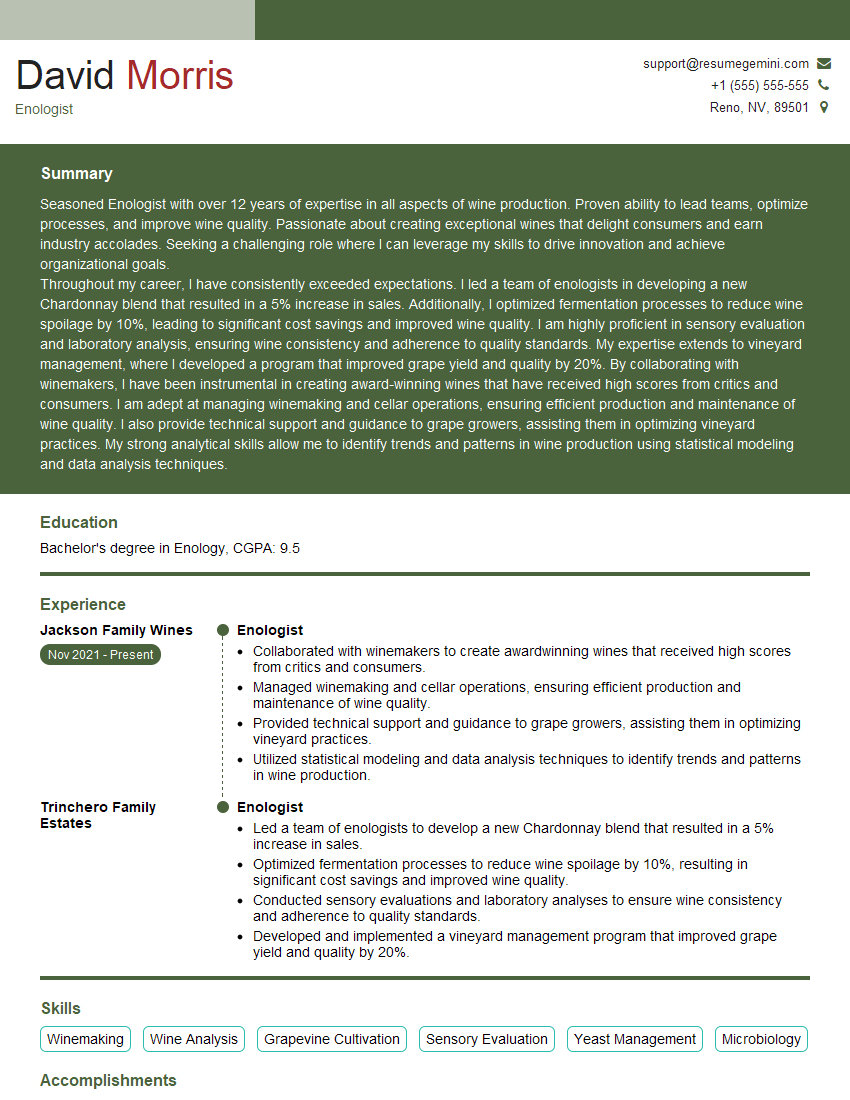
Mastering the art and science of winemaking opens doors to exciting career opportunities in a dynamic and rewarding industry. To maximize your chances of landing your dream job, a strong and ATS-friendly resume is crucial. ResumeGemini is a trusted resource to help you build a professional and impactful resume that highlights your skills and experience effectively. We provide examples of resumes tailored to Winemaker positions to guide you in crafting a compelling application. Take the next step towards your career success today!
Explore more articles
Users Rating of Our Blogs
Share Your Experience
We value your feedback! Please rate our content and share your thoughts (optional).
What Readers Say About Our Blog
To the interviewgemini.com Webmaster.
Very helpful and content specific questions to help prepare me for my interview!
Thank you
To the interviewgemini.com Webmaster.
This was kind of a unique content I found around the specialized skills. Very helpful questions and good detailed answers.
Very Helpful blog, thank you Interviewgemini team.