Feeling uncertain about what to expect in your upcoming interview? We’ve got you covered! This blog highlights the most important Truss Fabrication Knowledge interview questions and provides actionable advice to help you stand out as the ideal candidate. Let’s pave the way for your success.
Questions Asked in Truss Fabrication Knowledge Interview
Q 1. Explain the different types of trusses and their applications.
Trusses are structural elements composed of interconnected members forming a rigid framework. Different truss types are categorized based on their geometry and applications. Let’s explore some common ones:
- Simple Trusses: These are the most basic, featuring triangles as their primary structural units. They’re ideal for smaller spans and simpler loads, like roof supports in small buildings. Think of a classic triangular roof structure – that’s a simple truss in action.
- King Post Truss: A vertical member (king post) connects the apex to the base, providing additional support for heavier loads. This is often used for slightly larger spans where a simple truss might not be sufficient.
- Queen Post Truss: Similar to a King Post but with two vertical members (queen posts) providing increased support and load distribution. They handle larger spans and loads compared to the King Post Truss, often seen in larger bridges or buildings.
- Fink Truss: A common type featuring inclined top chords and vertical and inclined web members. Its efficiency makes it perfect for roof structures requiring moderate spans and loads, frequently used in residential and commercial construction.
- Howe Truss: Similar to the Fink truss, but with the vertical members in compression and the diagonal members in tension. It’s known for its straightforward design and is suitable for roofs and bridges.
- Warren Truss: Characterized by its equilateral triangular configuration. It’s excellent for bridges and structures requiring a balance of compression and tension throughout the members.
The choice of truss type depends on factors like span length, anticipated loads (dead and live loads), material properties, and overall design considerations. A structural engineer carefully assesses these factors to select the most appropriate truss type for a given project.
Q 2. Describe the process of designing a truss for a specific load.
Designing a truss for a specific load involves a systematic process using engineering principles and software tools. Here’s a breakdown:
- Load Determination: This is the crucial first step, carefully calculating all loads the truss will experience. This includes dead loads (weight of the truss itself and any permanent fixtures), live loads (variable loads like snow, wind, people, or equipment), and environmental loads (like seismic activity).
- Truss Geometry Definition: The layout of the truss is defined, selecting the appropriate type based on the loads and span. Software like AutoCAD or specialized structural analysis programs are often employed to create a detailed model.
- Structural Analysis: Sophisticated software performs the analysis using methods like the method of joints or method of sections to calculate the forces (tension and compression) acting on each member. This step is crucial to ensure the truss is strong enough to withstand the anticipated loads.
- Member Sizing: Based on the forces calculated in the previous step, the appropriate cross-sectional area for each member is determined. This ensures that each member has sufficient strength to resist the forces acting upon it. Material properties such as yield strength are considered at this stage.
- Connection Design: Designing the connections where members meet is critical. This often involves detailing welds, bolts, or pins, ensuring sufficient strength and stability at each joint.
- Check for Code Compliance: The final design must adhere to relevant building codes and safety standards to guarantee structural integrity and public safety.
Throughout this process, engineers use iterative refinement, adjusting the design as needed to optimize the truss for strength, cost-effectiveness, and aesthetic requirements. For example, if initial analysis reveals a member exceeding its stress limits, the engineer might increase the member’s size or alter the truss geometry.
Q 3. What are the common materials used in truss fabrication?
The selection of materials for truss fabrication depends on factors like strength, cost, weight, and availability. Common materials include:
- Steel: A popular choice due to its high strength-to-weight ratio, excellent weldability, and versatility. Different grades of steel are available to suit various load requirements. For instance, high-strength low-alloy steel is frequently used where weight minimization is critical.
- Aluminum: Lighter than steel but still possesses significant strength. It’s commonly used in applications where weight is a major concern, such as aircraft or long-span structures. However, aluminum is more expensive than steel.
- Wood: A traditional material, particularly suitable for smaller-scale trusses. Its renewability and ease of working are advantages. However, wood’s strength and durability are lower compared to steel or aluminum.
- Timber Composites: These materials combine wood with other materials to enhance strength and durability. Glulam (glued laminated timber) is a prime example. They offer a balance between the sustainability of wood and increased strength properties.
The choice of material significantly impacts the overall design and cost. Steel remains a prevalent choice for larger and more demanding projects due to its robustness, although aluminum’s advantages make it attractive for applications where weight reduction is paramount.
Q 4. How do you ensure the accuracy of truss dimensions during fabrication?
Accuracy in truss dimensions is paramount to ensure structural integrity. Several measures are implemented:
- Precise Cutting and Fabrication: Modern fabrication uses CNC (Computer Numerical Control) machines for precise cutting and shaping of members. These machines are programmed with the exact dimensions from the design drawings, minimizing human error.
- Regular Calibration: CNC machines and measuring tools undergo periodic calibration to maintain accuracy. This ensures that the dimensions produced consistently match the design specifications.
- Quality Control Inspections: Experienced inspectors meticulously verify dimensions throughout the fabrication process. They use various measuring instruments like steel tapes, calipers, and laser measuring tools for rigorous checks.
- Templates and Jigs: Templates and jigs are employed to ensure consistent and accurate assembly of truss members. These help to ensure proper alignment and spacing between the components.
- 3D Modeling Verification: 3D models of the truss can be used to verify the dimensions virtually. This allows for identification of any potential discrepancies before physical fabrication.
The combination of advanced technology and skilled human oversight ensures that the fabricated truss closely aligns with the design parameters. Any deviation, even slight, is meticulously addressed to prevent compromising the structure’s stability.
Q 5. What quality control measures do you implement during truss fabrication?
Rigorous quality control is fundamental throughout the truss fabrication process. Key measures include:
- Material Inspection: Incoming materials are thoroughly inspected to ensure compliance with specified quality standards. This includes checks on material properties, certifications, and visual inspection for defects.
- Welding Inspection: Welds are visually inspected and often subjected to non-destructive testing (NDT) methods like radiographic testing (RT) or ultrasonic testing (UT) to detect internal flaws.
- Dimensional Checks: Regular dimensional checks are performed at various stages of fabrication using precision measuring equipment. Any deviations from the design drawings are immediately addressed.
- Assembly Verification: Before completion, the assembled truss undergoes a thorough inspection to verify its conformity with the design and to detect any errors in assembly.
- Documentation: Meticulous documentation of each step of the process is essential. This includes records of materials used, inspection results, and any corrective actions taken. This documentation provides traceability and aids in identifying potential areas for improvement.
Implementing a comprehensive quality control system ensures that the finished truss meets the required specifications, promoting safety and reliability. Regular audits and internal reviews help continually refine processes and improve quality.
Q 6. Explain the different welding techniques used in truss fabrication.
Various welding techniques are used in truss fabrication, selected based on the materials and design requirements. Common methods include:
- Shielded Metal Arc Welding (SMAW): A common method using a consumable electrode to create the weld. It’s relatively inexpensive and portable but requires skilled welders to achieve high-quality welds. Suitable for many steel applications in truss fabrication.
- Gas Metal Arc Welding (GMAW): Also known as MIG welding, this method uses a continuously fed wire electrode. It offers higher deposition rates and is often preferred for faster production. Widely used in steel truss fabrication.
- Gas Tungsten Arc Welding (GTAW): Known as TIG welding, this method provides excellent weld quality and control. It is often used for aluminum and stainless steel trusses. TIG welds are generally stronger and more aesthetically pleasing compared to SMAW or GMAW.
- Flux-Cored Arc Welding (FCAW): Similar to GMAW but using a tubular electrode filled with flux. It provides good penetration and can be used in outdoor environments without shielding gas, making it suitable for various steel applications.
The selection of welding technique is crucial for ensuring the quality and integrity of the welds. Each technique has its strengths and weaknesses, and a skilled welding engineer will choose the most appropriate method based on material type, thickness, joint design and overall project demands. For instance, TIG welding might be favored for thin-walled aluminum members, while MIG welding may be preferred for thick steel sections in a factory setting.
Q 7. How do you handle discrepancies between the design and fabrication drawings?
Discrepancies between design and fabrication drawings are addressed through a careful and methodical process:
- Identification and Documentation: Any discrepancies must be promptly identified and clearly documented. This includes noting the specific location, nature, and extent of the differences.
- Root Cause Analysis: It’s crucial to investigate the origin of the discrepancy. Was it an error in the design drawings, a misinterpretation during fabrication, or a problem with the manufacturing process?
- Impact Assessment: The potential impact of the discrepancy on the structural integrity of the truss needs to be evaluated. This might involve re-analysis using structural software to determine if any adjustments are necessary.
- Corrective Action: Depending on the nature and impact of the discrepancy, corrective action is taken. This could range from minor adjustments on site to major modifications requiring rework. All changes need to be documented and approved by the relevant authorities.
- Communication: Open communication among the design team, fabrication team, and any other stakeholders is crucial. Any changes or deviations must be transparently communicated to all involved parties.
Addressing discrepancies efficiently is vital for ensuring the safety and functionality of the fabricated truss. Effective communication and a systematic approach are critical to handle such situations professionally and effectively, adhering to quality standards and preventing project delays.
Q 8. Describe your experience with different types of truss connections.
Truss connections are the heart of a truss’s structural integrity. My experience encompasses a wide range, from simple bolted connections to more complex welded and pinned joints. Each type has its strengths and weaknesses, and selection depends heavily on the load requirements, material properties, and the overall design of the truss.
- Bolted Connections: These are relatively easy to fabricate and disassemble, making them suitable for temporary structures or those needing easy maintenance. However, bolt holes weaken the members, and proper torque is crucial to prevent loosening and failure.
- Welded Connections: Welding offers superior strength and stiffness compared to bolting, resulting in a more efficient structure. However, skilled welders are required, and proper weld inspection is paramount to ensure quality and prevent defects. I’m proficient in various welding techniques, including fillet welds and butt welds, and have experience with both manual and automated welding processes. I also understand the importance of using appropriate weld symbols to ensure clarity and accuracy in fabrication drawings.
- Pinned Connections: Pinned connections allow for rotation at the joint, making them ideal for certain truss configurations that experience significant changes in load distribution. This type of connection necessitates precise machining of the pin and its receiving hole to maintain structural integrity and prevent premature failure due to excessive play.
For example, in a recent project involving a large-span roof truss, we opted for welded connections for the majority of the members due to the high loads involved. However, we utilized pinned connections at specific points to accommodate thermal expansion and contraction.
Q 9. What safety precautions do you take during truss fabrication?
Safety is paramount in truss fabrication. My approach follows strict adherence to OSHA regulations and best practices. This begins with a comprehensive risk assessment before any work commences. Specific precautions include:
- Proper Personal Protective Equipment (PPE): This includes safety glasses, hard hats, steel-toed boots, gloves, and hearing protection, depending on the specific task. I enforce consistent PPE use and ensure that all team members are properly trained in its use.
- Safe Handling of Materials: Using appropriate lifting equipment like cranes and forklifts with trained operators, proper slings, and load securing methods is crucial. We avoid manual lifting whenever possible, especially for heavy members. Regular equipment inspections and maintenance are essential.
- Welding Safety: In welding operations, we ensure adequate ventilation, use appropriate fire extinguishers, and enforce the use of welding screens to protect others from arc flash. Regular checks on welding equipment for faults or gas leaks are also a must.
- Fall Protection: Working at heights is common in truss fabrication; therefore, we always use appropriate fall arrest systems and ensure that all work platforms are secure and properly guarded.
- Regular Safety Meetings: We conduct regular safety meetings to discuss potential hazards, review accident prevention measures, and encourage a proactive safety culture.
One instance where rigorous safety procedures were crucial was during the fabrication of a complex, large-scale truss for a stadium. By strictly adhering to safety protocols, we successfully completed the project without any incidents.
Q 10. How do you ensure the structural integrity of a fabricated truss?
Ensuring structural integrity involves a multi-faceted approach that starts even before fabrication. It involves meticulous design, precise fabrication, and thorough quality control.
- Accurate Design: The design should be performed using appropriate software (discussed later) and adhere to relevant building codes and standards. Load calculations must be comprehensive, accounting for dead loads, live loads, wind loads, and snow loads, as applicable.
- Precise Fabrication: Adherence to the design drawings is critical. Dimensions must be accurate, and all connections must be made according to specifications. Regular quality checks during the fabrication process, including dimensional checks and visual inspections, are vital.
- Material Quality Control: Utilizing high-quality materials that meet specified strength and yield criteria is crucial. We use certified materials and maintain proper storage to prevent damage or degradation.
- Non-Destructive Testing (NDT): In some critical applications, NDT techniques such as ultrasonic testing or magnetic particle inspection may be utilized to detect internal defects in welds or materials.
- Post-Fabrication Inspection: A final inspection ensures the completed truss meets design specifications and is free from defects before it is shipped for installation.
Think of it like building a house; a strong foundation (design) and quality construction (fabrication) are vital. Ignoring even minor details can jeopardize the overall structural integrity.
Q 11. What software are you proficient in for truss design and detailing?
My expertise in truss design and detailing includes proficiency in several leading software packages. I am highly experienced with:
- Tekla Structures: I use Tekla Structures for 3D modeling, detailing, and fabrication drawings. Its capabilities for complex geometry and efficient detailing make it ideal for intricate truss designs.
- Autodesk Robot Structural Analysis: I use Robot Structural Analysis for finite element analysis (FEA) to validate the design and assess stresses and strains under various load conditions. This software is crucial for optimizing designs and ensuring structural safety.
- AutoCAD: I use AutoCAD for 2D drafting and detailing, especially for producing shop drawings and fabrication diagrams.
I am also familiar with other software such as SAP2000 and STAAD Pro, providing me with a diverse skillset applicable to various projects and client preferences.
Q 12. Explain your experience with truss erection and installation.
My experience in truss erection and installation spans several large-scale projects. This involves not only the physical installation but also meticulous planning and safety management.
- Planning and Logistics: This includes coordinating with crane operators, ground crews, and other trades. Detailed lifting plans, including rigging diagrams and weight calculations, are essential to ensure safe and efficient lifting operations.
- On-site Supervision: I actively supervise the erection process, ensuring that all procedures are followed and that safety precautions are strictly enforced. This also includes regular inspection to make sure the alignment of the members is within the required tolerance.
- Troubleshooting: Unexpected issues can arise during erection; my experience allows me to effectively troubleshoot such problems, making necessary adjustments while maintaining safety and adherence to design requirements.
- Temporary Bracing: During erection, temporary bracing is often necessary to maintain stability and prevent collapse. I am experienced in planning and implementing appropriate bracing schemes.
For example, during the erection of a large truss bridge, we developed a detailed lifting plan that accounted for wind conditions and potential obstructions, ensuring a smooth and incident-free installation.
Q 13. How do you calculate the stresses and strains on a truss member?
Calculating stresses and strains on a truss member requires a solid understanding of structural mechanics. The most common method is using the method of joints or the method of sections, based on static equilibrium principles. These methods allow for the determination of internal forces (tensile or compressive) in each member.
Method of Joints: This involves isolating individual joints and applying equilibrium equations (ΣFx = 0, ΣFy = 0) to solve for unknown forces in the connecting members.
Method of Sections: This technique involves passing an imaginary section through the truss, isolating a portion of the truss, and applying equilibrium equations to determine forces in the cut members.
Once the internal forces are determined, stress is calculated by dividing the force by the cross-sectional area of the member (Stress = Force/Area). Strain is calculated by dividing the change in length by the original length (Strain = Change in Length/Original Length). These values are crucial for determining whether the member is adequately designed to withstand the applied loads and comply with safety factors defined by building codes and regulations. Software like Robot Structural Analysis automates much of this calculation, providing detailed stress and strain reports.
Q 14. Describe your experience with different types of truss analysis techniques.
My experience covers a range of truss analysis techniques, each with its own strengths and applications:
- Method of Joints and Method of Sections: These are fundamental hand-calculation methods for simple trusses. They provide a clear understanding of the internal forces and are valuable for checking software results or understanding basic structural behavior.
- Matrix Methods: These advanced numerical methods, implemented in software, are essential for analyzing complex trusses with numerous members and supports. These methods are more computationally efficient for larger structures.
- Finite Element Analysis (FEA): FEA uses sophisticated software to divide the truss into smaller elements and solve for the stress and displacement at each node, providing a detailed picture of the structural behavior under various load cases. FEA is particularly useful for analyzing complex loading scenarios, considering non-linear effects, and identifying areas of stress concentration.
The choice of analysis technique depends on the complexity of the truss and the required level of detail. For simple trusses, hand calculations may suffice. However, for larger and more complex projects, FEA using specialized software is often necessary to ensure accuracy and safety.
Q 15. What is your experience with Finite Element Analysis (FEA) in truss design?
Finite Element Analysis (FEA) is indispensable in modern truss design. It’s a powerful computational method that allows us to simulate the structural behavior of a truss under various load conditions. Instead of building physical prototypes for every design iteration, FEA lets us predict stresses, deflections, and overall stability virtually. This significantly reduces costs, time, and material waste. My experience involves using FEA software like ANSYS and Abaqus to model complex truss systems, inputting material properties, boundary conditions (supports), and load cases (dead loads, live loads, wind loads, etc.). The software then calculates the internal forces in each member, allowing me to optimize the design for strength and efficiency. For example, I once used FEA to identify a potential weak point in a large roof truss design – a detail that would have been very difficult and expensive to discover through traditional methods. The software highlighted high stress concentrations in a specific connection, allowing us to reinforce it before fabrication, preventing a potential failure.
I regularly use FEA to explore design alternatives, comparing different materials (steel, aluminum, wood), member sizes, and connection types. This iterative process allows for a highly optimized design that meets all specified requirements while minimizing material usage and maximizing cost-effectiveness. FEA is not just a tool for verification; it’s a crucial part of the design process itself.
Career Expert Tips:
- Ace those interviews! Prepare effectively by reviewing the Top 50 Most Common Interview Questions on ResumeGemini.
- Navigate your job search with confidence! Explore a wide range of Career Tips on ResumeGemini. Learn about common challenges and recommendations to overcome them.
- Craft the perfect resume! Master the Art of Resume Writing with ResumeGemini’s guide. Showcase your unique qualifications and achievements effectively.
- Don’t miss out on holiday savings! Build your dream resume with ResumeGemini’s ATS optimized templates.
Q 16. How do you manage a team during a truss fabrication project?
Managing a team during truss fabrication requires a blend of technical expertise and strong leadership. I foster a collaborative environment where open communication and mutual respect are paramount. My approach begins with clear task assignments, ensuring each team member understands their role and responsibilities. Regular progress meetings are held to track milestones, address challenges, and maintain momentum. I encourage proactive problem-solving, empowering team members to suggest solutions and contribute their unique skills. For example, on a recent project, a welder proposed a more efficient welding sequence that reduced fabrication time by 15%. This demonstrates the importance of valuing input from every team member. Conflict resolution is handled fairly and decisively, always prioritizing the project’s success while ensuring individual needs are considered. Finally, I believe in celebrating successes, both big and small, to maintain team morale and motivation throughout the project lifecycle.
Q 17. How do you handle project delays or unexpected issues during truss fabrication?
Project delays and unexpected issues are inevitable in fabrication. My approach involves a proactive risk assessment at the project’s outset. This helps anticipate potential problems (e.g., material delays, equipment malfunctions, weather disruptions) and develop contingency plans. If a delay or unexpected issue arises, I initiate a thorough investigation to understand the root cause. This might involve reviewing the fabrication schedule, checking material availability, or consulting with subcontractors. Once the cause is identified, I develop a revised schedule, if necessary, and communicate it clearly to all stakeholders. For example, a recent delivery delay of critical components was addressed by re-prioritizing tasks and utilizing available resources efficiently. Transparent communication is key; keeping clients and team members informed allows for collaborative problem-solving and prevents unnecessary anxiety. Sometimes, change orders are required to accommodate unforeseen circumstances, and these are always documented thoroughly and agreed upon by all parties.
Q 18. Describe your experience with different types of truss bracing systems.
My experience encompasses various truss bracing systems, each suited to specific applications and load conditions. Common types include:
- K-bracing: A simple and effective system using diagonal members arranged in a ‘K’ shape. It’s often used in smaller trusses and provides lateral stability.
- X-bracing: Similar to K-bracing, but with diagonal members forming an ‘X’ pattern. Offers improved lateral stability compared to K-bracing, particularly under uneven loads.
- Diagonal bracing: Uses diagonal members to transfer lateral loads to the supporting structure. Commonly used in larger trusses and often combined with other bracing systems.
- Moment resistant connections: Used in trusses requiring higher stiffness and strength, particularly in seismic zones. These connections resist the bending moments in addition to axial forces.
The choice of bracing system depends on factors such as the truss’s size, load requirements, and the overall structural design. I have experience selecting and designing bracing systems for various applications, including roof trusses, floor trusses, and bridge structures. Each project requires a careful evaluation of the specific needs and constraints, leading to the selection of the optimal bracing strategy.
Q 19. Explain your knowledge of relevant building codes and standards for truss fabrication.
Adherence to relevant building codes and standards is crucial for safe and compliant truss fabrication. My knowledge encompasses codes such as the International Building Code (IBC), American Society of Civil Engineers (ASCE) standards, and relevant local building codes. I understand the requirements for material specifications (e.g., allowable stresses, weld quality), connection designs, and overall structural stability. These codes provide minimum requirements that must be met; often, we exceed these standards to ensure a high margin of safety. I am proficient in interpreting code requirements, ensuring that our designs and fabrication processes comply with all applicable regulations. This involves careful review of design documents, material certifications, and inspection reports to guarantee compliance throughout the project lifecycle. A thorough understanding of these codes is vital to ensuring public safety and avoiding potential legal issues.
Q 20. How do you ensure the proper handling and storage of truss materials?
Proper handling and storage of truss materials are crucial for preventing damage, maintaining material quality, and ensuring efficient fabrication. This involves several key steps:
- Protection from the elements: Materials should be stored under cover to protect them from rain, snow, and excessive sun exposure. This prevents rust, warping, or other damage.
- Proper stacking and support: Lumber should be stacked to allow for air circulation, preventing moisture buildup and mold. Steel members should be supported properly to prevent warping or bending.
- Organized storage: Materials should be clearly identified and organized to facilitate easy retrieval during fabrication. This minimizes time spent searching for materials and improves workflow efficiency.
- Security: The storage area should be secure to prevent theft or vandalism.
Neglecting proper material handling can lead to increased costs due to material damage or delays in fabrication. Implementing these procedures ensures that materials arrive at the fabrication site in optimal condition, allowing for smooth and efficient construction.
Q 21. What is your experience with working drawings and fabrication shop drawings?
Working drawings and fabrication shop drawings are integral to the truss fabrication process. Working drawings provide the overall design and structural details, while fabrication shop drawings are more detailed documents that guide the fabrication process. My experience involves working closely with architects and engineers to review working drawings, ensuring all dimensions, specifications, and connection details are clearly defined. I am proficient in using various software tools such as AutoCAD and Revit to create detailed fabrication shop drawings. These drawings include dimensions, material specifications, cut lists, weld details, and any other information required by the fabrication team. Accuracy and precision are paramount here, as any errors can have significant implications on the structural integrity of the final product. I meticulously review all shop drawings to ensure that they are complete, accurate, and consistent with the working drawings before fabrication commences, preventing costly mistakes and rework.
Q 22. Describe your experience with the use of CNC machinery in truss fabrication.
My experience with CNC machinery in truss fabrication is extensive. I’ve worked with various CNC controlled cutting, drilling, and even robotic welding systems. These machines are crucial for achieving precision and efficiency in truss production. For example, a CNC router allows for the precise cutting of lumber or metal components to the exact dimensions specified in the design, minimizing material waste and ensuring consistent accuracy across all components. Similarly, CNC-controlled drilling machines allow for precise placement of holes for connecting members, significantly reducing the margin for error and improving the overall strength and stability of the finished truss.
In one project, we used a CNC plasma cutter to cut hundreds of steel truss members to identical specifications. The speed and precision of the CNC machine allowed us to complete the project well ahead of schedule and significantly reduced material waste compared to manual cutting methods. We also utilize CNC machines for creating complex cuts and shapes in custom truss designs, something which would be incredibly time-consuming and potentially inaccurate with manual methods.
Q 23. How do you troubleshoot issues encountered during the fabrication process?
Troubleshooting in truss fabrication involves a systematic approach. I begin by identifying the specific problem – is it a dimensional inaccuracy, a welding defect, or a material issue? Then, I examine the process to pinpoint the root cause. This often involves checking the design drawings, the CNC program settings, the condition of the machinery, and the quality of the materials.
For instance, if a truss member is consistently too short, I’d first check the CNC program for errors, then examine the raw material to rule out any inconsistencies in length. If the problem persists, I would then inspect the machine itself for calibration issues. In cases of welding defects, I’d check the welding parameters – amperage, travel speed, and wire feed – and visually inspect the weld for proper penetration and bead formation. Documentation is key, allowing for systematic traceability and preventing similar issues in the future.
Q 24. How do you maintain proper documentation throughout the truss fabrication process?
Maintaining proper documentation is paramount in truss fabrication. This ensures traceability, quality control, and project management. We use a combination of digital and physical documentation methods. This includes digital design files (CAD drawings), CNC program files, material certifications, quality control inspection reports, and detailed fabrication logs. These logs include details such as material lot numbers, machine settings, operator initials, dates, and any issues encountered. This comprehensive record allows us to track the entire lifecycle of each truss from design to completion.
For example, each cut piece of metal is labelled with its unique identification number linked to the CAD drawing and the CNC program. This prevents confusion during assembly and facilitates easy identification of parts. Physical records, like signed-off inspection reports, provide a paper trail for quality assurance and compliance purposes. This meticulous record-keeping helps in identifying potential issues early on, reducing rework and improving overall quality.
Q 25. What is your experience with lean manufacturing principles in truss fabrication?
My experience with lean manufacturing principles in truss fabrication is focused on maximizing efficiency and minimizing waste. We implement several lean techniques, such as 5S (Sort, Set in Order, Shine, Standardize, Sustain) to maintain a clean and organized workspace, reducing search time for materials and tools. We use Kaizen events for continuous improvement, regularly reviewing processes and identifying areas for improvement. We also strive for just-in-time inventory management, minimizing the amount of materials stored to reduce storage costs and prevent obsolescence.
For instance, we implemented a pull system for materials, where materials are only ordered when needed for a specific project, eliminating excess inventory. Through this lean approach, we have significantly reduced lead times, improved overall efficiency, and minimized waste, leading to cost savings and enhanced customer satisfaction.
Q 26. Describe your knowledge of different types of truss joints and their strengths.
Truss joints are critical for the structural integrity of the truss. Common types include gusset plates, which are metal plates used to connect members, and welded joints. The strength of a joint depends on several factors, including the type of joint, the material used, the size and thickness of the members, and the quality of the connection. Gusset plates, for example, offer high strength when properly designed and fastened. Welded joints can be extremely strong but require skilled welders and proper welding procedures to ensure a quality weld. Another example is a bolted joint which offers a strong connection but requires careful consideration of bolt size and spacing.
The choice of joint type is influenced by factors such as the load requirements, material properties, and fabrication methods. For instance, welded joints are preferred for high-strength steel trusses, while bolted joints may be more suitable for timber trusses where welding isn’t feasible. Accurate engineering calculations and adherence to industry standards are essential to ensure the structural integrity of the truss and the safety of its application.
Q 27. How do you calculate the weight of a fabricated truss?
Calculating the weight of a fabricated truss involves determining the weight of each individual member and summing them. This requires knowing the length, cross-sectional area, and material density of each member. For example, for a steel truss, you would use the density of steel (approximately 7850 kg/m³), the cross-sectional area of each member (calculated from the dimensions), and the length of each member to calculate the weight of each member using the formula: Weight = Density * Volume = Density * Area * Length.
Once the weight of each individual member is calculated, these weights are summed to determine the total weight of the truss. Software programs can automate this calculation process, taking the CAD design as input and outputting the total weight. Accurate weight calculations are critical for transportation, installation, and ensuring the supporting structure can handle the load.
Q 28. What is your experience with different types of metal coatings and their application to trusses?
My experience includes working with various metal coatings for trusses, each offering different properties. Galvanization (hot-dip galvanizing) is a common method, providing excellent corrosion resistance by immersing the steel in molten zinc. Powder coating offers a wide range of colors and finishes, providing both protection and aesthetics. Other coatings such as zinc-rich primers or specialized coatings for high-humidity or marine environments are also employed depending on the application’s requirements.
The choice of coating depends on several factors, including the environment the truss will be exposed to, the required lifespan, and the budget. For instance, galvanized trusses are ideal for outdoor applications due to their excellent corrosion resistance, while powder coating may be preferable for indoor trusses where aesthetics are important. Proper application of the coating is crucial to ensuring its effectiveness. Each coating type requires specific surface preparation and application techniques to guarantee optimal performance and longevity.
Key Topics to Learn for Truss Fabrication Knowledge Interview
- Truss Design Principles: Understanding load paths, stress distribution, and the impact of different truss configurations (e.g., Pratt, Howe, Warren).
- Material Selection and Properties: Knowledge of suitable materials (steel, aluminum, wood) and their respective strengths, weaknesses, and applications in truss fabrication.
- Connection Methods: Familiarity with various joining techniques (welding, bolting, gusset plates) and their implications for structural integrity and efficiency.
- Fabrication Processes: Understanding the steps involved in truss manufacturing, from cutting and shaping to assembly and quality control.
- Blueprint Reading and Interpretation: Ability to accurately read and understand engineering drawings, specifications, and fabrication details for truss construction.
- Safety Regulations and Practices: Knowledge of relevant safety standards and procedures for working with heavy machinery and structural components.
- Quality Control and Inspection: Understanding methods for ensuring the accuracy, strength, and compliance of fabricated trusses with design specifications.
- Troubleshooting and Problem-Solving: Ability to identify and resolve common issues encountered during the fabrication process, such as material defects or dimensional inaccuracies.
- Software Proficiency (if applicable): Familiarity with relevant CAD software (e.g., AutoCAD, Revit) used in truss design and fabrication.
- Estimating and Costing: Understanding the factors influencing the cost of truss fabrication and ability to develop accurate cost estimates.
Next Steps
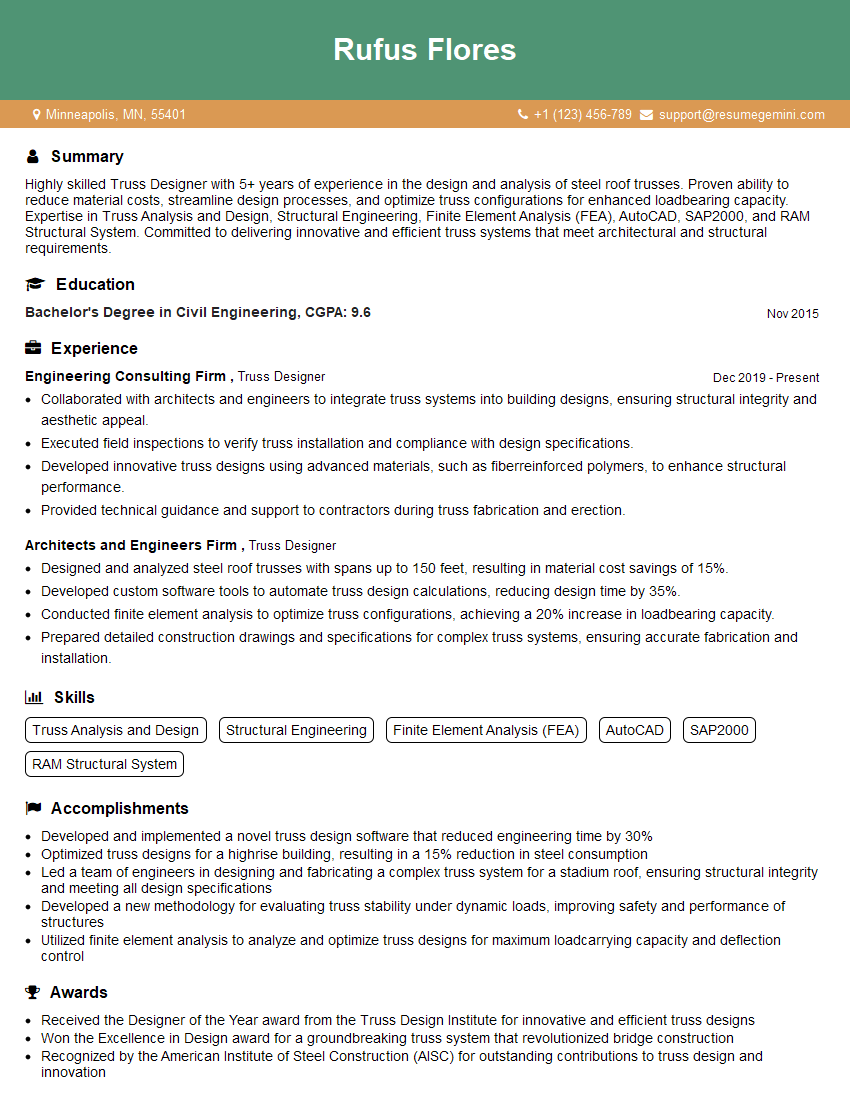
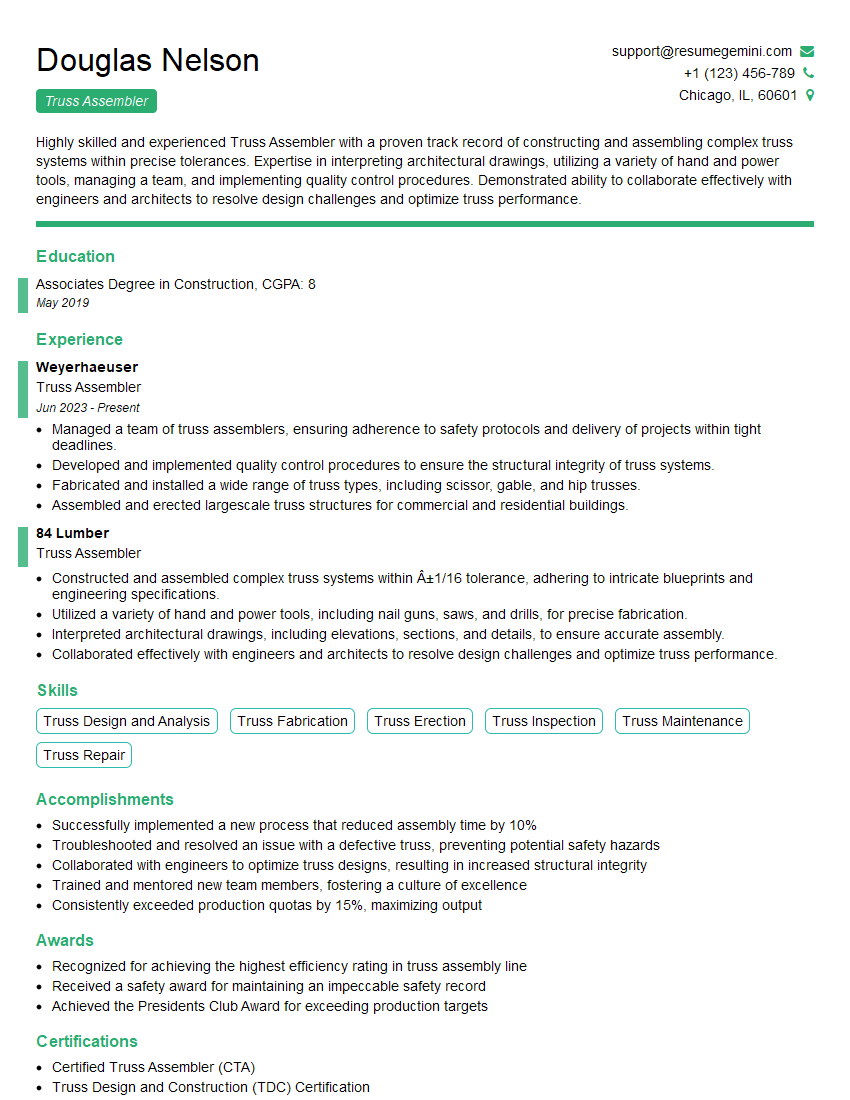
Mastering Truss Fabrication Knowledge is crucial for career advancement in the construction and engineering industries. A strong understanding of these principles demonstrates your technical expertise and problem-solving capabilities, opening doors to more challenging and rewarding roles. To significantly increase your job prospects, create an ATS-friendly resume that highlights your skills and experience effectively. ResumeGemini is a trusted resource that can help you build a professional and impactful resume. They provide examples of resumes tailored to Truss Fabrication Knowledge to give you a head start. Invest the time in crafting a compelling resume – it’s your first impression with potential employers.
Explore more articles
Users Rating of Our Blogs
Share Your Experience
We value your feedback! Please rate our content and share your thoughts (optional).
What Readers Say About Our Blog
To the interviewgemini.com Webmaster.
Very helpful and content specific questions to help prepare me for my interview!
Thank you
To the interviewgemini.com Webmaster.
This was kind of a unique content I found around the specialized skills. Very helpful questions and good detailed answers.
Very Helpful blog, thank you Interviewgemini team.