Interviews are more than just a Q&A session—they’re a chance to prove your worth. This blog dives into essential Cable Preparation and Termination interview questions and expert tips to help you align your answers with what hiring managers are looking for. Start preparing to shine!
Questions Asked in Cable Preparation and Termination Interview
Q 1. Explain the process of preparing a CAT5e cable for termination.
Preparing a CAT5e cable for termination involves several crucial steps to ensure a reliable connection. Think of it like preparing ingredients for a recipe – each step is essential for a successful outcome. First, you need to carefully measure and cut the cable to the correct length, leaving enough slack for maneuvering. Then, you’ll need to carefully strip the outer jacket, revealing the individual twisted pairs. It’s important to avoid nicking the wires during this process. Next, untwist the pairs only slightly at the ends, to prepare them for insertion into the keystone jack or punch-down block. Finally, ensure the wires are straight and neatly arranged before termination to avoid cross-talk and signal interference.
Imagine you’re building a bridge – each wire is a strand, and a neatly arranged termination ensures structural integrity. A messy termination leads to a weak and unreliable connection, like a bridge prone to collapse.
Q 2. Describe the difference between a TIA/EIA 568A and 568B wiring standard.
The TIA/EIA 568A and 568B standards define the color code arrangement of wires in a twisted-pair cable. They are essentially two different ways to arrange the same wires, resulting in functionally equivalent cables. The key difference lies in the order of the orange/white and green/white pairs. In 568A, the orange/white wire is on pin 1, while in 568B, the green/white wire is on pin 1. This seemingly small difference is crucial for maintaining proper network functionality. Choosing between A and B depends on your specific network setup. Usually both ends of a cable should use the same standard (A-A or B-B) for consistency.
- 568A: Orange/white, Orange, Green, Blue, Blue/white, Green/white, Brown, Brown/white
- 568B: Green/white, Green, Orange, Blue, Blue/white, Orange/white, Brown, Brown/white
Think of it like writing your name – you can write it forwards or backwards, but both still represent the same identity. Similarly, both standards represent the same cabling, just with a different wire order.
Q 3. What tools are essential for cable termination and preparation?
Essential tools for cable termination and preparation include:
- Cable Stripper/ Cutter: To remove the outer jacket and precisely cut the cable to the correct length without damaging the wires.
- Wire Stripper: To carefully remove insulation from individual wires without cutting or damaging the conductors.
- Punch Down Tool: Used to securely terminate wires into a 110 punch down block or keystone jack.
- Crimping Tool: For attaching RJ45 connectors to the cable ends securely.
- Cable Tester: To verify continuity, correct wiring, and identify faults after termination.
- Wire Cutters/Flush Cutters: for cleanly trimming excess wire after termination
- Measuring Tape/ Ruler: To accurately measure the required cable length.
These are the fundamental tools of the trade. Just as a chef needs the right knives, a cable technician relies on these tools for precise and efficient work.
Q 4. How do you test cable continuity and identify faults?
Testing cable continuity and identifying faults is done using a cable tester. A good cable tester will indicate whether there are shorts, opens, or miswires in the cable. These devices apply a signal to one end of the cable and measure the response at the other end. Any deviation from the expected response indicates a fault. Most testers have LEDs or a digital display that show the connectivity status of each pair. More sophisticated testers can pinpoint the exact location of faults along the cable’s length.
Think of it like testing a circuit – you need to ensure a complete, uninterrupted path for the electrical current to flow. Similarly, a cable test ensures a complete and accurate path for data to travel.
For example, if the tester shows an open circuit on one pair, it means a break in the wire. A short circuit means two wires are touching, causing interference. Miswiring indicates incorrect pin assignment, leading to connectivity issues.
Q 5. Explain the process of terminating a fiber optic cable.
Terminating a fiber optic cable is a more delicate process than copper cabling, requiring specialized tools and techniques. It involves cleaning the fiber ends, precisely cleaving them to ensure a perfectly flat and perpendicular surface, and then connecting them to a connector using epoxy or other adhesive. Different connectors exist, such as SC, ST, LC, and FC, each with its own specific termination procedure. The process often involves using a fusion splicer to precisely join two fiber optic strands. Precision and cleanliness are paramount to avoid signal loss and ensure optimal transmission.
Imagine connecting two extremely thin, fragile threads of glass; the process demands utmost care and accuracy.
Specific steps depend on the connector type and equipment used, but generally involve prepping the fiber end, inserting it into the connector, polishing, and testing for signal loss and return loss using specialized equipment. It’s crucial to use proper safety glasses and avoid touching the fiber end to prevent contamination and damage.
Q 6. What safety precautions should be taken during cable termination?
Safety precautions during cable termination are essential to prevent injuries and damage to equipment. Always:
- Wear safety glasses to protect your eyes from flying debris during cutting or stripping.
- Use appropriate hand protection (gloves) to avoid cuts or abrasions.
- Avoid loose clothing and jewelry that could get caught in machinery.
- Properly ground yourself to prevent static electricity discharge, particularly when working with fiber optic cables.
- Work in a well-lit area to ensure visibility and prevent mistakes.
- Be mindful of sharp tools and use them carefully.
- Never look directly into a laser source used for testing fibre optic cables
- Always disconnect power before working on any live equipment.
Safety is not just a guideline; it’s a non-negotiable part of the job. A small lapse in safety can lead to serious consequences.
Q 7. What are the common causes of cable termination failures?
Common causes of cable termination failures include:
- Improper stripping: Nicking or damaging the conductors during stripping.
- Incorrect wire arrangement: Following the wrong wiring standard or incorrect pin assignment.
- Loose connections: Insufficient crimping or improper seating in the punch-down block.
- Damaged connectors: Using bent, broken, or poorly made RJ45 connectors.
- Poor quality cable: Using substandard cables with thin or brittle insulation.
- Dust and debris: Contamination in the connector can impair connectivity (especially crucial for fiber optics).
- Bending radius violations: Bending cables too sharply can cause internal damage and signal loss.
These issues often lead to connectivity problems, slow network speeds, or complete loss of communication. Regular testing and attention to detail during termination help prevent these failures.
Q 8. How do you identify different types of cables (e.g., coaxial, fiber optic, twisted pair)?
Identifying different cable types involves careful observation of physical characteristics and sometimes specialized testing equipment. Here’s a breakdown:
- Coaxial Cable: Typically features a central conductor surrounded by insulation, a braided metallic shield, and an outer jacket. Think of the cable used for your TV or older internet connections. The shield provides excellent protection against electromagnetic interference (EMI).
- Fiber Optic Cable: Recognizable by its small diameter and often translucent or colored outer jacket. It transmits data as light pulses through a glass or plastic core. You’ll find these used in high-speed internet and long-distance communication networks.
- Twisted Pair Cable: Consists of pairs of insulated copper wires twisted together. The twisting helps reduce crosstalk (interference between pairs). This is the ubiquitous cable for Ethernet networks in offices and homes. You might see different categories like Cat5e, Cat6, etc., indicating varying performance capabilities.
Sometimes, cable markings or accompanying documentation will explicitly state the cable type. However, visual inspection and understanding the cable’s construction are essential skills for cable professionals.
Q 9. Explain the importance of cable labeling and documentation.
Cable labeling and documentation are absolutely critical for efficient troubleshooting, maintenance, and future expansion of any cabling infrastructure. Imagine a building with hundreds of cables – without proper labeling, finding the specific cable you need becomes a nightmare.
- Clear Identification: Labels should clearly identify the cable’s purpose (e.g., ‘Network – Server Room to Office 3’), the cable type (e.g., ‘Cat6’), and potentially the date of installation or any relevant identification numbers.
- Organized Documentation: This goes beyond simple labels. A comprehensive database or drawing should show the cable’s path, its connections at each end, and potentially any intermediate connections or devices it passes through. This allows for easy tracing and understanding of the entire network.
- Safety and Compliance: Proper labeling is often a requirement for safety and compliance regulations in various industries. It helps prevent accidental disconnections or damage to critical systems.
In short, thorough labeling and documentation save time, prevent errors, and are essential for maintaining a well-organized and efficient cabling system. A well-documented system is a testament to professionalism and minimizes downtime.
Q 10. Describe the proper way to strip and prepare a coaxial cable for termination.
Preparing a coaxial cable for termination requires precision to ensure a good connection and optimal signal transmission. Here’s a step-by-step guide:
- Measure and Cut: Measure the required length and carefully cut the cable using a sharp cable cutter, ensuring a clean, square cut.
- Strip the Outer Jacket: Use a coaxial cable stripper to carefully remove the outer jacket, exposing the braided shield. Be cautious not to nick the inner conductor.
- Strip the Shield: Carefully strip back a small portion of the braided shield, taking care not to damage the dielectric insulation underneath. The amount will depend on the connector type.
- Prepare the Inner Conductor: Using a small, sharp tool, carefully strip back the insulation from the inner conductor, exposing a small length. Avoid damaging the central conductor.
- Connect the Connector: Carefully insert the prepared cable into the connector, ensuring proper alignment of the inner conductor and shield. Crimp the connector firmly using a suitable crimping tool to secure the connection.
Practice is key! Improper stripping can lead to poor signal quality, or even damage the cable. Using the right tools for the specific cable type is essential for a clean and professional termination.
Q 11. What are the different types of connectors used in cable termination?
The type of connector used in cable termination depends on the cable type and application. Some common examples include:
- Coaxial Connectors: F-type, BNC, RCA, and SMA are commonly used for applications like cable TV, video equipment, and radio frequency (RF) systems.
- Fiber Optic Connectors: SC, FC, ST, LC are some standard connectors used in fiber optic networks, each with its own mechanism for precise alignment of the optical fibers.
- Twisted Pair Connectors: RJ-45 is the ubiquitous connector for Ethernet networks, used to terminate Cat5e, Cat6, and other twisted-pair cables. RJ-11 is used for telephone lines.
Choosing the correct connector is vital for proper signal transmission. Using the wrong connector can lead to poor signal quality, connection failures, or even damage to equipment.
Q 12. How do you troubleshoot a faulty cable termination?
Troubleshooting a faulty cable termination involves a systematic approach. Here’s a process:
- Visual Inspection: Start by visually inspecting the termination. Look for any obvious signs of damage, such as bent pins, broken wires, or loose connections.
- Continuity Test: Use a multimeter or cable tester to check for continuity between the wires at both ends of the cable. This helps identify breaks or shorts in the cable.
- Signal Testing: Depending on the cable type, you might use specialized testing equipment (e.g., a network cable tester, an optical power meter for fiber) to measure the signal strength and quality. This helps identify signal degradation caused by a poor termination.
- Connector Integrity: Check if the connector is properly crimped and seated. Reseating or re-crimping the connector can often resolve the issue. If the connector is damaged, it may need to be replaced.
- Component Testing: If the cable tests fine, then the fault may lie with the equipment at either end of the cable. Check the connectors and ports on the devices connected to the cable.
A systematic approach, coupled with the right tools, ensures efficient and accurate troubleshooting of cable termination problems.
Q 13. What is the difference between single-mode and multi-mode fiber optic cables?
Single-mode and multi-mode fiber optic cables differ primarily in the core diameter and how they transmit light. This difference affects their performance and applications.
- Single-Mode Fiber: Has a very small core diameter (around 8-10 microns). This allows only one mode of light propagation, resulting in very low signal dispersion and enabling long-distance transmission with high bandwidth. Think of it like a single lane highway – less congestion, faster speeds.
- Multi-Mode Fiber: Has a larger core diameter (around 50-100 microns). Multiple modes of light propagation occur, leading to more signal dispersion and limiting the transmission distance. However, it is typically less expensive and easier to work with than single-mode fiber. Think of it like a multi-lane highway – more traffic, but easier to get onto.
Single-mode fiber is ideal for long-haul applications like telecommunications, while multi-mode fiber is more suitable for shorter distances such as within buildings or campuses.
Q 14. Explain the concept of impedance matching in cable termination.
Impedance matching in cable termination refers to ensuring that the characteristic impedance of the cable is matched to the impedance of the connected devices (e.g., source and load). This is crucial for efficient signal transmission and minimizes signal reflections.
Imagine sending a wave down a rope. If the rope suddenly ends, the wave will reflect back. Similarly, if the impedance isn’t matched, the signal will be reflected back towards the source, causing signal loss, distortion, and potential damage to equipment.
Mismatched impedance can lead to signal attenuation, signal reflections, standing waves, and ultimately data loss or equipment malfunction. Proper termination, using the correct connectors and terminators, ensures that the signal is properly absorbed by the load, preventing reflections and maximizing signal integrity.
In coaxial cables, the characteristic impedance is typically 50 ohms or 75 ohms (depending on the application), and terminators with matching impedance are used to prevent reflections.
Q 15. Describe the process of crimping a connector onto a cable.
Crimping a connector onto a cable is a crucial step in cable termination, ensuring a secure and reliable connection. It involves using a crimping tool to securely attach a connector (like an RJ45 for Ethernet or a BNC for coaxial cable) to the cable’s conductors. Think of it like fastening a button – you need the right tool and technique to get a strong, lasting connection.
The process generally involves these steps:
- Prepare the Cable: Strip the outer jacket of the cable to expose the inner conductors. The exact amount depends on the connector type and cable gauge. Use a cable stripper to avoid damaging the wires.
- Strip the Individual Conductors (if necessary): Some connectors require further stripping of the individual wire strands to a specific length, ensuring proper contact with the connector pins.
- Arrange the Conductors: Carefully arrange the conductors according to the connector’s wiring scheme (often color-coded). This is critical for proper signal transmission; even a single misplaced wire can lead to connectivity problems. Consult the wiring diagram for your specific connector.
- Insert into Connector: Carefully insert the prepared conductors into the connector, ensuring they’re seated correctly and fully inserted.
- Crimp the Connector: Use the appropriate crimping tool to firmly crimp the connector onto the cable. This creates a secure mechanical connection, ensuring a stable contact. The crimping tool needs to match the connector type. Using the wrong tool will damage the connector.
- Test the Connection: After crimping, test the connection using a cable tester to ensure continuity and proper signal transmission.
Example: When terminating an RJ45 connector for Ethernet, using the T568A or T568B wiring standard is crucial to guarantee a proper connection. Incorrect wiring will result in network connectivity issues.
Career Expert Tips:
- Ace those interviews! Prepare effectively by reviewing the Top 50 Most Common Interview Questions on ResumeGemini.
- Navigate your job search with confidence! Explore a wide range of Career Tips on ResumeGemini. Learn about common challenges and recommendations to overcome them.
- Craft the perfect resume! Master the Art of Resume Writing with ResumeGemini’s guide. Showcase your unique qualifications and achievements effectively.
- Don’t miss out on holiday savings! Build your dream resume with ResumeGemini’s ATS optimized templates.
Q 16. How do you handle excess cable after termination?
Handling excess cable after termination is vital for safety, aesthetics, and preventing accidental damage. Neglecting this can lead to tripping hazards or interfere with other equipment. The approach depends on the application and cable type.
- Securing the Cable: Use cable ties or straps to neatly bundle and secure the excess cable, preventing it from dangling or obstructing pathways.
- Using Cable Management Sleeves: These are great for protecting and organizing multiple cables. They come in various sizes and materials.
- Tucking and Routing: Route the cable along walls or under floorboards in a manner that minimizes visibility and prevents entanglement.
- Cable Clamps: For permanent installations, use cable clamps to fasten the cable to walls or structures. Ensure these clamps are suitable for the type of cable and won’t damage it.
- Neatly Coiling: For temporary setups or where clamping isn’t possible, carefully coil the excess cable, ensuring the loops are not too tight, which can damage the cable.
Example: In a server room, neatly managed cables are vital for efficient airflow and maintenance. Unorganized cables can hinder cooling systems and make troubleshooting difficult.
Q 17. What are the different types of cable testing equipment?
Cable testing equipment is crucial to ensure the integrity of cable installations. Various types are available, each with a specific function:
- Cable Certifiers/Testers: These perform comprehensive tests, including length measurement, wiremap verification (checking for shorts, opens, and miswires), and signal attenuation tests. They’re the most thorough but also typically the most expensive.
- Continuity Testers: These basic devices check for continuity (the presence of a continuous path) between two points, confirming a connection exists.
- Tone Generators/Probes: These identify specific cables within a bundle. The tone generator sends a signal, and the probe locates the cable.
- Multimeters: Though not exclusively for cable testing, multimeters can measure voltage, current, and resistance, useful for diagnosing cable faults.
- Optical Time-Domain Reflectometers (OTDRs): Used for fiber optic cables, OTDRs measure the attenuation and locate faults along the fiber length.
Example: A cable certifier would be used to verify the quality of an extensive network cable installation to guarantee proper signal transmission.
Q 18. How do you interpret cable test results?
Interpreting cable test results requires understanding what each test measures. The goal is to identify any problems that could affect performance. Results are often displayed numerically and visually.
- Wiremap: Displays the connectivity of each wire. Any errors indicate shorts, opens, or miswires.
- Length Measurement: Shows the cable’s actual length. This helps verify the cable is long enough for the job and is useful for troubleshooting.
- Attenuation: Measures signal loss over distance. High attenuation implies signal degradation, affecting transmission quality.
- Continuity Tests: Should show a ‘pass’ if there is a complete circuit between the two points being tested. A ‘fail’ indicates a break in the cable.
Example: If a wiremap shows a ‘short’ between two wires, it indicates that those wires are touching unexpectedly, causing connectivity issues. High attenuation values can indicate a damaged cable or excessively long cable, which can necessitate replacement.
Q 19. What are the industry standards and best practices for cable termination?
Industry standards and best practices for cable termination ensure consistent, reliable, and safe installations. These guidelines cover various aspects:
- Adherence to Standards: Following relevant standards like TIA/EIA-568 (for twisted-pair cabling) ensures interoperability and consistent quality. This means using approved cabling and termination techniques.
- Proper Stripping and Preparation: Accurate stripping and conductor preparation is crucial for reliable connections and prevents damage to the cable and connector.
- Correct Wiring Schemes: Following the correct wiring scheme (T568A or T568B for twisted-pair) is essential for network connectivity.
- Use of Approved Tools and Materials: Employing the correct tools, connectors, and cables is vital for achieving high-quality and long-lasting terminations.
- Cable Labeling and Documentation: Properly labeling cables and maintaining clear documentation is crucial for efficient maintenance and troubleshooting.
- Safety Precautions: Adhering to safety protocols, using appropriate safety equipment (like gloves), and working in a safe environment are essential.
Example: Failure to adhere to TIA/EIA-568 standards can result in network connectivity issues, requiring costly troubleshooting and repairs.
Q 20. Explain the use of a punch-down tool.
A punch-down tool is used to terminate cables in a 110-type block (also known as a Krone block) often found in patch panels and telephone systems. It’s used to securely connect individual wires to terminals within the block by physically punching the wire into a pre-formed slot.
The process involves:
- Open the Punch-Down Tool: The tool has a blade that needs to be opened. This blade will cut and crimp the wire into the block.
- Insert the Wire: Carefully insert the stripped end of the wire into the appropriate terminal within the block.
- Press the Punch-Down Tool: Firmly press the punch-down tool against the wire, ensuring the blade cuts through the wire insulation and creates a secure connection to the terminal.
Example: In a telephone system, a punch-down tool is essential for connecting individual phone lines to the main distribution frame.
Q 21. How do you properly terminate a cable in a wall plate?
Terminating a cable in a wall plate involves connecting the cable to the appropriate connectors within the wall plate, usually RJ45 jacks for network connections or telephone jacks. This allows for a clean and aesthetically pleasing connection point.
The steps usually include:
- Prepare the Cable: Strip the cable’s outer jacket and individual conductors to the correct lengths. Follow the wiring scheme based on the type of connector being used.
- Connect to Wall Plate Connectors: Insert the prepared wires into the correct slots of the wall plate connectors.
- Secure the Connections: For some wall plates, this might involve tightening screws or using a punch-down tool.
- Test the Connection: Test the termination using an appropriate cable tester to ensure proper connectivity.
- Mount the Wall Plate: Carefully mount the wall plate into the wall outlet.
Example: Terminating a network cable in a wall plate to connect a computer to a network switch will require the use of an RJ45 connector in the wall plate and following the correct T568A or T568B wiring standard.
Q 22. Describe the different types of cable shielding.
Cable shielding protects the signal from electromagnetic interference (EMI) and radio frequency interference (RFI). Different types offer varying levels of protection depending on the application and the severity of the interference. Common types include:
- Foil Shielding: A thin layer of conductive metal foil, usually aluminum, wrapped around the cable. It’s cost-effective but offers less protection than braided shielding, particularly at higher frequencies.
- Braided Shielding: Consists of interwoven metallic strands, typically copper or tinned copper, providing good flexibility and relatively high EMI/RFI protection. The density of the braid influences the effectiveness – a tighter braid offers superior shielding.
- Foil-Braided Shielding: Combines the benefits of both foil and braided shielding, offering a high degree of protection. The foil provides a continuous shield, while the braid offers flexibility and protection against mechanical damage.
- Concentric Shielding: Uses a conductive tube as a shield, providing excellent EMI/RFI protection, but it’s less flexible than braided shielding and more expensive. Often found in high-performance applications.
Think of it like this: foil shielding is like a single layer of protection (like wearing a t-shirt), braided shielding is like a mesh jacket (multiple layers providing more protection), and foil-braided shielding is like wearing both. Concentric shielding is like wearing a full suit of armor, offering maximum protection.
Q 23. What are the considerations for terminating cables in different environmental conditions?
Terminating cables in different environments requires careful consideration to ensure signal integrity and longevity. Key factors include:
- Temperature: Extreme temperatures can damage cable insulation and connectors. In very cold environments, materials may become brittle and prone to cracking. In hot environments, insulation can melt or become weakened. Choosing connectors and cables rated for the expected temperature range is crucial.
- Humidity: High humidity can lead to corrosion of connectors and degradation of insulation. Using sealed connectors and weatherproof cable glands is essential in humid environments. Consider applying a sealant to the termination points for added protection.
- Sunlight (UV exposure): Prolonged exposure to sunlight can degrade certain cable materials and cause them to become brittle. Using UV-resistant materials and shielding the cables from direct sunlight is recommended.
- Chemicals: Exposure to chemicals can damage cables and connectors. Ensure that the materials used are compatible with the chemicals present in the environment. Consider using corrosion-resistant materials such as stainless steel.
- Physical Stress: Cables may experience physical stress such as vibration, bending, or abrasion. Securely mounting the cables and using appropriate strain relief methods are essential to prevent damage.
For instance, terminating fiber optic cables outdoors requires UV-resistant jackets and connectors, along with proper grounding to prevent lightning strikes.
Q 24. How do you manage cable slack in a termination?
Managing cable slack is critical to prevent strain on the connectors and to ensure a secure, reliable termination. Excess slack can lead to signal degradation or even connector failure. Here’s how I approach it:
- Proper Cable Routing: Plan the cable route carefully to minimize unnecessary bends and slack. Secure the cable using cable ties or clamps at regular intervals.
- Strain Relief: Use strain relief boots or glands to protect the cable where it enters the termination point. This prevents stress from being transferred directly to the connector.
- Cable Management Systems: In complex installations, use cable trays, conduits, or other cable management systems to keep cables organized and prevent tangling.
- Looping: In some situations, it’s beneficial to create a slack loop to compensate for expansion or contraction due to temperature changes. This loop should be neatly secured to prevent it from becoming a tripping hazard.
- Neat Termination: Once a proper amount of slack is managed, carefully trim any excess cable, making sure not to damage the cable or its shielding.
Think of managing cable slack as ensuring that the cable is ‘breathing,’ allowing for flexibility without compromising the integrity of the termination. Over-tightening is bad, and leaving too much slack is equally undesirable.
Q 25. Explain your experience with different types of cable connectors (RJ45, BNC, SC, ST, etc.).
I have extensive experience terminating various types of cable connectors, including:
- RJ45: Used for Ethernet networks, requiring precise crimping to ensure proper connection. I’m proficient in using punch-down tools and crimping tools, and I always verify connectivity using a cable tester.
- BNC: Used for coaxial cables in applications such as video surveillance and RF systems. These require careful attention to the proper connection of the center conductor and the shield to prevent signal loss.
- SC and ST: Fiber optic connectors used in telecommunications and data centers. Terminating these connectors requires precision and specialized tools to ensure proper alignment of the fiber and minimize signal loss. I am experienced in cleaving, polishing and inspecting fiber ends for proper termination.
My experience spans various applications from residential networks to large-scale data centers. I’m adept at troubleshooting connectivity issues related to connector issues. A crucial part of working with these connectors is proper cleaning and handling to prevent damage.
Q 26. What is your experience with different cable materials (copper, fiber optic)?
My experience encompasses both copper and fiber optic cables, each presenting unique challenges and considerations:
- Copper Cables: I have worked extensively with various types of copper cabling, including twisted-pair, coaxial, and shielded cables. My experience includes understanding the different cable gauges, insulation materials, and shielding types, and how these impact signal integrity and performance in different applications.
- Fiber Optic Cables: My experience with fiber optic cables includes working with single-mode and multi-mode fibers, and with various connector types (SC, ST, LC). This includes working with fusion splicing and mechanical splicing techniques, as well as testing fiber optic links for attenuation and optical return loss.
I understand the differences in signal transmission and the importance of proper termination techniques for each cable type. For instance, copper cable termination focuses on maintaining proper impedance, while fiber optic cable termination centers on precision splicing and connector alignment to minimize light loss.
Q 27. Describe a challenging cable termination you encountered and how you resolved it.
One challenging termination I encountered involved a high-speed data cable in a high-EMI environment. The initial termination resulted in intermittent data dropouts. The cable ran through a section of the building with significant industrial equipment causing a high level of electromagnetic interference.
My troubleshooting steps included:
- Visual Inspection: Carefully examined the cable and connectors for any signs of damage or improper termination.
- Signal Testing: Used a high-speed cable tester to pinpoint the location and nature of the signal degradation.
- EMI Assessment: Measured the EMI levels in the area to confirm the interference levels.
- Shielding Enhancement: Added additional shielding to the cable using conductive tape and braid to mitigate the EMI. I also added a better quality grounded connector.
- Retesting and Verification: After implementing the above measures, I tested the connection again, verifying signal integrity and data throughput before marking the job as complete.
This experience highlighted the importance of thorough planning, proper material selection, and robust testing procedures, particularly in challenging environments. The key was recognizing the root cause was excessive EMI and addressing the problem with appropriate shielding and grounded connectors.
Key Topics to Learn for Cable Preparation and Termination Interview
- Cable Identification and Selection: Understanding different cable types (coaxial, fiber optic, twisted pair), their applications, and proper selection based on project requirements. Practical application: Explaining the differences between RG-6 and RG-59 coaxial cables and their suitable applications.
- Safety Procedures and Regulations: Adherence to safety protocols, including lockout/tagout procedures, proper use of personal protective equipment (PPE), and awareness of electrical hazards. Practical application: Describing your approach to ensuring workplace safety during cable termination.
- Stripping and Cleaning Techniques: Mastering precise cable stripping methods to avoid damaging the conductors and ensuring clean connections for optimal performance. Practical application: Demonstrating understanding of different stripping tools and techniques for various cable types.
- Crimping and Connector Installation: Proper installation of connectors (e.g., BNC, F-type, RJ45) using appropriate crimping tools and techniques to ensure reliable connections. Practical application: Troubleshooting a faulty crimped connection and explaining the steps to rectify it.
- Testing and Troubleshooting: Using testing equipment (e.g., cable testers, multimeters) to verify cable continuity, identify shorts or opens, and troubleshoot connection problems. Practical application: Describing your experience using cable testing equipment to identify and solve connection issues.
- Soldering Techniques (if applicable): Understanding and applying proper soldering techniques for specific cable types and connector applications. Practical application: Explaining the importance of proper solder joints and how to prevent cold solder joints.
- Understanding Cable Termination Standards: Familiarity with relevant industry standards and best practices for cable preparation and termination. Practical application: Discussing the significance of adhering to TIA/EIA standards in telecommunications cabling.
Next Steps
Mastering Cable Preparation and Termination is crucial for a successful career in telecommunications, networking, and related fields. Strong skills in this area demonstrate attention to detail, problem-solving abilities, and a commitment to quality workmanship – all highly valued by employers. To significantly boost your job prospects, focus on creating an ATS-friendly resume that highlights your skills and experience effectively. ResumeGemini is a trusted resource that can help you build a professional and impactful resume. Examples of resumes tailored to Cable Preparation and Termination are available to help you get started.
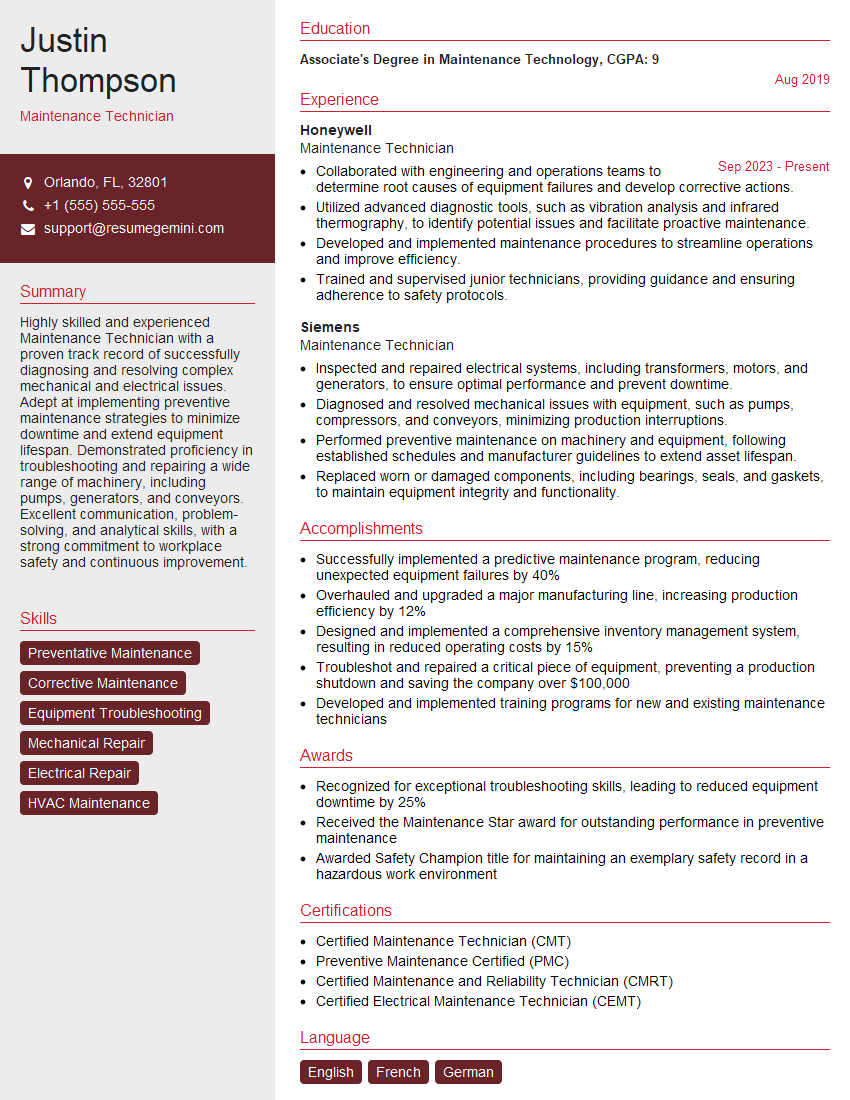
Maintenance Technician Resume Sample
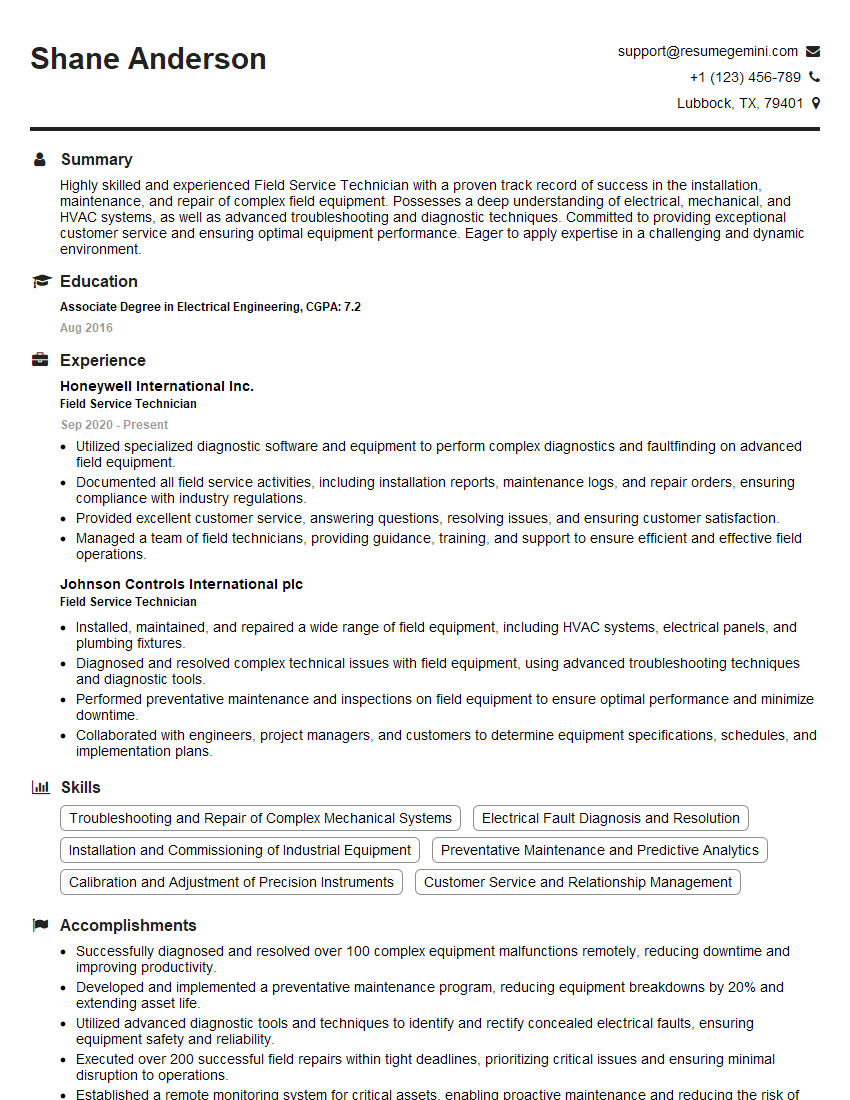
Field Service Technician Resume Sample
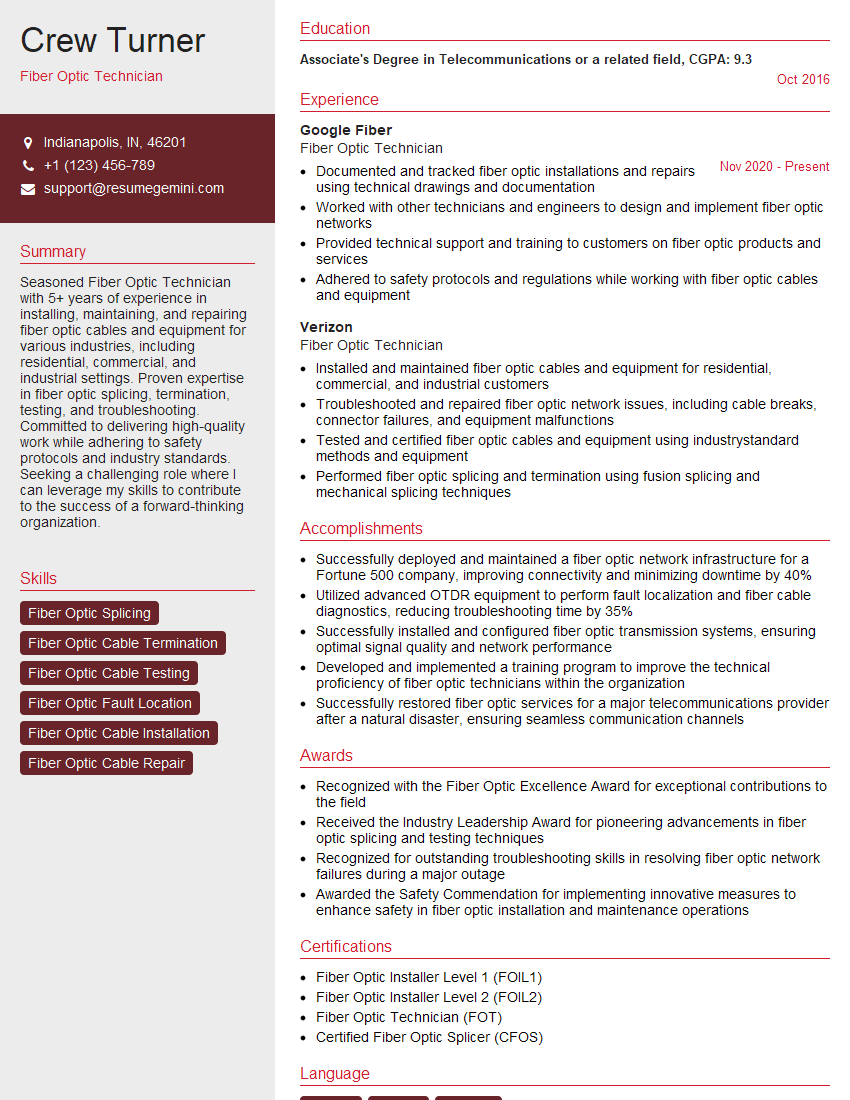
Fiber Optic Technician Resume Sample
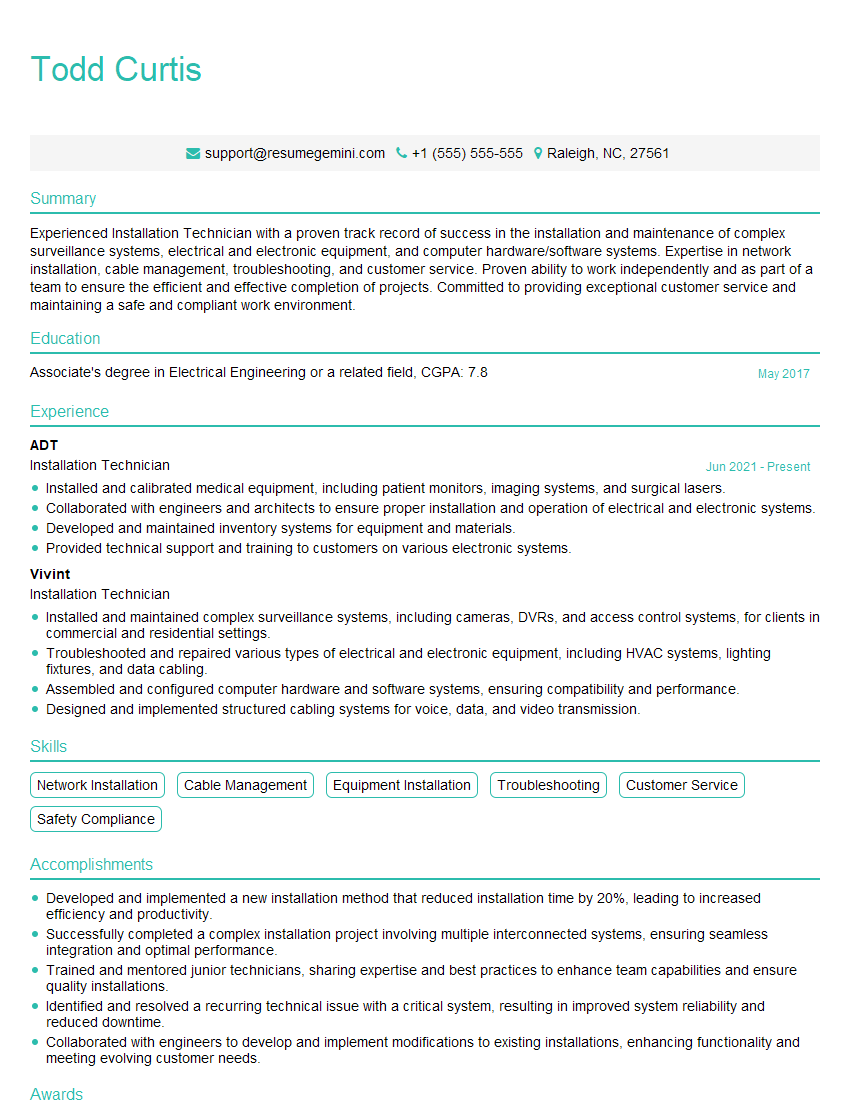
Installation Technician Resume Sample
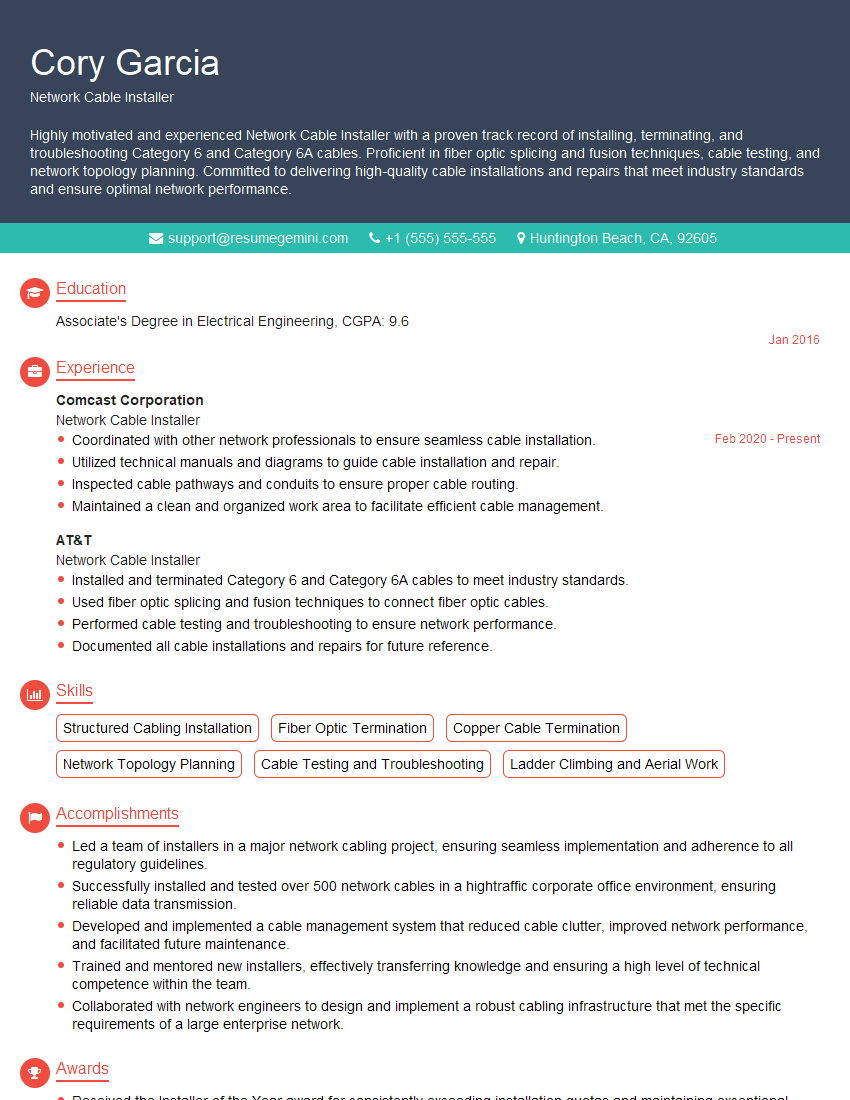
Network Cable Installer Resume Sample
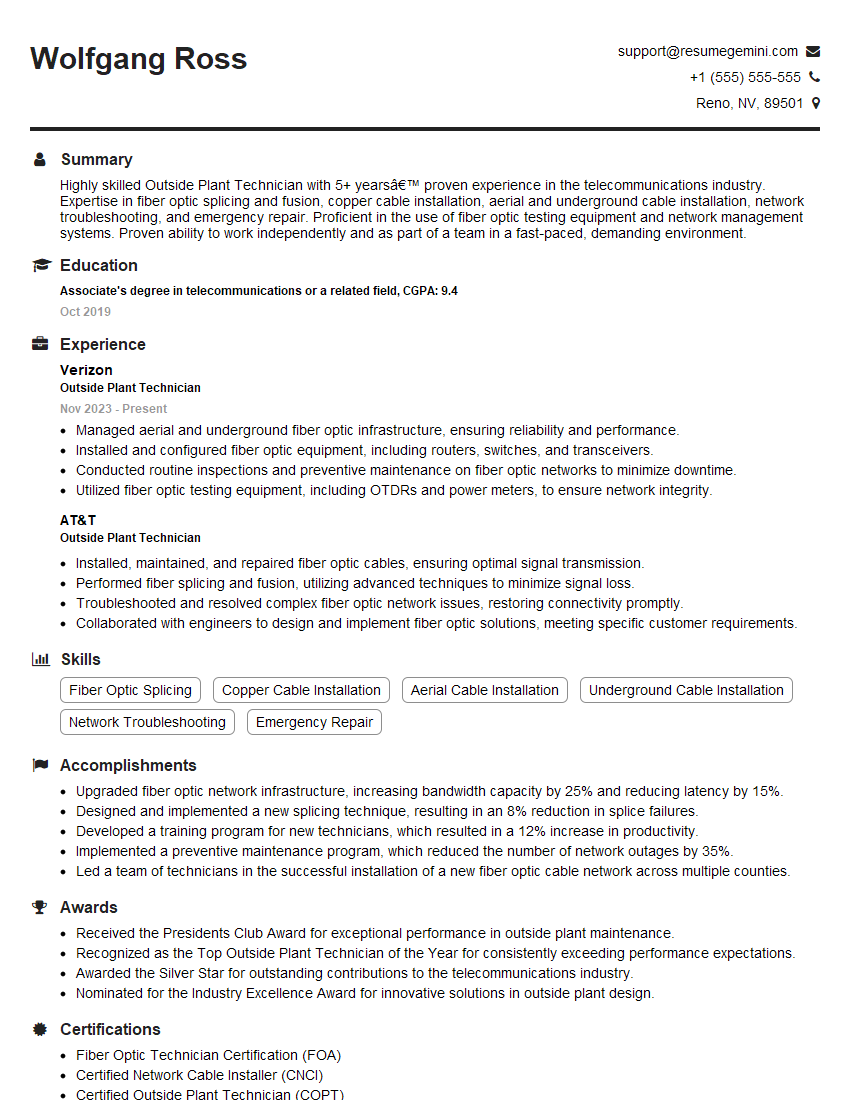
Outside Plant Technician Resume Sample
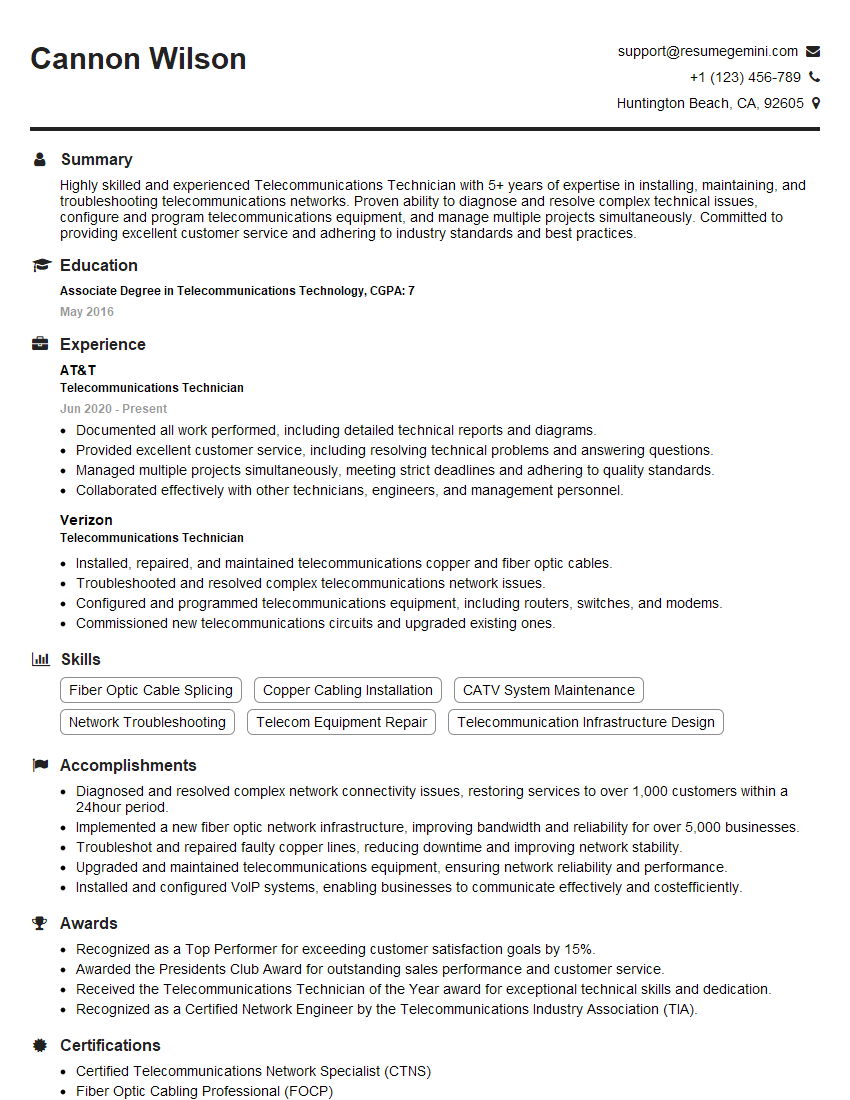
Telecommunications Technician Resume Sample
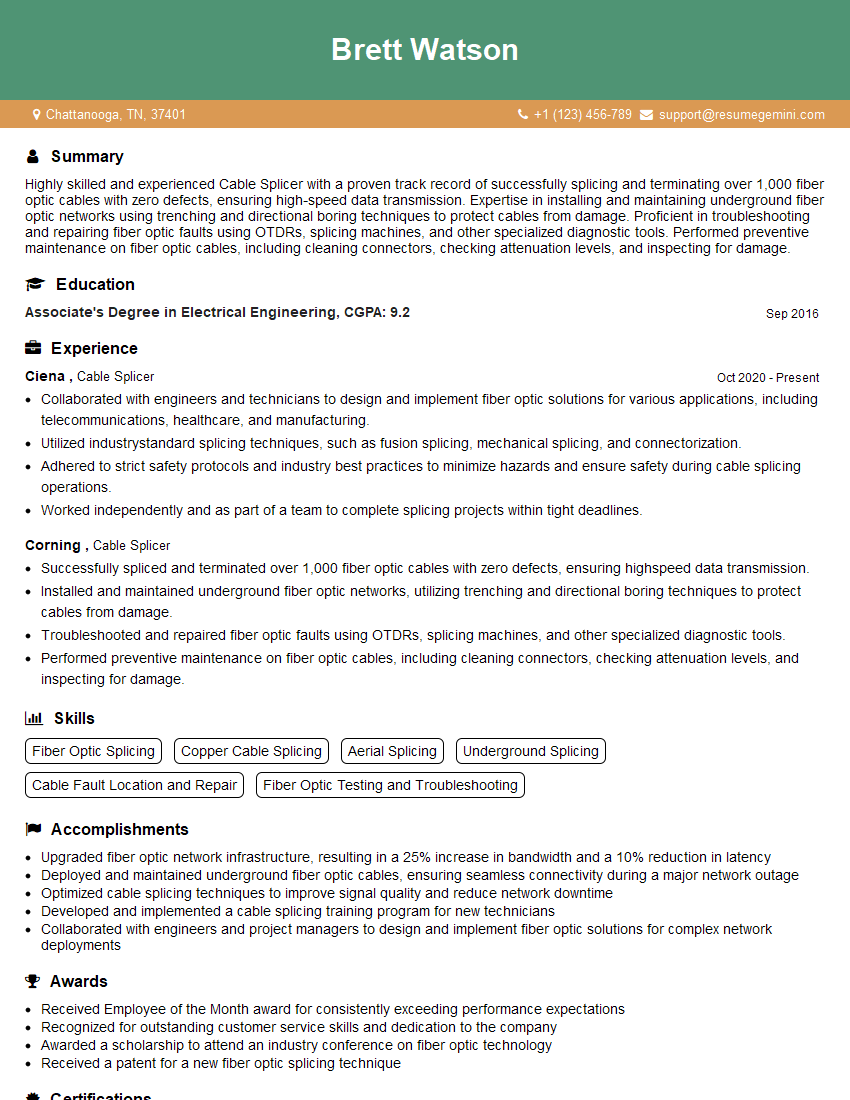
Cable Splicer Resume Sample
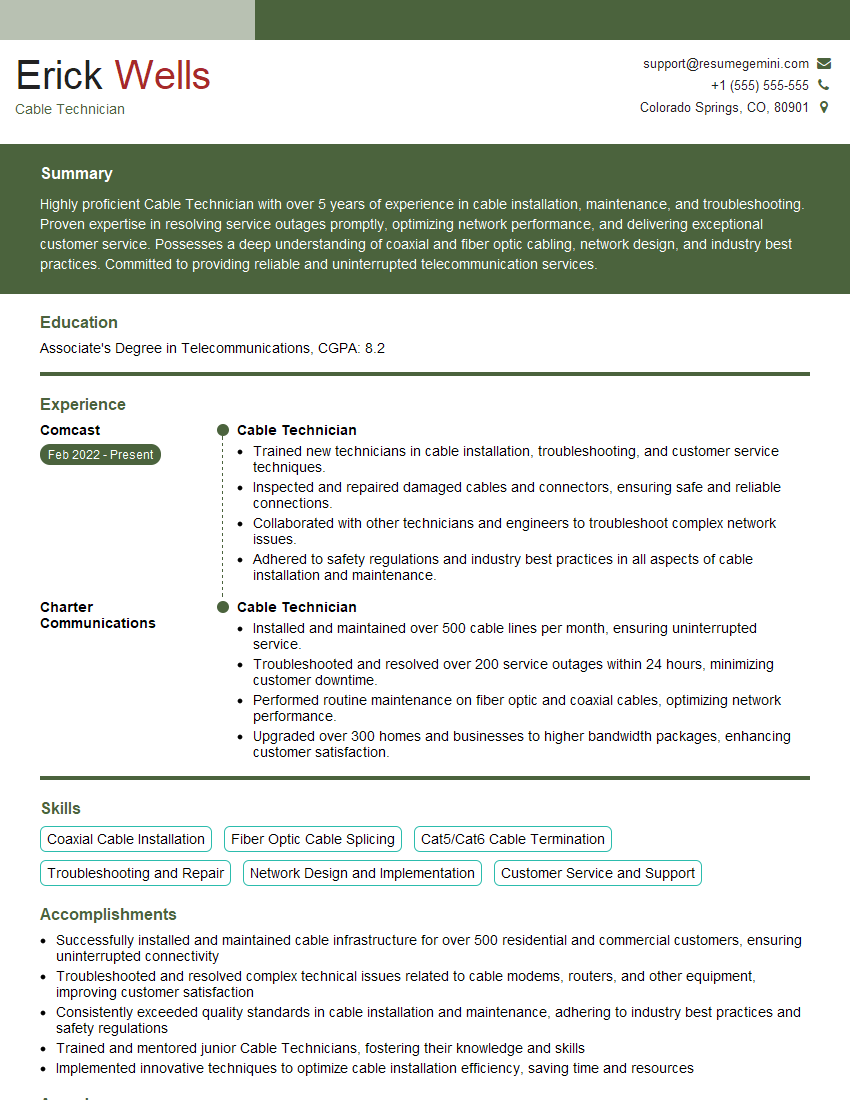
Cable Technician Resume Sample

Fiber Optic Splicer Resume Sample
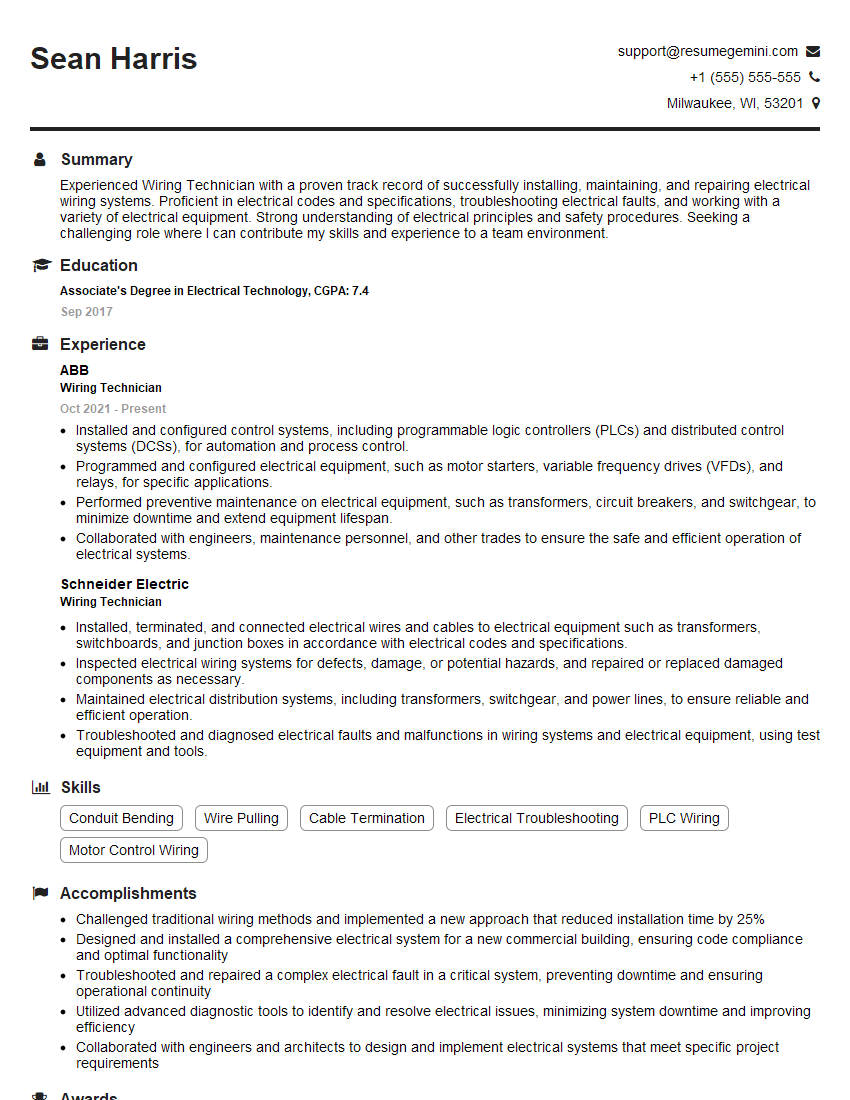
Wiring Technician Resume Sample
Explore more articles
Users Rating of Our Blogs
Share Your Experience
We value your feedback! Please rate our content and share your thoughts (optional).
What Readers Say About Our Blog
To the interviewgemini.com Webmaster.
Very helpful and content specific questions to help prepare me for my interview!
Thank you
To the interviewgemini.com Webmaster.
This was kind of a unique content I found around the specialized skills. Very helpful questions and good detailed answers.
Very Helpful blog, thank you Interviewgemini team.