Unlock your full potential by mastering the most common Dolly Camera Operation interview questions. This blog offers a deep dive into the critical topics, ensuring you’re not only prepared to answer but to excel. With these insights, you’ll approach your interview with clarity and confidence.
Questions Asked in Dolly Camera Operation Interview
Q 1. Describe your experience with different types of dollies (e.g., track dolly, airhead dolly).
My experience with dollies spans various types, each offering unique capabilities. Track dollies, the most common, utilize a rigid track for smooth, controlled movement. I’ve extensively used these on sets ranging from intimate interiors to expansive exteriors, mastering the techniques for laying track, adjusting curves, and ensuring a stable platform. Airhead dollies, on the other hand, offer greater flexibility, allowing for movement on uneven terrain. I’ve found these particularly useful in locations with limited space or challenging ground conditions, relying on their maneuverability to achieve specific camera angles. I also have experience with wheeled dollies for quick, less precise movements, often used for quick shots requiring agility. Each dolly type demands a different approach, but the core principles of smooth operation and safety remain paramount.
Q 2. Explain the process of setting up a dolly track for a specific shot.
Setting up a dolly track is a meticulous process that begins with careful planning. First, I review the shot’s requirements – the desired camera path, speed, and any potential obstacles. Then, I survey the location, identifying the best track placement to minimize disruption and maximize shot composition. For example, if the shot needs a smooth arc around an actor, I’ll carefully plan the track’s curve to match. The track itself is then laid out, ensuring it’s level and free of obstructions. Sometimes this involves adjusting the terrain subtly. Once laid, I ensure the track is securely fastened to prevent movement during the shot. Finally, I test the dolly’s movement along the track to identify and correct any inconsistencies before shooting commences. This pre-planning significantly contributes to a smooth and efficient shoot.
Q 3. How do you ensure smooth and precise dolly movements?
Smooth and precise dolly movements are achieved through a combination of technique and equipment. The dolly grip’s skill is crucial, requiring a delicate touch and precise control of the dolly’s speed and direction. This is complemented by using well-maintained equipment: ensuring the track is clean, properly lubricated (where applicable), and the dolly wheels are in good condition. It’s also essential to understand the weight distribution of the camera and its accessories to avoid jolts or uneven movement. For intricate moves, a remote-controlled dolly system can provide enhanced precision. Practicing various speeds and maneuvers helps to achieve a natural flow, avoiding sudden starts or stops. Thinking ahead and anticipating the next move allows for smoother transitions. For example, when transitioning from a fast dolly to a slow one, I would adjust the speed gradually to avoid any abrupt changes.
Q 4. What safety precautions do you take when operating a dolly?
Safety is paramount when operating a dolly. Before commencing any dolly shot, I ensure the area is clear of obstacles and personnel. This often involves coordinating with other crew members to create a safe working space. Clear communication is key – using verbal cues and hand signals to alert the crew to the dolly’s movement. I always have spotters positioned at crucial points of the track to monitor the dolly’s path and warn against potential hazards. The dolly track itself must be securely fixed to the ground, especially on uneven terrain, preventing it from shifting during the shot. Personal Protective Equipment (PPE) such as safety shoes are always worn to protect against potential hazards. Regular equipment checks are critical to ensure all elements are in safe and working order. For instance, I would regularly check the condition of track sections, dolly wheels and brakes. Finally, I always maintain a cautious, deliberate pace to avoid accidents.
Q 5. How do you communicate effectively with the camera operator and director during dolly shots?
Effective communication is the backbone of a successful dolly shot. Prior to filming, I collaborate with the camera operator to discuss the shot’s trajectory, speed, and any specific camera movements. A clear understanding of the shot’s intent, shared between the camera operator, director, and myself, ensures everyone is on the same page. During the shot, I use clear, concise verbal cues to signal starts, stops, and speed changes to the camera operator. Rehearsals are vital to fine-tune the collaboration and ensure a smooth flow. I also maintain open communication with the director, ensuring the shot aligns with their artistic vision. By listening to their feedback and adapting my approach, I contribute to a creative and efficient process. The key is clear, consistent, and proactive communication throughout.
Q 6. Describe your experience with different dolly speeds and how they affect the shot.
Dolly speed significantly influences the shot’s impact and narrative. A slow dolly can create a sense of suspense or intimacy, allowing the viewer to fully absorb details and emotions. A medium speed can provide a more natural, observational feel, similar to someone walking alongside. A fast dolly can convey urgency, action, or a sweeping perspective. For example, a slow dolly toward a character can amplify their emotional state, whereas a fast dolly might be used during a chase scene. I’ve found that mastering a range of speeds and integrating them effectively enhances the storytelling. Often, I’ll vary the speed throughout a shot to create a dynamic and engaging visual narrative.
Q 7. How do you handle unexpected problems during a dolly shot (e.g., track malfunction, uneven terrain)?
Unexpected problems can arise during a dolly shot, requiring quick thinking and problem-solving skills. If the track malfunctions, I’ll immediately stop the shot and assess the damage. Minor issues like loose track sections can be quickly repaired. More significant issues may require a replacement track section or even a change in shot strategy. Uneven terrain requires immediate adaptation; sometimes this could involve repositioning the track or potentially substituting the track dolly with a more suitable option like a wheeled dolly for minimal movements. Communication is crucial here – informing the director and camera operator about the problem and proposing alternative solutions. Having backup plans and problem-solving strategies in place ensures minimal disruption to the workflow. For example, I might have a different camera angle or shot prepared that eliminates the need for the dolly in case of a track malfunction.
Q 8. What are some common challenges you face when operating a dolly?
Operating a dolly presents several challenges, many stemming from the need for precision and coordination. One major hurdle is maintaining smooth, consistent movement. Uneven terrain, track imperfections, or even slight variations in operator pressure can lead to jerky or jarring shots.
Another common issue is managing cable management. Power cables, video feeds, and other connections can easily become tangled or strained during movement, potentially disrupting the shot or damaging equipment. Careful planning and the use of cable wraps and appropriate routing systems are crucial.
Finally, achieving the desired framing while operating the dolly requires skill and practice. Precise adjustments to speed, direction, and camera positioning are essential for executing the intended shot, particularly in complex shots involving camera movements combined with other techniques.
Q 9. Explain your understanding of camera angles and how they are affected by dolly movements.
Camera angles, fundamentally, define the viewer’s perspective on the subject. Dolly movements significantly influence these angles by changing the camera’s position relative to the subject and the overall scene. Think of a simple example: a dolly zoom (also known as a vertigo shot). This involves simultaneously zooming the lens while dollying in or out, creating a dramatic perspective shift where the subject seems to remain the same size, but the background dramatically expands or contracts, heightening tension or a sense of disorientation.
A dolly push, where the camera moves towards the subject, can create a feeling of intimacy or rising tension, while a dolly pull (moving away) can suggest detachment or reveal more of the environment. These effects are magnified by the interplay of camera height, angle (high, low, eye-level), and the subject’s movement. For instance, a low-angle dolly push might emphasize the subject’s power and dominance.
The interplay of dolly movement and camera angle is crucial in establishing mood, focus, and meaning within a shot.
Q 10. How do you maintain the dolly and its equipment?
Maintaining a dolly and its equipment is paramount for reliable operation and longevity. Regular cleaning is essential, particularly of the tracks, wheels, and moving parts, to prevent dust, debris, and corrosion. Lubrication of moving parts helps ensure smooth operation and prevents premature wear. I use a specialized lubricant specifically designed for moving camera equipment, paying particular attention to the wheels and the track itself.
Inspection for damage is also critical. I check the tracks for any signs of bending, warping, or damage. I also inspect the dolly’s wheels, ensuring they are aligned and free from damage. The camera mount is always checked before each shoot to ensure the stability and safety of the camera.
Cable management and proper storage of the dolly and its accessories are important for protection against accidental damage and theft.
Q 11. What types of shots are best suited for dolly movements?
Dolly movements excel at creating fluid, dynamic shots that reveal the environment and establish context. Tracking shots, following a moving subject, are quintessential dolly applications. This can showcase the subject in action, be it a person walking or a car driving.
Revealing shots, where the camera gradually reveals parts of a scene, are also well suited for dolly movements, often used for dramatic effect or establishing the scale of a location. Finally, establishing shots, which give a wide overview of a setting before zooming in or focusing on a specific detail, often utilize dolly movements for a controlled and engaging visual presentation.
Essentially, any shot needing a smooth, controlled camera movement to reveal environment, follow action or build suspense often benefits from the use of a dolly.
Q 12. How do you use a dolly to create a specific mood or feeling?
The mood or feeling created by a dolly shot is heavily influenced by the speed, direction, and the context of the scene. A slow, deliberate dolly push towards a lone figure can evoke feelings of suspense and anticipation, whereas a fast, chaotic dolly movement across a crowded scene might convey a sense of urgency or panic.
Consider the height of the camera too. A low-angle dolly shot can create a sense of power or intimidation, while a high-angle shot can evoke vulnerability or insignificance.
The combination of these elements, alongside lighting, sound, and editing, work together to craft the final emotional impact on the viewer.
For example, in a dramatic scene, a slow, steady dolly pull away from a character as they deliver an emotional monologue can create a sense of isolation and profound sadness.
Q 13. Describe your experience working with different types of cameras and lenses on a dolly.
My experience encompasses a wide range of cameras and lenses used on dollies, from lightweight mirrorless cameras for run-and-gun situations to heavy cinema cameras requiring more robust support systems. The key consideration when selecting a camera and lens is ensuring compatibility with the dolly system’s weight capacity and the desired level of stability. A heavier camera necessitates a sturdier dolly and potentially additional counterweights for balance.
Different lenses offer different creative possibilities. A wide-angle lens used on a dolly can create a sense of immersion and sweep across a wide landscape, whereas a telephoto lens allows for subtle tracking shots focusing on a specific subject without significantly changing perspective.
Each camera and lens combination necessitates adjustments to the dolly setup to ensure optimum performance and balance.
Q 14. How do you ensure the dolly track is properly leveled and aligned?
Proper leveling and alignment of the dolly track are fundamental to achieving smooth, consistent shots. Before any filming, I begin by visually inspecting the track for any obvious bends or irregularities. Then, I use a level to ensure the track is perfectly horizontal. Slight imperfections can be corrected using adjustable track supports or shims.
Alignment is equally important. The track must be straight and free from any curves or deviations, particularly over longer distances. I use a long straightedge or laser level to check the alignment across the entire length of the track, making adjustments as needed to ensure perfect alignment. This precision is essential for smooth, controlled movements and avoids unintended camera shaking or jarring movements.
Thorough preparation in this step significantly increases the quality of the final product by eliminating unwanted artifacts stemming from an unlevel or misaligned track.
Q 15. What is your experience with remote-controlled dollies?
My experience with remote-controlled dollies spans over eight years, encompassing a wide range of projects from independent films to high-budget commercials. I’m proficient in operating various brands and models, including both motorized and non-motorized systems. My expertise extends to both the technical aspects of operation, such as calibration and maintenance, and the creative application, ensuring smooth, precise movements that enhance the visual storytelling. For instance, on a recent commercial shoot, I successfully utilized a remote-controlled dolly to capture a complex, sweeping shot across a bustling city street, maintaining perfect focus and speed despite the unpredictable environment.
This involved precise calibration of the remote control and careful coordination with the focus puller to maintain depth of field as the camera moved through the scene. I’m also experienced with different control methods, including handheld remotes and those integrated with camera control units.
Career Expert Tips:
- Ace those interviews! Prepare effectively by reviewing the Top 50 Most Common Interview Questions on ResumeGemini.
- Navigate your job search with confidence! Explore a wide range of Career Tips on ResumeGemini. Learn about common challenges and recommendations to overcome them.
- Craft the perfect resume! Master the Art of Resume Writing with ResumeGemini’s guide. Showcase your unique qualifications and achievements effectively.
- Don’t miss out on holiday savings! Build your dream resume with ResumeGemini’s ATS optimized templates.
Q 16. Explain your understanding of the relationship between dolly movement and focus pulling.
Dolly movement and focus pulling are inextricably linked; they’re two sides of the same coin in creating visually compelling shots. As the camera dollies, the distance to the subject changes, requiring the focus puller to adjust the lens focus constantly to maintain sharpness. This requires seamless communication and coordination between the dolly grip and the focus puller. Imagine a dolly zoom – the camera moves towards the subject while simultaneously zooming out. Without precise coordination, the shot would be blurry and ineffective.
The complexity increases significantly with complex shots, requiring pre-visualization and careful marking of focus points and dolly positions. We often use focus charts or even pre-record test shots to determine the appropriate focus pull throughout the dolly movement. Smooth, consistent communication is crucial, using established signals and cues to ensure both operators are in sync.
Q 17. How do you plan and execute complex dolly shots involving multiple camera movements?
Planning complex dolly shots involves a meticulous process. It begins with a thorough understanding of the director’s vision, translating their creative intent into a precise operational plan. This involves careful storyboarding, shot-listing, and the creation of detailed camera movement diagrams. We’ll determine the type of dolly track needed (straight, curved, or a combination), the exact camera positions, speed variations, and the integration of other camera moves (like pans or tilts). We often use pre-visualization software to simulate the shot and refine the plan before even setting up on location.
- Step 1: Pre-Production Planning: Storyboarding, shot listing, and creating detailed diagrams.
- Step 2: Location Scouting: Assessing the environment, identifying potential challenges and solutions.
- Step 3: Equipment Selection: Choosing the appropriate dolly system and accessories (tracks, heads).
- Step 4: Markings and Rehearsals: Establishing precise camera positions, focus points, and practice runs.
- Step 5: Execution and Monitoring: Operating the dolly, closely monitoring speed and focus, making adjustments as necessary.
For example, a recent project involved a dolly shot that incorporated a 360-degree pan while the camera dollied along a curved track. This required careful planning, precise marking of the track, and a highly coordinated effort between the dolly grip, focus puller, and camera operator to ensure smooth and visually engaging movements.
Q 18. Describe your experience using various dolly accessories (e.g., dollies, tracks, heads).
My experience encompasses a broad range of dolly accessories. I’m proficient with various dolly systems, from lightweight handheld dollies suitable for smaller productions to heavy-duty, motorized systems used for larger-scale productions. I’m comfortable with different types of tracks, including straight, curved, and even specialized tracks for specific terrains or environments. I’ve worked with various camera heads, from simple fluid heads to sophisticated robotic heads that allow for incredibly precise and complex movements.
For instance, I’ve used a TechnoCrane for complex aerial shots and smaller, more agile dollies for work in confined spaces. Understanding the strengths and limitations of each accessory is crucial to selecting the optimal tools for the job. I understand the importance of proper maintenance and calibration to guarantee the smooth and reliable functioning of all the equipment. Regular lubrication, inspections, and calibration are essential parts of my workflow.
Q 19. How do you maintain a consistent speed and smoothness when using a dolly?
Maintaining consistent speed and smoothness is paramount for professional dolly operation. This requires a combination of technical skill and practice. For motorized dollies, precise control of the speed settings and smooth operation of the control system is key. For non-motorized dollies, a steady hand, practiced technique, and careful weight distribution are essential. I always pre-plan my movements and practice the shot beforehand to ensure smooth operation.
Visual cues and markers on the track are helpful for maintaining a consistent speed. The use of a clapperboard or other time-code device helps synchronize the dolly movement with other aspects of the production. Furthermore, I regularly calibrate my equipment and conduct routine maintenance checks to eliminate any friction or mechanical issues that might impact speed and smoothness.
Q 20. What are some common mistakes to avoid when operating a dolly?
Common mistakes to avoid include jerky movements, inconsistent speed, inaccurate focus, and poor communication with the focus puller and other crew members. Improper weight distribution on the dolly can lead to instability, resulting in shaky footage. Failing to properly secure the camera and other equipment can lead to accidents and damage. Not properly planning and rehearsing shots can lead to wasted time and subpar results. Underestimating the environment and not properly preparing for external factors (wind, uneven surfaces) can also severely impact shot quality.
For instance, not accounting for wind on an outdoor shoot could result in uncontrolled movements. Poor communication with the focus puller could result in a blurry shot that is unusable. Therefore, meticulous planning, clear communication, and thorough practice are crucial in avoiding these errors.
Q 21. How do you adapt your dolly operation to different environments (e.g., indoor, outdoor, tight spaces)?
Adapting to different environments requires flexibility and resourcefulness. Indoor environments often present challenges such as limited space, obstacles, and uneven flooring. This necessitates the selection of smaller, more maneuverable dollies and potentially the use of specialized tracks or even a Steadicam for extremely tight spaces. Outdoor shoots present their own set of challenges like wind, uneven terrain, and changing light conditions. I carefully scout the location beforehand and select equipment accordingly.
For example, in a tight indoor space, I might opt for a smaller dolly and a more agile camera head to execute the shot successfully. For an outdoor shoot on uneven ground, I would select tracks with a lower profile and potentially use sandbags to stabilize the setup. In each situation, safety is paramount; I always assess potential hazards and take the necessary precautions to ensure a smooth and safe shoot.
Q 22. Describe your experience working with different types of terrain and how this influences your dolly setup.
My experience with various terrains significantly impacts dolly setup. Smooth, level surfaces like studio floors are ideal; dolly tracks can be laid out easily, ensuring fluid movement. However, uneven ground like grassy fields or cobblestone streets demands careful planning and potentially specialized equipment.
- Level Surfaces (Studios): Here, the setup is straightforward. We can use standard track systems and focus on precise camera movements.
- Uneven Surfaces (Outdoor Locations): For uneven terrain, I assess the ground’s condition to select appropriate tracks or even consider alternatives like a wheeled dolly or a Steadicam if tracks are unsuitable. This often involves pre-scouting the location, marking out a safe and smooth path, and potentially leveling sections of the ground using plywood or other materials to create a stable base for the track.
- Challenging Terrain (Stairs, Slopes): Extremely difficult terrain might require specialized dollies designed for stairs or ramps, or even a different approach altogether, such as using a crane or jib arm for smooth camera movements. Safety becomes paramount here, and meticulous planning is essential.
For example, during a recent shoot on a beach, the shifting sand made it necessary to lay down sturdy plywood planks under the track to prevent sinking and ensure smooth movement. The extra preparation was well worth it for the beautiful, fluid shots we achieved.
Q 23. How do you use a dolly to create dynamic and engaging shots?
Creating dynamic and engaging shots with a dolly involves more than just moving the camera. It’s about carefully choreographing the movement to enhance the storytelling.
- Speed and Acceleration: Varying the dolly’s speed and acceleration creates visual interest and can reflect the emotional tone of a scene. A slow, deliberate movement can build tension, while a fast, sweeping shot can evoke excitement.
- Direction and Angle: The direction of the dolly movement (forward, backward, sideways) and the camera’s angle can significantly impact the shot’s impact. For instance, a low-angle shot moving towards a subject can create a sense of power and dominance, while a high-angle shot moving away can create a feeling of distance or isolation.
- Zooms and Pans: Combining dolly movement with zooms (changing focal length) or pans (rotating the camera on its vertical axis) produces even more dynamic effects, creating complex camera movements that add depth and visual richness to the scene. This is often called a ‘dolly zoom’ or ‘vertigo effect’.
In one project, we used a dolly zoom to emphasize a character’s feeling of disorientation. As the character spoke, we dollied in while simultaneously zooming out, creating a visually unsettling effect that perfectly conveyed the character’s emotional state.
Q 24. Explain your experience working with different lighting setups and how they interact with dolly movements.
Lighting is crucial in dolly shots; its interaction with movement can dramatically affect the shot’s quality and mood.
- Consistent Lighting: Maintaining consistent lighting throughout the dolly movement is vital to avoid jarring transitions. Smooth transitions are key, so we use lighting that doesn’t produce harsh shadows that change dramatically as the camera moves.
- Highlighting Movement: Lighting can emphasize the dolly movement. For example, backlighting can create dramatic silhouettes, whereas side lighting can highlight textures and surfaces as the camera passes over them.
- Dynamic Lighting Changes: In some situations, controlled lighting changes during a dolly shot can heighten the drama or create a specific mood. A gradual shift in intensity or color can subtly enhance the narrative.
- Shadows and Reflections: Always consider how the dolly’s movement will affect shadows and reflections. Moving the camera might reveal previously unseen shadows or cause reflections to shift, altering the overall visual effect.
In a recent shoot involving a nighttime scene, we carefully positioned and controlled our lighting to ensure the characters remained consistently illuminated as the dolly moved through the scene, maintaining visual continuity and enhancing the sense of mystery.
Q 25. What software or tools are you familiar with that support dolly operation planning?
Several software and tools assist in dolly operation planning.
- Previsualization Software (e.g., Autodesk Maya, 3ds Max): These allow us to create detailed 3D models of the set and plan camera movements virtually, allowing for adjustments before the actual shoot. This saves time and resources on set.
- Camera Planning Software (e.g., Shot Designer): This software specifically helps plan camera movements, including dolly shots, by providing detailed visualizations of the planned trajectories.
- Scripting Software (e.g., Final Draft): Though not directly involved in dolly movement, the script often dictates the type of dolly shots needed, providing guidance to the camera team during planning stages.
- Layout/Floor Planning Software (e.g., CAD Software): These help to map out the set and plan the track placement, ensuring efficient dolly movement. This is particularly useful in complex or confined spaces.
For instance, during a complex sequence requiring multiple dolly movements across a large set, we used Maya to pre-visualize the entire sequence, ensuring seamless camera movement and minimizing on-set adjustments.
Q 26. How do you troubleshoot technical issues related to the dolly or track system?
Troubleshooting dolly issues requires a systematic approach.
- Track Alignment: A misaligned track can cause jerky movement or derailment. Regularly check for track alignment and make adjustments as needed.
- Wheel Lubrication: Proper lubrication is crucial for smooth operation. Regularly inspect and lubricate the dolly wheels.
- Power Issues (for motorized dollies): Check the power source and connections. A low battery or loose connections can result in erratic movement.
- Track Obstructions: Ensure the track is free from debris or obstacles that could interfere with the dolly’s movement.
- Brakes and Locks: Check the functionality of the dolly’s brakes and locking mechanisms to ensure they are operating correctly.
In one instance, a sudden halt during a dolly shot was traced to a small piece of debris lodged between the wheel and the track. A quick cleaning resolved the problem, underscoring the importance of regular track inspection.
Q 27. Describe your experience collaborating with other crew members during dolly shots.
Collaboration is key during dolly shots.
- Camera Operator: I work closely with the camera operator to ensure they understand the intended movement. Clear communication is essential.
- Dolly Grip: The dolly grip is responsible for the smooth operation of the dolly. Effective collaboration ensures a fluid, precise shot.
- Focus Puller: Maintaining focus throughout the dolly movement requires coordination with the focus puller. This is critical for a sharp, well-defined image.
- Gaffer/Lighting Crew: Effective communication with the lighting crew ensures consistent illumination throughout the shot.
- Director/DP: Regular consultation with the director and director of photography guarantees the shot aligns with the overall vision.
For example, during a complex tracking shot involving a moving vehicle, successful collaboration between the dolly grip, camera operator, and focus puller was crucial to achieve the desired effect—a smooth, sharp image despite the dynamic conditions.
Key Topics to Learn for Dolly Camera Operation Interview
- Understanding Dolly Movement: Smooth operation, speed control, and achieving precise shots. Consider various track types and their impact on movement.
- Camera Mounting and Balancing: Properly securing the camera to the dolly, achieving balance for smooth operation, and understanding weight distribution’s impact on stability.
- Shot Composition and Planning: Pre-visualizing shots, planning dolly movements to enhance storytelling, and understanding the relationship between dolly movement and other camera techniques.
- Safety Procedures and Regulations: Understanding and adhering to on-set safety protocols, proper handling of equipment, and awareness of potential hazards.
- Troubleshooting and Problem Solving: Identifying and resolving common issues such as jerky movements, unbalanced setups, and track malfunctions. Thinking critically about solutions.
- Collaboration and Communication: Working effectively with the camera operator, director, and other crew members to achieve the desired shots. Clear communication is key.
- Different Dolly Types and Their Applications: Understanding the capabilities and limitations of various dolly systems (e.g., traditional track dollies, motorized dollies, handheld dollies) and selecting the appropriate system for different shooting scenarios.
- Maintaining Equipment: Understanding basic maintenance procedures for dollies and camera equipment, including cleaning, lubrication, and minor repairs.
Next Steps
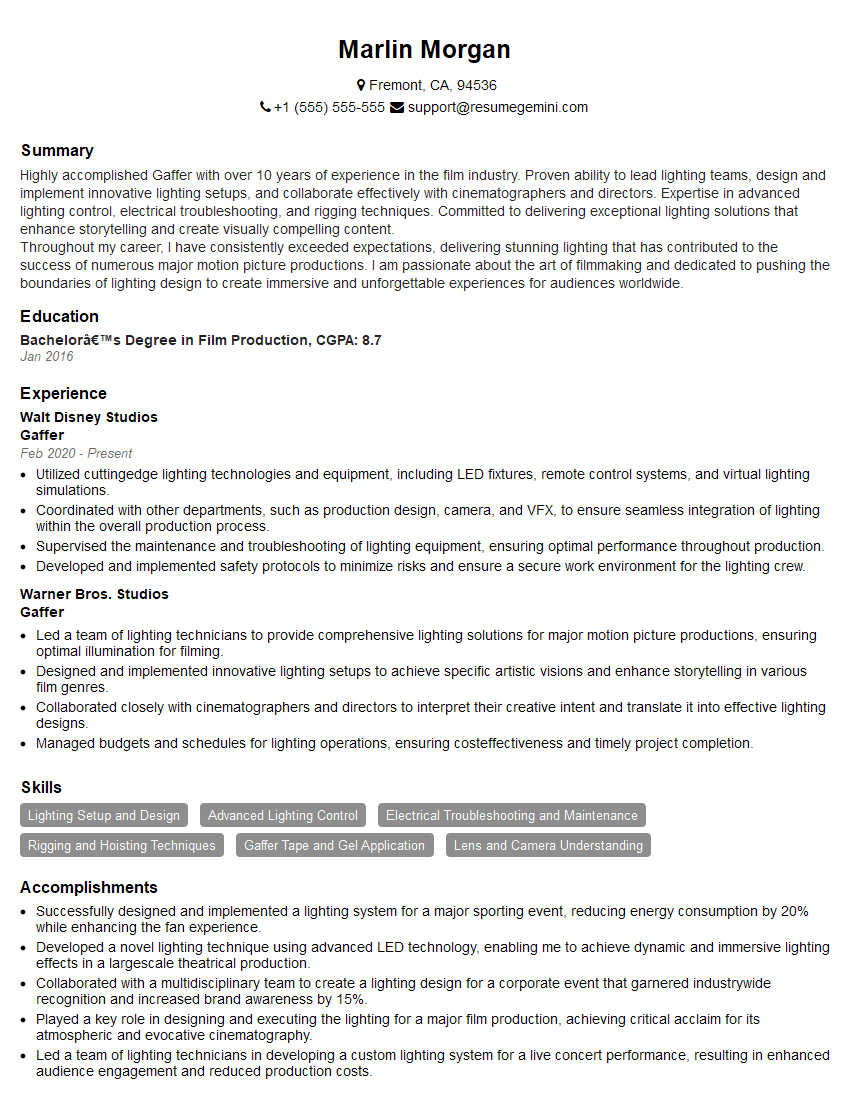
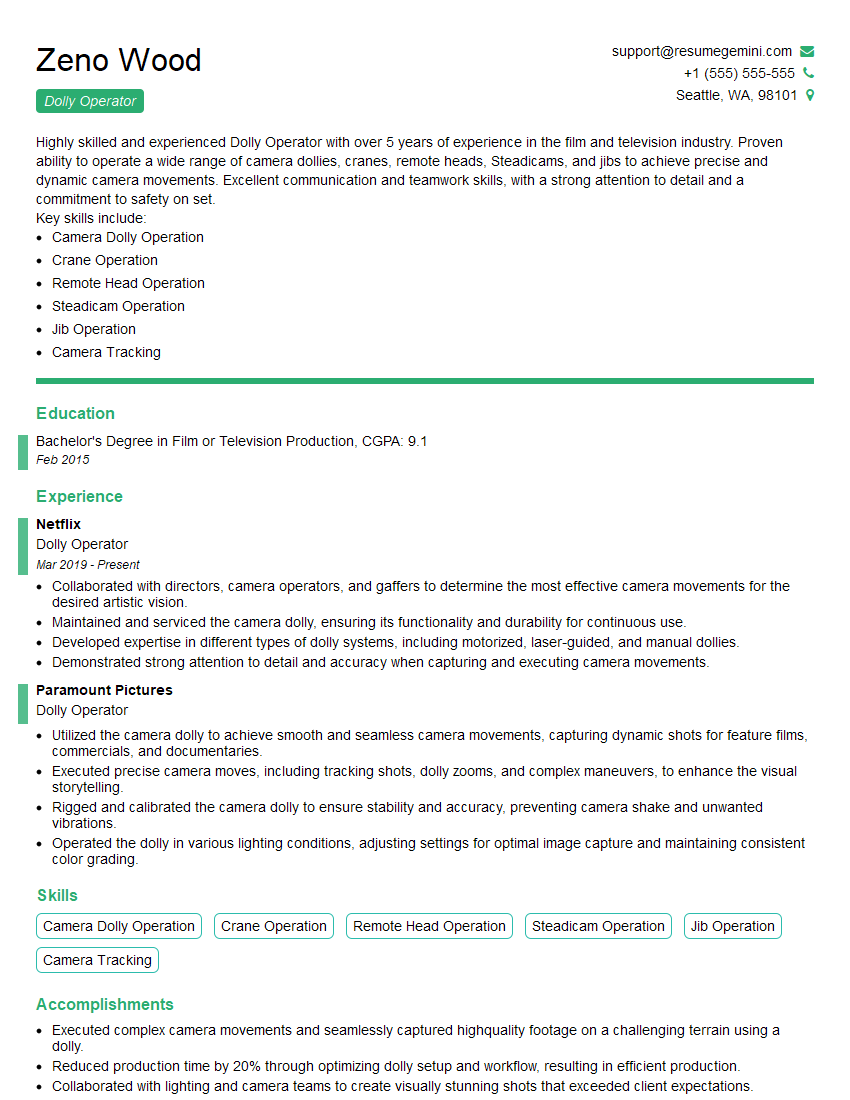
Mastering Dolly Camera Operation opens doors to exciting opportunities in film, television, and video production. A strong understanding of these techniques significantly enhances your value to any production team. To maximize your job prospects, focus on creating an ATS-friendly resume that clearly showcases your skills and experience. ResumeGemini is a trusted resource to help you build a professional and impactful resume, ensuring your application stands out. Examples of resumes tailored to Dolly Camera Operation are available within ResumeGemini to guide you.

Explore more articles
Users Rating of Our Blogs
Share Your Experience
We value your feedback! Please rate our content and share your thoughts (optional).
What Readers Say About Our Blog
To the interviewgemini.com Webmaster.
Very helpful and content specific questions to help prepare me for my interview!
Thank you
To the interviewgemini.com Webmaster.
This was kind of a unique content I found around the specialized skills. Very helpful questions and good detailed answers.
Very Helpful blog, thank you Interviewgemini team.