Interviews are more than just a Q&A session—they’re a chance to prove your worth. This blog dives into essential Sustainability Reporting Frameworks (GRI, GRI-365) interview questions and expert tips to help you align your answers with what hiring managers are looking for. Start preparing to shine!
Questions Asked in Sustainability Reporting Frameworks (GRI, GRI-365) Interview
Q 1. Define GRI Standards and explain their significance in sustainability reporting.
The GRI Standards (formerly known as GRI G4) are a globally recognized framework for sustainability reporting. They provide a common language and structure for organizations to disclose their economic, environmental, and social impacts. Their significance lies in enhancing transparency and accountability, enabling investors, customers, and other stakeholders to assess an organization’s sustainability performance. Think of them as a universally understood recipe for a sustainability report, ensuring consistency and comparability across different organizations.
The GRI Standards offer a comprehensive set of indicators covering various aspects of sustainability, promoting greater transparency and facilitating informed decision-making. They are designed to be flexible enough to accommodate organizations of different sizes and sectors while maintaining a high level of rigor.
Q 2. What are the key differences between GRI G4 and GRI Standards (GRI 365)?
The key difference between GRI G4 and the current GRI Standards (GRI 365) lies primarily in their structure and approach. GRI G4 was a more modular framework, offering a selection of indicators grouped into different aspects. GRI 365, on the other hand, represents a significant overhaul. It’s a more streamlined, principles-based framework focusing on materiality. This means organizations must identify and report on the topics most significant to their business and stakeholders, rather than simply checking off a predefined list of indicators. The core change is a shift from a checklist approach to a more holistic and context-specific approach.
Another significant difference is the emphasis on reporting quality. GRI 365 places a greater emphasis on the quality of data and the assurance process, ensuring reported information is credible and reliable. Think of G4 as a comprehensive cookbook with many optional recipes, while GRI 365 is a more sophisticated culinary school, focusing on the fundamental principles of preparing a high-quality dish tailored to your specific ingredients (material issues).
Q 3. Explain the concept of materiality in the context of GRI Standards.
Materiality, in the context of GRI Standards, refers to the aspects of an organization’s operations that are most significant to its economic, environmental, and social performance. These are the issues that significantly affect the organization’s ability to create value in the short, medium, or long term, and those that stakeholders consider most important. Essentially, it’s about focusing on what truly matters.
For example, a clothing company might consider its impact on water consumption and labor practices as highly material aspects, as these could directly affect its brand reputation and access to resources. Identifying material aspects ensures that the sustainability report focuses on the information most relevant to stakeholders, enabling them to make informed decisions.
Q 4. Describe the process of identifying material aspects using the GRI Standards.
Identifying material aspects using the GRI Standards involves a structured process. First, the organization should define its reporting boundary, specifying what parts of its operations are included in the report. Then, a comprehensive stakeholder engagement process is crucial. This involves identifying key stakeholders – investors, employees, customers, communities – and understanding their expectations and concerns regarding the organization’s sustainability performance.
Next, the organization analyzes its own operational data to identify potential environmental, social, and economic impacts. This data, combined with stakeholder input, allows the organization to prioritize the issues that are both impactful and relevant to stakeholders. Often, a materiality matrix is used to visually represent the intersection of these factors, helping to prioritize material aspects.
Finally, the identified material aspects are documented and disclosed in the sustainability report, along with how the organization is addressing them.
Q 5. How do you ensure the accuracy and reliability of data used in GRI reporting?
Ensuring the accuracy and reliability of data in GRI reporting is paramount. This requires establishing robust data collection and management systems, implementing quality control procedures, and potentially engaging independent assurance providers. Data should be collected from various sources, including operational data, surveys, and external databases, ensuring consistency and completeness.
Data quality should be regularly reviewed and validated. Procedures should be in place to identify, investigate, and correct any errors or inconsistencies. In many cases, organizations will undergo an external assurance process where an independent third party verifies the accuracy and reliability of the reported information, increasing the credibility of the report.
Q 6. What are the reporting boundaries defined by the GRI Standards?
The reporting boundaries defined by the GRI Standards specify the scope of operations and value chain activities included in the sustainability report. This might include the organization’s direct operations, its subsidiaries, joint ventures, and even a portion of its supply chain, depending on materiality assessments. It’s crucial to clearly define these boundaries to avoid misleading stakeholders and ensure transparency. The chosen boundary should be consistent throughout the report and clearly stated.
For example, a manufacturing company might include its own factories and direct suppliers within its reporting boundary, but exclude its customers’ operations. The decision on the extent of the boundary is based on the identified material aspects and the organization’s ability to collect relevant data. Transparency is critical; the rationale for the chosen boundary should be clearly explained.
Q 7. Explain the importance of stakeholder engagement in GRI reporting.
Stakeholder engagement is fundamental to effective GRI reporting. It ensures that the report reflects the concerns and expectations of those affected by the organization’s activities. By actively engaging with stakeholders – including employees, customers, suppliers, investors, communities, and NGOs – organizations can identify material aspects, gain valuable insights, and build trust. This engagement process also enhances the quality and relevance of the reporting.
Engaging stakeholders can involve various methods such as surveys, interviews, focus groups, and public consultations. The chosen methods should be appropriate to the specific stakeholder groups and the organization’s context. Feedback received through stakeholder engagement should be analyzed and used to refine the reporting process and improve the organization’s sustainability performance. This participatory approach enhances the credibility and legitimacy of the sustainability report.
Q 8. How do you address data limitations or gaps in GRI reporting?
Addressing data limitations in GRI reporting requires a multi-faceted approach. It’s crucial to acknowledge any gaps upfront and be transparent about them in your report. This builds trust and avoids misleading stakeholders.
Firstly, we meticulously document the limitations. For instance, if a specific metric, like Scope 3 emissions, lacks comprehensive data due to supply chain complexity, we clearly state this limitation and explain the methodology used to estimate the missing information. We might use proxy data, industry benchmarks, or expert estimations, clearly indicating the level of uncertainty associated with these estimations.
Secondly, we prioritize data collection improvements for future reporting cycles. We identify the root causes of the data gaps, developing strategies to collect the necessary information directly. This might involve implementing new data management systems, engaging with suppliers to improve their data collection practices, or investing in more sophisticated data analysis tools. This proactive approach demonstrates a commitment to ongoing improvement and data quality.
Finally, we focus on materiality. We concentrate on collecting data for the most material aspects of our sustainability performance, prioritizing aspects that significantly impact our business and stakeholders. This allows for a focused and meaningful report, even with limitations on certain data points. For example, if we discover a major data gap in a less material aspect, we might defer reporting on it until the next cycle, prioritizing resources on more critical data points.
Q 9. What are the key principles of the GRI Standards?
The GRI Standards are built upon ten key principles that ensure the quality, consistency, and comparability of sustainability reports. Think of them as the foundation upon which a credible report is built. These principles guide organizations in creating reports that are truly meaningful and informative.
- Completeness: The report should be comprehensive, including all material aspects of the organization’s sustainability performance.
- Clarity: Information should be easily understandable, avoiding overly technical jargon and presenting complex data in an accessible manner.
- Comparability: The report should allow for comparison with previous reports and those of other organizations. Consistent use of metrics is key.
- Accuracy: All information presented should be verifiable and free from material errors. Data should be properly sourced and validated.
- Timeliness: The reporting should be done promptly to provide stakeholders with timely information.
- Relevance: The report should address topics that are significant to the organization and its stakeholders.
- Balance: The report should include both positive and negative impacts. It should not just showcase successes; it should show areas for improvement.
- Reliability: Information presented should be credible, verifiable, and based on sound evidence.
- Materiality: The report should focus on the topics that matter most to the organization’s stakeholders. This involves engaging in stakeholder dialogues and identifying their key concerns.
- Sustainability Context: The report should place the organization’s sustainability performance within the broader context of its impacts and global challenges.
Q 10. How do you ensure compliance with the GRI Standards?
Ensuring GRI Standards compliance is an iterative process, not a one-time event. It requires a robust approach and continuous monitoring. It begins with a thorough understanding of the standards themselves.
We start by defining the scope of our reporting and identifying the most relevant standards based on our organization’s material topics. We then map those standards to our existing data collection processes, making adjustments as necessary. This might involve implementing new data tracking systems, defining clear procedures for data collection, and establishing internal controls to ensure data integrity. We also create a detailed reporting checklist to track progress and ensure compliance throughout the process.
Throughout the reporting process, we document all our data collection methods, evidence used, and any limitations encountered, maintaining a detailed audit trail. This is critical for demonstrating compliance and addressing any potential discrepancies. Regular internal reviews and quality assurance checks help detect inconsistencies and errors early in the process.
Finally, external assurance is a crucial step in building credibility. We engage an independent third-party assurance provider to review our report and provide an assurance statement on our compliance with the GRI Standards. This independent verification significantly enhances the reliability and trustworthiness of our report.
Q 11. Describe your experience in using GRI’s reporting software or tools.
While I haven’t worked directly with GRI’s specific reporting software, I have extensive experience with various sustainability data management and reporting tools. My expertise lies in leveraging these tools to streamline data collection, analysis, and reporting, ensuring alignment with the GRI Standards. In my previous role, we utilized a platform that integrated with various enterprise systems, allowing us to gather data on environmental performance, social impacts, and governance practices from across the organization.
My experience focuses on configuring these systems to collect and categorize data according to the GRI’s indicators. This involves establishing clear data mappings, ensuring data accuracy and completeness. The software’s reporting features allowed us to create interactive dashboards, produce customized reports tailored to different stakeholder groups, and analyze trends over time. Effectively using these tools is about more than just data entry; it is about building a comprehensive data management system that integrates sustainability into the core operations of the business.
The key to successful implementation is choosing a system that aligns with our organization’s needs and integrates seamlessly with existing systems. Training staff to use the chosen software is also crucial for successful implementation.
Q 12. Explain the role of assurance in GRI reporting.
Assurance in GRI reporting plays a vital role in enhancing the credibility and trustworthiness of a company’s sustainability performance claims. Think of it as an independent verification process, much like an audit of financial statements.
An independent, qualified third-party professional assesses the completeness, accuracy, and reliability of the sustainability information disclosed in the report. This assurance adds a layer of objectivity and validation, giving stakeholders greater confidence in the reported data and the organization’s commitment to transparency and accountability. The assurance process typically involves reviewing the organization’s data collection methods, analyzing supporting evidence, and evaluating the overall presentation of information. The level of assurance can vary, ranging from a limited assurance to a reasonable assurance.
The type of assurance obtained will influence stakeholder perceptions. A higher level of assurance, such as reasonable assurance, provides a stronger signal of credibility. It signifies a more rigorous verification process and reinforces the company’s commitment to transparency and accurate reporting.
Q 13. How do you incorporate the GRI Standards into a company’s overall sustainability strategy?
Integrating the GRI Standards into a company’s overall sustainability strategy isn’t just about producing a report; it’s about fundamentally embedding sustainability into the company’s operations and decision-making processes.
The first step involves aligning the GRI Standards with the company’s overall sustainability goals and strategic objectives. This typically requires a materiality assessment to identify the key sustainability issues relevant to the business and its stakeholders. The GRI Standards provide a robust framework to help define and report on these material topics.
Next, we map the GRI indicators to the organization’s existing data collection systems and processes. This often requires adjustments to existing data collection methods, data management systems, and internal reporting structures. This alignment ensures that the organization collects the necessary data to meet the requirements of the GRI Standards. The process then involves implementing new systems and procedures to collect and manage relevant data.
Finally, the data is used not just for reporting but also for internal decision-making and performance improvement. We use the GRI reporting process to identify areas for improvement and track progress towards sustainability goals. By integrating reporting and management systems, we create a closed loop which improves performance and strengthens the overall sustainability strategy.
Q 14. What are the challenges of implementing the GRI Standards?
Implementing the GRI Standards presents several challenges. One major hurdle is the extensive data requirements. Gathering comprehensive and reliable data across all aspects of an organization’s operations, particularly for Scope 3 emissions, can be time-consuming, resource-intensive, and complex.
Another significant challenge is the need for significant organizational change. Effective implementation demands a shift in mindset and culture, requiring all parts of the organization to understand and participate in the process. This means integrating sustainability into core business functions and creating appropriate internal systems and processes for data collection and management. It also involves training employees at all levels to understand their roles in sustainability reporting. Resistance to change and lack of internal buy-in can easily stall progress.
Finally, the standards’ evolving nature and the lack of universally standardized metrics across industries pose challenges for comparison and benchmarking. Keeping up to date with the changes and finding suitable benchmarks can be time-consuming and requires expertise. While these challenges are significant, they can be overcome with proper planning, resource allocation, and effective communication and training.
Q 15. How do you communicate GRI reports effectively to different stakeholders?
Communicating GRI reports effectively requires tailoring the message to each stakeholder group’s needs and understanding. Think of it like baking a cake – you wouldn’t serve the same slice to everyone. You need different ‘slices’ for different palates.
- Investors: Focus on financial materiality, risk management, and long-term value creation. Highlight key performance indicators (KPIs) related to profitability, efficiency, and return on investment. Use concise, data-driven language and visuals that are easy to interpret in financial terms.
- Customers: Emphasize ethical sourcing, product life-cycle impacts, and social responsibility. Show how your sustainability efforts translate to product quality, reliability, and positive social impacts. Use storytelling and visuals that connect with their values and concerns.
- Employees: Focus on workplace conditions, health and safety, employee development, and company culture. Highlight your commitment to diversity, inclusion, and well-being. Use a transparent and engaging tone, showing your commitment to their success within the organization.
- NGOs and Communities: Emphasize transparency, accountability, and community engagement. Showcase your efforts to mitigate environmental and social risks, promoting local communities’ interests and respecting human rights. Use clear, accessible language and detailed data to demonstrate progress and commitment.
- Government and Regulators: Prioritize compliance with relevant regulations and legislation. Highlight your environmental and social performance relative to industry standards and benchmarks. Use formal, precise language and detailed reporting aligned with regulatory requirements.
Regardless of the audience, a well-structured report with a clear executive summary, data visualization, and compelling storytelling is crucial for effective communication. Always consider accessibility for diverse needs, such as alternative formats for those with visual impairments.
Career Expert Tips:
- Ace those interviews! Prepare effectively by reviewing the Top 50 Most Common Interview Questions on ResumeGemini.
- Navigate your job search with confidence! Explore a wide range of Career Tips on ResumeGemini. Learn about common challenges and recommendations to overcome them.
- Craft the perfect resume! Master the Art of Resume Writing with ResumeGemini’s guide. Showcase your unique qualifications and achievements effectively.
- Don’t miss out on holiday savings! Build your dream resume with ResumeGemini’s ATS optimized templates.
Q 16. Compare and contrast GRI reporting with other sustainability reporting frameworks (e.g., SASB, TCFD).
GRI, SASB (Sustainability Accounting Standards Board), and TCFD (Task Force on Climate-related Financial Disclosures) are all sustainability reporting frameworks, but they differ in their focus and approach. Think of them as different lenses through which to view a company’s sustainability performance.
- GRI: Provides a comprehensive and widely adopted framework covering economic, environmental, and social aspects. It’s a principles-based approach, allowing flexibility in choosing relevant topics based on a company’s context. This breadth makes it suitable for a wide variety of organizations, but might lead to less focused reporting.
- SASB: Focuses on financially material sustainability issues specific to various industries. It’s more prescriptive, specifying metrics relevant to a company’s sector, aiding investors’ decision-making directly linked to financial performance. However, it may not encompass the entire breadth of a company’s sustainability impacts.
- TCFD: Concentrates specifically on climate-related risks and opportunities. It encourages companies to disclose information on governance, strategy, risk management, and metrics and targets related to climate change. This framework is essential for addressing climate-related financial risks but doesn’t cover the broader sustainability landscape.
In essence: GRI is broad, SASB is industry-specific and financially focused, and TCFD is climate-focused. Many organizations use a combination of these frameworks to provide a holistic sustainability report.
Q 17. Explain the role of data visualization in presenting GRI data.
Data visualization is crucial for presenting GRI data effectively; it transforms complex numbers into easily understandable visuals. Imagine trying to interpret a dense spreadsheet compared to a clear infographic – the latter is far more impactful.
- Charts and Graphs: Bar charts, line graphs, and pie charts effectively show trends, comparisons, and proportions of various performance indicators (e.g., emissions reduction over time, resource consumption).
- Maps: Geographic maps are valuable for visualizing spatial distribution of environmental or social impacts (e.g., waste generation across different facilities, community engagement initiatives in specific areas).
- Infographics: Combine text, data, and visuals to tell a compelling story about your sustainability performance, making complex information accessible to a wider audience.
- Dashboards: Interactive dashboards offer dynamic visualizations allowing stakeholders to explore the data at their own pace, filtering and focusing on areas of interest.
The key is to choose the right visualization technique for the data and the target audience. Keep it simple, accurate, and easy to interpret. Avoid cluttered visuals, and always provide clear labels and context.
Q 18. How do you manage the process of data collection and verification for GRI reporting?
Managing data collection and verification for GRI reporting is a systematic process requiring meticulous planning and robust procedures. It’s like building a house; you need a solid foundation to ensure stability.
- Data Collection Plan: Identify all relevant data points required for the report, specifying sources, collection methods, and timelines. This involves engaging different departments within the organization.
- Data Gathering: Collect data from diverse sources – internal systems, surveys, external databases. Ensure data quality through regular checks and validation processes.
- Data Verification: Employ robust processes for verifying the accuracy and completeness of the collected data. This might include internal audits, external assurance, or third-party verification depending on the materiality and sensitivity of the data.
- Documentation: Maintain thorough documentation of the data collection and verification process, including methodology, data sources, and any limitations. This is crucial for transparency and accountability.
- Data Management System: Implement a system to manage and track data throughout the reporting cycle. This could be a dedicated software, a spreadsheet, or a database, depending on the organization’s size and complexity.
A well-defined process ensures data reliability, builds stakeholder trust, and demonstrates the organization’s commitment to accurate and transparent reporting.
Q 19. Describe a situation where you faced a challenge in GRI reporting and how you resolved it.
In a previous role, we faced a challenge in accurately reporting Scope 3 emissions – those emissions occurring in a company’s value chain but outside its direct control. It was like trying to track a river’s source; difficult to pinpoint and quantify definitively.
Our initial data collection efforts were fragmented and incomplete due to the involvement of many suppliers. We lacked standardized data collection methods and adequate supplier engagement. To resolve this, we:
- Developed a robust supplier engagement strategy: We engaged directly with key suppliers, establishing collaborative relationships and implementing a standardized data collection template.
- Implemented a tiered approach: We focused our efforts on high-impact suppliers, prioritizing data collection for those with the largest emission footprints.
- Used emission factor estimation: For suppliers that couldn’t provide detailed data, we utilized industry-specific emission factors to estimate their contribution to our Scope 3 emissions.
- Improved data tracking and analysis: We implemented a dedicated database to track Scope 3 emission data from suppliers, enhancing data consistency and accuracy.
This multi-pronged approach significantly improved the accuracy and reliability of our Scope 3 emissions reporting, enhancing the credibility of our GRI report.
Q 20. Explain your understanding of the GRI Content Index and how it’s used.
The GRI Content Index is a table that maps the specific GRI standards used in a sustainability report to the corresponding information within the report. Think of it as a detailed table of contents, but specifically for sustainability data.
It provides a clear and concise overview of which standards have been applied and where the related information can be found in the report. This allows stakeholders to easily locate specific information relevant to their interests. For example, if an investor is interested in a company’s approach to labor practices (GRI Standard 406-2), they can quickly find the relevant section of the report using the Content Index.
Its use enhances transparency and enables stakeholders to understand which GRI standards have guided the report’s content and to efficiently find specific data points.
Q 21. How do you ensure the consistency of reporting across multiple reporting periods using GRI standards?
Ensuring consistency in GRI reporting across multiple periods requires a structured and systematic approach. It’s like keeping a consistent recipe when baking – the same ingredients and methods need to be used each time.
- Consistent Methodology: Maintain a consistent approach to data collection, calculation, and reporting methodologies throughout the reporting cycles. Document these methodologies clearly to ensure repeatability.
- Data Tracking System: Utilize a robust data management system to track key performance indicators (KPIs) and data changes over time. This ensures comparability across different reporting periods.
- Baseline Data: Establish a clear baseline for key indicators in the initial report. Subsequent reports should build on this baseline, demonstrating trends and progress over time.
- Regular Review and Updates: Regularly review and update the GRI reporting process to reflect changes in standards, organizational practices, and data availability.
- Internal Audits: Conduct regular internal audits to ensure the accuracy and consistency of the data and the adherence to the established methodology.
By maintaining consistency in these elements, organizations can build trust with their stakeholders and clearly demonstrate their sustainability performance trends over time.
Q 22. What are the key performance indicators (KPIs) you typically use in GRI reporting?
The specific Key Performance Indicators (KPIs) used in GRI reporting depend heavily on the organization’s industry, size, and material aspects. However, common KPIs across various GRI standards cover economic, environmental, and social performance. Think of them as the metrics that tell the sustainability story.
- Economic KPIs: These might include revenue, operating income, employee compensation, taxes paid, and economic contributions to communities. For example, a company might report its total economic impact on a specific region.
- Environmental KPIs: These often focus on greenhouse gas emissions (scope 1, 2, and 3), energy consumption, water usage, waste generation, and biodiversity impacts. A manufacturing company, for instance, might track its water consumption per unit produced and the percentage of waste recycled.
- Social KPIs: These encompass topics like employee diversity and inclusion, health and safety performance, human rights, community relations, and product responsibility. A retailer might track its employee turnover rate and the number of training hours provided.
GRI Standards provide a comprehensive list of potential KPIs, and companies select those most relevant to their operations and material aspects – the issues that significantly impact stakeholders and the business.
Q 23. How do you integrate GRI reporting with other company reporting processes?
Integrating GRI reporting with other company processes is crucial for efficiency and credibility. It shouldn’t be a standalone exercise.
- Data Consolidation: The ideal scenario involves using existing data collection systems. Instead of creating separate reporting systems, leverage data already collected for financial reporting, environmental management systems (EMS), and other internal processes. This minimizes extra work and reduces the risk of inconsistencies.
- Materiality Assessment: The materiality assessment – identifying the most significant sustainability issues for the organization – should inform both GRI reporting and other strategic initiatives. This ensures alignment and prioritization of efforts.
- Shared Resources: The sustainability team can often collaborate with finance, operations, and human resources departments to access and verify data. This fosters a collaborative culture around sustainability reporting.
- Integrated Reporting: Some companies combine GRI reporting with their financial reports to offer a holistic view of performance. This integrated approach enhances transparency and provides a more complete picture for stakeholders.
Essentially, effective integration avoids duplication, improves data quality, and makes the reporting process more efficient and sustainable in itself.
Q 24. Explain the importance of transparency and accountability in GRI reporting.
Transparency and accountability are the cornerstones of credible GRI reporting. Without them, the reports lack meaning and value.
- Transparency: This means openly disclosing information about the company’s sustainability performance, including both positive and negative aspects. It involves clearly explaining the methodology used to collect and analyze data, making sure there’s nothing hidden or obscured.
- Accountability: This implies taking responsibility for the reported information and demonstrating how the organization is addressing identified sustainability challenges. It involves setting targets, monitoring progress, and reporting on the outcomes – both successes and setbacks. This encourages continuous improvement.
Imagine a company boasting about its environmental performance without providing any supporting data or explanation of their processes. That lacks transparency. Conversely, a company that sets ambitious targets but fails to track and report its progress displays a lack of accountability. Both undermine trust and credibility.
Q 25. What are the potential benefits of using GRI Standards for an organization?
Adopting GRI Standards offers numerous benefits for organizations:
- Enhanced Reputation and Brand Value: Demonstrating a commitment to sustainability can attract investors, customers, and employees who value ethical and responsible business practices.
- Improved Stakeholder Engagement: GRI reporting provides a platform for open communication with stakeholders, fostering trust and building stronger relationships.
- Reduced Risks and Increased Resilience: Identifying and managing sustainability risks – such as climate change or supply chain disruptions – can enhance an organization’s resilience and reduce its vulnerability to future challenges.
- Access to Finance: Many investors increasingly use sustainability data to make investment decisions. GRI reporting can improve access to capital and lower borrowing costs.
- Operational Efficiency: Implementing sustainable practices can often lead to cost savings, improved resource management, and increased operational efficiency.
- Competitive Advantage: Leading in sustainability can differentiate a company from its competitors and attract customers who prioritize environmentally and socially responsible products and services.
Ultimately, embracing GRI Standards contributes to long-term value creation, enhancing the organization’s social license to operate.
Q 26. How do you measure the effectiveness of a company’s sustainability initiatives in relation to GRI Standards?
Measuring the effectiveness of sustainability initiatives in relation to GRI Standards requires a robust monitoring and evaluation framework.
- Benchmarking: Comparing performance against industry peers and setting ambitious but achievable targets aligned with GRI recommendations. This allows the organization to track its progress relative to others and identify areas for improvement.
- Data Tracking and Analysis: Regularly tracking KPIs relevant to the chosen GRI standards, analyzing trends, and assessing the impact of initiatives on identified key performance areas.
- Stakeholder Feedback: Gathering feedback from stakeholders – including employees, customers, communities, and investors – to gauge the perception and impact of the company’s sustainability initiatives. This helps identify areas where improvements are needed.
- Materiality Review: Periodically reviewing the materiality assessment to ensure the reported topics remain relevant and significant to the organization and its stakeholders. The business landscape changes, and so do material issues.
- Assurance: Seeking independent third-party assurance on the reported data adds credibility and increases trust in the reported information.
By consistently tracking, analyzing, and reporting on these aspects, an organization gains a clearer understanding of the effectiveness of its initiatives and identifies areas requiring adjustments. It’s not a one-time exercise; it’s an ongoing process of improvement.
Q 27. What are the implications of not complying with GRI Standards?
While there’s no legal penalty for not complying with GRI Standards themselves (they are voluntary), not reporting in accordance with them can have significant implications:
- Reputational Damage: A lack of transparency or the absence of a robust sustainability report can damage a company’s reputation, eroding trust among stakeholders. This can impact brand value and customer loyalty.
- Investor Pressure: Investors increasingly scrutinize companies’ ESG (Environmental, Social, and Governance) performance, and non-compliance can make it harder to attract investments and increase the cost of capital.
- Increased Regulatory Scrutiny: Governments worldwide are increasingly implementing regulations related to sustainability. A lack of robust sustainability reporting could lead to increased scrutiny from regulatory bodies.
- Loss of Competitive Advantage: Competitors who embrace GRI Standards or other sustainability reporting frameworks may gain a significant competitive edge, attracting customers and investors who prioritize sustainability.
- Difficulty in securing contracts: Some clients now require suppliers to meet certain sustainability standards, and a lack of GRI reporting could prevent companies from winning contracts.
In short, while GRI Standards are voluntary, the benefits of compliance far outweigh the risks of non-compliance in today’s business environment.
Q 28. How would you explain the concept of GRI Standards to a non-technical audience?
Imagine a company’s sustainability report as a detailed story about its impact on the world – the environment, its workers, and the communities where it operates. GRI Standards are like a set of guidelines for telling that story in a clear, consistent, and comparable way. They help organizations explain what they’re doing to be environmentally friendly, treat their employees fairly, and contribute positively to society.
Think of it like a recipe: everyone can bake a cake, but using a standard recipe ensures consistency and quality. Similarly, GRI Standards help companies report their sustainability efforts in a way that is understandable and comparable to others in the same industry. This allows investors, customers, and other stakeholders to easily evaluate their performance and make informed decisions.
These standards aren’t about rules or penalties, but rather about providing a common language and framework for sharing information about a company’s positive and negative impacts. The goal is increased transparency and accountability, allowing for informed decision-making and encouraging continuous improvement in sustainability performance.
Key Topics to Learn for Sustainability Reporting Frameworks (GRI, GRI-365) Interview
- GRI Standards Overview: Understand the structure and purpose of the GRI Standards, including the difference between Universal and Specific Standards.
- Materiality Assessment: Learn how to identify and prioritize key sustainability issues relevant to an organization, aligning with the GRI’s materiality principle. Practical application: Practice conducting a materiality assessment using hypothetical company data.
- Boundary Setting: Grasp the concept of defining the scope of reporting, including value chain considerations. Practical application: Analyze different boundary approaches and their implications for reporting.
- Data Collection and Assurance: Explore methods for gathering reliable and verifiable sustainability data, and the importance of independent assurance. Practical application: Discuss challenges in data collection and potential solutions.
- GRI 365 (GRI 100 Series) Deep Dive: Focus on the foundations of the standards, including general principles and reporting protocols. This covers the core elements of sustainability reporting that cut across all other standards.
- Specific Standard Application (Examples): Familiarize yourself with the application of specific GRI standards relevant to different sectors (e.g., energy, manufacturing, agriculture) and the related key performance indicators (KPIs).
- Reporting on Environmental, Social, and Governance (ESG) Issues: Understand how the GRI Standards address environmental, social, and governance aspects, and the interconnectedness of these areas.
- Reporting Challenges and Solutions: Anticipate common challenges encountered in sustainability reporting (e.g., data limitations, stakeholder engagement) and discuss practical solutions.
- GRI Reporting Software and Tools: Develop familiarity with common software used in the process of reporting and data management.
- Future Trends in Sustainability Reporting: Be prepared to discuss emerging trends and developments in the field, including integrated reporting and the evolving regulatory landscape.
Next Steps
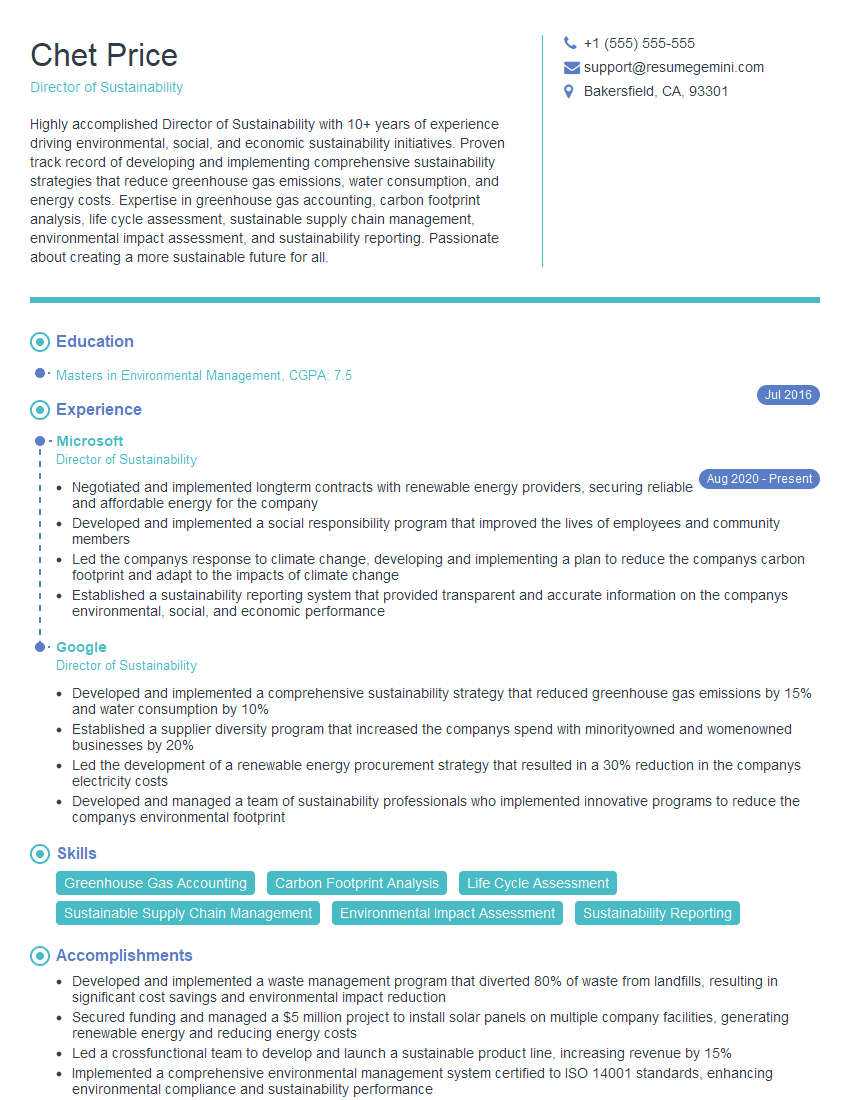
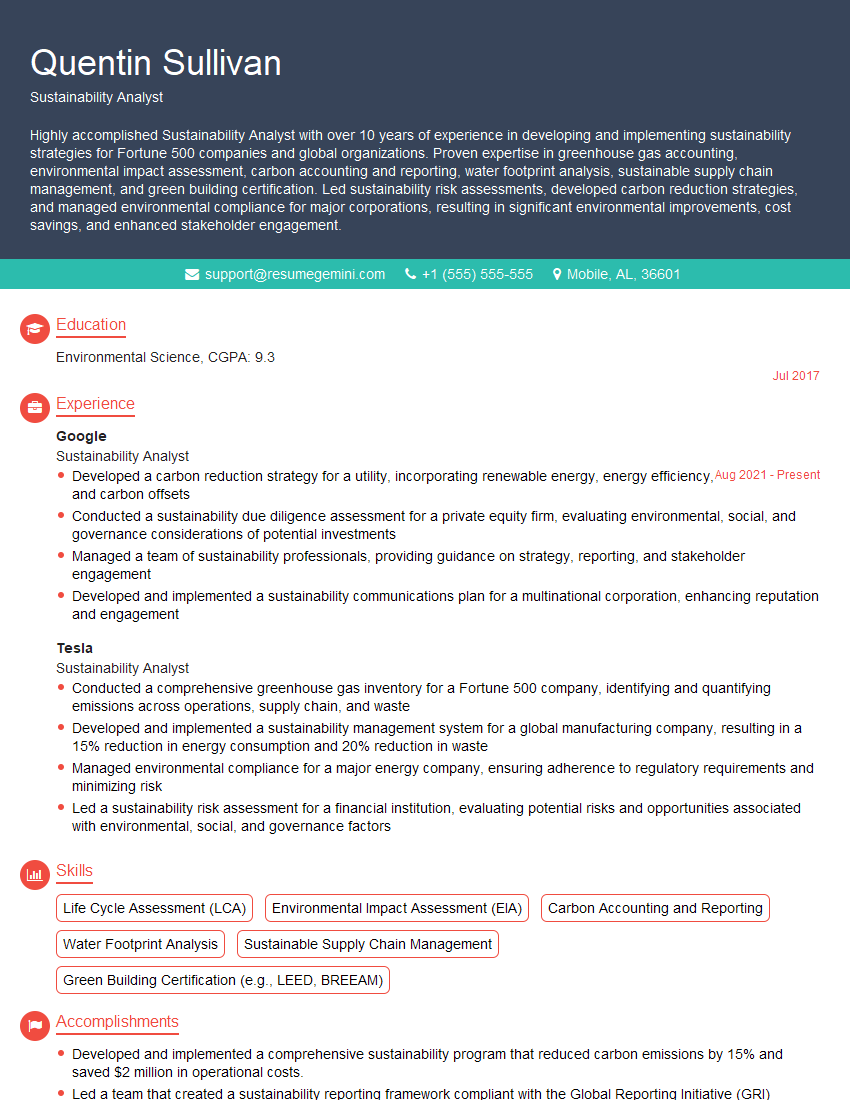
Mastering Sustainability Reporting Frameworks like GRI and GRI-365 is crucial for career advancement in the increasingly important field of ESG. Demonstrating this expertise on your resume significantly increases your chances of landing your dream role. Building an ATS-friendly resume is key to getting your application noticed. We recommend using ResumeGemini to create a compelling and effective resume that showcases your skills and experience in a way that Applicant Tracking Systems (ATS) can easily read and understand. ResumeGemini offers examples of resumes tailored to Sustainability Reporting Frameworks (GRI, GRI-365) to help you get started.

Explore more articles
Users Rating of Our Blogs
Share Your Experience
We value your feedback! Please rate our content and share your thoughts (optional).
What Readers Say About Our Blog
To the interviewgemini.com Webmaster.
Very helpful and content specific questions to help prepare me for my interview!
Thank you
To the interviewgemini.com Webmaster.
This was kind of a unique content I found around the specialized skills. Very helpful questions and good detailed answers.
Very Helpful blog, thank you Interviewgemini team.