Feeling uncertain about what to expect in your upcoming interview? We’ve got you covered! This blog highlights the most important Familiar with electrical codes and standards interview questions and provides actionable advice to help you stand out as the ideal candidate. Let’s pave the way for your success.
Questions Asked in Familiar with electrical codes and standards Interview
Q 1. What is the National Electrical Code (NEC) and why is it important?
The National Electrical Code (NEC) is a widely adopted standard for the safe installation of electrical wiring and equipment in the United States. Think of it as the rulebook for electricians. It’s published by the National Fire Protection Association (NFPA) and is regularly updated to reflect advancements in technology and safety practices. Its importance lies in minimizing the risk of electrical fires, shocks, and other hazards. Without the NEC, electrical installations would be a chaotic mix of potentially dangerous practices, leading to a significantly higher risk of injury and property damage. Compliance with the NEC is often mandated by local building codes and insurance companies.
Q 2. Explain the difference between grounding and bonding.
Grounding and bonding are both crucial for electrical safety, but they serve different purposes. Grounding connects non-current-carrying metal parts of an electrical system to the earth, providing a low-resistance path for fault currents to flow to the ground, thus preventing dangerous voltages from appearing on exposed metal surfaces. Imagine a lightning rod – it grounds the electrical charge from a lightning strike to protect a building. Bonding, on the other hand, connects non-current-carrying metal parts within an electrical system to each other, ensuring that they are all at the same electrical potential. This prevents voltage differences between these parts that could lead to a shock hazard. Think of bonding as creating a ‘safety net’ within the system. While different, they work together to ensure safety. A grounded system is also much safer if it should develop a fault.
Q 3. Describe the requirements for grounding electrodes.
Grounding electrodes provide a low-resistance path to earth for fault currents. The NEC specifies various acceptable grounding electrodes, including: a metal underground water pipe (if it meets specific criteria); a ground rod driven into the earth; a buried conductive plate; or a combination of these. The specific requirements depend on factors such as soil conditions and the size of the electrical system. Multiple electrodes are often used to achieve a low ground resistance, typically less than 25 ohms. Regular testing of the grounding system is essential to ensure its effectiveness. Imagine these electrodes as anchors, firmly securing the electrical system to the earth, providing a safe escape route for any stray electricity.
Q 4. What are the common voltage levels used in residential and commercial applications?
Residential applications commonly use 120/240 volts, single-phase three-wire systems. This means there are two 120-volt circuits relative to a neutral conductor, and a 240-volt circuit available between the two ‘hot’ wires. Commercial applications are more diverse, ranging from 120/208 volts, three-phase four-wire systems to higher voltage systems like 480 volts, three-phase four-wire systems, depending on the power requirements of the building and equipment. The choice of voltage depends on factors such as the power demand, the cost of installation, and the efficiency of the system. Higher voltage systems are more efficient for larger loads, but require specialized equipment.
Q 5. How do you determine the ampacity of a conductor?
The ampacity of a conductor is the maximum current it can carry continuously under specified conditions without exceeding its temperature rating. This is determined by several factors including: the conductor’s size (gauge), its material (copper or aluminum), the type of insulation, the installation method (e.g., buried, in conduit, in free air), and the ambient temperature. Ampacity tables, provided in the NEC, are used to find the appropriate ampacity for specific conditions. Improperly sizing conductors can lead to overheating, which is a fire hazard. Imagine the ampacity as the conductor’s ‘carrying capacity’; exceeding it is like overloading a truck beyond its weight limit.
Q 6. Explain the concept of overcurrent protection and its importance.
Overcurrent protection is crucial for preventing damage to electrical equipment and reducing the risk of fire. Overcurrent, which is current exceeding the rated value, can be caused by short circuits, overloads, and ground faults. The purpose of overcurrent protection is to automatically interrupt the flow of current when it exceeds a safe level. Without this protection, overheating could melt insulation, ignite combustible materials, and potentially lead to a fire. Think of it as a safety valve in a pressure cooker – it prevents catastrophic failure by releasing excess pressure.
Q 7. What are the different types of overcurrent protection devices?
Common types of overcurrent protection devices include: fuses, which melt and break the circuit when excessive current flows; and circuit breakers, which use a thermal or magnetic mechanism to trip and interrupt the circuit. Circuit breakers have the advantage of being reusable, while fuses need to be replaced. There are various types of circuit breakers designed for different applications and fault types, such as ground fault circuit interrupters (GFCIs) which provide protection against ground faults, and arc-fault circuit interrupters (AFCIs) which detect and interrupt dangerous arcing faults. The selection of the appropriate device depends on the specific application and the level of protection required.
Q 8. What are the requirements for installing electrical receptacles in bathrooms?
Bathroom electrical installations require extra care due to the presence of water, a major electrical hazard. The National Electrical Code (NEC) mandates specific safety measures. Generally, receptacles must be GFCI (Ground Fault Circuit Interrupter) protected. This means a device is installed that will quickly shut off power if a ground fault occurs, preventing potential electrocution. Receptacles must also be located a specific distance from the shower or bathtub – typically at least 1.2 meters (3-6 ft). Additionally, they often must be installed at least 1.8 meters (6 ft) above the floor for safety.
For example, in a newly constructed bathroom, all receptacles will typically be GFCI protected, likely by a GFCI breaker at the panel, or GFCI receptacles installed directly in the bathroom circuit. Older homes might require retrofitting existing receptacles with GFCI protection or installing new GFCI-protected receptacles in compliant locations. It’s crucial to consult the latest NEC for precise distances and requirements based on your location and specific bathroom layout.
Q 9. Describe the requirements for installing wiring in wet locations.
Wiring in wet locations, like outdoors or near pools, presents unique challenges. Water can cause short circuits and electrocution. The NEC dictates using specific wiring methods and materials to ensure safety. This includes using weatherproof boxes, conduits (pipes protecting the wires), and cables rated for wet locations (like those marked ‘W’ or ‘WX’). These materials are designed to withstand moisture and prevent water ingress. It’s vital to seal all connections and cable entries carefully to prevent water from entering the boxes and causing short circuits.
Imagine installing outdoor lighting for a patio. You wouldn’t use standard indoor wiring; you’d need to use outdoor-rated cable inside a weatherproof conduit and install it in a weatherproof box. This prevents water damage and ensures safety. Failure to follow these guidelines could lead to electrical hazards, equipment damage, and even fires.
Q 10. What are the requirements for installing electrical equipment in hazardous locations?
Hazardous locations, such as areas with flammable gases or dust, require specialized electrical equipment and installation methods to prevent explosions or fires. The NEC classifies hazardous locations based on the type and concentration of flammable materials present (Class I, II, III). Each class has specific requirements for equipment (explosion-proof or intrinsically safe), wiring methods, and installation practices. Equipment designed for hazardous locations is specifically rated and marked accordingly to indicate its suitability for the particular hazardous location class.
For instance, in a gasoline filling station (Class I, Division 1 location), you’d need explosion-proof fixtures and conduit to prevent ignition of flammable vapors. Using standard equipment could lead to a catastrophic event. This is a critical area where improper installation can have severe consequences. Correct installation requires a deep understanding of the NEC requirements for hazardous locations and specialized training.
Q 11. Explain the requirements for arc flash hazard analysis and mitigation.
Arc flash hazard analysis is crucial for ensuring worker safety when working on electrical equipment. An arc flash is a sudden, high-energy release of electrical energy that can cause severe burns, blindness, and even death. An arc flash hazard analysis involves calculating the potential arc flash energy at specific pieces of electrical equipment using software and standards like IEEE 1584. The analysis determines the required Personal Protective Equipment (PPE), such as arc flash suits and face shields, to safely perform work on the equipment.
Mitigation involves implementing measures to reduce the risk of an arc flash, such as implementing proper lockout/tagout procedures, using arc flash reduction equipment (like arc flash relays), and improving equipment design and maintenance. Following established safety procedures and utilizing the calculated PPE are essential steps for minimizing the risk to workers.
Q 12. How do you calculate the voltage drop in a circuit?
Voltage drop is the reduction in voltage across a circuit due to resistance in the conductors. Calculating voltage drop is vital to ensure equipment receives sufficient voltage. The formula is: VD = 2 * K * I * L / A
Where:
- VD = Voltage Drop (volts)
- K = Resistance constant (Ohms per 1000 ft) – depends on the conductor material and temperature
- I = Current (amps)
- L = Length (feet) of the conductor (one-way distance)
- A = Cross-sectional area (circular mils) of the conductor
For example, let’s say we have a 100-foot long circuit carrying 20 amps using copper wire with a resistance constant of 12.9 ohms per 1000 ft and a cross-sectional area of 10000 circular mils. The voltage drop would be: VD = 2 * 12.9 * 20 * 100 / 10000 = 5.16 volts. This is just an example and specific values need to be determined for each circuit based on equipment and conductor requirements.
Q 13. What are the different types of conduit and their applications?
Conduit is a protective metal or plastic pipe used to house and protect electrical wiring. Several types exist, each suited for different applications:
- Rigid Metal Conduit (RMC): Strong and durable, suitable for industrial and outdoor use where protection against physical damage is paramount. Often used in harsh environments.
- Intermediate Metal Conduit (IMC): Lighter and easier to install than RMC, suitable for less demanding applications.
- Electrical Metallic Tubing (EMT): Flexible and lightweight, ideal for residential and commercial settings, but less protective than RMC or IMC.
- Flexible Metal Conduit (FMC): Very flexible, useful for tight spaces and connections.
- Plastic Conduit (PVC): Less expensive and lighter than metal conduit; best suited for interior applications where resistance to corrosion is important and physical protection is less critical.
Choosing the right conduit depends on the environment, the level of protection needed, and the installation method. For example, RMC might be chosen for a factory floor with heavy machinery, while PVC would be suitable for interior wiring in a home.
Q 14. Explain the requirements for installing raceways.
Raceway installation, encompassing all types of conduits, requires adherence to NEC standards for safety and proper function. Key requirements include:
- Proper Support: Raceways must be securely fastened to prevent sagging and potential damage to the wires. Support intervals vary based on the type and size of the raceway.
- Correct Bends: Bends must be gradual and within the specified radius to avoid damaging the wires. Sharp bends can also reduce the conduit’s ability to protect the wiring.
- Proper Grounding: Metal raceways must be properly grounded to protect against electrical shock.
- Free from Obstructions: The raceway should be clear of obstructions and sharp bends to facilitate wire pulling and maintenance.
- Correct Fittings: Appropriate fittings, such as couplings and boxes, must be used to ensure a continuous and sealed raceway system.
Imagine pulling wires through a conduit that’s poorly supported and filled with sharp bends. This can damage the wires, making them a safety hazard and potentially causing a failure of the circuit. Proper raceway installation ensures efficient operation and long-term safety.
Q 15. What are the requirements for using flexible cords and cables?
Flexible cords and cables, while convenient, are subject to strict regulations to ensure safety. Their use is generally limited to applications where permanent wiring isn’t practical, such as connecting portable appliances or equipment. The National Electrical Code (NEC) outlines specific requirements based on the cord’s construction, application, and environment.
- Type of Cord: The correct cord type must be chosen for the intended application. For example, a lamp cord (typically SJT) is not suitable for a power tool (which might require a more rugged STW or SOW cord). The cord’s insulation and jacket must be rated for the voltage and temperature conditions it will encounter.
- Ampacity: The cord’s ampacity (current-carrying capacity) must be sufficient to handle the load without overheating. Overloading a cord is a major fire hazard. The NEC provides tables to determine appropriate ampacity based on cord size and installation conditions.
- Mechanical Protection: Flexible cords are vulnerable to damage from abrasion, crushing, and kinking. They need to be protected from such hazards. This often involves using cord grips, strain reliefs, and proper routing through conduits or raceways where applicable.
- Proper Termination: Connections must be made securely with the correct connectors and properly sized terminals, preventing loose wires that could cause overheating or shorts.
- Specific Locations: The use of flexible cords is restricted in certain locations, such as hazardous (classified) areas, wet locations, and buried installations. Alternative wiring methods are required in these instances.
Example: Imagine you’re installing a new lamp in your home. You wouldn’t use a heavy-duty appliance cord; you’d select a lamp cord rated for the lamp’s wattage and voltage. You would also ensure the cord is not pinched or damaged during installation.
Career Expert Tips:
- Ace those interviews! Prepare effectively by reviewing the Top 50 Most Common Interview Questions on ResumeGemini.
- Navigate your job search with confidence! Explore a wide range of Career Tips on ResumeGemini. Learn about common challenges and recommendations to overcome them.
- Craft the perfect resume! Master the Art of Resume Writing with ResumeGemini’s guide. Showcase your unique qualifications and achievements effectively.
- Don’t miss out on holiday savings! Build your dream resume with ResumeGemini’s ATS optimized templates.
Q 16. Describe the safety precautions when working with electrical equipment.
Safety when working with electrical equipment is paramount. It requires a combination of knowledge, precautions, and adherence to established safety procedures. Before even touching electrical equipment, you should always:
- De-energize the circuit: This is the single most important safety precaution. Turn off the power at the breaker panel and verify the power is off using a non-contact voltage tester.
- Lockout/Tagout: Implement a lockout/tagout (LOTO) procedure to prevent accidental re-energization. This involves physically locking the breaker or disconnecting device to prevent unintended operation.
- Use appropriate personal protective equipment (PPE): This includes insulated tools, safety glasses, rubber gloves, and appropriate footwear. The type of PPE will depend on the voltage level and the task being performed.
- Work with a partner: Having another person present can provide assistance and additional safety oversight, especially in potentially dangerous situations.
- Understand the equipment: Before working on any electrical equipment, make sure you understand its functionality, operating procedures, and potential hazards.
- Follow all applicable codes and standards: Adhere to local electrical codes (like the NEC in the US) and manufacturer’s instructions for all equipment and procedures.
Example: I was once working on a control panel, and even though the main breaker was off, I still used a non-contact voltage tester to double-check before I started working. This simple extra step saved me from a potential shock.
Q 17. What are the different types of electrical motors and their applications?
Electrical motors are the workhorses of industry, converting electrical energy into mechanical energy. They come in various types, each with its own advantages and applications:
- DC Motors: These motors operate on direct current. They offer precise speed control and high torque at low speeds, making them ideal for applications like robotics, electric vehicles, and some industrial machinery. Sub-types include brushed and brushless DC motors, each with its own pros and cons.
- AC Motors: These motors operate on alternating current. They are more rugged, simpler to maintain, and generally more cost-effective than DC motors. Common types include:
- Induction Motors (Asynchronous): The most widely used type, characterized by their simplicity, robustness, and relatively low cost. They’re used extensively in industrial applications like pumps, fans, and compressors.
- Synchronous Motors: These motors rotate at a speed directly proportional to the frequency of the AC power supply. They’re used where precise speed control is crucial, such as in clocks, timing devices, and some industrial machinery.
- Stepper Motors: These motors move in discrete steps, making them ideal for applications requiring precise positioning, such as 3D printers and CNC machines.
Example: A typical household refrigerator uses an induction motor to power the compressor. A robotic arm in a factory might use a DC servo motor for precise movements.
Q 18. Explain the principles of motor control.
Motor control involves regulating the speed, torque, and direction of an electric motor. It’s essential for efficient operation and safety. The principles involve manipulating the electrical power supplied to the motor using various methods:
- Voltage Control: Altering the voltage supplied to the motor directly affects its speed. This method is commonly used for DC motors and some AC motors.
- Frequency Control: For AC motors, adjusting the frequency of the power supply changes the motor’s speed. Variable frequency drives (VFDs) are used for this purpose, providing efficient and smooth speed control.
- Current Control: Monitoring and regulating the current flowing through the motor helps to protect it from overload and maintain optimal performance.
- Direction Control: Changing the phase sequence of the AC power supply or reversing the polarity of the DC supply allows the motor to be reversed.
- Closed-Loop Control: This incorporates feedback mechanisms to precisely regulate the motor’s speed and torque based on real-time measurements. Sensors provide information about the motor’s actual performance, allowing for adjustments to maintain the desired values.
Example: A VFD used in a conveyor belt system allows precise speed adjustment, optimizing material flow and energy efficiency.
Q 19. What is the purpose of a lockout/tagout procedure?
Lockout/Tagout (LOTO) is a safety procedure designed to prevent the unexpected energization or startup of machinery and equipment during maintenance or repair. It involves isolating energy sources and physically locking and tagging equipment to ensure that it cannot be inadvertently activated.
- Lockout: This involves using a lockable device to physically prevent the operation of the energy source (e.g., a padlock on a circuit breaker).
- Tagout: This involves attaching a tag to the energy-isolating device, clearly indicating that the equipment is locked out and should not be operated.
- Procedure: A formal LOTO procedure outlines the steps involved in isolating energy sources, locking out equipment, and verifying the lockout before commencing maintenance. This procedure usually includes a checklist to ensure every step is followed and signed off by the involved personnel.
- Training: Employees involved in LOTO procedures need to receive adequate training and certification to ensure the procedure’s effectiveness.
Example: Before working on a piece of machinery, an authorized technician would use a padlock on the main power breaker and attach a tag identifying themselves and the work being done. This prevents anyone from unintentionally switching on the power while maintenance is in progress. LOTO is crucial for preventing accidents and injuries.
Q 20. Describe your experience with interpreting electrical drawings.
I have extensive experience interpreting electrical drawings, including single-line diagrams, schematics, and wiring diagrams. I am proficient in understanding various symbols and notations, such as those defined in ANSI/IEEE standards. I can readily identify components, trace circuits, and determine the flow of power and control signals. My experience encompasses various levels of complexity, from simple residential circuits to intricate industrial control systems.
Example: In a recent project involving a large industrial facility, I utilized electrical schematics to troubleshoot a malfunctioning control circuit. By carefully analyzing the wiring diagram and tracing the signal path, I quickly identified a faulty relay that was causing the problem.
I’m also familiar with using software such as AutoCAD Electrical to create and modify electrical drawings.
Q 21. How familiar are you with different types of electrical testing equipment?
I am very familiar with a wide range of electrical testing equipment, both for general troubleshooting and specialized applications. My experience includes using:
- Multimeters: For measuring voltage, current, resistance, and continuity. I am proficient in using both analog and digital multimeters and interpreting the readings accurately.
- Clamp Meters: To measure current without breaking the circuit, essential for safety and efficiency.
- Megohmmeters (Meggers): For testing insulation resistance, identifying potential grounding issues and ensuring electrical safety.
- Ground Testers: To check the effectiveness of grounding systems and ensure electrical safety.
- Loop Testers: Used in protective relay testing.
- Power Quality Analyzers: To assess the quality and stability of the power supply and identify potential problems.
- Thermal Imagers: For detecting overheating components, a potential indicator of electrical problems.
Example: During a routine inspection of a power distribution system, I used a thermal imager to identify an overheating connection before it caused a major failure. This prevented a costly outage and potential safety hazard.
Q 22. Explain the process of troubleshooting electrical faults.
Troubleshooting electrical faults is a systematic process that involves identifying the problem, isolating the fault, and implementing a safe and effective repair. It’s like detective work, systematically eliminating possibilities until you find the culprit.
Visual Inspection: Begin by visually inspecting the circuit for obvious signs of damage, such as loose connections, frayed wires, burned components, or tripped breakers.
Testing with Multimeter: Use a multimeter to measure voltage, current, and resistance at various points in the circuit. This helps pinpoint where the fault lies. For instance, if you’re checking a circuit and find zero voltage at an outlet, you know the problem is upstream.
Tracing the Circuit: Follow the wiring diagram or trace the circuit physically to identify the path of the electricity and locate the faulty component or connection. This might involve checking individual wires, junctions, and switches.
Isolation: Once the fault is located, isolate the affected section of the circuit by turning off the appropriate breaker or disconnecting the power supply. This is crucial for safety!
Repair/Replacement: Repair or replace the faulty component or connection, ensuring that all connections are secure and the wiring is properly insulated. Always follow relevant electrical codes and standards during repairs.
Testing: After completing the repair, test the circuit to ensure it’s functioning correctly and safely before re-energizing the system. This might involve checking for correct voltage at outlets and verifying proper operation of any connected equipment.
For example, I once traced an intermittent power outage in a large office building to a faulty connection in a junction box hidden behind a false ceiling. By systematically checking each connection in that box with my multimeter, I was able to identify the loose wire and solve the problem.
Q 23. What is your experience with electrical code compliance inspections?
I have extensive experience with electrical code compliance inspections, having conducted hundreds of inspections across various project types, including residential, commercial, and industrial settings. My experience encompasses both new construction and renovation projects. I’m familiar with the National Electrical Code (NEC) and other relevant regional codes, and I thoroughly check all aspects of electrical installations, ensuring they meet the minimum safety requirements.
My inspections include verifying proper grounding, bonding, wire sizing, circuit protection, overcurrent protection devices, and the correct installation of electrical equipment. I meticulously document all findings, highlighting any code violations with detailed descriptions and photographs. I provide clear and concise reports that outline the necessary corrections to ensure code compliance, which typically helps avoid potential fire hazards and keeps installations safe.
Q 24. How do you stay updated with changes to the electrical codes?
Staying updated with changes in electrical codes is crucial for maintaining safety and compliance. I actively engage in several methods to stay informed:
NFPA Publications: I subscribe to the National Fire Protection Association (NFPA) and receive regular updates on NEC revisions and interpretations. They are the official publishers of the NEC.
Professional Development Courses: I regularly attend continuing education courses and seminars that focus on the latest electrical code changes and best practices. This hands-on training keeps my knowledge sharp and ensures I’m aware of any new technologies or techniques.
Industry Publications and Websites: I regularly read industry publications, online forums, and websites to stay abreast of emerging trends, new technologies, and interpretations of the codes.
Networking: Networking with other electrical professionals helps me learn about new challenges and solutions, as well as best practices. This is especially helpful for understanding practical applications of the codes in the field.
Q 25. Describe your experience working with various electrical systems (e.g., power distribution, lighting, control systems).
My experience encompasses a wide range of electrical systems. I’ve worked extensively with power distribution systems, designing and installing systems from small residential panels to large commercial switchboards. I understand the importance of proper load calculations, breaker sizing, and grounding techniques for safe and efficient power distribution.
In lighting systems, I’ve worked with various types of lighting technologies, including incandescent, fluorescent, LED, and high-intensity discharge. My expertise includes lighting design, control systems, and energy-efficient solutions. I’m proficient in the calculation of lighting levels, and I’m knowledgeable about emergency lighting codes and requirements.
I have significant experience with control systems, such as programmable logic controllers (PLCs) and building automation systems (BAS). My work has involved the design, installation, and troubleshooting of these systems for various applications, including HVAC, security, and industrial automation. I am also experienced with various communication protocols used in industrial automation.
Q 26. What are the common causes of electrical fires?
Electrical fires are a serious hazard, and understanding their common causes is essential for prevention. Many are caused by a combination of factors, but here are some of the most frequent:
Overloaded Circuits: When too many appliances or devices are plugged into a single circuit, it can overload the wiring, causing overheating and potentially a fire. Think of it like a straw too small for the amount of liquid you want to suck up – it will get clogged and hot.
Faulty Wiring: Worn, damaged, or improperly installed wiring can create sparks and heat, leading to fires. This is why regular inspections are critical.
Loose Connections: Loose connections at outlets, switches, or junctions create resistance and generate heat, increasing the risk of fire. The resistance can be significant, leading to arc flash, which is extremely dangerous.
Appliance Malfunctions: Faulty appliances, especially those with heating elements (e.g., ovens, heaters), can cause fires if not properly maintained or repaired.
Improper Grounding: Inadequate grounding can lead to electrical shock and increase the risk of fire, especially when there’s a fault in an appliance.
Q 27. How do you ensure workplace electrical safety according to OSHA standards?
Ensuring workplace electrical safety according to OSHA standards requires a multi-faceted approach. My approach centers around prevention and proactive measures:
Lockout/Tagout Procedures: I strictly enforce lockout/tagout procedures before any electrical work is performed, ensuring power is completely disconnected and the equipment is secured to prevent accidental energization.
Personal Protective Equipment (PPE): I make sure all electricians use appropriate PPE, including insulated tools, safety glasses, arc flash suits (where appropriate), and rubber gloves.
Regular Inspections: I conduct regular inspections of electrical equipment and wiring to identify potential hazards before they become problems. This is an ounce of prevention worth a pound of cure.
Training and Education: I provide comprehensive training to all personnel on safe work practices and the importance of following electrical safety procedures. This helps instill good habits.
Emergency Response Plan: I help develop and implement an emergency response plan for electrical incidents, including procedures for handling electrical shocks and fires.
Documentation: I maintain thorough documentation of all inspections, training, and incident reports to demonstrate compliance with OSHA regulations.
Q 28. Describe a situation where you had to solve an electrical problem that involved understanding and applying electrical codes.
During a renovation project, we encountered an unexpected problem with an existing electrical panel that didn’t meet current code requirements. The panel was significantly overloaded, and the wiring was inadequate for the increased load from the renovation. This presented a fire hazard.
Applying my knowledge of the NEC, I first determined the actual load requirements for the upgraded system. Then, I designed a solution that involved installing a new, larger capacity panel that met all relevant code requirements. This included correct sizing of the main breaker, branch circuits, and conductors, along with ensuring proper grounding and bonding. We also replaced the outdated wiring with modern, appropriately sized cabling.
The project was completed in compliance with all applicable codes and standards, ensuring the safety of the occupants and the longevity of the electrical system. This situation highlighted the importance of understanding not only the current codes but also how to apply them to solve real-world problems while prioritizing safety.
Key Topics to Learn for Familiar with Electrical Codes and Standards Interview
- National Electrical Code (NEC): Understanding the fundamental principles, organization, and common articles of the NEC. This includes practical application to various scenarios.
- Wiring Methods and Techniques: Knowledge of different wiring methods (e.g., conduit, cable tray, raceways), their applications, and code compliance. Be prepared to discuss practical examples and troubleshooting scenarios.
- Overcurrent Protection: Deep understanding of fuses, circuit breakers, and their role in protecting electrical systems. This includes calculations and practical application in various systems.
- Grounding and Bonding: Thorough understanding of grounding principles, equipment grounding conductors, and bonding techniques. Be ready to explain the importance of safety and code compliance.
- Electrical Calculations: Ability to perform basic electrical calculations (e.g., Ohm’s Law, power calculations) to ensure system design meets code requirements and safety standards.
- Electrical Safety: Comprehensive understanding of electrical hazards and safety precautions. This includes lockout/tagout procedures, arc flash safety, and personal protective equipment (PPE).
- Specific Code Articles (relevant to your experience): Focus on the articles and sections of the NEC most relevant to your experience and the job description. This shows targeted preparation.
- Interpreting Electrical Drawings and Schematics: Ability to read and understand electrical drawings, schematics, and other technical documents is crucial for practical application of codes.
- Troubleshooting Electrical Systems: Demonstrate problem-solving skills by outlining a systematic approach to troubleshooting electrical issues, referencing applicable codes and standards.
Next Steps
Mastering electrical codes and standards is paramount for a successful career in the electrical field, opening doors to diverse opportunities and higher earning potential. An ATS-friendly resume is your key to unlocking these opportunities. To maximize your chances, build a powerful resume that highlights your skills and experience effectively. ResumeGemini is a trusted resource to help you craft a professional and impactful resume tailored to the specific requirements of your target roles. Examples of resumes tailored to showcasing expertise in electrical codes and standards are available within ResumeGemini to provide guidance and inspiration for your own resume creation.

Electrical Superintendent Resume Sample

Electrical Contractor Resume Sample
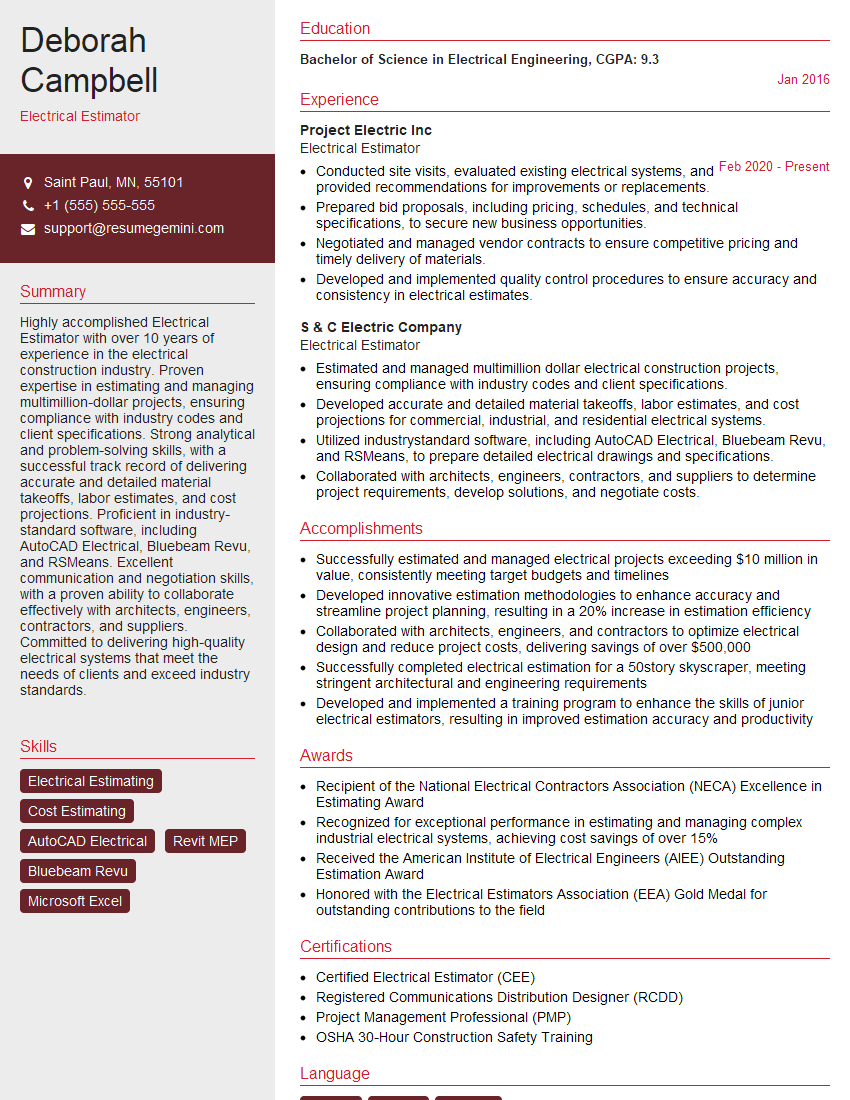
Electrical Estimator Resume Sample
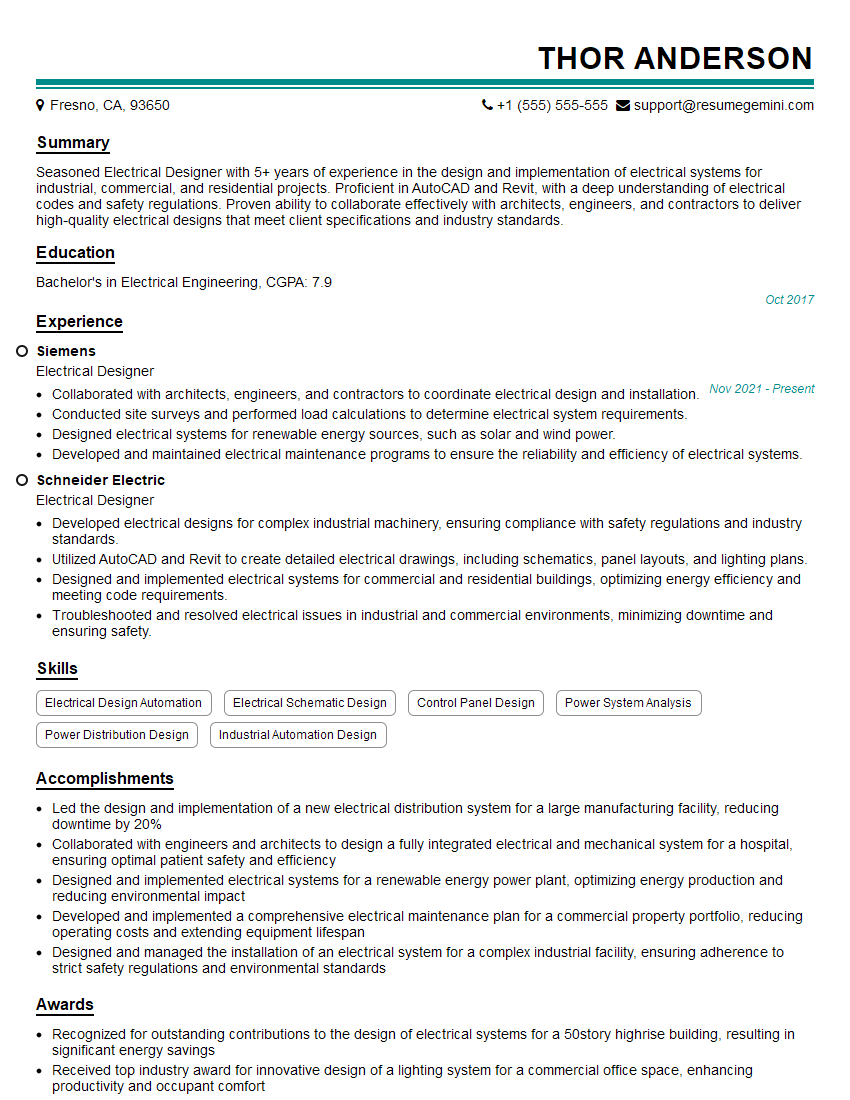
Electrical Designer Resume Sample
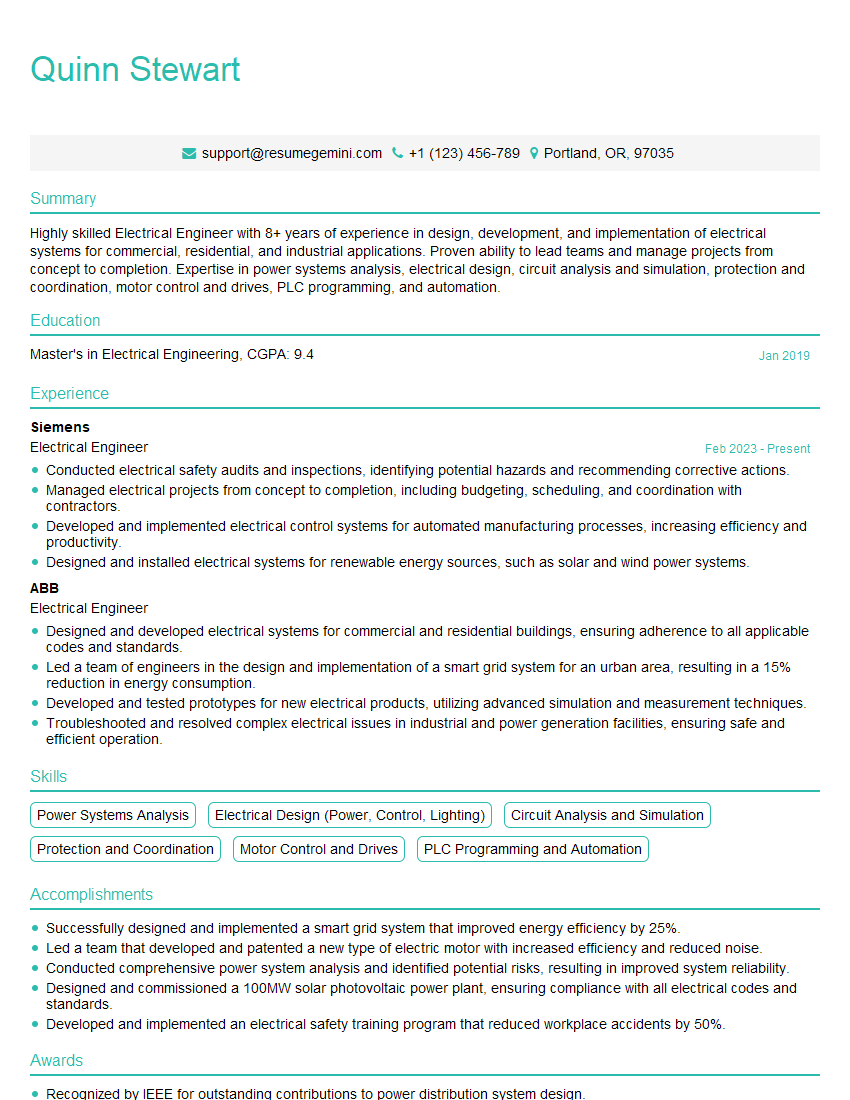
Electrical Engineer Resume Sample

Power Systems Engineer Resume Sample

Control Systems Engineer Resume Sample

Electrical Drafter Resume Sample
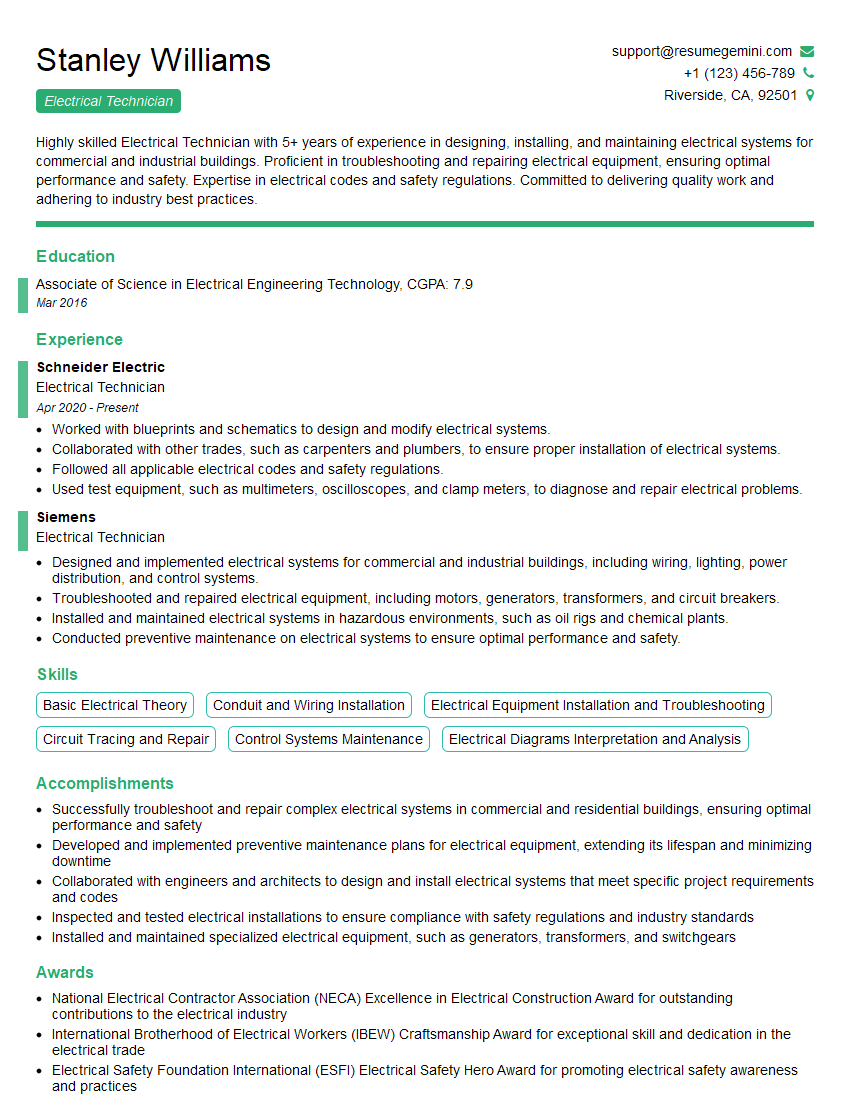
Electrical Technician Resume Sample

Construction Electrician Resume Sample
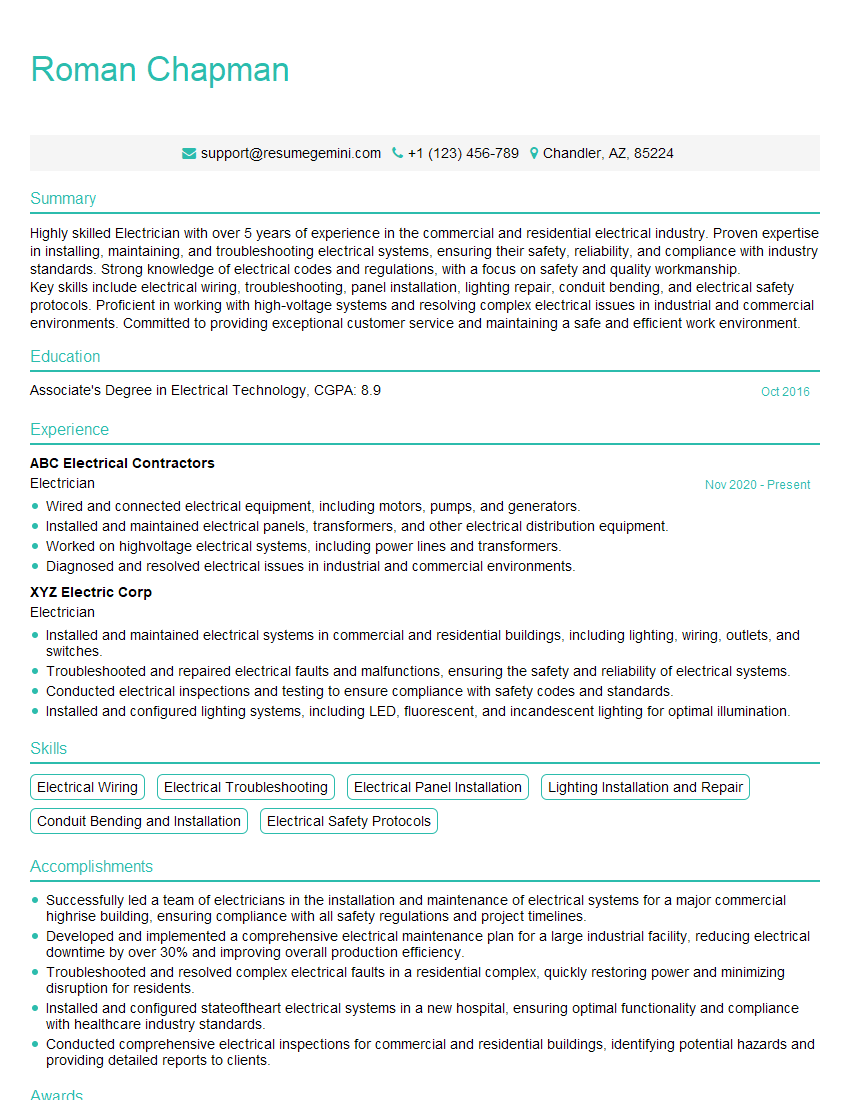
Electrician Resume Sample

Maintenance Electrician Resume Sample
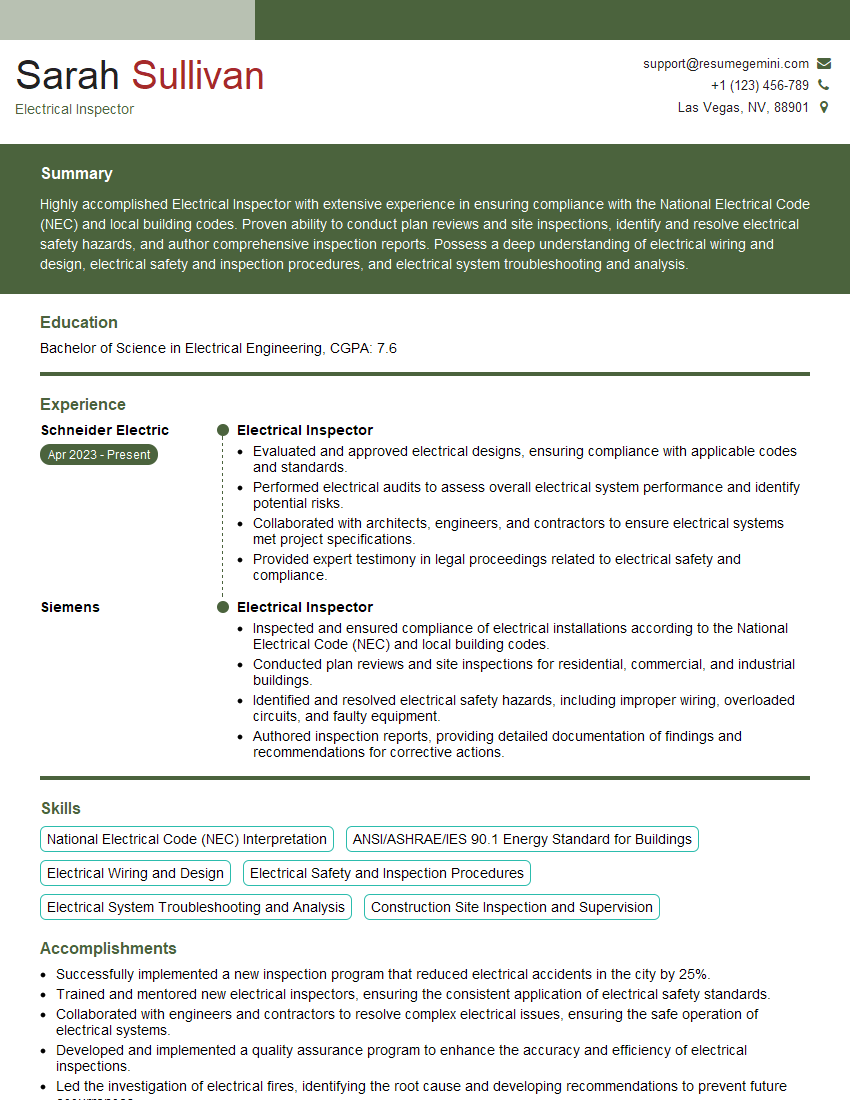
Electrical Inspector Resume Sample
Explore more articles
Users Rating of Our Blogs
Share Your Experience
We value your feedback! Please rate our content and share your thoughts (optional).
What Readers Say About Our Blog
To the interviewgemini.com Webmaster.
Very helpful and content specific questions to help prepare me for my interview!
Thank you
To the interviewgemini.com Webmaster.
This was kind of a unique content I found around the specialized skills. Very helpful questions and good detailed answers.
Very Helpful blog, thank you Interviewgemini team.