Cracking a skill-specific interview, like one for Supervised and Unsupervised Classification, requires understanding the nuances of the role. In this blog, we present the questions you’re most likely to encounter, along with insights into how to answer them effectively. Let’s ensure you’re ready to make a strong impression.
Questions Asked in Supervised and Unsupervised Classification Interview
Q 1. Explain the difference between supervised and unsupervised learning.
The core difference between supervised and unsupervised learning lies in the presence or absence of labeled data. In supervised learning, we have a dataset where each data point is labeled with its corresponding class or target variable. Think of it like a teacher supervising a student’s learning by providing correct answers. The algorithm learns to map inputs to outputs based on these labeled examples. Unsupervised learning, on the other hand, works with unlabeled data. The algorithm explores the data to find inherent structures, patterns, or relationships without any prior knowledge of the classes. It’s like a student exploring a subject independently, trying to discover the underlying principles.
Example: Imagine classifying emails as spam or not spam. Supervised learning would use a dataset of emails already labeled as spam or not spam to train a model. Unsupervised learning might try to group similar emails together based on word frequency or sender information, without knowing beforehand which are spam.
Q 2. What are some common supervised classification algorithms?
Several powerful algorithms are used for supervised classification. Some of the most common include:
- Logistic Regression: A linear model that predicts the probability of a data point belonging to a particular class. It’s simple, interpretable, and efficient, especially for binary classification problems.
- Support Vector Machines (SVMs): These algorithms find the optimal hyperplane that best separates data points into different classes. SVMs are effective in high-dimensional spaces and can handle complex datasets.
- Decision Trees: These create a tree-like model where each node represents a feature, each branch represents a decision rule, and each leaf node represents a class label. They are easy to visualize and understand.
- Random Forest: An ensemble method that combines multiple decision trees to improve accuracy and robustness. It reduces overfitting and handles high dimensionality well.
- Naive Bayes: Based on Bayes’ theorem, it assumes feature independence, simplifying calculations. It’s efficient and works well with high-dimensional data, particularly text classification.
- K-Nearest Neighbors (KNN): This algorithm classifies a data point based on the majority class among its ‘k’ nearest neighbors in the feature space. It’s simple to implement but can be computationally expensive for large datasets.
Q 3. What are some common unsupervised classification algorithms?
Unsupervised classification, also known as clustering, aims to group similar data points together without predefined labels. Popular algorithms include:
- K-Means Clustering: Partitions data into ‘k’ clusters by iteratively assigning data points to the nearest cluster centroid. It’s relatively simple and efficient but requires specifying ‘k’ beforehand.
- Hierarchical Clustering: Builds a hierarchy of clusters, either agglomerative (bottom-up) or divisive (top-down). It provides a visual representation of the cluster relationships but can be computationally expensive for large datasets.
- DBSCAN (Density-Based Spatial Clustering of Applications with Noise): Groups data points based on density. It identifies clusters of arbitrary shapes and handles noise effectively. However, it can be sensitive to parameter choices.
- Gaussian Mixture Models (GMMs): Assumes that data points are generated from a mixture of Gaussian distributions. It’s flexible and can model complex cluster shapes but can be computationally intensive.
Q 4. Describe the bias-variance tradeoff in classification.
The bias-variance tradeoff is a fundamental concept in machine learning. Bias refers to the error introduced by simplifying assumptions made by the model. A high-bias model makes strong assumptions and might miss important relationships in the data (underfitting). Variance refers to the model’s sensitivity to fluctuations in the training data. A high-variance model is very complex, fits the training data too closely, and performs poorly on unseen data (overfitting).
The goal is to find a balance. A model with low bias and low variance is ideal, but often, reducing bias increases variance, and vice versa. This is why model selection involves finding the right complexity to achieve good generalization performance.
Q 5. Explain overfitting and underfitting in the context of classification.
Overfitting occurs when a model learns the training data too well, including its noise and outliers. It performs exceptionally well on the training set but poorly on unseen data because it hasn’t learned the underlying patterns. Imagine memorizing the answers to a test instead of understanding the concepts. You’ll ace the specific test but fail any similar one.
Underfitting happens when a model is too simple to capture the underlying patterns in the data. It performs poorly on both the training and test sets. It’s like trying to fit a straight line to a curvy dataset – it won’t capture the nuances.
Q 6. How do you handle imbalanced datasets in classification?
Imbalanced datasets, where one class significantly outnumbers others, pose a challenge to classification algorithms. They tend to bias towards the majority class. Several techniques address this:
- Resampling: This involves modifying the dataset to balance class proportions. Oversampling increases the representation of minority classes, while undersampling reduces the majority class. Careful consideration of the methods used is crucial to prevent overfitting.
- Cost-sensitive learning: Assigns different misclassification costs to different classes, penalizing errors on the minority class more heavily. This adjusts the algorithm’s decision boundary to prioritize the minority class.
- Ensemble methods: Techniques like bagging and boosting can help improve performance on imbalanced datasets. For instance, a boosted decision tree would focus more on the misclassified samples from the minority class.
- Anomaly detection techniques: If the minority class represents anomalies, algorithms designed for anomaly detection might be more suitable than standard classification methods.
The choice of technique depends on the specific dataset and the application’s requirements.
Q 7. What are the advantages and disadvantages of decision trees?
Decision trees offer several advantages:
- Easy to understand and interpret: The tree structure provides a clear visualization of the decision-making process.
- Can handle both categorical and numerical data: They are versatile and adaptable to various datasets.
- Require little data preprocessing: They are relatively insensitive to outliers and missing data.
However, they also have disadvantages:
- Prone to overfitting: Complex trees can memorize the training data, leading to poor generalization.
- Can be unstable: Small changes in the data can lead to significant changes in the tree structure.
- Bias towards features with many levels: They tend to favor features with many distinct values.
Techniques like pruning and ensemble methods (e.g., Random Forest) are commonly used to mitigate these drawbacks.
Q 8. What are the advantages and disadvantages of support vector machines (SVMs)?
Support Vector Machines (SVMs) are powerful supervised learning models used for classification and regression. They work by finding the optimal hyperplane that maximally separates data points of different classes.
- Advantages:
- Effective in high dimensional spaces.
- Memory efficient because only a subset of support vectors is used in the decision function.
- Versatile: Different kernel functions can be used to handle non-linearly separable data.
- Relatively robust to outliers.
- Disadvantages:
- Can be computationally expensive for large datasets.
- The choice of kernel function and its parameters can significantly impact performance and requires careful tuning (often through cross-validation).
- Difficult to interpret the learned model compared to simpler models like linear regression.
- Not ideal for extremely noisy datasets or datasets with overlapping classes.
Example: Imagine classifying emails as spam or not spam. An SVM could learn a hyperplane in a high-dimensional space representing email features (word frequency, sender, links etc.) to effectively separate spam from non-spam emails.
Q 9. Explain the concept of regularization in classification.
Regularization is a technique used to prevent overfitting in machine learning models. Overfitting occurs when a model learns the training data too well, including its noise, and performs poorly on unseen data. Regularization adds a penalty term to the model’s objective function, discouraging overly complex models.
Common regularization methods include L1 (LASSO) and L2 (Ridge) regularization. L1 adds a penalty proportional to the absolute value of the model’s weights, while L2 adds a penalty proportional to the square of the weights. This penalty term forces the model to keep its weights smaller, reducing the influence of individual features and preventing overfitting.
Example: Imagine fitting a high-degree polynomial to a dataset with some noise. Without regularization, the polynomial might oscillate wildly to fit every data point, including the noise. Regularization would constrain the polynomial’s complexity, resulting in a smoother curve that generalizes better to new data.
# Example of L2 regularization in a linear model (using scikit-learn)from sklearn.linear_model import Ridgemodel = Ridge(alpha=1.0) # alpha controls the strength of regularizationQ 10. How do you evaluate the performance of a classification model?
Evaluating a classification model’s performance involves assessing its ability to correctly classify new, unseen data. This typically involves using a held-out test set that wasn’t used during training. Key metrics include:
- Accuracy: The percentage of correctly classified instances.
- Precision: Out of all instances predicted as positive, what proportion was actually positive?
- Recall (Sensitivity): Out of all actual positive instances, what proportion was correctly predicted?
- F1-score: The harmonic mean of precision and recall, providing a balanced measure.
- ROC curve and AUC: Visualizes the trade-off between true positive rate and false positive rate at various classification thresholds.
Example: In a medical diagnosis setting, high recall is crucial (we want to identify all sick patients, even if it means some false positives), while in a spam filter, high precision might be preferred (avoiding false positives is paramount).
Q 11. What are precision, recall, and F1-score, and how are they used?
Precision, recall, and F1-score are crucial metrics for evaluating the performance of classification models, especially when dealing with imbalanced datasets (where one class has significantly more instances than others).
- Precision: Measures the accuracy of positive predictions. It’s the ratio of true positives (TP) to the sum of true positives and false positives (FP):
Precision = TP / (TP + FP) - Recall (Sensitivity): Measures the ability of the model to find all positive instances. It’s the ratio of true positives to the sum of true positives and false negatives (FN):
Recall = TP / (TP + FN) - F1-score: The harmonic mean of precision and recall, providing a balanced measure considering both false positives and false negatives:
F1-score = 2 * (Precision * Recall) / (Precision + Recall)
Example: In a fraud detection system, high precision is critical to avoid falsely accusing legitimate customers (low FP). In a disease screening, high recall is crucial to ensure that all affected individuals are identified (low FN). The F1-score balances these considerations.
Q 12. Explain the ROC curve and AUC.
The Receiver Operating Characteristic (ROC) curve is a graphical representation of the performance of a binary classification model at various classification thresholds. It plots the true positive rate (TPR) against the false positive rate (FPR).
- True Positive Rate (TPR): The proportion of actual positives correctly identified.
- False Positive Rate (FPR): The proportion of actual negatives incorrectly identified as positives.
The Area Under the Curve (AUC) quantifies the overall performance of the classifier. An AUC of 1 indicates perfect classification, while an AUC of 0.5 indicates random classification.
Example: A higher AUC indicates better discriminatory power. In medical diagnosis, a higher AUC for a disease screening test means it can more effectively distinguish between healthy and diseased individuals.
Q 13. What is K-means clustering and how does it work?
K-means clustering is an unsupervised learning algorithm used to partition data points into k clusters, where k is a predefined number. The algorithm aims to minimize the within-cluster variance (sum of squared distances between data points and their cluster centroids).
How it works:
- Initialization: Randomly select k initial centroids (cluster centers).
- Assignment: Assign each data point to the nearest centroid based on Euclidean distance.
- Update: Recalculate the centroids as the mean of all data points assigned to each cluster.
- Iteration: Repeat steps 2 and 3 until the centroids no longer change significantly or a maximum number of iterations is reached.
Example: Imagine grouping customers based on their purchasing behavior. K-means could cluster customers into different segments (e.g., high-value, mid-value, low-value) based on features like spending amount and purchase frequency.
Q 14. What is hierarchical clustering and how does it differ from K-means?
Hierarchical clustering is another unsupervised learning algorithm that builds a hierarchy of clusters. Unlike K-means, which requires specifying the number of clusters beforehand, hierarchical clustering doesn’t need this parameter. It produces a dendrogram (tree-like diagram) showing the relationships between clusters at different levels.
Types: There are two main types:
- Agglomerative (bottom-up): Starts with each data point as a separate cluster and iteratively merges the closest clusters until a single cluster remains.
- Divisive (top-down): Starts with all data points in a single cluster and recursively splits the clusters until each data point is in its own cluster.
Difference from K-means:
- Number of clusters: K-means requires specifying k, while hierarchical clustering doesn’t.
- Cluster shape: K-means assumes spherical clusters, while hierarchical clustering can handle more complex shapes.
- Computational cost: Hierarchical clustering can be more computationally expensive for large datasets than K-means.
- Output: K-means produces a set of k clusters, while hierarchical clustering produces a dendrogram showing the hierarchical relationships.
Example: Imagine creating a taxonomy of different species of plants based on their characteristics. Hierarchical clustering could be used to create a tree-like structure showing the evolutionary relationships between these species.
Q 15. Explain the concept of dimensionality reduction in unsupervised learning.
Dimensionality reduction in unsupervised learning is the process of reducing the number of random variables under consideration by obtaining a set of principal variables. It’s like simplifying a complex scene by focusing only on its most important features. Instead of dealing with numerous, possibly correlated variables, we aim to capture the essential information in fewer dimensions while minimizing information loss. This is crucial because high-dimensional data can be computationally expensive to process, lead to the curse of dimensionality (where distance metrics become less meaningful), and obscure underlying patterns. Techniques like PCA and t-SNE achieve this by transforming the data into a lower-dimensional space, making it easier to visualize, analyze, and model.
For instance, imagine trying to analyze customer purchase data with hundreds of product categories. Dimensionality reduction could help identify a smaller set of underlying preferences (e.g., preference for electronics, clothing, or groceries), simplifying the analysis without significantly losing information about customer behavior.
Career Expert Tips:
- Ace those interviews! Prepare effectively by reviewing the Top 50 Most Common Interview Questions on ResumeGemini.
- Navigate your job search with confidence! Explore a wide range of Career Tips on ResumeGemini. Learn about common challenges and recommendations to overcome them.
- Craft the perfect resume! Master the Art of Resume Writing with ResumeGemini’s guide. Showcase your unique qualifications and achievements effectively.
- Don’t miss out on holiday savings! Build your dream resume with ResumeGemini’s ATS optimized templates.
Q 16. What are Principal Component Analysis (PCA) and t-SNE, and when would you use them?
Principal Component Analysis (PCA) is a linear dimensionality reduction technique. It finds the principal components, which are new uncorrelated variables that capture the maximum variance in the data. Think of it as rotating the data to align with the directions of greatest spread. PCA is excellent for noise reduction and feature extraction.
t-distributed Stochastic Neighbor Embedding (t-SNE) is a non-linear technique that focuses on preserving local neighborhood structures in the data. It’s particularly good at visualizing high-dimensional data in two or three dimensions, allowing us to see clusters and patterns that might be hidden in the original data. Unlike PCA, t-SNE doesn’t aim to capture global structure as well.
When to use them:
- Use PCA when you need to reduce dimensionality for computational efficiency, noise reduction, or feature extraction before feeding data into other algorithms (like supervised classification). It’s best for linearly separable data.
- Use t-SNE when you need to visualize high-dimensional data to understand its structure and identify clusters. It excels at revealing non-linear relationships but might not be suitable for very large datasets due to its computational cost.
For example, PCA can preprocess image data before training a classification model, while t-SNE can help visualize gene expression data to identify different cell types.
Q 17. How do you choose the optimal number of clusters in K-means?
Choosing the optimal number of clusters (K) in K-means is a crucial step. There’s no single perfect answer, but several methods can help:
- Elbow Method: Plot the within-cluster sum of squares (WCSS) against the number of clusters. The WCSS decreases as K increases. The ‘elbow point’ – the point where the rate of decrease slows down significantly – often indicates a good K. It’s a heuristic approach and may not always be clear-cut.
- Silhouette Analysis: Calculate the silhouette score for each data point, which measures how similar a data point is to its own cluster compared to other clusters. A higher average silhouette score indicates better clustering. The optimal K is the one that maximizes the average silhouette score.
- Gap Statistic: This method compares the WCSS of the clustered data to the expected WCSS of data generated from a uniform distribution. The optimal K is the one that maximizes the gap statistic.
Often, a combination of these methods provides the best result. It’s also important to consider the context and interpret the results visually by examining the clustered data to make sure that the clusters make intuitive sense.
Q 18. What are some techniques for evaluating the performance of clustering algorithms?
Evaluating clustering performance requires considering both internal and external metrics.
- Internal metrics assess the quality of the clustering without reference to external information. Examples include:
- Silhouette coefficient: Measures how similar a data point is to its own cluster compared to other clusters.
- Davies-Bouldin index: Measures the average similarity between each cluster and its most similar cluster.
- Calinski-Harabasz index: Measures the ratio of between-cluster dispersion to within-cluster dispersion.
- External metrics compare the clustering results to known class labels (if available). Examples include:
- Adjusted Rand Index (ARI): Measures the similarity between the clustering result and the true labels, correcting for chance.
- Homogeneity, completeness, and V-measure: These metrics assess different aspects of the relationship between the clustering and the true labels.
The choice of metrics depends on the specific application and the availability of ground truth labels. For example, if you are performing customer segmentation and don’t have predefined customer groups, internal metrics are more appropriate. If you’re evaluating a clustering algorithm on a dataset with known labels, external metrics are necessary.
Q 19. Describe the difference between K-means and DBSCAN clustering.
K-means and DBSCAN are both popular clustering algorithms, but they differ significantly in their approach:
- K-means is a partitioning method that aims to partition n observations into k clusters in which each observation belongs to the cluster with the nearest mean (cluster center). It requires specifying the number of clusters (k) beforehand. K-means assumes that clusters are spherical and of similar size.
- DBSCAN (Density-Based Spatial Clustering of Applications with Noise) is a density-based method that groups together points that are closely packed together (points with many nearby neighbors), forming clusters. It doesn’t require specifying the number of clusters and can discover clusters of arbitrary shapes. DBSCAN also identifies outliers (noise points) that don’t belong to any cluster.
Imagine grouping fruits: K-means might struggle to separate a cluster of similarly sized apples from a cluster of similarly sized oranges, but it might have problems distinguishing apples from pears, assuming a similar size. DBSCAN, however, could handle the different shapes of apples and pears based on density.
Q 20. Explain the concept of anomaly detection.
Anomaly detection, also known as outlier detection, is the process of identifying data points that deviate significantly from the norm. These anomalies can represent errors, fraud, system failures, or interesting events depending on the context. Think of it as finding the unusual suspects in a crowd. For example, a credit card transaction of an unusually large amount may indicate fraudulent activity, while a sudden spike in server errors might signal a system malfunction.
Anomaly detection is crucial in various fields such as fraud detection, network security, healthcare, and manufacturing. It helps us to identify unusual patterns that might be indicative of problems or opportunities.
Q 21. What are some common anomaly detection algorithms?
Several algorithms are used for anomaly detection, each with its strengths and weaknesses:
- Statistical methods: These methods assume a statistical distribution for the data and identify points that fall outside a certain threshold. Examples include using Z-scores or the IQR (interquartile range) to identify outliers.
- Clustering-based methods: These methods cluster the data and identify points that don’t belong to any cluster or are far from the nearest cluster center. DBSCAN is a good example.
- Machine learning methods: These methods use machine learning models to learn the normal patterns in the data and identify deviations from these patterns. Examples include One-Class SVM, Isolation Forest, and Autoencoders.
The choice of algorithm depends on the characteristics of the data and the specific application. For example, if the data is normally distributed, a statistical method might be appropriate. If the data has complex, non-linear patterns, a machine learning method might be more effective.
Q 22. How do you handle missing data in classification?
Missing data is a common hurdle in classification. Ignoring it isn’t an option as it can significantly bias your model. The best approach depends on the nature and extent of the missingness. Here’s a breakdown:
- Deletion: Simple, but can lead to information loss. We might use listwise deletion (removing entire rows with missing values) if the missing data is minimal and randomly distributed. Pairwise deletion removes only the specific missing value when calculating correlations or other statistics. However, this is best used carefully and if there is a significant reason to believe deletion won’t skew results significantly.
- Imputation: This involves filling in the missing values. Common methods include:
- Mean/Median/Mode Imputation: Replacing missing values with the mean (for continuous data), median (for skewed continuous data), or mode (for categorical data). Simple, but can reduce variance and distort relationships.
- K-Nearest Neighbors (KNN) Imputation: Fills missing values based on the values of its closest neighbors in the feature space. More sophisticated, but computationally expensive.
- Multiple Imputation: Creates multiple plausible imputed datasets, analyzes each, and then combines the results. Addresses uncertainty associated with single imputation and is generally considered a more robust approach.
- Model-Based Imputation: Uses a predictive model (e.g., regression or classification) to predict the missing values. This is powerful but requires careful model selection to avoid bias.
Choosing the right method depends on the amount of missing data, its pattern (e.g., MCAR, MAR, MNAR), and the characteristics of the dataset. For example, in a medical dataset with many missing values, multiple imputation might be preferred over simple mean imputation to avoid introducing bias and provide a more accurate representation of the underlying data distribution.
Q 23. How do you select relevant features for a classification model?
Feature selection is crucial for building effective classification models. Too many irrelevant features can lead to overfitting, while too few can result in underfitting. Here’s how we typically approach it:
- Filter Methods: These methods rank features based on statistical measures without considering the classifier. Examples include:
- Chi-squared test: Measures the dependence between categorical features and the class label.
- Correlation coefficient: Measures the linear relationship between continuous features and the class label.
- Information gain: Measures the reduction in entropy achieved by knowing the value of a feature.
- Wrapper Methods: These methods evaluate feature subsets based on their performance with a specific classifier. Examples include:
- Recursive Feature Elimination (RFE): Iteratively removes the least important features.
- Forward/Backward Selection: Starts with an empty/full set of features and iteratively adds/removes features based on performance.
- Embedded Methods: These methods integrate feature selection into the model training process. Examples include:
- L1 regularization (LASSO): Adds a penalty term to the objective function, shrinking the coefficients of less important features to zero.
- Tree-based models: Feature importance scores are naturally produced.
The choice of method depends on factors like the size of the dataset, computational resources, and the desired level of accuracy. A common strategy is to combine multiple methods. For example, I might start with a filter method to reduce the initial feature set significantly and then apply a wrapper method to fine-tune the feature selection for a given classifier.
Q 24. Explain the concept of feature scaling and its importance in classification.
Feature scaling transforms the features to a similar scale. This is vital because many classification algorithms are sensitive to feature ranges. For instance, if one feature ranges from 0 to 1, and another from 1000 to 10000, the algorithm might unfairly weigh the latter feature more heavily due to its larger magnitude, even if the former feature is more informative.
- Min-Max scaling (Normalization): Scales features to a range between 0 and 1.
x_scaled = (x - x_min) / (x_max - x_min) - Z-score standardization: Centers the data around zero with a standard deviation of 1.
x_scaled = (x - x_mean) / x_std
Choosing between these depends on the algorithm and data. Min-Max scaling is good for algorithms sensitive to magnitude (like k-NN), while Z-score standardization is often preferred for algorithms that assume normally distributed data (like SVM or linear models). Failing to scale features could lead to poor model performance, especially with distance-based algorithms.
Q 25. How do you deal with categorical features in classification?
Categorical features, unlike numerical ones, represent categories or groups. Directly using them in many algorithms isn’t feasible. Here are common approaches:
- One-Hot Encoding: Creates new binary features for each category. For example, if a feature ‘color’ has values ‘red’, ‘green’, ‘blue’, it’s transformed into three binary features: ‘color_red’, ‘color_green’, ‘color_blue’. This is suitable for nominal categorical features (no inherent order).
- Label Encoding: Assigns a unique integer to each category. For example, ‘red’ becomes 0, ‘green’ becomes 1, ‘blue’ becomes 2. This works well if there’s an ordinal relationship (order matters), but can introduce unwanted order assumptions if applied to nominal data.
- Target Encoding (Mean Encoding): Replaces each category with the average target variable value for that category. For example, the average salary of people in each profession. This is effective but can be prone to overfitting on smaller datasets, requiring regularization techniques such as smoothing.
The best technique depends on the nature of the categorical feature and the classification algorithm. One-hot encoding is generally safe and widely used, but can increase the dimensionality of your data. Label encoding can be simpler but makes assumptions about the order of categories. Target encoding is powerful but needs careful handling to avoid overfitting.
Q 26. Describe a situation where you used supervised classification and explain your approach.
I used supervised classification to predict customer churn for a telecommunications company. The goal was to identify customers at high risk of canceling their service so the company could proactively intervene.
Approach:
- Data Collection: We gathered data on customer demographics, service usage, billing history, and customer support interactions.
- Data Preprocessing: This included handling missing values (using KNN imputation), feature scaling (Z-score standardization), and one-hot encoding of categorical features.
- Feature Engineering: We created new features like average monthly bill and frequency of customer support calls to better capture customer behavior.
- Model Selection: We experimented with various algorithms like Logistic Regression, Support Vector Machines (SVM), and Random Forest. We evaluated performance using metrics like accuracy, precision, recall, and F1-score.
- Model Training and Evaluation: We used cross-validation techniques to ensure the model generalized well to unseen data. The Random Forest classifier achieved the highest F1 score.
- Deployment: The final model was deployed as a real-time prediction system, enabling the company to identify at-risk customers and tailor retention strategies accordingly.
Q 27. Describe a situation where you used unsupervised classification and explain your approach.
I used unsupervised classification to segment customers based on their purchasing behavior in an e-commerce setting. The aim was to tailor marketing campaigns to different customer groups.
Approach:
- Data Collection: We collected data on customer purchase history, including items purchased, frequency of purchases, and total spending.
- Data Preprocessing: We standardized the numerical features.
- Clustering Algorithm Selection: We chose K-Means clustering because of its simplicity and scalability. We determined the optimal number of clusters using the elbow method and silhouette analysis.
- Cluster Analysis: After running K-Means, we analyzed the characteristics of each cluster to understand the typical behavior of customers within each segment.
- Profiling Customer Segments: We identified key characteristics of each cluster, allowing us to label the segments (e.g., ‘High-value customers,’ ‘Budget-conscious shoppers,’ ‘Impulse buyers’).
- Application: These insights were used to develop targeted marketing strategies, such as personalized recommendations and promotions for each customer segment, leading to increased customer engagement and sales.
Q 28. What are some current trends and challenges in supervised and unsupervised classification?
The fields of supervised and unsupervised classification are rapidly evolving. Some key trends and challenges include:
- Increased Data Volume and Dimensionality: Handling massive datasets and high-dimensional features requires sophisticated algorithms and efficient computational methods. Dimensionality reduction techniques are increasingly important.
- Deep Learning Advancements: Deep learning models, particularly convolutional neural networks (CNNs) and recurrent neural networks (RNNs), are showing promising results in various classification tasks, especially image and text classification. However, training these models often requires significant computational resources and expertise.
- Interpretability and Explainability: Understanding why a model makes a particular prediction is crucial, especially in sensitive applications like medical diagnosis or loan approval. Developing more interpretable models is an active area of research. Techniques like SHAP values are gaining popularity.
- Handling Imbalanced Datasets: In many real-world scenarios, the classes are not evenly represented. This can lead to biased models. Techniques such as oversampling, undersampling, and cost-sensitive learning are used to address this.
- Generalization and Robustness: Ensuring that models generalize well to unseen data and are robust to noise and adversarial attacks is vital. Techniques like adversarial training and ensemble methods help in enhancing model robustness.
- Unsupervised Learning for Feature Engineering: Using unsupervised techniques like autoencoders for dimensionality reduction or feature extraction to improve the performance of supervised models is gaining traction.
Addressing these challenges requires ongoing research and development of new algorithms, techniques, and tools. It also demands a deeper understanding of the data and the specific classification problem at hand.
Key Topics to Learn for Supervised and Unsupervised Classification Interview
- Supervised Classification:
- Understanding different algorithms (e.g., Logistic Regression, Support Vector Machines, Decision Trees, Random Forests, Naive Bayes).
- Model evaluation metrics (e.g., accuracy, precision, recall, F1-score, ROC curve, AUC).
- Bias-variance tradeoff and techniques for regularization.
- Cross-validation techniques for robust model evaluation.
- Practical application: Image recognition, spam detection, customer churn prediction.
- Unsupervised Classification:
- Clustering algorithms (e.g., K-means, hierarchical clustering, DBSCAN).
- Dimensionality reduction techniques (e.g., Principal Component Analysis (PCA), t-SNE).
- Evaluating clustering performance (e.g., silhouette score, Davies-Bouldin index).
- Understanding the difference between various clustering methods and their applicability.
- Practical application: Customer segmentation, anomaly detection, document clustering.
- General Concepts:
- Feature engineering and selection.
- Handling imbalanced datasets.
- Understanding and addressing overfitting and underfitting.
- Model selection and hyperparameter tuning.
- Explainability and interpretability of models.
Next Steps
Mastering supervised and unsupervised classification is crucial for a successful career in data science and machine learning. These techniques are highly sought after by employers across various industries. To maximize your job prospects, invest time in creating a strong, ATS-friendly resume that highlights your skills and experience. ResumeGemini is a trusted resource to help you build a professional and impactful resume that showcases your expertise effectively. We provide examples of resumes tailored to roles focusing on supervised and unsupervised classification to help you get started.
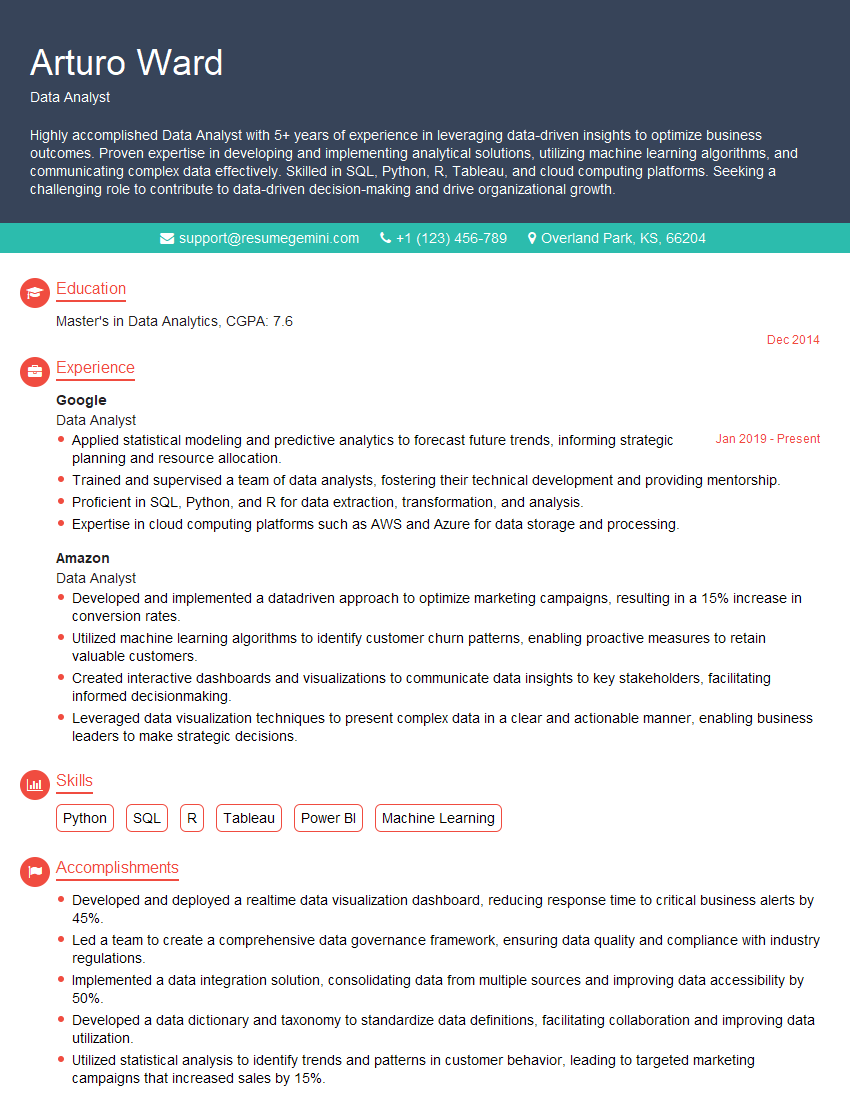
Data Analyst Resume Sample

Quantitative Analyst Resume Sample
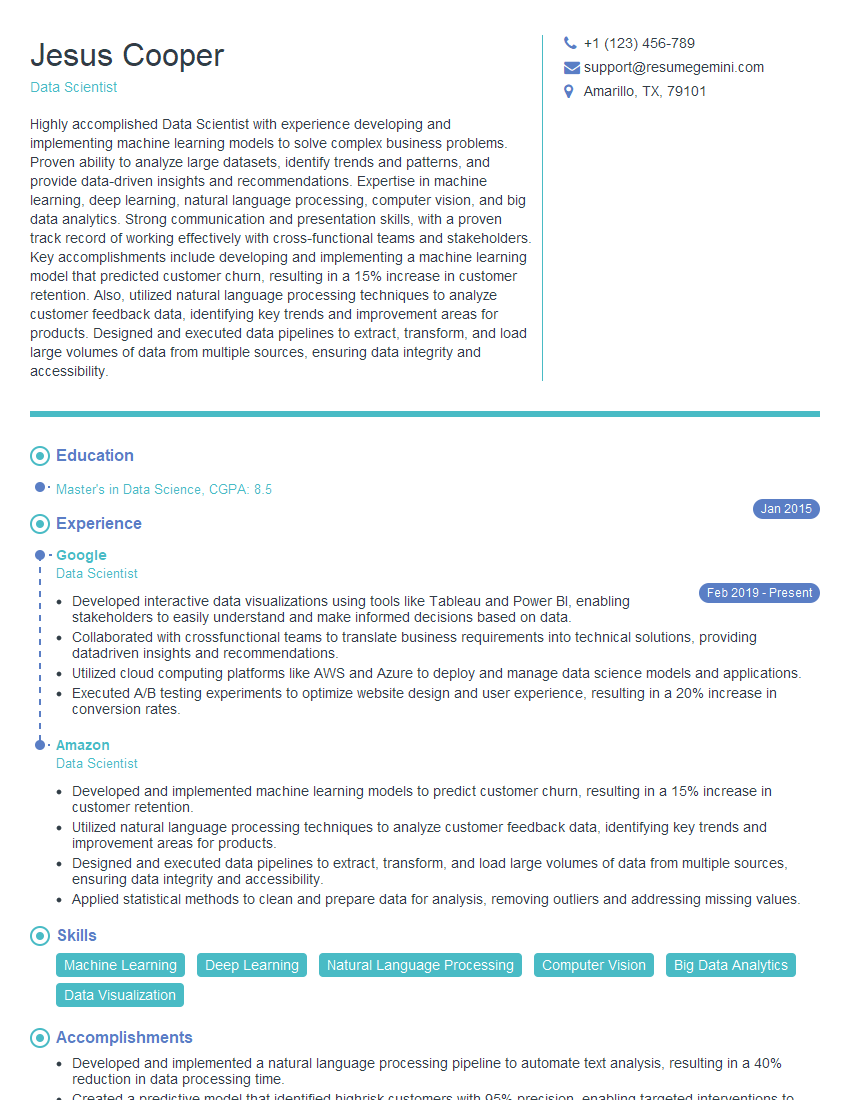
Data Scientist Resume Sample

Research Scientist Resume Sample
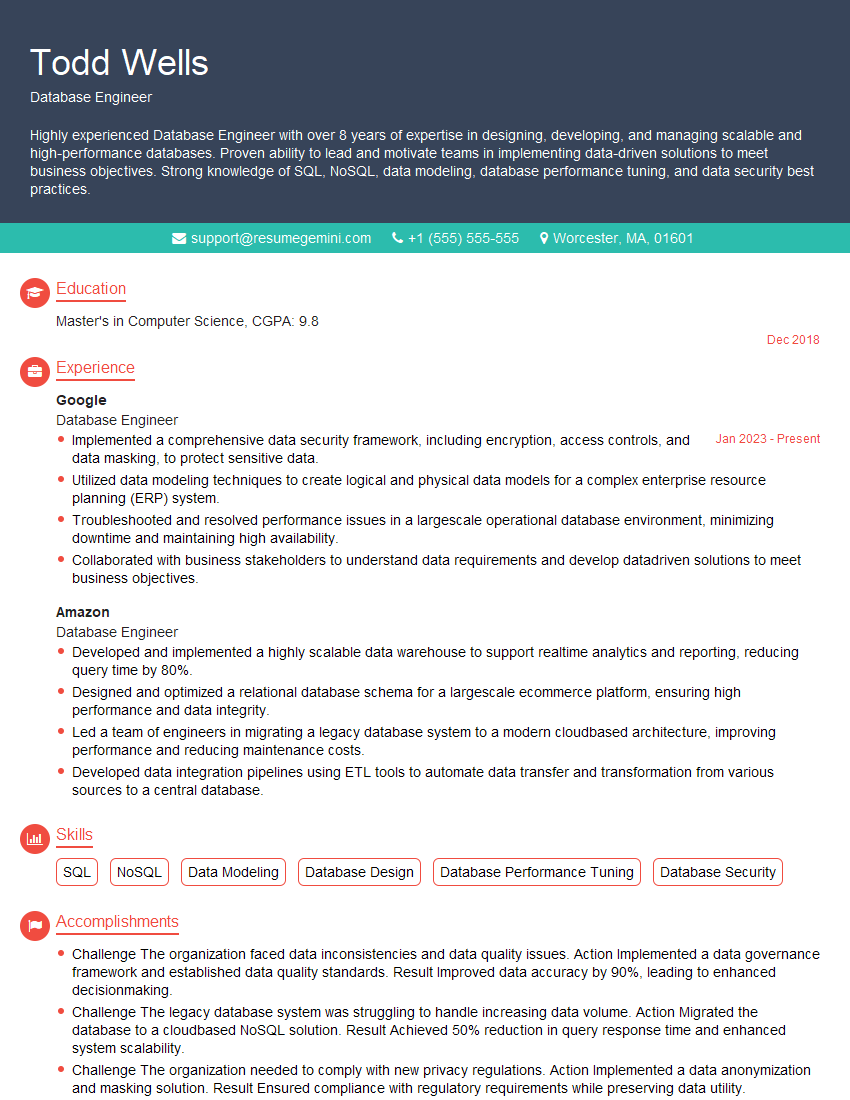
Database Engineer Resume Sample
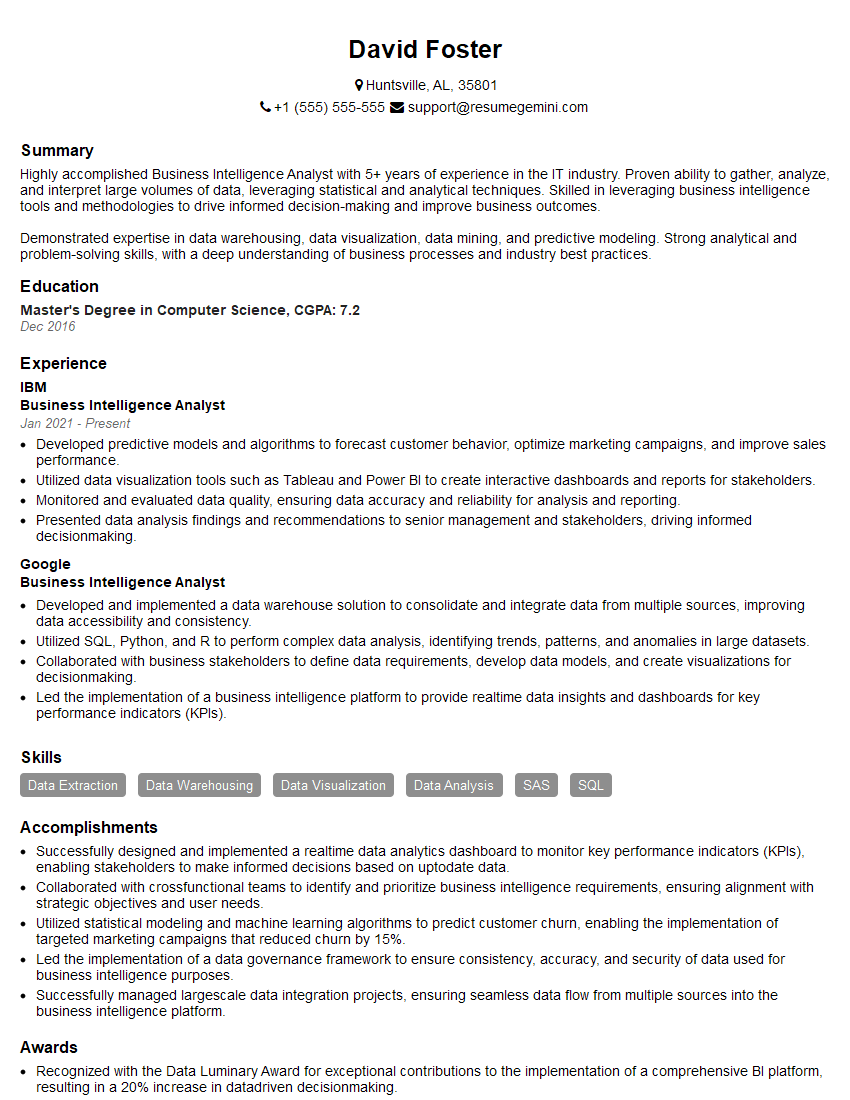
Business Intelligence Analyst Resume Sample

Machine Learning Engineer Resume Sample
Chief Data Scientist Resume Sample

Lead Data Scientist Resume Sample
Big Data Engineer Resume Sample

Computer Vision Engineer Resume Sample
Explore more articles
Users Rating of Our Blogs
Share Your Experience
We value your feedback! Please rate our content and share your thoughts (optional).
What Readers Say About Our Blog
To the interviewgemini.com Webmaster.
Very helpful and content specific questions to help prepare me for my interview!
Thank you
To the interviewgemini.com Webmaster.
This was kind of a unique content I found around the specialized skills. Very helpful questions and good detailed answers.
Very Helpful blog, thank you Interviewgemini team.