Are you ready to stand out in your next interview? Understanding and preparing for Pipeline Schedule Management interview questions is a game-changer. In this blog, we’ve compiled key questions and expert advice to help you showcase your skills with confidence and precision. Let’s get started on your journey to acing the interview.
Questions Asked in Pipeline Schedule Management Interview
Q 1. Explain the critical path method (CPM) and its application in pipeline scheduling.
The Critical Path Method (CPM) is a project management technique used to identify the longest sequence of tasks in a project, determining the shortest possible duration. This longest sequence is called the critical path. Any delay on tasks within the critical path directly impacts the overall project completion time. In pipeline scheduling, CPM helps determine the most crucial stages of pipeline construction, installation, or maintenance. For example, welding a critical section of the pipeline might be on the critical path, and any delays there would directly impact the overall project’s completion date.
In a pipeline project, we break down the entire process into individual tasks, each with an estimated duration. Then, we establish the dependencies between these tasks, identifying which tasks must be completed before others can start. We use network diagrams to visualize these dependencies. The longest path through this network represents the critical path. Software like Primavera P6 readily facilitates this process. By focusing on the critical path, resources are optimized and potential delays are proactively addressed.
Q 2. Describe different scheduling techniques used in pipeline projects (e.g., Gantt charts, PERT charts).
Several scheduling techniques are utilized in pipeline projects, each offering unique advantages:
- Gantt Charts: These are bar charts visually representing the schedule, showing tasks on a timeline. They’re excellent for visualizing task durations, dependencies, and progress. They clearly illustrate overlaps and potential resource conflicts. Think of it as a high-level overview of the project schedule.
- PERT (Program Evaluation and Review Technique) Charts: These are network diagrams that show task dependencies and durations, along with potential uncertainties using three time estimates (optimistic, most likely, and pessimistic). PERT is especially useful when dealing with tasks that have unpredictable durations, providing a probabilistic view of project completion.
- Precedence Diagramming Method (PDM): This method uses a network diagram to represent the logical relationships between activities. It’s more detailed than Gantt charts, clearly showing dependencies like finish-to-start, start-to-start, etc. It’s highly efficient in complex projects requiring detailed task sequencing.
The choice of technique often depends on the project’s complexity and the need for detailed planning versus a high-level overview. Often, a combination of these techniques is employed for comprehensive scheduling.
Q 3. How do you handle schedule delays and resource conflicts in a pipeline project?
Handling schedule delays and resource conflicts requires a proactive and systematic approach. When delays occur, I first identify the root cause. Is it due to unforeseen weather conditions, equipment malfunction, or perhaps a miscalculation in the initial schedule? Resource conflicts often arise from competing demands for the same equipment or personnel. For example, two welding teams might require the same welding machine simultaneously.
Strategies for Mitigation:
- Crashing the Schedule: Adding resources to critical path tasks to shorten their duration (but it may increase costs).
- Fast Tracking: Overlapping tasks that were originally scheduled sequentially (risks increase).
- Resource Leveling: Reschedule tasks to smooth out resource utilization over time, minimizing peaks and troughs in resource demand.
- Communication: Frequent communication with stakeholders and the project team is paramount to address problems promptly. Transparent communication is key to maintaining project morale and securing buy-in for potential adjustments.
- Change Management: Formally documenting and tracking all changes to the schedule and resource allocation through a change management process.
Regular monitoring of the schedule and proactive problem-solving are key to successfully navigating these challenges.
Q 4. What software are you proficient in for pipeline schedule management (e.g., Primavera P6, MS Project)?
I am proficient in several software packages for pipeline schedule management, including Primavera P6 and Microsoft Project. Primavera P6 is particularly powerful for large, complex projects, offering advanced features like resource leveling, critical path analysis, and risk management tools. I’ve extensively used it for planning and tracking pipeline projects, including managing multiple work packages, resource allocation, and cost control.
Microsoft Project, while less sophisticated than P6, is still a valuable tool, especially for smaller projects. Its user-friendly interface makes it accessible to a wider range of users. I’ve utilized it for tasks like developing detailed schedules, tracking progress, and preparing reports.
Q 5. Explain the concept of float/slack in a project schedule.
Float or slack represents the amount of time a task can be delayed without delaying the project’s overall completion date. It’s the difference between the late start and early start (or late finish and early finish) of a task. A task with zero float is on the critical path, meaning any delay will directly impact the project timeline. A task with positive float offers flexibility in scheduling; it can be delayed without jeopardizing the overall project.
Example: Imagine Task A (duration 5 days) must precede Task B (duration 3 days). Task A’s early start is day 1, and its early finish is day 5. Task B’s early start is day 6. However, Task A’s late finish is day 8. The float for Task A is 3 days (8-5).
Q 6. How do you perform resource leveling in pipeline scheduling?
Resource leveling aims to smooth out resource utilization over time. It’s about distributing resource demands evenly, minimizing peaks and valleys in resource usage. This prevents situations where specific resources are overloaded during certain periods and underutilized at other times.
In pipeline scheduling, this could mean strategically adjusting the schedule to avoid having multiple welding crews needing the same specialized welding machine at the same time. We might reschedule some tasks or adjust their durations to avoid resource conflicts. Software tools like Primavera P6 offer automated resource leveling functionalities. However, manual adjustments are often necessary to address nuances that the software might overlook.
The process involves: analyzing resource requirements, identifying resource constraints, adjusting schedules, potentially adjusting task durations, and continuously monitoring and refining the schedule. It’s an iterative process, requiring close collaboration between the scheduling team and resource managers.
Q 7. What are the key performance indicators (KPIs) you monitor in pipeline schedule management?
Key Performance Indicators (KPIs) I monitor in pipeline schedule management include:
- Schedule Performance Index (SPI): Measures the efficiency of schedule execution (Earned Value/Planned Value). An SPI > 1 indicates ahead of schedule, while < 1 indicates behind schedule.
- Critical Path Progress: Tracking the progress of tasks on the critical path is essential. Any slippage here directly affects the project’s completion date.
- Resource Utilization: Monitoring the utilization of key resources (equipment, personnel) to identify potential over-allocation or under-utilization issues.
- Cost Performance Index (CPI): Measures cost efficiency (Earned Value/Actual Cost). A CPI > 1 indicates cost underrun, while < 1 indicates cost overrun.
- Schedule Variance: Measures the difference between planned and actual progress (Earned Value – Planned Value).
- Number of Schedule Changes: Frequent changes might indicate instability in planning or execution, deserving closer investigation.
Regularly monitoring these KPIs allows for proactive intervention, ensuring the project stays on track and within budget.
Q 8. Describe your experience with Earned Value Management (EVM) in pipeline projects.
Earned Value Management (EVM) is a powerful project management technique that integrates scope, schedule, and cost to provide a comprehensive assessment of project performance. In pipeline projects, where the work often involves geographically dispersed activities and complex logistics, EVM is crucial for monitoring progress and identifying potential issues early. I have extensive experience using EVM in pipeline projects, from initial planning to final closeout. This includes developing the project’s Work Breakdown Structure (WBS) to define individual work packages, assigning costs and durations to each, and then tracking the earned value (EV) against the planned value (PV) and actual cost (AC). Key metrics like Schedule Variance (SV) and Cost Variance (CV) provide early warnings of schedule slippage or cost overruns, enabling proactive intervention. For example, on a recent cross-country pipeline project, we used EVM to identify a delay in the right-of-way acquisition phase. This early warning allowed us to renegotiate timelines with landowners, mitigating the impact on the overall project schedule. We leveraged the EVM data to generate regular reports to stakeholders, highlighting both successes and potential risks, and using this information to guide decision-making.
Q 9. How do you manage risks and uncertainties in pipeline scheduling?
Managing risks and uncertainties in pipeline scheduling requires a proactive and systematic approach. I typically use a combination of techniques, starting with comprehensive risk identification during the planning phase. This involves brainstorming sessions with the project team, reviewing historical data from similar projects, and incorporating external factors like weather conditions and regulatory approvals. Once identified, risks are analyzed to determine their likelihood and potential impact on the schedule. We then develop mitigation strategies, including contingency plans and buffers built into the schedule. For example, if there’s a risk of delays due to inclement weather, we might add buffer time to the schedule for those activities most susceptible to weather delays. Regular monitoring of the schedule and these risks is critical. We use tools like Monte Carlo simulations to assess the probability of meeting deadlines considering various uncertainties. Finally, open communication channels between stakeholders ensure that any emerging risks are addressed promptly and that updated schedules are readily available to everyone.
Q 10. Explain the process of creating a baseline schedule.
Creating a baseline schedule is a fundamental step in project management. It involves defining the scope of the project, breaking it down into manageable tasks, estimating the duration of each task, identifying dependencies between tasks, and assigning resources. The process starts with a thorough understanding of the project scope. We then use a scheduling tool, like Primavera P6 or MS Project, to input this information and create a network diagram that visually represents the project’s tasks and their interdependencies. Resource allocation, considering availability and constraints, is a vital part of this process. After the initial schedule is drafted, it’s reviewed and approved by key stakeholders, becoming the baseline schedule against which future progress is measured. A well-defined baseline schedule provides a clear understanding of what needs to be done, when it should be done, and who is responsible. This is crucial for effective project monitoring and control. Think of it as a roadmap – providing clear directions to the destination.
Q 11. How do you communicate schedule updates and progress reports to stakeholders?
Effective communication is key to successful pipeline project management. I use a multi-faceted approach to keep stakeholders informed about schedule updates and progress. Regular progress meetings are crucial, typically held weekly or bi-weekly. These meetings provide a forum for discussing progress, challenges, and potential solutions. Visual aids such as Gantt charts and progress reports, clearly demonstrating the project status against the baseline schedule, greatly enhance understanding. We also use project management software to provide real-time updates and dashboards that stakeholders can access independently. These dashboards frequently include key performance indicators (KPIs) like percent complete, schedule variance, and critical path status, allowing for quick visualization of the project’s health. Furthermore, formal progress reports are prepared and distributed at regular intervals, typically monthly, providing a more detailed analysis of progress and any deviations from the plan. For critical updates or urgent issues, direct and immediate communication through email or phone calls ensures timely responses.
Q 12. What is your experience with change management in pipeline projects?
Change management is an integral part of pipeline projects, as unforeseen circumstances and evolving requirements are inevitable. My experience includes implementing a structured change management process that adheres to a formal request, review, and approval workflow. Each change request is documented, evaluated for its impact on scope, schedule, and cost, and subjected to a thorough risk assessment. We utilize a change control board to review proposed changes and determine their feasibility and acceptance. This board consists of representatives from relevant stakeholders, ensuring buy-in and collaboration. Once a change is approved, the schedule is updated, and stakeholders are notified. Any associated cost or schedule impacts are clearly communicated and incorporated into the revised project plan. We ensure that all changes are documented and tracked, maintaining a transparent and auditable record of project evolution. For example, a change in the pipeline’s diameter requires reevaluation of the entire schedule, impacting material procurement, welding, and testing activities. Our change management process ensured this ripple effect was addressed methodically.
Q 13. How do you handle scope creep and its impact on the schedule?
Scope creep, the uncontrolled expansion of project requirements, is a significant threat to pipeline project schedules. To mitigate this, we implement rigorous scope definition and control processes from the outset. This starts with detailed requirement gathering and documentation at the beginning of the project. A change control board, as described previously, ensures that any proposed changes are formally evaluated and approved before being incorporated into the project. This formal process ensures that changes are not introduced haphazardly, and their impact on the schedule can be properly assessed. We also emphasize proactive communication and stakeholder engagement to identify and address potential scope creep early. For example, if a stakeholder requests a new feature, we analyze its impact on the schedule and budget, presenting options to the stakeholders. Should scope changes be unavoidable, we use techniques like crashing the schedule (expediting critical tasks) or resource leveling (optimizing resource allocation) to minimize schedule disruptions, always keeping stakeholders informed of the associated trade-offs.
Q 14. Describe your experience with developing and maintaining a project schedule.
Developing and maintaining a project schedule is an iterative process requiring expertise in scheduling software, critical path analysis, and resource management. My experience encompasses all aspects of this process, from initial conceptualization to final project closure. I start by defining the project’s objectives, key deliverables, and milestones. This involves collaborative sessions with various stakeholders to establish a shared understanding of the project’s scope. Using project management software, I then create the project schedule, breaking down tasks into smaller, manageable activities. Critical path analysis helps identify the longest sequence of dependent tasks, highlighting activities that directly influence the overall project duration. Resource allocation is optimized, considering resource constraints and availabilities. Regular monitoring and updates are vital. The schedule is regularly reviewed, and any deviations from the baseline are analyzed and addressed proactively. Changes are managed according to the change control process, ensuring that the schedule accurately reflects the current project status. Finally, lessons learned are documented and integrated into future projects to enhance the efficiency and effectiveness of schedule management. This ongoing iterative process ensures the schedule remains a dynamic and accurate reflection of the project’s progress.
Q 15. How do you identify and mitigate schedule risks?
Identifying and mitigating schedule risks is crucial for project success. It’s like navigating a ship – you need to anticipate storms (risks) and prepare accordingly. My approach involves a proactive three-step process:
- Risk Identification: This starts with brainstorming sessions involving all stakeholders. We use techniques like SWOT analysis (Strengths, Weaknesses, Opportunities, Threats) and a Probability and Impact Matrix to identify potential risks. For instance, a risk might be a supplier delay or unexpected technical challenges. We document each risk, assigning a probability of occurrence and potential impact on the schedule.
- Risk Analysis & Quantification: Once identified, we analyze each risk. This involves determining its likelihood and the potential impact on the project timeline and budget. We might use Monte Carlo simulations to model the impact of uncertainty on the schedule, providing a range of possible completion dates rather than a single point estimate. This helps in making informed decisions.
- Risk Mitigation & Contingency Planning: For each significant risk, we develop mitigation strategies. This could involve procuring materials early, building buffer time into the schedule (float), identifying alternative suppliers, or establishing clear escalation paths. We also develop contingency plans – alternative actions to take if a risk occurs. For example, if a supplier delay is anticipated, we might have a backup supplier lined up. Regular monitoring and reporting are crucial to track the effectiveness of these plans.
This systematic approach ensures we’re not just reacting to problems, but proactively managing them, minimizing disruption and keeping the project on track.
Career Expert Tips:
- Ace those interviews! Prepare effectively by reviewing the Top 50 Most Common Interview Questions on ResumeGemini.
- Navigate your job search with confidence! Explore a wide range of Career Tips on ResumeGemini. Learn about common challenges and recommendations to overcome them.
- Craft the perfect resume! Master the Art of Resume Writing with ResumeGemini’s guide. Showcase your unique qualifications and achievements effectively.
- Don’t miss out on holiday savings! Build your dream resume with ResumeGemini’s ATS optimized templates.
Q 16. What is your experience with different scheduling software packages?
I’m proficient in several scheduling software packages, each with its strengths and weaknesses. My experience includes:
- Microsoft Project: This is an industry standard, ideal for complex projects with multiple dependencies. I’m comfortable using its features for task breakdown, resource allocation, critical path analysis, and baseline tracking.
- Primavera P6: This is a more powerful tool, often used for large-scale, complex projects with numerous stakeholders. I’ve used it for enterprise-level projects, appreciating its features for resource leveling, multi-project management, and advanced reporting.
- Asana/Jira: While less focused on detailed scheduling, these Agile project management tools are excellent for tracking progress on tasks within sprints and offer good collaboration features. I’ve integrated these tools effectively alongside more robust scheduling software for specific project phases.
My choice of software always depends on the project’s complexity, team size, and client preferences. I’m adaptable and can quickly learn and leverage the capabilities of new software as needed.
Q 17. Explain your experience in using different types of project constraints.
Project constraints are limitations that influence scheduling decisions. Think of them as boundaries you must work within. My experience encompasses several types:
- Time Constraints: These are deadlines or fixed durations for the entire project or specific tasks. Meeting a product launch date is a classic example.
- Resource Constraints: This involves limitations on the availability of resources such as personnel, equipment, or budget. For example, having only two engineers available for a specific task limits the parallel work that can be done.
- Budget Constraints: Budget restrictions dictate how much can be spent on resources and activities, influencing the project schedule. This might require prioritizing tasks or finding cost-effective solutions.
- Scope Constraints: These constraints define the project’s deliverables. Changes in scope often impact the schedule, requiring careful planning and replanning.
I’ve managed projects with various combinations of constraints. The key is to clearly identify and document all constraints upfront and then develop a schedule that respects those limitations while aiming for optimal completion time. This often involves trade-off decisions. For example, adding more resources to accelerate a task might alleviate a time constraint but increase budget constraints.
Q 18. Describe your understanding of the various types of dependencies in a project schedule.
Dependencies are relationships between tasks, defining the sequence in which they must be executed. Understanding dependency types is critical for accurate scheduling. The main types include:
- Finish-to-Start (FS): Task B cannot start until Task A is finished. This is the most common type.
- Start-to-Start (SS): Task B cannot start until Task A has started. Example: Design and construction can start concurrently but design needs to start before construction.
- Finish-to-Finish (FF): Task B cannot finish until Task A is finished. Example: Testing and documentation can happen concurrently but both need to be finished before deployment.
- Start-to-Finish (SF): Task B cannot finish until Task A has started. This is less common and often leads to complexities in scheduling.
Misunderstanding dependencies can lead to inaccurate schedules and delays. I carefully define and document all dependencies using a Work Breakdown Structure (WBS) and clearly communicate them to the project team. Software like MS Project visually represents these dependencies, helping us to identify the critical path – the sequence of tasks that determines the shortest possible project duration.
Q 19. How do you ensure the accuracy and reliability of the project schedule?
Ensuring schedule accuracy and reliability requires a multifaceted approach:
- Accurate Task Definition: Tasks should be clearly defined, with realistic estimates of their durations. This involves breaking down large tasks into smaller, more manageable components.
- Realistic Resource Allocation: Account for resource availability and potential conflicts. Over-allocating resources can lead to unrealistic schedules.
- Regular Progress Monitoring: Regularly track progress against the baseline schedule, identifying deviations early. This involves using Earned Value Management (EVM) techniques to compare planned versus actual work.
- Change Management Process: Implement a formal process for managing scope changes, ensuring that any impact on the schedule is assessed and incorporated.
- Communication & Collaboration: Maintain open communication channels with all stakeholders. Regular status meetings and progress reports are essential.
- Risk Management (as discussed earlier): Proactively identifying and mitigating risks helps prevent schedule disruptions.
By combining these approaches, we ensure the schedule reflects reality and becomes a reliable tool for project management. Any significant deviation triggers an investigation and adjustment to the plan.
Q 20. What is your approach to resolving schedule conflicts between different teams or contractors?
Schedule conflicts between teams or contractors are common, but solvable. My approach involves:
- Clearly Defined Interfaces: Establish clear responsibilities and interfaces between teams. This includes defining task dependencies and handoff points.
- Regular Communication: Facilitate open communication between teams through regular meetings, progress reports, and collaborative tools.
- Mediation & Negotiation: If conflicts arise, I act as a mediator, facilitating discussions between teams to find mutually agreeable solutions. This might involve adjusting task durations, re-allocating resources, or re-sequencing activities.
- Escalation Process: For unresolved conflicts, an established escalation process should be in place to involve senior management if needed.
- Documentation: All agreements and decisions should be documented to avoid misunderstandings and ensure accountability.
The key is proactive communication and a collaborative approach. Focusing on shared goals and the overall project success helps in resolving conflicts efficiently.
Q 21. Describe your experience in forecasting and projecting project completion dates.
Forecasting and projecting project completion dates involves combining historical data, current progress, and risk assessment. My approach is iterative and incorporates several techniques:
- Earned Value Management (EVM): EVM provides a quantitative measure of project performance, allowing us to predict future progress and potential completion dates based on past performance. It’s like measuring how much of the “pie” has been baked and estimating the remaining time based on the baking speed.
- Critical Path Method (CPM): Analyzing the critical path allows for identifying activities that have the greatest impact on the project duration. This helps us to focus efforts on those critical tasks to maintain the schedule.
- Monte Carlo Simulation: This statistical technique allows us to model the impact of uncertainty on the schedule, providing a range of possible completion dates instead of a single point estimate. This provides a more realistic and reliable forecast.
- Trend Analysis: Tracking the progress of tasks over time allows us to identify trends and potential issues. This helps us adjust our forecasts as necessary.
I regularly update my forecasts and share them with stakeholders, highlighting any potential risks and mitigation strategies. Transparency and open communication are key to managing expectations and keeping the project on track.
Q 22. How do you utilize historical data to improve future pipeline project schedules?
Historical data is invaluable for refining future pipeline project schedules. We don’t just look at past durations; we analyze the why behind those durations. This involves a deep dive into factors like weather delays, equipment failures, permitting issues, and even workforce productivity fluctuations. For example, if historical data reveals consistent delays in welding during specific months due to high humidity, we can proactively adjust the schedule, potentially using different welding techniques or scheduling that activity for drier periods.
My approach involves:
- Data Collection and Cleaning: Gathering reliable data from previous projects, ensuring accuracy and consistency across different sources.
- Trend Analysis: Identifying patterns and recurring issues using statistical methods and data visualization tools. This helps us anticipate potential problems.
- Root Cause Analysis: Investigating the underlying reasons for schedule deviations. Was it a lack of resources, unforeseen circumstances, or poor planning?
- Schedule Optimization: Integrating the insights gained to create more realistic and robust schedules for future projects. This might involve adjusting buffer times, resource allocation, or even the project sequencing itself.
For instance, in a past project, analysis of historical data revealed a correlation between pipeline coating delays and unexpected supplier issues. This led us to implement a dual-sourcing strategy for coating materials in subsequent projects, significantly reducing schedule risk.
Q 23. Explain your understanding of the relationship between cost and schedule in pipeline projects.
In pipeline projects, cost and schedule are inextricably linked. They exist in a delicate balance; changes in one directly impact the other. This relationship is often described as the ‘cost-schedule trade-off’. For example, accelerating a project by adding more resources (more workers, faster equipment) will inevitably increase costs. Conversely, cutting costs by using cheaper materials or reducing workforce might lead to schedule delays due to decreased efficiency or increased risk of failures.
Understanding this dynamic requires:
- Early Cost Estimation: Accurately estimating the cost of various scheduling options. This helps in making informed decisions.
- Earned Value Management (EVM): Using EVM to track both cost and schedule performance against the baseline. This provides early warnings of potential cost overruns or schedule slips.
- Critical Path Analysis: Identifying the critical path—the sequence of tasks that determines the shortest possible project duration. Focusing on optimizing this path can minimize schedule and cost impacts.
- Risk Assessment: Identifying potential schedule delays and their associated cost implications, which aids in mitigation planning.
Imagine a scenario where a delay in acquiring permits threatens the project schedule. We might explore expedited permit processing (higher cost) versus a schedule adjustment (potential project delay and associated cost impacts). Careful analysis of these trade-offs is crucial for optimal project management.
Q 24. How do you integrate schedule management with other project management functions (e.g., risk management, cost control)?
Schedule management doesn’t exist in a vacuum; it’s deeply integrated with other project management functions. A robust project plan requires seamless integration to achieve the project goals efficiently and effectively.
- Risk Management: Schedule risks (delays, disruptions) are identified, analyzed, and mitigated proactively. Risk assessment feeds into the schedule, incorporating buffer times or contingency plans.
- Cost Control: The schedule impacts costs directly. We use techniques like EVM to monitor schedule performance and its effect on the project budget. Schedule changes are reviewed for their cost implications.
- Quality Management: The schedule needs to allow sufficient time for quality control checks and inspections. Rushing through processes often compromises quality, potentially leading to rework and further schedule delays.
- Resource Management: The schedule is built upon resource availability (equipment, personnel, materials). Resource allocation is a key input in creating a feasible and optimized schedule.
- Communication Management: Frequent and transparent communication is vital to keep all stakeholders informed of the schedule progress, changes, and potential risks.
For instance, if a risk assessment identifies a high probability of equipment failure, we might incorporate extra maintenance time into the schedule and budget accordingly, preventing costly delays.
Q 25. Explain your experience with working on large-scale pipeline projects.
I’ve been fortunate to work on several large-scale pipeline projects, including a cross-country natural gas pipeline and an offshore oil pipeline. These projects involved thousands of personnel, complex logistics, and substantial regulatory oversight. The scale necessitates a highly structured approach to schedule management, employing sophisticated scheduling software and robust communication protocols.
Key aspects of my experience include:
- Developing detailed work breakdown structures (WBS): Breaking down the project into manageable tasks with clear dependencies.
- Employing critical path method (CPM) and program evaluation and review technique (PERT): Analyzing task dependencies and identifying the critical path to optimize the schedule.
- Utilizing project management software: Using tools like Primavera P6 or MS Project to create, track, and manage the schedule, facilitating collaborative work among various teams.
- Managing multiple contractors and subcontractors: Coordinating the efforts of diverse teams with different expertise and schedules, ensuring integrated progress.
- Regular progress reporting and stakeholder communication: Providing frequent updates to keep stakeholders informed, resolve issues promptly, and prevent major setbacks.
The success in these projects relied heavily on proactive risk management, meticulous planning, and constant collaboration among all stakeholders. The ability to adapt to unforeseen circumstances and adjust the schedule effectively was paramount.
Q 26. How do you manage the impact of external factors (e.g., weather, permits) on the pipeline schedule?
External factors pose significant challenges to pipeline project schedules. Effective management requires proactive planning and robust contingency plans.
My approach includes:
- Weather Forecasting and Mitigation: Incorporating weather data into the schedule, incorporating buffer times for anticipated delays due to inclement weather. This may involve adjusting work schedules to avoid peak weather conditions.
- Permitting and Regulatory Compliance: Actively tracking the permitting process, identifying potential delays, and engaging with regulatory bodies to expedite approvals. Buffer times are incorporated to account for potential delays.
- Stakeholder Engagement: Maintaining open communication with local communities, landowners, and other stakeholders to address concerns and avoid delays caused by conflicts or objections.
- Contingency Planning: Developing detailed contingency plans for various scenarios, such as equipment failure, unexpected weather events, or permit delays. These plans outline alternative approaches to minimize disruptions.
- Real-Time Monitoring and Adjustment: Regularly monitoring the progress and adjusting the schedule as needed based on real-time information on external factors.
For instance, on one project, we incorporated weather forecasts into our daily scheduling decisions. When a severe storm was predicted, we proactively shifted non-weather-sensitive tasks to avoid delays. This proactive approach helped maintain the project schedule despite unexpected weather events.
Q 27. What is your experience with developing and implementing project recovery plans?
Developing and implementing project recovery plans is a crucial part of pipeline project management. These plans are essential when the project falls behind schedule or encounters unforeseen challenges.
My approach involves:
- Identify the root cause of the delay: Conduct a thorough analysis to understand why the project is behind schedule. This could involve interviewing team members, reviewing project documentation, and analyzing the critical path.
- Develop corrective actions: Based on the root cause analysis, develop specific actions to address the delay. These might involve adding resources, adjusting the schedule, or implementing new procedures.
- Create a revised schedule: Develop a revised schedule that incorporates the corrective actions and reflects a realistic timeline for completion.
- Secure necessary resources: Ensure that the necessary resources (personnel, equipment, materials) are available to implement the recovery plan.
- Monitor progress and make adjustments: Regularly monitor progress against the revised schedule and make adjustments as needed. This iterative approach is key to successful recovery.
For example, I once managed a project where a major equipment failure caused a significant schedule delay. We quickly assembled a team, secured replacement equipment, and adjusted the schedule accordingly, successfully minimizing the overall project impact.
Q 28. Describe your approach to continuous improvement in pipeline schedule management.
Continuous improvement is critical in pipeline schedule management. It’s not a one-time effort, but an ongoing process of refinement and optimization.
My approach focuses on:
- Post-Project Reviews: Conducting thorough reviews after each project to identify areas for improvement. This includes analyzing schedule performance, identifying lessons learned, and documenting best practices.
- Data Analysis and Reporting: Analyzing historical data to identify recurring issues and trends. This data informs decisions for future projects.
- Technology Adoption: Exploring and implementing new technologies and tools to improve schedule management processes. This may include using advanced scheduling software or adopting new project management methodologies.
- Training and Development: Investing in training and development for project team members to improve their skills and knowledge in schedule management.
- Benchmarking: Comparing project performance against industry benchmarks to identify areas for improvement.
For example, after completing a project, we realized that our initial resource allocation was inefficient. This led us to develop a new resource allocation model for future projects, improving schedule adherence and cost efficiency. Continuous improvement is an iterative cycle of learning, adapting, and refining our processes to enhance project success.
Key Topics to Learn for Pipeline Schedule Management Interview
- Project Planning & Sequencing: Understanding critical path analysis, precedence diagramming, and the impact of dependencies on project timelines.
- Resource Allocation & Leveling: Optimizing resource utilization to avoid bottlenecks and ensure efficient project execution. Practical application: Balancing competing demands for personnel, equipment, and materials.
- Schedule Compression Techniques: Exploring methods like crashing and fast-tracking to shorten project durations while managing potential risks.
- Risk Management & Contingency Planning: Identifying potential schedule disruptions and developing mitigation strategies to minimize delays.
- Software Proficiency: Demonstrating familiarity with scheduling software such as Primavera P6, MS Project, or similar tools. Practical application: Explain your experience with creating and managing project schedules within these environments.
- Earned Value Management (EVM): Understanding EVM principles and metrics for tracking project progress, cost performance, and schedule adherence. Practical application: Interpreting EVM data to identify and address schedule variances.
- Change Management & Updates: Effectively handling schedule changes, incorporating updates, and communicating revisions to stakeholders.
- Communication & Collaboration: Highlighting your skills in coordinating schedules across multiple teams and effectively communicating progress updates.
Next Steps
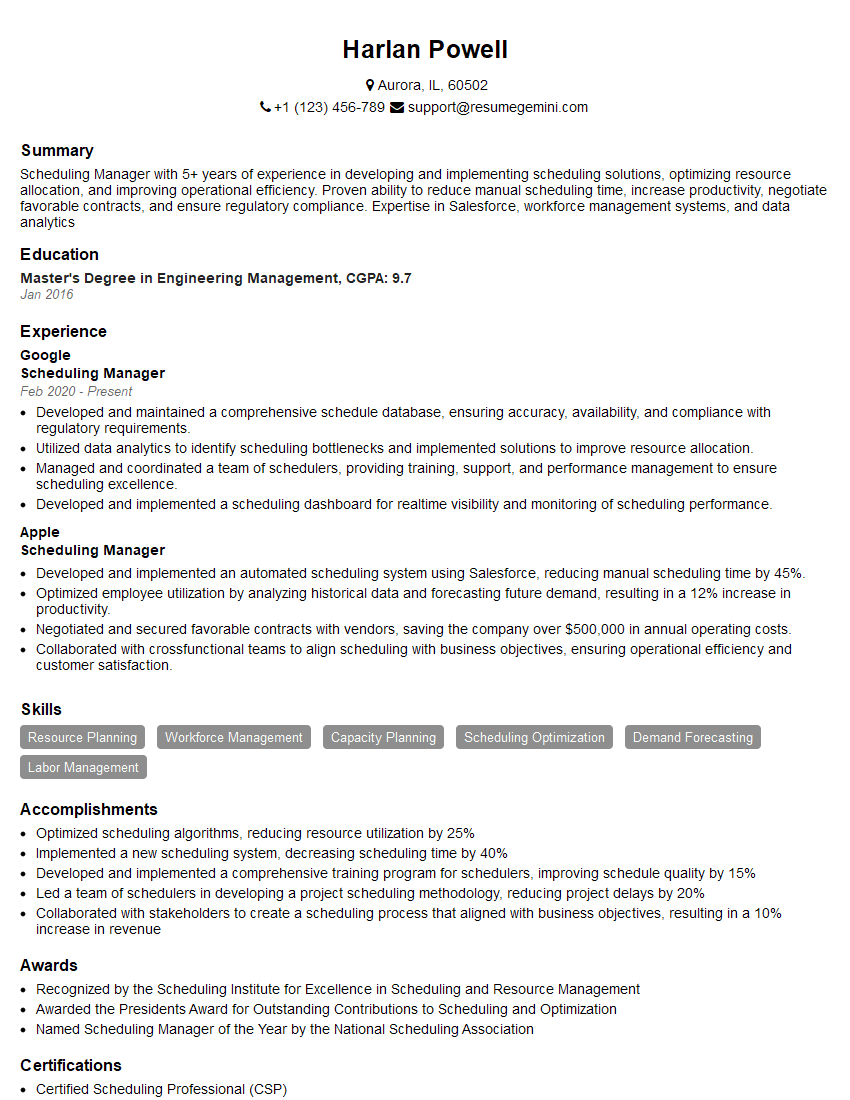
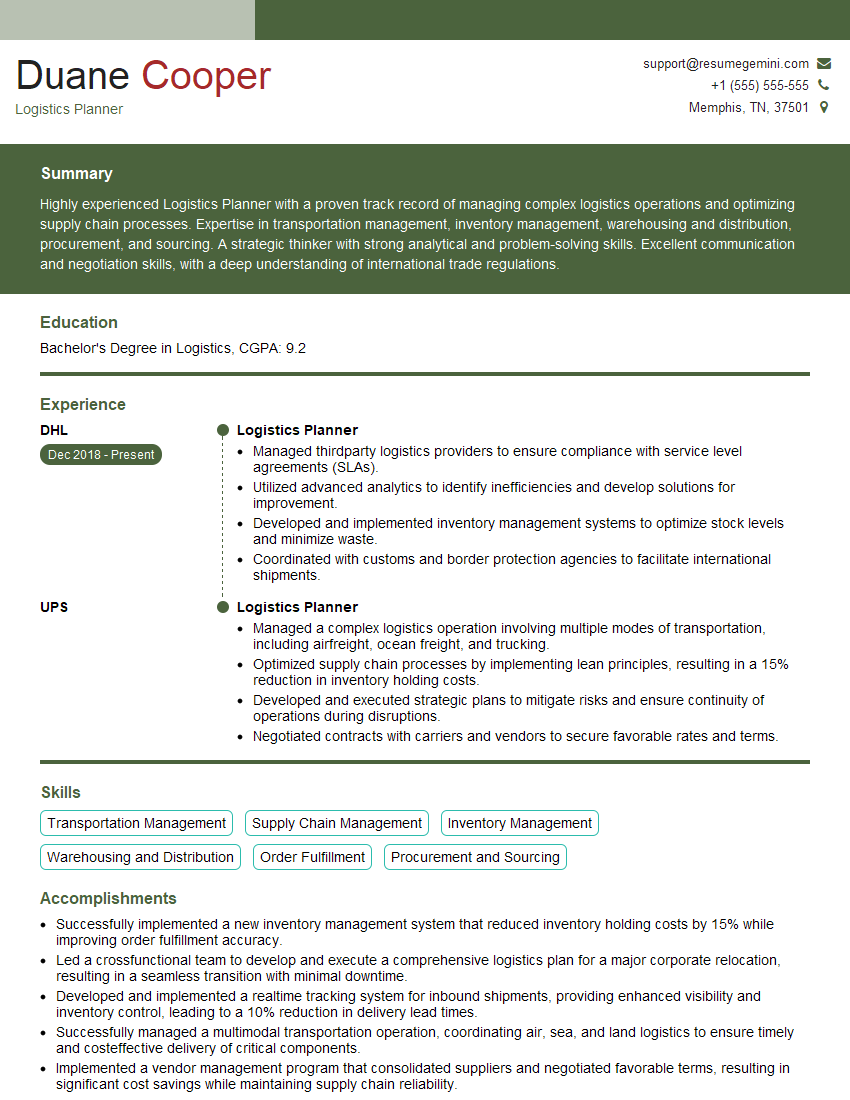
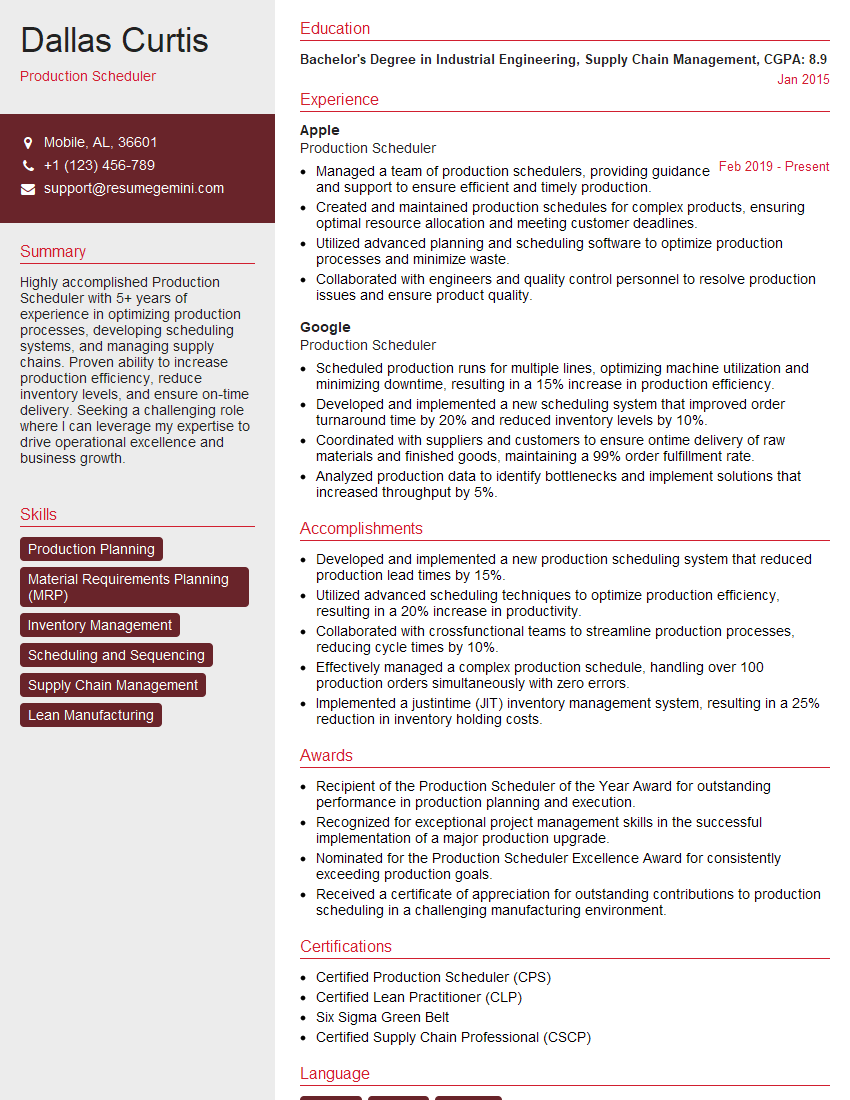
Mastering Pipeline Schedule Management is crucial for career advancement in project management and related fields. It demonstrates a strong understanding of project planning, execution, and control, opening doors to more challenging and rewarding roles. To maximize your job prospects, creating an ATS-friendly resume is essential. ResumeGemini can help you craft a compelling and effective resume that highlights your skills and experience in Pipeline Schedule Management. Examples of resumes tailored to this specialization are available for your review, providing practical guidance to help you stand out from the competition.


Explore more articles
Users Rating of Our Blogs
Share Your Experience
We value your feedback! Please rate our content and share your thoughts (optional).
What Readers Say About Our Blog
To the interviewgemini.com Webmaster.
Very helpful and content specific questions to help prepare me for my interview!
Thank you
To the interviewgemini.com Webmaster.
This was kind of a unique content I found around the specialized skills. Very helpful questions and good detailed answers.
Very Helpful blog, thank you Interviewgemini team.