Preparation is the key to success in any interview. In this post, we’ll explore crucial Cooling Tower Operation and Maintenance interview questions and equip you with strategies to craft impactful answers. Whether you’re a beginner or a pro, these tips will elevate your preparation.
Questions Asked in Cooling Tower Operation and Maintenance Interview
Q 1. Explain the principle of evaporative cooling.
Evaporative cooling leverages the principle that water absorbs a significant amount of heat when it changes from a liquid to a gas (vapor). Imagine sweating on a hot day; the sweat evaporating from your skin cools you down. Cooling towers work similarly. Warm water is sprayed over a fill media, increasing the surface area exposed to air. As air flows through the fill, some of the water evaporates, absorbing heat from the remaining water. This cooled water is then returned to the system, while the warm, moist air is expelled. The efficiency of evaporative cooling is directly related to the relative humidity of the ambient air; lower humidity means more efficient cooling.
Q 2. Describe the different types of cooling towers (e.g., induced draft, forced draft, natural draft).
Cooling towers are broadly classified into three main types based on how they induce airflow:
- Natural Draft Cooling Towers: These rely on natural convection. The warm, moist air rising from the tower creates a natural draft. They are typically large, hyperboloid structures, and are most effective in areas with consistent, strong winds. Think of a giant chimney effect.
- Forced Draft Cooling Towers: These utilize fans located at the bottom of the tower to push air upwards through the fill, ensuring consistent airflow regardless of wind conditions. They are generally more compact than natural draft towers.
- Induced Draft Cooling Towers: These use fans at the top of the tower to pull air through the fill. This method creates a more consistent airflow and can be more efficient than forced draft towers, especially in high-wind conditions, as it prevents the air from being disrupted.
The choice of tower type depends heavily on factors like site constraints, climate, and budget. Forced and induced draft towers are more common in modern industrial settings due to their compact size and controllability.
Q 3. What are the key components of a cooling tower and their functions?
A cooling tower comprises several key components, each playing a crucial role:
- Basin: The reservoir at the bottom of the tower that collects the cooled water.
- Fill Media: A structure (often plastic or wood) designed to maximize water-air contact, promoting efficient evaporation. Think of it as increasing the surface area for cooling.
- Distribution System: A network of pipes and nozzles that evenly distributes the warm water over the fill media. Even distribution is crucial for optimal performance.
- Fans (in forced and induced draft towers): These move air through the tower, driving the evaporation process.
- Louvers/Drift Eliminators: These prevent water droplets from being carried out of the tower with the air, minimizing water loss and reducing potential environmental impact.
- Water Inlet/Outlet Pipes: Connect the cooling tower to the main cooling water system.
Q 4. How do you troubleshoot low water level in a cooling tower?
Troubleshooting low water levels in a cooling tower is a systematic process. First, check for obvious leaks: examine the basin for cracks, inspect all pipes and connections for visible leaks, and look for signs of water around the tower base. Then:
- Check the makeup water system: Ensure the float valve or automatic makeup system is functioning correctly and replenishing water as needed. A malfunctioning float valve is a frequent cause of low water levels.
- Inspect the pump(s): Verify that the water pumps are working properly and delivering sufficient flow. A faulty pump can lead to insufficient water circulation and slow replenishment.
- Check for excessive drift: Inspect the drift eliminators; if they are damaged or clogged, more water than usual may be carried away with the air.
- Examine the fill media: Check for excessive scaling or fouling, which can restrict water flow and reduce evaporation efficiency, potentially leading to more water being lost through other mechanisms.
- Monitor water temperature and flow rates: Any significant deviations from normal operating parameters might point to further problems within the cooling system.
If the problem persists after these checks, consult a cooling tower specialist to investigate further. Ignoring low water levels can lead to serious damage to the cooling tower and the entire system.
Q 5. Explain the importance of water treatment in cooling towers.
Water treatment in cooling towers is paramount for several reasons:
- Preventing scaling and fouling: Hard water deposits (scaling) and biological growth (fouling) can significantly reduce heat transfer efficiency, leading to reduced cooling capacity and increased energy consumption. Imagine a clogged pipe—water can’t flow efficiently.
- Corrosion control: Untreated water can be corrosive to the tower’s components (metals, concrete), shortening the lifespan of the equipment and leading to costly repairs.
- Microbial control: Cooling towers provide an ideal environment for bacteria, algae, and other microorganisms to thrive. These can cause fouling, release unpleasant odors, and in some cases, even pose health risks (e.g., Legionella).
- Maintaining water quality: Treatment ensures the water remains within acceptable parameters for both the cooling system and the environment.
Regular water treatment is a proactive approach to preventing these problems and extending the life of the cooling tower.
Q 6. What are common water treatment chemicals used and their purpose?
Several common chemicals are used in cooling tower water treatment:
- Corrosion Inhibitors: These chemicals protect metal components from corrosion. Examples include azoles (like benzotriazole) and phosphonates.
- Scale Inhibitors: These prevent the formation of hard water deposits. Examples include polyphosphates, organophosphonates, and polymers.
- Biocides (algicide/bactericides): These control the growth of microorganisms. Examples include chlorine, bromine, and non-oxidizing biocides (e.g., isothiazolones).
- Dispersants: These help keep suspended solids from settling and forming deposits.
The specific chemicals and dosages used depend on the water’s characteristics and the cooling tower’s design. A water treatment professional should determine the appropriate treatment program.
Q 7. Describe the process of cleaning and maintaining a cooling tower.
Cleaning and maintaining a cooling tower is a multi-step process:
- Regular Inspections: Frequent visual inspections for leaks, corrosion, debris buildup, and other issues are crucial for early detection of problems.
- Chemical Cleaning: Periodic chemical cleaning is necessary to remove scale and fouling from the fill media, pipes, and basin. This typically involves circulating a cleaning solution through the system.
- Mechanical Cleaning: This may involve physically cleaning the fill media by removing debris, using high-pressure water jets, or other suitable methods.
- Drift Eliminator Cleaning: Regular cleaning of drift eliminators prevents excessive water loss and ensures efficient operation.
- Basin Cleaning: The basin should be regularly cleaned to remove accumulated sludge and debris.
- Fan Maintenance: Regular checks and maintenance of fans (lubrication, cleaning, blade inspection) are essential for optimal airflow.
- Water Treatment Monitoring: Regularly monitoring water chemistry parameters (pH, alkalinity, hardness, etc.) is crucial to ensure the effectiveness of the treatment program.
The frequency of cleaning and maintenance depends on factors such as water quality, operating conditions, and the cooling tower’s design. A comprehensive maintenance schedule is recommended to ensure the efficient and reliable operation of the cooling tower, extending its life and minimizing downtime.
Q 8. How do you identify and address scaling and fouling in a cooling tower?
Scaling and fouling in cooling towers are major problems, reducing efficiency and potentially causing damage. Scaling is the buildup of mineral deposits (like calcium carbonate) from the water, while fouling involves organic matter, silt, algae, and other impurities. Identifying these issues involves visual inspection, water testing, and performance monitoring.
- Visual Inspection: Regularly inspect the tower’s interior, paying close attention to the fill media, basin, and pipes. Look for white, crusty deposits (scaling) or slimy, discolored areas (fouling).
- Water Testing: Conduct regular water analysis to check for high levels of hardness (indicating scaling potential) and the presence of various contaminants. This helps identify the specific type of fouling.
- Performance Monitoring: Reduced cooling capacity, increased water temperature, and higher pump energy consumption can all be indicative of scaling and fouling. Regular monitoring of these parameters is crucial.
Addressing scaling and fouling requires a multi-pronged approach:
- Chemical Treatment: Using appropriate water treatment chemicals (acids for scaling, biocides for fouling) can effectively remove existing deposits and prevent future buildup. The selection of chemicals depends on the specific type and severity of the problem.
- Mechanical Cleaning: For severe scaling, mechanical cleaning might be necessary. This could involve high-pressure water jets, brushes, or specialized cleaning tools to remove deposits. This needs to be done carefully to avoid damaging the tower components.
- Regular Maintenance: Preventive maintenance, including regular cleaning and chemical treatment, significantly reduces the likelihood of severe scaling and fouling.
For example, I once worked on a tower where severe scaling had reduced cooling efficiency by 20%. After implementing a regular acid cleaning schedule and adjusting the chemical treatment program, we restored efficiency and avoided costly repairs.
Q 9. What are the safety precautions when working on a cooling tower?
Safety is paramount when working on a cooling tower. These structures are often tall, contain hazardous chemicals, and present risks of falls, electrocution, and biological hazards.
- Lockout/Tagout Procedures: Always follow strict lockout/tagout procedures before performing any maintenance on electrical equipment or pumps to prevent accidental startup.
- Fall Protection: Use appropriate fall protection equipment like harnesses and lifelines, particularly when working at heights. Ensure proper scaffolding and access points are used.
- Personal Protective Equipment (PPE): Wear appropriate PPE, including safety glasses, gloves, respirators (especially when working with chemicals), and protective clothing. This protects against chemical splashes, dust inhalation, and other hazards.
- Confined Space Entry Procedures: If entering the tower basin or other confined spaces, follow strict confined space entry procedures, including atmospheric monitoring and having a standby worker present.
- Awareness of Biological Hazards: Cooling towers can harbor Legionella bacteria. Therefore, it’s crucial to follow safe water handling practices and adhere to guidelines for preventing Legionellosis.
- Chemical Handling Safety: Properly handle and store all chemicals, following the manufacturer’s safety data sheets (SDS). Ensure proper ventilation when working with chemicals.
A good analogy is treating cooling tower maintenance like handling hazardous materials in a chemical lab – meticulous safety protocols are a non-negotiable requirement.
Q 10. Explain the role of fill media in a cooling tower.
Fill media is the heart of a cooling tower, maximizing the heat transfer surface area between the warm water and the air. It’s typically made of PVC, fiberglass, or other materials designed to withstand the harsh environment. The fill media increases the contact time and surface area for evaporative cooling.
- Increased Surface Area: The complex design of the fill media significantly increases the surface area of the water exposed to the air, facilitating efficient evaporation.
- Water Distribution: The fill media ensures even distribution of water over the surface, preventing hot spots and maximizing cooling efficiency. Uneven distribution reduces the overall effectiveness.
- Evaporative Cooling: As water flows over the fill media, evaporation occurs, cooling the remaining water. The fill media’s design optimizes this process.
- Airflow Management: The fill media directs airflow, improving contact between the air and water, and thus enhancing cooling performance.
Think of the fill media as a highly efficient radiator for water, maximizing the contact area with air for effective heat dissipation.
Q 11. How do you inspect and maintain the cooling tower fan?
Cooling tower fans are crucial for drawing air through the tower, driving the evaporative cooling process. Regular inspection and maintenance are vital for optimal performance and longevity.
- Visual Inspection: Check the fan blades for damage, wear, or debris buildup. Look for cracks, bends, or signs of corrosion. Also inspect the motor and drive components for any loose connections or damage.
- Vibration Monitoring: Excessive vibration can indicate bearing wear or imbalance. Use vibration sensors or simply feel for excessive vibration to detect potential problems.
- Lubrication: Proper lubrication of bearings and gearboxes is critical for smooth operation and extended lifespan. Follow the manufacturer’s recommendations for lubrication frequency and type of lubricant.
- Belt Tension: If the fan is belt-driven, ensure the belts are properly tensioned. Loose belts can slip and cause damage.
- Motor Inspection: Check the motor windings for any signs of overheating or damage. Monitor the motor current to ensure it’s within the normal operating range.
For instance, I once discovered a loose connection in a fan motor’s wiring, which was causing excessive heat and the risk of motor failure. Addressing this simple issue prevented a significant downtime event.
Q 12. Describe the process of inspecting and maintaining the cooling tower pump.
The cooling tower pump is a critical component, circulating water throughout the system. Regular inspection and maintenance are essential for reliability and efficiency.
- Visual Inspection: Check for leaks, corrosion, or damage to the pump casing, piping, and seals. Look for any signs of wear and tear.
- Vibration Monitoring: Similar to the fan, monitor the pump for excessive vibration. This can indicate problems with bearings, impellers, or alignment issues.
- Pressure Monitoring: Monitor the pump’s discharge pressure to ensure it’s within the normal operating range. Changes in pressure can indicate pump wear, clogging, or other issues.
- Flow Rate Measurement: Verify that the pump is delivering the required flow rate. Reduced flow can indicate issues like pump wear or clogging in the piping system.
- Lubrication: Check and lubricate the pump bearings as per the manufacturer’s recommendations.
- Seal Inspection: Inspect the pump seals for leaks. Leaking seals indicate wear and need to be addressed promptly to prevent water loss and potential damage.
In one instance, a seemingly minor leak at a pump seal resulted in significant water loss and reduced cooling capacity. A timely seal replacement prevented more serious problems and costly downtime.
Q 13. Explain the importance of regular inspections and maintenance of the cooling tower.
Regular inspections and maintenance are vital for ensuring optimal performance, extending the lifespan of the cooling tower, and preventing costly breakdowns. Neglecting maintenance can lead to decreased efficiency, increased energy consumption, and even catastrophic failures.
- Preventative Maintenance: Regular cleaning, chemical treatment, and inspections prevent scaling, fouling, and corrosion, extending the life of components.
- Optimized Performance: Well-maintained towers operate at peak efficiency, minimizing energy consumption and maximizing cooling capacity.
- Reduced Downtime: Regular maintenance prevents unexpected breakdowns and reduces downtime, saving time and money.
- Safety: Regular inspections identify potential safety hazards before they escalate, ensuring a safer work environment.
- Extended Lifespan: Proper maintenance significantly increases the lifespan of the cooling tower, deferring the need for costly replacements.
Imagine a car; neglecting regular maintenance will lead to breakdowns and higher repair costs. Cooling towers are similar; proactive maintenance is far more cost-effective than reactive repairs.
Q 14. How do you interpret cooling tower performance data (e.g., water temperature, flow rate)?
Interpreting cooling tower performance data involves analyzing key parameters to assess its efficiency and identify potential problems.
- Water Temperature: Monitor the inlet and outlet water temperatures. A large difference indicates efficient cooling, while a small difference suggests potential problems like scaling, fouling, or insufficient airflow.
- Flow Rate: Measure the water flow rate to ensure the pump is delivering the required amount of water. Reduced flow rate indicates potential pump issues or blockages in the piping system.
- Approach Temperature: This is the difference between the wet-bulb temperature of the air and the outlet water temperature. A high approach temperature indicates poor cooling performance.
- Range Temperature: The difference between the inlet and outlet water temperatures. A smaller range suggests issues like low airflow or scaling.
- Energy Consumption: Monitor the energy consumption of the fans and pumps. Increased energy consumption can indicate inefficiencies that need to be addressed.
By analyzing these parameters and comparing them to historical data and manufacturer specifications, you can pinpoint potential problems and take corrective action. For example, a consistently high approach temperature might point to a need for cleaning the fill media or inspecting the fans for efficiency.
Q 15. Describe common cooling tower failures and their causes.
Cooling towers, while robust, are susceptible to various failures. These often stem from a combination of factors, including poor maintenance, aging components, and environmental conditions. Common failures include:
- Fill Media Degradation: Over time, the fill media (the material that increases water-air contact) can become clogged with debris, scale, or biological growth, reducing its efficiency and leading to decreased cooling capacity. Imagine a showerhead with clogged holes – the water flow is restricted. This often manifests as higher water temperatures leaving the tower.
- Fan Motor Failure: The large fans driving air circulation are critical. Failure can be due to bearing wear, electrical issues, or damage from severe weather. A failed fan means inadequate airflow, resulting in poor cooling.
- Leakage: Cracks in the basin, piping, or connections can lead to significant water loss and potential structural damage. This is costly and environmentally concerning.
- Corrosion: Exposure to water and air leads to corrosion of metal components. This is particularly problematic in towers using untreated or poorly treated water. Corrosion weakens the structure and can cause leaks or failures of critical components.
- Pump Failure: The pumps circulating water through the tower are vital. Failure due to wear, cavitation, or electrical issues results in loss of cooling and potential overheating of the system.
- Scaling and Fouling: Mineral deposits and biological growth accumulate on heat transfer surfaces, reducing efficiency and potentially blocking flow. Think of limescale buildup in a kettle – it inhibits heat transfer.
Understanding the root cause is crucial for effective repair and prevention. Regular inspections and a preventative maintenance plan are vital to minimize these failures.
Career Expert Tips:
- Ace those interviews! Prepare effectively by reviewing the Top 50 Most Common Interview Questions on ResumeGemini.
- Navigate your job search with confidence! Explore a wide range of Career Tips on ResumeGemini. Learn about common challenges and recommendations to overcome them.
- Craft the perfect resume! Master the Art of Resume Writing with ResumeGemini’s guide. Showcase your unique qualifications and achievements effectively.
- Don’t miss out on holiday savings! Build your dream resume with ResumeGemini’s ATS optimized templates.
Q 16. How do you troubleshoot a cooling tower that is not cooling efficiently?
Troubleshooting an inefficient cooling tower requires a systematic approach. First, establish a baseline – what is the expected performance? Then, compare it to the current performance. Key areas to investigate:
- Water Temperature Differential: Measure the inlet and outlet water temperatures. A small difference indicates poor cooling. Check for sufficient water flow and airflow.
- Airflow: Inspect the fans for proper operation and measure the airflow using an anemometer. Obstructions, fan blade damage, or motor issues can reduce airflow.
- Water Flow: Verify that the water pumps are operating correctly and check for blockages in the piping. Reduced water flow severely impacts cooling.
- Fill Media Condition: Inspect the fill media for clogging, degradation, or damage. Clogged media significantly reduces efficiency.
- Water Chemistry: Test the water for scaling, corrosion, and biological growth. Poor water chemistry contributes to fouling and decreased efficiency.
- Heat Exchanger Condition: In some systems, a separate heat exchanger is used. Check its efficiency and cleanliness.
Addressing these points systematically allows for pinpointing the problem and implementing the necessary corrective actions, which could range from cleaning the fill to replacing a faulty pump.
Q 17. What are the signs of a leaking cooling tower?
Detecting a leaking cooling tower involves careful observation and regular inspection. Signs of a leak can be subtle or obvious:
- Visible Water Leakage: Obvious dripping or pooling of water around the base or structure of the tower is a clear sign.
- Increased Water Consumption: A sudden increase in water usage without a corresponding increase in cooling demand could indicate leakage.
- Water Stains: Discoloration or staining on the tower structure or surrounding ground can point to persistent leaks.
- Dampness or Wetness: Noticeably damp areas on or around the tower structure can signal a leak, even if not actively dripping.
- Erosion or Deterioration: Noticeable corrosion or damage to the tower structure, particularly around seams or joints, can indicate underlying leaks.
- Lower Water Level: Consistently low water levels in the basin despite consistent operation implies a leak.
Regular visual inspections, coupled with monitoring water levels and consumption, are critical for early detection of leaks before they escalate into significant problems.
Q 18. Explain the process of repairing a leaking cooling tower.
Repairing a leaking cooling tower depends on the location and severity of the leak. Minor leaks might involve simple patching, while major leaks require more extensive repairs or even replacement of components. The process generally involves:
- Identify and Locate the Leak: Thoroughly inspect the entire tower to pinpoint the leak source, possibly using dye testing to visualize leaks.
- Isolate the Area: If possible, isolate the affected section to minimize water loss and allow for safe access.
- Prepare the Surface: Clean and prepare the damaged area by removing any loose material, debris, or corrosion.
- Apply Repair Material: Depending on the material of the tower and the type of leak, different repair methods are employed. This could range from using specialized epoxy compounds to welding for structural damage.
- Cure and Inspect: Allow sufficient time for the repair material to cure completely. Then, inspect the repair for effectiveness.
- Pressure Test (If Applicable): For significant repairs, a pressure test is vital to ensure the integrity of the repair.
- Documentation: Maintain detailed records of the repair, including materials used, methods employed, and dates.
For large or complex leaks, it is crucial to consult with experienced cooling tower technicians or engineers. Attempting major repairs without proper expertise can lead to further damage or safety hazards.
Q 19. How do you maintain proper water chemistry in a cooling tower?
Maintaining proper water chemistry is vital for preventing scale formation, corrosion, and biological growth in a cooling tower. This involves regular monitoring and treatment. Key aspects:
- pH Control: Maintaining the water’s pH within an optimal range (typically 6.0-8.0) minimizes corrosion and scaling. This is done by adding chemicals such as sulfuric acid or caustic soda.
- Calcium and Magnesium Control: High levels of calcium and magnesium lead to scaling. Treatment methods include using acid addition or employing threshold inhibitors to prevent scale formation.
- Corrosion Inhibition: Corrosion inhibitors are added to protect metal components. These chemicals form a protective layer on the metal surfaces.
- Biological Control: Regular treatment with biocides prevents the growth of algae, bacteria, and fungi. This helps to maintain cleanliness and prevent fouling.
- Regular Testing: Frequent testing of water samples provides crucial data on pH, alkalinity, calcium hardness, and other parameters, guiding chemical adjustments.
- Blowdown Management: Regular blowdown (removing a portion of the water) is essential to prevent the concentration of impurities and to maintain the desired chemical balance.
A well-defined water treatment program, tailored to the specific water source and tower design, is essential for efficient and long-lasting operation.
Q 20. What are the environmental considerations related to cooling tower operation?
Cooling tower operation has significant environmental considerations, primarily concerning water and air quality.
- Water Consumption: Cooling towers consume substantial amounts of water, leading to water depletion in some areas. Water conservation measures such as improved blowdown management and employing closed-cycle systems are essential.
- Waterborne Diseases: Cooling towers can harbor bacteria like Legionella, which can cause Legionnaires’ disease. Proper water treatment, regular cleaning, and maintaining proper water chemistry are crucial to prevent the growth of pathogenic microorganisms.
- Air Emissions: Cooling towers release water vapor into the atmosphere. This can contribute to localized humidity and fog, but it is generally less significant than other industrial emissions.
- Chemical Usage: The chemicals used for water treatment can have environmental impacts. Careful selection of environmentally friendly chemicals and proper disposal of waste are necessary.
Sustainable practices, including water conservation techniques and responsible chemical management, are paramount to minimize the environmental footprint of cooling tower operation.
Q 21. Explain the concept of drift loss in a cooling tower.
Drift loss in a cooling tower refers to the small amount of water that is carried away by the air stream as it exits the tower. Imagine a fine mist escaping from the top. These tiny water droplets are entrained in the airflow.
Several factors influence drift loss, including the tower design, the fill media type, and the airflow rate. High drift loss can lead to significant water wastage and the potential for the dispersal of waterborne microorganisms.
Drift eliminators are commonly installed at the top of cooling towers to minimize drift loss. These devices, typically made of louvers or mesh, help to capture the water droplets before they exit the tower, reducing water waste and mitigating the environmental impact.
Q 22. How do you minimize drift loss in a cooling tower?
Drift loss in a cooling tower refers to the water that’s carried away by the air stream as a mist. Minimizing this is crucial for water conservation and preventing environmental issues. We can significantly reduce drift loss through several key strategies. Firstly, ensuring the tower’s fill is in optimal condition is paramount. Damaged or clogged fill media reduces the tower’s efficiency and increases drift. Regularly inspecting and cleaning or replacing the fill as needed is essential. Secondly, proper maintenance of the eliminators is vital. Eliminators are designed to separate water droplets from the airstream. Regular inspection for damage or clogging, and cleaning or replacement as necessary, greatly reduces drift. Thirdly, maintaining the correct water distribution is critical. Uneven distribution can lead to localized areas of high water velocity, increasing drift. This means checking the spray nozzles for proper function and adjusting water flow accordingly. Finally, operational parameters play a significant role. Operating the tower at its designed capacity prevents overloading, which often leads to increased drift. Maintaining the correct water level and air flow are also crucial. Think of it like this: the fill is like a sponge, the eliminators are the wringer, and the distribution system is the faucet – all must work together perfectly to minimize water loss.
Q 23. Describe the different types of cooling tower fans and their maintenance.
Cooling towers utilize various fan types, each with unique maintenance needs. The most common are axial flow fans and centrifugal fans. Axial flow fans are characterized by their blades arranged along a central shaft, pushing air parallel to the shaft’s axis. These are often found in smaller towers and require regular lubrication of the bearings and checking for blade wear and imbalance, which can lead to vibration and noise. We’d also inspect the fan motor for overheating and ensure proper alignment. Centrifugal fans, on the other hand, use impellers to accelerate air radially, creating a higher pressure. These are more common in larger towers and require similar maintenance to axial fans, but also necessitate more frequent inspection of the impeller’s condition. Regular checks for wear, cracks, or deformation are vital to prevent catastrophic failure. In both cases, preventative maintenance is key—regular lubrication, vibration analysis, and visual inspections are cost-effective measures that avoid unexpected breakdowns. I’ve personally experienced a situation where neglecting regular lubrication led to a bearing failure in an axial flow fan, resulting in significant downtime and repair costs. This experience emphasized the importance of meticulous preventative maintenance schedules.
Q 24. What are the advantages and disadvantages of different cooling tower types?
Several cooling tower types exist, each with its own strengths and weaknesses. Counterflow towers, for example, have the air and water flowing in opposite directions, offering high efficiency but potentially higher drift rates. Crossflow towers, where air and water move perpendicularly, are typically more compact and less expensive, but their efficiency is generally lower than counterflow towers. Mechanical-draft towers, utilizing fans to induce airflow, are more energy-intensive but offer better performance in low-wind conditions compared to natural-draft towers, which rely on natural convection and are hence more energy-efficient but less effective in calm environments. The choice depends heavily on factors like available space, budget, climate conditions, and required cooling capacity. For instance, in arid climates with high wind speeds, a natural-draft tower might be suitable. However, a humid climate with limited space may favor a compact crossflow mechanical-draft tower. The best option is always a carefully considered one based on a thorough site assessment.
Q 25. How do you perform a comprehensive cooling tower inspection?
A comprehensive cooling tower inspection involves a multi-stage process. It starts with a visual inspection, checking the overall structure for signs of damage, corrosion, or leaks. Next, we evaluate the fill media for clogging or degradation, ensuring optimal water distribution and heat transfer. The eliminators are carefully inspected for damage or blockage, affecting drift and efficiency. We then check the fan motor and blades for wear, vibration, and alignment, critical for operational safety and performance. The water distribution system is thoroughly examined for leaks, blockages, or uneven spraying. The basin is checked for debris, scale buildup, and leaks. Finally, we assess the plumbing and piping for corrosion, leaks, and proper connections. This entire process often involves using specialized tools and instruments such as a vibration meter, water quality testing kit, and a thermal imaging camera to identify subtle issues. Documentation with photos and reports is essential for record-keeping and future maintenance planning. Think of it as a comprehensive health checkup for the cooling tower, preventing small problems from escalating into major issues.
Q 26. What are the legal and regulatory requirements for cooling tower operation?
Legal and regulatory requirements for cooling tower operation vary by location but generally focus on water quality, environmental protection, and worker safety. Regulations often address the discharge of water containing chemicals and the prevention of Legionella bacteria growth. Regular testing and reporting of water quality parameters are usually mandatory. Safety regulations might involve procedures for accessing the tower, working at heights, and lockout/tagout procedures for maintenance. Specific guidelines related to air emissions and noise pollution might also apply. Compliance with these regulations is not just a matter of legal adherence; it’s also crucial for responsible environmental stewardship and worker protection. I’ve worked in areas with stringent regulations, requiring rigorous documentation of every maintenance action, water testing result, and safety procedure followed.
Q 27. How do you handle emergency situations related to cooling tower malfunction?
Emergency situations, such as a major leak or fan failure, require immediate action. The first step is always safety – ensuring personnel are evacuated from the immediate area and the system is secured to prevent further damage or injury. Next, we assess the extent of the problem to determine the appropriate response. A small leak might be manageable with temporary repairs while a major structural issue would require professional assistance and possibly a temporary shutdown. We then initiate emergency procedures, potentially including contacting emergency services, activating backup systems if available, and notifying relevant personnel and authorities. Detailed documentation of the incident, including the cause, actions taken, and resulting damage, is essential for future analysis and prevention of similar events. I remember one instance where a sudden power outage triggered a major water leak, but our quick response and activation of emergency procedures minimized the damage. Thorough training and well-defined protocols are vital in effectively handling such emergencies.
Q 28. Explain your experience with troubleshooting and repairing cooling tower equipment.
My experience in troubleshooting and repairing cooling tower equipment spans several years and a wide variety of issues. I’ve successfully diagnosed and repaired issues ranging from minor leaks and pump failures to major structural problems and control system malfunctions. For example, I once resolved a recurring issue of low cooling efficiency in a counterflow tower by identifying and rectifying a problem with the water distribution system. This involved a detailed inspection of the nozzles, pipes, and the fill media, ultimately leading to the discovery of several clogged nozzles that were restricting water flow. In another case, I tackled a situation where the fan motor unexpectedly failed, requiring a careful evaluation to determine the cause of failure—eventually tracing it to a faulty motor starter. Throughout my career, a methodical, step-by-step approach has always proved vital; this entails careful inspection, data analysis, and the testing of hypotheses before implementing repairs. Detailed documentation of troubleshooting steps and solutions is crucial for future reference and improvement of operational procedures.
Key Topics to Learn for Your Cooling Tower Operation and Maintenance Interview
- Cooling Tower Fundamentals: Understanding the principles of evaporative cooling, heat transfer mechanisms, and the different types of cooling towers (e.g., counterflow, crossflow).
- Water Chemistry and Treatment: Mastering water quality parameters (pH, conductivity, alkalinity, etc.), understanding the role of chemical treatments in preventing scaling, corrosion, and microbial growth, and troubleshooting water chemistry imbalances.
- Pumping Systems and Hydraulics: Knowledge of centrifugal pumps, flow rates, pressure drops, and troubleshooting pump malfunctions, including understanding the impact on cooling tower efficiency.
- Fan and Motor Operation: Understanding fan types, motor controls (VFDs), and troubleshooting fan and motor issues, including balancing and alignment procedures.
- Fill Media and Distribution Systems: Understanding the function and maintenance of various fill media types, identifying signs of deterioration, and recognizing issues in the water distribution system impacting even cooling.
- Instrumentation and Control Systems: Familiarity with temperature sensors, flow meters, level controls, and PLC systems used to monitor and control cooling tower operation. Understanding alarm conditions and troubleshooting.
- Preventative Maintenance and Inspections: Knowledge of scheduled maintenance procedures, inspection techniques, and developing preventative maintenance plans to extend cooling tower lifespan and reduce downtime.
- Troubleshooting and Repair: Ability to diagnose common problems, such as leaks, corrosion, fouling, and fan motor issues, and to implement effective repair strategies.
- Safety Procedures and Regulations: Understanding OSHA regulations, lockout/tagout procedures, and safe working practices within a cooling tower environment.
- Energy Efficiency and Optimization: Knowledge of methods to improve cooling tower efficiency, reduce energy consumption, and minimize water usage.
Next Steps: Level Up Your Career
Mastering Cooling Tower Operation and Maintenance opens doors to exciting career advancements and higher earning potential. The demand for skilled professionals in this field is strong, so showcasing your expertise effectively is crucial. Building an ATS-friendly resume is your first step to getting noticed by recruiters. Make sure your resume highlights your skills and experience in a way that Applicant Tracking Systems can easily identify.
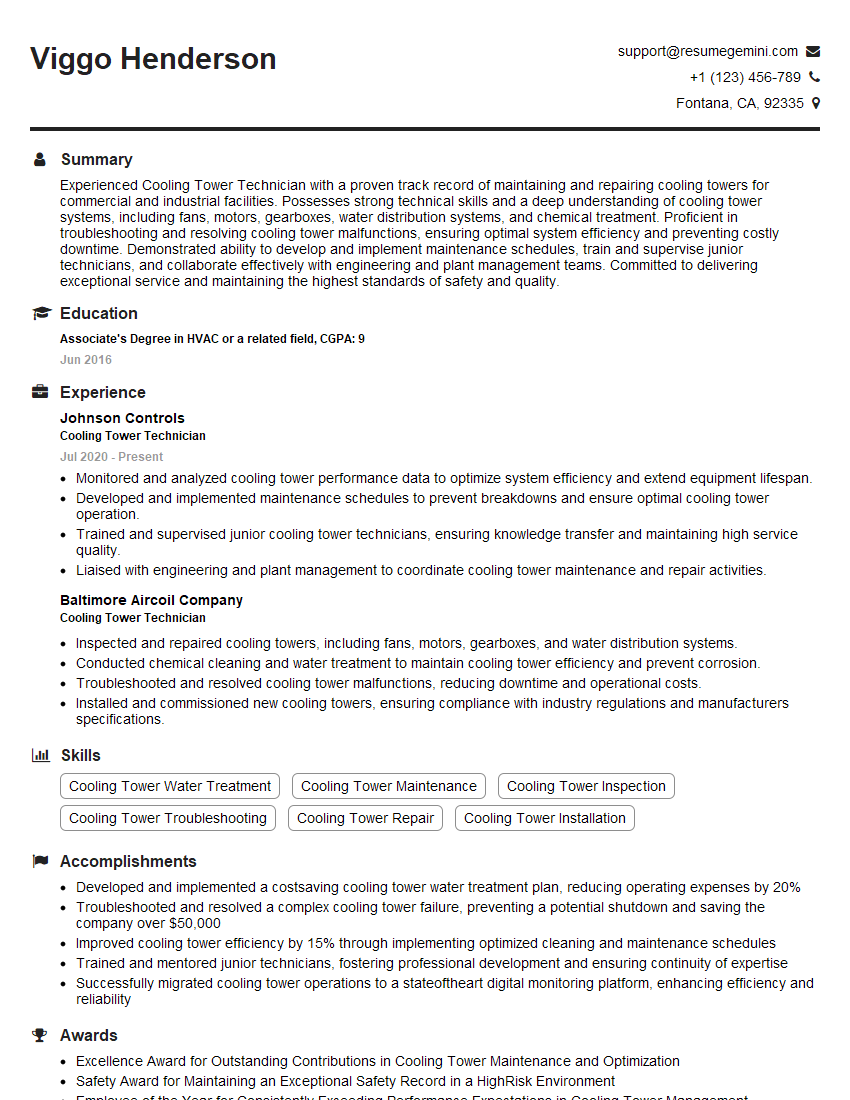
To help you create a truly impactful resume that stands out, we recommend using ResumeGemini. ResumeGemini provides a user-friendly platform to craft professional resumes, ensuring yours is optimized for applicant tracking systems and recruiters. We even provide examples of resumes tailored specifically to Cooling Tower Operation and Maintenance professionals to help inspire you. Take charge of your career today – build your best resume with ResumeGemini.
Explore more articles
Users Rating of Our Blogs
Share Your Experience
We value your feedback! Please rate our content and share your thoughts (optional).
What Readers Say About Our Blog
To the interviewgemini.com Webmaster.
Very helpful and content specific questions to help prepare me for my interview!
Thank you
To the interviewgemini.com Webmaster.
This was kind of a unique content I found around the specialized skills. Very helpful questions and good detailed answers.
Very Helpful blog, thank you Interviewgemini team.