Preparation is the key to success in any interview. In this post, we’ll explore crucial Cotton Economics interview questions and equip you with strategies to craft impactful answers. Whether you’re a beginner or a pro, these tips will elevate your preparation.
Questions Asked in Cotton Economics Interview
Q 1. Explain the factors influencing global cotton prices.
Global cotton prices are a complex interplay of several factors, operating both on a micro and macro level. Think of it like a delicate balance scale: when one side weighs more heavily, the price shifts.
- Supply and Demand: The most fundamental factor. A large harvest leads to lower prices, while a poor harvest due to drought or pests can drive prices significantly higher. This is basic economics – scarcity increases value.
- Weather Patterns: Unpredictable weather events like droughts, floods, or extreme temperatures during crucial growth stages can drastically reduce yields, impacting global supply and pushing prices up. Think of the devastating impact of a hurricane on a major cotton-producing region.
- Government Policies: Subsidies, export quotas, and tariffs implemented by various countries can significantly influence supply and price. For example, a country imposing export restrictions on cotton can lead to price increases in the global market.
- Exchange Rates: Fluctuations in currency exchange rates impact the cost of cotton imports and exports, influencing prices for both buyers and sellers. A stronger dollar, for instance, can make US cotton more expensive for international buyers.
- Technological Advancements: New technologies in cotton farming, such as improved seed varieties, irrigation techniques, and pest management, can affect yields and, consequently, prices. More efficient production generally lowers costs and prices.
- Speculation in Futures Markets: Trading in cotton futures contracts can create price volatility, especially in the short term. Speculators’ bets on future prices can amplify existing price trends, often unrelated to underlying supply and demand fundamentals.
- Demand from Textile Industry: Global textile production, particularly demand for apparel and home textiles, is a major driver of cotton demand. Changes in fashion trends or economic growth in key consumer markets directly affect cotton prices. Think about the impact of a major fashion trend embracing cotton clothing – demand surges and price rises.
Q 2. Describe the current supply and demand dynamics in the cotton market.
Current supply and demand dynamics in the cotton market are highly variable and influenced by many of the factors mentioned above. Analyzing them requires a nuanced approach.
In recent years, we’ve seen fluctuations in global cotton production, with some years experiencing bumper crops and others falling short due to weather events. For example, a significant drought in a major producing region like India can significantly tighten global supply and increase prices. Conversely, favorable weather conditions in multiple regions can lead to a surplus and price drops. The demand side is equally crucial; rapid economic growth in countries like India and Bangladesh boosts consumption, while recessions or shifts in global fashion trends can reduce it. Therefore, forecasting cotton supply and demand requires a close watch on various factors, ranging from weather predictions to economic growth forecasts.
A crucial point to note is that the cotton market is highly globalized, making it vulnerable to events in any major producing or consuming region. A disruption in one area can have ripple effects throughout the entire global market.
Q 3. What are the major cotton-producing regions and their characteristics?
Major cotton-producing regions boast unique characteristics that affect their yields and the quality of cotton produced. These characteristics are often interwoven.
- India: A leading producer, known for its diverse range of cotton types, including long-staple varieties. Production is significantly impacted by monsoon rainfall patterns.
- United States: A significant exporter, predominantly producing high-quality Upland cotton. US cotton production benefits from advanced agricultural technology and efficient irrigation systems.
- China: A massive consumer and producer, largely focused on meeting its domestic needs. Cotton production is often supported by government policies.
- Brazil: A growing cotton producer with expanding acreage and increasing yields. Beneficial climate conditions in many areas contribute to strong yields.
- Australia: Produces high-quality cotton in specific regions, its production heavily dependent on reliable rainfall and irrigation.
- Pakistan: Production is susceptible to climate change and water scarcity, impacting yields.
Each region’s characteristics influence the type and quality of cotton produced, affecting pricing and market dynamics. For example, the superior quality of US long-staple cotton commands a higher price compared to shorter-staple varieties from other regions.
Q 4. Discuss the impact of weather patterns on cotton yields.
Weather patterns are paramount in cotton production; they directly influence yields and quality. Think of it as the lifeblood of the crop.
- Temperature: Extreme heat or cold during critical growth stages can damage plants and reduce yields. Optimal temperatures are needed for successful boll development and fiber maturation.
- Rainfall: Sufficient rainfall is crucial, but excessive rain can lead to waterlogging and fungal diseases, negatively impacting quality and yield. Droughts, on the other hand, severely restrict growth and reduce yields, often resulting in lower quality fiber.
- Sunlight: Adequate sunlight is essential for photosynthesis and fiber development. Cloudy conditions or insufficient sunlight can hinder growth.
- Pests and Diseases: Weather patterns can influence the prevalence of pests and diseases. Excessive moisture can promote fungal growth, while dry conditions can exacerbate pest infestations. This adds another layer of complexity to weather’s impact.
Predicting and mitigating the impact of weather on cotton yields is a constant challenge for farmers and market analysts. Advanced weather forecasting, improved irrigation techniques, and disease-resistant varieties are crucial for adapting to increasingly unpredictable weather patterns.
Q 5. Analyze the role of government policies on cotton production and trade.
Government policies play a significant role in shaping cotton production and trade, both domestically and internationally. These policies can be a boon or a bane, depending on their design and implementation.
- Subsidies: Many countries provide subsidies to their cotton farmers, impacting competitiveness in the global market. Subsidies can lead to overproduction and price distortions.
- Trade Policies: Tariffs, quotas, and other trade barriers can restrict or encourage cotton trade, influencing global supply and prices. Protectionist policies can shield domestic farmers but may hurt consumers and international trade.
- Support Programs: Governments often implement support programs, such as crop insurance or research funding, which directly affect production levels and farmers’ resilience to market fluctuations. These programs can enhance production sustainability and ensure a stable supply.
- Environmental Regulations: Policies addressing water usage, pesticide use, and carbon emissions are increasingly affecting cotton production methods and costs. These regulations can raise production costs, but contribute to environmentally friendly cotton production.
Understanding a country’s cotton policies is vital for market analysis. For instance, a sudden change in subsidy levels in a major producing nation can significantly alter global supply and prices, requiring careful assessment and recalibration of market forecasts.
Q 6. Explain the different cotton grades and their pricing.
Cotton is graded based on several factors, determining its quality and, consequently, its price. Think of it like grading gemstones – the higher the quality, the higher the value.
- Fiber Length: Longer fibers generally produce stronger, smoother yarns, commanding a higher price. This is measured in inches or millimeters.
- Fiber Strength: Stronger fibers are more durable, resulting in higher-quality fabrics. Strength is usually measured in grams per tex.
- Fiber Uniformity: Consistent fiber length and diameter lead to better spinning performance and higher-quality yarn. Uniformity is crucial for even fabrics.
- Micronaire: This measures fiber fineness and maturity, influencing the softness and feel of the fabric. Different micronaire values are suitable for different applications.
- Color: Whiter cotton generally fetches a higher price than cotton with yellow or other color stains, though some naturally colored cottons can command premium prices.
- Trash Content: The presence of impurities like leaf fragments or seeds negatively impacts quality and reduces price.
Cotton grades are assigned based on standardized testing procedures, and different markets might use slightly different grading systems. Premium grades, such as extra-long staple cotton, command significantly higher prices than lower-grade cotton due to their superior properties.
Q 7. How does the futures market impact cotton prices?
The futures market plays a pivotal role in influencing cotton prices, primarily by allowing producers, buyers, and speculators to hedge against price risk and speculate on future price movements. Think of it as a sophisticated prediction market.
Hedging: Producers can use futures contracts to lock in a price for their cotton harvest, protecting themselves against potential price drops. Similarly, textile mills can use futures contracts to secure cotton supplies at a fixed price, shielding them from price increases.
Speculation: Speculators trade futures contracts based on their predictions of future price movements. Their actions can create price volatility, sometimes unrelated to the underlying supply and demand fundamentals. A significant speculative surge in buying, for example, can artificially inflate cotton prices.
Price Discovery: The futures market helps discover the market price for cotton, providing a benchmark price that influences spot market transactions. The futures price acts as an indicator of future supply and demand conditions, guiding market participants’ decision-making.
The interplay of hedging and speculation in the futures market can significantly affect the price of cotton, sometimes leading to price swings that do not perfectly reflect the actual supply and demand fundamentals. Understanding how the futures market operates is critical for anyone involved in the cotton industry.
Q 8. What are the key risks associated with cotton trading?
Cotton trading, like any commodity market, is fraught with risk. These risks can be broadly categorized into price risk, quality risk, and logistical risk.
- Price Risk: This is perhaps the most significant risk. Cotton prices are volatile, influenced by factors like weather patterns (affecting yields), global supply and demand, economic conditions, and even speculation in futures markets. A sudden drop in price can wipe out profits for traders and producers alike. Imagine a farmer who contracts to sell cotton at a certain price; if the market price plummets before harvest, they could face significant losses.
- Quality Risk: The quality of cotton, assessed by factors like fiber length, strength, micronaire, and color, directly impacts its value. Unexpected quality issues, due to pests, disease, or improper harvesting, can lead to significant price reductions. For example, if a shipment is found to have high levels of trash or impurities, the buyer may reject it or demand a discount.
- Logistical Risk: Getting cotton from the farm to the mill involves various stages, each presenting logistical challenges. Delays, damage during transport, and even theft are potential risks. A delay in shipping due to unforeseen circumstances (like port congestion or a natural disaster) can cause significant financial losses, particularly in a time-sensitive market.
Effective risk management strategies, including hedging (discussed later), diversification, and careful contract negotiation, are crucial for mitigating these risks in cotton trading.
Q 9. Describe the cotton supply chain from farm to fabric.
The cotton supply chain is a complex network spanning from the farm to the final fabric product. It can be visualized in several stages:
- Farming: This involves planting, cultivating, and harvesting the cotton crop. Factors like soil conditions, irrigation, pest control, and weather significantly impact yield and quality.
- Ginning: Harvested cotton bolls are processed at ginning mills to separate the seeds from the fibers. This is a crucial step in preparing the cotton for further processing.
- Baling and Transportation: The ginned cotton is compressed into bales and transported to various locations, such as warehouses, textile mills, or ports for export.
- Spinning: Textile mills transform the raw cotton fibers into yarn through a spinning process. The type of yarn produced depends on the intended use of the fabric.
- Weaving or Knitting: The yarn is then woven into fabric on looms or knitted into fabric using knitting machines. This stage determines the fabric structure and properties.
- Dyeing and Finishing: The fabric undergoes dyeing, printing, and other finishing processes to achieve the desired color, texture, and other properties.
- Garment Manufacturing: The finished fabric is cut and sewn into garments or used in other applications like home furnishings.
- Retail and Consumption: The finished products are then sold through various retail channels to consumers.
Each stage involves various stakeholders, including farmers, ginners, traders, textile manufacturers, retailers, and consumers, making it a truly globalized industry.
Q 10. Explain the concept of cotton hedging.
Cotton hedging is a risk management strategy used to protect against price fluctuations. It involves using financial instruments, primarily futures contracts, to offset potential losses from price changes. Imagine a cotton farmer expecting a harvest in six months. They could enter into a futures contract, agreeing to sell their cotton at a predetermined price at a future date. This locks in a price, eliminating the risk of a price drop before the harvest. However, it also means they forfeit the potential gains if the market price rises above the agreed-upon price.
How it works:
- Futures Contract: A legally binding agreement to buy or sell a specific quantity of cotton at a predetermined price on a future date. The price is based on current market conditions and expectations.
- Offsetting Risk: If the market price falls, the farmer might lose money on their physical cotton, but gains on their futures contract, partially or completely offsetting the loss. Conversely, if the market price rises, they benefit from the higher market price, but their futures contract would result in a loss (compared to the higher market price). This loss can be seen as an insurance premium to reduce the risk of greater loss from lower prices.
Example: A farmer anticipates a 1000-bale harvest and enters a futures contract to sell at $1.00/lb. If the market price drops to $0.80/lb, the farmer loses money on the physical cotton but makes a profit from the futures contract, mitigating the overall financial impact. This is a simplification, as commissions and other factors need to be considered.
Q 11. How do you assess the quality of cotton?
Assessing cotton quality is crucial for determining its value and suitability for different applications. It involves a combination of subjective and objective methods. Key parameters include:
- Fiber Length: The length of individual cotton fibers directly impacts the strength and fineness of the yarn. Longer fibers generally produce higher-quality yarn.
- Fiber Strength: This refers to the tensile strength of the fibers, reflecting their resistance to breakage. Stronger fibers are essential for durable fabrics.
- Micronaire: This measures the fiber maturity and fineness, influencing the yarn’s softness and handle.
- Fiber Uniformity: Consistent fiber length and diameter contribute to higher-quality yarn. Non-uniform fibers result in uneven yarn and fabric.
- Color: Cotton color is assessed using standardized scales and influences its acceptability for various applications. Whiter cotton is generally preferred.
- Trash Content: The amount of foreign matter (leaves, seeds, etc.) present in the cotton, affecting the spinning performance and yarn quality.
Assessment Methods: Quality assessment involves visual inspection, laboratory testing using instruments like the High Volume Instrument (HVI), and subjective evaluation by experienced graders. The HVI system provides objective data on fiber properties, while human graders assess color and other qualitative aspects.
Example: A high-quality cotton variety like Pima cotton would have longer fibers, high strength, a desirable micronaire value, good uniformity, and low trash content, resulting in a superior yarn and fabric.
Q 12. What are the major challenges facing the cotton industry?
The cotton industry faces numerous challenges, broadly categorized as:
- Price Volatility: Cotton prices are notoriously volatile, impacting farmers’ incomes and creating uncertainty for the entire supply chain. Weather patterns, global market conditions, and speculative trading are key drivers of this volatility.
- Pest and Disease Management: Cotton is susceptible to various pests and diseases, requiring significant pesticide use which raises environmental concerns and increases production costs. Developing resistant varieties and sustainable pest management strategies are crucial.
- Water Consumption: Cotton cultivation is water-intensive, particularly in rain-fed agriculture. Water scarcity in many cotton-growing regions is a major concern, driving the need for more efficient irrigation techniques.
- Competition from Synthetic Fibers: Synthetic fibers like polyester pose a significant competitive threat to cotton, particularly in price-sensitive segments. The cotton industry needs to focus on the unique properties of cotton to maintain its market share.
- Sustainability Concerns: The environmental impact of cotton production, including pesticide use, water consumption, and greenhouse gas emissions, is a growing concern among consumers and brands. Sustainable cotton production practices are essential for the long-term viability of the industry.
Addressing these challenges requires a multi-pronged approach involving technological advancements, policy interventions, and a commitment to sustainable practices throughout the supply chain.
Q 13. Discuss sustainable cotton farming practices.
Sustainable cotton farming practices aim to minimize the environmental impact of cotton production while ensuring the economic viability of farmers. Key aspects include:
- Integrated Pest Management (IPM): Employing a combination of biological, cultural, and chemical methods to control pests, reducing reliance on synthetic pesticides and minimizing their environmental impact.
- Water-Efficient Irrigation: Adopting techniques like drip irrigation or sprinkler systems to reduce water consumption and improve water-use efficiency.
- Soil Health Management: Implementing practices like crop rotation, cover cropping, and no-till farming to improve soil health, reduce erosion, and enhance nutrient cycling.
- Reduced Pesticide Use: Minimizing the use of synthetic pesticides through IPM, developing pest-resistant varieties, and exploring alternative pest control methods.
- Organic Cotton Farming: Producing cotton without the use of synthetic pesticides, herbicides, or fertilizers, adhering to strict certification standards. This approach enhances soil health and protects biodiversity.
- Biodiversity Conservation: Protecting and enhancing biodiversity in and around cotton fields through measures such as hedgerow planting and habitat restoration.
Examples of certifications that promote sustainable cotton farming practices include Better Cotton Initiative (BCI) and Organic Cotton.
Q 14. Analyze the impact of technological advancements on cotton production.
Technological advancements have significantly impacted cotton production, improving efficiency, yield, and quality. Key areas include:
- Precision Agriculture: Utilizing technologies like GPS, remote sensing, and GIS to optimize resource use (fertilizers, water, pesticides) and improve yield. This approach allows for site-specific management based on real-time data.
- Genetically Modified (GM) Cotton: GM cotton varieties engineered for pest resistance (e.g., Bt cotton) reduce the need for pesticides and improve yields. However, concerns regarding potential environmental impacts and the dominance of a few seed companies need consideration.
- Improved Ginning Technology: Modern ginning machines enhance efficiency and reduce fiber damage, resulting in higher-quality cotton.
- Automation and Robotics: Automation in various stages of cotton production, from planting and harvesting to processing, increases efficiency and reduces labor costs. Robots and automated systems are slowly being integrated, reducing labor dependency and costs.
- Data Analytics and AI: Using data analytics and artificial intelligence to predict yields, optimize farming practices, and improve supply chain efficiency. Data-driven decision-making enables more precise resource allocation and better risk management.
These advancements, while promising, require careful consideration of their environmental and socio-economic impacts to ensure their sustainable integration into the cotton production system.
Q 15. What are the key indicators used to forecast cotton prices?
Forecasting cotton prices is a complex endeavor involving numerous interconnected factors. Key indicators can be broadly categorized into supply-side and demand-side elements. Supply-side indicators include global cotton production estimates (influenced by weather patterns, acreage planted, and yields in major producing countries like India, the US, and Brazil), carryover stocks from previous seasons (representing the surplus available at the start of a new season), and the overall health of the cotton crop (assessments of pest infestations, diseases, and drought impact). Demand-side indicators focus on consumption patterns. These include global textile demand (driven by factors like clothing trends, economic growth, and industrial production), cotton yarn and fabric prices, and the price of substitute fibers like polyester. Additionally, exchange rates and speculation in the futures market play a significant role. For example, a weak dollar makes US cotton more attractive to international buyers, thus increasing demand. Sophisticated models, often combining statistical analysis with expert judgment, are used to integrate these indicators for price prediction.
- Global Production Estimates: USDA reports are crucial.
- Carryover Stocks: High stocks usually exert downward pressure on prices.
- Textile Demand: Economic indicators such as GDP growth in major textile-consuming nations are key.
- Futures Market Activity: Tracking speculative trading reveals shifts in market sentiment.
Career Expert Tips:
- Ace those interviews! Prepare effectively by reviewing the Top 50 Most Common Interview Questions on ResumeGemini.
- Navigate your job search with confidence! Explore a wide range of Career Tips on ResumeGemini. Learn about common challenges and recommendations to overcome them.
- Craft the perfect resume! Master the Art of Resume Writing with ResumeGemini’s guide. Showcase your unique qualifications and achievements effectively.
- Don’t miss out on holiday savings! Build your dream resume with ResumeGemini’s ATS optimized templates.
Q 16. How do you interpret cotton market reports?
Interpreting cotton market reports requires a systematic approach. I start by examining the source’s reputation and methodology. Government agencies like the USDA (United States Department of Agriculture) and ICAC (International Cotton Advisory Committee) provide reliable data. Private sector reports can offer valuable insights but should be scrutinized for potential biases. The reports usually contain several key components: production forecasts, supply and demand estimates, price projections, and analysis of market factors. I pay close attention to the following:
- Production data: Analyzing acreage planted, yields, and overall production in key growing regions helps understand supply availability.
- Consumption data: Understanding global textile consumption trends helps predict demand.
- Price trends: Analyzing historical and current prices, along with projected prices, helps assess market value.
- Market factors: Understanding external factors like economic conditions, weather patterns, and government policies influencing the cotton market is crucial.
Finally, I compare the information across multiple reports to get a comprehensive view, considering potential discrepancies and biases. It’s a process of triangulation, aiming to build a balanced and robust understanding.
Q 17. Explain the difference between organic and conventional cotton.
The core difference between organic and conventional cotton lies in their cultivation methods. Conventional cotton farming relies heavily on synthetic pesticides, herbicides, and fertilizers. These chemicals are used to maximize yields and control pests and weeds. Organic cotton farming, on the other hand, adheres to strict guidelines that prohibit the use of such synthetic inputs. Instead, organic farmers rely on natural pest and weed control methods like crop rotation, biological pest control, and natural fertilizers (e.g., compost). This approach aims to minimize environmental impact and ensure soil health, creating a more sustainable agricultural system. The certification process is also strictly controlled and audited to ensure that organic cotton meets specific standards throughout the production chain.
Think of it like this: conventional cotton is like using a fast-acting, powerful medicine – efficient but with potential side effects. Organic cotton is more like employing a holistic wellness approach – slower, but focused on long-term health and sustainability.
Q 18. Discuss the role of genetic modification in cotton production.
Genetic modification (GM) in cotton production has revolutionized the industry, primarily through the development of Bt cotton. Bt cotton is engineered to produce a protein from the bacterium Bacillus thuringiensis (Bt). This protein is toxic to certain insect pests, particularly bollworms, which are significant cotton destroyers. This reduces or eliminates the need for chemical insecticide applications, leading to lower pesticide costs, reduced environmental impact, and potentially higher yields. However, the use of GM cotton has also generated debates about potential risks to biodiversity and the development of insect resistance. Ongoing research focuses on developing GM varieties resistant to multiple pests and diseases, and addressing the potential downsides through sustainable integrated pest management strategies. Moreover, GM technology is being explored to improve cotton fiber quality, enhance drought tolerance, and improve the plant’s resilience against various environmental challenges.
Q 19. What are the major cotton pests and diseases and their management?
Cotton is susceptible to various pests and diseases that can significantly impact yield and quality. Major pests include bollworms (Helicoverpa species), aphids, whiteflies, and mites. Diseases include Verticillium wilt, Fusarium wilt, and various fungal leaf spots. Management strategies typically involve an integrated pest management (IPM) approach, combining various tactics:
- Cultural Practices: Crop rotation, proper irrigation, and balanced fertilization enhance the plant’s natural resistance.
- Biological Control: Utilizing natural predators or parasitoids of pest insects helps keep populations in check.
- Chemical Control: Use of specific insecticides and fungicides, but with a focus on minimizing application and targeting specific pests/diseases, is crucial.
- Resistant Varieties: Planting cotton varieties resistant to specific pests or diseases is an effective preventative measure.
- Monitoring: Regular scouting and monitoring for pest and disease presence allows for early detection and timely intervention.
The best approach is a balanced strategy tailored to specific local conditions and pest pressures, emphasizing prevention and minimizing the reliance on chemical interventions whenever possible.
Q 20. Explain the impact of trade agreements on the cotton market.
Trade agreements significantly impact the cotton market by influencing access to markets and shaping global competition. Agreements like the WTO’s Agreement on Agriculture aim to reduce trade barriers like tariffs and quotas. This can lead to increased international trade in cotton, boosting market access for exporting countries and benefiting consumers through potentially lower prices. However, the impact can be uneven. Subsidies provided by some governments to their domestic cotton producers can distort the market, giving an unfair advantage and harming producers in other countries. Trade agreements can also create complexities in terms of sanitary and phytosanitary regulations (SPS), affecting the trade of organic or GM cotton. Free trade areas, like the EU’s internal market, can also significantly impact the competitiveness of the cotton industry within those zones. The elimination of tariffs or the implementation of quotas can create shifts in production and consumption patterns, impacting profitability and competitiveness within the global market.
Q 21. Describe the role of cotton in the global textile industry.
Cotton is the dominant natural fiber in the global textile industry, playing a crucial role in clothing, home textiles, and industrial applications. Its softness, breathability, and absorbency make it highly desirable for apparel. It is used in various products from casual wear and sportswear to high-end fashion garments. Beyond apparel, cotton is a key component in home textiles like towels, bedding, and upholstery. Its versatility allows it to be blended with synthetic fibers to create fabrics with enhanced properties. Its use in industrial applications ranges from medical products like bandages to filtration materials and even specialized protective clothing. The global textile industry’s dependence on cotton highlights its continued importance, despite the rise of synthetic fibers, reflecting consumer preference for its natural comfort and performance characteristics.
Q 22. How does climate change affect cotton production?
Climate change significantly impacts cotton production, primarily through altered temperature and precipitation patterns. Increased temperatures can lead to heat stress in plants, reducing yields and fiber quality. Changes in rainfall can cause either drought stress, hindering growth, or excessive moisture, increasing the risk of diseases like fungal infections. For example, prolonged periods of drought in traditionally productive regions like the American Southwest have already been observed to decrease cotton yields significantly. Conversely, more intense rainfall events can lead to flooding, damaging crops and delaying harvests.
Furthermore, the frequency and intensity of extreme weather events – such as hailstorms, floods, and heat waves – are increasing, posing considerable risks to cotton crops. These events can lead to complete crop failure, resulting in significant economic losses for farmers. In addition, the rise in sea levels and salinization of coastal land can make cotton cultivation in coastal areas increasingly challenging.
Adaptation strategies are crucial. These include developing drought-resistant and heat-tolerant cotton varieties, implementing efficient irrigation techniques like drip irrigation, and utilizing climate-smart agricultural practices to mitigate the negative impacts of climate change on cotton production.
Q 23. Discuss the economic implications of cotton price volatility.
Cotton price volatility has severe economic implications across the entire cotton value chain. Farmers are particularly vulnerable, as their income is directly tied to fluctuating market prices. Unpredictable prices make it difficult for them to plan investments, secure loans, and manage their operations effectively. A sudden price drop can wipe out profits, potentially leading to farm bankruptcies.
Similarly, cotton ginners, textile mills, and traders face risks due to price volatility. Ginners might struggle to secure adequate processing capacity if prices drop unexpectedly. Textile mills, which often commit to long-term production contracts, face challenges in managing costs when cotton prices fluctuate drastically. Consumers also experience impacts, though less directly, as price swings affect the cost of clothing and other cotton products.
Managing this volatility requires strategies like hedging (using financial instruments to offset price risks), diversification of income sources for farmers, and improved market information systems to increase transparency and price predictability. Government policies like price support programs can offer a safety net for farmers in times of crisis, however these can sometimes distort markets and have unintended consequences.
Q 24. What are the different types of cotton contracts?
Cotton contracts vary depending on several factors, including the type of cotton, quantity, delivery terms, and price mechanism. Here are some common types:
- Spot contracts: These involve immediate delivery of cotton at an agreed-upon price. They’re commonly used for smaller transactions and offer less price risk but less time for planning.
- Futures contracts: These are standardized contracts traded on exchanges, specifying a quantity and quality of cotton to be delivered at a future date. They allow buyers and sellers to hedge against price risks. For instance, a textile mill might buy futures contracts to lock in a cotton price for their future production needs.
- Forward contracts: Similar to futures but negotiated privately between two parties, without the standardization of exchange-traded contracts. These offer flexibility in terms and conditions but carry higher counterparty risk.
- Options contracts: These give the buyer the right, but not the obligation, to buy or sell cotton at a specific price on or before a certain date. This provides flexibility in managing price risks.
The choice of contract depends on the specific needs and risk tolerance of the buyer and seller. For example, a large textile company might use a combination of futures and forward contracts to manage their exposure to price fluctuations.
Q 25. Analyze the competitiveness of cotton compared to other fibers.
Cotton’s competitiveness against other fibers like polyester, nylon, and other natural fibers like linen depends on several factors, including price, performance characteristics, and sustainability concerns. Cotton’s advantages include its softness, breathability, and absorbency, making it popular for apparel. However, its susceptibility to shrinking and wrinkling, and the environmental impact of its production, are significant drawbacks.
Polyester and other synthetic fibers are often cheaper and more durable than cotton, making them attractive for various applications. However, their environmental footprint, particularly in terms of microplastic pollution, is a growing concern. Consumers are increasingly demanding sustainable alternatives, favoring organically grown cotton or recycled fibers.
The competitiveness of cotton will depend on its ability to address sustainability concerns through practices like reduced water and pesticide usage, improved waste management, and the development of more sustainable production methods. The pricing and overall sustainability of competing fibers will also be critical factors shaping the future of cotton’s market share.
Q 26. Explain the concept of cotton ginning.
Cotton ginning is the process of separating the cotton fibers from the seeds. Before ginning, the cotton bolls are harvested, and the cotton seeds are still attached to the fibers. This makes the fiber unusable in its raw form. The ginning process involves using machinery to mechanically separate the fibers from the seeds, creating usable cotton lint that can then be processed into yarn and fabric.
Historically, this was a labor-intensive process, but modern ginning plants utilize high-capacity machinery that significantly increases efficiency. The ginning process typically involves several steps: cleaning (removing trash and impurities), opening and cleaning the cotton bolls, separating the fibers from the seeds, and then pressing the cleaned cotton lint into bales for transportation and storage. The by-product, cottonseed, is valuable itself, often used for oil production and animal feed.
The efficiency and capacity of ginning facilities are vital for cotton production, directly impacting the speed and cost of bringing the crop to market. Technological advancements in ginning technology continue to improve efficiency and reduce waste.
Q 27. Discuss the importance of cotton storage and handling.
Proper cotton storage and handling are crucial for maintaining fiber quality and preventing losses. Cotton is susceptible to damage from moisture, insects, and microorganisms. Improper storage can lead to deterioration in fiber quality, affecting its strength, color, and overall value. This results in economic losses for farmers, ginners, and textile manufacturers.
Effective storage involves maintaining appropriate environmental conditions, including low humidity and temperature, to prevent mold growth and insect infestation. Warehouses should be well-ventilated and protected from pests. Cotton bales should be stacked carefully to allow for adequate air circulation. Regular monitoring of temperature and humidity levels is essential. Furthermore, effective pest control measures, including fumigation, are crucial in preventing damage and losses.
Efficient handling during transportation and processing is equally important to minimize fiber damage and contamination. This includes the use of appropriate handling equipment and transportation methods to avoid excessive compression or damage to the bales.
Q 28. What are the ethical considerations in cotton production?
Ethical considerations in cotton production are increasingly important due to the environmental and social impacts of conventional cotton farming. These include:
- Water usage: Cotton cultivation is water-intensive, and in regions facing water scarcity, this can lead to environmental and social problems. Sustainable irrigation techniques and water-efficient cotton varieties are crucial.
- Pesticide use: Conventional cotton farming often relies heavily on pesticides, harming human health, biodiversity, and the environment. Organic cotton production and integrated pest management strategies aim to minimize these negative impacts.
- Labor practices: Concerns about fair wages, working conditions, and child labor exist in some cotton-producing regions. Fair trade certification and ethical sourcing initiatives seek to address these issues.
- Land use: Cotton farming can contribute to deforestation and habitat loss, especially if land conversion practices are unsustainable. Sustainable land management practices are essential to mitigate these impacts.
Consumers are increasingly demanding ethically sourced cotton. Certifications like organic cotton, Fairtrade, and Better Cotton Initiative (BCI) provide assurances about sustainable and ethical production practices. Transparency and traceability in the supply chain are also critical for ensuring ethical sourcing.
Key Topics to Learn for Cotton Economics Interview
- Supply and Demand Dynamics: Understanding the factors influencing global cotton production and consumption, including weather patterns, technological advancements, and geopolitical events.
- Pricing and Market Analysis: Analyzing cotton futures contracts, price forecasting models, and the impact of market speculation on cotton prices. Practical application includes interpreting market data to predict price fluctuations.
- Cotton Production Costs and Efficiency: Examining the various factors contributing to cotton production costs (labor, land, inputs) and analyzing strategies for optimizing farm efficiency and profitability.
- Global Trade and Policy: Understanding international trade agreements, tariffs, and quotas that impact the global cotton market, and analyzing their influence on price and supply chains.
- Risk Management in Cotton Production and Trading: Exploring hedging strategies, insurance options, and other risk mitigation techniques used to manage price volatility and other uncertainties.
- Sustainability and Ethical Considerations: Analyzing the environmental and social impacts of cotton production, including water usage, pesticide application, and fair labor practices. Understanding sustainable cotton farming initiatives and their market implications.
- Data Analysis and Interpretation: Developing proficiency in analyzing large datasets related to cotton production, trade, and pricing. Practical application includes using statistical tools to draw meaningful insights from market data.
Next Steps
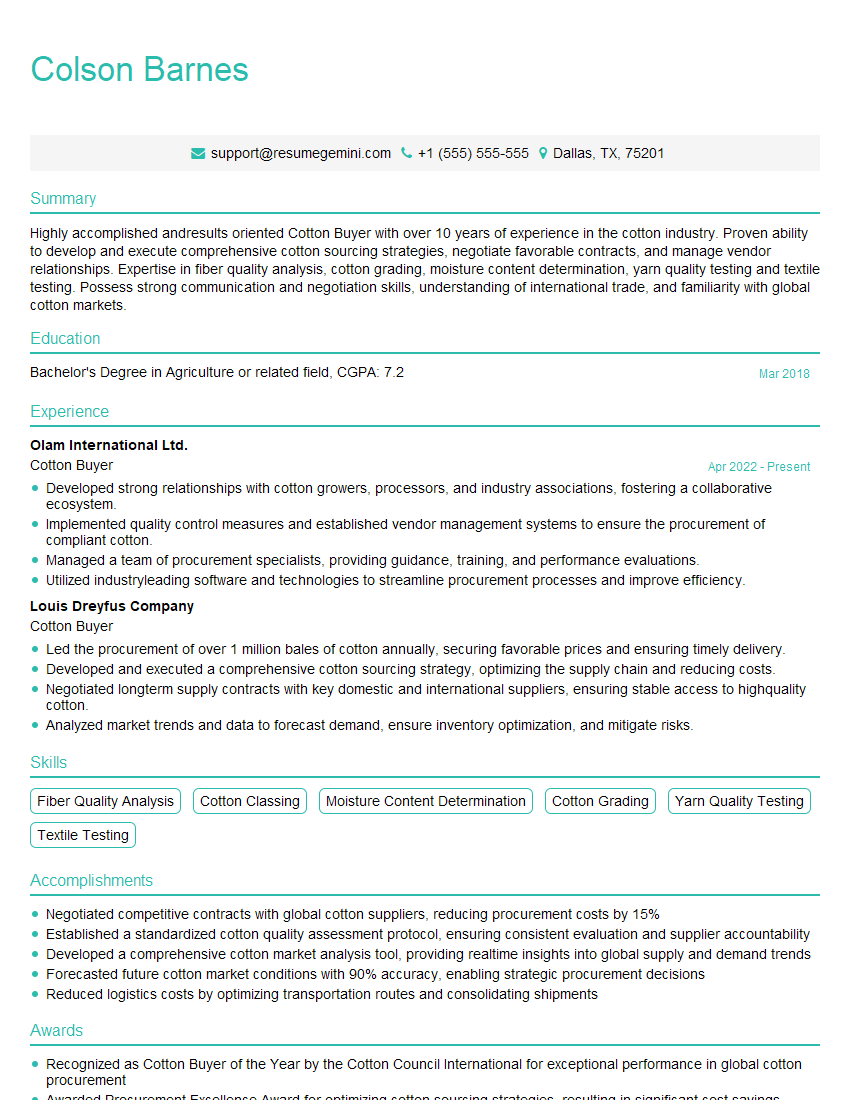
Mastering Cotton Economics is crucial for career advancement in the agricultural and textile industries, opening doors to exciting roles in trading, research, policy, and agricultural management. To maximize your job prospects, creating a strong, ATS-friendly resume is essential. ResumeGemini is a trusted resource to help you build a professional resume that highlights your skills and experience effectively. Examples of resumes tailored to the Cotton Economics field are available to guide you through this process, ensuring your application stands out.
Explore more articles
Users Rating of Our Blogs
Share Your Experience
We value your feedback! Please rate our content and share your thoughts (optional).
What Readers Say About Our Blog
To the interviewgemini.com Webmaster.
Very helpful and content specific questions to help prepare me for my interview!
Thank you
To the interviewgemini.com Webmaster.
This was kind of a unique content I found around the specialized skills. Very helpful questions and good detailed answers.
Very Helpful blog, thank you Interviewgemini team.