Interviews are more than just a Q&A session—they’re a chance to prove your worth. This blog dives into essential Power Electronics Repair interview questions and expert tips to help you align your answers with what hiring managers are looking for. Start preparing to shine!
Questions Asked in Power Electronics Repair Interview
Q 1. Explain the different types of power electronic converters.
Power electronic converters are circuits that change the voltage, current, and frequency of an electrical power supply. They are crucial components in many applications, from cell phone chargers to electric vehicle motor drives. They’re classified primarily by their function:
- AC-DC Converters (Rectifiers): These convert alternating current (AC) from the mains to direct current (DC). Examples include bridge rectifiers, used in almost all electronic devices that plug into the wall.
- DC-DC Converters: These change one DC voltage level to another. This is incredibly common, as many electronic components require specific voltages. Buck, boost, and buck-boost converters fall into this category.
- DC-AC Converters (Inverters): These convert DC to AC, often at a specific frequency. Solar panels generate DC power, but inverters are needed to feed AC power back into the grid or to power AC devices.
- AC-AC Converters: These change the voltage and/or frequency of an AC signal. Cycloconverters and AC voltage regulators are examples; they are often used in industrial applications.
Each type uses different switching techniques and components to achieve its conversion function. The choice depends on the application’s specific voltage and current requirements and efficiency needs.
Q 2. Describe the working principle of a buck converter.
A buck converter, also known as a step-down converter, reduces a higher DC input voltage to a lower DC output voltage. Imagine it like a water valve—it controls the flow of energy to achieve a desired lower pressure.
It works using a switching element (typically a MOSFET) that rapidly switches on and off, creating a chopped DC signal. This chopped signal is then passed through an inductor and a capacitor. The inductor stores energy during the on-time, and the capacitor smooths out the voltage fluctuations, producing a relatively constant lower DC output voltage.
During the MOSFET’s ON state, current flows from the input to the output through the inductor. During the OFF state, the inductor’s stored energy continues to flow to the output through a diode. The duty cycle (the percentage of time the MOSFET is ON) determines the output voltage. A higher duty cycle leads to a higher output voltage (though still lower than the input).
//Simplified example: Output Voltage = Input Voltage * Duty CycleBuck converters are incredibly efficient and are widely used in laptop power adapters, mobile phone chargers, and many other power supply applications.
Q 3. How does a boost converter work and what are its applications?
A boost converter, or step-up converter, increases a lower DC input voltage to a higher DC output voltage. Think of it like a pump—it boosts the energy level.
It also uses a switching element (usually a MOSFET) and an inductor. When the MOSFET is ON, current flows through the inductor, storing energy. When the MOSFET is OFF, the inductor releases its stored energy into the output capacitor through a diode. This results in an output voltage higher than the input voltage.
The output voltage is higher than the input and is determined by the duty cycle and the input voltage. A higher duty cycle will lead to a higher output voltage, but there are practical limits.
Boost converters are used in various applications, including:
- Battery-powered devices: Boosting a low battery voltage to power a higher-voltage circuit.
- Solar power systems: Increasing the low voltage from solar panels to a usable level.
- DC-DC converters in automobiles: Stepping up the 12V car battery voltage to higher voltages for electronic systems.
Q 4. What are the different types of power MOSFETs and their characteristics?
Power MOSFETs (Metal-Oxide-Semiconductor Field-Effect Transistors) are crucial switching elements in power electronics due to their fast switching speeds and high current handling capabilities. There are several types, categorized based on their structure and characteristics:
- N-Channel MOSFETs: These are the most common type. They conduct current when a positive voltage is applied to the gate. They generally have lower on-resistance than P-channel MOSFETs.
- P-Channel MOSFETs: These conduct current when a negative voltage is applied to the gate. They are often used in complementary pairs with N-channel MOSFETs in H-bridge configurations.
- Vertical MOSFETs: These have a vertical structure, optimizing for high voltage and low on-resistance.
- Lateral MOSFETs: These have a lateral structure, typically used for lower voltage applications.
The key characteristics to consider when selecting a MOSFET include:
- On-resistance (RDS(on)): Lower is better as it reduces power losses.
- Breakdown voltage (VDSS): The maximum voltage the MOSFET can withstand.
- Switching speed: Faster switching minimizes switching losses.
- Gate charge (Qg): Affects switching speed and gate driver design.
The selection of the appropriate MOSFET depends heavily on the specific application’s voltage and current requirements and the desired switching frequency.
Q 5. Explain the concept of switching losses in power converters.
Switching losses in power converters are energy losses that occur during the transitions between the ON and OFF states of the switching elements (MOSFETs, IGBTs, etc.). These losses are significant, particularly at higher switching frequencies.
There are two main types of switching losses:
- Turn-on loss: Energy is lost during the time it takes for the switch to fully turn on. During this transition, both the switch and the diode conduct, resulting in current flowing through both components, generating heat.
- Turn-off loss: Energy is lost during the turn-off transition. Similar to turn-on, both the switch and diode conduct briefly creating power loss.
These losses manifest as heat in the switching devices, requiring appropriate heatsinks to prevent overheating and component failure. Careful design of the gate drive circuit can minimize these losses by ensuring fast and efficient switching.
Minimizing switching losses is critical for improving efficiency and reducing the size and cost of power converters. Techniques like soft-switching (using resonant circuits or zero-voltage switching) can significantly reduce these losses.
Q 6. How do you troubleshoot a faulty power supply?
Troubleshooting a faulty power supply requires a systematic approach to identify the root cause. Safety is paramount; always disconnect the power supply from the mains before starting any troubleshooting.
Here’s a step-by-step approach:
- Visual Inspection: Check for any obvious signs of damage, such as burnt components, bulging capacitors, or loose connections.
- Input Voltage Check: Verify the input voltage is within the specified range using a multimeter. A faulty mains connection or voltage surge could be the problem.
- Output Voltage Check: Use a multimeter to measure the output voltage. Compare it to the specified value. A significant deviation points to an issue within the converter circuitry.
- Component Testing: Test key components such as diodes, capacitors, and transistors using a multimeter or specialized component tester. Look for shorts, opens, or out-of-spec values.
- Switching Element Check (MOSFET, IGBT): If dealing with switching converters, check the switching elements for proper operation. This might require more advanced test equipment, such as an oscilloscope.
- Control Circuitry Check: Examine the control circuitry (if accessible) for any faults. This often involves using an oscilloscope to observe waveforms and identify anomalies.
- Load Test: Once repairs are made, test the power supply under load to ensure it operates correctly and can handle the intended current.
Proper documentation and schematic diagrams are indispensable for effective troubleshooting. If you’re uncertain about any step, it’s best to consult a qualified technician.
Q 7. What are common causes of power supply failure?
Power supply failures can stem from a variety of causes, many related to aging components or environmental factors:
- Electrolytic Capacitor Failure: Electrolytic capacitors are prone to drying out over time, leading to reduced capacitance or even short circuits. This is a very common cause of power supply failure.
- Transistor or MOSFET Failure: Overheating, overvoltage, or age can cause transistors and MOSFETs to fail, leading to power supply malfunction or complete shutdown.
- Diode Failure: Diodes can fail due to excessive current or voltage, leading to open or short circuits.
- Overvoltage or Undershoots: Transient voltage spikes (surges) or prolonged undervoltage can damage components within the power supply.
- Overheating: Inadequate cooling can cause components to overheat and fail.
- Fuse Failure: A blown fuse is a protective measure, often indicating an underlying fault in the power supply circuitry.
- EMI/RFI Interference: Electromagnetic interference (EMI) or radio-frequency interference (RFI) can cause malfunctions or erratic behavior.
Preventative maintenance, such as regularly checking for bulging or leaking capacitors, and ensuring adequate ventilation, can help extend the lifespan of power supplies.
Q 8. Describe different fault-finding techniques for power electronic circuits.
Fault-finding in power electronics requires a systematic approach combining visual inspection, measurements, and analysis. Think of it like detective work – you need to gather clues to identify the culprit.
Visual Inspection: This is the first step. Look for obvious signs of damage like burned components (resistors, capacitors, inductors), loose connections, broken solder joints, or physical damage to the circuit board. For example, a bulging capacitor is a clear indication of internal failure.
Component Testing: Once you’ve visually inspected the circuit, use a multimeter to test individual components. Check for shorts, opens, and correct values of resistors, capacitors, and diodes. A simple continuity test can quickly identify open circuits. For example, a shorted diode will show a low resistance in both forward and reverse bias.
Signal Tracing: Use an oscilloscope (explained in more detail in a later answer) to observe voltage and current waveforms at various points in the circuit. This helps identify areas with unusual or unexpected signals, pointing towards faulty components or sections.
Controlled Power-Up: Before applying full power, start with a reduced voltage to minimize damage in case there’s a significant fault. Gradually increase the voltage while monitoring the circuit’s behavior.
Logic Analysis (for complex circuits): In more intricate power electronics systems, using a logic analyzer to track digital control signals can pinpoint problems within the control circuitry. This is particularly useful in SMPS troubleshooting.
Remember to always document your findings and measurements. A well-maintained logbook is crucial for effective troubleshooting.
Q 9. What safety precautions should be taken while repairing power electronics?
Safety is paramount when working with power electronics. High voltages and currents are involved, and a single mistake can lead to serious injury or death.
High Voltage Awareness: Always assume that capacitors are charged even after the power is disconnected. Discharge them using a proper discharge tool before handling. A quick touch can result in a painful shock, and a larger capacitor can be lethal.
Personal Protective Equipment (PPE): Wear appropriate PPE, including safety glasses, insulated gloves, and safety shoes. These protect you from electrical shock, burns, and flying debris.
Proper Tools: Use insulated tools and test equipment to avoid electrical shocks. Ensure all your tools are in good working condition.
Working Environment: Work in a well-ventilated area to avoid exposure to fumes or gases. Ensure the work area is clean, organized, and free from hazards.
Lockout/Tagout Procedures: If you’re working on a system connected to a larger power grid, implement proper lockout/tagout procedures to prevent accidental energizing of the equipment.
Never work alone. Have someone nearby who can assist in case of an emergency.
Q 10. Explain the use of oscilloscopes in power electronics troubleshooting.
The oscilloscope is an indispensable tool for power electronics troubleshooting. It allows you to visualize voltage and current waveforms in real-time, revealing anomalies that a multimeter might miss. Think of it as an ‘X-ray’ for electrical signals.
Waveform Analysis: An oscilloscope displays voltage and current waveforms, enabling you to check for correct shapes, frequencies, and amplitudes. For example, a distorted switching waveform in a DC-DC converter could indicate a faulty MOSFET or control circuitry.
Timing Measurements: It accurately measures the time intervals between events, vital in analyzing the switching behavior of power semiconductors. Measuring the dead time between switches is critical in preventing shoot-through in many converter topologies.
Voltage and Current Measurements: Besides showing waveform shapes, the oscilloscope can provide precise voltage and current measurements. Measuring the peak-to-peak voltage across a MOSFET during switching can help diagnose overvoltage issues.
Signal Integrity: It reveals signal noise and interference, which can point to problems with grounding, shielding, or component failures.
When using an oscilloscope, proper probe selection and grounding techniques are vital to get accurate measurements. Incorrect probing can lead to misleading or incorrect results.
Q 11. How do you diagnose problems with DC-DC converters?
Diagnosing problems with DC-DC converters involves a combination of techniques. A systematic approach will be your best friend.
Input Voltage Check: Verify that the input voltage is within the specified range. A low input voltage will directly affect the output.
Output Voltage Measurement: Measure the output voltage with a multimeter. Is it within the specifications? A significantly lower or higher voltage indicates a problem.
Load Test: Apply a known load to the converter and observe the output voltage. Does the voltage sag excessively under load? This might point to problems with the output capacitor or the switching circuitry.
Waveform Analysis: Use an oscilloscope to analyze the switching waveforms of the transistors or MOSFETs and the inductor current. Check for unusual spikes, ringing, or distorted waveforms. Unusual waveforms will highlight faulty components or design flaws.
Component Checks: Check the diodes, capacitors, and inductors for shorts, opens, or out-of-tolerance values using a multimeter.
Control Circuitry: In more complex converters, investigate the control circuitry using a multimeter or a logic analyzer to ensure correct control signals.
For example, a significant drop in the output voltage under load could indicate a faulty output capacitor, while a distorted switching waveform might point towards a faulty MOSFET or a control problem.
Q 12. How do you test and repair SMPS (Switch Mode Power Supplies)?
Testing and repairing SMPS (Switch Mode Power Supplies) requires a careful and methodical approach due to their complex circuitry and high voltages.
Safety First: Always discharge all high-voltage capacitors before working on the unit. Remember, high voltage is deadly.
Visual Inspection: Examine the board carefully for obvious damage, burnt components, or loose connections.
Input Voltage Check: Verify the input voltage is correct.
Output Voltage Measurement: Check the output voltage with a multimeter under no-load and full-load conditions.
Waveform Analysis: An oscilloscope is invaluable here. Analyze the switching waveforms of the MOSFETs or transistors, the control signals, and the current through the inductor.
Component Testing: Use a multimeter to test individual components like capacitors, resistors, diodes, and transistors. Pay close attention to the switching transistors as they often fail due to the stress of repeated switching cycles.
Control Circuit Testing: Test the control IC (often a PWM controller) and its associated components.
Protection Circuits: Check over-current, over-voltage, and short-circuit protection circuits. A faulty protection circuit can mask more subtle problems.
Remember to replace components with exact specifications to maintain the SMPS performance and stability. Improper replacement can cause further damage or instability.
Q 13. What are the different types of power semiconductors?
Power semiconductors are the workhorses of power electronics, forming the heart of switches and converters. They handle significant power, converting and controlling electrical energy.
Bipolar Junction Transistors (BJTs): These are relatively simple and widely used, but have limitations at high frequencies. They’re often used in simpler, lower-power applications.
Metal-Oxide-Semiconductor Field-Effect Transistors (MOSFETs): These are widely used in modern power electronics due to their fast switching speeds, low on-resistance, and ease of control. They’re the backbone of many modern high-frequency applications.
Insulated Gate Bipolar Transistors (IGBTs): These combine the advantages of BJTs and MOSFETs. They’re favored for high-power, high-voltage applications like motor drives and industrial power supplies. They offer a good balance of switching speed and power handling capacity.
Thyristors (SCRs, Triacs): Used for high-power applications where switching speed isn’t as critical, these can handle very high voltages and currents. They are often employed in older or very high-power control systems.
The choice of semiconductor depends on the specific application’s requirements for voltage, current, switching frequency, and cost.
Q 14. Explain the concept of thermal management in power electronics.
Thermal management is crucial in power electronics because power semiconductors generate significant heat during operation. Improper heat dissipation leads to reduced efficiency, performance degradation, and premature component failure. Think of it as keeping your engine from overheating.
Heat Sinks: These are passive devices that increase the surface area for heat transfer, allowing more efficient cooling. The size and design of the heat sink are critical to effective thermal management.
Fans: These are active cooling methods that force air across the heat sinks, improving heat dissipation, particularly important in higher-power applications.
Heat Pipes: These are passive devices that utilize the principles of evaporation and condensation to transfer heat effectively. They are especially useful for distributing heat evenly across a larger area.
Liquid Cooling: For high-power applications, liquid cooling systems offer better heat dissipation than air cooling. These systems can be complex but can keep even high-power components running well below their thermal limits.
Thermal Interface Materials (TIMs): These materials are placed between the semiconductor and the heat sink to minimize thermal resistance and ensure effective heat transfer. A poor thermal interface can significantly reduce cooling effectiveness.
Effective thermal management prolongs the lifespan of power electronics components, improves efficiency, and ensures reliable operation.
Q 15. Describe the importance of heatsinks in power electronics.
Heatsinks are crucial in power electronics because they manage the heat generated by power components. Power devices, like transistors and diodes, dissipate significant energy as heat during operation. This heat can cause a decrease in performance, damage components, and even lead to catastrophic failure. Heatsinks work by increasing the surface area available for heat dissipation, allowing the heat to transfer more efficiently to the surrounding environment. Think of it like this: a small candle flame is easier to extinguish than a large bonfire – the larger surface area of the bonfire makes heat dissipation much harder. The design of a heatsink, including its material (often aluminum or copper), fins, and contact with the component, significantly impacts its effectiveness. An improperly sized or installed heatsink can lead to overheating and premature component failure, while a well-designed one ensures reliable and long-lasting operation.
In a practical setting, consider a large power supply in a server rack. The power transistors inside generate considerable heat; without adequate heatsinking, these transistors will overheat and fail, taking down the entire system. Proper heatsink selection and mounting are critical for the longevity and reliability of such equipment.
Career Expert Tips:
- Ace those interviews! Prepare effectively by reviewing the Top 50 Most Common Interview Questions on ResumeGemini.
- Navigate your job search with confidence! Explore a wide range of Career Tips on ResumeGemini. Learn about common challenges and recommendations to overcome them.
- Craft the perfect resume! Master the Art of Resume Writing with ResumeGemini’s guide. Showcase your unique qualifications and achievements effectively.
- Don’t miss out on holiday savings! Build your dream resume with ResumeGemini’s ATS optimized templates.
Q 16. How do you identify different types of capacitors and inductors?
Identifying capacitors and inductors involves several techniques. For capacitors, you need to look at physical markings and characteristics. Look for markings indicating capacitance value (in µF or pF), voltage rating (in volts), and sometimes tolerance. The physical size is often an indicator of capacitance and voltage rating – larger units typically have higher capacitance and/or voltage. Capacitor types also have distinctive features; for example, electrolytic capacitors often have a polarity indicator (a positive (+) and negative (-) symbol). Ceramic capacitors are usually smaller and have different markings than electrolytic capacitors. Inductors are identified similarly, with markings indicating inductance value (in µH or mH), current rating (in amps), and sometimes resistance. Their physical size usually correlates with inductance and current rating.
We can also use tools like a multimeter. For a capacitor, a multimeter’s capacitance function can directly measure the capacitance value, while for an inductor, we can measure its resistance (DC resistance or DCR) and often use an LCR meter to measure the inductance directly. Visual inspection can reveal physical damage, such as bulges, cracks, or burned markings, which indicate potential failure.
Q 17. What are the common problems with capacitors and inductors?
Common problems with capacitors include: bulging (due to internal pressure buildup from overheating or electrolyte leakage), shorted capacitors (resulting in a short circuit, often manifested by no resistance on a multimeter test), open capacitors (which create an open circuit, showing infinite resistance), and decreased capacitance (leading to a reduction in the device’s performance). Inductors often fail due to overheating, causing insulation breakdown and short circuits between windings. Physical damage from vibration or impact can break the wires connecting to the inductor or damage the coil itself. Soldering issues can also cause failures in both capacitors and inductors.
For example, a bulging capacitor in a power supply can cause intermittent operation or complete failure. Similarly, a shorted inductor can lead to excessive current draw and potential component damage. Regular inspection and preventive maintenance, including the use of thermal imaging cameras to detect overheating, is crucial for avoiding these issues.
Q 18. How do you troubleshoot a faulty integrated circuit (IC) in a power supply?
Troubleshooting a faulty IC in a power supply is a systematic process. First, you should visually inspect the IC for any physical damage. Look for burn marks, cracks, or loose connections. Then, using a multimeter, check the power supply rails leading to the IC. Ensure that the supply voltages are within specifications. A failed IC may not have correct voltages on its power pins. Then, check the input and output signals of the IC, comparing them to the expected values based on the circuit schematic.
If you suspect the IC is faulty, you may want to try replacing it with a known good part. However, before doing so, it’s crucial to ensure other components around it are also functioning properly to avoid a repeat failure. You should also consider checking passive components such as capacitors and resistors that are connected to the IC. This is crucial as a faulty component may have damaged the IC. If the problem persists after replacing the IC and checking other related components, the fault may lie elsewhere in the circuit.
It’s helpful to use an oscilloscope to examine the waveforms and signals in the circuit and check for any abnormal behavior, which can indicate where the failure originates. Remember, always use proper ESD (electrostatic discharge) precautions to prevent damaging sensitive components.
Q 19. What are the different types of feedback control mechanisms used in power converters?
Power converters utilize various feedback control mechanisms to regulate the output voltage or current. Common types include:
- Voltage Mode Control: This directly controls the output voltage. A feedback signal comparing the actual output voltage with the desired setpoint is used to adjust the duty cycle of the PWM signal. It’s simple to implement but can have issues with instability at high frequencies.
- Current Mode Control: This method controls the output current. The feedback signal monitors the output current, adjusting the duty cycle to maintain a constant current. It offers faster transient response and improved stability compared to voltage mode but can suffer from subharmonic oscillations.
- Peak Current Mode Control: A variant of current mode control; it senses the peak current in each switching cycle, providing better current limiting and reducing the risk of subharmonic oscillations.
- Average Current Mode Control: Another variation; it uses the average current, rather than peak current, for better stability under variable load conditions. It can be more complex to implement.
The choice of feedback control mechanism depends on the specific application and performance requirements. For instance, current mode control is often preferred for applications requiring fast dynamic response, such as motor drives, while voltage mode control might be suitable for less demanding applications where simplicity and cost-effectiveness are key considerations.
Q 20. Explain the concept of pulse-width modulation (PWM).
Pulse-Width Modulation (PWM) is a technique used to control the average power delivered to a load by varying the width of the pulses of a periodic signal. Imagine a light dimmer switch: it doesn’t actually turn the light fully on and off, but instead rapidly switches it on and off many times per second. The longer the light is on in each cycle, the brighter it appears. PWM operates on a similar principle; the switching frequency is much higher (typically in the kilohertz or megahertz range). A PWM signal is a square wave where the width (or duty cycle) of the high pulse is varied to control the average output.
A 50% duty cycle means the pulse is high for half the period and low for the other half. This results in half the maximum power. A 10% duty cycle will deliver 10% of the maximum power, and so on. PWM is extensively used in power converters because it allows for precise control of the output power, high efficiency, and reduced switching losses compared to other methods.
Q 21. How do you calculate the efficiency of a power converter?
The efficiency of a power converter is calculated as the ratio of output power to input power, typically expressed as a percentage. The formula is:
Efficiency (%) = (Output Power / Input Power) * 100
Output Power is the actual power delivered to the load, while Input Power is the power drawn from the source. Both powers are typically measured in Watts (W). To measure these, you need to measure the voltage and current at both the input and output of the converter.
For example, if a converter has an input voltage of 12V and draws 5A (Input Power = 60W) and delivers 10V at 4A to the load (Output Power = 40W), its efficiency would be:
Efficiency (%) = (40W / 60W) * 100 = 66.7%
Losses in a power converter are due to various factors like conduction losses in transistors and diodes, switching losses, and losses in passive components. Improving the efficiency is crucial for reducing energy waste and heat generation in power electronics systems.
Q 22. What are the different types of power electronic systems?
Power electronic systems are everywhere, from the smallest gadgets to the largest industrial machines. They are essentially circuits that control and convert electrical power. The main categories are:
- AC-DC Converters (Rectifiers): These convert alternating current (AC) from the mains supply into direct current (DC), often used to power electronic devices. Think of your phone charger – that’s a rectifier.
- DC-DC Converters: These change one DC voltage level to another. Your laptop’s power adapter, which takes the mains AC, converts it to DC, and then converts that DC to a lower voltage for the laptop, is an example of a rectifier followed by a DC-DC converter.
- DC-AC Converters (Inverters): These turn DC into AC. Solar panels generate DC power; an inverter converts this into the AC used in homes.
- AC-AC Converters (Cycloconverters): These change the AC voltage level or frequency. These are less common but are used in some specialized industrial applications.
Each category encompasses various topologies (circuit configurations), like buck, boost, and bridge converters, each optimized for specific applications and performance requirements.
Q 23. Describe your experience with different types of soldering techniques.
My soldering experience is extensive, encompassing various techniques crucial for delicate power electronics repair. I’m proficient in:
- Through-hole soldering: This is the traditional method of soldering components with leads into holes on a printed circuit board (PCB). I use this for larger components and situations requiring robust connections.
- Surface mount technology (SMT) soldering: This involves soldering very small components directly onto the surface of a PCB. This requires precision and often involves specialized tools like a hot air rework station and fine-tipped soldering irons for different component sizes and heat sensitivities.
- Reflow soldering: This is a process for SMT components where the entire PCB is heated in an oven to melt the solder paste, allowing for mass production and highly reliable connections. I’m experienced in troubleshooting reflow soldering issues, identifying defects, and making repairs.
- Soldering with different alloys: I’m familiar with various solder types, including lead-free (SnPb) and lead-containing (Pb-free), choosing the appropriate alloy based on the application’s temperature requirements and component sensitivity.
Beyond the technique, I prioritize clean soldering, minimizing the risk of shorts and ensuring long-term reliability.
Q 24. What software and tools are you familiar with for power electronics repair?
For power electronics repair, I utilize a range of software and tools. My proficiency includes:
- Schematic capture software: I’m comfortable using software like Altium Designer, Eagle, and KiCad to view, analyze, and even modify schematics. This is essential for understanding circuit operation and troubleshooting.
- Simulation software: Software like LTSpice or PSIM helps in simulating circuit behavior and predicting outcomes before making any physical changes, saving time and avoiding potential damage.
- Data acquisition and analysis tools: I’m familiar with oscilloscopes (both digital and analog), multimeters (including clamp meters for current measurement), function generators for signal injection, and spectrum analyzers for frequency analysis. This allows for comprehensive testing and fault diagnosis.
- Specialized tools: These include hot air rework stations, soldering irons with various tips, desoldering tools, and microscopes for inspecting fine details.
Q 25. Explain your experience in reading and interpreting schematics.
Reading and interpreting schematics is fundamental to my work. I can easily decipher component values (resistors, capacitors, inductors), trace signal paths, understand power supply configurations, and identify potential failure points. My experience allows me to quickly grasp the circuit’s overall function and isolate problem areas.
For instance, I can use a schematic to understand the gate drive circuit of an IGBT (Insulated Gate Bipolar Transistor), identifying the components responsible for controlling the switching of the IGBT and pinpoint potential issues like gate drive resistor failures that lead to poor switching performance.
I approach schematic reading systematically, starting with the power supply and tracing the signal flow to understand the overall functionality before focusing on specific sections of interest. This methodical approach is crucial for efficient troubleshooting.
Q 26. Describe a challenging power electronics repair you successfully completed.
One challenging repair involved a high-power inverter used in a solar energy system. The inverter had failed completely, and initial diagnostics pointed towards multiple potential sources of failure. It displayed symptoms of erratic switching and excessive heating.
My approach involved:
- Systematic Inspection: I began with a visual inspection to check for obvious damage like burnt components or loose connections.
- Component-Level Testing: I tested various components – IGBTs, diodes, capacitors, and gate driver ICs – using a multimeter, oscilloscope, and curve tracer to isolate faulty elements.
- Schematic Analysis: I consulted the schematic to understand the interactions of different parts and trace potential paths of failures, using the test results to confirm or reject failure hypotheses.
- Targeted Repair: This led me to identify a few faulty IGBT modules and several shorted filter capacitors. I replaced these components, ensuring proper heatsinking and connection.
- Functional Testing: After the repair, rigorous functional testing was performed, including measuring output voltage, current waveforms, and efficiency under various load conditions. The system functioned perfectly after the repair.
This repair highlighted the importance of systematic troubleshooting and accurate component-level testing. Successfully completing this repair reinforced the significance of understanding the system’s overall design and operation.
Q 27. How do you handle high voltage circuits during repair?
Safety is paramount when working with high-voltage circuits. My procedures include:
- Complete Power Isolation: Before even touching the equipment, I always ensure the power supply is completely disconnected and locked out, often using a tag-out system for additional safety. I verify the absence of voltage using a high-voltage tester.
- Proper Personal Protective Equipment (PPE): I always wear appropriate PPE, including insulated gloves, safety glasses, and safety shoes. For extremely high voltages, specialized protective suits might be necessary.
- Discharge Capacitors: High-voltage circuits often contain large capacitors that store significant energy even when the power is off. I use appropriate discharge tools to safely dissipate this stored energy before starting any repair.
- Grounding Procedures: I ensure that the equipment is properly grounded to prevent dangerous static electricity buildup or shocks.
- Working with Assistants: For particularly dangerous high-voltage repairs, working with a colleague adds an extra layer of safety. Another person can monitor and assist during the process, improving safety.
Safety is never compromised; meticulous preparation and adherence to safety procedures are non-negotiable.
Q 28. Describe your experience with various testing equipment (e.g., multimeters, function generators).
My experience with various testing equipment is extensive. I regularly utilize:
- Multimeters: These are essential for basic measurements like voltage, current, and resistance. I’m proficient in using both digital and analog multimeters, understanding their limitations and applying appropriate techniques for accurate measurements.
- Oscilloscopes: These are crucial for analyzing waveforms, measuring frequency, amplitude, and rise/fall times. I can interpret complex waveforms to diagnose issues like switching transients, oscillations, and signal integrity problems.
- Function Generators: These are used to inject test signals into the circuit for simulating various operating conditions and observing the response. I use them to test the functionality of different circuit sections and identify potential weaknesses.
- Clamp Meters: These allow for non-invasive current measurements, useful in high-current circuits where direct connection may be challenging or unsafe. This is particularly helpful for detecting overcurrent conditions.
- Spectrum Analyzers: These are used to analyze the frequency content of signals, identifying unwanted noise or interference. This is useful in detecting conducted electromagnetic interference (EMI) or radiated EMI issues.
Beyond these common tools, I am familiar with more specialized equipment like power analyzers and insulation resistance testers, depending on the complexity of the repair task.
Key Topics to Learn for Power Electronics Repair Interview
- Fundamentals of Power Electronics: Understanding basic power electronic converters (buck, boost, buck-boost, inverters, rectifiers), their operation, and applications.
- Troubleshooting Techniques: Mastering systematic diagnostic approaches, including the use of multimeters, oscilloscopes, and other test equipment to identify faulty components.
- Component-Level Repair: Proficiency in identifying, replacing, and soldering various power electronic components such as MOSFETs, IGBTs, diodes, capacitors, and inductors.
- Switched-Mode Power Supply (SMPS) Repair: Deep understanding of SMPS architectures, control loops, and common failure modes.
- DC-DC Converter Repair: Expertise in diagnosing and repairing various types of DC-DC converters used in different applications.
- AC-DC Converter Repair: Knowledge of different rectifier topologies and their associated challenges in repair.
- Motor Drive Repair: Understanding the principles of motor control and the common issues encountered in repairing motor drive systems.
- Safety Procedures: Emphasis on safe handling of high-voltage and high-power equipment, adhering to safety regulations and best practices.
- Practical Application: Experience in repairing various power electronic devices such as chargers, inverters, power supplies in industrial settings, and renewable energy systems.
- Problem-Solving Methodology: Developing a structured approach to fault diagnosis, utilizing schematics, datasheets, and troubleshooting guides.
Next Steps
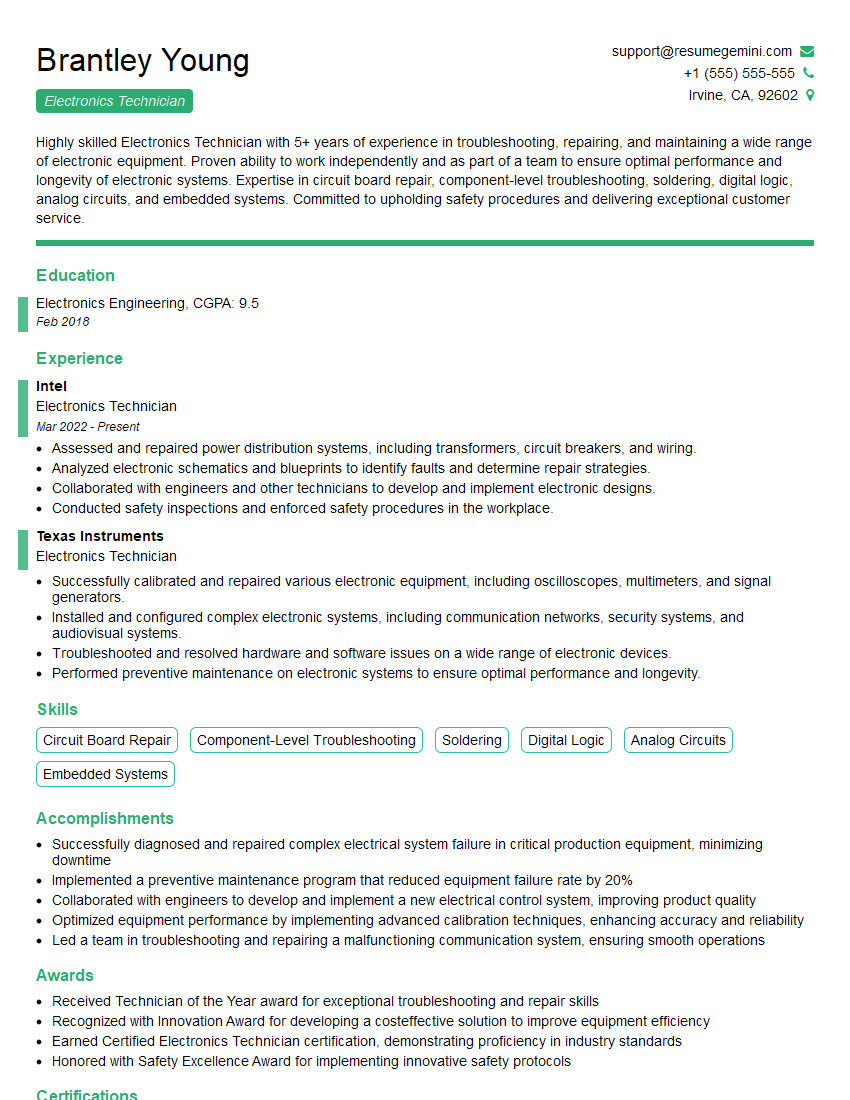
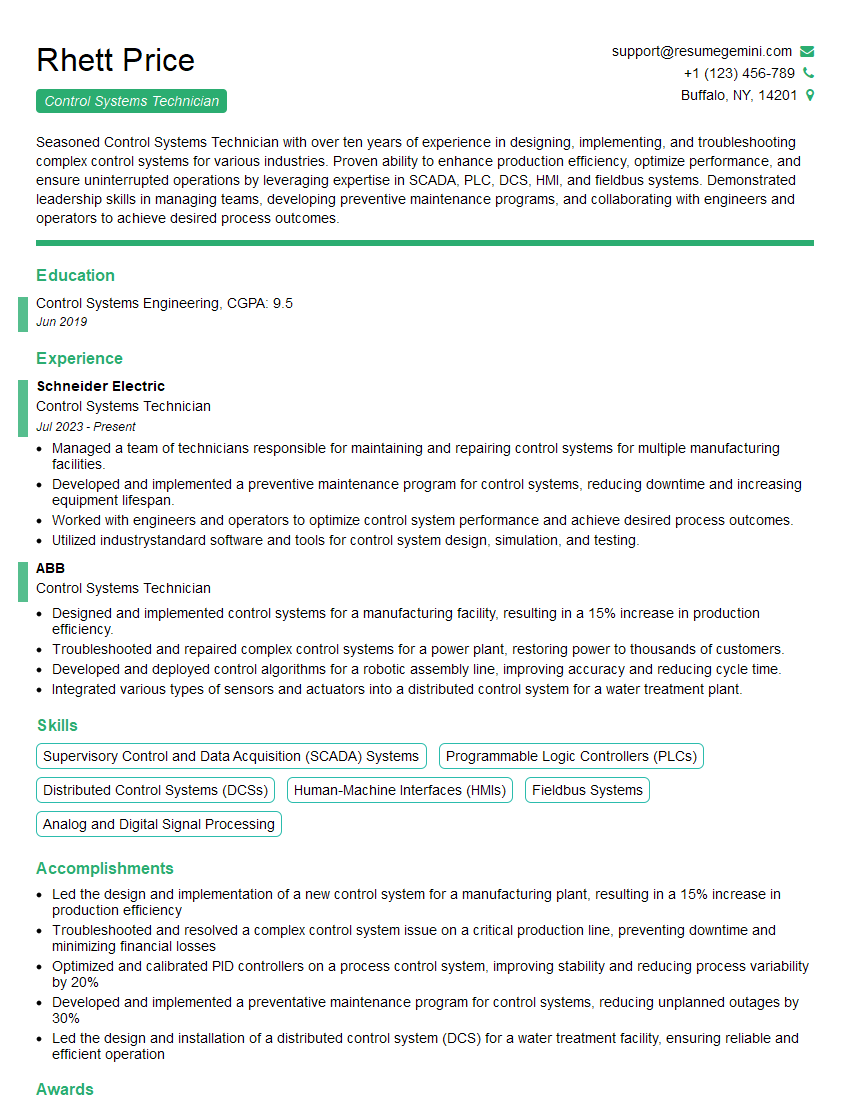
Mastering Power Electronics Repair opens doors to exciting and rewarding careers in diverse industries. A strong understanding of these crucial concepts will significantly boost your interview performance and ultimately your career prospects. To enhance your chances of landing your dream job, creating a compelling and ATS-friendly resume is paramount. ResumeGemini is a trusted resource that can help you build a professional and effective resume, tailored to highlight your skills and experience. Examples of resumes specifically tailored for Power Electronics Repair professionals are available through ResumeGemini to help you showcase your expertise effectively. Invest time in crafting a strong resume—it’s your first impression on potential employers.

Explore more articles
Users Rating of Our Blogs
Share Your Experience
We value your feedback! Please rate our content and share your thoughts (optional).
What Readers Say About Our Blog
To the interviewgemini.com Webmaster.
Very helpful and content specific questions to help prepare me for my interview!
Thank you
To the interviewgemini.com Webmaster.
This was kind of a unique content I found around the specialized skills. Very helpful questions and good detailed answers.
Very Helpful blog, thank you Interviewgemini team.