Cracking a skill-specific interview, like one for Grasping, requires understanding the nuances of the role. In this blog, we present the questions you’re most likely to encounter, along with insights into how to answer them effectively. Let’s ensure you’re ready to make a strong impression.
Questions Asked in Grasping Interview
Q 1. Explain the difference between precision and power grasps.
Precision grasps and power grasps represent two fundamental approaches to object manipulation. Think of it like this: a precision grasp is like delicately holding a teacup, while a power grasp is like firmly gripping a heavy suitcase.
Precision grasps involve using the fingers and thumb to precisely manipulate small or delicate objects. The object is typically held between the fingertips, allowing for fine motor control and dexterity. Examples include picking up a pen, assembling small electronics, or performing microsurgery. The force applied is relatively low, prioritizing control over strength.
Power grasps, on the other hand, emphasize strength and stability over precision. The object is usually held within the palm, with the fingers and thumb providing a secure grip. This is suitable for large or heavy objects where the primary goal is to securely hold the object rather than manipulate it precisely. Examples include lifting a box, carrying a heavy tool, or holding a steering wheel. A higher force is applied, ensuring the object doesn’t slip.
Q 2. Describe various types of robotic grippers and their applications.
Robotic grippers come in a vast array of designs, each tailored to specific applications. The choice of gripper depends heavily on the object’s properties and the task’s requirements.
- Parallel/Two-Finger Grippers: These are simple, robust, and cost-effective. They’re suitable for cylindrical objects and are commonly used in industrial automation like pick-and-place tasks. Think of a simple claw-like gripper.
- Three-Finger Grippers: Offering improved dexterity than two-finger grippers, they can grasp a wider range of object shapes. They’re used in applications requiring more refined manipulation.
- Vacuum Grippers: These use suction to grasp flat or smooth objects. They are commonly found in logistics and manufacturing for handling boxes, sheets, or similar items. Think of the suction cups on a robotic arm used to lift glass.
- Magnetic Grippers: Ideal for ferromagnetic materials, these are simple and strong. They’re often used in scrap metal handling or automotive manufacturing.
- Adaptive Grippers: These are designed to adapt to various object shapes and sizes. Examples include soft robotic grippers made from flexible materials like silicone, or grippers with multiple articulating fingers and sensors.
- Underwater Grippers: These grippers need to operate in the specific conditions of underwater environments and are often more robust to deal with increased pressure and corrosion.
The applications are diverse and span various industries, including manufacturing, logistics, healthcare, and even space exploration.
Q 3. What are the challenges in designing a robust grasping system for unstructured environments?
Designing robust grasping systems for unstructured environments presents significant challenges due to the unpredictable nature of the surroundings. Unlike a controlled factory setting, real-world environments are messy and cluttered.
- Object Variability: Objects can vary significantly in shape, size, weight, material properties, and orientation. A gripper designed for perfectly shaped blocks will struggle with irregularly shaped objects.
- Occlusion and Clutter: Objects might be partially hidden or surrounded by other objects, making it difficult to locate and grasp the target item. A robotic arm may not be able to reach a box completely hidden behind other items.
- Sensor Noise and Uncertainty: Sensors used for object detection and manipulation are susceptible to noise and inaccuracies, affecting the accuracy and reliability of grasping. A sensor might misinterpret the position or shape of an object, causing a failed grasp.
- Real-time Constraints: Grasping operations often need to be performed quickly and efficiently, which places constraints on the computational complexity of the algorithms used for planning and control. A slow system may not be able to react to changing conditions.
Addressing these challenges requires advanced sensing, sophisticated grasp planning algorithms, and robust control strategies.
Q 4. How do you handle uncertainties in object shape, size, and position during grasping?
Handling uncertainties in object properties requires a multi-pronged approach that combines robust perception, adaptive control, and intelligent planning.
- Advanced Sensing: Employing multiple sensors such as cameras, tactile sensors, and force/torque sensors allows for a more comprehensive understanding of the object’s state. Vision systems can provide information about shape and position, while tactile sensors can provide information about surface texture and slip.
- Adaptive Control: Implementing adaptive control algorithms enables the gripper to adjust its actions based on real-time sensory feedback. If the object slips, the controller can adjust the grip force or finger placement to maintain a stable grasp.
- Probabilistic Grasp Planning: Grasp planning algorithms should incorporate uncertainty in object properties, planning multiple potential grasps to increase the success rate. This might involve generating a range of potential grasp configurations, ranked by their probability of success.
- Learning-Based Approaches: Machine learning techniques, such as reinforcement learning, can be used to train robots to grasp objects in uncertain conditions. The robot learns through trial and error, improving its grasping performance over time.
The key is to develop systems that can tolerate inaccuracies and adapt to unexpected situations.
Q 5. Explain the concept of force closure and its importance in grasping.
Force closure is a crucial concept in grasping that ensures an object remains firmly held even under external disturbances. Imagine trying to hold a slippery bar of soap; force closure is what ensures you don’t drop it.
A grasp is considered to be in force closure if the object is completely constrained in all six degrees of freedom (three translational and three rotational). This means that no matter which direction a force is applied to the object, the gripper can counteract it and prevent the object from moving. This is achieved by having multiple contact points and ensuring that the forces applied by the gripper at these points can create a resultant force that always opposes any external force.
Importance: Force closure guarantees a secure and robust grasp, preventing slippage and object dropping, especially in dynamic or unpredictable environments. It’s essential for reliable object manipulation in applications ranging from manufacturing to surgery.
Q 6. Describe different grasp planning algorithms and their advantages/disadvantages.
Several grasp planning algorithms exist, each with its own strengths and weaknesses. The choice depends on factors such as computational cost, accuracy requirements, and the complexity of the environment.
- Analytical Methods: These methods use mathematical models to compute grasps that satisfy force closure conditions. They can be computationally expensive but guarantee a stable grasp if successful. However, they often struggle with complex object shapes.
- Geometric Methods: These methods focus on finding grasps that maximize the contact area between the gripper and the object. They are often less computationally intensive than analytical methods, but may not guarantee force closure.
- Optimization-Based Methods: These methods use optimization techniques to find grasps that satisfy various criteria, such as maximizing stability, minimizing force, or maximizing the distance to the object’s center of mass. They provide flexibility but may be computationally demanding.
- Learning-Based Methods: These use machine learning to learn grasp strategies from data, offering adaptability and resilience to unseen objects. However, they require a substantial amount of training data.
Each approach has its pros and cons, and the best choice often involves a hybrid approach combining different techniques.
Q 7. How do you address issues of slippage and object dropping during grasping?
Slippage and object dropping are critical issues that must be addressed in any robust grasping system. The goal is to predict and prevent these failures before they occur.
- Force/Torque Sensing: Monitoring the forces and torques applied by the gripper allows for real-time detection of slippage. A sudden decrease in gripping force or an unexpected torque indicates slippage, enabling immediate corrective action.
- Adaptive Grip Control: Implementing adaptive control algorithms allows the gripper to dynamically adjust its grip force and finger placement to compensate for slippage. This means actively adjusting the grip in response to real-time sensor readings.
- Friction Modeling: Accurate modeling of the frictional forces between the gripper and the object allows for a more accurate prediction of slippage. This can inform decisions about appropriate grip forces and contact locations.
- Redundant Grasps: Using redundant grasp configurations, whereby multiple contact points are maintained, provides a safety net in case one contact point fails. This increases robustness.
- Tactile Sensing: Incorporating tactile sensors enables a more refined understanding of the contact between the gripper and the object, allowing for early detection of impending slippage.
By combining these approaches, we create grasping systems that are far less prone to the problems of slippage and object dropping.
Q 8. Explain the role of sensor data (e.g., force/torque, vision) in grasping control.
Sensor data is absolutely crucial for robust and adaptable grasping. Think of it like our own sense of touch and sight – we use them constantly to pick things up. For a robot, sensors provide the feedback necessary to adjust its grip in real-time.
Force/Torque sensors, embedded in the gripper fingers or wrist, measure the forces and torques applied during grasping. This information is essential for determining if an object is securely held, preventing slippage, or detecting unexpected impacts. For example, if the force sensor detects a sudden drop in gripping force, the robot can immediately adjust its grip to compensate.
Vision systems (cameras) provide crucial geometric information about the object’s shape, pose, and location. This helps the robot plan a suitable grasp, identifying stable grasp points and avoiding precarious configurations. For example, a vision system might analyze the shape of a bottle to determine the optimal location to grasp it—avoiding the fragile neck and gripping the body instead. The integration of both force/torque and vision data allows for more robust and reliable grasping, handling variability in object pose and properties.
Q 9. Discuss different control strategies for robotic grasping (e.g., impedance, force, position).
Robotic grasping control strategies can be broadly classified into position, force, and impedance control. Each has its strengths and weaknesses.
- Position Control: This is the simplest approach. The robot attempts to move its gripper to a pre-planned position and orientation. It’s effective for rigid objects in predictable environments but struggles with variations in object pose or unexpected forces. Think of a simple pick-and-place operation from a perfectly organized bin.
- Force Control: Here, the robot aims to maintain a specific force on the object during grasping. This is crucial for delicate objects that require gentle handling or when interaction with the environment is involved. Imagine carefully picking up a fragile egg; force control prevents crushing.
- Impedance Control: This is a more sophisticated approach that combines aspects of both position and force control. The robot maintains a desired relationship between force and position. It allows for compliance, accommodating variations in object pose or external disturbances. This is ideal for grasping objects with uncertain properties or in dynamic environments, like a robot assembling parts on a moving conveyor belt. It’s like having a soft hand – you can adjust your grip based on how much resistance you feel.
Q 10. How do you design a grasping system for a specific object with known properties?
Designing a grasping system for a specific object starts with a thorough understanding of its properties. This is an iterative process.
- Object Analysis: Determine the object’s size, shape, weight, material properties (rigidity, fragility, texture), and possible variations. Use CAD models, 3D scans, or manual measurements. For instance, a cylindrical object will require a different grasp than a cube.
- Grasp Point Selection: Identify stable and secure grasp points. Factors like friction, center of mass, and the object’s geometry influence this decision. We’d want to avoid grasping delicate parts or areas with low friction. For example, you wouldn’t grip a cup by its handle.
- Gripper Design: Choose a gripper type suitable for the object and selected grasp points. This might be a parallel gripper, three-fingered hand, or a custom-designed gripper. This choice is guided by object properties and desired manipulation. Consider how much force needs to be applied to grip the object safely.
- Control Strategy Selection: Choose an appropriate control strategy (position, force, or impedance control) based on the object’s characteristics and the environment. For a fragile object, force control would be preferable.
- Sensor Integration: Integrate appropriate sensors (force/torque, vision, tactile) to provide feedback for accurate and robust grasping. Vision aids in locating the object, and force sensors help avoid slippage.
- Simulation and Testing: Conduct simulations and real-world testing to validate the design. Refine the system based on experimental results. This crucial step ensures that the system operates reliably in different scenarios.
Q 11. Explain the concept of tactile sensing and its relevance to grasping.
Tactile sensing refers to the ability of a robotic gripper to sense the physical properties of an object through direct contact. Think of it as giving the robot a sense of touch. Tactile sensors provide rich information regarding surface texture, pressure distribution, slip, and object shape, exceeding the capabilities of vision alone.
Its relevance to grasping is immense. Tactile information enhances the robustness and adaptability of grasping systems. For instance, a tactile sensor can detect if an object is slipping, allowing the robot to adjust its grip accordingly. It can also provide information about the object’s shape and texture that might be difficult or impossible for vision systems to detect, allowing for more nuanced and secure grasps. Tactile sensing is particularly crucial for grasping objects with complex shapes or uncertain properties.
Q 12. Describe the challenges of grasping deformable objects.
Grasping deformable objects presents several significant challenges that are not encountered when handling rigid objects.
- Shape Uncertainty: Deformable objects change shape upon grasping, making it challenging to predict the optimal grasp configuration. A cloth, for instance, will conform to the shape of the gripper.
- Force Control: Applying excessive force can damage or deform the object excessively, while insufficient force leads to slippage. Finding the right balance is critical.
- Slippage Detection: Detecting slippage is more complex than with rigid objects due to the object’s changing shape. Traditional force sensors may not be enough.
- Modeling Complexity: Accurately modeling the deformation behavior of an object is computationally challenging, requiring sophisticated physics-based models.
- Sensor Integration: Tactile sensors are particularly crucial for grasping deformable objects because they provide real-time information about the contact forces and surface deformation.
Q 13. How do you evaluate the success of a grasping operation?
Evaluating the success of a grasping operation depends on the specific application and desired outcomes. Several metrics can be used, often in combination.
- Grasp Stability: Is the object securely held without slippage or dropping? This can be evaluated by measuring the forces and torques exerted by the gripper.
- Grasp Success Rate: What percentage of attempted grasps are successful? This is a crucial metric for assessing the overall reliability of the system.
- Object Damage: Has the object been damaged during the grasping process? This is crucial for fragile or valuable objects. Visual inspection or specialized sensors might be used.
- Time Taken: How long does the grasping operation take? Efficiency is often a key factor, particularly in high-throughput applications.
- Energy Consumption: How much energy is used to perform the grasp? This is a significant factor in applications where battery life is a constraint.
These metrics can be combined into a single performance score or weighted based on the relative importance of each factor. This could include a weighted average of success rate, time taken, and energy consumption, for instance.
Q 14. What are the trade-offs between different gripper designs?
Gripper designs present various trade-offs, each suitable for different tasks and objects. Here’s a comparison of common gripper types:
- Parallel Grippers: Simple, robust, and cost-effective. Excellent for grasping cylindrical or block-like objects. Limited dexterity and adaptability.
- Three-Fingered Grippers: More dexterous than parallel grippers, allowing for more complex grasping strategies. More complex to control and can be more expensive.
- Underactuated Grippers: Use fewer actuators to achieve a wide range of grasps. Less complex and cost-effective but typically have lower dexterity.
- Soft Grippers: Made from flexible materials, ideal for delicate and deformable objects. Requires careful force control and is prone to wear and tear.
- Adaptive Grippers: Can adjust their shape to fit various objects. High adaptability but usually more complex and expensive.
The choice depends on factors like cost, dexterity requirements, object properties, and the desired level of robustness. A simple parallel gripper is sufficient for picking up boxes from a conveyor belt, while a soft gripper is necessary for handling delicate fruits.
Q 15. Explain how you would approach designing a grasping system for a novel object.
Designing a grasping system for a novel object is a multi-step process that blends geometric analysis, physics-based simulation, and often, machine learning. It starts with thorough object characterization.
3D Model Acquisition: First, we need a detailed 3D model of the object. This can be obtained through various methods like 3D scanning, photogrammetry, or CAD models. The accuracy of this model is crucial for successful grasp planning.
Grasp Point Generation: Next, we utilize algorithms to identify potential grasp points on the object’s surface. These algorithms often consider factors like the object’s geometry, stability, and the capabilities of the robotic hand. For example, we might prioritize grasp points that offer a strong grip with minimal risk of slippage. Popular algorithms include Antipodal Grasp, which identifies pairs of contact points that provide opposing forces.
Grasp Quality Assessment: Once potential grasp points are identified, we evaluate their quality using metrics such as force closure (how strongly the object is held), robustness (resistance to external disturbances), and ease of approach (how easily the robot can reach the grasp point).
Simulation and Refinement: Before deployment on a physical robot, we heavily rely on physics-based simulation to test the effectiveness of the planned grasps. This allows us to identify and correct potential issues early on, preventing costly failures in the real world. This stage may involve iterative refinement of the grasp points and hand configuration.
Hardware Integration: Finally, the chosen grasp is implemented on the robotic system, incorporating necessary sensor feedback (force/torque sensors, vision) for real-time adaptation and error correction.
For example, grasping a oddly shaped glass requires a delicate approach. We might use a soft gripper or a multi-fingered hand to conform to its shape and avoid breakage. A highly textured object might require a gripper with increased friction.
Career Expert Tips:
- Ace those interviews! Prepare effectively by reviewing the Top 50 Most Common Interview Questions on ResumeGemini.
- Navigate your job search with confidence! Explore a wide range of Career Tips on ResumeGemini. Learn about common challenges and recommendations to overcome them.
- Craft the perfect resume! Master the Art of Resume Writing with ResumeGemini’s guide. Showcase your unique qualifications and achievements effectively.
- Don’t miss out on holiday savings! Build your dream resume with ResumeGemini’s ATS optimized templates.
Q 16. Discuss the role of machine learning in improving robotic grasping.
Machine learning plays a transformative role in robotic grasping, significantly improving robustness and adaptability to unseen objects. Traditionally, grasping relied heavily on handcrafted rules and geometric analysis, which struggled with variability in real-world scenarios.
Data-Driven Grasp Synthesis: Machine learning algorithms, particularly deep learning models, can learn from vast datasets of object images and grasp configurations. This allows them to predict successful grasps for objects they’ve never seen before. Convolutional Neural Networks (CNNs) are commonly used to extract features from images, while recurrent neural networks (RNNs) can model the sequential nature of grasping actions.
Reinforcement Learning for Grasp Optimization: Reinforcement learning enables robots to learn optimal grasp strategies through trial and error. The robot receives rewards for successful grasps and penalties for failures, gradually learning to improve its performance. This approach is especially effective in scenarios with complex object manipulation.
Improved Grasp Quality Assessment: ML models can be trained to predict grasp quality metrics more accurately than traditional methods, allowing for faster and more reliable grasp planning. This often involves training a model on a dataset of grasp attempts, labelled with their success/failure and associated quality metrics.
For instance, a deep learning model might be trained on thousands of images of various objects with annotated successful grasps. This model could then be used to quickly predict suitable grasps for new, unseen objects, reducing the need for extensive geometric analysis.
Q 17. How do you handle multiple objects in a grasping scenario?
Handling multiple objects requires a more sophisticated approach than single-object grasping. It necessitates scene understanding, object recognition, and efficient motion planning.
Scene Segmentation: The first step is to identify and locate individual objects within the scene. This typically involves computer vision techniques such as image segmentation, which partitions the image into regions corresponding to different objects.
Object Recognition and Pose Estimation: Once objects are segmented, they need to be recognized and their 3D poses (position and orientation) estimated. This information is crucial for planning collision-free grasps.
Grasp Planning and Sequencing: Planning grasps for multiple objects involves carefully sequencing actions to avoid collisions and ensure efficient manipulation. Algorithms like motion planning algorithms are used to find collision-free paths for the robot arm.
Multi-Object Grasping Strategies: Different strategies can be employed depending on the task. This might involve picking objects one by one or using a more complex strategy that grasps multiple objects simultaneously. The choice depends on the task, the objects involved, and the robot’s capabilities.
Imagine a robot sorting items on a conveyor belt. The system must first identify each object, determine its pose, and plan a sequence of grasps that minimizes collision and maximizes throughput.
Q 18. Explain the concept of grasp quality metrics.
Grasp quality metrics provide a quantitative assessment of how well a grasp will perform. These metrics are crucial for selecting the best grasp among many possibilities.
Force Closure: This indicates whether the forces exerted by the gripper on the object are sufficient to prevent slippage in any direction. A force-closure grasp guarantees that the object cannot move regardless of external forces.
Robustness: This measures the grasp’s resistance to external disturbances, such as vibrations or impacts. A robust grasp is less likely to fail due to unexpected forces.
Approach Angle: This refers to the angle at which the robot approaches the object. A favorable approach angle minimizes the risk of collision and improves the efficiency of the grasping motion.
Grasp Wrench Space: This is a more advanced metric that considers the range of forces and torques the gripper can apply to the object while maintaining a stable grasp.
For example, a high force closure score indicates a secure grip, while a low robustness score might suggest a potential for slippage.
Q 19. Describe the different types of robotic hands.
Robotic hands come in a variety of designs, each with its own strengths and limitations. The choice depends on the application and the nature of the objects to be manipulated.
Two-Fingered Grippers: These are the simplest and most common type, offering a relatively simple design and control. They are suitable for cylindrical or box-shaped objects.
Three-Fingered Grippers: These provide more dexterity than two-fingered grippers, allowing for a wider range of grasp configurations. They are often used in tasks requiring precise manipulation.
Multi-Fingered Hands: These highly dexterous hands often mimic human hands, having multiple fingers with multiple degrees of freedom. They can grasp a wide variety of objects in various ways, but are more complex to control.
Parallel Grippers: These have two fingers that move parallel to each other, closing like a clamp. They’re simple, robust, and suitable for objects with relatively uniform shapes.
Soft Grippers: These use soft materials to conform to the shape of the object, enabling the handling of fragile or irregularly shaped items. They are often used in delicate tasks where damage needs to be avoided.
Vacuum Grippers: These use suction to grasp objects. They are simple and effective for flat, smooth objects, but not suitable for porous or textured surfaces.
Each type is best suited for different tasks. For example, a delicate assembly task would benefit from a multi-fingered hand, whereas picking up a box might only require a simple parallel gripper.
Q 20. How would you choose the appropriate gripper for a specific task?
Choosing the right gripper for a specific task involves considering several factors.
Object Properties: The size, shape, weight, fragility, texture, and surface properties of the objects to be manipulated significantly influence gripper selection. Fragile objects demand soft grippers, while heavy objects require robust, high-force grippers.
Task Requirements: The level of dexterity, speed, and precision needed for the task also matters. A high-precision assembly task requires a dexterous hand, while a simple pick-and-place operation might only need a parallel gripper.
Environmental Conditions: The environment where the robot operates can affect the choice. Harsh environments may demand grippers with specialized materials or sealing to protect against dust, water, or chemicals.
Cost and Complexity: More complex grippers such as multi-fingered hands are more expensive and harder to control than simpler grippers like parallel or vacuum grippers. The choice involves a trade-off between capabilities and cost.
For example, handling eggs requires a soft gripper to avoid breakage, whereas moving heavy parts on an assembly line might necessitate a strong parallel gripper with a high gripping force.
Q 21. What are the limitations of current robotic grasping technology?
Despite significant advancements, current robotic grasping technology still faces several limitations.
Adaptability to Unseen Objects: Existing systems often struggle with grasping objects that significantly differ from those they were trained on. Generalizing to unseen objects remains a challenge.
Robustness to Uncertainty: Uncertainties in object pose, shape, and environmental conditions can lead to grasping failures. Improving robustness to these uncertainties is crucial.
Dexterity and Manipulation Capabilities: Current robotic hands often lack the dexterity and fine motor control of human hands, limiting their ability to handle complex objects or perform delicate manipulations.
Computational Cost: Real-time grasp planning for complex scenes or objects can be computationally expensive, requiring powerful processors and efficient algorithms.
Sensor Limitations: The accuracy and reliability of sensors used for object detection, pose estimation, and force feedback can affect grasping performance.
Overcoming these limitations is a key area of ongoing research, involving developments in machine learning, robotics, and sensor technologies.
Q 22. How do you incorporate safety considerations into your grasping system design?
Safety in grasping system design is paramount. It’s not just about preventing damage to the object being grasped, but also ensuring the safety of the robot, the environment, and any humans nearby. We incorporate safety through several key strategies:
Force Limiting: The robot’s actuators are programmed with force limits. If the robot encounters unexpected resistance (e.g., hitting an obstacle), the force sensor triggers a shutdown preventing damage. Imagine a robotic arm attempting to grasp a fragile object – force limiting prevents crushing it.
Emergency Stops: Implementing easily accessible emergency stop buttons and software mechanisms allows immediate halting of the grasping operation in case of unforeseen events.
Redundancy: Using multiple sensors (force/torque sensors, vision systems) provides a safety net. If one sensor fails, others can compensate, alerting the system to potential issues. This is akin to having a backup system in a car.
Risk Assessment & Simulation: Before deploying a system, we conduct thorough risk assessments and simulations to identify potential hazards and proactively address them. This helps anticipate potential problems before they lead to accidents.
Safe Gripper Design: The gripper itself should be designed to minimize pinch points and sharp edges that could cause injuries. Consider a soft gripper for delicate objects, and robust grippers for heavy objects.
Q 23. Explain the concept of compliant grasping.
Compliant grasping refers to a grasping strategy where the gripper possesses some degree of flexibility or ‘give’. Instead of rigidly clamping onto an object, a compliant gripper adapts to the object’s shape and position, improving the reliability of grasping. Think of it like the way your hand adapts to holding an oddly shaped object — you don’t grip it with an iron fist.
This compliance can be achieved through various methods:
Flexible materials: Using soft, deformable materials in the gripper’s fingers allows them to conform to the object’s surface.
Underactuated designs: Grippers with fewer actuators than degrees of freedom can passively adapt to the object’s shape.
Force control: Instead of rigidly controlling position, force control allows the gripper to adjust its grip force based on sensor feedback, ensuring a secure grasp without crushing the object.
The advantage of compliant grasping is its robustness. It’s better at handling variations in object pose and shape, making it suitable for grasping unknown objects in unpredictable environments. A rigid gripper, in contrast, is far more susceptible to failure if the object isn’t perfectly positioned.
Q 24. Describe different methods for object recognition in robotic grasping.
Object recognition is crucial for successful robotic grasping. Several methods exist, each with its strengths and weaknesses:
Vision-based methods: These are the most common. Cameras capture images of the object, and algorithms process these images to identify the object and its pose (position and orientation). Techniques include:
Template matching: Comparing the image to a database of known objects.
Feature extraction (e.g., SIFT, SURF): Identifying distinctive features in the image and matching them to known object models.
Deep learning (Convolutional Neural Networks – CNNs): Training a neural network to directly classify and locate objects from images.
Tactile sensing: Sensors embedded in the gripper’s fingers provide tactile information about the object’s shape, texture, and stiffness. This is particularly useful for grasping objects that are difficult to recognize visually, such as objects in low-light conditions or objects hidden from view.
Proprioception: This refers to the robot’s ‘sense of self’. Sensors in the robot’s joints and actuators can provide information about the robot’s own movements and the forces it is experiencing. This information can be used to infer the shape and properties of the grasped object.
Often, a combination of these methods is used to achieve robust and reliable object recognition for grasping.
Q 25. How do you deal with grasping objects of unknown weight and material?
Grasping objects of unknown weight and material requires a cautious and adaptive approach. We use a combination of techniques:
Adaptive grasping strategies: Instead of using a pre-programmed grip force, the robot can adjust its grip force based on sensor feedback. If the object is heavier than expected, the robot can increase the grip force; if it’s lighter, the grip force can be reduced to prevent damage. This is like adjusting your grip strength as you lift an object of uncertain weight.
Force/torque sensing: Sensors measure the forces and torques applied during grasping, providing feedback about the object’s weight, stiffness, and slipperiness. This is crucial for ensuring a secure grasp without damaging the object.
Soft grippers: Soft grippers are less likely to damage delicate objects or slip on smooth surfaces compared to rigid grippers. Their compliance absorbs unexpected impacts and variations in object shape.
Grasp planning algorithms: Sophisticated algorithms can plan grasps based on visual and tactile sensor data, choosing grasp points that are less sensitive to variations in object properties.
It’s important to understand that handling completely unknown objects is very challenging and may necessitate a more conservative approach, such as using a wider safety margin or employing additional visual and tactile sensors.
Q 26. Explain the role of friction in grasping.
Friction plays a critical role in successful grasping. It’s the force that opposes relative motion between two surfaces in contact. Without sufficient friction, the object would simply slip out of the gripper’s grasp. Think of trying to hold a bar of soap – its low friction makes it difficult to grip.
We consider friction in several ways:
Gripper material selection: The gripper material should have a high coefficient of friction with the types of objects being handled. Rubber or silicone are common choices for their high friction.
Surface texture: Adding texture to the gripper’s fingers can significantly increase friction. Consider the tread on a tire, providing more surface contact and grip.
Grip force calculation: The required grip force needs to overcome the forces that tend to cause slippage. This calculation considers the object’s weight, shape, and the coefficient of friction between the gripper and the object.
Friction compensation: Algorithms can compensate for variations in friction based on sensor feedback. If the object is slipping, the robot can increase its grip force to maintain a secure grasp.
Q 27. Discuss the challenges in grasping objects in cluttered environments.
Grasping in cluttered environments presents significant challenges because the robot needs to identify the target object among other objects, plan a collision-free path to reach it, and perform the grasp without disturbing other objects. The difficulties include:
Occlusion: The target object may be partially or fully hidden by other objects.
Complex geometry: The cluttered scene creates complex pathways and requires sophisticated motion planning algorithms to avoid collisions.
Unpredictable contact: Unexpected contact with other objects during the grasping operation can lead to failure.
Computational complexity: Planning a grasp in a cluttered environment is computationally expensive, requiring efficient algorithms and hardware.
To overcome these challenges, we use:
Advanced perception: 3D vision systems, such as RGB-D cameras, provide detailed information about the scene’s geometry and the locations of objects.
Motion planning algorithms: Algorithms such as Rapidly-exploring Random Trees (RRTs) and sampling-based planners are used to generate collision-free paths.
Dexterous manipulation: Using robots with multiple degrees of freedom allows for more complex manipulation strategies, enabling the robot to maneuver around obstacles.
Grasp planning algorithms: Algorithms that consider object relationships and potential collisions during the grasp planning process.
Q 28. How would you test and validate a robotic grasping system?
Testing and validating a robotic grasping system involves a multi-stage process to ensure its reliability and safety:
Unit testing: Individual components, such as sensors, actuators, and control algorithms, are tested independently to verify their proper functioning.
Integration testing: The components are integrated and tested together to ensure they work correctly as a system.
Simulation testing: The grasping system is tested in a simulated environment to evaluate its performance under various conditions, including different object shapes, weights, and cluttered environments. This reduces the risk of damage to hardware during initial testing phases.
Real-world testing: The system is tested on real objects in a controlled environment. This involves grasping a wide variety of objects, assessing success rates, and measuring key metrics, such as speed, accuracy, and robustness.
Performance evaluation: Metrics such as grasping success rate, cycle time, and robustness to variations in object properties are collected and analyzed to assess the system’s performance. We use various statistical methods to quantify the performance.
Failure analysis: When failures occur, their causes are analyzed to identify areas for improvement in the design, control algorithms, or sensor systems.
User testing: In many scenarios, user testing is important to ensure the system’s usability and safety. This is especially vital in applications involving human interaction.
This iterative process ensures that the robotic grasping system is robust, reliable, and safe for its intended application.
Key Topics to Learn for Grasping Interview
Preparing for a Grasping interview requires a multifaceted approach. Success hinges on demonstrating a strong understanding of both the theoretical underpinnings and practical applications of the subject. Focus your studies on these key areas:
- Fundamental Principles: Master the core concepts and definitions related to Grasping. Understanding the foundational elements is crucial for tackling more complex challenges.
- Algorithms and Data Structures: Explore how various algorithms and data structures are utilized within Grasping. Practice implementing and analyzing their efficiency in different scenarios.
- Practical Applications and Use Cases: Familiarize yourself with real-world examples of Grasping in action. Consider case studies and scenarios to solidify your understanding of its practical implications.
- Problem-Solving Techniques: Develop a systematic approach to problem-solving. Practice breaking down complex problems into smaller, manageable parts and applying your knowledge of Grasping to find effective solutions.
- Advanced Topics: Depending on the specific role, explore advanced concepts within Grasping, such as optimization techniques, scalability considerations, and integration with other systems.
- Common Challenges and Troubleshooting: Anticipate potential challenges and difficulties you might encounter when working with Grasping. Familiarize yourself with common troubleshooting methods and best practices.
Next Steps
Mastering Grasping opens doors to exciting career opportunities and positions you for significant professional growth. To maximize your chances of success, a well-crafted resume is essential. An ATS-friendly resume significantly increases your visibility to recruiters and hiring managers. We highly recommend using ResumeGemini to build a professional and impactful resume tailored to showcase your Grasping expertise. ResumeGemini provides you with the tools and resources to create a resume that stands out. Examples of resumes tailored to Grasping are available to help guide you.

Automation Engineer Resume Sample

Electrical Engineer Resume Sample

Manufacturing Engineer Resume Sample

Quality Control Engineer Resume Sample
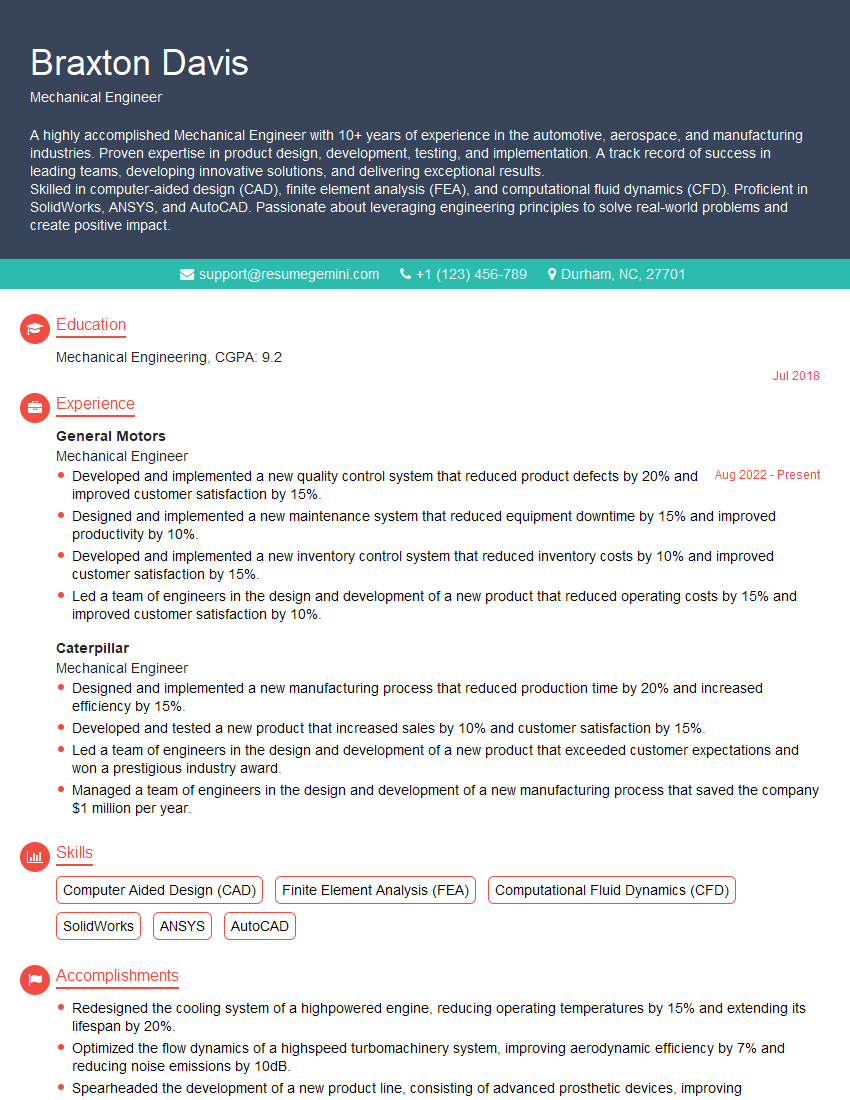
Mechanical Engineer Resume Sample

Control Systems Engineer Resume Sample

Mechatronics Engineer Resume Sample

Product Design Engineer Resume Sample

Robotics Engineer Resume Sample

Automation Technician Resume Sample
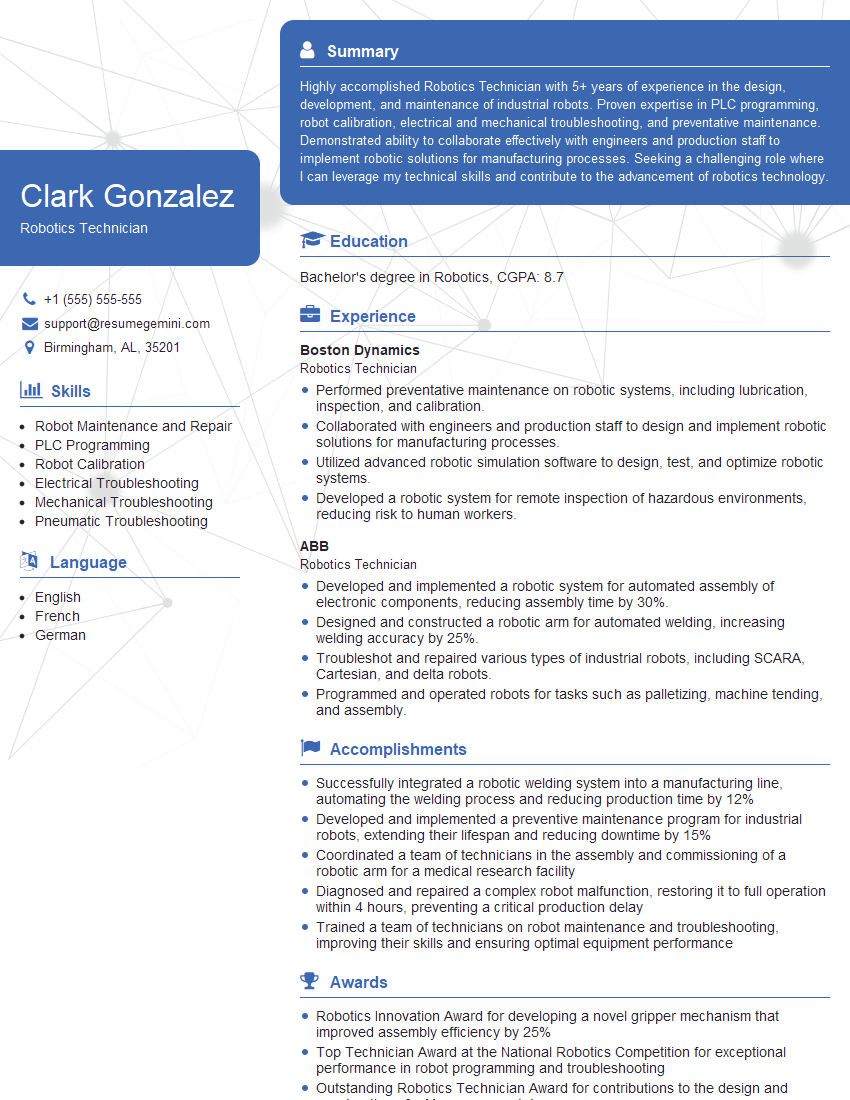
Robotics Technician Resume Sample

Embedded Systems Engineer Resume Sample
Explore more articles
Users Rating of Our Blogs
Share Your Experience
We value your feedback! Please rate our content and share your thoughts (optional).
What Readers Say About Our Blog
To the interviewgemini.com Webmaster.
Very helpful and content specific questions to help prepare me for my interview!
Thank you
To the interviewgemini.com Webmaster.
This was kind of a unique content I found around the specialized skills. Very helpful questions and good detailed answers.
Very Helpful blog, thank you Interviewgemini team.