The thought of an interview can be nerve-wracking, but the right preparation can make all the difference. Explore this comprehensive guide to Radiation Transport Modeling interview questions and gain the confidence you need to showcase your abilities and secure the role.
Questions Asked in Radiation Transport Modeling Interview
Q 1. Explain the difference between deterministic and stochastic methods in radiation transport.
Deterministic and stochastic methods represent two fundamentally different approaches to solving the radiation transport equation, which describes how radiation particles (like photons or neutrons) move through a material. Deterministic methods, like the discrete ordinates method (SN) or the finite element method, solve the equation directly. Think of it like meticulously mapping every single road on a map to find the fastest route. They provide a deterministic solution; if you run the calculation again with the same inputs, you’ll get the same answer. Stochastic methods, like the Monte Carlo method, simulate the individual particle paths randomly. Imagine instead of mapping every road, you send out thousands of cars and track their routes. The average time taken by these cars gives you an approximate answer. The result has statistical uncertainty, meaning multiple runs will yield slightly different results, but they should converge to the true solution with enough simulations.
Q 2. Describe the Monte Carlo method and its applications in radiation transport.
The Monte Carlo method is a powerful stochastic technique that simulates the transport of radiation particles by randomly sampling from probability distributions governing their interactions. Imagine you’re playing darts, aiming for the bullseye. Each dart throw represents a particle’s journey; some hit close, others miss wide. Monte Carlo works similarly. We repeatedly simulate individual particle trajectories, tracking their interactions (scattering, absorption, etc.), and statistically analyze the results to obtain overall quantities of interest like dose distributions or radiation fluxes. Its power lies in its ability to handle complex geometries and heterogeneous materials that would be computationally intractable for deterministic methods. For instance, modeling radiation therapy treatment planning, where highly irregular anatomical shapes and varied tissue densities are common, heavily relies on Monte Carlo simulations to accurately predict dose distribution.
Applications include:
- Medical physics: Dose calculations in radiotherapy and diagnostic imaging.
- Nuclear engineering: Reactor shielding design and criticality safety analysis.
- Remote sensing: Atmospheric radiative transfer modeling.
- Materials science: Studying radiation effects on materials.
Q 3. What are the limitations of deterministic methods in radiation transport?
Deterministic methods, while efficient for simple problems, face several limitations. They struggle with:
- Complex geometries: Discretizing highly irregular shapes into a manageable computational mesh can be extremely challenging and computationally expensive, often leading to significant errors.
- Heterogeneous materials: Accurately representing materials with varying properties across the simulation domain can be difficult, potentially sacrificing accuracy.
- Low-probability events: Deterministic methods may struggle to accurately capture rare events, like deep penetration of radiation through thick shields. These events are critical for safety analysis but might be missed due to numerical limitations.
- Ray effects: In some cases, particularly with coarse meshes, numerical artifacts called ray effects can occur, leading to inaccurate results.
For instance, simulating radiation transport in a complex medical device with intricate geometries using a deterministic method might be incredibly difficult and may produce inaccurate results, whereas a Monte Carlo simulation could easily handle this scenario.
Q 4. Explain the concept of cross-sections in radiation transport.
Cross-sections are the probability of a specific interaction (e.g., scattering, absorption) between a radiation particle and a target atom or nucleus. Imagine a target (an atom) and projectiles (radiation particles). The cross-section is the effective area the target presents to the projectile, which determines the likelihood of a collision. A larger cross-section implies a higher probability of interaction. Cross-sections are crucial inputs to radiation transport simulations, and their values are typically obtained experimentally or through nuclear data evaluations. These values depend strongly on the energy of the radiation particle and the type of material. Different interactions have different cross-sections. For example, the photoelectric effect cross-section is dominant at lower energies, whereas Compton scattering is more important at higher energies.
Q 5. How do you handle boundary conditions in radiation transport simulations?
Boundary conditions define how radiation particles behave when they reach the edge of the simulation domain. Common types include:
- Vacuum: Particles that reach the boundary are considered lost (absorbed or escaped).
- Reflection: Particles are reflected specularly (like a mirror) or diffusely (randomly).
- Periodic: Opposite boundaries are connected, creating a repeating pattern, useful for modeling infinite or periodic systems.
- Albedo: A fraction of the incident radiation is reflected, with the rest being absorbed or transmitted.
The choice of boundary conditions is critical; inappropriate conditions can significantly affect the simulation results. For example, in a reactor shielding simulation, using a vacuum boundary condition on the outer shield might underestimate the radiation levels in a nearby area if some radiation is reflected back from the surroundings.
Q 6. What are the different types of radiation sources used in modeling?
Various radiation sources are used in modeling, depending on the application. Examples include:
- Point source: Radiation emitted from a single point, often used as a simplification in initial modeling stages.
- Plane source: Radiation emitted uniformly from a plane surface.
- Volume source: Radiation emitted uniformly or non-uniformly from a volume (like a radioactive material).
- Directional source: Radiation emitted in a specific direction, used to simulate beams or collimated sources.
- Spectrum source: Radiation emitted with a defined energy distribution (spectrum), providing a more realistic representation of real-world sources.
In medical physics, for example, simulating external beam radiotherapy might use a directional source to represent the radiation beam from a linear accelerator, while simulating internal radiation therapy with brachytherapy sources would involve a volume source.
Q 7. Describe different types of radiation interactions (e.g., Compton scattering, photoelectric effect).
Radiation particles interact with matter through various processes:
- Photoelectric effect: A photon transfers its entire energy to an atom, ejecting an electron. This is dominant at low photon energies and high atomic numbers.
- Compton scattering: A photon scatters off an electron, losing some energy in the process. This is a significant interaction mechanism across a wide range of photon energies.
- Pair production: A high-energy photon interacts with the electric field of a nucleus, creating an electron-positron pair. This occurs only above a certain energy threshold.
- Elastic scattering: A particle interacts without any energy loss, only changing its direction. Examples include neutron elastic scattering and Rayleigh scattering for photons.
- Inelastic scattering: A particle interacts and loses some energy, like in Compton scattering. Examples include neutron inelastic scattering and Raman scattering for photons.
Understanding these interactions is vital for accurate simulation, as each process affects the energy and direction of radiation particles, and thus the overall radiation dose or flux.
Q 8. Explain the concept of radiation shielding and its importance.
Radiation shielding is the process of reducing the amount of ionizing radiation that reaches a person, object, or area. Think of it like sunscreen for radiation – it protects us from harmful rays. It’s incredibly important because exposure to ionizing radiation, like X-rays or gamma rays, can cause damage to living tissue, leading to health problems like cancer or radiation sickness. Shielding is crucial in various applications, from nuclear power plants and medical facilities to spacecraft and particle accelerators, where radiation sources are present. The goal is to minimize exposure to acceptable levels, as defined by regulatory bodies.
Q 9. How do you design a radiation shielding system?
Designing a radiation shielding system is a multi-step process involving careful consideration of several factors. First, we need to identify the type and energy of the radiation source. Gamma rays require different shielding materials than neutrons, for example. Next, we determine the required level of shielding, often guided by regulatory limits and safety standards. This involves calculating the thickness and composition of the shielding material needed to attenuate the radiation to the desired level. This calculation often involves complex radiation transport simulations. We then select suitable materials based on their shielding properties, cost, and ease of fabrication and handling. Finally, we design the physical structure of the shield, ensuring it’s structurally sound, easy to maintain, and compatible with the surrounding environment. For instance, shielding a nuclear reactor might involve a combination of concrete, steel, and specialized materials like boron carbide, while shielding an X-ray machine may simply involve lead or lead-lined walls.
Q 10. What are the key factors influencing the accuracy of radiation transport simulations?
The accuracy of radiation transport simulations hinges on several key factors. First, the accuracy of the nuclear data used is paramount. This data describes how different materials interact with radiation, including cross-sections for scattering and absorption. Inaccurate data can lead to significant errors in the simulation results. Secondly, the numerical methods employed in solving the transport equation directly impact accuracy. Monte Carlo methods, while generally accurate, are computationally expensive and their accuracy depends on the number of simulated particles. Deterministic methods, such as discrete ordinates, are faster but can be less accurate, particularly for complex geometries. The choice of mesh size and spatial discretization in deterministic methods also greatly affects accuracy. Lastly, the modeling of the geometry and materials involved needs to be realistic; simplifying a complex geometry can lead to significant deviations from reality. Finally, the treatment of boundary conditions also plays a crucial role in the accuracy of the results. A realistic and complete representation of all aspects is vital for reliable results.
Q 11. Discuss the role of variance reduction techniques in Monte Carlo simulations.
Variance reduction techniques are essential in Monte Carlo simulations to improve efficiency and reduce computational time. Because Monte Carlo methods rely on statistical sampling, a large number of particle histories are often necessary to achieve accurate results. Variance reduction techniques aim to reduce the statistical uncertainty in the results without increasing the number of simulations dramatically. Common techniques include importance sampling (biasing the sampling to focus on important regions), splitting (dividing particles into multiple particles in important areas), Russian roulette (eliminating particles with low importance), and correlated sampling (using the same random numbers for different simulations). Imagine searching for a specific needle in a haystack. Variance reduction is like strategically focusing your search on areas where the needle is more likely to be found, rather than randomly searching the entire haystack.
Q 12. Explain the concept of criticality and its relevance to reactor physics.
Criticality refers to the state where a nuclear chain reaction is self-sustaining. In reactor physics, it’s the balance between neutron production and neutron loss. If the number of neutrons produced in fission exceeds the number lost through absorption or leakage, the chain reaction will grow exponentially, leading to a power increase. This is a supercritical state. If the production and loss are equal, the reaction is critical and the power level remains stable. A subcritical state signifies that the reaction will die out. Maintaining criticality is crucial for the safe and efficient operation of nuclear reactors. The control rods in a reactor serve to adjust the neutron population and maintain criticality at the desired power level. Achieving and controlling criticality is a fundamental aspect of reactor design and operation.
Q 13. How do you validate the results of a radiation transport simulation?
Validating radiation transport simulation results is a critical step to ensure accuracy and reliability. This often involves a multi-pronged approach. First, we can compare the simulation results with benchmark solutions from well-established experiments or other validated codes. These benchmarks provide a reference point against which our simulation results can be evaluated. Secondly, we can compare simulation results against experimental data collected specifically for this purpose. This might involve conducting experiments in a controlled environment and measuring relevant radiation quantities to directly compare with our simulation predictions. We then analyze any discrepancies to identify potential sources of error, such as inaccuracies in nuclear data or limitations in the simulation methodology. Thirdly, code verification techniques, focusing on the numerical correctness of the code itself, should also be performed. This helps ascertain that the code accurately solves the underlying transport equation. A rigorous validation process ensures that the simulation results are trustworthy and can be confidently used for decision-making.
Q 14. What are some common software packages used for radiation transport modeling?
Several software packages are commonly used for radiation transport modeling. MCNP (Monte Carlo N-Particle transport code) is a widely used Monte Carlo code known for its versatility and accuracy. FLUKA (Fluka: a Monte Carlo simulation toolkit) is another powerful Monte Carlo code frequently employed in high-energy physics applications. SERPENT (SERPENT: a continuous-energy Monte Carlo reactor physics burnup calculation code) is specifically designed for reactor physics simulations. These are just a few examples. Each software package offers unique features and capabilities, and the best choice depends on the specific application and requirements of the problem. Many other deterministic codes are also available, offering a range of trade-offs between computational efficiency and accuracy.
Q 15. (MCNP, FLUKA, Geant4, Serpent etc.) Describe your experience with one.
My primary experience lies with MCNP (Monte Carlo N-Particle Transport Code). It’s a widely-used, versatile code for simulating the transport of neutrons, photons, and electrons through various materials. I’ve used MCNP extensively for various applications, from designing shielding for nuclear reactors to optimizing radiation therapy treatment plans. MCNP’s strength lies in its ability to handle complex geometries and sophisticated physics models. For instance, I recently used it to model the radiation field within a novel brachytherapy applicator. The process involved creating a detailed geometric model of the applicator, defining the source terms, specifying the material compositions, and then running the simulation to obtain dose distributions and other relevant parameters. Analyzing the output data, including tally results like dose, fluence, and energy deposition, allowed for optimization of the design for improved treatment efficacy and reduced side effects.
A key feature I often utilize is MCNP’s variance reduction techniques, such as importance sampling and weight windows, which are crucial for accelerating simulations and achieving acceptable statistical accuracy, especially for problems with deep penetration or low probabilities of interaction. The code’s extensive library of cross-section data is also essential for accurate modeling across a wide range of energies and materials.
Career Expert Tips:
- Ace those interviews! Prepare effectively by reviewing the Top 50 Most Common Interview Questions on ResumeGemini.
- Navigate your job search with confidence! Explore a wide range of Career Tips on ResumeGemini. Learn about common challenges and recommendations to overcome them.
- Craft the perfect resume! Master the Art of Resume Writing with ResumeGemini’s guide. Showcase your unique qualifications and achievements effectively.
- Don’t miss out on holiday savings! Build your dream resume with ResumeGemini’s ATS optimized templates.
Q 16. Explain the importance of radiation transport in medical physics.
Radiation transport is fundamental in medical physics because it governs how ionizing radiation interacts with biological tissues. Accurate modeling is crucial for various applications, primarily in radiation therapy and medical imaging. In radiotherapy, understanding how radiation beams interact with the patient’s anatomy, including scattering and absorption, is essential for planning treatments that effectively target tumors while minimizing damage to surrounding healthy tissues. For example, the dose distribution calculated using Monte Carlo methods, such as those in MCNP or Geant4, directly informs the treatment plan, guiding the selection of beam angles, energies, and intensities. The goal is to deliver a prescribed dose to the tumor volume while maintaining dose to organs at risk (OARs) below tolerance levels.
In medical imaging, radiation transport modeling plays a role in developing and calibrating imaging systems. For instance, in PET (Positron Emission Tomography) scanning, the decay of radiotracers and subsequent positron annihilation are modeled to reconstruct images showing the distribution of the tracer within the body. Accurate modeling ensures accurate image reconstruction and diagnostic interpretation. In summary, radiation transport modeling bridges the gap between the radiation sources used in medicine and the resulting dose or image, ultimately improving the safety and effectiveness of medical procedures.
Q 17. Describe different types of detectors used in radiation measurements.
A variety of detectors are used in radiation measurements, each with specific advantages and disadvantages depending on the type of radiation and the application. They can be broadly classified based on the detection mechanism:
- Ionization Chambers: These are based on the ionization of a gas by radiation. They are simple, robust, and provide a good measure of radiation dose rate. They are commonly used for area monitoring and radiation protection.
- Proportional Counters: Similar to ionization chambers, but they amplify the ionization signal, making them more sensitive. They are often used for detecting low-level radiation.
- Geiger-Müller Counters: Highly sensitive detectors that produce a pulse for each ionizing event. They are widely used for radiation detection, though they don’t provide detailed energy information.
- Scintillation Detectors: These detectors use scintillating materials that emit light when interacting with radiation. The light is then detected by a photomultiplier tube (PMT), providing a signal proportional to the energy deposited. These are widely used for spectroscopy and medical imaging.
- Semiconductor Detectors: Based on the creation of electron-hole pairs in a semiconductor material. They offer high energy resolution and are frequently used in spectroscopy and medical imaging.
- Film Badges: Passive detectors using photographic film that darkens proportionally to the absorbed dose. These are often used for personal dosimetry.
The choice of detector depends on factors like the type and energy of the radiation being measured, the required sensitivity, and the desired energy resolution.
Q 18. How do you account for the effects of geometry in radiation transport calculations?
Geometry is paramount in radiation transport calculations as it directly influences the path of radiation and subsequent interactions. In MCNP, for instance, the geometry is defined using a combination of surfaces and cells. Each cell represents a volume of space with a specific material composition, and the surfaces define the boundaries of these cells. The complex geometry description is the most challenging aspect of many radiation transport problems. Consider a human body – accurately representing its complex 3D structure, including organs and tissues with different densities and compositions, is crucial for dose calculations in radiotherapy.
Different methods exist for geometric modeling. One approach is using CAD (Computer-Aided Design) software to create a detailed 3D model, which is then imported into the transport code. Alternatively, the geometry can be described directly within the transport code using its built-in capabilities. The choice depends on the complexity of the geometry and the available tools. Accurate geometry modeling is essential for obtaining realistic results. Even small inaccuracies can lead to significant errors in dose calculations, potentially impacting treatment planning or safety assessments. Sophisticated techniques like meshing and surface approximation can be used to handle very complex geometries, but this adds to the computational cost and complexity.
Q 19. Explain the concept of dose calculation in radiation therapy.
Dose calculation in radiation therapy is the process of determining the amount of energy deposited by ionizing radiation in biological tissues. This is crucial for treatment planning, as it allows radiation oncologists to optimize the treatment plan to deliver the required dose to the tumor while minimizing damage to healthy tissues. Several approaches are employed for dose calculations, with Monte Carlo methods being increasingly popular due to their ability to handle complex geometries and physics more accurately.
The process typically involves:
- Defining the treatment plan: This includes specifying the beam parameters (energy, intensity, angles) and the patient’s anatomy.
- Modeling the radiation transport: This involves simulating the interaction of the radiation beams with the patient’s tissues using Monte Carlo or other methods. The code calculates energy deposition at various points within the tissues.
- Calculating the dose: The energy deposition is converted to dose units (typically Gray (Gy), which represents the absorbed dose per unit mass). This accounts for the different sensitivities of various tissues to radiation.
- Analyzing the dose distribution: The calculated dose distribution is visualized using specialized software, enabling the evaluation of dose conformity, homogeneity, and the dose received by organs at risk (OARs).
Precise dose calculation is vital because overdosing can cause severe side effects, whereas underdosing may compromise tumor control. The accuracy of dose calculation depends heavily on accurate modeling of the radiation transport and patient anatomy.
Q 20. Discuss the challenges of modeling radiation transport in complex geometries.
Modeling radiation transport in complex geometries presents several challenges. One major challenge is the computational cost. Simulating the interaction of radiation with a highly detailed anatomical model, for example, requires significant computing resources, potentially increasing simulation times to impractical levels. The complexity arises from the need to track the trajectories of countless particles and their interactions with the various materials and interfaces present in the model.
Another challenge is the accuracy of the geometry representation itself. Discretizing the geometry into a computational mesh introduces inherent approximations. The finer the mesh, the more accurate but computationally expensive the simulation. Balancing accuracy and computational efficiency is a crucial consideration. Further, handling complex interfaces between different materials, such as those present in heterogeneous tissues, requires careful consideration of boundary conditions and can lead to numerical errors. Moreover, incorporating all relevant physical processes, such as scattering, absorption, and secondary particle production, into the model with appropriate accuracy adds to the complexity. Ultimately, efficient algorithms, advanced numerical techniques, and powerful computing infrastructure are essential for tackling the challenges of modeling radiation transport in complex geometries.
Q 21. How do you handle uncertainty and error in radiation transport simulations?
Uncertainty and error are inherent in radiation transport simulations, stemming from various sources such as statistical uncertainty in Monte Carlo calculations, approximations in physical models, and uncertainties in input parameters (e.g., material composition, source specifications). Handling these uncertainties is crucial for ensuring reliable results.
Several strategies are used to address these issues:
- Statistical uncertainty quantification: In Monte Carlo simulations, the results are subject to statistical fluctuations. Running multiple simulations and analyzing the variance allows for quantifying this uncertainty. Sufficient numbers of histories must be simulated to reduce statistical uncertainty to an acceptable level.
- Sensitivity analysis: This technique assesses the impact of variations in input parameters on the simulation results. It helps to identify which parameters are most influential and warrant careful attention in terms of accuracy.
- Validation and verification: Comparing simulation results with experimental data is essential for validating the accuracy of the model. Verification involves checking the consistency and correctness of the code itself.
- Uncertainty propagation: This involves propagating the uncertainties in input parameters through the calculation to obtain the uncertainty in the final results. This provides a more realistic representation of the uncertainty associated with the simulation.
By systematically addressing these sources of uncertainty, we can ensure the reliability and usefulness of radiation transport simulations in various applications.
Q 22. Describe the importance of radiation transport in nuclear safety analysis.
Radiation transport modeling is absolutely crucial in nuclear safety analysis because it predicts how radiation, including neutrons and gamma rays, behaves within a system. This is vital for determining radiation levels, shielding effectiveness, and the overall safety of nuclear reactors, spent fuel storage facilities, and other nuclear installations. Imagine trying to design a reactor without understanding how neutrons will scatter and interact – it would be impossible to ensure safe operation. The model helps us predict the radiation dose to workers and the public, ensuring we stay well below acceptable limits. It’s all about accurately predicting where radiation goes and how intense it will be in any given location.
For instance, accurate modeling allows us to design effective shielding to protect personnel from harmful radiation. It helps us evaluate the potential consequences of accidents, ensuring containment systems are robust enough to handle radiation releases. Without such modeling, we’d be essentially designing nuclear systems blindly.
Q 23. What are some of the emerging trends in radiation transport modeling?
The field of radiation transport modeling is constantly evolving. Several key trends are shaping the future of this technology. One is the increasing use of high-fidelity methods, which incorporate more detailed physics and geometries, leading to more accurate simulations. This allows us to handle complex scenarios, such as those involving heterogeneous materials or intricate geometries. Think modeling the detailed structure of a reactor core instead of a simplified representation.
Another major trend is the development of advanced computational techniques. The sheer size and complexity of many radiation transport problems necessitate powerful computational methods. Parallel computing, using multiple processors simultaneously, is indispensable for handling these massive simulations. We also see growing adoption of machine learning techniques to accelerate simulations and improve the accuracy of predictions, including the use of surrogate models and deep learning for faster estimations.
Finally, the development of coupled simulations is gaining traction. Often, radiation transport interacts strongly with other physical processes, such as fluid dynamics and heat transfer. Coupled simulations integrate these processes, providing a more holistic understanding of a system’s behavior. For example, modeling the effects of coolant flow and temperature on neutron behavior in a reactor core provides a more realistic simulation.
Q 24. Explain the concept of adjoint transport and its applications.
Adjoint transport is a powerful technique used to efficiently calculate sensitivity and perturbation effects in radiation transport. Instead of directly calculating the flux, which is the number of particles at each point in the system, we solve the adjoint equation. The adjoint flux provides information about the importance of different regions of the system to a specific quantity of interest, like the detector response. Imagine trying to find the most important component in a chain of events; the adjoint method effectively highlights those key components.
For example, suppose we want to determine how a small change in the shielding material will impact the radiation dose at a certain point. Directly calculating this would require numerous forward transport simulations. However, using the adjoint solution, we only need to solve the adjoint problem once. Then, we can efficiently calculate the effect of any material change on the dose at the point of interest. This is a huge computational advantage, particularly when dealing with many parameters or design iterations.
Applications include optimal shielding design, uncertainty quantification, and sensitivity analysis in various nuclear applications. Essentially, adjoint transport offers an elegant and efficient way to answer ‘what-if’ questions in radiation transport.
Q 25. Describe your experience with parallel computing in radiation transport simulations.
I have extensive experience utilizing parallel computing techniques in radiation transport simulations, primarily using Message Passing Interface (MPI) and OpenMP. I’ve worked on projects involving large-scale simulations requiring the computational power of hundreds of processor cores. In one project, we modeled the transport of neutrons in a large-scale nuclear reactor core. The simulation involved a highly detailed representation of the fuel assemblies and other core components, necessitating a parallel implementation to reduce the runtime from weeks to a few days. This drastic reduction in runtime was critical for the timely completion of the project.
My experience encompasses strategies for optimizing parallel performance, including load balancing, data partitioning, and communication efficiency. I’m familiar with different parallel algorithms and their suitability for various radiation transport methods. For instance, I’ve worked with both domain decomposition methods and particle splitting approaches, selecting the optimal approach depending on the specific problem and available computational resources. I also possess expertise in debugging and performance profiling of parallel codes to ensure optimal performance.
Q 26. How do you choose an appropriate radiation transport code for a specific application?
Selecting the appropriate radiation transport code depends heavily on the specific application, the desired accuracy, the available computational resources, and the problem’s complexity. There isn’t a single ‘best’ code.
Consider these factors:
- Problem geometry and material complexity: Simple geometries might be handled by deterministic codes like MCNP or Serpent, while complex geometries might require Monte Carlo methods.
- Energy range of interest: Different codes excel in specific energy ranges. Some codes are better suited for high-energy applications, while others are optimized for low-energy problems.
- Accuracy requirements: The required level of accuracy dictates the choice between deterministic and Monte Carlo methods. Monte Carlo simulations are often preferred for high-accuracy applications but can be computationally expensive.
- Computational resources: The size and complexity of the problem determine the computational resources required. Parallel computing capabilities are crucial for large-scale simulations.
- Specific features: Some codes offer specific features like coupled transport capabilities or advanced variance reduction techniques that might be essential for a particular application.
A thorough understanding of available codes, their capabilities, and limitations, is essential for making an informed choice.
Q 27. Explain your understanding of radiation transport in different energy ranges.
Radiation transport across different energy ranges presents distinct challenges and requires different approaches. At high energies (MeV range), interactions are primarily governed by nuclear reactions, such as elastic and inelastic scattering. The penetration depth of radiation is significant, and the modeling requires accurate representation of these nuclear reactions. This is common in applications like shielding design for nuclear reactors or high-energy accelerators.
In the intermediate energy range (keV to MeV), both nuclear interactions and electronic interactions become significant. The interactions become increasingly complex as you move down to the keV range. In the low energy range (eV to keV), electronic interactions (photoelectric effect, Compton scattering) dominate. This range is crucial for modeling radiation transport in medical imaging, radiation therapy, and certain industrial applications. Accurate treatment of these interactions is critical for accurate predictions in these domains. The choice of cross-section data and the transport method needs to reflect the physics relevant to the particular energy range.
Q 28. Describe a challenging radiation transport problem you have solved and how you approached it.
One challenging problem I tackled involved modeling radiation transport in a complex, heterogeneous system with significant streaming effects. This was a spent fuel storage facility with intricate geometries and various materials, including fuel assemblies, water, concrete, and steel. The presence of void spaces caused significant radiation streaming, making accurate modeling difficult. The problem involved precisely determining the radiation dose rates throughout the facility to ensure compliance with safety regulations.
My approach involved a combination of techniques. We used a high-fidelity Monte Carlo code capable of handling the complex geometry. To mitigate the computational cost, we employed advanced variance reduction techniques, such as importance sampling and weight windows, to focus the simulations on regions of interest. We also carefully validated our model using experimental data from a similar facility. This iterative process of simulation and validation allowed us to achieve sufficient accuracy and confidence in our predictions, leading to a safe and efficient storage configuration.
Key Topics to Learn for Radiation Transport Modeling Interview
- Fundamentals of Radiation Transport: Understand the underlying physics governing radiation interactions with matter (absorption, scattering, emission). Grasp the concepts of cross-sections and attenuation coefficients.
- Monte Carlo Methods: Familiarize yourself with the principles and applications of Monte Carlo simulations in radiation transport, including variance reduction techniques.
- Deterministic Methods: Explore deterministic methods such as discrete ordinates (SN) and finite element methods for solving the Boltzmann transport equation. Understand their strengths and limitations compared to Monte Carlo.
- Radiation Transport Codes: Gain familiarity with popular radiation transport codes (mentioning specific codes is avoided to remain generic and applicable across various tools). Be prepared to discuss their capabilities and limitations.
- Practical Applications: Be ready to discuss applications of radiation transport modeling in diverse fields like nuclear reactor design, medical physics (radiation therapy planning), nuclear safety analysis, and remote sensing.
- Problem-Solving and Analytical Skills: Practice solving problems related to radiation shielding calculations, source term estimations, and dosimetry. Develop your ability to interpret and analyze results from simulations.
- Specific Software and Tools: While specific software varies by role, demonstrate understanding of relevant software packages used in radiation transport modeling. Highlight your proficiency in data analysis and visualization.
Next Steps
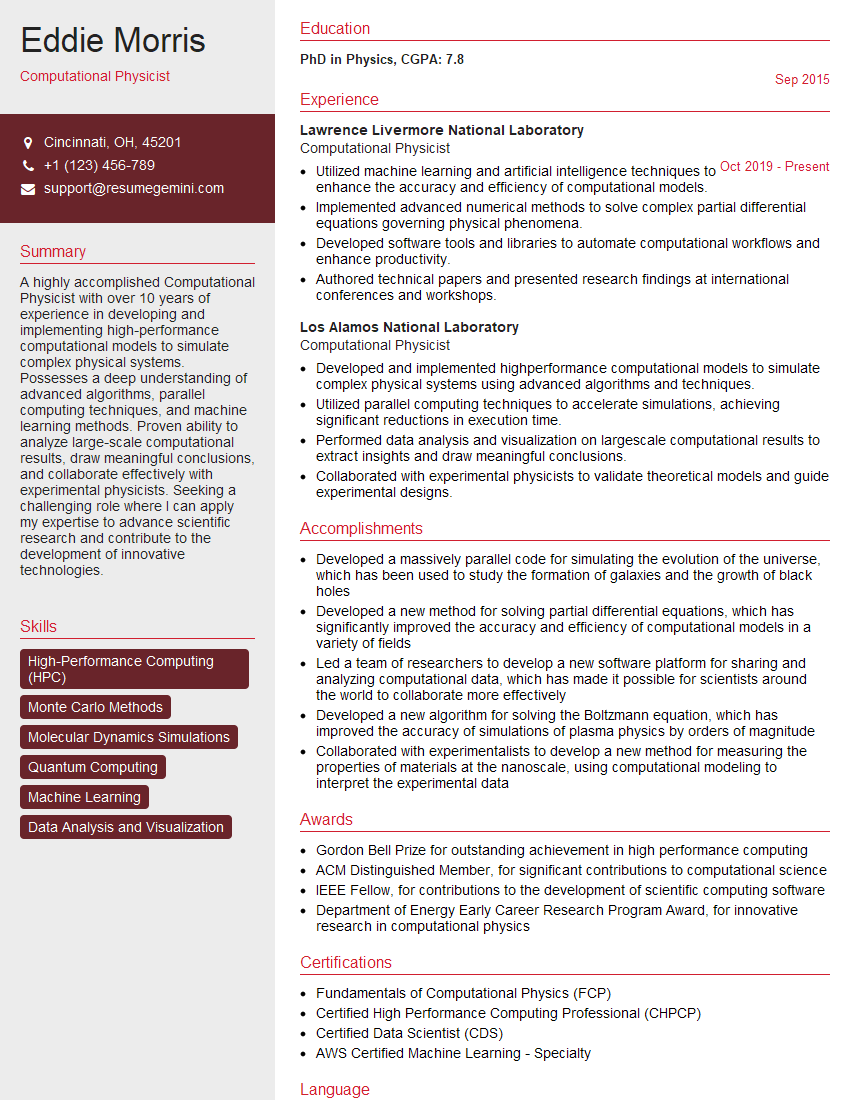
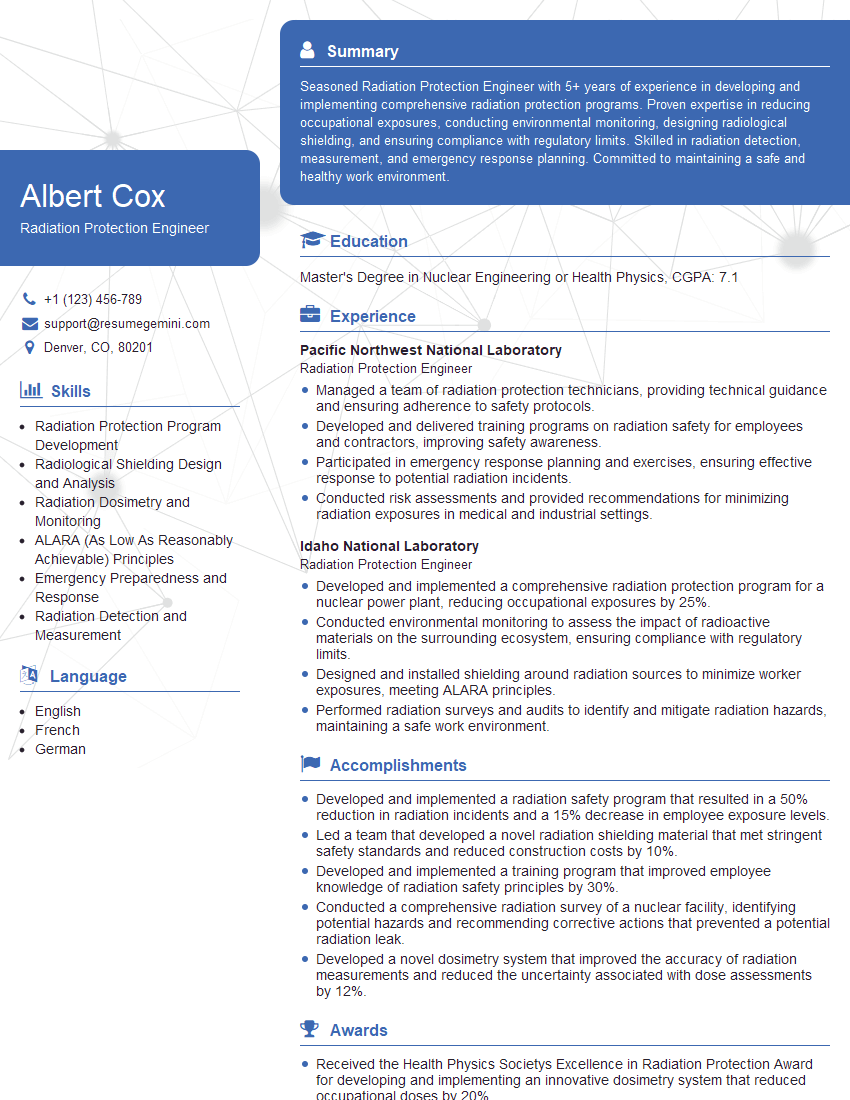
Mastering radiation transport modeling opens doors to exciting and impactful careers in various high-demand sectors. A strong understanding of these principles is crucial for success in roles requiring advanced analytical and problem-solving skills. To significantly enhance your job prospects, creating an ATS-friendly resume is essential. This ensures your qualifications are effectively communicated to hiring managers and Applicant Tracking Systems. We strongly recommend using ResumeGemini, a trusted resource for building professional and impactful resumes. ResumeGemini provides examples of resumes tailored to Radiation Transport Modeling, helping you showcase your expertise effectively. Take the next step towards your dream career today!




Explore more articles
Users Rating of Our Blogs
Share Your Experience
We value your feedback! Please rate our content and share your thoughts (optional).
What Readers Say About Our Blog
To the interviewgemini.com Webmaster.
Very helpful and content specific questions to help prepare me for my interview!
Thank you
To the interviewgemini.com Webmaster.
This was kind of a unique content I found around the specialized skills. Very helpful questions and good detailed answers.
Very Helpful blog, thank you Interviewgemini team.