The right preparation can turn an interview into an opportunity to showcase your expertise. This guide to Marble Cutting and Shaping interview questions is your ultimate resource, providing key insights and tips to help you ace your responses and stand out as a top candidate.
Questions Asked in Marble Cutting and Shaping Interview
Q 1. What types of marble are best suited for intricate carving?
Choosing the right marble for intricate carving is crucial. The ideal marble possesses a fine grain, even texture, and is relatively free from fractures or inclusions. These imperfections can easily disrupt the carving process and compromise the final product’s structural integrity. For example, Carrara marble from Italy, known for its fine grain and white background, is a popular choice for intricate work because it allows for delicate detail and sharp lines. Similarly, some types of statuary marble, prized for their purity and ability to take a high polish, are also excellent choices for complex carvings. Conversely, marbles with coarse grains or significant veining might be better suited for simpler designs, as the imperfections could become problematic during intricate carving.
Ultimately, the selection process depends on the design complexity, desired aesthetic, and the sculptor’s experience. A skilled artisan can work with slightly less ideal marble, but selecting the correct material significantly simplifies the task and enhances the end result.
Q 2. Describe the different methods used for cutting marble.
Marble cutting employs several methods, each tailored to different needs and scales of projects. Wire sawing, using a continuous diamond-impregnated wire loop, is prevalent for cutting large blocks into slabs. This is a relatively slow but precise method, minimizing waste and creating clean cuts. Gang saws, which use multiple diamond blades to cut multiple slabs simultaneously, are employed for mass production. For more intricate work or smaller pieces, specialized diamond saws, resembling circular saws but with diamond-tipped blades, offer greater control and accuracy. Hand tools, such as chisels and mallets, might be used for delicate shaping and fine detailing, especially for artistic projects. The choice of method depends on factors such as the size of the block, the complexity of the design, and the desired level of precision.
Q 3. Explain the process of polishing marble to a high gloss finish.
Polishing marble to a high-gloss finish is a multi-step process that involves progressively finer abrasives. It starts with coarser grits (e.g., 50-grit diamond pads) to remove scratches and imperfections left from cutting or shaping. Then, the grits are gradually refined (e.g., 100, 200, 400, 800, 1500, 3000), removing progressively finer scratches and increasing the surface smoothness. Each stage requires thorough cleaning to prevent scratches from coarser grits from being embedded into the next stage. Following this, polishing compounds, often containing metal oxides like cerium oxide, are used to achieve a mirror-like shine. Finally, a high-quality sealant might be applied to protect the surface and enhance its luster. The process requires patience and skill to achieve a uniform, even finish, avoiding swirl marks and burnishing. Improper polishing can dull the finish, hence precise technique and the right tools are paramount.
Q 4. How do you ensure accurate measurements and cuts when working with marble?
Accuracy is paramount in marble fabrication. We begin by meticulously reviewing the design blueprints or specifications and creating precise full-scale drawings. This helps us accurately plan the cuts and ensure everything is correctly scaled. Modern CAD/CAM systems can generate precise digital models and cutting paths for automated processes, offering improved accuracy and repeatability. For manual cutting, templates, accurate measuring instruments (e.g., calipers, rulers), and careful marking are vital. Double-checking measurements at every stage of the process helps mitigate errors. Experienced artisans also develop an ‘eye’ for judging measurements, constantly verifying accuracy through observation.
Q 5. What safety precautions do you take when operating marble cutting machinery?
Safety is a top priority when working with marble cutting machinery. We always wear appropriate personal protective equipment (PPE), including safety glasses, dust masks (especially when working with dry cutting methods), hearing protection, and gloves to prevent cuts and abrasions. Machines must be properly maintained and regularly inspected, ensuring all safety guards are in place and functioning correctly. Work areas should be kept clean and free of debris to prevent tripping hazards. Never operate machinery when tired or under the influence of drugs or alcohol. Regular training and adherence to safety protocols are essential for preventing accidents. When using hand tools, proper techniques and sharp tools minimize strain and avoid injury.
Q 6. How do you identify and address common defects in marble during fabrication?
Identifying and addressing marble defects is a key skill. Common defects include cracks, fissures, staining, and mineral inclusions. These can be identified through careful visual inspection, even before cutting begins. Ultrasonic testing can reveal hidden internal flaws. During fabrication, cracks can be stabilized with epoxy resins. Staining can be addressed through various cleaning and polishing techniques, but sometimes severe staining might require the affected area to be removed and replaced. Mineral inclusions can sometimes create aesthetic appeal but if they weaken the stone, they may need to be carefully addressed during the cutting or shaping process. The method of repair depends on the type and severity of the defect, as well as the intended use of the final product.
Q 7. Describe your experience with various marble cutting tools (e.g., diamond saws, routers).
My experience with marble cutting tools is extensive. I’m proficient in operating various diamond saws, from large wire saws used for block cutting to smaller circular saws for more intricate cuts. I understand the nuances of blade selection, depending on the type of marble and the desired cut. I am also skilled in using CNC routers for precise shaping and complex carvings, which can significantly enhance both efficiency and accuracy. In addition, my experience extends to hand tools like chisels, points, and hammers. Understanding the optimal use of each tool for specific tasks ensures the highest quality finish. I believe this diverse skill set allows me to tackle any project effectively, from large-scale installations to delicate sculptural pieces.
Q 8. What techniques do you use to create specific surface textures on marble?
Achieving specific surface textures on marble is an art that blends traditional techniques with modern technology. The desired finish dictates the method. For example, a highly polished mirror finish requires meticulous grinding and polishing using progressively finer diamond abrasives. This process involves multiple steps, starting with coarse grits to remove imperfections and ending with ultra-fine polishing compounds for a flawless sheen. Think of it like sanding wood, but with much more precision and control.
Conversely, a honed finish, characterized by its matte appearance, requires less polishing. We focus on achieving a smooth, even surface, avoiding the final high-gloss steps. This is ideal for areas where a less reflective surface is desired.
Beyond these basic finishes, we can create more intricate textures. Acid etching, for instance, can create subtle patterns and variations in surface relief, lending a unique character to the marble. Sandblasting can also create various textures, from lightly textured to deeply pitted surfaces depending on the pressure and nozzle used. Finally, techniques like hand-chiseling allow for completely bespoke textural work, creating unique and artisanal effects.
Q 9. How do you handle large marble slabs safely and efficiently?
Handling large marble slabs requires meticulous planning and safety precautions. We utilize specialized equipment, such as vacuum lifters and overhead cranes, to move these heavy and potentially unwieldy pieces safely. These machines allow us to lift and maneuver the slabs with minimal risk of damage or injury. Before lifting, we carefully inspect the slabs for any cracks or weak points to prevent accidents during transit.
Furthermore, we employ specialized slings and straps designed for marble handling. These are chosen based on the size and weight of the slab to ensure secure transport. Properly trained personnel, adhering to strict safety protocols and utilizing personal protective equipment (PPE) such as safety gloves and steel-toed boots, are essential to avoid accidents. The entire operation, from the initial lift to placement in the designated area, is coordinated to ensure smooth, efficient, and safe movement.
For example, when working on a large, intricate floor installation, we meticulously plan the movement of each slab, making sure the crane operator and ground crew are perfectly synchronized to prevent collisions or dropping of the material.
Q 10. Explain your experience with CNC machining of marble.
CNC machining has revolutionized marble fabrication. My experience with CNC routers allows me to create incredibly precise and complex shapes and designs with speed and accuracy far surpassing traditional methods. This technology is ideal for intricate detailing, repetitive patterns, and three-dimensional sculpting. Programming the CNC machine involves using specialized CAD/CAM software to design the desired shape, which is then translated into instructions that the machine can understand.
For example, I’ve used CNC machining to create intricate bas-relief sculptures with incredibly fine details, something nearly impossible to achieve solely by hand. The machine’s ability to precisely follow the programmed path results in a consistent and high-quality finish. I find it particularly useful for creating multiple identical pieces, as the programming ensures perfect replication.
However, it’s crucial to understand the limitations of the material. The feed rates and cutting parameters must be carefully adjusted depending on the type of marble being worked, its density, and the complexity of the design to prevent chipping or breakage.
Q 11. What are the different types of marble sealers and their applications?
Marble sealers are essential to protect marble from staining and weathering. The choice of sealer depends heavily on the intended application and the desired aesthetic. There are broadly two categories: penetrating sealers and topical sealers.
Penetrating sealers soak into the pores of the marble, protecting it from within. These are ideal for high-traffic areas or surfaces that are likely to experience spills or stains. They enhance the durability of the stone without significantly altering its appearance. However, they may not offer complete protection against aggressive stains.
Topical sealers form a film on the surface of the marble. These offer superior protection against staining and often impart a slight sheen. They’re good for areas where a higher degree of protection is needed, but they can potentially alter the natural look of the stone and may require reapplication over time. Choosing the right sealer often involves considering the specific properties of the marble and the anticipated level of exposure to moisture and stains.
Q 12. Describe your process for repairing damaged marble surfaces.
Repairing damaged marble surfaces requires skill and precision. The approach varies depending on the nature and extent of the damage. Minor scratches can often be buffed out using progressively finer polishing compounds. For more significant chips or cracks, resin repair is a common method. This involves carefully cleaning the damaged area, filling the void with a color-matched epoxy resin, and then carefully sanding and polishing to blend the repair seamlessly into the surrounding marble.
For larger cracks or breaks, a more involved process is often necessary. This may involve using specialized adhesives and clamps to stabilize the fractured pieces and filling the gaps with a suitable resin. Following the curing of the resin, the repaired section needs careful sanding, polishing, and potentially color matching to restore the surface to its original condition. The key to success is careful attention to detail and the use of high-quality materials to ensure a durable and aesthetically pleasing repair.
For instance, I once repaired a large crack in a valuable antique marble fireplace mantel. The process was meticulous, involving stabilizing the crack, injecting resin to fill the void, and then painstakingly matching the color and texture to the surrounding marble. The final result was almost invisible, maintaining the integrity and beauty of the mantel.
Q 13. How do you determine the best approach for cutting complex shapes in marble?
Cutting complex shapes in marble requires a multi-faceted approach, often combining traditional techniques with modern technology. The first step involves creating a precise design using CAD software. This allows for accurate visualization and detailed planning of the cutting process. Once the design is finalized, we can choose the appropriate cutting method, considering factors such as the complexity of the shape, the size of the marble piece, and the desired level of precision.
For simple shapes, hand-held tools like diamond saws or chisels may be sufficient. However, for intricate designs, CNC machining offers unparalleled precision and efficiency. In some cases, a combination of both methods may be used. For instance, a CNC machine might be used to create the rough shape, followed by hand finishing for intricate detailing. Throughout the process, careful consideration is given to minimizing waste and maximizing the utilization of the marble slab. The success of this process relies on a deep understanding of both the capabilities of the tools and the properties of the marble itself.
For example, creating a sculpted marble fountain with intricate flowing curves and detailed foliage requires a combination of CNC machining for the initial sculpting and hand carving for the final details and refinement. Careful planning and precision are essential to ensure the final piece is both aesthetically pleasing and structurally sound.
Q 14. What are the challenges associated with working with different marble colors and densities?
Different marble colors and densities present unique challenges in cutting and shaping. The color of the marble is often an indicator of its mineral composition, which directly affects its hardness and brittleness. For instance, darker marbles often contain more minerals and tend to be harder and more resistant to cutting than lighter marbles. This means adjustments to cutting speed and blade selection are necessary to prevent chipping or breakage.
Density also plays a crucial role. Denser marbles require more power and potentially different tooling to achieve a clean, smooth cut. In addition, different marbles react differently to various finishing techniques. The optimal polishing method and the type of sealer used may vary based on the specific marble’s porosity and mineral composition. A thorough understanding of these variations is essential for achieving optimal results and minimizing material waste. For example, a highly veined marble might require more careful planning to preserve the integrity of the pattern during cutting, while a denser marble might necessitate the use of more robust tooling.
Q 15. Explain your experience with creating custom marble designs.
Creating custom marble designs is a blend of artistry and precision. It starts with understanding the client’s vision – be it a sleek, modern countertop or an intricately carved fireplace mantel. I begin by translating their ideas into detailed sketches, often incorporating 3D modeling software to visualize the final product. This allows for adjustments and refinement before any cutting begins. For example, a recent project involved designing a custom marble mosaic for a bathroom floor. The client provided inspiration images, and I created a digital mockup, experimenting with different marble types and patterns to achieve the desired aesthetic. This collaborative process ensures the final piece perfectly meets the client’s expectations.
Once the design is finalized, the real craftsmanship begins. We select the appropriate marble slab based on color, veining, and structural integrity. The cutting process itself involves careful planning to minimize waste and maximize the utilization of the valuable material. I’ve worked on designs requiring intricate curves, complex geometries, and detailed carvings, all executed with precision and attention to detail using a combination of CNC machines and hand tools.
Career Expert Tips:
- Ace those interviews! Prepare effectively by reviewing the Top 50 Most Common Interview Questions on ResumeGemini.
- Navigate your job search with confidence! Explore a wide range of Career Tips on ResumeGemini. Learn about common challenges and recommendations to overcome them.
- Craft the perfect resume! Master the Art of Resume Writing with ResumeGemini’s guide. Showcase your unique qualifications and achievements effectively.
- Don’t miss out on holiday savings! Build your dream resume with ResumeGemini’s ATS optimized templates.
Q 16. Describe your troubleshooting skills when encountering issues during the cutting process.
Troubleshooting is an integral part of marble cutting. Issues can arise from various sources – faulty equipment, unforeseen flaws in the marble itself, or even operator error. My approach is systematic: I always start by identifying the root cause. For instance, if a blade is breaking frequently, I check for blade alignment, appropriate cutting speed for the marble type, and the quality of the coolant. If the marble is chipping or cracking, this may indicate a structural weakness in the slab itself, necessitating a change in the cutting plan or the selection of a different slab.
I rely on my experience to recognize recurring problems and develop preventative measures. For example, I know that certain types of marble are more prone to thermal shock during cutting, so I adjust the coolant flow accordingly. Often, the solution is simple; sometimes, it requires creative problem-solving. Once, a complex curve I was cutting was producing an unsatisfactory finish. By slightly adjusting the blade angle and feed rate, and utilizing a finer-grit diamond blade, I was able to achieve a much smoother, more polished cut. Documenting these solutions helps in avoiding similar issues in the future.
Q 17. How do you maintain and clean your marble cutting tools?
Maintaining and cleaning marble cutting tools is critical for ensuring both safety and precision. This is a multi-step process. Immediately after use, tools are thoroughly cleaned to remove any marble dust or debris. Diamond blades, for example, are cleaned with a specialized brush and a water-based solution. This prevents clogging and extends their lifespan. Regularly, we inspect blades for damage—checking for cracks, chips, or uneven wear. Damaged blades are replaced immediately to avoid compromising the quality of the cut.
Lubrication is also vital. Moving parts of our machinery require regular lubrication with appropriate-grade oils or greases. This prevents wear and tear and ensures the smooth operation of the equipment. We also regularly check coolant levels and quality, ensuring it’s clean and properly mixed to provide adequate cooling and lubrication during the cutting process. This routine maintenance ensures the longevity of our tools and the consistency of our work.
Q 18. What are the different types of adhesives used for marble installation?
The choice of adhesive for marble installation depends on several factors, including the type of marble, the substrate (what the marble is being installed on), and the intended application. There’s no one-size-fits-all answer.
- Epoxy-based adhesives: These are strong, versatile, and provide excellent bonding strength, making them suitable for both interior and exterior applications, especially for large or heavy pieces.
- Mastic adhesives: These are often used for smaller applications and are easier to clean up. However, they may not be as strong as epoxy and are more suitable for interior use.
- Thin-set mortars: These cement-based adhesives are commonly used for larger installations, offering good strength and moisture resistance. They are often preferred for flooring applications.
In my experience, selecting the right adhesive is crucial for a long-lasting, secure installation. Poor adhesive choice can lead to issues such as cracking, loose tiles, or even structural failure. I always carefully consider the specific requirements of each project before selecting the appropriate adhesive.
Q 19. How do you ensure consistent quality in your marble cutting and shaping work?
Consistent quality is paramount in marble cutting and shaping. It’s achieved through a combination of meticulous planning, skilled execution, and rigorous quality control. We begin with a thorough inspection of the marble slabs, rejecting any with significant flaws or imperfections. The cutting process itself is guided by precise measurements and careful attention to detail. We use calibrated tools and machines and regularly check their accuracy.
We also employ a multi-stage quality control process. This begins with the initial design review, progressing through intermediate checks during the cutting and shaping stages, and culminates in a final inspection before the finished product is shipped. This meticulous approach ensures consistency and accuracy, resulting in high-quality marble pieces that meet our exacting standards and, most importantly, client expectations.
Q 20. What software or CAD programs are you familiar with in relation to marble design and cutting?
I’m proficient in several software programs vital for efficient and accurate marble design and cutting. My expertise includes:
- AutoCAD: Used for creating precise 2D drawings and detailed plans for complex cuts.
- SketchUp: Used for 3D modeling, allowing clients to visualize the final product and make design adjustments before the actual cutting begins.
- Various CNC programming software: This is essential for generating the G-code instructions needed to operate our CNC cutting machines with precision and efficiency. The specific software varies depending on the machine model, but my experience spans multiple platforms.
These software skills allow me to translate client designs into manufacturing instructions, ensuring accuracy and minimizing errors. The ability to seamlessly integrate design and manufacturing is key to delivering high-quality results.
Q 21. Describe your experience with working on large-scale marble projects.
I have extensive experience working on large-scale marble projects, ranging from the fabrication of extensive flooring in commercial buildings to the creation of monumental sculptures. These projects present unique logistical and technical challenges. For instance, a recent project involved creating a large, intricately carved marble façade for a hotel. This required careful planning regarding material sourcing, transportation, on-site cutting and assembly, and meticulous coordination with other trades.
Successful completion of such projects requires not only technical skill but also strong project management skills. This involves meticulous planning, effective communication with all stakeholders, and adherence to strict timelines and budgets. My experience in managing large teams, coordinating multiple aspects of a project, and problem-solving on-the-fly has been instrumental in consistently delivering exceptional results on even the most demanding large-scale projects.
Q 22. How do you handle client expectations regarding marble fabrication projects?
Managing client expectations in marble fabrication is crucial for project success. It begins with a thorough initial consultation. We discuss the project in detail, exploring design preferences, budget constraints, and the client’s vision. I present realistic timelines and potential challenges upfront, ensuring transparency. We then create detailed drawings and samples, allowing clients to visualize the final product and make informed decisions. Regular updates throughout the process, including photos and videos, maintain communication and manage expectations. If unexpected issues arise (e.g., material flaws), I proactively communicate them to the client, presenting solutions and alternatives. This approach fosters trust and minimizes misunderstandings, resulting in a positive client experience.
For example, I once worked with a client who envisioned a highly intricate, hand-carved marble fireplace surround. During the initial consultation, I highlighted the time and cost implications of such detailed work, showcasing similar projects to manage expectations. Regular updates, including photos of the carving progress, kept the client informed and confident in the outcome.
Q 23. What are your strategies for optimizing efficiency in marble cutting?
Optimizing efficiency in marble cutting involves a multi-pronged approach. First, we leverage advanced technology, such as CNC (Computer Numerical Control) machinery for precise, automated cutting. This reduces human error and significantly speeds up the process. Careful planning is also key; we optimize cutting patterns to minimize waste and maximize material utilization. This involves using specialized software to create efficient layouts based on the slab dimensions and the project’s requirements. Moreover, we maintain our equipment meticulously, ensuring blades are sharp and machines are calibrated for optimal performance. Finally, we employ experienced, skilled artisans who are well-versed in efficient techniques, reducing the time spent on each piece.
For instance, when cutting multiple identical pieces for a tiled floor, CNC cutting allows us to produce them simultaneously with high accuracy, far surpassing manual cutting speed and precision. Careful planning of the cutting pattern on the large slab also ensures minimal waste from offcuts.
Q 24. How do you manage waste materials during the marble fabrication process?
Waste management is a critical aspect of sustainable marble fabrication. We categorize waste meticulously. Smaller pieces are often repurposed for smaller projects or mosaics. Larger offcuts can be sold to other businesses for different applications. We also have a system in place for the responsible disposal of unusable materials. This involves partnering with recycling facilities that specialize in handling stone waste, minimizing environmental impact. Implementing these strategies not only reduces landfill waste but also contributes to cost savings by maximizing material utilization.
An example is transforming small marble scraps into decorative tiles or using dust collected during polishing to create grout for smaller jobs. This process of conscientious resource management is environmentally and financially beneficial.
Q 25. Describe your knowledge of different marble finishing techniques (e.g., honing, buffing).
Marble finishing techniques significantly influence the final appearance and durability of the stone. Honing uses progressively finer abrasive stones to create a smooth, matte finish. This is often the first step before other finishes. Buffing, following honing, uses polishing compounds to enhance the shine and create a glossy surface. Other techniques include polishing (for a high-gloss sheen), sandblasting (for a textured look), and etching (for subtle patterns or anti-slip surfaces). The choice depends on the desired aesthetic and the functional requirements of the piece.
For example, a honed finish might be preferred for bathroom floors to provide a slip-resistant surface, while a highly polished finish might be chosen for a countertop to enhance its elegance.
Q 26. What types of marble are most suitable for outdoor applications?
Selecting marble for outdoor applications requires considering its durability and resistance to weathering. Marbles with a dense, fine grain structure and low porosity are ideal. These characteristics minimize water absorption, reducing the risk of frost damage and staining. Some suitable options include Imperial Danby, Crema Marfil, and some varieties of granite (though technically not marble). These marbles exhibit high resistance to abrasion and staining, ensuring longevity even under harsh weather conditions.
For example, Imperial Danby marble’s reputation for durability makes it a popular choice for outdoor paving and cladding in regions with freezing temperatures.
Q 27. How do you prevent chipping and cracking during marble cutting and shaping?
Preventing chipping and cracking during marble cutting and shaping involves careful technique and the right tools. Using sharp, appropriately sized blades is crucial. Slow, steady cutting minimizes stress on the material. Adequate support is also critical; the marble piece should be firmly secured to prevent movement during cutting. Using coolant during cutting helps reduce heat buildup and minimizes thermal stress that can lead to cracks. Finally, understanding the material’s natural weaknesses and grain direction helps in planning the cuts to avoid potential fracture points.
For example, we always ensure that the cutting blade is properly aligned and that we have sufficient support for the marble piece to prevent vibrations during the cutting process. This careful approach minimizes the risk of damaging the stone. Careful planning of cutting direction is also critical to avoid fracturing.
Q 28. Explain your understanding of the health and safety regulations related to marble cutting.
Health and safety regulations in marble cutting are paramount. This includes using appropriate personal protective equipment (PPE), such as safety glasses, respirators (to prevent inhaling stone dust), and hearing protection (due to the noise from machinery). Regular machine maintenance is essential to prevent accidents. The workspace must be well-ventilated to reduce the accumulation of dust, a known respiratory irritant. We also adhere to strict protocols for waste disposal, ensuring proper handling of hazardous materials. Regular safety training for employees is mandatory to promote awareness and responsible work practices. Furthermore, we meticulously follow all local and national regulations concerning workplace safety.
For example, we conduct regular safety inspections of our equipment and require all employees to wear appropriate PPE at all times. We have a dedicated safety officer who oversees our compliance with all relevant regulations.
Key Topics to Learn for Marble Cutting and Shaping Interview
- Understanding Marble Properties: Learn about different marble types, their hardness, grain structure, and potential weaknesses. This knowledge is crucial for selecting the right tools and techniques.
- Cutting Techniques: Master various cutting methods, including wire sawing, diamond sawing, and hand tooling. Understand the applications and limitations of each technique.
- Shaping and Finishing: Explore different shaping techniques like carving, grinding, polishing, and honing. Learn how to achieve specific finishes and textures.
- Tool Selection and Maintenance: Familiarize yourself with various tools used in marble cutting and shaping, including their proper use, maintenance, and safety procedures. Demonstrate your understanding of tool selection based on the specific task.
- Safety Procedures and Regulations: Discuss safety protocols, including proper use of personal protective equipment (PPE) and adherence to relevant industry safety regulations.
- Blueprint Reading and Interpretation: Showcase your ability to understand and interpret technical drawings and blueprints for accurate execution of projects.
- Problem-Solving and Troubleshooting: Be prepared to discuss your approach to problem-solving in scenarios involving damaged materials, tool malfunctions, or unexpected challenges during the shaping process.
- Quality Control and Inspection: Explain your methods for ensuring the quality of your work and identifying potential defects throughout the process.
- Project Management Fundamentals: Demonstrate an understanding of project timelines, resource allocation, and efficient workflow management.
Next Steps
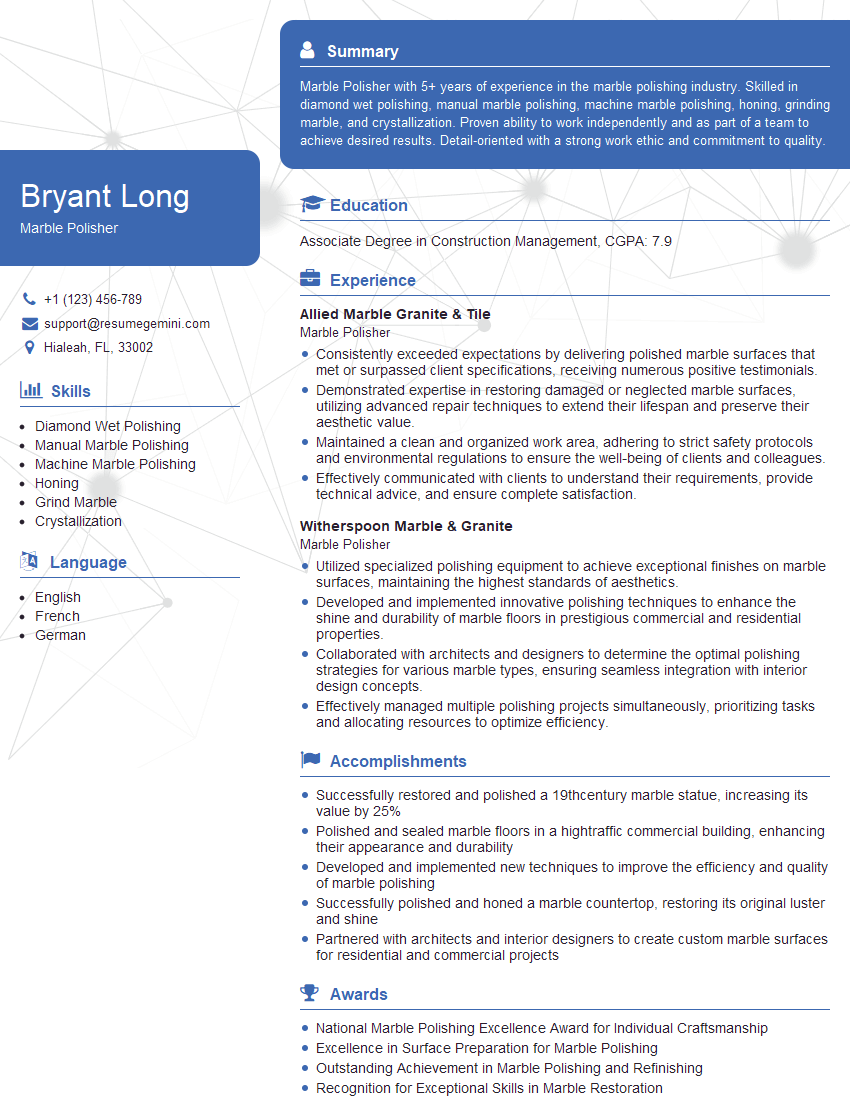
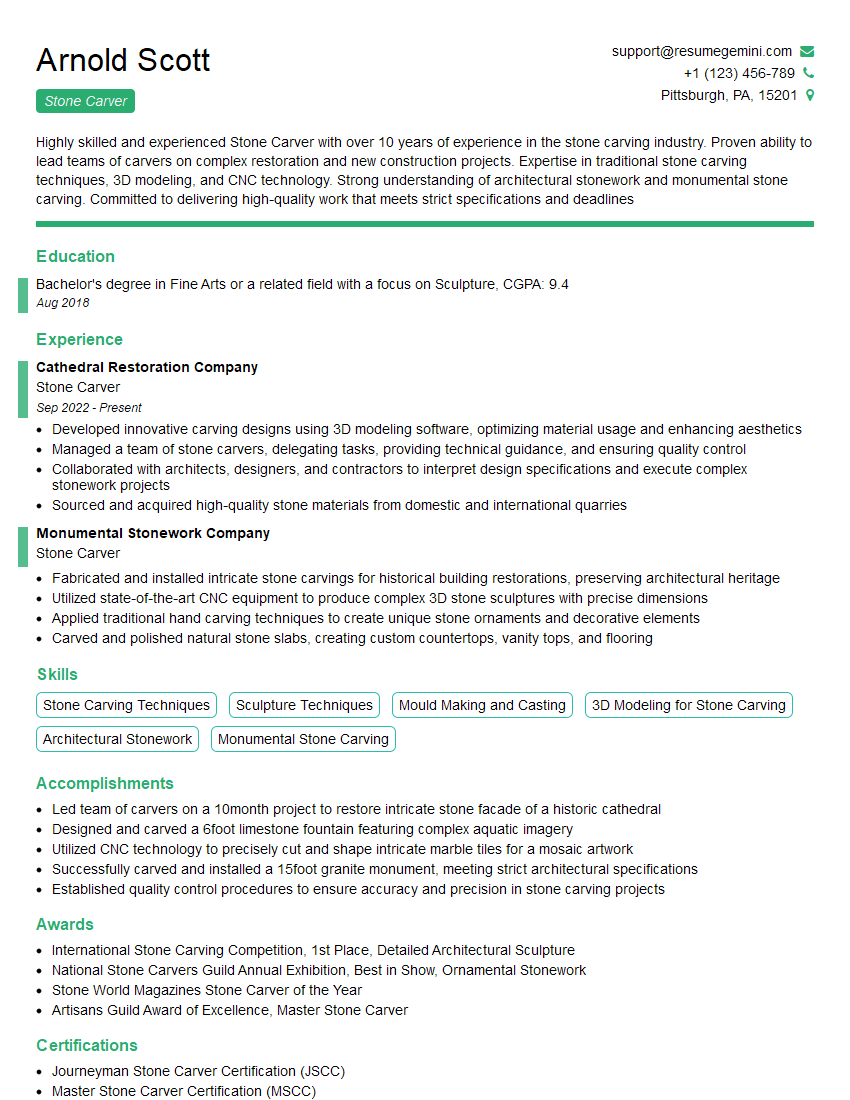
Mastering marble cutting and shaping opens doors to a rewarding career with diverse opportunities for growth and specialization. To maximize your job prospects, a well-crafted, ATS-friendly resume is essential. ResumeGemini is a trusted resource that can help you build a professional resume that highlights your skills and experience effectively. ResumeGemini provides examples of resumes tailored to the Marble Cutting and Shaping industry, helping you create a compelling document that showcases your expertise and increases your chances of securing your dream role.



Explore more articles
Users Rating of Our Blogs
Share Your Experience
We value your feedback! Please rate our content and share your thoughts (optional).
What Readers Say About Our Blog
To the interviewgemini.com Webmaster.
Very helpful and content specific questions to help prepare me for my interview!
Thank you
To the interviewgemini.com Webmaster.
This was kind of a unique content I found around the specialized skills. Very helpful questions and good detailed answers.
Very Helpful blog, thank you Interviewgemini team.