Every successful interview starts with knowing what to expect. In this blog, we’ll take you through the top Ability to work with high voltage systems interview questions, breaking them down with expert tips to help you deliver impactful answers. Step into your next interview fully prepared and ready to succeed.
Questions Asked in Ability to work with high voltage systems Interview
Q 1. Explain the difference between AC and DC high voltage systems.
The fundamental difference between AC (Alternating Current) and DC (Direct Current) high voltage systems lies in the direction and nature of the current flow. In DC systems, the current flows consistently in one direction, like water flowing down a river. This is simpler to understand and often used in applications requiring constant voltage, such as high-voltage transmission lines and some industrial processes. In AC systems, however, the current periodically reverses direction, much like a wave oscillating back and forth. This cyclical nature makes AC more easily transformed to different voltage levels using transformers, a key advantage for long-distance power transmission and distribution. This also leads to potential issues with AC that are not encountered in DC systems such as skin effect and inductive reactance.
Practical Differences:
- Transmission: AC is favored for long-distance transmission because of the ease of voltage transformation using transformers. DC is becoming increasingly relevant with advancements in HVDC technology, especially for underwater cables and long-distance transmission where losses are significant.
- Applications: DC high voltage is used in applications like high-voltage power supplies for industrial processes and specialized devices. AC high voltage dominates the power grid and domestic power distribution.
- Safety: Both AC and DC high voltage are equally dangerous. The potential for lethal electric shock exists regardless of the type of current.
Q 2. Describe the safety precautions you would take when working with high voltage equipment.
Safety is paramount when working with high voltage equipment. My approach involves a multi-layered safety strategy, beginning with thorough planning and risk assessment. This includes:
- Permit-to-Work System: Always obtain a permit before starting any work, detailing the tasks, hazards, and control measures.
- Lockout/Tagout Procedures: Implementing strict lockout/tagout procedures is critical to ensure equipment is completely de-energized and isolated before commencing work. This prevents accidental energization.
- Personal Protective Equipment (PPE): Wearing appropriate PPE is non-negotiable. This includes insulated gloves, rubber boots, safety helmets, and eye protection. The voltage rating of the PPE must exceed the system voltage significantly.
- Grounding and Bonding: Proper grounding and bonding of equipment and tools are essential to prevent dangerous voltage build-up. This requires using equipment rated appropriately for the voltage.
- Visual Inspection: Before touching any equipment, I always conduct a visual inspection for any signs of damage or wear.
- Trained Personnel: Only appropriately trained and authorized personnel should work with high voltage equipment. Regular refresher training is crucial to maintain competence.
- Emergency Procedures: A clear emergency plan with designated personnel and emergency response procedures must be in place.
- Voltage Verification: After lockout/tagout, I always use a non-contact voltage tester to verify that the equipment is truly de-energized before commencing work.
Example: I once worked on a project involving 132kV lines, and our team meticulously followed every step of the lockout/tagout procedure, meticulously grounding each component before starting any maintenance.
Q 3. What are the common causes of high voltage equipment failure?
High voltage equipment failures can stem from a variety of factors, often combining several contributing elements:
- Insulation Degradation: Ageing, exposure to environmental factors (moisture, heat, UV radiation), and mechanical stress can weaken insulation, leading to breakdown and arcing.
- Overvoltage: Surges or transient overvoltages can exceed the equipment’s design limits, damaging components and leading to flashovers.
- Overcurrent: Excessive current flow, often caused by faults or short circuits, can generate excessive heat, melting conductors and damaging insulation.
- Mechanical Stress: Vibrations, extreme temperature fluctuations, or physical impacts can cause components to crack or deform, compromising their integrity.
- Poor Maintenance: Lack of regular maintenance and inspections can allow minor problems to escalate into major failures.
- Manufacturing Defects: Substandard manufacturing practices or defects in materials can lead to premature failures.
- Environmental Factors: Contamination such as dust, salt spray, or corrosive substances can significantly degrade insulation and cause premature failures.
Example: A failure in a high voltage transformer might be caused by a combination of ageing insulation, overcurrent due to a system fault, and moisture ingress from a damaged seal.
Q 4. How do you test for high voltage insulation resistance?
Testing high voltage insulation resistance requires specialized equipment and techniques to ensure safety and accuracy. The most common method uses a Megohmmeter (or insulation resistance tester), which applies a high DC voltage to the insulation and measures the leakage current. A high resistance indicates good insulation, while a low resistance suggests potential insulation breakdown. The test voltage and time are determined based on the equipment’s specifications and voltage rating. For example, testing a 132kV cable requires significantly higher test voltage and longer test duration than a lower voltage cable. Before testing, all the relevant safety measures mentioned before need to be implemented.
Procedure:
- Preparation: De-energize the equipment and properly ground it. Connect the Megohmmeter leads appropriately to the conductor and the grounded metal casing. The test voltage should be chosen based on the equipment’s specifications and safely above its operating voltage.
- Testing: Apply the test voltage and observe the reading on the Megohmmeter. The insulation resistance is usually measured in megaohms (MΩ).
- Interpretation: Compare the measured resistance to the acceptable values specified in the equipment’s documentation or relevant standards. Low resistance indicates potential problems requiring attention.
Safety Considerations: Remember, even with the equipment de-energized, residual charge could be present. Proper grounding, use of PPE and adherence to safety procedures are essential.
Q 5. Explain the principles of grounding and bonding in high voltage systems.
Grounding and bonding in high voltage systems are critical for safety and preventing damage. Grounding connects the system or equipment to the earth, providing a low-resistance path for fault currents to flow safely to the ground, preventing dangerous voltage build-up and protecting personnel. Bonding connects multiple metallic parts or enclosures together at the same potential, eliminating voltage differences between them and preventing electric shock. Both techniques work together to minimize electrical hazards.
Principles:
- Grounding: Effective grounding requires a low-resistance path to the earth, usually achieved using ground rods, grounding grids, or other conductive structures in direct contact with the earth. The lower the resistance, the better the protection.
- Bonding: Bonding ensures that all exposed conductive parts are at the same potential. This prevents potential differences that could lead to shock or arcing if a fault occurs. It often involves using conductors to interconnect equipment and structures.
Example: In a substation, all metal enclosures of transformers, switchgear, and other equipment are bonded together. Additionally, each component is grounded to prevent a dangerous potential difference between components should a fault occur.
Q 6. Describe different types of high voltage protective equipment.
High voltage protective equipment is essential for the safety of personnel working with high voltage systems. The type of equipment required depends on the voltage level and the nature of the work. Common examples include:
- Insulated Gloves: These are made from high-dielectric-strength materials and are tested to withstand specified voltages. They provide protection against electric shock when handling energized conductors.
- Insulated Tools: Similar to gloves, insulated tools (screwdrivers, pliers, etc.) are designed to prevent electric shock. The insulation must be rated appropriately for the voltage level.
- Insulated Boots: These are made from insulating material with a high dielectric strength and protect against electric shock by preventing ground fault current from reaching the body.
- Safety Helmets: While not directly for electrical protection, safety helmets protect from falling objects and other head injuries, which are potential hazards in high-voltage environments.
- Protective Clothing: Protective clothing (suits, vests) made from flame-resistant materials offers protection against electric arcs and fire hazards.
- Face Shields and Eye Protection: Protects against flash burns and debris during electrical incidents.
- Insulated Blankets and Mats: Used to provide insulation between workers and grounded surfaces when working on energized equipment.
- Voltage Testers/Indicators: Non-contact voltage testers are used to verify that equipment is de-energized before commencing work. Contact-type testers are used to measure voltage levels in various applications.
Importance: The voltage rating of all PPE must exceed the system voltage by a significant margin, usually several times, and should be regularly inspected and tested for damage.
Q 7. What are the potential hazards associated with working on high voltage lines?
Working on high voltage lines presents several significant hazards:
- Electric Shock: This is the most immediate and potentially lethal hazard. Contact with energized conductors can lead to severe burns, cardiac arrest, and death. The magnitude of the shock depends on the voltage level, current path, and duration of contact.
- Electric Arc Flash: A sudden, high-energy arc of electricity can occur if a fault develops or if a conductive object comes into contact with energized components. This can cause severe burns, blindness, and hearing loss.
- Falls: Working at height on transmission towers or poles carries a significant risk of falls, resulting in severe injuries or fatalities.
- Burns: Burns can occur from electric arcs, contact with energized components, or fires resulting from electrical faults.
- Electromagnetic Fields (EMFs): Long-term exposure to strong EMFs from high-voltage lines is associated with potential health risks, although the extent of these risks is still under investigation.
- Fire Hazards: Electrical faults can cause fires that can spread rapidly, resulting in significant property damage and serious injuries.
Mitigation: These hazards are addressed through rigorous safety procedures, training, appropriate PPE, and regular maintenance inspections of equipment and lines.
Q 8. How do you interpret high voltage test results?
Interpreting high voltage test results requires a systematic approach, combining knowledge of the equipment under test, the test procedures, and the relevant standards. We’re looking for evidence of dielectric strength, insulation resistance, and partial discharge activity. Let’s say we’re testing a power transformer. A successful withstand test, where the transformer endures a specified high voltage without breakdown, indicates good insulation integrity. Conversely, a failure during the test, perhaps a flashover or puncture, points to a weakness in the insulation system that needs immediate attention. Analysis also includes examining the test waveforms – unusual oscillations or excessive current could suggest internal problems. The results aren’t just pass/fail; the data provides insights into the overall health of the high voltage equipment.
For example, if we see consistently lower-than-expected insulation resistance values over multiple tests, we might suspect moisture ingress. Partial discharge measurements can reveal tiny discharges within the insulation, even before a complete breakdown, allowing for preventative maintenance. Always compare results with previous tests and manufacturers’ specifications for a comprehensive assessment.
Q 9. Explain the operation of a high voltage circuit breaker.
A high voltage circuit breaker is a crucial safety device that interrupts high-voltage current flow in case of a fault. Imagine a dam with a floodgate – the circuit breaker acts as that gate. Its operation involves several steps. First, a fault detection system senses an overcurrent or ground fault. This triggers the circuit breaker’s mechanism. Common mechanisms include electromechanical systems using powerful solenoids or compressed air, and vacuum or sulfur hexafluoride (SF6) gas interrupters which rely on the dielectric strength of the gas to quench the arc.
In an electromechanical breaker, the solenoid rapidly moves contacts apart, creating an arc. This arc is then quickly extinguished either by the separation of the contacts or by using an arc-quenching medium. In gas-insulated breakers, the arc is contained and extinguished within the gas. The entire process must happen extremely quickly to protect equipment and personnel from damage and injury. The speed is critical; a prolonged arc can severely damage the system. The post-fault condition is then assessed, and the breaker can be manually or automatically reset for subsequent use.
Q 10. What are the different types of high voltage insulators and their applications?
High voltage insulators are essential for preventing current leakage and electrical breakdown. Several types exist, each with its strengths and weaknesses.
- Porcelain insulators: These are widely used in overhead power lines due to their high dielectric strength, weather resistance, and relatively low cost. Think of the classic white ceramic insulators you see on power poles.
- Glass insulators: Similar to porcelain, offering good dielectric strength and weather resistance. They’re often preferred in areas with high pollution levels because they are easier to clean.
- Polymer insulators: These are becoming increasingly popular due to their lightweight nature, high strength-to-weight ratio, and resistance to vandalism. However, they can be susceptible to UV degradation over time.
- Composite insulators: Combining different materials like fiberglass and silicone rubber, these offer a blend of properties, balancing mechanical strength, hydrophobic behavior, and dielectric strength.
- Gas-insulated bushings: Used for high-voltage equipment like transformers and circuit breakers, these employ gases like SF6 to provide insulation.
The choice of insulator depends on factors such as voltage level, environmental conditions, and cost considerations. For example, polymer insulators are often chosen for areas prone to vandalism, while porcelain or glass are preferred for high-voltage applications where long-term reliability is paramount.
Q 11. Describe the process of commissioning a high voltage substation.
Commissioning a high voltage substation is a rigorous process ensuring everything operates as designed and safely. It involves several key stages:
- Pre-commissioning: Thorough inspection of all equipment, verifying correct installation and connections. This often includes checking insulation resistance and performing partial discharge tests.
- Individual equipment testing: Each component, like transformers, circuit breakers, and protective relays, undergoes individual tests to verify its performance according to specifications. This might involve high voltage withstand tests, insulation resistance measurements, and relay settings verification.
- System testing: After individual components are tested, the whole substation is tested as a system. This includes various protection system tests, verifying the coordinated operation of circuit breakers and relays under various fault conditions. Simulated faults are induced to verify the system’s response.
- Protection and control system testing: This ensures the protection relays operate correctly and the control systems function as intended, maintaining safety and stability. This involves testing different scenarios and verifying correct communication between equipment.
- Final inspection and handover: Once all tests are successfully completed and any identified issues are rectified, the substation is formally inspected, and documentation is reviewed before handover to the operating personnel.
Throughout the process, safety is paramount. All personnel must adhere to strict safety protocols and use appropriate personal protective equipment (PPE). The commissioning process ensures safe and reliable operation of the high voltage substation.
Q 12. Explain the concept of voltage surge and its effects on high voltage systems.
A voltage surge, also known as a transient overvoltage, is a sudden, rapid increase in voltage in an electrical system. Imagine a calm lake suddenly hit by a large wave. This surge can have devastating effects on high voltage systems. Several factors can cause voltage surges, including lightning strikes, switching operations (like connecting or disconnecting loads), faults, and capacitor bank switching.
The effects on high voltage systems can be severe. Surges can cause insulation breakdown in cables and equipment, leading to equipment failure, arc flashes (dangerous electrical explosions), and fires. They can also damage electronic components and protective devices, disrupting the entire system. Protective devices like surge arresters (also known as surge protectors) are installed to mitigate the effects of surges by diverting excess energy to ground.
For instance, a lightning strike near a power line could induce a significant voltage surge, potentially causing failure of insulators or internal damage to transformers. Proper grounding and efficient surge protection are crucial to minimizing these risks.
Q 13. How do you troubleshoot a high voltage fault?
Troubleshooting a high voltage fault is a complex process demanding expertise and caution. Safety is the top priority; always ensure the system is de-energized and properly locked out before attempting any repairs.
The process often begins with a thorough investigation to identify the affected area and the nature of the fault. This often involves examining protective relay logs, reviewing fault indicators on circuit breakers, and using specialized diagnostic equipment to pinpoint the location of the fault. Tools like infrared cameras can detect overheating, indicative of a problem.
Once the location is determined, the damaged equipment or faulty component must be identified. This requires a meticulous inspection and testing. After the faulty component is found, replacement or repair is conducted according to safety procedures and relevant standards. After the repairs, thorough testing is done to ensure the system is operating correctly and safely before re-energizing the system.
For example, if a protective relay indicates a ground fault on a particular section of a transmission line, specialized testing equipment would help pinpoint the exact location of the fault along the line. This may involve measurements such as line impedance or using a high impedance ground fault locator. This systematic approach ensures quick and safe resolution of high voltage faults.
Q 14. What are the regulations and standards related to working with high voltage systems?
Regulations and standards for working with high voltage systems are stringent, prioritizing safety and reliability. These vary by country and region but generally align with international standards. Key standards include IEC (International Electrotechnical Commission) and IEEE (Institute of Electrical and Electronics Engineers) standards. These standards cover aspects like:
- Safety procedures: Detailed guidelines are provided for safe working practices, including lockout/tagout procedures, personal protective equipment (PPE), and emergency response plans.
- Equipment design and testing: Standards define design requirements and testing procedures for high-voltage equipment to ensure their safety and reliability. This includes insulation levels, protection schemes, and withstand capabilities.
- Installation and maintenance: Specific standards govern the installation, maintenance, and operation of high voltage systems, outlining procedures to ensure safety and compliance.
- Occupational safety and health: Regulations mandate strict adherence to safety protocols to protect workers from electrical hazards. This involves regular training and competency assessments.
Compliance with these standards is mandatory and ensures that those working with high voltage systems are adequately trained, the equipment is safe, and the operations are reliable, minimizing risks to workers and the public.
Q 15. Describe different types of high voltage transformers.
High-voltage transformers are crucial components in power transmission and distribution systems, stepping voltage up or down to suit various needs. They’re categorized based on several factors, including their core type, cooling method, and application.
- Power Transformers: These are the workhorses of the grid, used in substations to step voltage up for long-distance transmission and down for local distribution. They’re typically very large, often exceeding several MVA (Mega Volt-Ampere) in rating.
- Instrument Transformers: These transformers accurately measure high voltages and currents, providing safe, scaled-down signals for monitoring and protection equipment. They include Current Transformers (CTs) and Potential Transformers (PTs).
- Autotransformers: These have only one winding, with a portion tapped for voltage adjustment. They’re useful for voltage regulation but lack the galvanic isolation of a dual-winding transformer.
- Distribution Transformers: Smaller transformers found at the distribution level, they step voltage down from high-voltage transmission lines to lower voltages suitable for residential and commercial use.
- Specific Design Transformers: There are specialized transformers like those used in high-voltage DC (HVDC) transmission systems, which necessitate specific designs to handle the unique characteristics of DC power.
For example, a large power transformer in a substation might step up voltage from 230 kV to 765 kV for long-distance transmission, while a smaller distribution transformer might step down 12 kV to 240 V for residential use. The choice of transformer type depends entirely on the specific application and voltage levels involved.
Career Expert Tips:
- Ace those interviews! Prepare effectively by reviewing the Top 50 Most Common Interview Questions on ResumeGemini.
- Navigate your job search with confidence! Explore a wide range of Career Tips on ResumeGemini. Learn about common challenges and recommendations to overcome them.
- Craft the perfect resume! Master the Art of Resume Writing with ResumeGemini’s guide. Showcase your unique qualifications and achievements effectively.
- Don’t miss out on holiday savings! Build your dream resume with ResumeGemini’s ATS optimized templates.
Q 16. Explain the principles of arc flash protection.
Arc flash protection is paramount in high-voltage environments, aiming to mitigate the severe dangers of electrical arc flashes. These are explosive releases of energy that can cause serious burns, hearing loss, and even fatalities. The protection strategy is multi-faceted:
- Engineering Controls: These are the primary line of defense, focusing on preventing arc flash incidents. This includes using proper equipment grounding, insulation, and sufficient clearances. Properly designed and maintained switchgear is essential.
- Administrative Controls: These involve procedures, training, and safety protocols. Lockout/Tagout procedures are vital to ensure equipment is de-energized before maintenance. Regular safety training is crucial to educate workers about arc flash hazards and safe working practices.
- Personal Protective Equipment (PPE): When working on energized equipment, specialized PPE, such as arc-rated clothing, face shields, and hearing protection, is mandatory. The selection of PPE is based on the incident energy analysis for the specific task.
Incident Energy calculations, based on the system’s fault current and impedance, determine the appropriate PPE needed. A comprehensive arc flash risk assessment, including incident energy calculation, is legally required before performing any work on high-voltage equipment.
Q 17. What are the different methods of high voltage cable termination?
High-voltage cable termination is the process of safely and reliably connecting high-voltage cables to equipment, ensuring electrical continuity and insulation. Several methods exist, each suited to different voltage levels and cable types:
- Compression Terminations: These use a compression fitting to securely grip the cable conductor and provide a reliable connection. They are relatively simple to install but require careful attention to ensure proper compression.
- Heat-Shrink Terminations: These use heat-shrinkable tubing and insulation to seal the connection, providing excellent environmental protection. They are reliable and offer good insulation but require a heat source for installation.
- Pour-Fill Terminations: This method fills the termination with an insulating compound, providing excellent insulation and environmental protection. This is commonly used for high voltage applications.
- Epoxy Resin Terminations: Similar to pour-fill, but the use of epoxy resin offers superior strength and electrical properties, often chosen for high-stress or harsh environments.
The choice of termination method depends on various factors such as voltage level, cable type, environmental conditions, and installation requirements. A poorly executed termination can lead to insulation failure, arcing, and safety hazards.
Q 18. How do you calculate the voltage drop in a high voltage transmission line?
Calculating voltage drop in a high-voltage transmission line involves considering the line’s resistance, reactance, and the current flowing through it. It’s crucial for ensuring efficient power delivery and avoiding excessive losses.
The simplest calculation (for a single-phase line) uses Ohm’s Law with impedance:
Voltage Drop = I * ZWhere:
Iis the line current (amperes)Zis the total impedance of the line (ohms), which is the vector sum of resistance (R) and reactance (X):Z = √(R² + X²)
For three-phase lines, the calculation is more complex and depends on the line configuration (e.g., delta or wye). You’ll need to account for phase-to-phase and phase-to-neutral voltages. Specialized software tools or power system analysis programs often simplify these calculations for complex transmission lines.
Accurate calculation of voltage drop is crucial for proper voltage regulation and system stability. Excessive voltage drop can lead to power quality issues and equipment malfunction.
Q 19. What are the different types of high voltage relays and their functions?
High-voltage relays are essential protective devices that monitor electrical parameters and initiate corrective actions in case of faults or abnormal conditions. Several types exist, each with specific functions:
- Overcurrent Relays: These detect excessive current, indicating short circuits or overloads. They’re usually the first line of defense in a protection scheme.
- Differential Relays: These compare currents entering and leaving a protected zone. Any significant difference indicates an internal fault within the zone.
- Distance Relays: These measure the impedance to a fault along a transmission line, determining its location and initiating tripping based on distance.
- Ground Fault Relays: These detect ground faults, which are dangerous situations involving current flowing to ground.
- Busbar Protection Relays: These protect the main busbars in a substation from faults.
- Transformer Protection Relays: These provide comprehensive protection for transformers, detecting faults and abnormal operating conditions.
The choice of relay type depends on the specific application and equipment being protected. A coordinated protection scheme uses multiple relays to ensure that faults are isolated quickly and safely, minimizing damage and ensuring system stability. For example, a distance relay might be used to protect a long transmission line, while a differential relay is used for a transformer.
Q 20. Explain the concept of capacitive and inductive reactance in high voltage systems.
Capacitive and inductive reactance are fundamental electrical properties influencing the behavior of AC currents in high-voltage systems. They represent opposition to current flow, but unlike resistance, they don’t dissipate energy as heat.
- Inductive Reactance (XL): This arises from the inductance of components like inductors, transformers, and transmission lines. It opposes changes in current, leading to a phase lag between voltage and current. It’s calculated as:
XL = 2πfL, wherefis frequency andLis inductance. - Capacitive Reactance (XC): This arises from the capacitance between conductors, especially in high-voltage transmission lines. It opposes changes in voltage, leading to a phase lead between voltage and current. It’s calculated as:
XC = 1/(2πfC), wherefis frequency andCis capacitance.
In high-voltage systems, these reactances significantly affect power flow, voltage regulation, and system stability. The interplay between inductive and capacitive reactance is critical; they can partially cancel each other out, influencing power factor and system resonance. For instance, long transmission lines exhibit both significant inductance and capacitance, requiring careful consideration in design and operation to avoid voltage instability and power oscillations.
Q 21. Describe the use of protective relays in high voltage systems.
Protective relays are the nervous system of high-voltage systems, ensuring rapid detection and isolation of faults to prevent damage, maintain system integrity, and safeguard personnel. Their role is critical for maintaining the reliability and safety of the power grid.
They accomplish this by continuously monitoring various electrical parameters like current, voltage, and impedance. When a fault condition, such as a short circuit or ground fault, is detected, the relays rapidly initiate a trip signal. This signal triggers circuit breakers to isolate the faulty section of the system, preventing damage to equipment and the spread of the fault.
Without protective relays, faults could cascade through the system, leading to widespread blackouts and potentially catastrophic consequences. They are essential for ensuring the safe and reliable operation of high-voltage systems, reducing downtime, and limiting the financial impact of power outages.
Modern protective relay systems often include advanced features like communications capabilities and self-diagnostic tools, enabling remote monitoring, data analysis, and improved system maintenance.
Q 22. How do you ensure the safety of personnel working near high voltage equipment?
Ensuring personnel safety near high voltage equipment is paramount and relies on a multi-layered approach. It begins with rigorous training, emphasizing the inherent dangers of high voltage and the importance of adhering to safety protocols. This includes understanding the effects of electrical shock, arc flash hazards, and the potential for catastrophic equipment failure. Before any work commences, a comprehensive risk assessment must be conducted to identify potential hazards and develop a safe work plan. This often involves de-energizing the equipment, applying lockout/tagout procedures to prevent accidental energization, and using appropriate personal protective equipment (PPE).
PPE can include insulated gloves, face shields, arc-flash suits, and safety footwear. Additionally, proper grounding and bonding techniques are crucial to prevent the build-up of static electricity and the occurrence of unexpected voltage surges. Regular safety inspections of equipment and work areas are vital to identify and address potential hazards proactively. Finally, clear communication and coordination among team members are essential to ensure everyone is aware of the potential risks and knows their roles in maintaining a safe working environment. For example, a power company might use a ‘Permit-to-Work’ system, requiring approval and confirmation from multiple stakeholders before any work is done near high voltage lines.
Q 23. What are the common types of high voltage switchgear?
High voltage switchgear encompasses a range of devices used to control and protect high voltage circuits. Common types include:
- Circuit Breakers: These are essential for interrupting fault currents and isolating sections of the electrical system. They come in various designs, including air-blast, oil-filled, and SF6 (sulfur hexafluoride) gas-insulated circuit breakers, each suited to different voltage levels and applications.
- Disconnecting Switches (isolators): These switches are used for isolating equipment during maintenance or repairs. They are not designed to interrupt fault currents, so the circuit must be de-energized before operating them.
- Busbars: These are conductive bars or tubes that serve as common connection points for various circuits within the switchgear. They are typically made of copper or aluminum and designed to carry high currents.
- Current Transformers (CTs) and Potential Transformers (PTs): These transformers step down the high voltage and current for measurement and protection purposes. The signals from these transformers are used in relay protection schemes.
- Protective Relays: These electronic devices monitor the electrical parameters of the system and initiate circuit breaker tripping in the event of faults or abnormal operating conditions.
The choice of switchgear depends heavily on factors such as voltage level, fault current capacity, and environmental conditions. For example, gas-insulated switchgear is often preferred in substations due to its compact size and superior insulation properties compared to air-insulated switchgear.
Q 24. Explain the concept of power factor correction in high voltage systems.
Power factor correction in high voltage systems is crucial for improving efficiency and reducing energy losses. The power factor represents the ratio of real power (kW) to apparent power (kVA) in an AC circuit. A lagging power factor, common in inductive loads like motors, indicates that a significant portion of the apparent power is reactive power, which does not perform any useful work but contributes to increased current flow.
This increased current leads to higher losses in transmission lines and transformers. Power factor correction involves adding capacitive elements to the system, which counteract the inductive reactance and bring the power factor closer to unity (1). This is often achieved using capacitor banks, either switched manually or automatically by power factor controllers. A higher power factor means less current is drawn for the same amount of real power, reducing energy losses and improving system efficiency. For instance, a large industrial plant with many motors might employ multiple capacitor banks strategically placed throughout its high voltage distribution system to optimize power factor correction.
Q 25. Describe different types of high voltage measurement instruments.
Measuring high voltage requires specialized instruments capable of safely handling and accurately measuring high voltage levels without risk of damage or injury. Some common types include:
- High Voltage Voltmeters: These instruments measure voltage levels directly or through potential transformers (PTs). They use various techniques including electrostatic voltmeters, capacitive voltage transformers (CVTs), and potential transformers.
- High Voltage Ammeters: These instruments measure current levels, often indirectly using current transformers (CTs) to step down the current to a safe level for measurement. These are crucial for monitoring load and identifying potential overload situations.
- High Voltage Insulation Testers (Megohmeters): These devices measure the insulation resistance of high voltage equipment, providing an indicator of insulation condition. Low insulation resistance can indicate deterioration and potential hazards.
- High Voltage Power Quality Analyzers: These advanced instruments monitor various parameters like voltage sags, surges, harmonics, and power factor, providing comprehensive insights into the quality of the high voltage power supply.
- Digital Oscilloscopes: These versatile instruments can capture and analyze transient events such as voltage surges and current waveforms, providing valuable diagnostic information for troubleshooting.
The selection of the instrument depends on the specific measurement needed and the voltage level involved. Safety precautions, such as proper grounding and use of insulated probes, are essential when handling any high voltage measurement instruments.
Q 26. How do you handle an emergency situation involving high voltage equipment?
Emergency situations involving high voltage equipment demand immediate and decisive action, prioritizing safety above all else. The first step is to ensure the safety of personnel by immediately evacuating the area and establishing a safe perimeter. Never attempt to approach or touch energized equipment. Then, call for emergency services (fire department, paramedics, and the relevant utility company) immediately.
Once the area is secured, initial assessment of the situation is needed to understand the nature of the emergency. If possible, try to identify the source of the problem and, depending on your training, determine if there are any immediate safety concerns like fire hazards or potential for further escalation. Once emergency services arrive, cooperate fully with their instructions and provide any relevant information to aid in the response and the investigation of the incident. Thorough documentation of the event and the subsequent actions is vital for post-incident analysis and prevention of future occurrences.
For example, an arc flash incident might require the immediate use of fire extinguishers to control the fire, while a fallen power line needs a wide cordon and waiting for the power company to de-energize the line before any approach is possible.
Q 27. What are the different methods of high voltage cable installation?
High voltage cable installation is a complex process that requires specialized equipment and expertise. The choice of installation method depends on various factors, including cable type, voltage level, environmental conditions, and accessibility.
- Direct Burial: Cables are buried directly in the ground, often within a protective conduit or trench. This method is commonly used for underground power transmission.
- Trenching and Laying: Cables are laid in a prepared trench, often with bedding material for protection and backfilling with earth.
- Aerial Installation: Cables are strung on poles or towers, often using specialized clamps and insulators. This method is commonly used for overhead power transmission.
- Pulling Through Conduits: Cables are pulled through pre-installed conduits, providing protection and routing flexibility.
- Horizontal Directional Drilling (HDD): A non-destructive method for installing cables underground, minimizing surface disruption.
Regardless of the method, proper grounding and bonding are essential to prevent voltage surges and ensure safety. Each method also requires careful consideration of cable stress, environmental protection, and adherence to safety regulations.
Q 28. Explain the importance of regular maintenance of high voltage equipment.
Regular maintenance of high voltage equipment is critical for ensuring safety, reliability, and efficiency. Preventive maintenance helps identify and address potential problems before they escalate into major failures or safety hazards. It prolongs the equipment’s lifespan, minimizes downtime, and reduces the risk of costly repairs.
A typical maintenance program includes visual inspections, checking for signs of damage or deterioration (e.g. cracks, corrosion, loose connections), testing insulation resistance, checking operational parameters like temperature and vibration, and cleaning the equipment of accumulated dust and debris. For instance, oil-filled circuit breakers require regular oil sampling and analysis to detect any signs of contamination or degradation. Gas-insulated switchgear needs periodic testing of the gas pressure and purity to ensure continued insulation capabilities. The specific maintenance tasks and their frequency are dictated by manufacturer recommendations, operational conditions, and relevant industry standards. The aim is to proactively prevent breakdowns and ensure a safe, reliable, and efficient high voltage power system. Neglecting maintenance can lead to unplanned outages, equipment failures, safety incidents, and significant financial losses.
Key Topics to Learn for Ability to Work with High Voltage Systems Interviews
- Safety Procedures and Regulations: Understanding and applying relevant safety standards (e.g., lockout/tagout procedures, personal protective equipment requirements) for high-voltage environments. This includes theoretical knowledge of arc flash hazards and practical application of safety protocols.
- High-Voltage Equipment Operation and Maintenance: Familiarity with the operation and maintenance of various high-voltage equipment, including transformers, circuit breakers, insulators, and switchgear. Practical application would involve describing troubleshooting procedures for common equipment malfunctions.
- Electrical Theory Fundamentals: A solid grasp of fundamental electrical principles, including Ohm’s Law, Kirchhoff’s Laws, and AC/DC circuit analysis. This forms the theoretical foundation for understanding high-voltage system behavior.
- Protective Relaying and System Protection: Knowledge of different types of protective relays and their functions in safeguarding high-voltage systems. Practical examples could include explaining the operation of a differential relay or distance relay.
- High-Voltage Testing and Measurement Techniques: Understanding various methods for testing and measuring high-voltage systems, including dielectric strength testing and insulation resistance measurements. Practical applications would involve describing the procedures and interpreting the results of these tests.
- Troubleshooting and Problem-Solving: Ability to diagnose and solve problems in high-voltage systems, including identifying faults, isolating problematic components, and implementing repair strategies. This encompasses both theoretical understanding and practical experience.
Next Steps
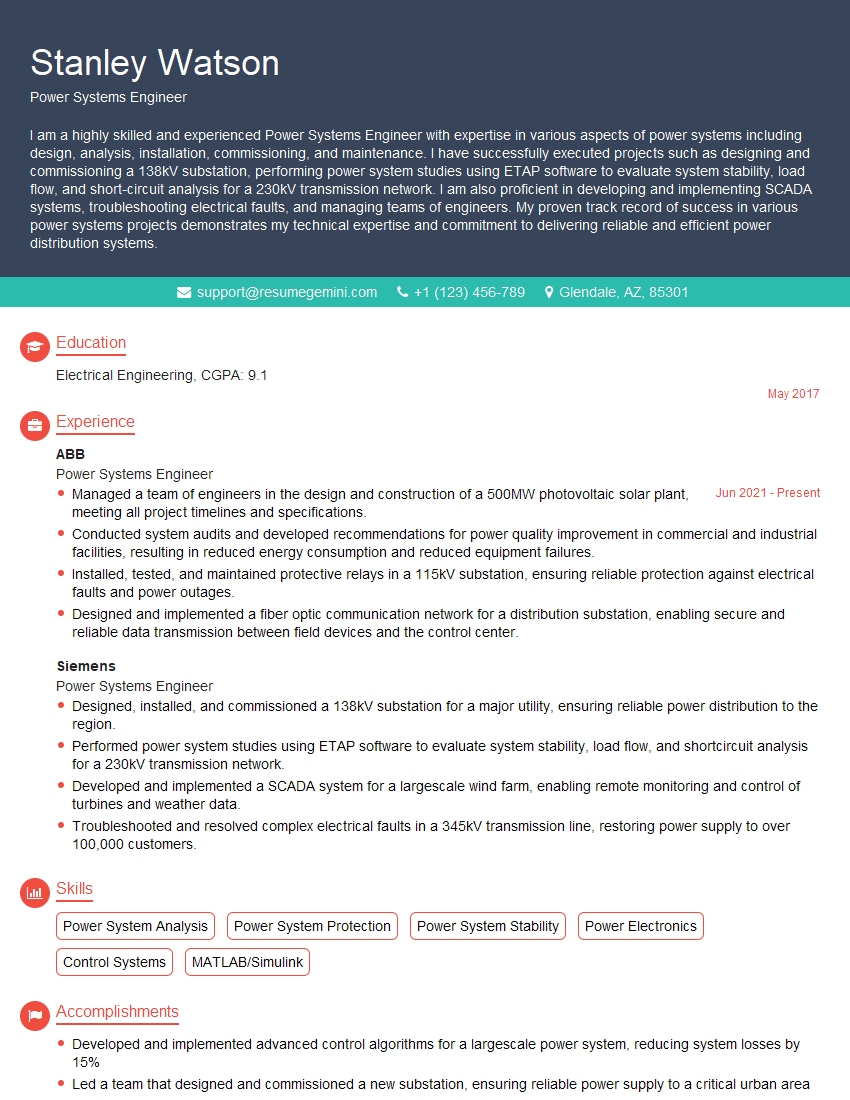
Mastering the ability to work with high-voltage systems opens doors to exciting and rewarding careers in power generation, transmission, and distribution. Demonstrating this expertise effectively is crucial for landing your dream job. To significantly boost your job prospects, it’s essential to create an ATS-friendly resume that highlights your skills and experience. ResumeGemini is a trusted resource that can help you build a professional and impactful resume tailored to the energy sector. We provide examples of resumes specifically designed for candidates with experience in high-voltage systems to help you showcase your qualifications effectively. Invest time in crafting a compelling resume – it’s your first impression on potential employers.
Explore more articles
Users Rating of Our Blogs
Share Your Experience
We value your feedback! Please rate our content and share your thoughts (optional).
What Readers Say About Our Blog
To the interviewgemini.com Webmaster.
Very helpful and content specific questions to help prepare me for my interview!
Thank you
To the interviewgemini.com Webmaster.
This was kind of a unique content I found around the specialized skills. Very helpful questions and good detailed answers.
Very Helpful blog, thank you Interviewgemini team.