Interviews are opportunities to demonstrate your expertise, and this guide is here to help you shine. Explore the essential Archaeological Theory and Methods interview questions that employers frequently ask, paired with strategies for crafting responses that set you apart from the competition.
Questions Asked in Archaeological Theory and Methods Interview
Q 1. Explain the difference between processual and post-processual archaeology.
Processual and post-processual archaeology represent two major paradigms in archaeological thought, differing significantly in their approaches to interpreting the past. Processual archaeology, dominant from the 1960s to the 1980s, emphasizes a scientific, objective approach. It seeks to explain cultural change through evolutionary models, focusing on material culture as a reflection of societal adaptation to environmental pressures and technological advancements. Think of it like a biologist studying animal behavior—seeking universal laws governing cultural development. They often employ quantitative methods, statistical analysis, and a focus on broad, cross-cultural comparisons.
Post-processual archaeology, emerging as a reaction against processualism in the late 1980s, critiques this objective stance, arguing that interpretations are inherently subjective and influenced by the archaeologist’s own biases and perspectives. It emphasizes the individual agency of past people, the importance of symbolic meaning, and the complexities of social interactions. Instead of seeking universal laws, post-processualists explore the diverse meanings and interpretations of the past, recognizing the multiplicity of voices and perspectives. Imagine it as an art historian studying a painting, considering the artist’s intent, the social context, and the viewer’s interpretation. Qualitative methods, such as detailed analysis of individual artifacts and textual sources, are key to this approach.
For example, a processual archaeologist might analyze the distribution of pottery types across a region to understand trade networks and population movements, while a post-processual archaeologist might focus on the stylistic variations within those pottery types to understand the symbolic meanings and social identities they represented.
Q 2. Describe the various methods used for archaeological excavation.
Archaeological excavation is a meticulous process that involves carefully removing earth and other materials to uncover and document buried artifacts and features. The methods used vary depending on the site’s context, preservation conditions, and the research questions being addressed. Several key methods include:
- Trenching: Digging long, narrow trenches to expose stratigraphic layers. This is useful for understanding the chronological sequence of events at a site.
- Wheeler box-grid: A systematic approach where the excavation area is divided into squares or grids, allowing for precise mapping and recording of finds. This is particularly important for preserving the integrity of the site and providing context.
- Open-area excavation: Removing earth over a larger area, often used in sites with shallow deposits or where a broad understanding of the site layout is needed.
- Step-trenching: Used on sloping sites, excavation proceeds in steps or levels to maintain a clear stratigraphic profile.
- Test pits: Small, exploratory excavations used to assess the potential of a site before undertaking a larger-scale excavation.
Regardless of the method, meticulous recording is paramount. This includes detailed mapping, photography, and the careful cataloging and analysis of all finds. The goal is not just to uncover artifacts but to understand their context within the site’s stratigraphy and overall landscape.
Q 3. What are the ethical considerations in archaeological fieldwork?
Ethical considerations are paramount in archaeological fieldwork. The principles of respect for the past, the rights of indigenous communities, and the preservation of cultural heritage underpin all ethical practice. Key considerations include:
- Repatriation: Returning human remains and culturally significant artifacts to their rightful communities. This is especially crucial when working with indigenous populations who may have strong spiritual or ancestral ties to these items.
- Consultation: Engaging with local communities and indigenous groups throughout the research process, obtaining their informed consent, and ensuring that their perspectives and interests are respected and incorporated.
- Preservation: Protecting the archaeological site and its contents from damage or looting. This includes implementing appropriate conservation measures and security protocols.
- Data sharing: Making research findings and data publicly accessible, fostering collaboration, and promoting transparency within the archaeological community.
- Stewardship: Recognizing that archaeological sites are not just objects of study but also places of cultural significance that deserve protection and respect.
Ignoring these ethical considerations can lead to serious consequences, such as damage to cultural heritage, alienation of communities, and the perpetuation of colonial practices. Ethical archaeology prioritizes collaboration, respect, and responsible stewardship of the past.
Q 4. How do you apply stratigraphy in archaeological interpretation?
Stratigraphy, the study of layered deposits, is fundamental to archaeological interpretation. The principle of superposition—that lower layers are generally older than upper layers—provides a basic chronological framework for interpreting a site. By carefully documenting the sequence of layers, archaeologists can establish a relative chronology, placing artifacts and features within a temporal sequence.
For example, if a Roman coin is found in a layer beneath a medieval potsherd, we can infer that the Roman coin is older. This relative dating, however, is not absolute. Understanding the formation processes of the layers (e.g., natural erosion, human activity) is critical to avoid misinterpretations. A layer might have been disturbed, or objects might have been moved from their original positions.
Archaeologists use various techniques to refine stratigraphic interpretations, such as careful recording of soil profiles, the identification of distinctive layers, and the analysis of artifact assemblages within each layer. The goal is to construct a detailed history of the site’s occupation and transformation over time, understanding how different activities and events shaped the site’s development.
Q 5. Explain the concept of cultural relativism in archaeology.
Cultural relativism in archaeology is the principle of understanding and interpreting past cultures on their own terms, without imposing our present-day values or biases. It recognizes that different societies have developed different ways of life, belief systems, and social structures, and that these should be assessed within their own historical and cultural contexts. This means avoiding ethnocentrism—the tendency to judge other cultures by the standards of one’s own.
For instance, practices that might seem strange or unusual to us today, such as certain burial rituals or forms of social organization, should be understood within the context of the beliefs and values of the culture that practiced them. Instead of judging them as ‘primitive’ or ‘backward,’ we should strive to comprehend their significance to the people who lived them. Cultural relativism doesn’t imply moral relativism; it simply requires us to suspend our own judgments and attempt to understand the past on its own terms.
A good example is the interpretation of ancient warfare. What may appear to us as aggressive and barbaric acts could have held different significance within the cultural context of the time. Cultural relativism pushes us to question our assumptions and explore alternative interpretations, leading to a richer and more nuanced understanding of the past.
Q 6. What are the different dating techniques used in archaeology?
Archaeologists use various dating techniques to determine the age of artifacts and sites. These methods can be broadly categorized as relative or absolute dating.
Relative dating methods establish the chronological sequence of events, but do not provide precise ages. Examples include:
- Stratigraphy: As discussed above, determining the relative age of layers based on their position.
- Typological seriation: Ordering artifacts based on stylistic changes over time.
- Fluorine dating (for bones): Assessing the relative age of bones based on the amount of fluorine absorbed from the surrounding soil.
Absolute dating methods provide a numerical age for artifacts or sites. Examples include:
- Radiocarbon dating (14C): Measures the decay of carbon-14 isotopes in organic materials, providing ages up to around 50,000 years BP (Before Present).
- Potassium-argon dating (K-Ar): Measures the decay of potassium-40 isotopes in volcanic rocks, useful for dating sites older than 100,000 years.
- Thermoluminescence dating (TL): Measures the stored energy in crystalline materials, such as pottery, that have been heated.
- Dendrochronology (tree-ring dating): Counting the annual growth rings of trees to determine their age and the age of associated timbers.
The choice of dating method depends on the nature of the material and the age range being investigated. Often, multiple methods are used to cross-check and refine age estimates.
Q 7. Discuss the importance of archaeological context.
Archaeological context refers to the spatial and temporal relationships between artifacts, features, and environmental conditions at a site. It encompasses everything from the immediate surroundings of an artifact to the broader landscape and its historical development. Understanding context is crucial because it provides the framework for interpreting the meaning and significance of archaeological finds.
Imagine finding a single Roman coin. If found isolated in a field, it offers limited information. However, if found within a well-defined Roman settlement, alongside other artifacts and structures, it reveals a great deal more about its use, the people who lived there, and the site’s history. Context helps answer questions like: How were objects used? What were the social and economic relationships like? How did the environment impact human activity?
Losing an artifact’s context – through looting or careless excavation – significantly diminishes its value. Context provides the essential information needed to understand the past, ensuring the integrity and reliability of archaeological interpretations.
Q 8. How do you analyze artifact assemblages?
Analyzing artifact assemblages is a cornerstone of archaeological interpretation. It involves more than just identifying individual objects; it’s about understanding the relationships between them to reconstruct past behaviors and lifeways. We begin by meticulously recording the context of each artifact – its location, association with other finds, and stratigraphic level. This detailed spatial information is crucial. Then, we categorize the artifacts based on typology (form, material, decoration), and technology (manufacturing techniques). This allows us to identify patterns and clusters. For example, a concentration of chipped stone tools near animal bones might suggest a butchering site. Further analysis might involve quantitative methods like frequency counts, ratios, and spatial statistics to identify significant trends and potentially reveal social organization, economic activity, or technological changes over time. We might use seriation techniques to order assemblages chronologically based on stylistic changes. Imagine finding many ceramic fragments of a specific type in one layer and fewer in the next – this suggests a shift in ceramic production or preference over time. The interpretation is always contextualized within the broader site and regional archaeological record.
Q 9. Describe your experience with GIS in archaeological research.
Geographic Information Systems (GIS) are indispensable in modern archaeology. I’ve extensively used GIS in several projects, integrating spatial data from various sources – survey data, excavation records, remote sensing imagery – to create detailed site maps, analyze spatial distributions of artifacts, and model past landscapes. For instance, in a recent project studying a Roman settlement, we used GIS to map the location of buildings, roads, and agricultural fields. By overlaying this data with environmental data such as soil type and water sources, we were able to model the settlement’s resource exploitation strategies and its impact on the environment. Beyond mapping, GIS allows for spatial statistical analysis, such as kernel density estimation to visualize artifact concentrations or spatial autocorrelation analysis to identify patterns of clustering or dispersion. It’s a powerful tool for hypothesis testing and visualizing complex spatial relationships. The ability to create visually compelling maps and analyses enhances communication and aids in presenting our findings to a broader audience.
Q 10. Explain the use of remote sensing techniques in archaeology.
Remote sensing techniques provide non-invasive methods for investigating archaeological sites and landscapes. These techniques allow us to survey large areas quickly and identify potential sites before ground-level excavation. Commonly used methods include aerial photography (identifying crop marks or soil variations indicating buried features), LiDAR (Light Detection and Ranging, creating high-resolution digital terrain models revealing subtle ground variations), and ground-penetrating radar (GPR, detecting subsurface features by analyzing radar wave reflections). For example, LiDAR has been instrumental in mapping ancient Mayan cities hidden beneath dense rainforest canopies, revealing previously unknown structures and settlements. Similarly, aerial photography can highlight subtle variations in vegetation growth caused by buried walls or ditches. The data obtained from these techniques are then integrated into GIS for further analysis and interpretation. This multi-stage approach significantly enhances the efficiency and effectiveness of archaeological research, minimizing invasive excavation and maximizing the information gleaned from the study area.
Q 11. What are the different types of archaeological survey methods?
Archaeological survey methods vary depending on the research question and the environment. They can be broadly classified into two categories: pedestrian survey and geophysical survey. Pedestrian surveys involve systematically walking across a site or landscape, recording surface finds and features. This can range from simple surface collection to more intensive techniques like systematic sampling using quadrats or transects. Geophysical surveys utilize instruments to detect subsurface features without excavation. Examples include magnetometry (detecting variations in the earth’s magnetic field caused by buried structures), resistivity (measuring the electrical resistance of the soil), and ground-penetrating radar (GPR) as mentioned earlier. The choice of method depends on factors such as the size of the area, the type of terrain, and the anticipated types of features. Often, a combination of techniques provides the most comprehensive understanding of a site. For example, a large-scale regional survey might begin with aerial photography and LiDAR to identify promising areas for further pedestrian survey and geophysical investigation, followed by targeted excavations to confirm and analyze the identified features.
Q 12. How do you handle unexpected discoveries during excavation?
Unexpected discoveries are part and parcel of archaeology! When encountering something unforeseen during excavation, the most important response is meticulous documentation and careful preservation. We immediately halt the excavation in the area of the discovery and contact the relevant authorities or experts if needed. The unexpected find is carefully documented photographically and through detailed field notes, including its exact location, stratigraphy (layer position), and any associated artifacts. We switch to a more conservative excavation strategy, using smaller tools and techniques to avoid damage. If the discovery is delicate or requires specialized handling (e.g., human remains, unique artifacts), we might call upon specialists in conservation or other relevant fields. The unexpected find is then analyzed separately and its implications for our initial hypotheses are reassessed. This flexible approach to research is crucial; the unexpected discovery might reveal completely new aspects of the site or reshape our understanding of the past.
Q 13. Describe your experience with archaeological conservation techniques.
Archaeological conservation is crucial for preserving the cultural heritage we uncover. My experience includes both in-field and laboratory conservation. In-field conservation focuses on stabilizing artifacts in situ to protect them from the elements and further deterioration before they’re transported to the laboratory. This might involve applying consolidants to fragile materials or using protective coatings. Laboratory conservation involves more complex procedures depending on the material. Organic materials like wood or bone often require controlled environmental storage, sometimes including treatments to prevent fungal or insect infestation. Metal artifacts might require cleaning to remove corrosion products, and ceramic fragments need careful joining and reconstruction. The techniques used vary depending on the material and the degree of deterioration. For example, I’ve worked on stabilizing a waterlogged wooden boat, which involved a lengthy process of slow drying and consolidation to prevent cracking and shrinkage. Ethical considerations are paramount; interventions must be carefully planned and documented to ensure the long-term preservation of the artifacts and the integrity of the archaeological record.
Q 14. Explain the importance of archaeological documentation.
Archaeological documentation is absolutely vital. It’s the foundation upon which all interpretations are built, ensuring the reproducibility and validity of our research. Comprehensive documentation includes detailed field notes, precise measurements, photographic records (including scale and context shots), drawings, and digital data. The level of detail is crucial; vague descriptions or poorly taken photographs can severely limit the value of future analysis. Accurate recording of context – the precise location of artifacts within the stratigraphy – is essential because once artifacts are removed from their original context, vital information is irretrievably lost. This information is not just for the immediate research team; it allows for future research, reassessment of interpretations, and ensures the long-term preservation of this irreplaceable information. Consider a scenario where a previously unnoticed detail in a photograph reveals a new understanding of a ritual practice decades after the original excavation. That’s the power of rigorous and thorough documentation. It’s the legacy of our work, allowing future archaeologists and scholars to build upon our findings.
Q 15. What are the key principles of archaeological research design?
Archaeological research design is the meticulous planning process that ensures a project’s success. It’s akin to creating a blueprint before building a house – without it, you risk wasting resources and potentially missing crucial information. Key principles include formulating a clear research question, defining the scope of the investigation (geographical area, time period, etc.), selecting appropriate methods (survey, excavation, analysis), and developing a robust sampling strategy to ensure the data collected is representative. For example, if investigating the transition to agriculture, the research question might be ‘What environmental and social factors contributed to the adoption of agriculture in this region?’ The scope would then define the specific geographical area and chronological period to be studied. The methods might include geophysical survey to identify potential sites, followed by targeted excavation and analysis of plant and animal remains to understand subsistence patterns.
- Research Question Formulation: A well-defined, focused question guides the entire process.
- Scope Definition: Setting geographical and chronological boundaries.
- Method Selection: Choosing appropriate techniques based on research questions and resources.
- Sampling Strategy: Ensuring representative data collection through systematic or stratified sampling.
- Ethical Considerations: Respecting cultural heritage and obtaining necessary permits.
Career Expert Tips:
- Ace those interviews! Prepare effectively by reviewing the Top 50 Most Common Interview Questions on ResumeGemini.
- Navigate your job search with confidence! Explore a wide range of Career Tips on ResumeGemini. Learn about common challenges and recommendations to overcome them.
- Craft the perfect resume! Master the Art of Resume Writing with ResumeGemini’s guide. Showcase your unique qualifications and achievements effectively.
- Don’t miss out on holiday savings! Build your dream resume with ResumeGemini’s ATS optimized templates.
Q 16. How do you interpret archaeological evidence?
Interpreting archaeological evidence is a complex process that involves multiple stages. It’s not simply about finding artifacts; it’s about understanding what they tell us about the past. It starts with meticulous recording and documentation of all finds – their context (location, association with other artifacts) is crucial. Then, we utilize various analytical methods – such as typology (classifying artifacts based on form), seriation (arranging artifacts in chronological order), and spatial analysis (studying the distribution of artifacts). For example, the discovery of a cluster of flint tools near animal bones might suggest a butchering site. However, this interpretation needs to be supported by further analysis, comparing the tools to known tool types from other sites, examining wear patterns on the tools, and considering the environmental context. We constantly test our interpretations against existing theories and models, refining our understanding as we gather more data.
Interpretation involves contextualizing finds within broader historical, environmental, and social frameworks. It’s an iterative process – new discoveries and theoretical advancements often lead to revised interpretations.
Q 17. What are the challenges of public archaeology?
Public archaeology faces several challenges. One major hurdle is communication. Making complex archaeological concepts accessible and engaging for a non-specialist audience requires careful planning and effective communication strategies. Another challenge lies in managing expectations. The public often holds romanticized views of archaeology, fueled by popular media, and may be disappointed when the reality of fieldwork proves less glamorous. There are also ethical and legal challenges. Balancing the need for public access and engagement with the protection of sensitive sites and artifacts is crucial. This includes careful consideration of cultural sensitivities, particularly when dealing with sites of significance to indigenous communities. Funding is a persistent issue; securing sufficient resources for public outreach and education programs can be difficult, and the need for community involvement often increases the required effort.
Q 18. Describe your experience with archaeological reporting and publication.
My experience with archaeological reporting and publication is extensive. I have authored numerous research papers, presented at international conferences, and contributed to several archaeological site reports. These reports follow strict guidelines, detailing all aspects of the research process – from initial research design and fieldwork methodology to data analysis and interpretation. Clear and precise language is essential, supported by detailed illustrations, tables, and maps. The goal is to present the findings in a transparent and reproducible manner, allowing other researchers to evaluate and build upon our work. I’ve also worked on collaborative projects, where effective communication and shared responsibility are crucial for producing high-quality publications. One of my most significant publications detailed the socio-economic dynamics of a Bronze Age settlement based on detailed artifact analysis and spatial distribution. The publication process involved rigorous peer-review to ensure accuracy and scientific validity before publication in a reputable journal.
Q 19. Discuss the role of theory in archaeological interpretation.
Theory plays a crucial role in archaeological interpretation. It provides the framework through which we understand and explain the past. It’s not simply about describing what we find; it’s about making sense of it, creating narratives that connect the pieces of the puzzle. For example, understanding the development of complex societies requires theoretical frameworks like those drawn from evolutionary anthropology or political economy. Without theories, our observations are merely a collection of facts, lacking explanation or deeper meaning. Different theoretical perspectives offer different ways to interpret the same evidence. A Marxist perspective might focus on economic inequalities and power dynamics within a past society, while a post-processual approach might prioritize individual agency and meaning-making.
Q 20. Explain your understanding of different archaeological paradigms.
Archaeological paradigms are overarching theoretical frameworks that guide research. The dominant paradigms have shifted over time. Processual archaeology, for example, emphasized scientific methods and sought to explain cultural change through ecological and adaptive processes. It employed quantitative methods and focused on large-scale patterns. In contrast, post-processual archaeology critiques the objectivity of processual approaches, highlighting the role of individual agency, interpretation, and the inherent biases of the archaeologist. Post-processual archaeologists often use qualitative methods and focus on the subjective experiences and meanings of past peoples. More recent paradigms, such as post-colonial archaeology, critically examine the power dynamics and colonial legacies embedded within archaeological practice. Understanding these different paradigms is vital for critically evaluating interpretations and engaging with a diverse range of perspectives.
Q 21. How do you incorporate interdisciplinary approaches in archaeological research?
Interdisciplinary approaches are essential for comprehensive archaeological research. By integrating perspectives from other disciplines such as geology, paleobotany, zooarcheology, and anthropology, we can achieve a much richer understanding of the past. For example, studying ancient diets necessitates collaboration with zooarchaeologists and paleobotanists to analyze animal and plant remains. Similarly, understanding the impact of climate change on past societies requires collaboration with geologists and climatologists. In one of my projects, investigating the impact of a volcanic eruption on a prehistoric settlement, we collaborated with volcanologists to analyze the tephra layers and geologists to understand landscape changes. This interdisciplinary approach provided a more complete picture of the event’s impact on the local population and its long-term consequences. Furthermore, working with specialists in other areas like GIS (Geographic Information Systems) and statistical modelling is becoming increasingly important for spatial analysis and sophisticated data interpretation.
Q 22. Describe your experience with artifact analysis and classification.
Artifact analysis and classification are fundamental to archaeology. It involves systematically examining and categorizing recovered objects to understand their function, creation, and context within a site. This process begins with meticulous recording of each artifact’s location, association with other finds (context), and observable characteristics. I have extensive experience in this, ranging from basic typological classification (grouping artifacts based on shared visual attributes) to more sophisticated approaches like technological analysis (examining manufacturing techniques) and stylistic analysis (identifying decorative patterns or artistic choices).
For instance, in a recent project excavating a Roman villa, I analyzed ceramic fragments. Initial typological classification sorted them into various vessel forms (e.g., bowls, amphorae). Further technological analysis revealed variations in clay composition and firing techniques, suggesting different origins or production methods. This information, combined with contextual data (e.g., finding a particular type of bowl consistently in kitchen areas), helps reconstruct daily life and economic activities at the villa. My experience also extends to the use of databases and software like PAST for managing and analyzing large artifact collections.
Q 23. Explain your knowledge of different lithic analysis techniques.
Lithic analysis, the study of stone tools, employs diverse techniques to understand prehistoric technologies and human behavior. These range from simple visual inspection to sophisticated laboratory methods. I am proficient in various techniques, including:
- Visual analysis: This involves carefully examining the tool’s morphology (shape, size), raw material, and evidence of use-wear (microscopic damage from use).
- Metric analysis: Precise measurements of dimensions and angles provide quantitative data for comparing tools and understanding manufacturing techniques.
- Traceological analysis: Microscopic examination of use-wear patterns reveals the tool’s function (e.g., cutting, scraping, chopping). This often involves the use of high-powered microscopy and comparison to experimentally produced wear patterns.
- Refitting: Reassembling broken stone tools provides valuable information about the manufacturing process and the spatial distribution of activities.
For example, during a project focusing on Paleolithic sites, I used traceological analysis to differentiate between tools used for butchering animals and those used for woodworking. The microscopic wear patterns revealed distinct characteristics that corresponded to different activities. My expertise also encompasses the use of statistical software to analyze large lithic assemblages and interpret patterns of technological change over time.
Q 24. How do you ensure the ethical and responsible stewardship of archaeological sites?
Ethical and responsible stewardship of archaeological sites is paramount. It’s about balancing the pursuit of knowledge with the preservation of cultural heritage for future generations. My approach involves strict adherence to ethical guidelines and relevant legislation. This includes:
- Minimizing impact: Employing non-destructive techniques whenever possible, careful excavation methods, and prompt reburial of human remains.
- Respect for cultural heritage: Consulting with Indigenous communities and descendant groups, respecting religious or spiritual beliefs associated with sites, and ensuring their involvement in research decisions.
- Data management and preservation: Creating comprehensive site records, accurately documenting finds, and ensuring long-term access to data through appropriate archives. This includes detailed photographic documentation and 3D modeling.
- Transparency and collaboration: Openly sharing research findings, collaborating with other specialists, and fostering public engagement to increase awareness of the importance of archaeological heritage.
In one instance, working with a First Nations community, we collaborated closely on every aspect of the project, from research design to the interpretation and dissemination of results. Their input was essential to ensuring respectful and meaningful engagement with their ancestral lands.
Q 25. What are some common biases in archaeological interpretation, and how can they be mitigated?
Archaeological interpretation is inherently susceptible to biases. These can stem from various sources, including the archaeologist’s own cultural background, theoretical framework, and even the research questions posed. Some common biases include:
- Ethnocentrism: Interpreting past societies through the lens of one’s own culture.
- Presentism: Imposing modern values and perspectives onto past events.
- Confirmation bias: Seeking out and emphasizing evidence that supports pre-existing hypotheses while neglecting contradictory data.
- Sampling bias: Drawing conclusions based on incomplete or non-representative data sets.
Mitigation strategies involve:
- Reflexivity: Critically examining one’s own biases and their influence on interpretations.
- Interdisciplinary collaboration: Incorporating perspectives from other fields (e.g., anthropology, history, geology) to broaden understanding.
- Rigorous methodology: Employing systematic data collection and analysis techniques.
- Transparency and peer review: Subjectivity to thorough review and discussion by peers.
For example, acknowledging potential ethnocentric biases when interpreting evidence of social stratification requires careful consideration of the specific cultural context and avoidance of simple analogies with modern social structures.
Q 26. Describe your experience working with diverse teams in an archaeological setting.
I have a strong record of successful collaboration in diverse archaeological teams. My experience encompasses working with individuals from various cultural backgrounds, disciplinary specializations, and levels of experience. Successful teamwork necessitates:
- Effective communication: Clearly articulating ideas, actively listening to others, and valuing diverse perspectives.
- Shared goals: Establishing a common understanding of the research aims and methodologies.
- Respectful collaboration: Acknowledging and appreciating individual contributions and expertise.
- Conflict resolution: Approaching disagreements constructively and collaboratively.
A memorable example involved a project involving archaeologists, geologists, botanists, and zoologists. The interdisciplinary nature of the project required meticulous coordination, clear communication, and a shared commitment to a common objective. Effective teamwork was crucial to successfully integrating different types of data and creating a comprehensive understanding of the site.
Q 27. Explain your understanding of the legal frameworks surrounding archaeological work.
My understanding of the legal frameworks surrounding archaeological work is extensive. These vary by country and jurisdiction but generally involve:
- National and regional heritage laws: These laws define what constitutes archaeological heritage, establish permit requirements for excavations, and outline procedures for managing and protecting sites. This often includes provisions for the repatriation of cultural materials.
- International conventions: Treaties and agreements (such as UNESCO conventions) govern the protection of cultural heritage across borders, particularly concerning the illicit trafficking of antiquities.
- Land ownership and access: Laws pertaining to property rights and access to land where archaeological sites are located. This often involves navigating legal processes for obtaining excavation permits.
- Ethical codes: Professional organizations establish ethical codes of conduct, often including provisions for working with indigenous communities and descendant groups.
Understanding these legal frameworks is crucial for ensuring the legality and ethical integrity of all archaeological activities. I’m adept at navigating these regulations, always working in full compliance with local and international laws.
Q 28. How do you manage and analyze large datasets in archaeological research?
Managing and analyzing large datasets is an integral part of modern archaeological research. The sheer volume of data generated from GPS surveys, GIS mapping, artifact databases, and other sources necessitates sophisticated techniques. My experience includes:
- Database management systems: Using specialized software (e.g., Access, Filemaker Pro, or more advanced relational databases) to organize, manage, and query large amounts of archaeological data.
- Geographic Information Systems (GIS): Employing GIS software (e.g., ArcGIS, QGIS) to spatially analyze archaeological data, creating maps and models of site layout and distribution of artifacts.
- Statistical analysis: Utilizing statistical software packages (e.g., R, SPSS) to perform quantitative analysis of archaeological data, including spatial statistics, cluster analysis, and other relevant methods.
- Programming skills: Familiarity with programming languages (e.g., Python) to automate data processing, analysis, and visualization tasks.
For example, in a large-scale regional survey, I used GIS to analyze spatial patterns of settlement distribution, identifying potential relationships between environmental factors and site location. Statistical analysis was then employed to test these hypotheses. Efficient data management and advanced analytical techniques are essential for extracting meaningful insights from large and complex datasets.
Key Topics to Learn for Archaeological Theory and Methods Interview
- Post-Processual Archaeology: Understanding its critiques of processualism and its emphasis on individual agency and interpretation. Consider its impact on fieldwork strategies and site reporting.
- Excavation Techniques: Mastering various excavation methods (e.g., stratigraphic excavation, open-area excavation) and their appropriate applications based on site context and research questions. Be prepared to discuss the importance of meticulous recording and documentation.
- Dating Methods: Demonstrate a firm understanding of relative and absolute dating techniques (e.g., radiocarbon dating, dendrochronology, thermoluminescence) and their limitations. Be ready to discuss the selection criteria for appropriate dating methods for different archaeological materials.
- Landscape Archaeology: Explain the principles and methodologies involved in studying past human-environment interactions. This includes understanding the role of GIS and remote sensing techniques.
- Archaeological Theory and its Impact on Research Design: Articulate how different theoretical frameworks (e.g., Marxist Archaeology, Feminist Archaeology) shape research questions, methodology, and interpretation of findings. Be prepared to discuss the ethical implications of your chosen theoretical approach.
- Data Analysis and Interpretation: Discuss your proficiency in analyzing archaeological data, including statistical methods and the importance of rigorous interpretation to avoid bias. Be able to explain your approach to presenting and disseminating findings.
- Archaeological Ethics and Cultural Heritage Management: Demonstrate an understanding of ethical considerations in archaeological practice, including repatriation of artifacts and responsible fieldwork practices. Be ready to discuss the role of archaeologists in preserving cultural heritage.
Next Steps
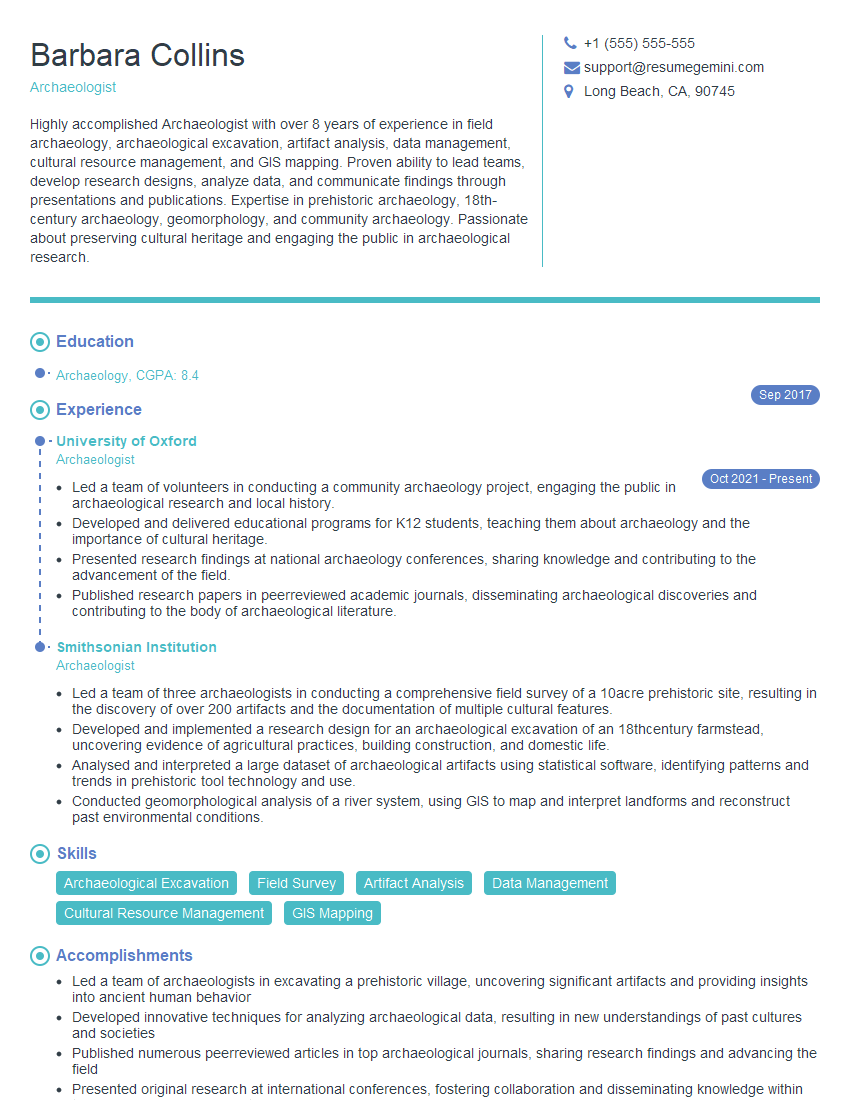
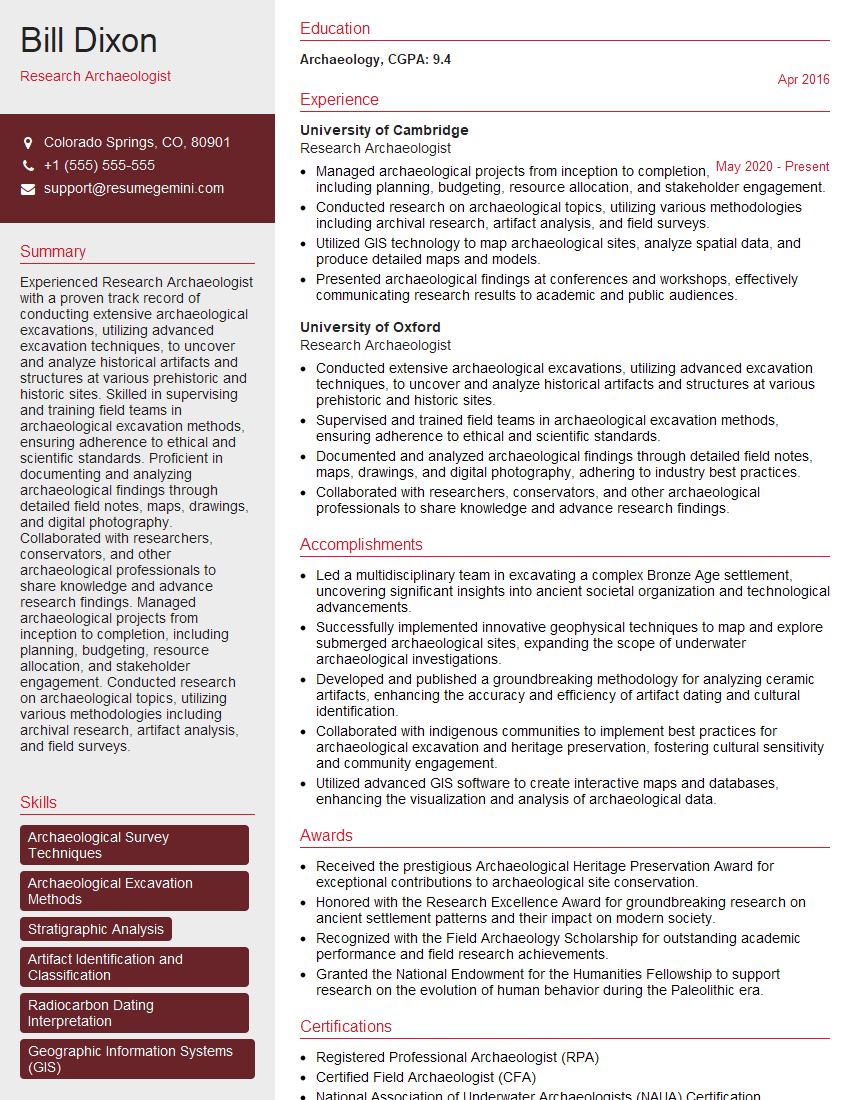
Mastering Archaeological Theory and Methods is crucial for career advancement in this dynamic field. A strong understanding of these principles will allow you to critically evaluate research, design effective projects, and contribute meaningfully to the discipline. To enhance your job prospects, creating a compelling and ATS-friendly resume is essential. ResumeGemini offers a trusted platform for building a professional resume that highlights your skills and experience effectively. Examples of resumes tailored to Archaeological Theory and Methods are available through ResumeGemini to help guide you in crafting a winning application.
Explore more articles
Users Rating of Our Blogs
Share Your Experience
We value your feedback! Please rate our content and share your thoughts (optional).
What Readers Say About Our Blog
To the interviewgemini.com Webmaster.
Very helpful and content specific questions to help prepare me for my interview!
Thank you
To the interviewgemini.com Webmaster.
This was kind of a unique content I found around the specialized skills. Very helpful questions and good detailed answers.
Very Helpful blog, thank you Interviewgemini team.