Preparation is the key to success in any interview. In this post, we’ll explore crucial Basic Electrical Skills interview questions and equip you with strategies to craft impactful answers. Whether you’re a beginner or a pro, these tips will elevate your preparation.
Questions Asked in Basic Electrical Skills Interview
Q 1. What is Ohm’s Law and how is it used in electrical circuits?
Ohm’s Law is a fundamental principle in electronics that describes the relationship between voltage (V), current (I), and resistance (R) in an electrical circuit. It states that the current flowing through a conductor is directly proportional to the voltage across it and inversely proportional to its resistance. This relationship is expressed mathematically as: V = IR
In simpler terms, imagine water flowing through a pipe. Voltage is like the water pressure, current is the flow rate of the water, and resistance is how narrow the pipe is. Higher pressure (voltage) means more water flow (current), while a narrower pipe (higher resistance) restricts the flow.
Ohm’s Law is used extensively in circuit analysis. For example, if you know the voltage applied to a resistor and its resistance, you can calculate the current flowing through it. Similarly, if you know the current and resistance, you can determine the voltage. This is crucial for designing and troubleshooting circuits, ensuring components operate within their safe limits.
Example: A 12V battery is connected to a 6Ω resistor. Using Ohm’s Law (I = V/R), we can calculate the current: I = 12V / 6Ω = 2A. Therefore, 2 Amps of current will flow through the resistor.
Q 2. Explain the difference between AC and DC current.
The main difference between AC (Alternating Current) and DC (Direct Current) lies in the direction of electron flow. In DC, electrons flow consistently in one direction, like a river flowing downstream. This is the type of current produced by batteries and solar cells. Its voltage remains relatively constant over time.
In AC, the direction of electron flow changes periodically, reversing its direction at regular intervals. Imagine a see-saw moving back and forth. This type of current is what powers our homes and is generated by power plants. Its voltage also changes periodically, typically following a sine wave pattern.
Key Differences Summarized:
- Direction: DC – unidirectional; AC – bidirectional
- Voltage: DC – constant; AC – periodically varying
- Applications: DC – batteries, electronics; AC – power grids, household appliances
AC has advantages in long-distance power transmission due to its ability to be easily stepped up and down in voltage using transformers. DC, on the other hand, is often preferred in electronic devices because it’s easier to control and regulate.
Q 3. Describe the function of a circuit breaker.
A circuit breaker is an automatic safety device designed to protect an electrical circuit from damage caused by overcurrent or short circuits. It acts as a switch that automatically trips (opens) when the current flowing through it exceeds a predetermined threshold, cutting off the power supply and preventing potential hazards like fires or equipment damage.
Imagine it as a fuse but much more sophisticated and reusable. When excessive current flows, the breaker’s internal mechanism detects this and physically interrupts the circuit, thereby protecting the wiring and connected equipment. Once the fault is rectified, the breaker can be manually reset, restoring power.
Circuit breakers offer superior protection compared to fuses because they’re reusable, whereas fuses need replacement after they’ve blown. They’re essential components in electrical panels, ensuring the safety and reliability of our electrical systems.
Q 4. What are the safety precautions when working with electricity?
Safety when working with electricity is paramount. Never take shortcuts. Always follow these precautions:
- Never work on energized circuits without proper lockout/tagout procedures. This involves disconnecting the power source and physically locking it to prevent accidental re-energization. This step is absolutely non-negotiable.
- Use insulated tools and equipment. This will protect you from electrical shocks.
- Wear appropriate personal protective equipment (PPE), including insulated gloves, safety glasses, and footwear.
- Work with a partner. A second person can provide assistance and supervision, increasing safety.
- Be aware of your surroundings. Avoid working in wet or damp conditions, which can increase the risk of electric shock.
- Understand the circuit before working on it. Familiarize yourself with the voltage, current, and other relevant parameters.
- Never assume a circuit is de-energized. Always verify using a voltage tester.
Failing to adhere to these safety guidelines can result in severe injury or death. Always prioritize safety.
Q 5. How do you test for continuity in a circuit?
Continuity testing verifies the existence of a complete, unbroken path for current to flow in an electrical circuit. It’s used to check for wiring faults, shorted components, or breaks in conductors.
A multimeter is the primary tool for continuity testing. Set the multimeter to the continuity mode (usually symbolized by a diode or a continuity symbol). Then, touch the multimeter’s probes to the two points you want to test. If there’s a continuous path, the multimeter will typically beep and display a near-zero resistance reading. Absence of a beep and a high resistance reading indicates a break in the circuit.
Example: Checking a wire for a break. Touch one probe to one end of the wire and the other probe to the other end. A beep confirms continuity; no beep indicates a break in the wire.
Continuity testing is critical in troubleshooting electrical problems; it helps quickly identify faulty wires, components, or connections.
Q 6. Explain the purpose of grounding.
Grounding, or earthing, provides a safe path for fault currents to flow to the earth in case of an electrical fault or short circuit. It protects people and equipment from dangerous electrical shocks and potential fires.
Think of it as a safety valve. If a live wire comes into contact with a metal chassis of an appliance, a properly grounded system provides a low-resistance path to the earth, diverting the fault current away from people and preventing the chassis from becoming energized. The high current flow will trip the breaker or blow a fuse.
Grounding is a critical safety feature in virtually all electrical systems. Without it, a short circuit could result in a dangerous electrical shock or a fire.
Q 7. What are the different types of wire and their applications?
Different types of wires are used for various applications depending on their properties, including conductivity, insulation, and durability.
- Solid Copper Wire: Excellent conductivity, used in applications requiring high current carrying capacity and durability, often found in house wiring.
- Stranded Copper Wire: More flexible than solid wire, often used in applications where flexibility is crucial such as appliance cords.
- Aluminum Wire: Lighter than copper but with slightly lower conductivity, sometimes used in high-voltage transmission lines due to its cost-effectiveness.
- Multi-conductor Cable: Contains multiple insulated wires bundled together, ideal for carrying multiple signals or power circuits.
- Coaxial Cable: Consists of a central conductor surrounded by insulation, a shield, and an outer jacket, used for high-frequency applications like cable television and internet connections.
- Fiber Optic Cable: Transmits data using light signals, offering high bandwidth and long distances, used in high-speed internet and telecommunications.
The choice of wire type depends significantly on factors such as current carrying capacity, voltage level, flexibility requirements, and environmental conditions.
Q 8. How do you read an electrical schematic?
Reading an electrical schematic, also known as a wiring diagram, is like reading a map for electricity. It shows you the pathway of the current through a system, identifying components and their connections. You start by identifying the symbols representing different components – resistors, capacitors, inductors, switches, and more. Each symbol has a specific meaning standardized across the industry. Next, follow the lines connecting these symbols; these lines represent the wires carrying the current. The direction of current flow (if indicated) is usually shown by arrows or the arrangement of symbols. Finally, you should look for any annotations or labels that provide additional information, such as voltage ratings or component values.
Example: Imagine a simple schematic showing a battery connected to a light bulb via a switch. The battery symbol would be depicted with a longer and shorter line, the light bulb with a circle and a wavy line inside, and the switch as a break in the line, allowing you to trace the path the current will take – from the battery, through the switch, to the light bulb and back to the battery, when the switch is closed.
Practical Application: Electricians use schematics daily for troubleshooting, installations, and repairs. By understanding the schematic, they can trace a circuit, identify a faulty component, or plan a new installation accurately.
Q 9. What are the different types of electrical motors?
Electrical motors convert electrical energy into mechanical energy. There are many types, but some of the most common are:
- DC Motors: These operate using direct current (DC) electricity. They are further categorized into brushed and brushless motors. Brushed DC motors use brushes to provide electrical contact to the rotating armature, while brushless motors employ electronic switches for better efficiency and longevity. Think of a simple toy car or a small fan – those often use DC motors.
- AC Motors: These operate using alternating current (AC) electricity. They are broadly classified into synchronous and asynchronous (induction) motors. Synchronous motors rotate at a speed directly proportional to the frequency of the AC power supply, while induction motors are self-starting and widely used in industrial applications, such as pumps and compressors. Most household appliances use AC motors.
- Stepper Motors: These motors rotate in discrete steps rather than continuously. They are controlled by precisely timed pulses and are often used in applications requiring precise positioning, such as 3D printers or robotics.
- Servomotors: These are used in systems requiring precise control of position, velocity, and acceleration. They employ feedback mechanisms to ensure accurate movement and are crucial in many automated systems.
The choice of motor depends on the specific application requirements, considering factors such as speed, torque, efficiency, cost, and size.
Q 10. Explain the function of a transformer.
A transformer is a passive electrical device that changes the voltage (and current) of an AC power supply. It does this using the principle of electromagnetic induction. Essentially, it consists of two coils of wire – the primary and secondary coils – wound around a common ferromagnetic core. When AC current flows through the primary coil, it creates a fluctuating magnetic field in the core. This magnetic field induces a voltage in the secondary coil, proportionally to the ratio of turns in the primary and secondary coils.
Function: The key function is to step up or step down voltage. If the secondary coil has more turns than the primary, the output voltage will be higher (step-up transformer). If it has fewer turns, the output voltage will be lower (step-down transformer). Power remains relatively constant (ignoring losses); a step-up transformer delivers a higher voltage at a lower current, and a step-down transformer delivers a lower voltage at a higher current.
Example: Power transmission lines use step-up transformers to increase voltage to reduce power loss during transmission over long distances. Step-down transformers then decrease voltage to safer levels for household use.
Q 11. What is the difference between series and parallel circuits?
The key difference between series and parallel circuits lies in how the components are connected and how the current and voltage are distributed.
- Series Circuit: In a series circuit, components are connected end-to-end, forming a single path for the current to flow. The current is the same through all components. However, the voltage is divided across each component proportionally to its resistance. If one component fails, the entire circuit breaks.
- Parallel Circuit: In a parallel circuit, components are connected across each other, providing multiple paths for the current to flow. The voltage is the same across all components, but the current is divided among them depending on their resistance. If one component fails, the others continue to operate.
Example: Think of Christmas lights. Older strings were connected in series; if one bulb went out, the whole string went dark. Modern strings are typically parallel, so one bulb failing doesn’t affect the others.
Q 12. How do you calculate power in an electrical circuit?
Power in an electrical circuit is the rate at which energy is consumed or transferred. It’s measured in watts (W). There are several ways to calculate power, depending on the known quantities:
- P = VI: This is the most common formula, where P is power in watts, V is voltage in volts, and I is current in amperes.
- P = I²R: This formula uses current (I) and resistance (R) in ohms.
- P = V²/R: This formula uses voltage (V) and resistance (R).
Example: If a circuit has a voltage of 12V and a current of 2A, the power is P = VI = 12V × 2A = 24W. Or, if a circuit has a resistance of 10 ohms and a current of 2A, the power is P = I²R = (2A)² × 10Ω = 40W.
Q 13. What is the purpose of a fuse?
A fuse is a safety device that protects an electrical circuit from overcurrent. It consists of a thin wire that melts and breaks the circuit if the current exceeds a predetermined value. This prevents damage to components and reduces the risk of fire or electrical shock.
Purpose: Fuses are essential for protecting circuits from damage caused by short circuits, overloads, or equipment malfunctions. When an excessive current flows, the fuse’s wire melts, creating an open circuit and interrupting the current flow. The fuse is then replaced.
Example: Household circuits often have fuses or circuit breakers to protect against overloads from multiple appliances running simultaneously. If a short circuit occurs, the fuse blows, cutting off power to that circuit.
Q 14. Explain the concept of voltage drop.
Voltage drop refers to the decrease in voltage across a component or section of a circuit due to the resistance of the conductor. Think of it as the energy lost by electrons as they push through the wire. It’s important to understand that voltage doesn’t ‘disappear’ but rather gets converted into other forms of energy, such as heat.
Explanation: The amount of voltage drop depends on the current flowing through the component and the resistance of the component (or conductor). Ohm’s Law (V = IR) directly describes this relationship. A higher current or higher resistance will result in a larger voltage drop. Excessive voltage drop can lead to malfunctioning of devices or overheating of wires.
Example: A long extension cord with thin wires will have significant voltage drop when a high-power appliance is connected. This results in lower voltage at the appliance, potentially causing it to run poorly or even damage the appliance.
Q 15. How do you troubleshoot a simple electrical circuit?
Troubleshooting a simple electrical circuit involves systematically identifying the source of a malfunction. Think of it like detective work! You need to gather clues and eliminate possibilities until you find the culprit.
Safety First: Always disconnect the power to the circuit before starting any troubleshooting. This is paramount to prevent electrical shock.
Visual Inspection: Begin with a thorough visual check. Look for loose connections, damaged wires (burnt insulation, exposed wires), or any obvious physical problems. Sometimes, the solution is as simple as tightening a loose screw!
Testing with a Multimeter: A multimeter is your best friend here. It measures voltage, current, and resistance. Check the voltage at the power source to ensure power is reaching the circuit. Then, measure the voltage at various points in the circuit to identify where the voltage drops off, indicating a break or short circuit. For instance, if you’re troubleshooting a light that doesn’t work, you’d check the voltage at the switch, then at the light fixture itself.
Continuity Test: Use the multimeter’s continuity test to check for breaks in the wiring. This tests if a complete circuit exists. A continuous beep indicates a closed circuit, while no beep suggests a break.
Systematic Approach: Work your way through the circuit, testing components one by one. If it’s a simple series circuit, the problem is likely in the component where the voltage drops to zero.
Component Testing: If a component is suspected, remove it from the circuit and test it individually using the multimeter. For example, you could test a switch by measuring resistance in the on and off positions.
Documentation: Keep detailed notes of your findings. This is crucial if you need to revisit the problem later or if others need to understand your troubleshooting process.
Example: Imagine a simple circuit with a battery, a switch, and a light bulb. If the light doesn’t turn on, you’d first check the battery voltage. Then, you’d check the voltage at the switch and at the bulb terminals. If there’s no voltage at the bulb, the problem lies either in the switch or the wiring between the switch and the bulb.
Career Expert Tips:
- Ace those interviews! Prepare effectively by reviewing the Top 50 Most Common Interview Questions on ResumeGemini.
- Navigate your job search with confidence! Explore a wide range of Career Tips on ResumeGemini. Learn about common challenges and recommendations to overcome them.
- Craft the perfect resume! Master the Art of Resume Writing with ResumeGemini’s guide. Showcase your unique qualifications and achievements effectively.
- Don’t miss out on holiday savings! Build your dream resume with ResumeGemini’s ATS optimized templates.
Q 16. What are the different types of electrical switches?
Electrical switches control the flow of electricity in a circuit. There’s a wide variety, each designed for different applications.
Toggle Switches: The most common type, they have an ON and OFF position. Think of the light switches in your home.
Rocker Switches: Similar to toggle switches, but operate with a rocking motion. They are often used in appliances and electronic devices.
Push-Button Switches: These are activated by pressing a button. They can be momentary (only on while pressed) or maintained (stay on until released).
Rotary Switches: These switches have multiple positions, allowing for selection of different circuits or settings. They are often used in older appliances and equipment.
DIP Switches: Small switches used in electronic devices for configuration settings. They are often found on circuit boards.
Limit Switches: These are activated by mechanical movement, often used in automated systems to detect the position of a machine part.
The choice of switch depends on the application’s needs – the required current rating, the number of positions needed, the type of actuation (manual, mechanical, etc.), and the desired safety features.
Q 17. Describe the function of a relay.
A relay is an electrically operated switch. It uses a small electrical current to control a much larger current. Think of it as an electrical intermediary – a tiny signal acts as a control to switch a much larger load on or off.
This is useful for applications where a low-voltage control circuit needs to switch a high-voltage or high-current load. For example, you could use a low-voltage signal from a microcontroller to control a powerful motor using a relay.
Relays have three main parts:
Coil: An electromagnet that is energized by the control circuit. When the coil is energized, it creates a magnetic field.
Contacts: These are the switching elements, usually made of metal. The magnetic field created by the coil moves these contacts, either opening or closing the circuit.
Core: A ferromagnetic material that helps to concentrate the magnetic field generated by the coil.
Relays provide electrical isolation between the control circuit and the load, improving safety and reliability. They are common in automobiles, industrial controls, and various electronic devices.
Q 18. What are the common types of electrical connectors?
Electrical connectors provide a way to join two or more wires or cables together. The type used depends heavily on factors such as voltage, current, and the environment.
Screw Terminals: Common in household wiring and smaller devices. Wires are secured with screws.
Wire Nuts/Connectors: These twist-on connectors provide a simple way to join wires together. Primarily used in low-voltage applications.
Push-in Connectors: These connectors allow for easy insertion of wires without tools. Used in various devices.
Crimp Connectors: A small metal sleeve is crimped onto the wire end to create a secure connection. Common in automotive and electronics applications.
Terminal Blocks: A strip with multiple terminals, ideal for connecting numerous wires in a neat and organized manner. Often used in industrial controls.
Plugs and Sockets: Various types cater to different needs. For example, standard AC plugs and sockets for household appliances, or specialized connectors for industrial machinery.
Choosing the right connector is crucial for safety and reliability. Using an incorrectly sized connector can lead to overheating, loose connections, and potential fire hazards.
Q 19. Explain the importance of proper wire sizing.
Proper wire sizing is crucial for electrical safety and system performance. The wire’s diameter, expressed as its American Wire Gauge (AWG) number, determines its current-carrying capacity. Using wire that’s too small for the current can lead to overheating, which may cause a fire, while using wire that’s too large is unnecessary and costly.
Factors influencing wire size selection:
Current: The higher the current, the larger the wire diameter needed.
Voltage: Higher voltages generally require smaller diameter wires for the same current level.
Length: Longer wires have higher resistance and require larger diameters to minimize voltage drop.
Ambient Temperature: High ambient temperatures reduce a wire’s current carrying capacity.
Installation Method: How the wire is installed (e.g., in conduit, in free air) influences its heat dissipation and therefore the appropriate size.
Using the wrong wire size can result in inefficient energy transfer, voltage drops, and potential safety hazards. Always consult electrical codes and relevant standards for appropriate wire sizing.
Example: A small appliance might use 18 AWG wire, while a heavy-duty appliance could require 10 AWG or larger. Improper sizing in a house wiring scenario, such as using too small of a gauge for a high-power circuit, could lead to overheating and a fire hazard. Electrical codes provide the necessary tables to select the correct wire size based on amperage and other factors.
Q 20. What are the different types of electrical outlets?
Electrical outlets provide a convenient way to connect electrical devices to the power supply. Different types cater to various voltage and current requirements.
NEMA 5-15R (Type A): The standard North American outlet, providing 120V AC, 15A.
NEMA 5-20R (Type B): Similar to Type A, but with a 20A capacity.
NEMA 6-15R (Type C): Used for 250V AC, 15A, commonly found in industrial settings.
NEMA 6-20R (Type D): Similar to Type C, but with a 20A capacity.
GFCI Outlets: Ground Fault Circuit Interrupters offer enhanced safety by shutting off power if a ground fault is detected, protecting against electric shock.
AFCI Outlets: Arc Fault Circuit Interrupters protect against electrical fires caused by arcing.
Choosing the correct outlet is essential for safety and proper operation of appliances. Incorrectly sizing an outlet can cause overheating, damage to the appliance, or even a fire. Always ensure compatibility between the outlet and the appliance being used.
Q 21. How do you identify different types of wires?
Identifying different types of wires involves examining several key features:
Color Coding: Different colors indicate different functions (e.g., black for hot, white for neutral, green for ground). This is crucial for safe wiring. Note that color codes can vary slightly based on region and standards.
Insulation Material: The material of the insulation (e.g., PVC, rubber, Teflon) provides clues about the wire’s intended use and its temperature rating. For example, heat-resistant insulation is used for higher temperature applications.
Gauge: The wire’s gauge (AWG number) indicates its diameter and current-carrying capacity. Larger gauge numbers mean smaller diameters.
Marking/Printing on the wire: Manufacturers often print information like the AWG number, voltage rating, and insulation type directly on the wire or its jacket.
Construction: Some wires have multiple strands (stranded wire) for flexibility, while others are solid core. Stranded wire is more flexible than solid core wire.
Always refer to the relevant electrical codes and standards for correct interpretation of wire markings and color codes. Misidentifying wires can have serious safety consequences.
Example: In North American wiring, a black wire is typically the hot wire, carrying the power to the device. A white wire is the neutral wire, returning the power to the source. A green or bare copper wire is the ground wire, providing a safety path for electrical current in case of a fault. A thicker gauge wire (smaller AWG number) might be used for larger loads and higher current requirements, compared to thinner gauge wires.
Q 22. What safety measures should be taken before working on electrical equipment?
Safety is paramount when working with electrical equipment. Before even touching anything, you must prioritize de-energizing the circuit. This means turning off the power at the breaker box or disconnecting the equipment from the power source. Never rely solely on a switch; always double-check with a voltage tester to ensure the circuit is truly dead. This prevents accidental shocks that can be fatal.
Beyond de-energizing, consider these additional safety measures:
- Wear appropriate Personal Protective Equipment (PPE), including safety glasses, insulated gloves, and safety shoes. This protects you from potential arc flashes, electrical shocks, and falling objects.
- Use insulated tools to prevent accidental contact with live wires. Check your tools regularly for any damage to the insulation.
- Work in a well-lit and organized space to minimize the risk of accidents. Clutter can lead to tripping or accidental contact with equipment.
- If you are unsure about anything, consult a qualified electrician. It’s always better to err on the side of caution.
- Never work alone. Having a colleague nearby allows for immediate assistance in case of an emergency.
Remember, a moment of carelessness can lead to severe consequences. Thorough preparation and strict adherence to safety protocols are essential for every electrical task, no matter how small.
Q 23. Explain the concept of impedance.
Impedance is the opposition to the flow of alternating current (AC) in a circuit. Unlike resistance, which only considers the opposition to direct current (DC), impedance also accounts for the effects of capacitance and inductance. Imagine it like this: resistance is a simple roadblock, while impedance is a more complex obstacle course with twists and turns caused by capacitors and inductors.
It’s measured in ohms (Ω), just like resistance, but it’s a complex number with both magnitude and phase. The magnitude represents the overall opposition to current flow, while the phase indicates the time delay between the voltage and current waveforms. This phase difference is crucial in AC circuits and significantly impacts the circuit’s overall behaviour.
The formula for impedance (Z) in a series RLC circuit is:
Z = √(R² + (XL - XC)²)Where:
- R is resistance
- XL is inductive reactance (opposition due to inductance)
- XC is capacitive reactance (opposition due to capacitance)
Understanding impedance is crucial in designing and analyzing AC circuits, particularly in applications like power transmission, filter design, and audio systems. Without understanding impedance, you would not be able to correctly design circuits that use AC power effectively.
Q 24. How do you measure current, voltage, and resistance?
We use a multimeter to measure current, voltage, and resistance. This versatile instrument is essential for any electrician. Before using it, always ensure it’s correctly set to the appropriate range and function to prevent damage to the meter or injury to yourself.
Measuring voltage: Connect the multimeter’s leads (positive and negative) across the component to measure the voltage drop. Make sure the meter is set to the appropriate voltage range (AC or DC, and a range higher than the expected voltage).
Measuring current: You must insert the multimeter in series with the component to measure the current. It needs to be set to the appropriate current range (AC or DC) and the circuit must be open or broken for inserting the meter.
Measuring resistance: Disconnect the component from the circuit before measuring its resistance. Set the multimeter to the ohms (Ω) function and touch the leads to the component’s terminals.
Always remember to select the appropriate range – starting with the highest range and gradually reducing it helps prevent damage to the meter. It is also crucial to observe the polarity when measuring current and voltage in DC circuits.
Q 25. What is a capacitor and what is its function?
A capacitor is a passive two-terminal electrical component that stores energy in an electric field. Think of it like a tiny rechargeable battery, but instead of chemical reactions, it uses an electric field to store energy between two conductive plates separated by an insulator (dielectric).
Its function primarily revolves around its ability to store and release electrical energy. This property makes capacitors incredibly useful in various applications:
- Filtering: Smoothing out fluctuating voltage or current in circuits. Imagine it’s like a shock absorber for electrical signals.
- Timing: Creating time delays in circuits, such as in flash circuits in cameras.
- Energy storage: Storing energy that can then be released quickly, as in camera flashes or pulsed power systems.
- Coupling and decoupling: Blocking DC signals while allowing AC signals to pass, or vice-versa.
The capacitance (C), which measures the capacitor’s ability to store charge, is inversely proportional to the distance between the plates and directly proportional to their area. The type of dielectric material used also significantly impacts the capacitance.
Q 26. What is an inductor and what is its function?
An inductor is a passive two-terminal electrical component that stores energy in a magnetic field. Unlike a capacitor that stores energy in an electric field, an inductor utilizes a magnetic field generated when current flows through a coil of wire. Imagine it as a temporary magnet whose strength depends on the current flowing through it.
Its primary function stems from its ability to oppose changes in current. This property is called inductance (L) and is measured in Henries (H). When the current changes, the inductor generates a voltage that opposes this change. This opposition to changes in current makes inductors incredibly useful in various applications:
- Filtering: Blocking high-frequency AC signals while allowing low-frequency signals to pass, useful in power supplies and audio circuits.
- Energy storage: Storing energy in a magnetic field, useful in some power converters and switching regulators.
- Tuning: Creating resonant circuits in radio receivers and other frequency-selective applications.
- Spark suppression: Limiting voltage spikes in circuits, protecting sensitive components.
The inductance of an inductor depends on factors such as the number of turns in the coil, the coil’s geometry, and the material of the core.
Q 27. Explain the concept of Kirchhoff’s laws.
Kirchhoff’s laws are fundamental principles in circuit analysis. They provide a systematic way to analyze the current and voltage relationships in any electrical circuit, regardless of its complexity. There are two key laws:
Kirchhoff’s Current Law (KCL): The sum of currents entering a node (junction) in a circuit equals the sum of currents leaving that node. Imagine it as a water pipe junction: the total amount of water flowing in must equal the total amount flowing out. This law highlights the conservation of charge in a circuit.
Kirchhoff’s Voltage Law (KVL): The sum of voltage drops around any closed loop in a circuit equals zero. Think of it like a roller coaster: the total rise in height (voltage gain) must equal the total fall (voltage drop) as it completes a full loop. This law demonstrates the conservation of energy in a circuit.
These two laws, when applied together, provide a powerful tool for solving complex circuit problems, allowing us to calculate currents, voltages, and resistances in various circuit configurations.
Q 28. Describe different types of electrical wiring methods.
Electrical wiring methods vary depending on the application, environment, and safety requirements. However, some common methods include:
- Conduit Wiring: Wires are run inside protective metal or plastic pipes (conduits), offering excellent protection against physical damage and environmental factors. This is commonly used in commercial and industrial settings.
- Surface Mounting: Wires are attached directly to the surface of walls or ceilings using surface-mounted raceways or cable trays. This is a quicker and often more cost-effective method than conduit wiring, but it offers less protection.
- Concealed Wiring: Wires are run inside walls or ceilings, hidden from view. This is aesthetically pleasing but requires more extensive work and careful planning to ensure proper installation and avoid damage to the wires.
- Cable Tray Systems: Multiple cables are bundled and supported using cable trays, particularly useful in large-scale installations where numerous cables need to be organized and managed.
- Busbar Systems: Used primarily in high-current applications, busbars are thick conductors providing a concentrated path for large currents.
The choice of wiring method depends on factors such as building codes, environmental conditions, load requirements, and budget. Each method has its own advantages and disadvantages regarding safety, cost, and ease of installation. Understanding these factors is crucial for selecting the most appropriate wiring method for a specific application.
Key Topics to Learn for Basic Electrical Skills Interview
- Ohm’s Law and Kirchhoff’s Laws: Understand the fundamental relationships between voltage, current, and resistance, and how to apply these laws to analyze simple and complex circuits. Consider practical applications like calculating voltage drops across resistors in a series circuit.
- Circuit Analysis Techniques: Master techniques like nodal analysis and mesh analysis to solve for unknown voltages and currents in more intricate circuits. Practice applying these techniques to real-world scenarios such as troubleshooting a faulty circuit.
- AC/DC Circuits: Differentiate between alternating current (AC) and direct current (DC) circuits, understanding their properties and applications. Explore the concepts of frequency, phase, and impedance in AC circuits. Practical application: understanding the differences in how each type powers devices.
- Electrical Safety Procedures: Demonstrate a thorough understanding of safe working practices, including lockout/tagout procedures, proper use of personal protective equipment (PPE), and hazard identification. This is crucial for any electrical role.
- Basic Electrical Components: Gain a firm understanding of the function and application of common components such as resistors, capacitors, inductors, diodes, and transistors. Be prepared to discuss their characteristics and how they interact within a circuit.
- Wiring Diagrams and Schematics: Develop the ability to read and interpret electrical schematics and wiring diagrams. Practice tracing signals and identifying components within a circuit diagram.
- Troubleshooting and Problem Solving: Develop systematic approaches to identifying and resolving electrical faults. Practice using multimeters and other diagnostic tools to locate and repair problems in circuits.
Next Steps
Mastering basic electrical skills is crucial for a successful and rewarding career in many fields. A strong foundation in these concepts will open doors to exciting opportunities and allow you to confidently tackle complex challenges. To significantly increase your chances of landing your dream job, creating an ATS-friendly resume is essential. ResumeGemini is a trusted resource that can help you build a professional and impactful resume that gets noticed by recruiters. We provide examples of resumes tailored to Basic Electrical Skills to guide you in crafting your perfect application. Let ResumeGemini help you highlight your skills and land that interview!
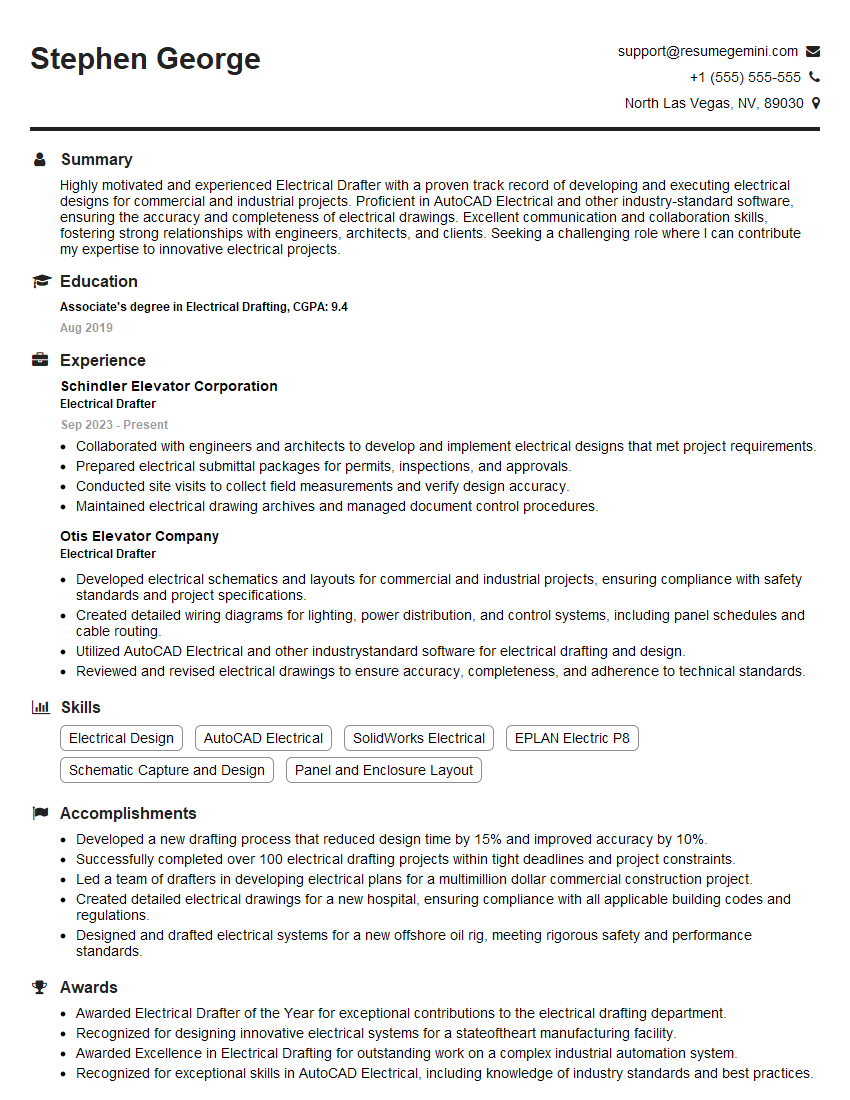
Electrical Drafter Resume Sample
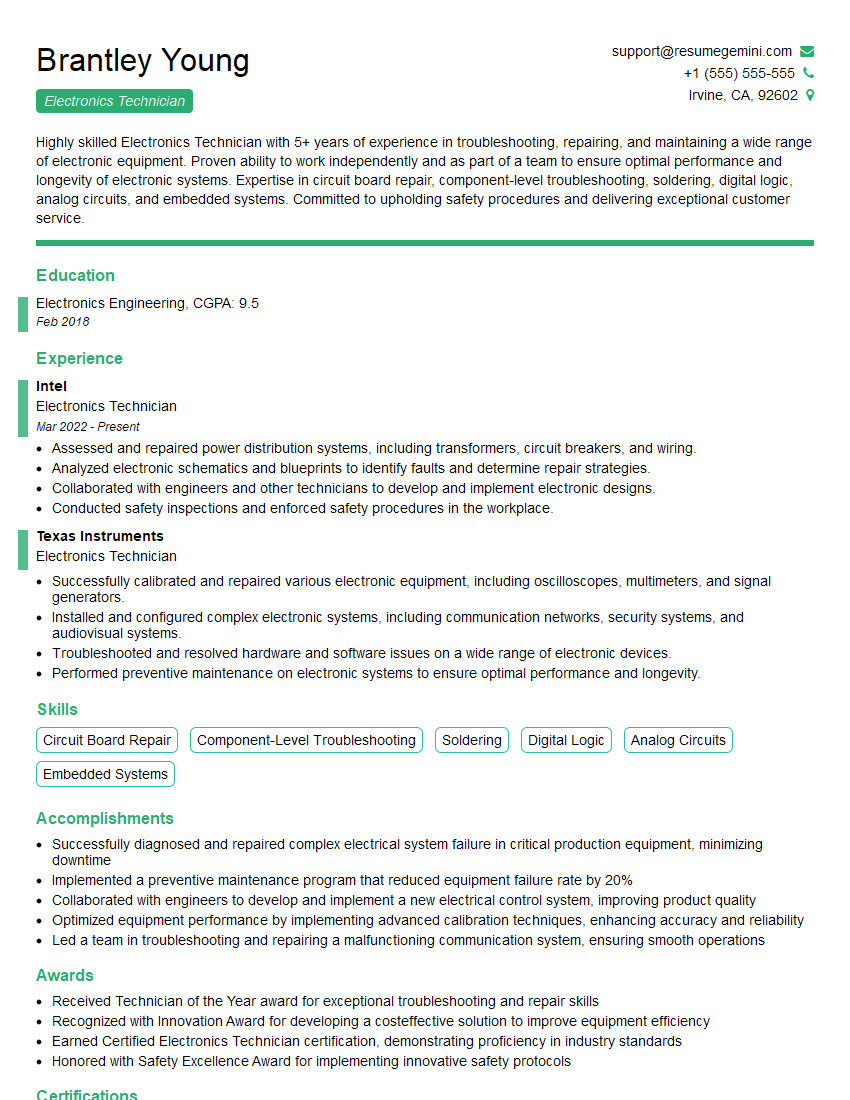
Electronics Technician Resume Sample
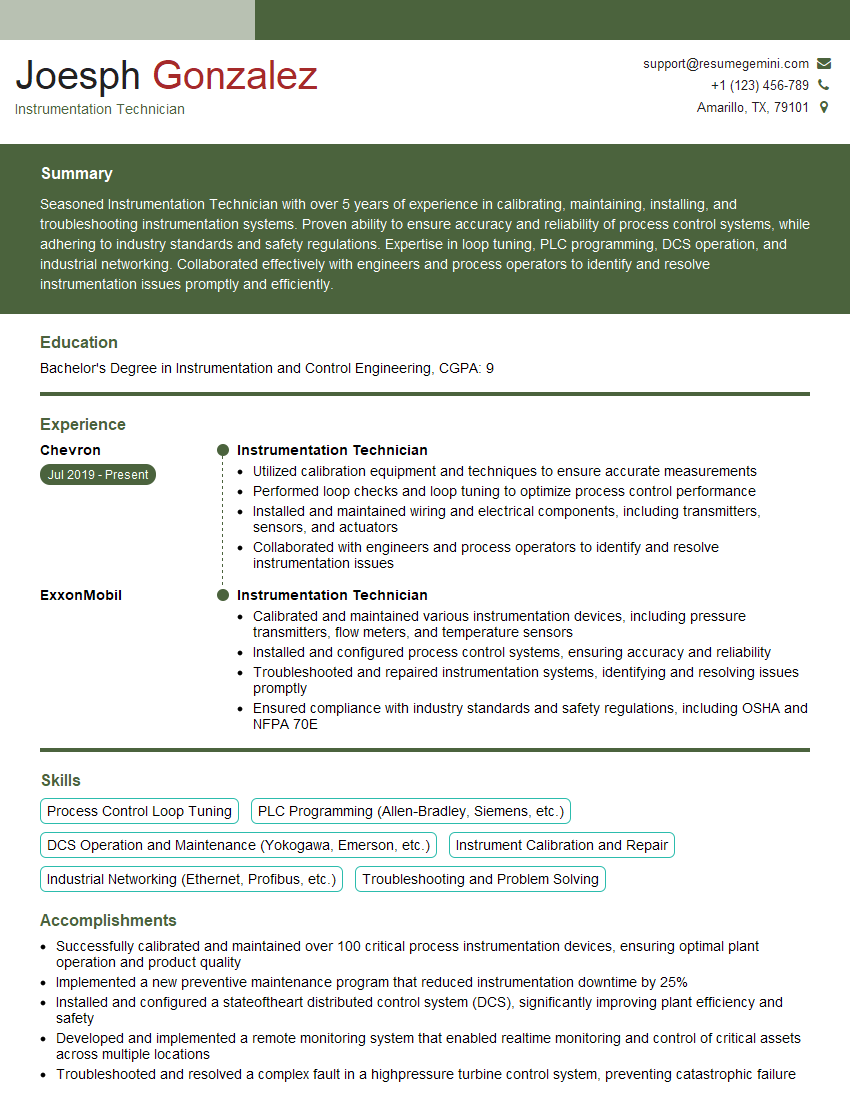
Instrumentation Technician Resume Sample
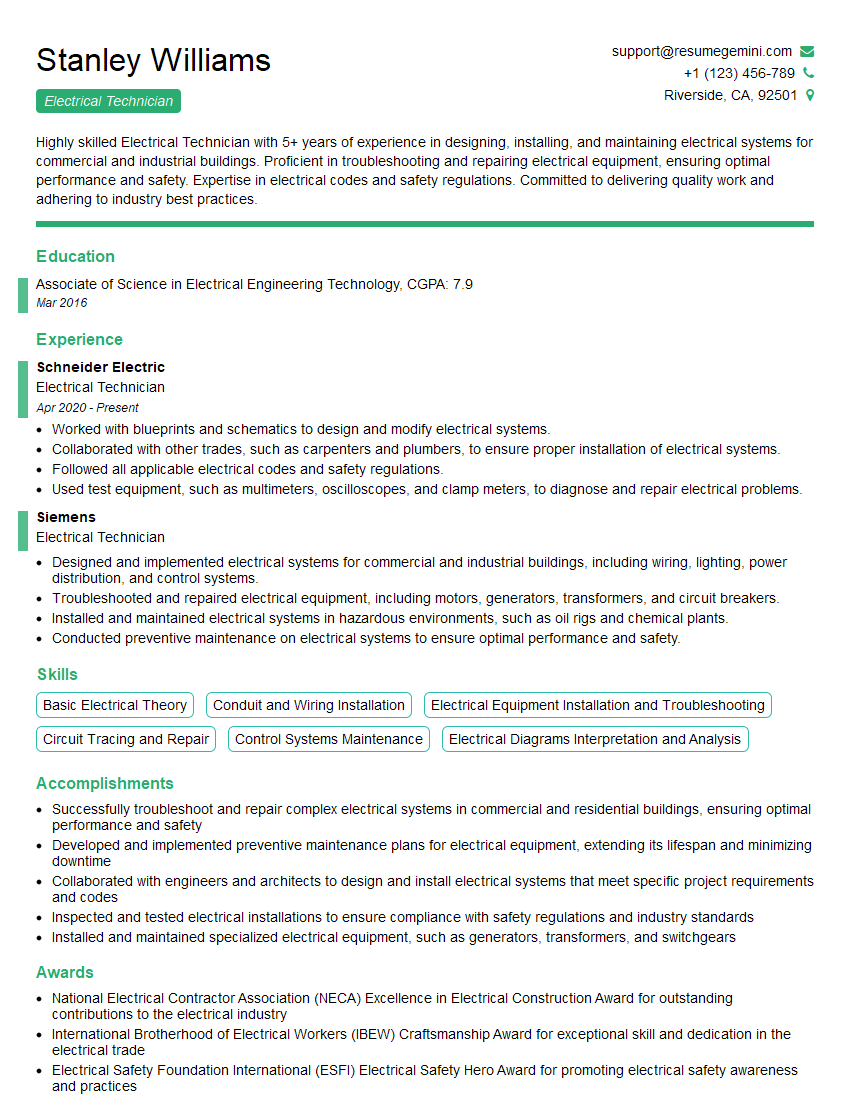
Electrical Technician Resume Sample
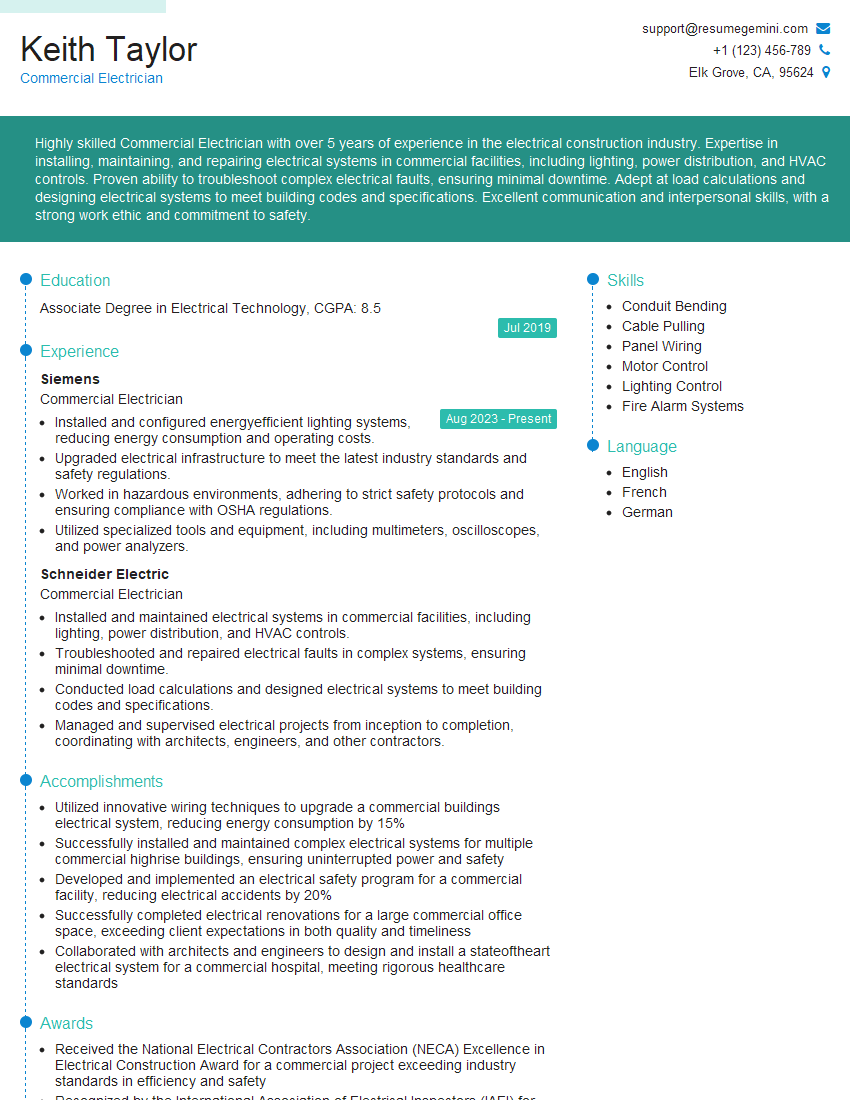
Commercial Electrician Resume Sample
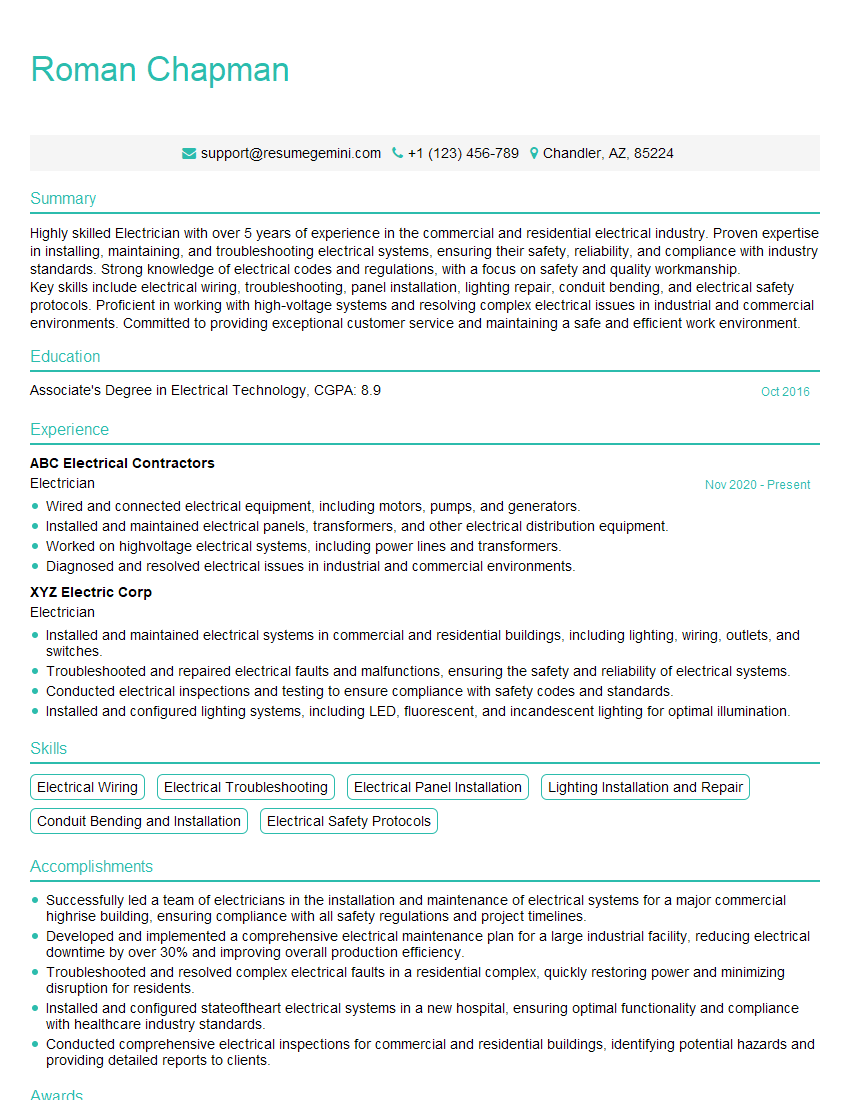
Electrician Resume Sample
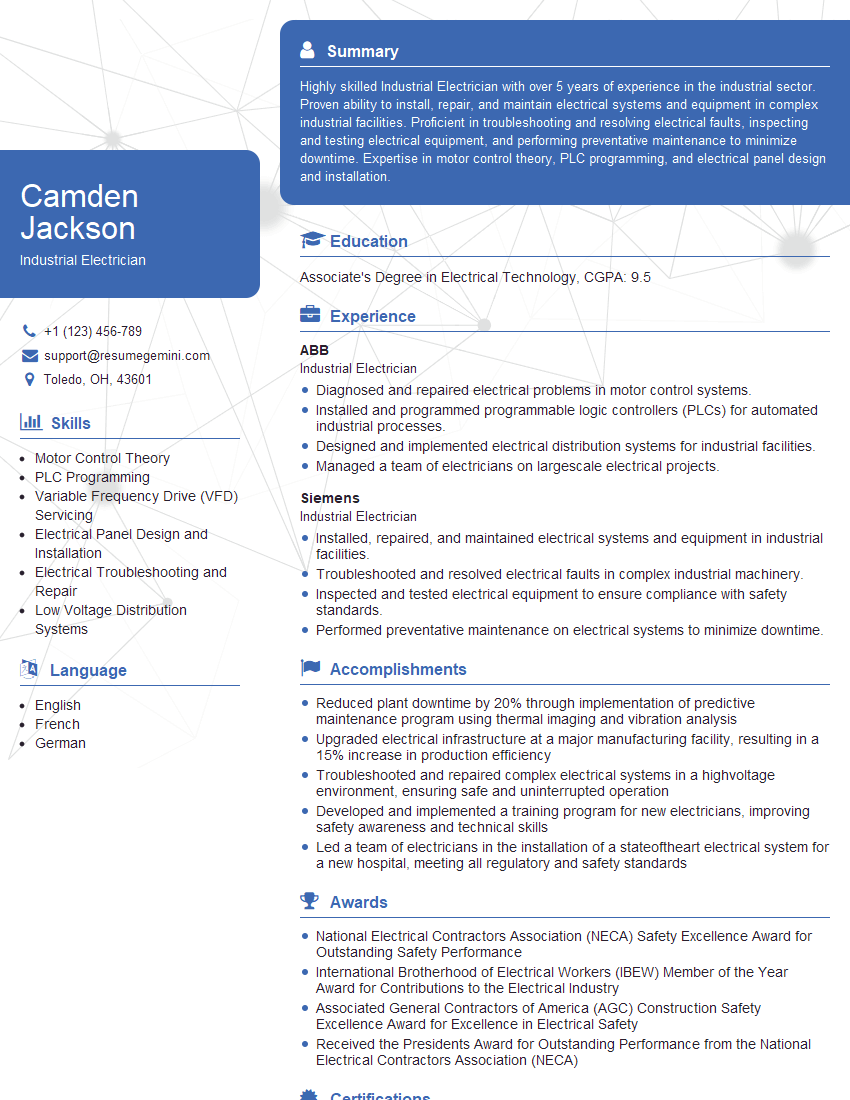
Industrial Electrician Resume Sample
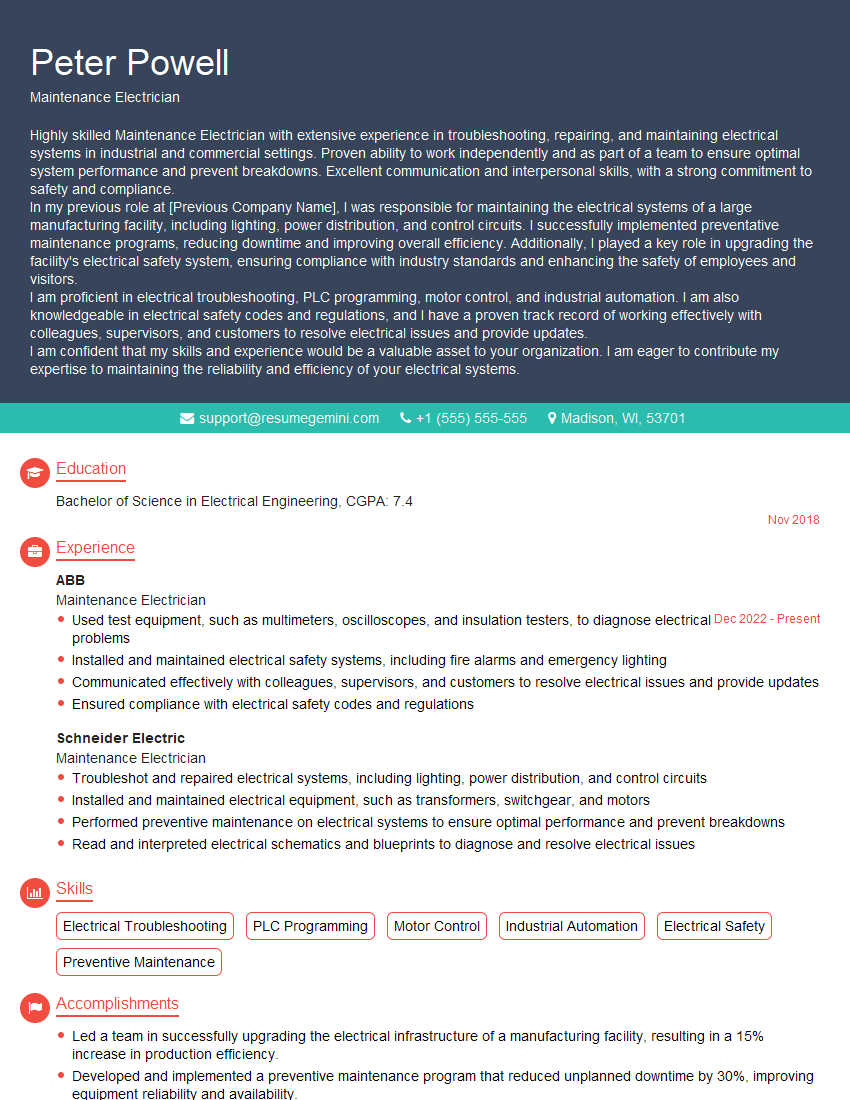
Maintenance Electrician Resume Sample

Solar Panel Installer Resume Sample
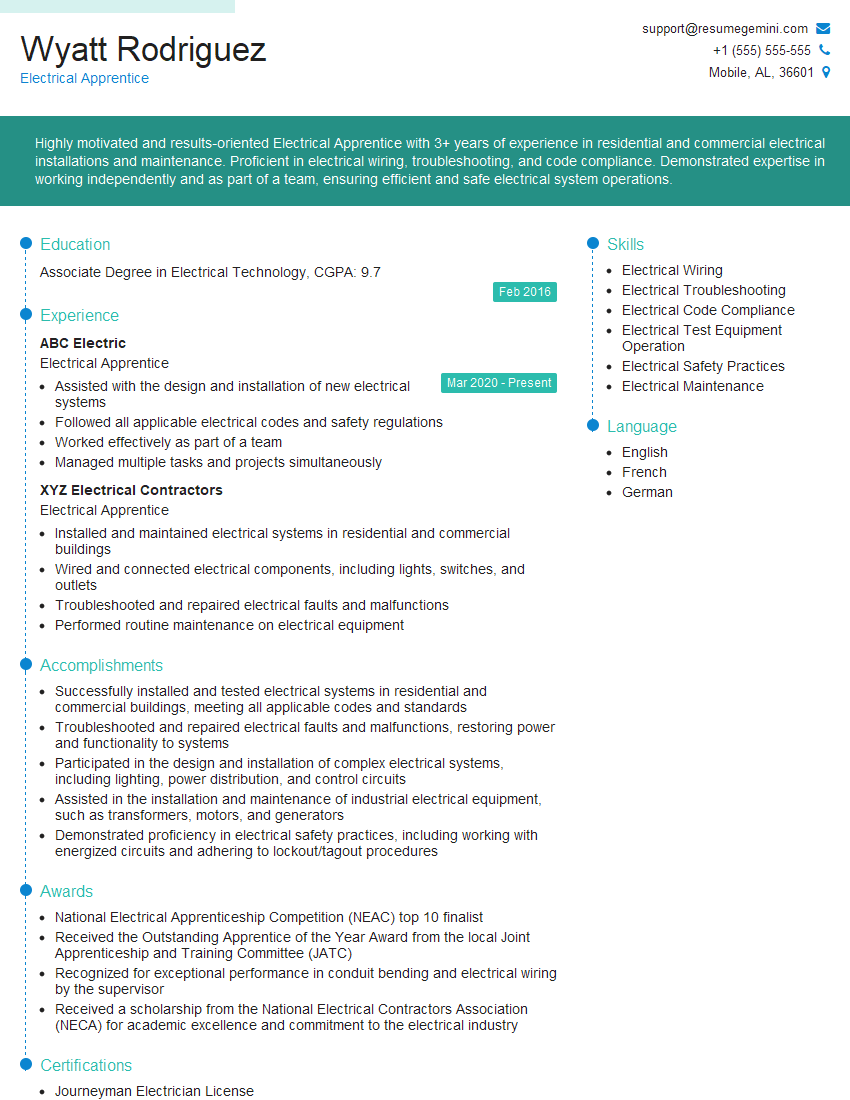
Electrical Apprentice Resume Sample
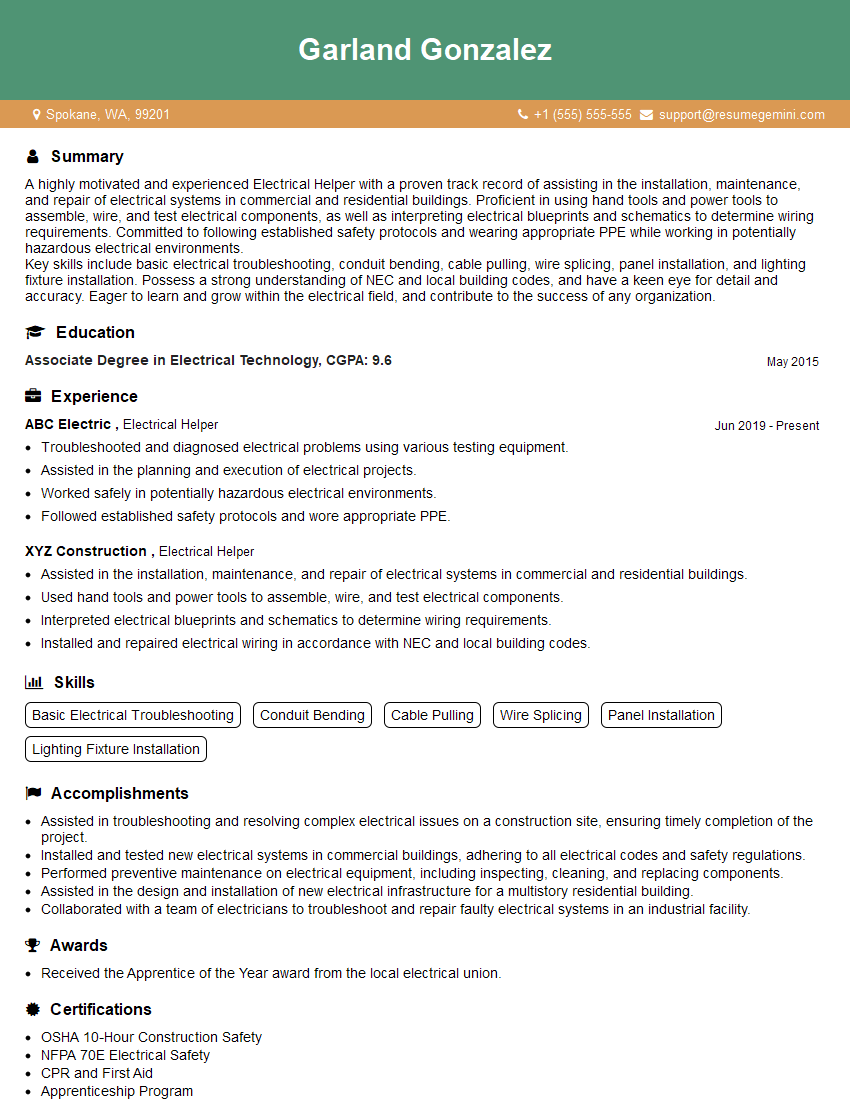
Electrical Helper Resume Sample
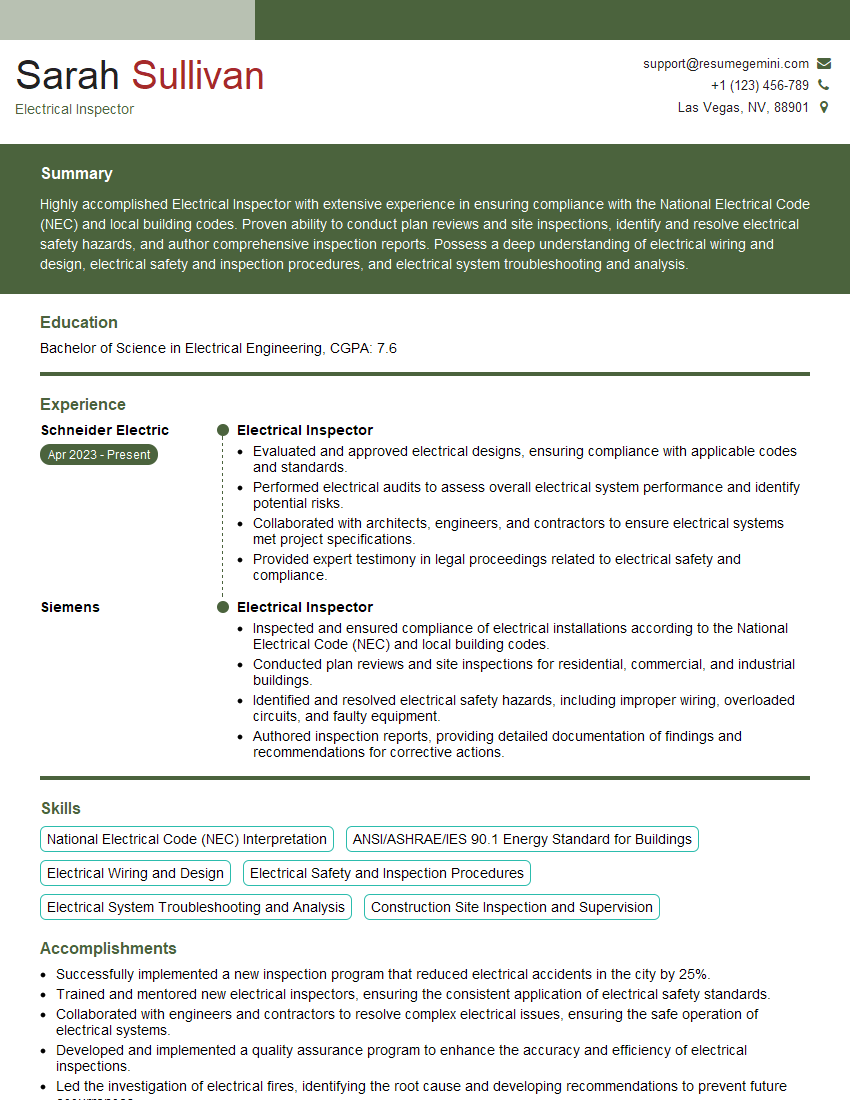
Electrical Inspector Resume Sample
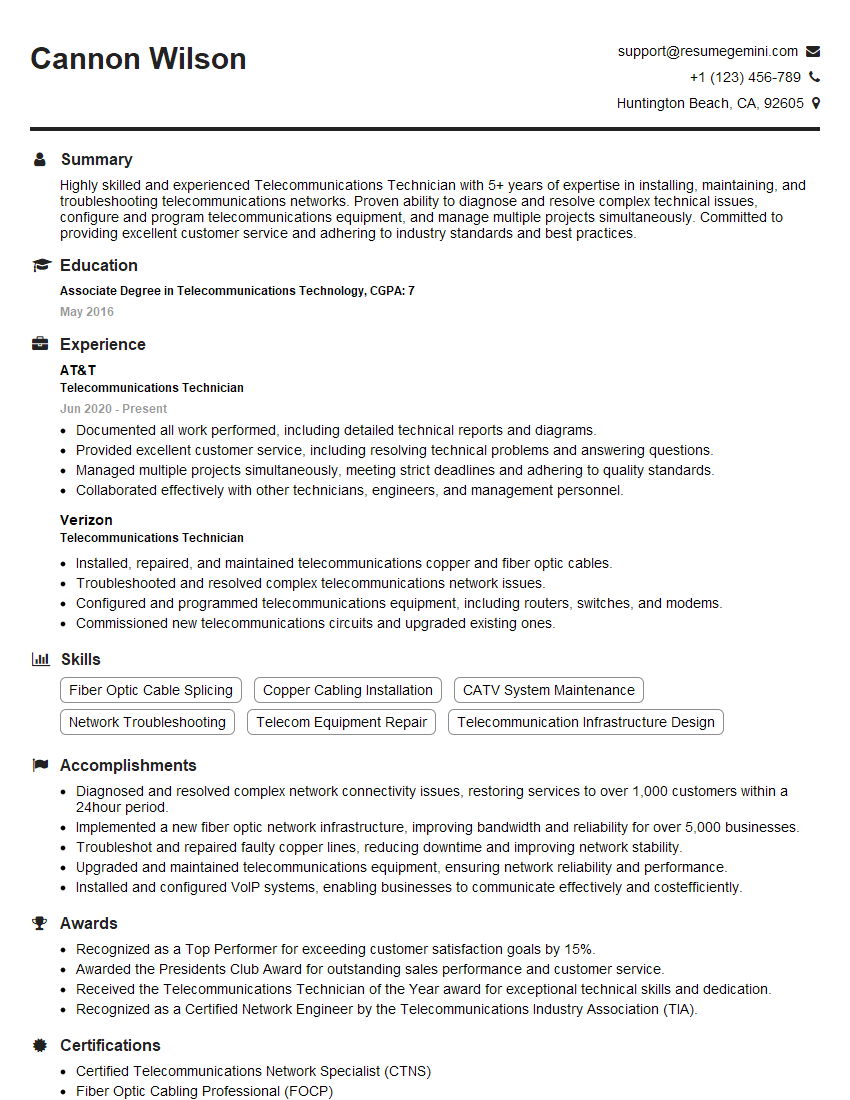
Telecommunications Technician Resume Sample
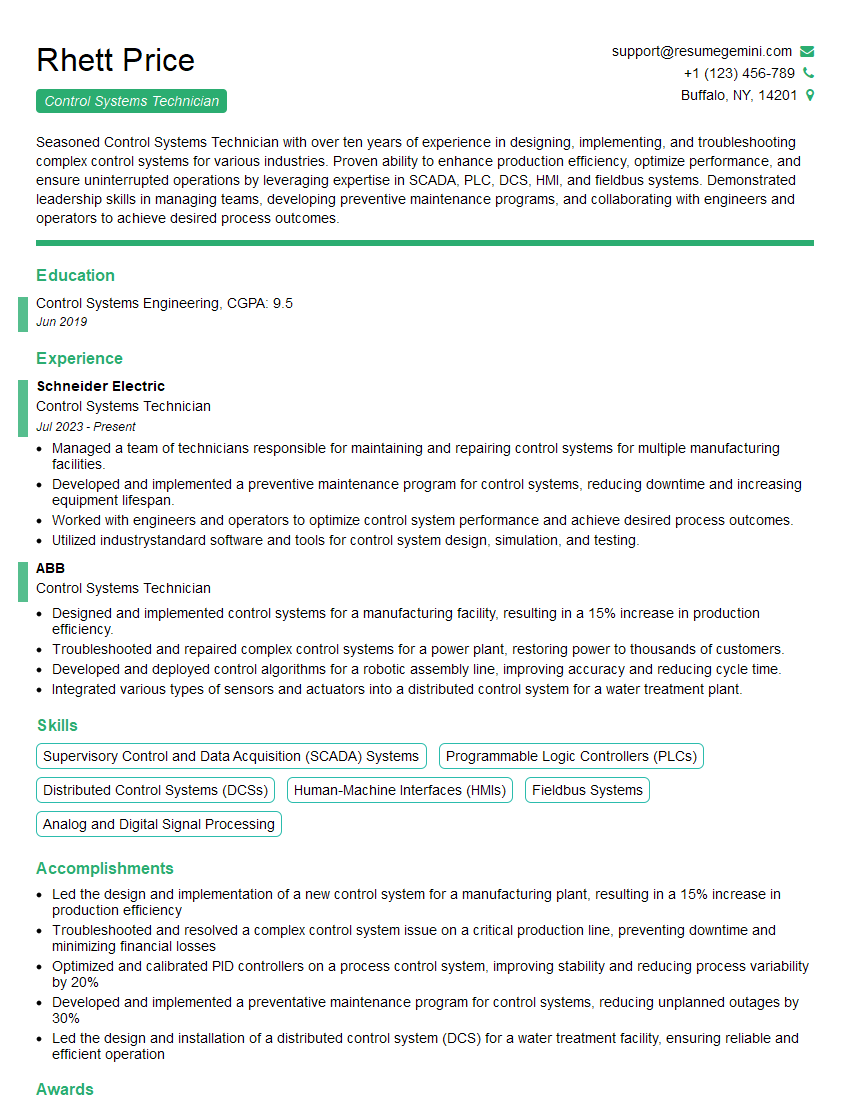
Control Systems Technician Resume Sample
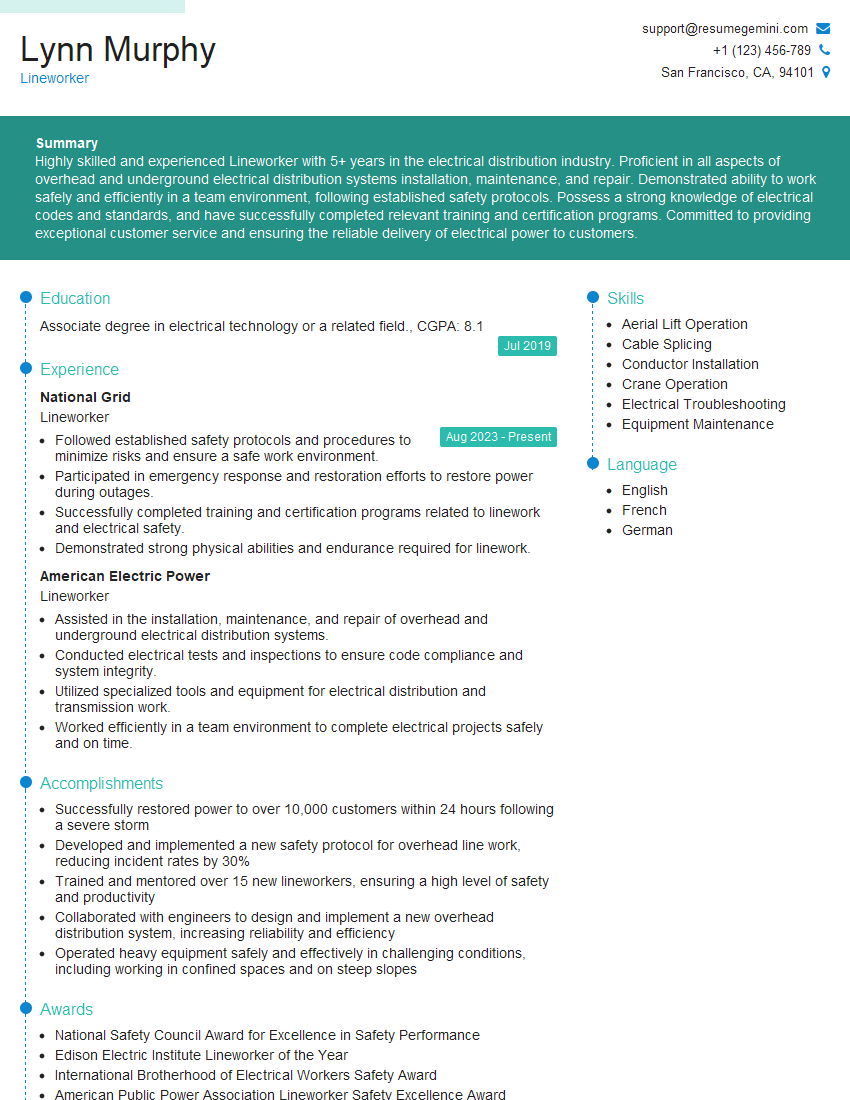
Lineworker Resume Sample
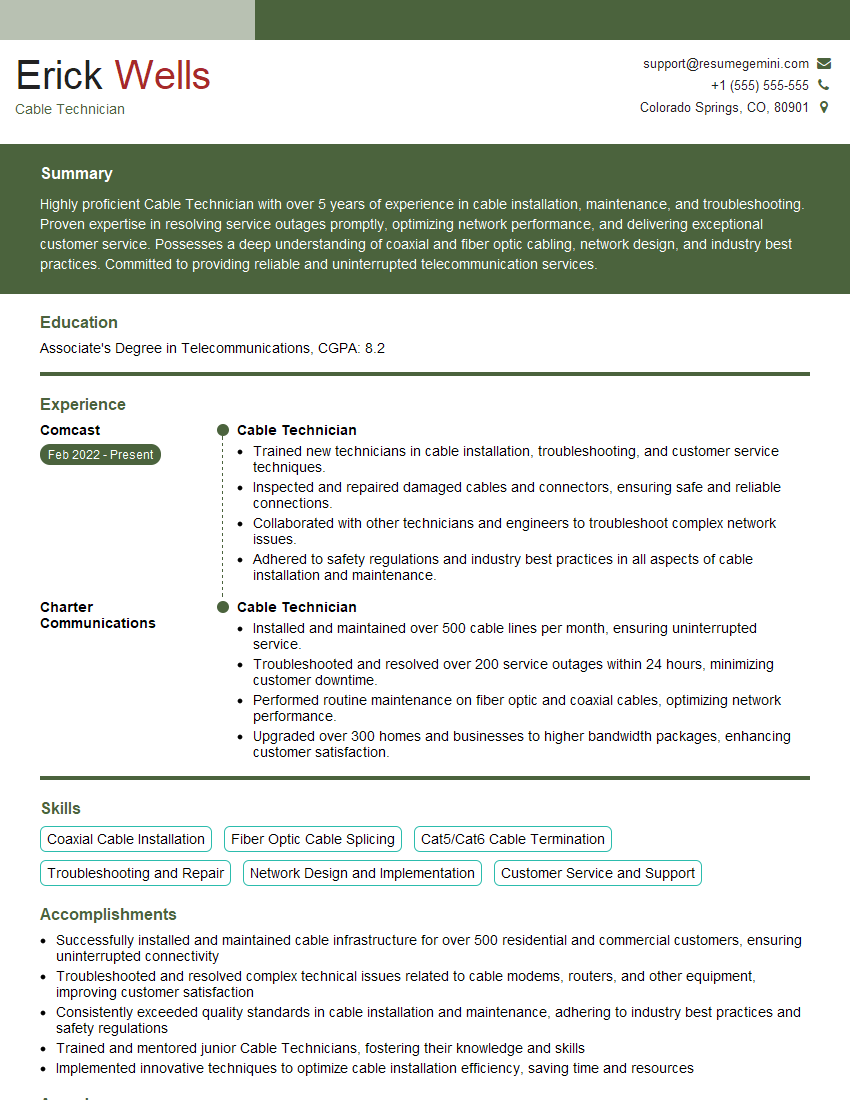
Cable Technician Resume Sample
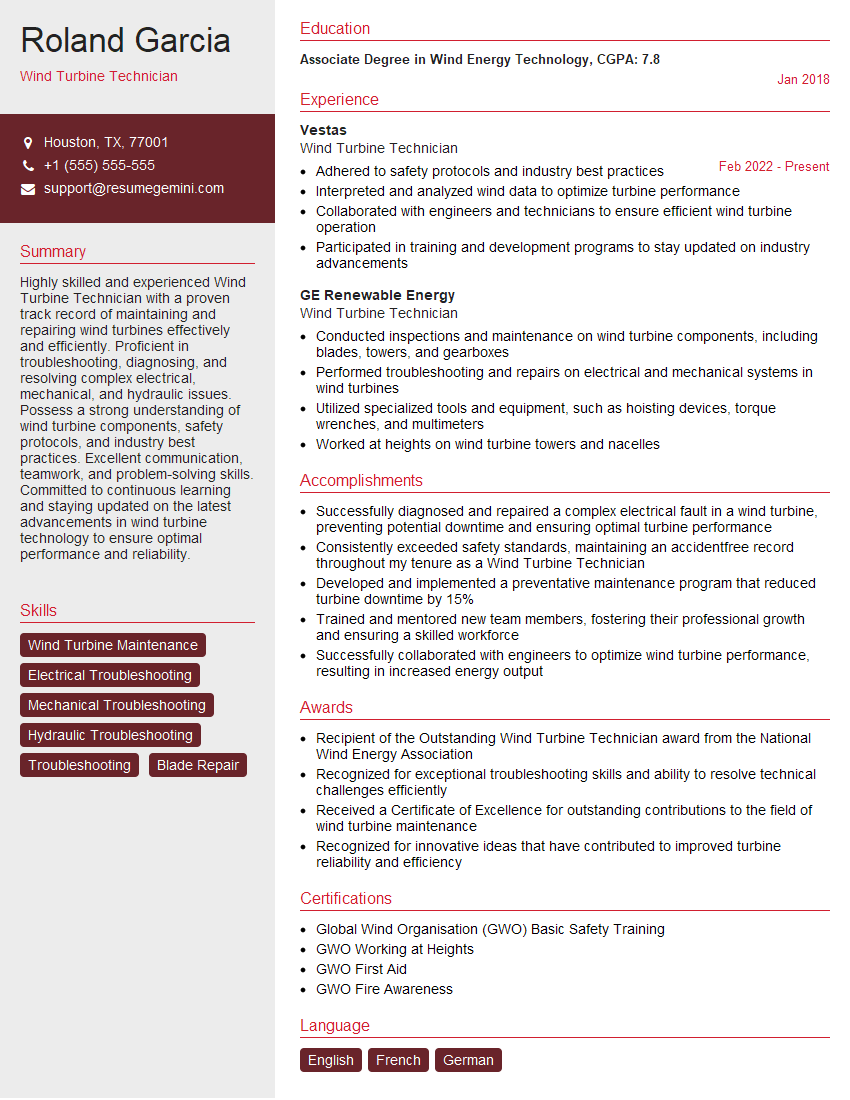
Wind Turbine Technician Resume Sample
- Electrical Drafter
- Electronics Technician
- Instrumentation Technician
- Electrical Technician
- Commercial Electrician
- Electrician
- Industrial Electrician
- Maintenance Electrician
- Solar Panel Installer
- Electrical Apprentice
- Electrical Helper
- Electrical Inspector
- Telecommunications Technician
- Control Systems Technician
- Lineworker
- Cable Technician
- Wind Turbine Technician
Explore more articles
Users Rating of Our Blogs
Share Your Experience
We value your feedback! Please rate our content and share your thoughts (optional).
What Readers Say About Our Blog
To the interviewgemini.com Webmaster.
Very helpful and content specific questions to help prepare me for my interview!
Thank you
To the interviewgemini.com Webmaster.
This was kind of a unique content I found around the specialized skills. Very helpful questions and good detailed answers.
Very Helpful blog, thank you Interviewgemini team.