Every successful interview starts with knowing what to expect. In this blog, we’ll take you through the top Big Data Analysis Techniques interview questions, breaking them down with expert tips to help you deliver impactful answers. Step into your next interview fully prepared and ready to succeed.
Questions Asked in Big Data Analysis Techniques Interview
Q 1. Explain the difference between structured, semi-structured, and unstructured data.
Data comes in various formats, and understanding these formats is crucial for effective Big Data analysis. We categorize data primarily into structured, semi-structured, and unstructured data based on its organization and format.
- Structured Data: This is highly organized data residing in a predefined format, typically relational databases. Think of a spreadsheet or a SQL database table with clearly defined columns and rows. Each column represents a specific attribute (like ‘name’ or ‘age’), and each row represents a record. Example: A customer database with fields like CustomerID, Name, Address, and PurchaseHistory.
- Semi-structured Data: This data doesn’t conform to a rigid table structure like structured data but does possess some organizational properties. It often uses tags or markers to separate data elements. A common example is JSON or XML data. Example: A JSON object representing a product might contain fields like ‘productID’, ‘productName’, ‘description’, and ‘price’, but the structure isn’t as strict as a relational database table.
- Unstructured Data: This is the most challenging type to analyze because it lacks predefined organization or structure. It includes text documents, images, audio files, and videos. Example: A collection of customer reviews or social media posts.
Understanding these distinctions helps us choose the appropriate analytical tools and techniques. Structured data lends itself well to SQL queries and traditional database management systems, while semi-structured and unstructured data requires techniques like NoSQL databases, text mining, and machine learning.
Q 2. Describe the Hadoop Distributed File System (HDFS) architecture.
Hadoop Distributed File System (HDFS) is the core storage component of Hadoop, designed for storing and processing massive datasets across a cluster of commodity hardware. Its architecture is built on a master-slave model.
- NameNode (Master): This is the central control unit responsible for managing the file system’s metadata (like file location, permissions, and directory structure). It doesn’t store the actual data; instead, it maintains a namespace of all files and directories.
- DataNodes (Slaves): These are the worker nodes that actually store the data blocks. They report their status and health to the NameNode. HDFS replicates data across multiple DataNodes for fault tolerance.
Data is broken down into blocks, typically 128MB or 256MB, which are then replicated across multiple DataNodes. This replication ensures high availability – if one DataNode fails, the data is still accessible from the replicas. The NameNode directs the DataNodes on where to store the data blocks and how to handle client read/write requests. This distributed architecture allows for scaling to petabytes or even exabytes of data.
Imagine a massive library; the NameNode acts as the library catalog, knowing where each book (data block) is located, while the DataNodes are the shelves holding the actual books.
Q 3. What are the key differences between Spark and Hadoop?
Both Spark and Hadoop are powerful frameworks for big data processing, but they have key differences in their architecture and performance characteristics.
- Data Processing Engine: Hadoop uses MapReduce for batch processing, while Spark uses in-memory computation. This means Spark is significantly faster for iterative algorithms and interactive queries because it doesn’t repeatedly read data from disk.
- Speed and Performance: Spark is considerably faster than Hadoop for many tasks due to its in-memory processing. Hadoop’s disk-based processing makes it slower, particularly for iterative algorithms.
- Programming Languages: Hadoop primarily uses Java, while Spark supports multiple languages including Java, Scala, Python, and R, making it more accessible to a broader range of data scientists.
- Fault Tolerance: Both offer fault tolerance, but Spark’s lineage tracking allows for more efficient recovery from failures.
In essence, Hadoop is a robust and mature framework well-suited for batch processing of large datasets, while Spark provides speed and flexibility for both batch and real-time processing, particularly for iterative tasks and interactive data exploration.
Q 4. Explain the concept of MapReduce.
MapReduce is a programming model and a processing framework used for distributed data processing on large datasets. It simplifies complex data processing tasks by breaking them into smaller, manageable units that can be executed in parallel across a cluster of machines. It’s like dividing a large task among many workers.
The process involves two main phases:
- Map Phase: The input data is divided into smaller chunks, and the
mapfunction is applied to each chunk independently. Themapfunction transforms the input data into key-value pairs. Think of it as organizing the data. - Reduce Phase: The key-value pairs generated in the
mapphase are grouped by key and passed to thereducefunction. Thereducefunction aggregates the values for each key, performing calculations or summaries. Think of it as synthesizing the organized data.
Example (simplified):
Let’s say we want to count word occurrences in a large text file.Map: Reads each line, splits it into words, and emits (word, 1) key-value pairs.Reduce: Receives all (word, 1) pairs for the same word and sums the values to get the total count for each word.
MapReduce is inherently parallelizable, making it efficient for processing massive datasets. The framework handles data partitioning, distribution, and fault tolerance automatically.
Q 5. How do you handle missing values in a big data dataset?
Missing values are a common issue in big data analysis, and how you handle them significantly impacts your results. There’s no one-size-fits-all solution; the best approach depends on the dataset, the missing data pattern, and the analytical goal.
- Deletion: Remove rows or columns with missing values. This is simple but can lead to significant data loss, especially if missing values are not randomly distributed. Use this cautiously, only if the amount of missing data is small and random.
- Imputation: Replace missing values with estimated values. Common techniques include:
- Mean/Median/Mode Imputation: Replace missing values with the mean (average), median (middle value), or mode (most frequent value) of the respective feature. Simple but can distort the distribution.
- Regression Imputation: Predict missing values using regression models based on other features. More sophisticated, but requires careful model selection.
- K-Nearest Neighbors (KNN) Imputation: Impute missing values based on the values of similar data points (neighbors). Effective if the data has a clear structure.
- Advanced Techniques: For complex missing data patterns, consider techniques like multiple imputation (generating multiple plausible imputed datasets) or maximum likelihood estimation.
Before choosing a method, analyze the pattern of missing data: Is it missing completely at random (MCAR), missing at random (MAR), or missing not at random (MNAR)? This understanding guides the selection of an appropriate imputation strategy. Always document your choice and its potential impact on the analysis.
Q 6. What are some common data cleaning techniques?
Data cleaning is a crucial preprocessing step in big data analysis. It involves identifying and correcting or removing inaccurate, incomplete, irrelevant, duplicated, or improperly formatted data.
- Handling Missing Values: As discussed previously, techniques like imputation or deletion are used.
- Outlier Detection and Treatment: Identify and handle outliers (extreme values) using techniques like box plots, scatter plots, or Z-score analysis. Outliers might be errors or genuine extreme values requiring careful consideration – you might remove them, transform them (e.g., using log transformation), or cap them.
- Data Transformation: Convert data into a suitable format for analysis. This includes standardizing or normalizing numerical data, encoding categorical data (e.g., using one-hot encoding), and date/time formatting.
- Duplicate Removal: Identify and remove duplicate entries. This is especially important in large datasets where duplicates can significantly skew results.
- Data Consistency: Ensure data consistency across different sources. This involves standardizing spellings, units, formats, and ensuring data integrity.
- Noise Reduction: Remove or smooth out noise (random errors) in the data using techniques like smoothing or filtering.
Effective data cleaning significantly improves the quality and reliability of the analysis. It is an iterative process often requiring domain knowledge and careful consideration of the data and analysis goals.
Q 7. Describe different types of data joins.
Data joins combine data from multiple tables based on a common attribute. Different join types produce varying results depending on how they handle matching and non-matching rows.
- Inner Join: Returns only the rows where the join condition is met in both tables. Think of it as finding the intersection of the data.
- Left (Outer) Join: Returns all rows from the left table (the one specified before the
JOINkeyword) and the matching rows from the right table. If there’s no match in the right table, it fills inNULLvalues for the right table’s columns. - Right (Outer) Join: Similar to a left join, but it returns all rows from the right table and the matching rows from the left table.
NULLvalues are used where there’s no match in the left table. - Full (Outer) Join: Returns all rows from both tables. If there’s a match, the corresponding rows are combined. If there’s no match,
NULLvalues are used for the missing columns.
The choice of join type depends entirely on the analytical goal. For example, an inner join is suitable when you want only the overlapping data, while a full outer join is useful when you need all data from both tables, even if there are no matches between them. Understanding these join types is fundamental for efficient data integration and analysis.
Q 8. Explain the concept of data warehousing.
Data warehousing is the process of consolidating data from various sources into a central repository for analysis and reporting. Think of it as a highly organized library for your data. Instead of scattered books (data) across many rooms (databases), a data warehouse brings them together, neatly cataloged and easily accessible. This allows for a unified view of your business operations, enabling better decision-making.
A typical data warehouse architecture involves extracting, transforming, and loading (ETL) data from operational databases, flat files, and other sources. The transformed data is then stored in a subject-oriented, integrated, time-variant, and non-volatile manner. Subject-oriented means data is organized around specific business subjects (e.g., customers, products). Integrated means data from diverse sources is harmonized. Time-variant means historical data is preserved, and non-volatile means the data is read-only, preventing accidental modifications.
For instance, a retail company might consolidate sales data from different stores, website transactions, and customer relationship management (CRM) systems into a data warehouse to analyze sales trends, customer behavior, and inventory management.
Q 9. What are some common data visualization techniques?
Data visualization techniques are essential for communicating insights derived from data analysis. They transform complex data into easily understandable visual representations. Some common techniques include:
- Bar charts: Comparing categorical data.
- Line charts: Showing trends over time.
- Scatter plots: Illustrating relationships between two variables.
- Pie charts: Representing proportions of a whole.
- Heatmaps: Displaying data density across two dimensions.
- Histograms: Showing the distribution of a numerical variable.
- Box plots: Summarizing the distribution of data, showing quartiles and outliers.
- Geographic maps: Representing data geographically.
- Network graphs: Showing relationships between entities.
Choosing the right technique depends on the type of data and the message you want to convey. For example, a line chart is ideal for tracking website traffic over time, while a bar chart is suitable for comparing sales figures across different product categories.
Q 10. How do you perform data exploration and feature engineering?
Data exploration and feature engineering are crucial steps in the data analysis process. Data exploration involves understanding the data’s characteristics, identifying patterns, and detecting anomalies. Feature engineering is the process of creating new features from existing ones to improve model performance.
Data Exploration: This usually begins with descriptive statistics (mean, median, standard deviation) and visualization. We look for missing values, outliers, and correlations between variables. Tools like pandas in Python are frequently used for this purpose. import pandas as pd; data = pd.read_csv('data.csv'); print(data.describe()) This code snippet shows basic descriptive statistics using pandas.
Feature Engineering: This involves transforming raw data into features that are more informative for the machine learning model. Examples include:
- One-hot encoding: Converting categorical variables into numerical representations.
- Scaling: Standardizing or normalizing numerical features to a common range.
- Creating interaction terms: Combining existing features to capture interactions.
- Feature extraction: Deriving new features from existing ones (e.g., extracting day of week from a date).
For example, if you have a dataset with customer age, you might create new features such as ‘age_group’ (young, middle-aged, senior) or ‘age_squared’ to capture non-linear relationships.
Q 11. What are some common machine learning algorithms used in Big Data analysis?
Many machine learning algorithms are used in Big Data analysis, each with its strengths and weaknesses. The choice depends on the specific problem and data characteristics. Some common algorithms include:
- Linear Regression: Predicts a continuous target variable based on linear relationships with predictor variables.
- Logistic Regression: Predicts a binary or categorical target variable.
- Support Vector Machines (SVMs): Effective for high-dimensional data and classification tasks.
- Decision Trees and Random Forests: Tree-based models that are easy to interpret and robust to outliers.
- Gradient Boosting Machines (GBMs): Ensemble methods that combine multiple decision trees to improve accuracy.
- Naive Bayes: A probabilistic classifier based on Bayes’ theorem.
- K-Means Clustering: An unsupervised learning algorithm for grouping similar data points.
For example, linear regression could predict house prices based on size and location, while logistic regression could predict customer churn based on demographics and usage patterns. GBMs are often used in competitions and real-world applications because of their strong predictive power.
Q 12. Explain the concept of A/B testing.
A/B testing, also known as split testing, is a randomized experiment used to compare two versions of something (e.g., a website, an email, an advertisement) to determine which performs better. Imagine you have two different versions of a website’s homepage. You randomly show one version (A) to half your users and the other version (B) to the other half. By tracking key metrics (e.g., conversion rate, click-through rate), you can determine which version is more effective.
The core principle is randomization to minimize bias. By randomly assigning users to either version A or B, you ensure that any difference in performance is due to the variations themselves, not other confounding factors. Statistical analysis is then used to determine if the difference in performance is statistically significant, ensuring the results are not just due to random chance.
A/B testing is widely used in various industries, from e-commerce (testing different product layouts) to marketing (testing different ad copy) to software development (testing different UI designs).
Q 13. How do you evaluate the performance of a machine learning model?
Evaluating a machine learning model’s performance involves assessing its ability to generalize to unseen data. This involves several steps:
- Splitting the data: Divide your data into training, validation, and test sets. The training set is used to train the model, the validation set for tuning hyperparameters, and the test set for evaluating the final model’s performance on unseen data.
- Choosing appropriate metrics: Select metrics relevant to your problem (e.g., accuracy, precision, recall for classification; RMSE, MAE for regression).
- Applying the model: Train the model on the training set and tune hyperparameters using the validation set.
- Evaluating on the test set: Apply the final trained model to the test set and calculate the chosen performance metrics.
- Comparing models: If you are comparing multiple models, compare their performance metrics on the test set to select the best model.
- Considering other factors: Beyond accuracy, consider factors like model interpretability, computational cost, and fairness.
It’s crucial to avoid overfitting, where a model performs well on the training data but poorly on unseen data. Proper data splitting and cross-validation techniques help prevent overfitting.
Q 14. What are some common performance metrics for evaluating models?
Common performance metrics for evaluating machine learning models vary depending on whether the problem is classification or regression.
Classification:
- Accuracy: The percentage of correctly classified instances.
- Precision: Out of all instances predicted as positive, what proportion were actually positive.
- Recall (Sensitivity): Out of all actual positive instances, what proportion were correctly predicted as positive.
- F1-score: The harmonic mean of precision and recall.
- AUC-ROC (Area Under the Receiver Operating Characteristic Curve): Measures the model’s ability to distinguish between classes.
Regression:
- Mean Squared Error (MSE): The average squared difference between predicted and actual values.
- Root Mean Squared Error (RMSE): The square root of MSE, providing a more interpretable scale.
- Mean Absolute Error (MAE): The average absolute difference between predicted and actual values.
- R-squared: The proportion of variance in the dependent variable explained by the model.
The choice of metric depends on the specific problem and what aspects of the model’s performance are most important. For instance, in medical diagnosis, high recall might be prioritized even if it comes at the cost of lower precision.
Q 15. Explain the concept of overfitting and underfitting.
Overfitting and underfitting are two common problems in machine learning that occur when a model is either too complex or too simple to accurately capture the underlying patterns in the data.
Overfitting happens when a model learns the training data *too well*, including its noise and outliers. This results in a model that performs exceptionally well on the training data but poorly on unseen data (testing data). Imagine trying to memorize the answers to a test instead of understanding the concepts – you might ace the specific test but fail a similar one.
Underfitting, on the other hand, occurs when a model is too simple to capture the complexities of the data. It fails to learn the underlying patterns, leading to poor performance on both training and testing data. This is like trying to describe a complex painting with only a few brushstrokes; you miss the key details.
Example: Suppose we’re predicting house prices. An overfitted model might find spurious correlations between house price and the color of the paint in a specific room. An underfitted model might only consider the size of the house, ignoring crucial factors like location and amenities.
To avoid these issues, we employ techniques like cross-validation, regularization (L1 and L2), and feature selection, carefully choosing model complexity and using appropriate training data.
Career Expert Tips:
- Ace those interviews! Prepare effectively by reviewing the Top 50 Most Common Interview Questions on ResumeGemini.
- Navigate your job search with confidence! Explore a wide range of Career Tips on ResumeGemini. Learn about common challenges and recommendations to overcome them.
- Craft the perfect resume! Master the Art of Resume Writing with ResumeGemini’s guide. Showcase your unique qualifications and achievements effectively.
- Don’t miss out on holiday savings! Build your dream resume with ResumeGemini’s ATS optimized templates.
Q 16. How do you handle imbalanced datasets?
Imbalanced datasets, where one class significantly outnumbers others, are a common challenge in classification problems. For example, in fraud detection, fraudulent transactions are far fewer than legitimate ones. This imbalance can lead to biased models that perform poorly on the minority class (the one we often care most about).
Several techniques can address this:
- Resampling: This involves either oversampling the minority class (creating duplicates) or undersampling the majority class (removing instances). Oversampling techniques like SMOTE (Synthetic Minority Over-sampling Technique) generate synthetic samples instead of simple duplication, which can help prevent overfitting.
- Cost-sensitive learning: We can assign different misclassification costs to different classes. For example, misclassifying a fraudulent transaction as legitimate is far more costly than vice-versa, so we assign a higher penalty to this type of error.
- Ensemble methods: Techniques like bagging and boosting, especially those designed for imbalanced data like AdaBoost and Gradient Boosting Machines (GBM), can improve performance by combining multiple models.
- Anomaly detection techniques: If the minority class is truly anomalous, techniques like One-Class SVM or Isolation Forest might be more appropriate than traditional classification.
The best approach depends on the specific dataset and the problem’s context. Careful evaluation and experimentation are key to finding the most effective strategy.
Q 17. Describe your experience with SQL and NoSQL databases.
I have extensive experience with both SQL and NoSQL databases. My SQL experience primarily revolves around relational databases like PostgreSQL and MySQL, where data is organized into structured tables with well-defined schemas. I’m proficient in writing complex queries using SELECT, JOIN, WHERE, GROUP BY, and other clauses for data retrieval, manipulation, and analysis. I’ve used SQL for tasks like data warehousing, ETL (Extract, Transform, Load) processes, and reporting.
My NoSQL experience encompasses various database types, including document databases like MongoDB, key-value stores like Redis, and graph databases like Neo4j. I understand the trade-offs between different NoSQL models and choose the appropriate database based on the specific data structure and application requirements. NoSQL is particularly useful for handling large volumes of unstructured or semi-structured data, common in Big Data scenarios. For example, I’ve used MongoDB to store JSON-like documents containing user profiles and interactions in a social media analysis project.
I often find myself using both SQL and NoSQL databases in the same project; SQL for structured data and NoSQL for more flexible data storage.
Q 18. What is data governance and why is it important?
Data governance is the process of establishing policies, procedures, and standards to ensure the quality, integrity, and accessibility of data throughout its lifecycle. It’s like creating a set of rules for how we handle our valuable data assets, ensuring everyone plays by the same rules.
It’s crucial for several reasons:
- Improved data quality: Consistent standards and processes minimize errors and inconsistencies.
- Regulatory compliance: Many industries have regulations (like GDPR) mandating specific data handling practices.
- Enhanced data security: Proper governance helps protect sensitive data from unauthorized access and breaches.
- Better decision-making: High-quality, reliable data leads to more informed and accurate decisions.
- Increased efficiency: Clear processes streamline data management tasks, reducing operational costs and improving productivity.
Implementing effective data governance often involves establishing data dictionaries, defining data ownership roles, implementing data quality checks, and creating data security policies.
Q 19. Explain the concept of data lineage.
Data lineage is a comprehensive record of a data asset’s journey from its origin to its final destination. It tracks how data is created, processed, transformed, and used across various systems and applications. Think of it as a detailed audit trail for every piece of data, documenting its transformations and dependencies. This is particularly crucial in Big Data environments due to the complexity of data flows and the involvement of numerous systems.
Understanding data lineage is essential for:
- Data quality monitoring: Identifying the source of errors and inconsistencies.
- Data governance: Ensuring compliance with policies and regulations.
- Auditing and compliance: Providing a clear record of data transformations for regulatory audits.
- Impact analysis: Determining the effects of changes in data sources or processing steps.
- Data discovery: Finding and understanding relevant data assets within complex systems.
Tools and techniques for capturing data lineage include metadata management systems, data catalogs, and lineage tracking software.
Q 20. How do you ensure data quality in a Big Data environment?
Ensuring data quality in a Big Data environment requires a multifaceted approach. Simply put, we need to make sure the data is accurate, consistent, complete, and timely. This is more challenging in Big Data due to the sheer volume, velocity, and variety of data involved.
Key strategies include:
- Data profiling: Analyzing data to understand its characteristics, identify anomalies, and assess its quality.
- Data cleansing: Identifying and correcting or removing erroneous, incomplete, or inconsistent data.
- Data validation: Implementing rules and checks to ensure data conforms to predefined standards.
- Data monitoring: Continuously tracking data quality metrics and alerting on potential issues.
- Metadata management: Maintaining a comprehensive inventory of data assets and their attributes to improve discoverability and understanding.
- Data governance policies: Establishing clear guidelines and processes for data handling and management.
Automated tools and techniques are crucial for managing data quality at scale, and we often employ automated data quality checks within ETL pipelines and use specialized monitoring tools to track data quality over time.
Q 21. What are some common challenges in Big Data analysis?
Big Data analysis presents unique challenges:
- Data volume and velocity: Processing and analyzing massive datasets in real-time or near real-time requires specialized infrastructure and algorithms.
- Data variety and veracity: Handling diverse data types (structured, semi-structured, unstructured) and ensuring data accuracy and reliability are crucial.
- Data storage and management: Cost-effective and scalable storage solutions are needed to manage petabytes or even exabytes of data.
- Data security and privacy: Protecting sensitive data from unauthorized access and ensuring compliance with privacy regulations is a major concern.
- Skill gap: Finding and retaining skilled professionals with expertise in Big Data technologies and analytics is challenging.
- Integration complexity: Integrating disparate data sources and systems can be complex and time-consuming.
- Cost: The infrastructure, software, and personnel required for Big Data analysis can be expensive.
Addressing these challenges requires a strategic approach involving careful planning, selecting the appropriate technologies, building robust data pipelines, and investing in skilled personnel.
Q 22. How do you handle large datasets that don’t fit into memory?
Handling datasets exceeding available memory requires employing techniques that process data in chunks or distributed computing frameworks. Think of it like eating a massive pizza – you wouldn’t try to eat the whole thing at once! Instead, you’d take a slice at a time.
Common approaches include:
- Data Partitioning: Breaking down the large dataset into smaller, manageable partitions that can fit into memory. This can be done based on various criteria, like date, user ID, or geographic location. We then process each partition independently and combine the results later.
- External Sorting: Algorithms like merge sort can be adapted to handle data residing on disk. The data is sorted in smaller chunks in memory, written to disk, then merged iteratively to obtain a fully sorted dataset.
- Distributed Computing Frameworks: Frameworks like Hadoop MapReduce, Spark, or Dask allow parallel processing across multiple machines, enabling the handling of datasets far larger than the memory capacity of a single machine. These frameworks distribute the data and processing tasks across a cluster, aggregating the results in the end.
For example, in a project analyzing web server logs, I partitioned the data by date, processing each day’s logs separately using Spark. This allowed for efficient processing of months’ worth of data on a cluster of machines.
Q 23. Explain your experience with cloud-based Big Data platforms (AWS, Azure, GCP).
I have extensive experience with cloud-based Big Data platforms, particularly AWS, Azure, and GCP. My experience spans across various services within each platform, focusing on their strengths for different tasks.
- AWS: I’ve worked extensively with EMR (Elastic MapReduce) for running Spark and Hadoop jobs, S3 for data storage, and Redshift for data warehousing. I’ve also leveraged Glue for ETL processes and Kinesis for real-time data streaming.
- Azure: My experience with Azure includes using HDInsight for Hadoop and Spark clusters, Azure Data Lake Storage Gen2 for large-scale data storage, and Azure Synapse Analytics for data warehousing and analytics.
- GCP: On GCP, I’ve utilized Dataproc for managing Hadoop and Spark clusters, Cloud Storage for data storage, and BigQuery for highly scalable, serverless data warehousing. I’ve also worked with Dataflow for batch and streaming data processing.
In one project, we migrated a large on-premise Hadoop cluster to AWS EMR, resulting in significant cost savings and improved scalability. The migration involved careful planning, data transfer optimization, and thorough testing to ensure minimal downtime.
Q 24. Describe your experience with ETL processes.
ETL (Extract, Transform, Load) processes are crucial for preparing data for analysis. It’s like cleaning and organizing your ingredients before you start cooking a delicious meal. My experience encompasses the entire ETL lifecycle, from data extraction to final loading.
I’ve used various tools and technologies for ETL, including:
- Apache Sqoop: For transferring data between Hadoop and relational databases.
- Apache Kafka Connect: For connecting Kafka to various data sources and sinks.
- Cloud-based ETL services: AWS Glue, Azure Data Factory, and Google Cloud Data Fusion offer managed ETL services with visual interfaces and pre-built connectors.
- Custom scripts: I’ve written custom Python and Scala scripts for specific ETL tasks, leveraging libraries like Pandas and Spark SQL for data manipulation and transformation.
In a recent project, I optimized an existing ETL process using Apache Spark, reducing the processing time by 60%. This involved identifying bottlenecks, optimizing data transformations, and parallelizing the process effectively.
Q 25. What is your experience with data streaming technologies like Kafka?
Kafka is a powerful, distributed streaming platform ideal for handling high-volume, real-time data streams. Imagine it as a high-speed highway for data, enabling quick and efficient data transportation between different applications.
My experience includes:
- Producing and consuming messages: I’ve built applications that both publish data to Kafka topics and consume data from those topics, using various client libraries in Python and Java.
- Kafka Streams: I’ve used Kafka Streams for performing real-time data processing and aggregations directly within the Kafka platform.
- Kafka Connect: I’ve leveraged Kafka Connect to integrate Kafka with various other data systems, simplifying data ingestion and distribution.
In a fraud detection project, we used Kafka to ingest real-time transaction data. Kafka’s ability to handle high throughput and low latency was crucial for detecting fraudulent activities in real-time.
Q 26. How do you choose the appropriate Big Data technology for a specific project?
Choosing the right Big Data technology involves careful consideration of several factors. It’s not a one-size-fits-all solution; the best technology depends on the project’s specific requirements.
Key factors to consider include:
- Data volume and velocity: For massive datasets and high-velocity streams, distributed systems like Spark or Flink are preferred. Smaller datasets might be handled efficiently with traditional databases.
- Data structure and schema: Structured data often benefits from relational databases or columnar databases like BigQuery. Unstructured data like text or images might require NoSQL databases or specialized processing techniques.
- Budget and resources: Cloud-based managed services offer scalability and cost-effectiveness, but might have higher operational costs. On-premise solutions provide greater control but require significant infrastructure investment.
- Real-time requirements: Real-time processing needs technologies like Kafka and Spark Streaming. Batch processing can use Hadoop MapReduce or Spark.
- Team expertise: Choosing a technology your team is familiar with can significantly reduce development time and improve maintainability.
For example, in a project with limited budget and structured data, we opted for a cloud-based data warehouse solution like BigQuery, providing excellent cost-effectiveness and scalability.
Q 27. Explain your experience with different programming languages used in Big Data analysis (e.g., Python, R, Java, Scala).
I’m proficient in several programming languages commonly used in Big Data analysis. Each language has its strengths and weaknesses, and choosing the right one depends on the specific task.
- Python: I frequently use Python for data exploration, cleaning, and visualization, leveraging libraries like Pandas, NumPy, and Scikit-learn. Its ease of use and extensive ecosystem make it ideal for prototyping and rapid development.
- R: R is my go-to language for statistical modeling and advanced data analysis. Its rich statistical capabilities and visualization libraries make it powerful for uncovering insights.
- Java: I use Java for building robust and scalable applications within Hadoop and Spark ecosystems. Its performance and maturity make it suitable for large-scale data processing.
- Scala: Scala is another excellent language for Spark development, offering a concise and functional programming style. Its interoperability with Java expands its capabilities.
In a recent machine learning project, I used Python for data preprocessing and model training, leveraging its extensive machine learning libraries. Then, I used Scala to deploy the model within a Spark application for real-time scoring.
Q 28. Describe a time you had to troubleshoot a Big Data system issue. What was the issue, and how did you resolve it?
During a project involving real-time data processing with Spark Streaming, we encountered a significant performance bottleneck. The application was consuming data from Kafka but processing it much slower than the ingestion rate, leading to data backlog and eventually system failure.
The issue stemmed from inefficient data transformations within the Spark Streaming application. We were performing several complex joins and aggregations in a single stage, creating unnecessary shuffling and data movement across the cluster.
To resolve this, we implemented the following steps:
- Optimized data transformations: We broke down the complex transformations into smaller, more manageable stages. This reduced the amount of data shuffled between stages.
- Improved data partitioning: We carefully selected partitioning keys to ensure that data was evenly distributed across the cluster, minimizing data skew.
- Increased cluster resources: We increased the number of executor cores and memory in our Spark cluster to handle the increased processing load.
- Performance monitoring: We implemented comprehensive performance monitoring to identify and address any recurring bottlenecks.
By addressing these issues, we significantly improved the application’s performance, eliminating the data backlog and ensuring real-time processing of incoming data without failures. This experience reinforced the importance of careful planning, efficient code design, and robust monitoring in large-scale data processing systems.
Key Topics to Learn for Big Data Analysis Techniques Interview
- Data Wrangling and Preprocessing: Understanding techniques like data cleaning, handling missing values, feature scaling, and data transformation is crucial for accurate analysis. Practical application: Preparing large datasets from diverse sources for machine learning models.
- Exploratory Data Analysis (EDA): Mastering EDA techniques like visualization, summary statistics, and pattern identification allows for insightful data understanding. Practical application: Identifying key trends and anomalies in customer behavior data to inform business decisions.
- Data Mining Techniques: Familiarize yourself with algorithms like association rule mining, clustering (k-means, hierarchical), and classification (decision trees, logistic regression) for extracting valuable information. Practical application: Building recommendation systems or fraud detection models.
- Big Data Technologies: Gain a solid understanding of technologies like Hadoop, Spark, and NoSQL databases. Practical application: Processing and analyzing massive datasets efficiently using distributed computing frameworks.
- Statistical Modeling and Hypothesis Testing: Develop a strong foundation in statistical concepts relevant to data analysis, including regression analysis, A/B testing, and hypothesis testing. Practical application: Evaluating the effectiveness of marketing campaigns or drawing statistically sound conclusions from data.
- Data Visualization and Communication: Learn to effectively communicate your findings through compelling visualizations and clear reports. Practical application: Presenting analytical insights to stakeholders in a concise and impactful manner.
- Ethical Considerations in Data Analysis: Understand the ethical implications of data collection, analysis, and interpretation, including bias detection and privacy concerns. Practical application: Ensuring fairness and responsible use of data in decision-making processes.
Next Steps
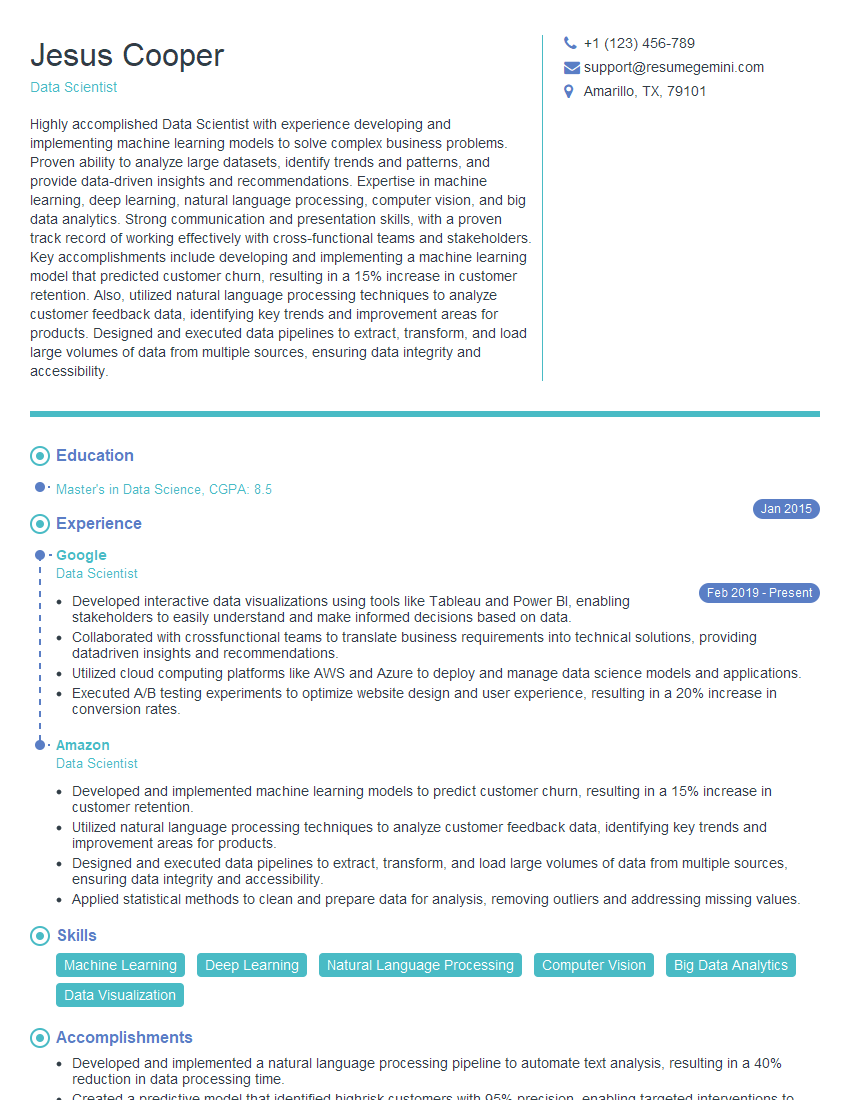
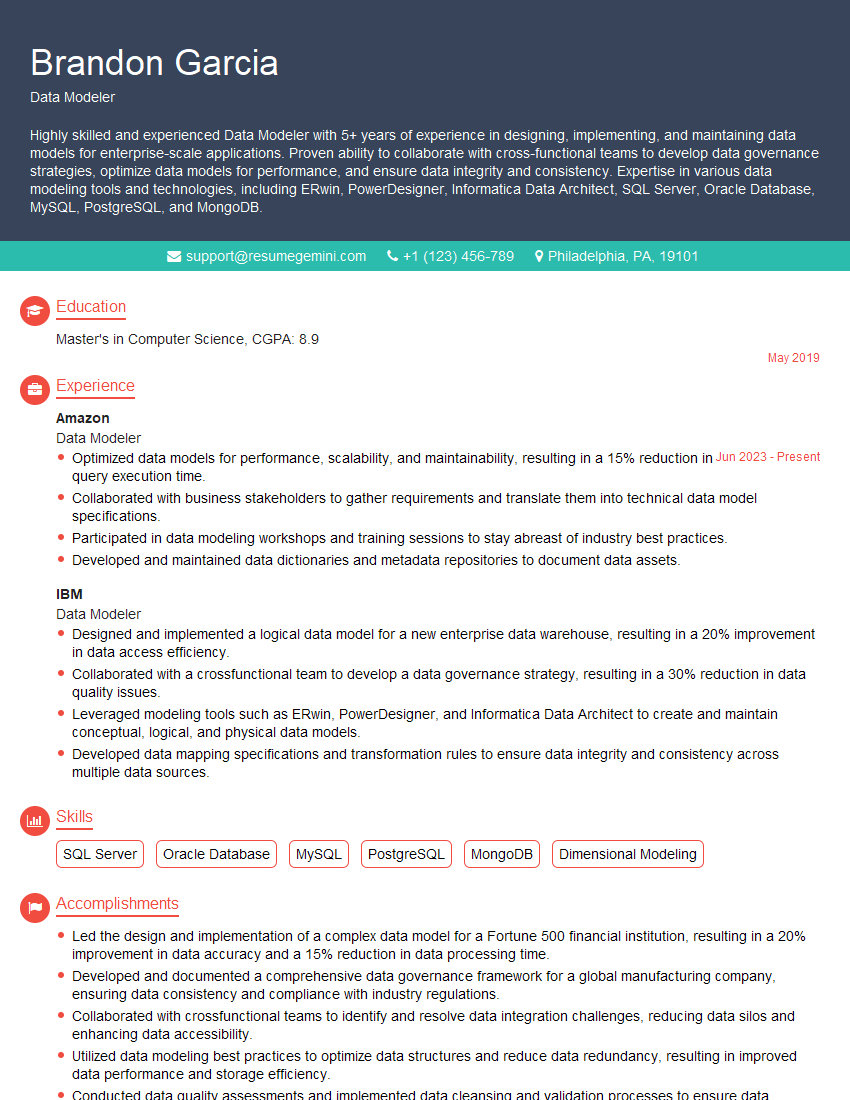
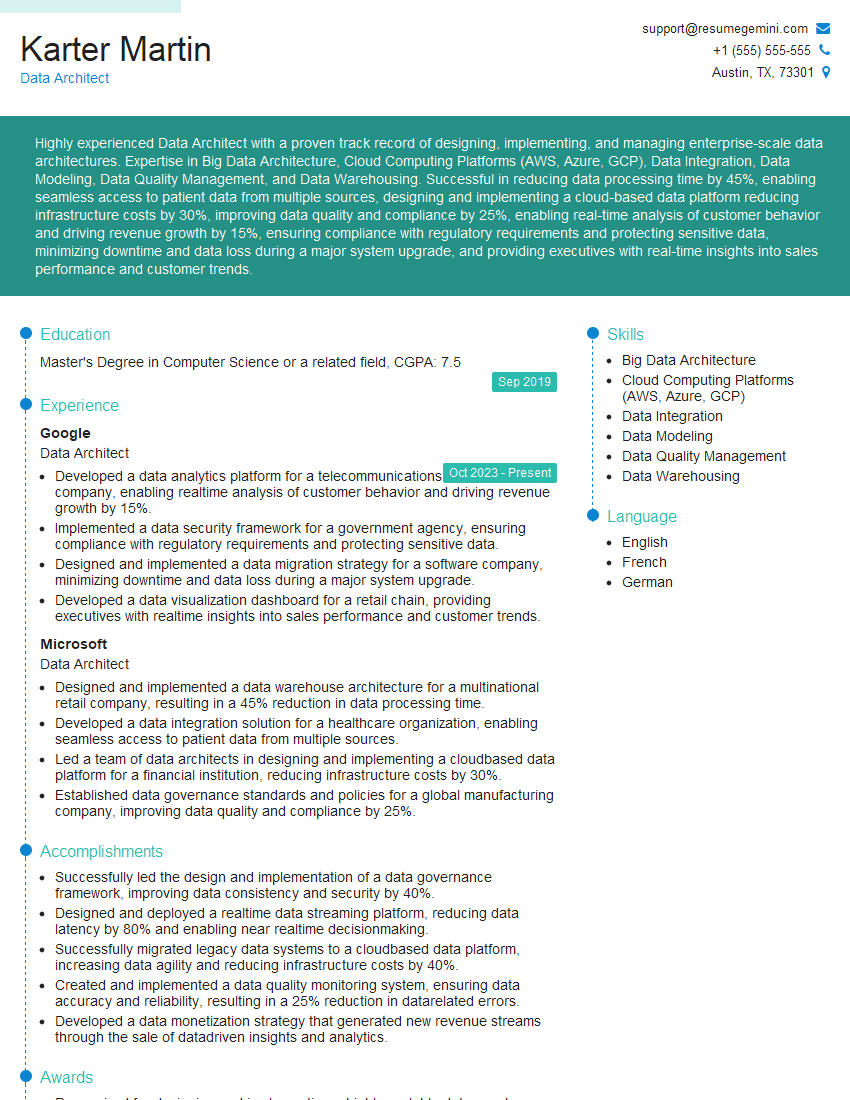
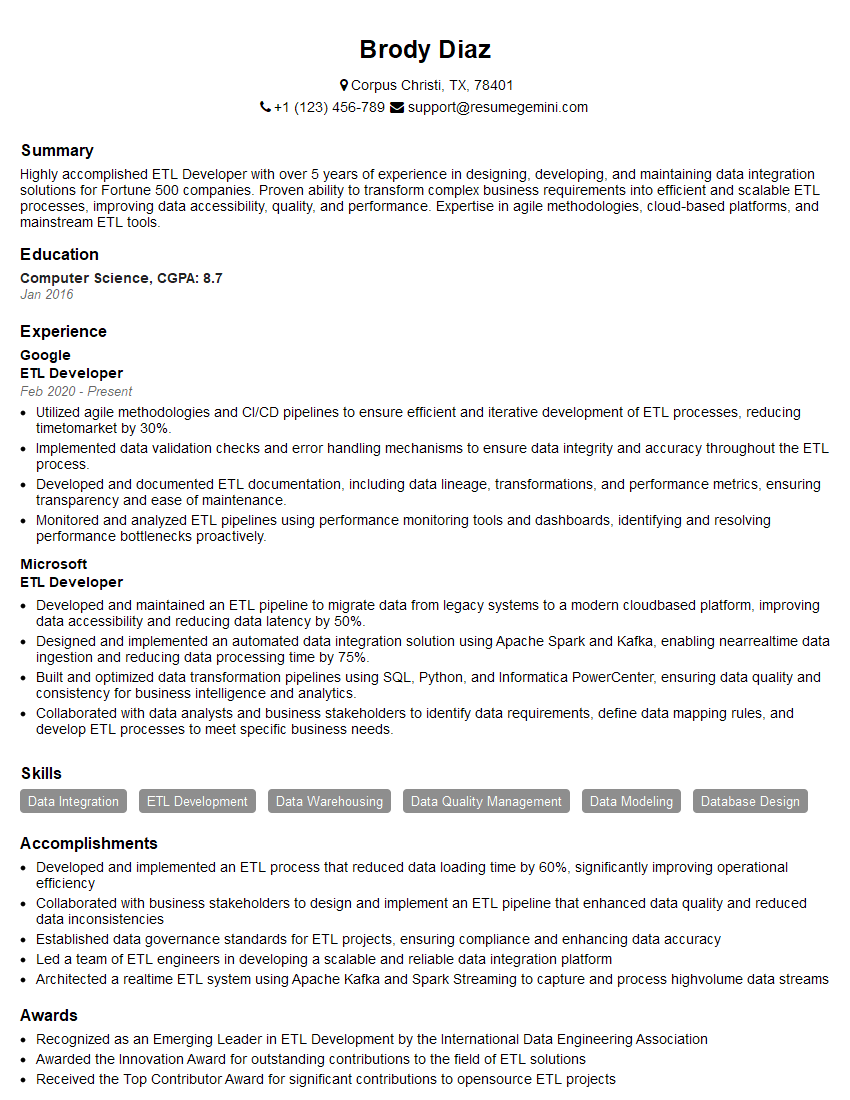
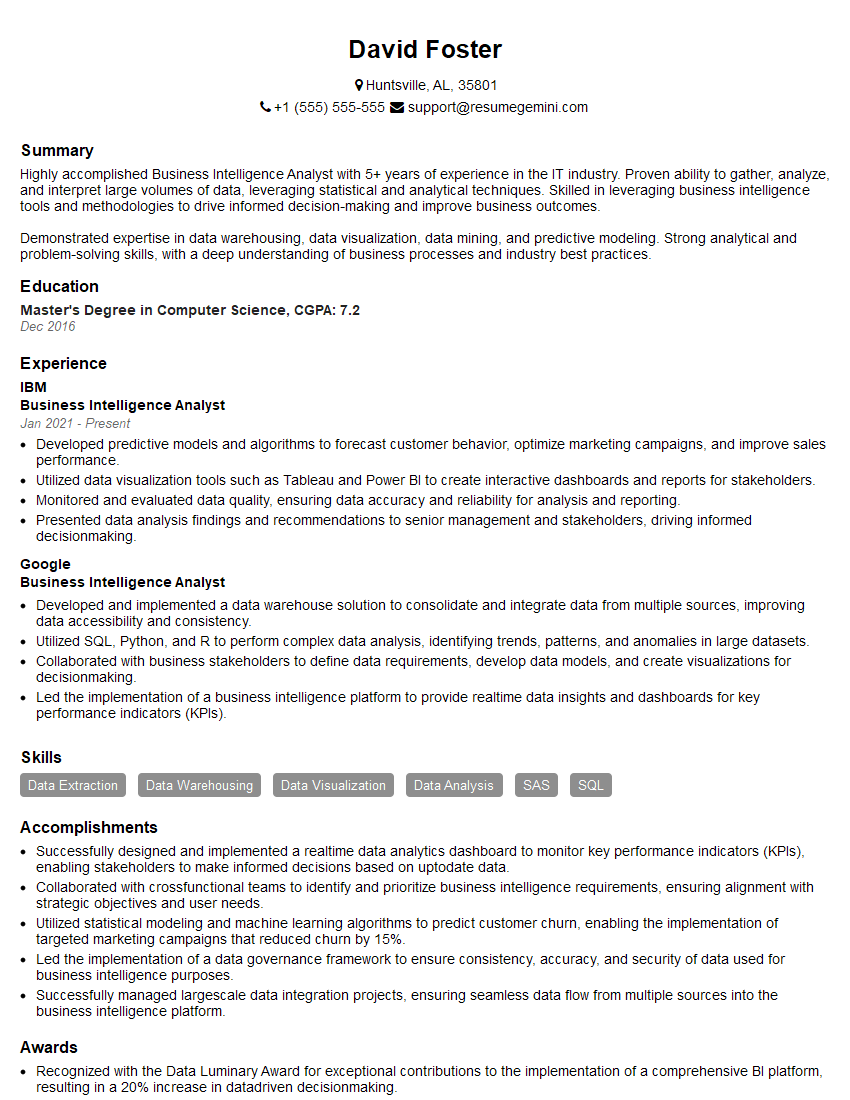
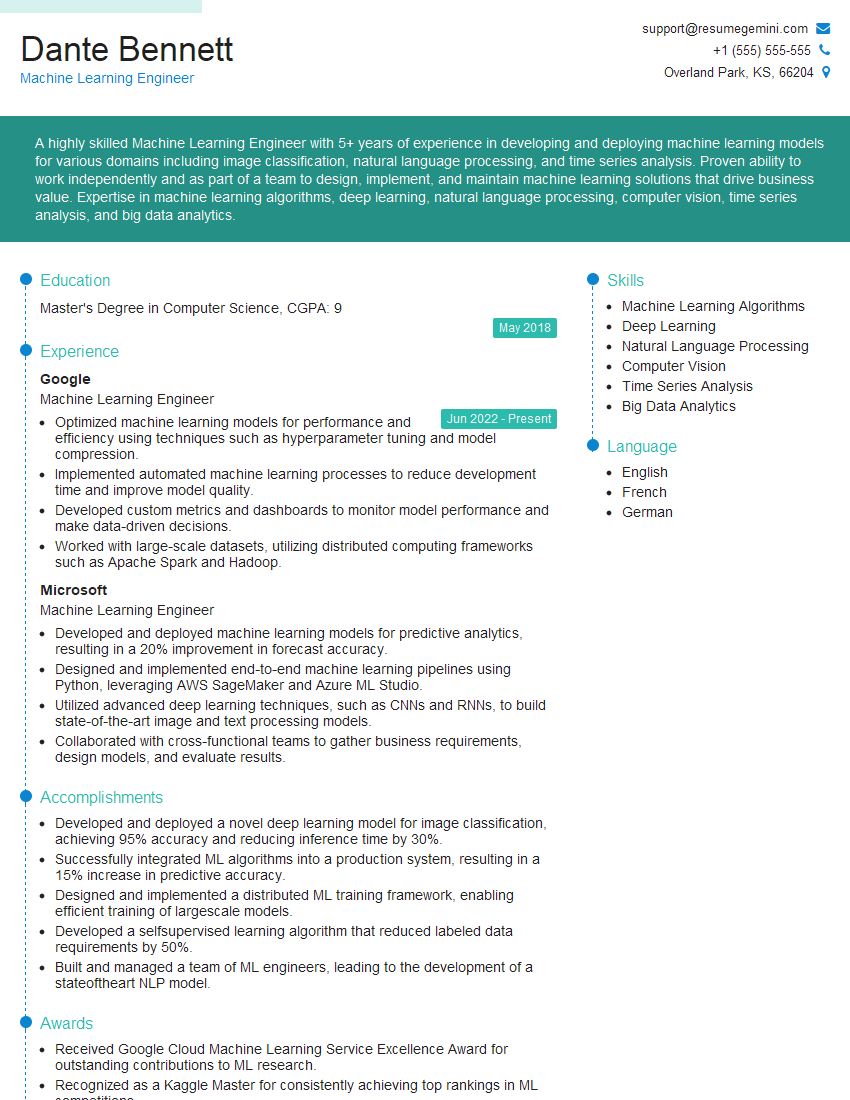
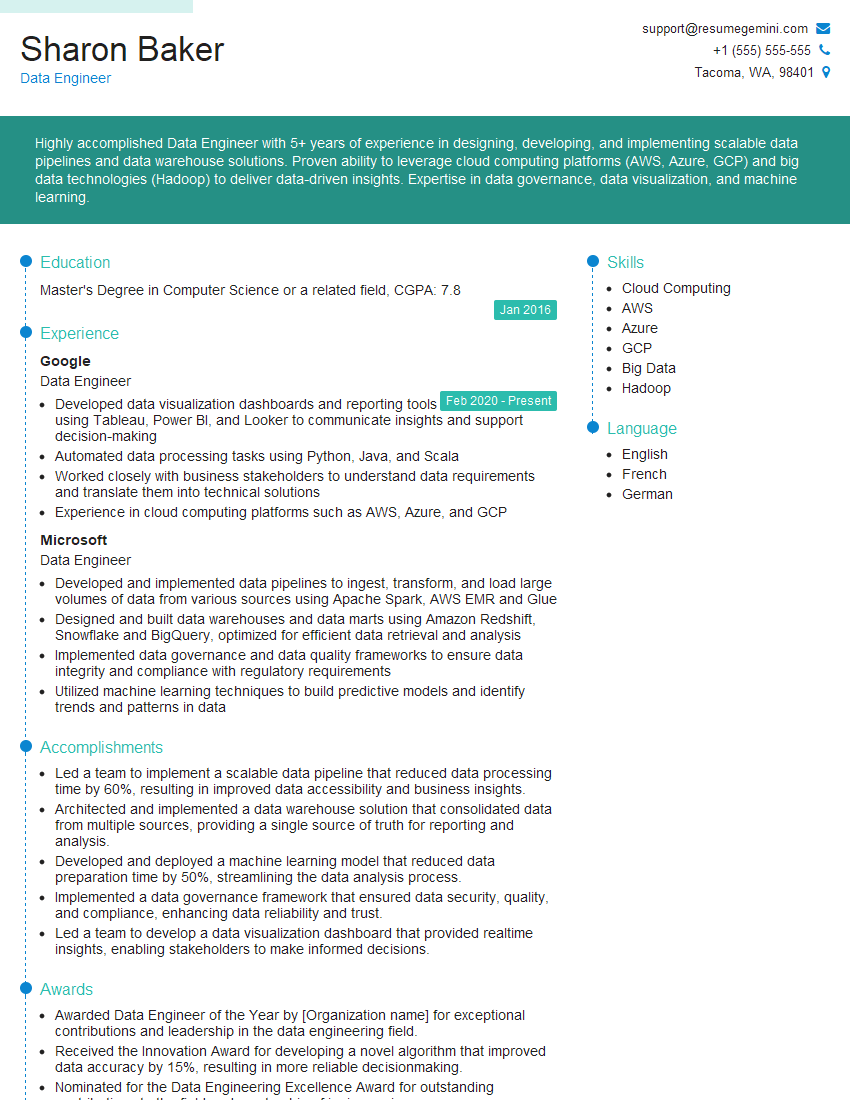
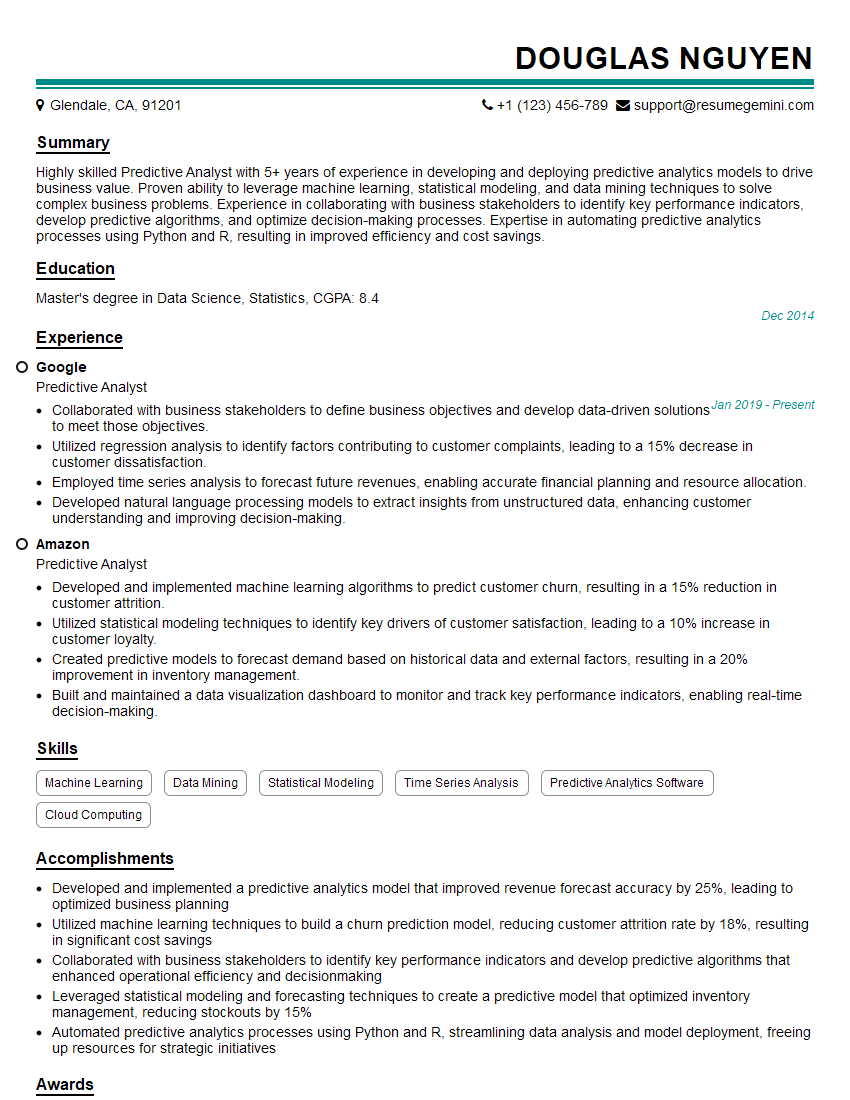
Mastering Big Data Analysis Techniques is key to unlocking exciting career opportunities in a rapidly growing field. A strong understanding of these techniques will significantly enhance your employability and open doors to high-impact roles. To maximize your chances of landing your dream job, invest time in creating an ATS-friendly resume that highlights your skills and experience effectively. ResumeGemini is a trusted resource that can help you build a professional and impactful resume, tailored to the specific requirements of Big Data Analysis roles. Examples of resumes tailored to Big Data Analysis Techniques are available to guide you.
Explore more articles
Users Rating of Our Blogs
Share Your Experience
We value your feedback! Please rate our content and share your thoughts (optional).
What Readers Say About Our Blog
To the interviewgemini.com Webmaster.
Very helpful and content specific questions to help prepare me for my interview!
Thank you
To the interviewgemini.com Webmaster.
This was kind of a unique content I found around the specialized skills. Very helpful questions and good detailed answers.
Very Helpful blog, thank you Interviewgemini team.