Cracking a skill-specific interview, like one for Biodiesel Process Economics, requires understanding the nuances of the role. In this blog, we present the questions you’re most likely to encounter, along with insights into how to answer them effectively. Let’s ensure you’re ready to make a strong impression.
Questions Asked in Biodiesel Process Economics Interview
Q 1. Explain the key economic factors influencing biodiesel production costs.
Biodiesel production costs are influenced by a complex interplay of factors. Think of it like baking a cake – you need the right ingredients (feedstock), the right equipment (plant and machinery), and the right environment (regulations and market conditions). The key economic factors fall into these categories:
- Feedstock Costs: This is usually the largest component, varying wildly based on the type of oil (e.g., soybean oil, used cooking oil, algae oil) and its availability. A plentiful, cheap feedstock drastically reduces production costs.
- Energy Costs: Biodiesel production is energy-intensive, requiring substantial heat and power for processes like transesterification. Fluctuations in electricity and fuel prices directly affect profitability.
- Labor Costs: Plant size and automation level directly influence labor costs. A smaller, less automated plant will have higher labor costs per unit of biodiesel produced.
- Capital Costs: This includes the initial investment in land, building construction, equipment purchase (reactors, separators, storage tanks), and installation. These costs are heavily dependent on plant capacity and technology choices. A larger plant may have lower per-unit capital costs but requires a significantly higher initial investment.
- Transportation and Logistics: Getting the feedstock to the plant and the finished biodiesel to the market adds to the overall cost. Geographic location and transportation infrastructure significantly impact these costs. A plant located near both feedstock sources and markets minimizes transport costs.
- Processing Costs: These include costs associated with pretreatment of the feedstock (e.g., degumming, filtration), catalyst usage, and waste disposal. Efficient process design and waste management strategies can significantly lower these costs.
- Government Regulations and Policies: Taxes, subsidies, and environmental regulations all affect the final cost of biodiesel. For example, carbon taxes could increase production costs, while subsidies could make it more economically viable.
Understanding these interconnected factors is crucial for successful biodiesel production economics.
Q 2. Describe the different feedstock options for biodiesel production and their impact on costs.
Biodiesel feedstock options are diverse, each impacting cost differently. Think of it like choosing ingredients for a recipe – some are cheap and readily available, others are more expensive and niche. Common feedstocks include:
- Soybean Oil: Widely used, relatively inexpensive in many regions, but its price is subject to agricultural market fluctuations. This is a classic example of a commodity feedstock where price volatility is a significant risk.
- Used Cooking Oil (UCO): A cost-effective option, potentially reducing waste, but requires careful processing to remove contaminants and ensure quality. Collection and transportation logistics can be challenging.
- Palm Oil: Abundant and relatively cheap, but its production raises significant environmental concerns about deforestation and biodiversity loss. Growing global demand for palm oil is increasing prices and the environmental impact is increasingly a factor in assessing its cost.
- Algae: A promising sustainable option, but currently very expensive due to the complexity of cultivation and harvesting. Technological advancements are necessary for algae-based biodiesel to become economically competitive.
- Animal Fats (Tallow, Grease): A readily available and sometimes inexpensive source, particularly in regions with high livestock farming. However, concerns about food vs. fuel competition exist and the quality consistency can vary.
The choice of feedstock depends on several factors including availability, price, environmental impact, and the processing capabilities of the biodiesel plant. A comprehensive economic analysis considering all these factors is essential.
Q 3. What are the major capital and operating costs associated with a biodiesel plant?
Setting up a biodiesel plant requires significant investment, encompassing both capital and operating costs. Think of it as building a house – you need the initial construction materials and labor (capital) and then ongoing expenses like utilities and maintenance (operating).
- Capital Costs:
- Land Acquisition and Site Preparation: The cost of land, site clearing, and infrastructure development.
- Plant Construction: Building costs, including the reactor, storage tanks, separation equipment, and utilities.
- Equipment Purchase and Installation: The cost of specialized machinery for transesterification, purification, and other processes.
- Engineering and Design: Professional fees for the design and engineering of the plant.
- Operating Costs:
- Feedstock Procurement: The cost of purchasing the raw materials (oil, methanol, catalyst).
- Utilities: Electricity, water, and steam consumption.
- Labor: Salaries and benefits for plant operators and maintenance personnel.
- Maintenance and Repair: Regular maintenance and replacement of equipment parts.
- Catalyst Costs: The cost of replacing catalysts (e.g., sodium hydroxide) depending on the process.
- Waste Treatment and Disposal: Costs associated with managing the by-products of the process (glycerol).
- Transportation and Storage: Costs associated with moving feedstock, product, and by-products.
A detailed breakdown of these costs is crucial for accurate project budgeting and feasibility assessment.
Q 4. How do you perform a lifecycle cost analysis for a biodiesel production facility?
A lifecycle cost analysis (LCCA) for a biodiesel plant provides a comprehensive overview of all costs incurred throughout its lifespan. Think of it like planning a long-term investment – you need to consider not only the upfront cost but also the ongoing expenses and potential future replacements. It typically involves:
- Defining the plant’s lifespan: This usually ranges from 20 to 30 years.
- Estimating all costs over the lifespan: This includes initial capital investment, annual operating costs (maintenance, labor, utilities, feedstock), and potential costs associated with major equipment replacements or upgrades throughout the lifespan.
- Considering the time value of money: Future costs are discounted to their present value to account for the fact that money earned today is worth more than money earned in the future. This uses a discount rate based on factors such as risk.
- Developing a cost model: This often uses spreadsheet software (e.g., Excel) to project costs year by year, taking into account factors like inflation and potential changes in feedstock prices and regulatory environment. This often considers scenarios such as worst-case, best-case, and a most likely scenario.
- Analyzing results: The LCCA provides a total present value of all costs, allowing comparison of different design options, plant sizes, and technologies.
By considering the entire lifecycle, LCCA helps in making informed decisions about the economic viability of the project and aids in optimal decision-making over the entire life of the facility.
Q 5. What are the common methods for evaluating the economic viability of a biodiesel project?
Several methods evaluate biodiesel project economic viability. These techniques help determine if the project is profitable and worth the investment. These include:
- Net Present Value (NPV): NPV calculates the difference between the present value of cash inflows (revenue from biodiesel sales) and the present value of cash outflows (costs). A positive NPV suggests profitability.
- Internal Rate of Return (IRR): IRR is the discount rate that makes the NPV of a project equal to zero. A higher IRR indicates a more attractive investment.
- Payback Period: This measures the time it takes for the cumulative cash inflows to equal the initial investment. A shorter payback period is generally preferred.
- Return on Investment (ROI): ROI measures the profitability of an investment relative to its cost. A higher ROI suggests a more efficient use of capital.
- Sensitivity Analysis: This examines the impact of changes in key variables (e.g., feedstock price, energy costs, biodiesel price) on the project’s profitability. It helps identify critical factors and quantify the risks associated with uncertainties.
These methods, often used in combination, provide a comprehensive assessment of a biodiesel project’s financial feasibility.
Q 6. Discuss the role of government incentives and regulations in biodiesel economics.
Government incentives and regulations play a crucial role in shaping biodiesel economics. They can either stimulate growth by making biodiesel production more attractive or hinder it by imposing additional costs. Examples include:
- Tax Credits and Subsidies: These directly reduce the cost of biodiesel production, making it more competitive with petroleum-based fuels. They can significantly improve profitability.
- Renewable Portfolio Standards (RPS): These mandates require electricity providers and fuel retailers to procure a certain percentage of their energy from renewable sources, including biodiesel. This creates a guaranteed market for biodiesel producers.
- Environmental Regulations: Regulations on greenhouse gas emissions can indirectly impact biodiesel economics. Biodiesel, being a cleaner fuel, might benefit from carbon pricing policies which place a cost on emissions.
- Feedstock Subsidies: Some governments incentivize feedstock production to ensure supply and improve the cost competitiveness of biodiesel. This can lower feedstock price volatility.
- Import Tariffs and Trade Policies: These affect the competitiveness of biodiesel against imports and the price that producers can obtain for their products.
The policy landscape is constantly evolving, so understanding current and anticipated regulations is crucial for biodiesel project planning and financial modeling.
Q 7. Explain the concept of feedstock price volatility and its impact on biodiesel profitability.
Feedstock price volatility is a major challenge in biodiesel economics. It’s like relying on a fluctuating ingredient market for your cake recipe – sometimes the price is low, other times it’s sky-high. This unpredictability directly affects profitability. Factors influencing feedstock price volatility include:
- Agricultural Market Conditions: Weather patterns, crop yields, and global supply and demand dynamics greatly impact feedstock prices. A poor harvest can drastically increase prices.
- Energy Prices: Energy prices often correlate with feedstock prices, as energy is required for cultivation, harvesting, and processing.
- Global Demand: Increasing global demand for biodiesel, particularly in countries implementing renewable energy policies, can push feedstock prices upward.
- Speculation: Speculation in agricultural commodity markets can exacerbate price volatility.
Mitigation strategies include:
- Hedging: Employing financial instruments to lock in feedstock prices at a certain level for a specified period.
- Diversifying Feedstock Sources: Reducing reliance on a single feedstock minimizes the impact of price fluctuations in any one source.
- Long-Term Contracts: Securing long-term contracts with feedstock suppliers can provide price stability.
- Developing Robust Financial Models: Building financial models that account for a range of possible feedstock price scenarios is crucial for risk management.
Managing feedstock price volatility is essential for ensuring the long-term financial health of a biodiesel plant.
Q 8. How do you analyze the break-even point for a biodiesel production facility?
Analyzing the break-even point for a biodiesel production facility involves determining the production volume at which total revenue equals total costs. This is crucial for understanding the minimum production needed to avoid losses. We typically use a cost-volume-profit (CVP) analysis. This involves identifying fixed costs (e.g., rent, salaries, insurance) and variable costs (e.g., feedstock, utilities, catalysts). The break-even point in units is calculated as: Fixed Costs / (Selling Price per Unit - Variable Cost per Unit). For example, if fixed costs are $1 million annually, the selling price is $10/gallon, and variable costs are $6/gallon, the break-even point is 250,000 gallons ($1,000,000 / ($10 - $6)). Beyond this volume, the facility generates profit. It’s vital to conduct sensitivity analysis, altering key variables like feedstock price or energy costs to understand the break-even point under different scenarios.
A crucial aspect is accurately predicting feedstock costs, which can be volatile. Using historical data and market forecasts is essential. Furthermore, we must account for potential changes in government regulations or subsidies that directly affect profitability.
Q 9. Describe different biodiesel production technologies and their associated economic impacts.
Several biodiesel production technologies exist, each with its own economic implications. The most common are:
- Base-catalyzed transesterification: This is the most widely used method, relatively simple, and uses methanol and a catalyst (sodium or potassium hydroxide). It’s cost-effective but produces wastewater that requires careful treatment, adding to operational costs.
- Acid-catalyzed transesterification: This uses a strong acid catalyst, suitable for lower-quality feedstocks. While avoiding wastewater issues, it’s slower and yields lower biodiesel conversion rates, increasing production time and lowering overall efficiency.
- Supercritical methanol transesterification: This method uses methanol at supercritical conditions (high pressure and temperature), eliminating the need for a catalyst. It’s faster and yields higher purity, but requires specialized equipment, leading to higher capital investment costs.
- Enzyme-catalyzed transesterification: This uses enzymes as catalysts, offering an environmentally friendly approach. However, enzymes are more expensive than chemical catalysts and the process may be slower, potentially impacting the overall profitability.
The economic impact is influenced by factors such as capital investment (equipment, land), operating costs (feedstock, energy, labor, maintenance), and the selling price of biodiesel. A higher initial investment in advanced technologies like supercritical methods might be offset by faster production and higher-quality yields. Choosing the optimal technology depends on a detailed cost-benefit analysis considering feedstock availability, scale of operation, and environmental regulations.
Q 10. What are the key performance indicators (KPIs) used to assess the economic efficiency of a biodiesel plant?
Key Performance Indicators (KPIs) for assessing a biodiesel plant’s economic efficiency include:
- Production Capacity Utilization: The percentage of maximum production capacity actually achieved. A higher percentage signifies better efficiency and profitability.
- Yield: The amount of biodiesel produced per unit of feedstock. A higher yield reduces raw material costs and improves overall profitability.
- Production Cost per Gallon/Liter: Tracks the total cost associated with producing each unit of biodiesel. Lower costs directly increase profitability.
- Gross Profit Margin: The difference between revenue and cost of goods sold, expressed as a percentage of revenue. A higher margin indicates better pricing strategies and operational efficiency.
- Return on Investment (ROI): Measures the profitability of an investment relative to its cost. A higher ROI shows a better return on the capital invested.
- Payback Period: The time it takes to recoup the initial investment. Shorter payback periods are desirable.
Monitoring these KPIs regularly allows for timely adjustments in operations, feedstock sourcing, or pricing strategies to optimize profitability. Comparing these indicators against industry benchmarks aids in identifying areas for improvement and maintaining competitiveness.
Q 11. How do you assess the environmental impact of biodiesel production from an economic perspective?
Assessing the environmental impact of biodiesel production economically involves incorporating externalities—costs or benefits not reflected in market prices—into the analysis. This includes things like greenhouse gas emissions, water pollution from wastewater, and air pollution from energy use. Methods such as Life Cycle Assessment (LCA) quantify these environmental impacts. Then, we can assign monetary values to these impacts, e.g., using carbon taxes or pollution permits, to incorporate them into the economic analysis.
For example, if a biodiesel plant releases significant greenhouse gasses, we might include a carbon tax penalty in the operating costs to reflect the environmental damage. Conversely, if the plant uses renewable energy sources, we may account for positive environmental externalities, resulting in reduced costs or higher profitability.
This broadened economic view makes a more comprehensive picture of the overall cost and benefit of biodiesel production, enabling informed decisions regarding investment and policy.
Q 12. Explain the concept of net present value (NPV) and its application in biodiesel project evaluation.
Net Present Value (NPV) is a crucial financial metric used in biodiesel project evaluation. It discounts future cash flows back to their present value, considering the time value of money—a dollar today is worth more than a dollar tomorrow due to potential investment opportunities. A positive NPV indicates the project is expected to generate more value than it costs, making it financially viable. The formula is: NPV = Σ [Ct / (1 + r)^t] - C0, where Ct is the net cash flow at time t, r is the discount rate (reflecting the risk and opportunity cost of capital), and C0 is the initial investment.
In a biodiesel project, we would estimate future revenues from biodiesel sales, subtract operating and maintenance expenses, and discount these cash flows using an appropriate discount rate (e.g., reflecting the risk associated with fluctuating feedstock prices and energy costs). A higher discount rate reflects greater risk and will result in a lower NPV. A project with a positive NPV is considered worthwhile.
For example, if a biodiesel project has an initial investment of $5 million and projected annual net cash flows of $1.5 million for five years, with a discount rate of 10%, we would calculate the NPV to determine if it’s financially viable.
Q 13. Discuss the role of risk assessment in biodiesel project financing.
Risk assessment is critical in biodiesel project financing, as the industry is susceptible to various uncertainties. These include:
- Feedstock price volatility: Prices of vegetable oils and animal fats can fluctuate significantly, impacting profitability.
- Energy price fluctuations: Biodiesel production is energy-intensive; changes in energy prices directly affect costs.
- Government policies and subsidies: Changes in regulations or the removal of subsidies can dramatically affect project viability.
- Technological risks: Unforeseen technical issues could lead to production delays or increased costs.
- Market risks: Changes in demand for biodiesel could reduce profitability.
Risk assessment involves identifying, analyzing, and quantifying these risks. This might involve using techniques like sensitivity analysis (examining the impact of changes in key variables on NPV), scenario analysis (evaluating outcomes under different market conditions), and Monte Carlo simulation (using probability distributions to model uncertainty). The results inform the level of risk tolerance and the financial structuring of the project, potentially involving risk mitigation strategies like hedging against feedstock price volatility or securing long-term contracts with buyers.
Q 14. How do you determine the optimal scale of a biodiesel production facility?
Determining the optimal scale of a biodiesel production facility involves balancing economies of scale with the risks of overcapacity. Economies of scale mean that larger facilities often have lower per-unit production costs due to factors like bulk purchasing of feedstock and more efficient equipment utilization. However, excessively large facilities carry higher capital costs, greater financial risk in case of market downturns, and increased logistical complexities.
The optimal scale is often determined through detailed cost analysis, considering different plant capacities. This includes:
- Fixed Costs: These don’t vary with production volume (land, equipment).
- Variable Costs: These vary directly with production volume (feedstock, energy, labor).
- Revenue Projections: Estimated biodiesel sales based on market demand and pricing.
We would model the profitability of different scales using tools like NPV and internal rate of return (IRR). The optimal scale maximizes profitability while considering the risks associated with larger facilities. Market demand forecasts are crucial for this analysis. It’s also important to consider the availability of suitable feedstock in the region.
Q 15. What are the different methods for pricing biodiesel and their market implications?
Biodiesel pricing is complex, influenced by various factors. Common methods include:
- Market-based pricing: This mirrors the price of petroleum diesel, often with a premium or discount depending on factors like feedstock availability and government incentives. A common example is biodiesel being priced at a certain percentage above or below the diesel price on a given day. The market implication here is direct competition with petroleum diesel, requiring biodiesel to be price-competitive to gain market share.
- Cost-plus pricing: This calculates the production cost (including feedstock, processing, and logistics) and adds a predetermined markup for profit. For example, a producer might add a 15% markup to their total production cost. The market implication is that profitability hinges on efficient production and cost control. It might lead to higher prices if costs are high, potentially impacting market share.
- Government-regulated pricing: Some governments mandate biodiesel blending or offer subsidies, directly influencing the price. This approach can stabilize prices but can also distort the market, potentially hindering competitiveness without the support.
Market implications are significant. Pricing models directly impact consumer adoption, investor interest, and the overall viability of biodiesel production. A well-chosen pricing strategy balances profitability with market competitiveness.
Career Expert Tips:
- Ace those interviews! Prepare effectively by reviewing the Top 50 Most Common Interview Questions on ResumeGemini.
- Navigate your job search with confidence! Explore a wide range of Career Tips on ResumeGemini. Learn about common challenges and recommendations to overcome them.
- Craft the perfect resume! Master the Art of Resume Writing with ResumeGemini’s guide. Showcase your unique qualifications and achievements effectively.
- Don’t miss out on holiday savings! Build your dream resume with ResumeGemini’s ATS optimized templates.
Q 16. How does the energy balance affect the economic feasibility of biodiesel production?
The energy balance in biodiesel production refers to the ratio of energy produced (in the form of biodiesel) to the energy consumed during the entire production process. This includes energy for feedstock cultivation, processing, transportation, and refining. A positive energy balance means more energy is produced than consumed, making it environmentally and economically favorable. Conversely, a negative balance signals energy inefficiency, making the process economically unsustainable.
Let’s illustrate with an example: if a biodiesel plant uses 10 units of energy to produce 11 units of biodiesel, the energy balance is positive (1.1). However, if it consumes 12 units to produce the same 11 units of biodiesel, the energy balance is negative (0.916), signifying that more energy is expended than obtained.
Economic feasibility is directly tied to this balance. A negative or low positive energy balance implies higher production costs, reducing profitability and potentially rendering the project economically infeasible. Producers constantly strive for process optimization to improve the energy balance and maximize return on investment.
Q 17. Explain the concept of economies of scale in the context of biodiesel production.
Economies of scale in biodiesel production refer to the cost advantages achieved through increased production volume. As production capacity grows, the cost per unit of biodiesel typically decreases. This is because fixed costs (e.g., equipment, land, permits) are spread across a larger production quantity.
For instance, a large-scale plant with automated processes can achieve lower per-unit processing costs compared to a smaller, manually operated plant. Furthermore, bulk purchasing of feedstock and efficient waste management also contribute to lower per-unit costs. Consider a scenario where a small plant incurs $50,000 in fixed costs and produces 10,000 liters of biodiesel annually. The fixed cost per liter is $5. A large plant with $100,000 in fixed costs but producing 50,000 liters annually would have a fixed cost per liter of only $2. This demonstrates the significant cost reduction possible with scale.
In practice, this means larger biodiesel producers can often offer lower prices while maintaining profitability, enhancing their market competitiveness. This also attracts larger investments, further fueling growth.
Q 18. Describe the impact of transportation costs on the overall economics of biodiesel.
Transportation costs significantly impact the economics of biodiesel production. These costs include the transport of feedstock to the processing plant and the distribution of finished biodiesel to consumers. The distance from feedstock sources and markets to the processing plant is a crucial factor.
For example, a plant located far from both feedstock suppliers and consumers will incur higher transportation costs, reducing profitability. A facility situated near a major highway or port may enjoy lower transportation costs and thus a greater margin. Biodiesel, being relatively heavy, can incur greater costs than other products.
Strategies to mitigate these costs include selecting a plant location strategically close to both feedstock and market, negotiating favorable transportation contracts, and exploring alternative transportation modes to reduce per-unit costs. Producers must diligently factor transportation costs into their financial models and optimize logistics to ensure viability.
Q 19. How do you evaluate the potential for carbon credits in a biodiesel project?
Carbon credits represent a potential revenue stream for biodiesel projects. Biodiesel, being a renewable fuel, often results in lower greenhouse gas emissions compared to petroleum diesel. Carbon credits are awarded for projects that demonstrably reduce carbon emissions, and these credits can be sold in carbon markets. The potential for generating carbon credits depends on several factors:
- Feedstock type: Using sustainably sourced feedstock (e.g., waste cooking oil) can significantly increase the potential for carbon credits.
- Greenhouse gas emissions reduction: A comprehensive life cycle assessment (LCA) is crucial to accurately quantify greenhouse gas emissions reductions compared to conventional diesel.
- Carbon market prices: The value of carbon credits fluctuates based on market demand and regulatory frameworks. A thriving carbon market enhances the financial benefit of carbon credits.
- Verification and certification: Obtaining third-party verification and certification of the emissions reductions is necessary to validate carbon credits and allow their sale.
Evaluating the potential requires detailed LCA studies, market research to assess carbon credit prices, and thorough due diligence on certification processes.
Q 20. Discuss the challenges associated with securing financing for a biodiesel project.
Securing financing for a biodiesel project presents several challenges. These include:
- High capital investment: Biodiesel plants require substantial upfront investment in equipment, infrastructure, and land.
- Market volatility: Fluctuations in feedstock prices, biodiesel prices, and government policies can create uncertainty for lenders.
- Technological risks: There are technological risks associated with the production process, which needs to be carefully evaluated in terms of risk mitigation.
- Regulatory compliance: Meeting environmental regulations and obtaining necessary permits can add complexity and delay the project timeline, impacting investor confidence.
- Limited track record: Compared to more established industries, biodiesel still has a relatively shorter track record, leading to higher perceived risk for investors.
To overcome these challenges, project developers need comprehensive business plans, strong management teams, proven technology, and detailed financial models demonstrating robust returns. They often leverage a combination of debt and equity financing, potentially incorporating government subsidies or incentives to secure funding.
Q 21. Explain the role of process optimization in enhancing biodiesel profitability.
Process optimization is critical for enhancing biodiesel profitability. This involves identifying and implementing improvements across the entire production chain, from feedstock selection to final product distribution.
Optimizations can focus on:
- Feedstock selection: Utilizing low-cost, high-yield feedstocks reduces raw material costs.
- Reaction conditions: Optimizing reaction parameters (e.g., temperature, catalyst concentration, reaction time) can improve biodiesel yield and quality.
- Process control: Implementing advanced process control systems for consistent and efficient operation minimizes waste and maximizes throughput.
- Waste management: Efficient management of by-products (e.g., glycerin) can generate additional revenue streams.
- Energy efficiency: Improving energy efficiency throughout the plant reduces operating costs.
Imagine a plant optimizing its catalyst usage, reducing waste, and improving energy efficiency. These smaller gains accumulate and significantly impact the overall production cost and ultimately profitability. Continuous monitoring and refinement of processes are essential for maintaining a competitive edge.
Q 22. How do you model the sensitivity of biodiesel production costs to changes in feedstock prices?
Modeling the sensitivity of biodiesel production costs to feedstock price fluctuations is crucial for risk assessment and investment decisions. We typically employ sensitivity analysis techniques, often using spreadsheet software or dedicated process simulation tools. The process involves creating a detailed cost model that includes all major inputs (feedstock, catalysts, energy, labor) and outputs (biodiesel, glycerin). We then systematically vary the feedstock price within a realistic range (e.g., +/- 20% from the base price) and observe the impact on the overall production cost. This is often visualized using graphs showing the change in biodiesel production cost as a function of feedstock price. For example, a simple model might use a linear relationship: Biodiesel Cost = (Feedstock Cost * Feedstock Usage) + Other Costs. By changing the Feedstock Cost variable, we can see how sensitive the total biodiesel cost is to its fluctuation. More complex models may use non-linear relationships to account for factors like economies of scale or changes in processing efficiency at varying feedstock prices.
Monte Carlo simulations offer a more sophisticated approach. By introducing randomness into the input parameters (including feedstock price, which can follow a defined probability distribution), we can generate a range of possible biodiesel production costs, providing a more robust understanding of the risk involved. For instance, if historical data suggests feedstock prices tend to follow a log-normal distribution, this can be incorporated into the simulation to get a more realistic estimate of potential cost variability. This helps investors make informed decisions about whether to invest in a biodiesel plant considering the inherent risk associated with volatile feedstock markets.
Q 23. What are the potential benefits of integrating biodiesel production with other renewable energy systems?
Integrating biodiesel production with other renewable energy systems offers significant synergistic benefits. Consider a scenario where a biodiesel plant is co-located with a biogas digester processing agricultural waste. The digester produces biogas, which can be used to provide process heat for the biodiesel transesterification reaction, reducing reliance on fossil fuels. The digestate (remaining material from the digester) can also serve as a fertilizer for growing oilseed crops, creating a closed-loop system. Furthermore, the glycerin byproduct of biodiesel production can be further processed into other valuable products like cosmetics or pharmaceuticals, enhancing profitability.
Similarly, pairing biodiesel production with solar or wind energy can further reduce the carbon footprint and operating costs. Excess electricity generated from these sources can power the biodiesel plant, especially during peak production periods. This integrated approach lowers energy bills and contributes to a more sustainable and economically viable energy production model, minimizing reliance on the volatile fossil fuel market. The economic advantages come from reduced energy costs, increased efficiency through process heat integration, and valorization of byproducts. This strategy also strengthens the overall environmental impact story, making the venture more attractive to investors and policymakers interested in sustainable development.
Q 24. Discuss the implications of technological advancements on biodiesel economics.
Technological advancements significantly impact biodiesel economics. Improved catalyst technologies, for instance, can lead to higher conversion rates and reduced catalyst usage, lowering production costs. Advances in process engineering, such as the development of continuous flow reactors, increase efficiency and throughput. This reduces capital costs per unit of biodiesel produced and improves the overall profitability of the operation. For example, a new catalyst that reduces reaction time by 50% could translate to significant energy savings and higher production volumes with the same equipment. The development of new feedstocks, like algae or waste cooking oil, can also dramatically impact cost structure. If these sources become cost-competitive or even cheaper than conventional feedstocks, it could drastically lower the overall production cost of biodiesel.
Furthermore, advancements in downstream processing and byproduct valorization are crucial. Converting the glycerin byproduct into high-value products significantly increases overall profitability. These innovations directly affect the overall economic viability of biodiesel, making it more competitive with fossil fuels and other renewable energy alternatives. Continuous monitoring of emerging technologies and their potential for cost reduction is essential for remaining competitive in the biodiesel industry. A proactive approach to incorporating these advancements is critical for long-term success and sustained profitability in the face of market competition and technological disruptions.
Q 25. How do you account for potential downtime and maintenance costs in a biodiesel economic model?
Accounting for downtime and maintenance costs is critical for a realistic biodiesel economic model. Downtime, caused by equipment failure, maintenance, or unforeseen circumstances, directly impacts production capacity and profitability. These costs should not be underestimated. We typically incorporate this using several approaches:
- Probability-based approach: Estimate the probability of equipment failure or planned maintenance based on historical data or manufacturer specifications. Then calculate the expected downtime and associated costs (lost production, labor, replacement parts). This might involve using a Monte Carlo simulation, assigning probabilities to different types of failures and their associated downtime and repair costs.
- Fixed-cost approach: Allocate a fixed percentage of the capital investment or annual operating budget to cover maintenance and repairs. This is a simpler approach, suitable when historical data is limited, but might be less accurate.
- Maintenance schedules: Factor in the cost of scheduled maintenance according to manufacturer guidelines or industry best practices. This includes labor, spare parts, and potential loss of production during shutdowns.
A comprehensive model should incorporate both planned and unplanned downtime, considering their respective financial impacts. This detailed costing provides a more realistic assessment of the total cost of biodiesel production and avoids an overly optimistic financial projection.
Q 26. Explain the importance of accurate forecasting of future biodiesel demand.
Accurate forecasting of future biodiesel demand is paramount for making sound investment and production decisions in the biodiesel industry. Underestimating demand can lead to insufficient production capacity and lost market share, while overestimating demand results in excess capacity and financial losses. This is particularly vital in a growing market that is highly influenced by government policies and fluctuating fossil fuel prices.
Demand forecasting involves analyzing various factors including: government regulations (e.g., mandates for renewable fuel blending), the price of competing fuels (e.g., petroleum diesel), economic growth projections, technological advancements affecting biodiesel production, and consumer preferences. Time series analysis, econometric modeling, and market research are commonly employed techniques. For example, econometric models might examine the relationship between biodiesel price, gasoline price, and overall fuel consumption to predict future biodiesel demand. Market research involves surveys and focus groups to gauge consumer attitudes toward renewable fuels and their willingness to pay. A robust demand forecast helps biodiesel producers optimize production levels, secure necessary financing, and plan for future expansion. Inaccurate forecasts could lead to major financial losses, especially for new entrants in the market. Thus, incorporating various forecasting methods and scenario analysis is critical to mitigate the risk of inaccurate projections.
Q 27. Discuss the ethical considerations related to biodiesel production and its economic implications.
Ethical considerations in biodiesel production significantly influence its economic viability. Sourcing feedstock sustainably is crucial. Using food crops for biodiesel production raises ethical concerns about food security and potential price increases for basic food staples. This negative public perception can translate into government regulations and consumer boycotts, harming the economic performance of unsustainable biodiesel production systems. Similarly, using land for biodiesel feedstock cultivation that could otherwise be used for food production or biodiversity conservation has ethical ramifications.
The environmental impact of biodiesel production is another key ethical consideration. While biodiesel reduces greenhouse gas emissions compared to petroleum diesel, its overall environmental impact depends on various factors including feedstock type, fertilizer usage, and processing methods. Transparency in the production process and accurate life-cycle assessment (LCA) are crucial to demonstrate the environmental benefits and address potential negative impacts. Companies committed to sustainable practices attract environmentally conscious investors and consumers, leading to a positive economic impact. On the other hand, companies neglecting environmental concerns face increased scrutiny and potential regulations which will be costly to remedy. A robust ethical framework for biodiesel production is integral for its long-term economic success and broader societal acceptance.
Q 28. How do you compare the economic viability of biodiesel with other renewable fuels?
Comparing the economic viability of biodiesel with other renewable fuels like ethanol, biogas, or hydrogen requires a comprehensive analysis that takes into account multiple factors. A life-cycle cost analysis is essential. This compares the total cost of producing and using each fuel, considering factors such as feedstock costs, production efficiency, energy consumption, transportation, and environmental externalities (e.g., greenhouse gas emissions). The specific costs vary greatly depending on regional factors. For instance, the cost of corn for ethanol production might be significantly different in the US compared to Europe. Furthermore, government policies and subsidies heavily influence the economic competitiveness of different fuels.
Consider the availability of feedstocks and infrastructure as another important aspect. Biodiesel production often relies on locally available oilseeds or waste vegetable oils, which can be more accessible and cost-effective in certain regions than other renewable fuel sources. In contrast, establishing the infrastructure for hydrogen production and distribution can be significantly more expensive. Analyzing energy return on investment (EROI) is also critical. EROI compares the energy input required for fuel production to the energy output generated from its combustion. A higher EROI indicates greater energy efficiency. By carefully considering these various factors and using detailed economic models, we can make a sound comparison and determine which renewable fuel offers the best economic advantages in a given context.
Key Topics to Learn for Biodiesel Process Economics Interview
- Feedstock Analysis & Costing: Understanding the economic impact of different feedstock sources (e.g., vegetable oils, animal fats) on biodiesel production costs, including transportation and preprocessing expenses.
- Process Optimization & Efficiency: Analyzing and improving the efficiency of various biodiesel production methods (e.g., transesterification, acid catalysis) to minimize production costs and maximize yield.
- Capital & Operating Costs: Evaluating the initial investment required for biodiesel plants, including equipment, land, and infrastructure, as well as ongoing operational costs (e.g., energy, labor, maintenance).
- Product Pricing & Market Analysis: Understanding the factors influencing biodiesel prices, including market demand, competition, and government policies. Analyzing market trends and forecasting future price fluctuations.
- Environmental Impact & Sustainability: Assessing the environmental benefits and costs of biodiesel production, including lifecycle analysis (LCA) and carbon footprint calculations. Understanding the economic implications of sustainability certifications and regulations.
- Financial Modeling & Analysis: Developing and interpreting financial models to evaluate the profitability of biodiesel production projects. Using techniques such as discounted cash flow (DCF) analysis and sensitivity analysis.
- Risk Management & Mitigation: Identifying and evaluating potential risks associated with biodiesel production, such as feedstock price volatility, technological failures, and regulatory changes. Developing strategies to mitigate these risks.
- Policy & Regulatory Landscape: Understanding the impact of government policies, subsidies, and regulations on the biodiesel industry. Analyzing the economic implications of various policy scenarios.
Next Steps
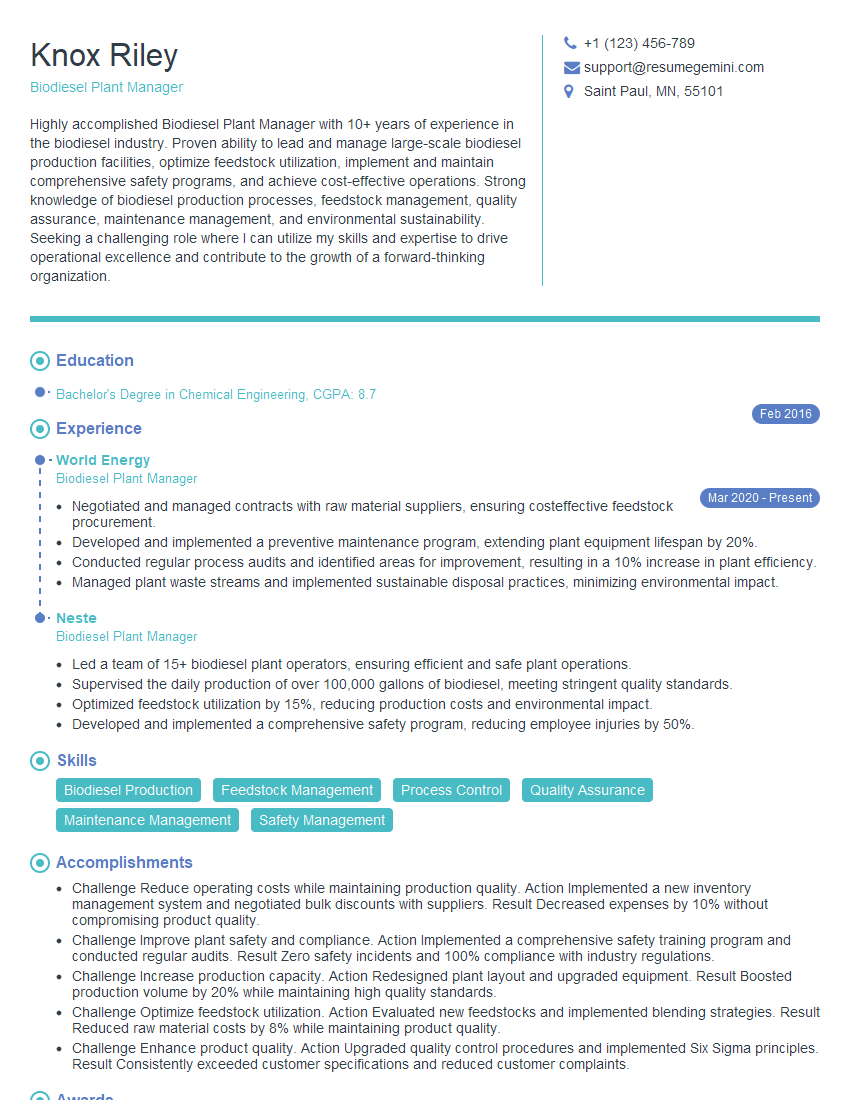
Mastering Biodiesel Process Economics is crucial for a successful career in this dynamic and growing industry. A strong understanding of these concepts will significantly enhance your interview performance and open doors to exciting opportunities. To further strengthen your job prospects, creating an ATS-friendly resume is paramount. ResumeGemini is a trusted resource that can help you craft a compelling resume that showcases your skills and experience effectively. ResumeGemini provides examples of resumes tailored specifically to the Biodiesel Process Economics field, ensuring your application stands out from the competition. Invest the time to build a strong resume – it’s an investment in your future.
Explore more articles
Users Rating of Our Blogs
Share Your Experience
We value your feedback! Please rate our content and share your thoughts (optional).
What Readers Say About Our Blog
To the interviewgemini.com Webmaster.
Very helpful and content specific questions to help prepare me for my interview!
Thank you
To the interviewgemini.com Webmaster.
This was kind of a unique content I found around the specialized skills. Very helpful questions and good detailed answers.
Very Helpful blog, thank you Interviewgemini team.