Interviews are opportunities to demonstrate your expertise, and this guide is here to help you shine. Explore the essential Brand Representation interview questions that employers frequently ask, paired with strategies for crafting responses that set you apart from the competition.
Questions Asked in Brand Representation Interview
Q 1. Describe your experience developing and implementing brand strategies.
Developing and implementing brand strategies is a multifaceted process that begins with a deep understanding of the brand’s essence, its target audience, and its competitive landscape. It involves a rigorous analysis phase, creative ideation, strategic planning, and meticulous execution.
For example, in my previous role at a sustainable fashion company, we developed a brand strategy focused on communicating the brand’s commitment to ethical sourcing and eco-friendly practices. This involved not just creating marketing materials highlighting these aspects, but also implementing changes throughout the supply chain to ensure authenticity. We conducted extensive market research to understand our target audience’s values and preferences, which informed the messaging and channels used in our campaign. The strategy included a mix of digital marketing, influencer collaborations, public relations, and events targeted at environmentally conscious consumers.
Another example involved a tech startup where we focused on establishing thought leadership in a niche market. The strategy centered on content marketing – creating valuable and engaging content (blog posts, white papers, webinars) that positioned the company as an expert in its field. This, coupled with targeted social media engagement and strategic partnerships, effectively elevated the brand’s profile and drove leads.
Q 2. How would you measure the success of a brand campaign?
Measuring the success of a brand campaign requires a multi-pronged approach, going beyond simple vanity metrics like likes and followers. A comprehensive evaluation should consider both qualitative and quantitative data.
- Quantitative Metrics: These involve measurable data points like website traffic, sales conversions, social media engagement (likes, shares, comments), brand mentions, and reach. For example, we might track the increase in website traffic from a specific campaign or the conversion rate from social media ads to sales.
- Qualitative Metrics: This focuses on understanding the impact on brand perception. Techniques include surveys, focus groups, social listening to understand consumer sentiment, and analyzing brand mentions for sentiment analysis (positive, negative, or neutral).
Ultimately, success is measured against pre-defined objectives. Did the campaign achieve its target for brand awareness, lead generation, or sales? By comparing pre-campaign and post-campaign metrics, we can quantify the effectiveness of our strategies.
Q 3. Explain your understanding of brand identity and its components.
Brand identity is the unique expression of a brand, encompassing its personality, values, and visual elements. It’s what makes a brand recognizable and memorable. It’s more than just a logo; it’s the overall perception and feeling associated with the brand in the minds of consumers.
Key components of brand identity include:
- Brand Name & Logo: The foundation of brand recognition.
- Brand Voice & Tone: The personality of the brand reflected in its communication style (e.g., formal, informal, humorous).
- Brand Values: The core principles guiding the brand’s actions and decisions (e.g., sustainability, innovation, customer-centricity).
- Brand Messaging: The key messages the brand communicates to its target audience.
- Visual Identity: This includes the color palette, typography, imagery, and overall design aesthetic. Consistency across all platforms is crucial.
- Brand Experience: This encompasses all interactions a customer has with the brand, from website navigation to customer service.
For instance, Apple’s brand identity is synonymous with minimalist design, innovation, and premium quality. This is reflected in its products, packaging, marketing materials, and customer service interactions.
Q 4. How do you handle negative brand perception or a crisis situation?
Handling negative brand perception or a crisis requires a swift, transparent, and empathetic response. The key is to acknowledge the issue, take responsibility where appropriate, and actively work to resolve the situation.
- Rapid Response: Address the issue immediately. Delay only amplifies the problem.
- Transparency & Honesty: Acknowledge the situation and be transparent about the steps being taken to rectify it. Avoid obfuscation or denial.
- Empathy & Apology: Show empathy for those affected and offer a sincere apology if warranted.
- Proactive Communication: Keep stakeholders (customers, media, employees) informed of developments and actions being taken.
- Damage Control: Implement strategies to mitigate the damage, such as correcting misinformation and addressing concerns directly.
- Long-term Strategy: Learn from the crisis and implement changes to prevent similar situations in the future. This might involve improving internal processes, refining communication protocols, or strengthening customer service.
For instance, if a product defect causes widespread safety concerns, a company should immediately issue a recall, communicate the issue transparently, and offer solutions to affected customers. Transparency and a proactive approach can significantly mitigate long-term reputational damage.
Q 5. What are your strategies for building brand awareness and loyalty?
Building brand awareness and loyalty are long-term goals requiring consistent effort. Strategies should focus on creating a strong brand identity, delivering exceptional customer experiences, and engaging with the target audience across multiple touchpoints.
Building Brand Awareness:
- Content Marketing: Create high-quality, valuable content that resonates with the target audience.
- Social Media Marketing: Engage with followers, build a community, and run targeted ad campaigns.
- Public Relations: Generate positive media coverage and build relationships with key influencers.
- Influencer Marketing: Partner with influencers to reach a wider audience.
- Event Marketing: Sponsor or participate in events relevant to the target audience.
Building Brand Loyalty:
- Exceptional Customer Service: Provide friendly, helpful, and efficient service.
- Loyalty Programs: Reward repeat customers with exclusive benefits.
- Personalized Experiences: Tailor interactions to individual customer preferences.
- Community Building: Foster a sense of community among brand advocates.
- Feedback Mechanisms: Actively solicit and respond to customer feedback.
For example, a coffee shop might build loyalty through a rewards program, personalized recommendations, and community events, while using social media and influencer collaborations to increase brand awareness.
Q 6. Describe your experience working with different marketing channels.
My experience spans a wide range of marketing channels, allowing me to develop holistic brand strategies that leverage the strengths of each platform.
- Digital Marketing: This includes SEO, SEM, social media marketing, email marketing, and content marketing. I have extensive experience optimizing websites for search engines, managing social media campaigns, and creating engaging email marketing sequences.
- Traditional Marketing: I’m proficient in print advertising, public relations, event marketing, and direct mail campaigns. Understanding the nuances of each channel is crucial for achieving optimal results.
- Influencer Marketing: Collaborating with influencers is a key part of my approach, as it facilitates brand awareness and consumer trust.
- Affiliate Marketing: I have experience in developing and managing affiliate programs to expand brand reach and drive sales.
In one project, we combined digital marketing (SEO, social media) with traditional PR (press releases, media outreach) to launch a new product, resulting in a significant boost in brand awareness and sales. The integrated approach ensured consistent messaging across all channels.
Q 7. How do you analyze brand performance and identify areas for improvement?
Analyzing brand performance and identifying areas for improvement involves a systematic approach that combines data analysis with qualitative insights.
- Data Collection: Gather data from various sources, including website analytics, social media metrics, sales data, customer feedback, and market research.
- Key Performance Indicator (KPI) Analysis: Identify key performance indicators (KPIs) relevant to the brand’s objectives (e.g., website traffic, conversion rates, customer satisfaction, brand awareness). Analyze trends and identify deviations from targets.
- Competitive Analysis: Assess the brand’s performance against competitors. Identify strengths and weaknesses relative to the competition.
- Customer Feedback Analysis: Analyze customer feedback from surveys, reviews, and social media to identify areas for improvement in product, service, or brand messaging.
- Qualitative Research: Conduct focus groups, interviews, or surveys to understand consumer perceptions and attitudes towards the brand.
- Actionable Insights: Based on the analysis, develop actionable recommendations to address identified issues and improve brand performance. This could involve refining marketing strategies, enhancing products or services, or improving customer service.
For example, analyzing website analytics might reveal low conversion rates on a particular landing page. Further investigation through user testing could reveal usability issues leading to design improvements. Regular performance analysis allows for continuous improvement and adaptation to changing market conditions.
Q 8. How do you adapt brand messaging for different target audiences?
Adapting brand messaging for different target audiences is crucial for effective marketing. It’s about speaking the right language to resonate with each specific group’s values, needs, and communication preferences. This isn’t about changing the core brand identity, but rather tailoring the *expression* of that identity.
For example, consider a skincare brand launching a new anti-aging cream. For a younger audience (25-35), the messaging might focus on preventative care and maintaining youthful radiance, using vibrant visuals and energetic language. However, for an older audience (55+), the messaging would emphasize reducing wrinkles and achieving a more youthful appearance, with a more sophisticated tone and imagery. This involves carefully selecting language, imagery, channels, and even the overall tone of the message. We’d also use different platforms to reach these different demographics: TikTok for the younger audience, and perhaps Facebook or print media for the older audience. Ultimately, the goal is consistent brand identity with customized communication.
- Audience Segmentation: Thoroughly understanding the demographic, psychographic, and behavioral characteristics of each target group is the first step.
- Messaging Tailoring: This includes adapting the language (formal vs. informal), tone (serious vs. playful), and style to match the audience’s preferences. We also consider cultural nuances and sensitivities.
- Channel Selection: Selecting the right platform to reach each audience is essential. A Gen Z audience is much more likely to engage on TikTok than on Facebook.
Q 9. How do you collaborate with cross-functional teams on brand initiatives?
Collaboration is the cornerstone of successful brand initiatives. I thrive in cross-functional team environments, actively seeking input from marketing, sales, product development, and even customer service teams. Effective collaboration requires clear communication, defined roles, and a shared understanding of the brand’s goals. I typically facilitate regular meetings and use project management tools to ensure everyone is aligned and informed.
For example, in a recent rebranding project, I worked closely with the product development team to ensure the new brand messaging reflected the improved features of our product. I also collaborated with the marketing team to develop a cohesive marketing campaign, with the sales team providing valuable insights into customer feedback and market trends. This collaborative approach ensures that brand initiatives are well-informed, well-executed, and achieve their objectives.
- Open Communication: Regular meetings and updates help to ensure everyone is on the same page.
- Shared Goals: Aligning all team members towards a common goal makes collaboration easier and more effective.
- Utilizing Tools: Project management software and shared documents enable seamless information sharing and tracking.
Q 10. How do you manage brand consistency across all platforms?
Maintaining brand consistency across all platforms is vital for building a strong and recognizable brand. Inconsistent messaging or visuals can confuse consumers and dilute brand equity. To achieve this, we develop comprehensive brand guidelines that encompass logo usage, color palettes, typography, imagery, tone of voice, and messaging. These guidelines act as a reference point for all teams involved in brand communication.
For example, we might use a style guide (digital or physical) that details specifications for logo placement, acceptable color variations, and preferred fonts. These guidelines are shared with all departments, and we regularly audit our brand presence across various platforms (website, social media, print materials, etc.) to ensure consistency. We also use brand management software to centralize brand assets and monitor online mentions, allowing for quick identification and correction of inconsistencies.
- Brand Guidelines Document: This document serves as a central resource for all brand-related decisions.
- Regular Audits: Conducting regular audits ensures that the brand guidelines are being followed across all platforms.
- Brand Management Software: These tools can help manage and maintain brand assets and monitor brand mentions online.
Q 11. Describe your experience with brand positioning and differentiation.
Brand positioning and differentiation are intrinsically linked. Positioning is about defining the brand’s place in the market relative to its competitors, while differentiation is about highlighting what makes it unique and desirable. My experience encompasses developing compelling brand positions that resonate with target audiences and stand out from the competition.
In one project, I helped a small coffee shop differentiate itself in a saturated market by focusing on ethically sourced beans and community engagement. We developed a brand story that emphasized sustainability and local partnerships, creating a unique brand identity that resonated strongly with environmentally conscious consumers. This involved market research to understand customer preferences and competitor strategies. We then crafted a clear value proposition, distinct messaging, and visual identity to reflect these elements. The result was an increase in customer loyalty and brand recognition.
- Competitive Analysis: Understanding the competitive landscape is crucial in developing a unique brand position.
- Value Proposition: Defining the unique value a brand offers to customers is essential for differentiation.
- Messaging and Visual Identity: These elements must reflect the brand’s position and differentiation strategy.
Q 12. What is your understanding of brand architecture?
Brand architecture refers to the organizational structure of a company’s brands. It outlines the relationships between different brands within a portfolio, defining how they are interconnected and how they communicate with consumers. A well-defined brand architecture simplifies consumer understanding and maximizes brand equity.
For instance, a company might have a house of brands architecture, where each brand operates independently (e.g., Procter & Gamble). Alternatively, they might employ a branded house architecture, where all products fall under a single master brand (e.g., Virgin). Choosing the right architecture depends on the company’s goals, the nature of its products, and its target market. Effective brand architecture facilitates clear communication, avoids brand confusion, and supports efficient resource allocation.
- House of Brands: Each brand has its own identity and target audience.
- Branded House: All products and services are marketed under one master brand.
- Endorsed Brands: A parent brand endorses sub-brands, providing a level of familiarity.
Q 13. How do you leverage market research to inform brand decisions?
Market research is indispensable for making informed brand decisions. It provides crucial insights into consumer preferences, behaviors, and perceptions. I utilize a variety of research methods, including quantitative surveys and qualitative interviews, to gather data on target audiences, competitive landscape, and market trends. This data guides decisions related to brand positioning, messaging, product development, and marketing strategies.
For instance, before launching a new product, I would conduct surveys and focus groups to understand customer needs and preferences. This research helps to ensure the product resonates with its target market and meets their expectations. We analyze competitor activities to understand what’s working and identify opportunities to differentiate. This data-driven approach leads to more effective brand strategies and better return on investment.
- Qualitative Research: In-depth interviews, focus groups, and ethnographic studies to understand consumer attitudes and motivations.
- Quantitative Research: Surveys, experiments, and data analysis to quantify market trends and consumer preferences.
- Competitive Analysis: Identifying and understanding competitors’ strengths and weaknesses.
Q 14. Explain your experience with budget management for brand campaigns.
Budget management is a critical aspect of brand campaign execution. My experience includes developing detailed budgets, tracking expenses, and ensuring efficient allocation of resources. I utilize project management tools and spreadsheets to track progress and identify potential overspending. I am adept at negotiating with vendors and optimizing spending to maximize ROI.
A key element is aligning the budget with the campaign’s objectives. Before allocating funds, we meticulously define the goals, target audiences, channels, and tactics. This allows for a more strategic approach to budget allocation. We consistently track expenses and compare them to the projected budget. This allows for prompt adjustments if necessary, maximizing budget efficiency. Regular reporting ensures transparency and accountability across all stakeholders.
- Budget Planning: Defining clear objectives and strategies to inform budget allocation.
- Expense Tracking: Utilizing project management tools and spreadsheets to track expenses against the budget.
- Performance Monitoring: Regularly reviewing the campaign’s performance and adjusting the budget as needed.
Q 15. How do you track key performance indicators (KPIs) for brand success?
Tracking KPIs for brand success requires a multifaceted approach, focusing on both quantitative and qualitative metrics. We need to understand what truly defines success for the brand – is it market share, customer loyalty, brand awareness, or a combination? Once we define those goals, we can select the right KPIs.
- Quantitative KPIs: These are measurable metrics. Examples include:
- Website traffic and engagement: Unique visitors, bounce rate, time on site, conversion rates.
- Social media engagement: Followers, likes, shares, comments, reach.
- Sales and revenue: Growth rate, customer lifetime value, average order value.
- Brand awareness: Brand mentions, search volume, social media sentiment.
- Qualitative KPIs: These are harder to measure numerically but equally important. Examples include:
- Brand perception: Customer surveys, focus groups, social listening to understand how customers view the brand.
- Customer satisfaction (CSAT): Measured through surveys and feedback forms.
- Net Promoter Score (NPS): A metric that measures customer loyalty and willingness to recommend.
Using a dashboard to visualize these KPIs is crucial for effective monitoring and identifying trends. Regularly reviewing this data allows for data-driven decision-making and necessary adjustments to the brand strategy.
Career Expert Tips:
- Ace those interviews! Prepare effectively by reviewing the Top 50 Most Common Interview Questions on ResumeGemini.
- Navigate your job search with confidence! Explore a wide range of Career Tips on ResumeGemini. Learn about common challenges and recommendations to overcome them.
- Craft the perfect resume! Master the Art of Resume Writing with ResumeGemini’s guide. Showcase your unique qualifications and achievements effectively.
- Don’t miss out on holiday savings! Build your dream resume with ResumeGemini’s ATS optimized templates.
Q 16. Describe a time you had to make a difficult decision impacting brand image.
In a previous role, we faced a crisis when a product, despite rigorous testing, experienced a significant malfunction impacting a small percentage of users. The immediate reaction was to recall the product, a costly and potentially image-damaging move. However, a rushed recall could have amplified negative publicity and damaged trust further. We had to decide between a full recall, a targeted repair program, or a silent fix with enhanced monitoring.
The decision was agonizing. We opted for a targeted repair program, communicating transparently with affected customers, providing swift solutions, and offering compensation for inconvenience. This approach minimized disruption, prioritized customer satisfaction, and ultimately preserved brand reputation. While financially impactful, prioritizing transparency and customer trust prevented a larger crisis.
Q 17. How do you handle conflicting feedback from different stakeholders?
Handling conflicting feedback requires a structured approach that prioritizes active listening and collaborative problem-solving. I typically employ a three-step process:
- Gather and analyze all feedback: Document each stakeholder’s perspective, identifying areas of agreement and disagreement.
- Facilitate a discussion: Create a safe space for stakeholders to share their concerns and rationale. The goal is understanding the root cause of the conflict, not necessarily immediate consensus.
- Find a compromise: Based on the analysis and discussion, identify solutions that address the key concerns of different stakeholders. Prioritize solutions aligned with overarching brand goals and values. This might involve prioritizing certain feedback based on its impact or the stakeholder’s influence.
For example, if the marketing team wants a bold, edgy campaign while the sales team prefers a conservative approach, finding a middle ground that balances brand personality with market appeal is crucial. This might involve A/B testing different approaches or creating variations of the campaign targeted towards specific customer segments.
Q 18. Explain your approach to creating a compelling brand story.
Creating a compelling brand story involves understanding the brand’s essence, its unique selling proposition, and its connection with the target audience. It’s about weaving together a narrative that resonates emotionally and intellectually.
My approach follows these steps:
- Define the brand’s core values and mission: What does the brand stand for? What problem does it solve? What is its unique contribution?
- Identify the target audience: Who are you trying to reach? What are their aspirations, challenges, and values?
- Craft a narrative arc: Structure the story with a beginning (brand origins, problem statement), middle (challenges faced, solutions offered), and end (future vision, impact). Incorporate relatable characters or events.
- Choose the right storytelling medium: Consider various platforms like website copy, social media posts, video content, or even podcasts to amplify the narrative.
- Maintain consistency: The brand story should be consistent across all touchpoints, reinforcing the core message and brand identity.
For example, a sustainable clothing brand’s story could focus on ethical sourcing, empowering artisans, and minimizing environmental impact. This narrative resonates with environmentally conscious customers and builds a strong emotional connection.
Q 19. How do you ensure brand messaging is aligned with the company’s values?
Ensuring brand messaging aligns with company values requires a conscious and ongoing effort. It’s about more than just slogans; it’s about integrating values into every aspect of communication.
This is achieved through:
- Defining and documenting company values: These values should be clearly articulated and easily understood by everyone in the organization.
- Developing a brand voice and tone guide: This guide defines the style, language, and personality of the brand’s communications, ensuring consistency and alignment with values.
- Reviewing all messaging for value alignment: Every piece of content, from website copy to social media posts, should be scrutinized to ensure it reflects the company’s values.
- Training employees on brand messaging: Equipping employees with the knowledge and skills to communicate the brand message effectively is vital. This includes understanding and internalizing the company values.
- Monitoring brand perception: Regularly analyzing customer feedback and brand mentions can help identify any discrepancies between stated values and perceived actions.
For instance, a company that values sustainability shouldn’t use packaging that isn’t eco-friendly. This incongruence would undermine the brand’s credibility and damage its reputation.
Q 20. What is your experience with brand guidelines and style guides?
I have extensive experience working with brand guidelines and style guides. I understand that these documents are not just design specifications; they are critical tools for maintaining brand consistency and ensuring a unified brand identity across all platforms.
My experience encompasses:
- Developing and updating brand guidelines: I’ve been involved in creating comprehensive brand guidelines that cover logo usage, color palettes, typography, imagery, tone of voice, and messaging principles.
- Enforcing brand guidelines: I understand the importance of ensuring that all marketing materials and communications adhere to the established brand guidelines. This often involves training and educating teams on proper usage.
- Adapting brand guidelines: I recognize that brand guidelines need to be adaptable to accommodate evolving brand strategies and market trends. This involves regularly reviewing and updating the guidelines to maintain relevance and effectiveness.
A well-defined style guide ensures that every piece of communication – from a social media post to a corporate brochure – reflects the brand’s personality and maintains a professional image.
Q 21. How familiar are you with competitive brand analysis?
Competitive brand analysis is fundamental to effective brand strategy. It helps understand the competitive landscape, identify opportunities, and refine our approach to stand out.
My familiarity includes:
- Identifying key competitors: Analyzing the market to determine direct and indirect competitors.
- Analyzing competitor strengths and weaknesses: Understanding their marketing strategies, target audiences, brand messaging, and overall market position.
- Benchmarking: Comparing our brand performance against competitors’ metrics to identify areas for improvement.
- Gap analysis: Identifying unmet customer needs or market gaps that our brand can address.
- Competitive advantage identification: Defining what makes our brand unique and how to leverage those differentiators.
For example, by analyzing a competitor’s successful social media campaign, we can identify best practices, adapt them to our brand, and create engaging content that resonates with our target audience. Competitive analysis is an iterative process that informs our decisions, ensures our brand remains relevant, and allows for proactive adaptation.
Q 22. Describe your experience with social media marketing for brands.
My experience with social media marketing for brands encompasses a multifaceted approach, focusing on strategic planning, content creation, community engagement, and performance analysis. I’ve managed social media campaigns for diverse brands, from startups to established corporations, leveraging platforms like Facebook, Instagram, Twitter, LinkedIn, and TikTok. This includes developing content calendars aligned with brand voice and target audience preferences, implementing targeted advertising strategies, monitoring brand mentions and sentiment, and responding to customer inquiries and feedback promptly and professionally. For example, for a sustainable fashion brand, we used Instagram’s shoppable posts and influencer marketing to significantly boost sales and brand awareness. In another instance, a B2B tech company saw a considerable increase in leads through a LinkedIn campaign focusing on thought leadership content and targeted advertising to specific industry professionals.
- Strategic Planning: Defining objectives, target audiences, and key performance indicators (KPIs).
- Content Creation: Developing engaging and visually appealing content tailored to each platform.
- Community Engagement: Fostering interactions with followers through contests, Q&As, and timely responses.
- Performance Analysis: Tracking key metrics, such as reach, engagement, and conversion rates, to optimize campaigns.
Q 23. How do you measure the ROI of brand-building activities?
Measuring the ROI of brand-building activities isn’t always straightforward, as it often involves long-term benefits that are difficult to quantify directly. However, we can track various indicators to assess the effectiveness of our efforts. Rather than focusing solely on immediate sales, we look at a combination of leading and lagging indicators.
- Leading Indicators (predict future success): Brand awareness (surveys, social media mentions), website traffic, engagement rates (likes, shares, comments), lead generation, media mentions.
- Lagging Indicators (measure past performance): Sales, customer acquisition cost (CAC), customer lifetime value (CLTV), market share, brand loyalty (repeat purchases, customer reviews).
We use a combination of qualitative and quantitative data, analyzing customer surveys, social listening tools, and sales figures. For instance, a successful influencer marketing campaign might not immediately translate into sales, but we can measure the increase in brand awareness and website traffic as leading indicators of future sales growth. By tracking these metrics over time and comparing them to investment in the brand-building activities, we can get a clearer picture of the ROI.
Q 24. What tools and technologies are you familiar with for brand management?
I’m proficient in various tools and technologies for brand management, ranging from social media analytics platforms to customer relationship management (CRM) systems. My toolkit includes:
- Social Media Management Tools: Hootsuite, Buffer, Sprout Social (for scheduling, monitoring, and analyzing social media performance).
- CRM Systems: Salesforce, HubSpot (for managing customer interactions and data).
- Analytics Platforms: Google Analytics, Adobe Analytics (for tracking website traffic and user behavior).
- Brand Monitoring Tools: Brandwatch, Mention (for tracking brand mentions and sentiment across various online channels).
- Design Software: Adobe Creative Suite (for creating brand assets).
- Project Management Tools: Asana, Trello (for organizing and tracking projects).
I am also adept at using data visualization tools such as Tableau and Power BI to effectively communicate brand performance data to stakeholders.
Q 25. How would you approach rebranding an existing product or service?
Rebranding an existing product or service requires a systematic approach, starting with thorough market research and analysis. This process involves several key steps:
- Market Research and Analysis: Understanding the current market landscape, competitive analysis, and customer perceptions of the existing brand.
- Defining Brand Objectives: Clearly articulating the goals of the rebranding effort, such as increasing brand awareness, enhancing brand perception, or targeting a new customer segment.
- Brand Positioning and Messaging: Developing a clear and concise brand message that resonates with the target audience.
- Visual Identity Refresh: Redesigning the logo, color palette, typography, and other visual elements to reflect the new brand identity.
- Brand Voice and Tone: Defining the brand’s personality and communication style.
- Implementation and Rollout: Implementing the new brand identity across all touchpoints, including the website, packaging, marketing materials, and social media.
- Monitoring and Evaluation: Tracking the effectiveness of the rebranding efforts and making necessary adjustments.
For example, when rebranding a legacy product, a phased approach might be necessary to minimize disruption to existing customers while gradually introducing the new brand identity.
Q 26. Describe your experience with crisis communications management.
My experience with crisis communications management involves a proactive and reactive approach. Proactive measures include developing a crisis communication plan that outlines procedures for handling various scenarios, identifying potential risks, and establishing clear communication channels. When a crisis arises, my approach is based on the following principles:
- Rapid Response: Acknowledge the issue quickly and transparently.
- Accurate Information: Provide factual information and avoid speculation.
- Empathy and Understanding: Show compassion for those affected.
- Consistent Messaging: Maintain a consistent message across all communication channels.
- Open Communication: Keep stakeholders informed of developments.
- Proactive Monitoring: Track media coverage and social media conversations.
I have successfully navigated several crises, including product recalls and negative media coverage, by implementing these strategies and working closely with leadership and other relevant teams. A successful crisis response relies on quick action, transparency, and a commitment to restoring trust.
Q 27. How do you identify and address potential brand risks?
Identifying and addressing potential brand risks is a crucial aspect of brand management. This involves a combination of proactive monitoring and reactive problem-solving. My approach includes:
- Regular Brand Audits: Assessing the current brand health, identifying weaknesses, and monitoring online sentiment.
- Competitive Analysis: Analyzing competitors’ strategies and identifying potential threats.
- Social Listening: Tracking social media conversations and identifying potential issues before they escalate.
- Risk Assessment: Identifying potential risks and developing mitigation strategies.
- Scenario Planning: Developing contingency plans for different crisis scenarios.
For example, proactively monitoring social media for negative feedback can enable early intervention and prevent a minor issue from escalating into a major crisis. By regularly assessing potential threats and developing mitigation strategies, we can strengthen the brand’s resilience and protect its reputation.
Q 28. What are your long-term career goals related to Brand Representation?
My long-term career goals in Brand Representation involve leveraging my expertise to lead and mentor teams, driving innovative brand strategies, and contributing to the success of organizations. I aspire to become a thought leader in the field, sharing my knowledge through publications and presentations. Specifically, I aim to:
- Lead and mentor a high-performing team of brand professionals.
- Develop and implement innovative brand strategies that drive growth and enhance brand equity.
- Contribute to the development of best practices in brand management.
- Share my knowledge and experience through writing, speaking engagements, and industry collaborations.
- Ultimately, I strive to build brands that resonate with consumers, fostering genuine connection and delivering lasting value.
Key Topics to Learn for Brand Representation Interview
- Brand Strategy & Positioning: Understanding how brands develop their unique identity, messaging, and target audience. Practical application: Analyze existing brand strategies and suggest improvements based on market trends.
- Brand Communication & Storytelling: Crafting compelling narratives that resonate with the target audience across various channels. Practical application: Develop a social media campaign strategy for a specific product or service.
- Crisis Communication & Reputation Management: Developing strategies to mitigate negative publicity and protect brand image. Practical application: Develop a crisis communication plan for a hypothetical brand scenario.
- Brand Advocacy & Influencer Marketing: Leveraging influencers and advocates to promote brand awareness and engagement. Practical application: Outline a plan to identify and collaborate with relevant influencers for a specific brand.
- Brand Measurement & Analytics: Tracking key performance indicators (KPIs) to assess the effectiveness of brand initiatives. Practical application: Discuss methods for measuring ROI of brand campaigns.
- Competitive Analysis & Benchmarking: Understanding the competitive landscape and identifying opportunities for differentiation. Practical application: Compare and contrast the brand strategies of two competing companies.
- Digital Brand Management: Understanding the nuances of building and maintaining a strong online brand presence. Practical application: Develop a content calendar strategy for a brand’s social media channels.
Next Steps
Mastering Brand Representation opens doors to exciting career opportunities in marketing, public relations, and communications, offering significant growth potential and high earning potential. To maximize your job prospects, crafting an ATS-friendly resume is crucial. This ensures your application gets noticed by recruiters and hiring managers. ResumeGemini is a trusted resource that can help you build a professional and impactful resume, designed to highlight your skills and experience effectively. Examples of resumes tailored to Brand Representation are provided to guide you further. Invest time in creating a resume that showcases your expertise and makes a lasting impression – it’s your first step to landing your dream job.
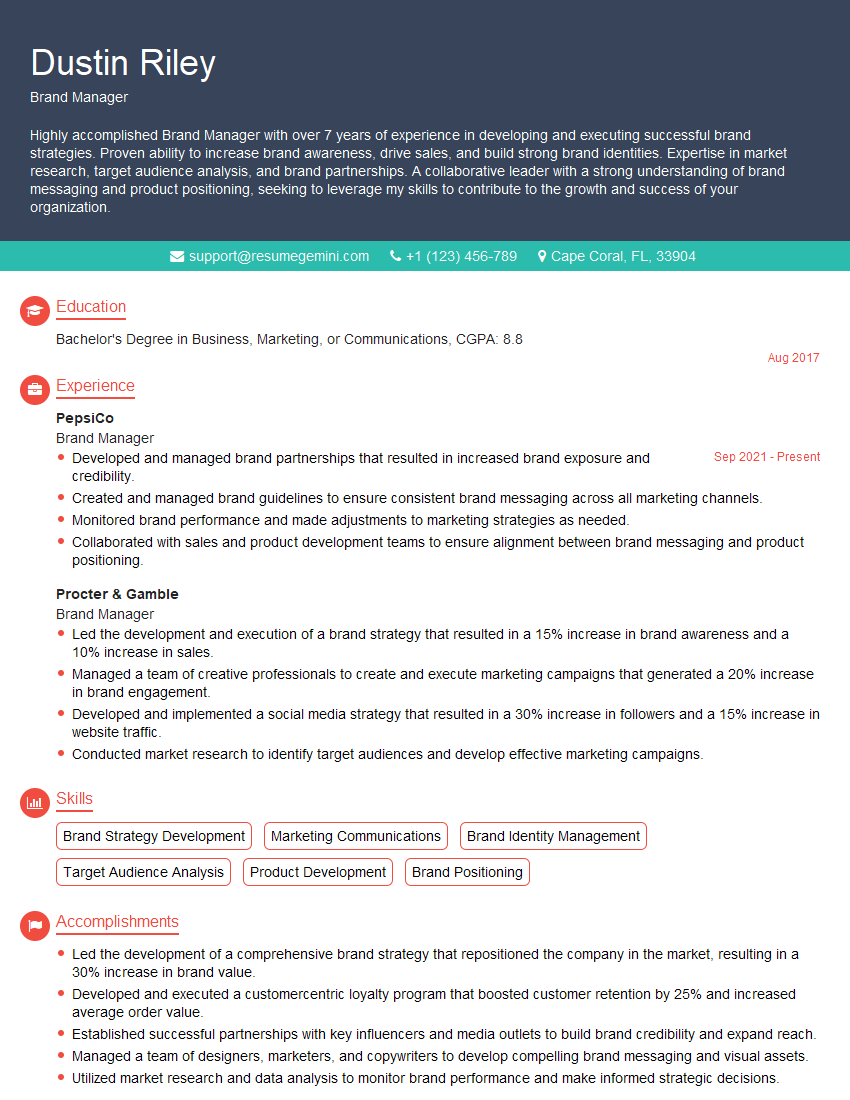
Brand Manager Resume Sample
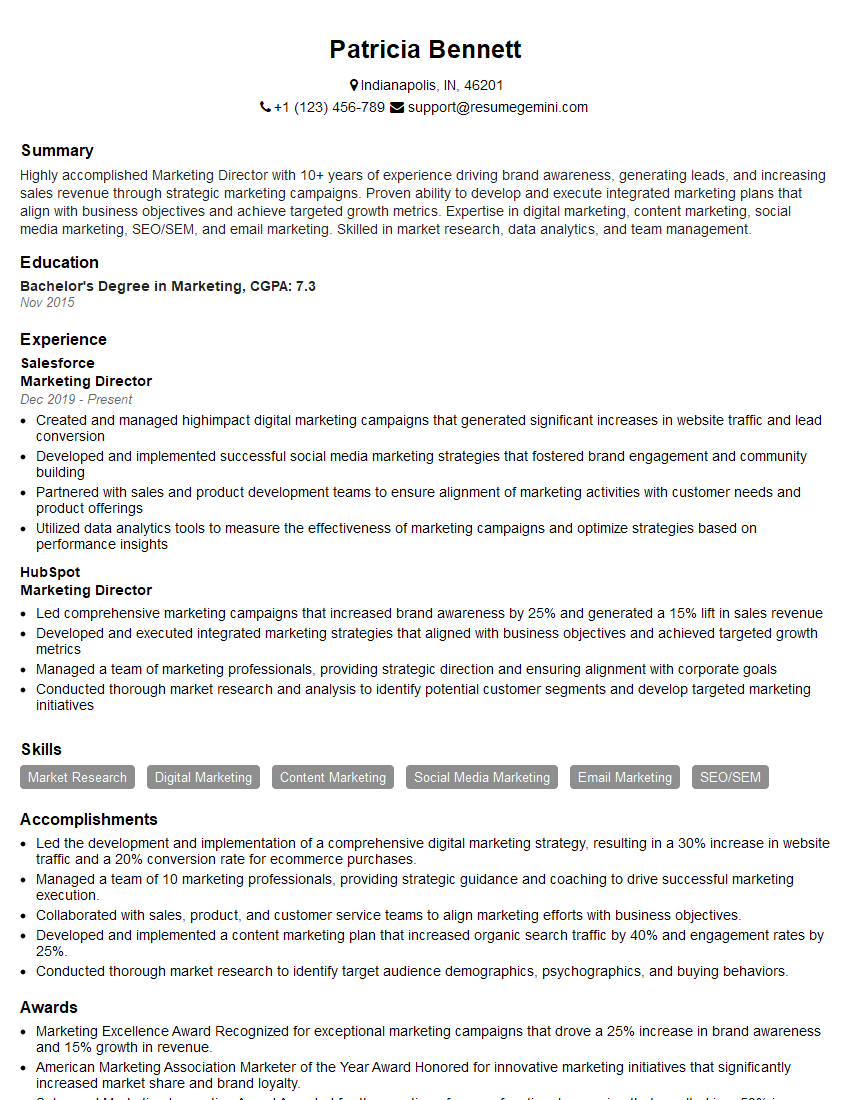
Marketing Director Resume Sample
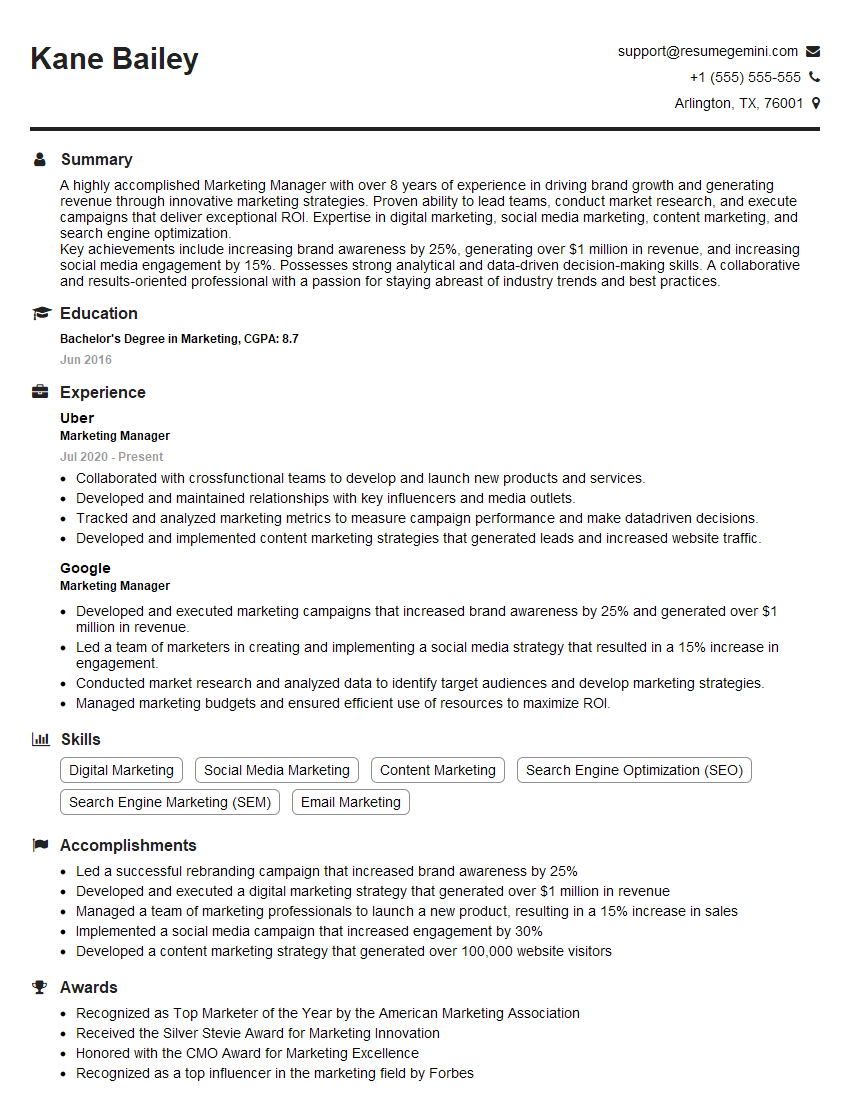
Marketing Manager Resume Sample
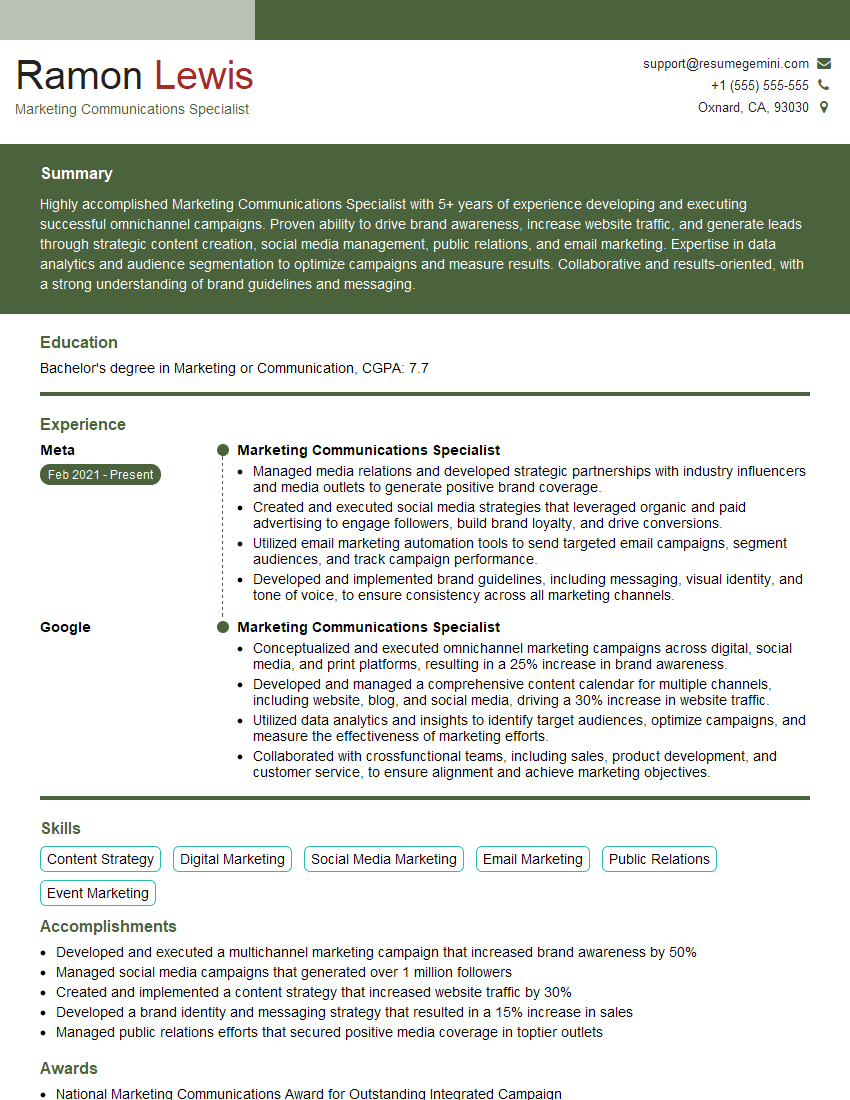
Marketing Communications Specialist Resume Sample

Communications Director Resume Sample

Communications Manager Resume Sample

Social Media Manager Resume Sample
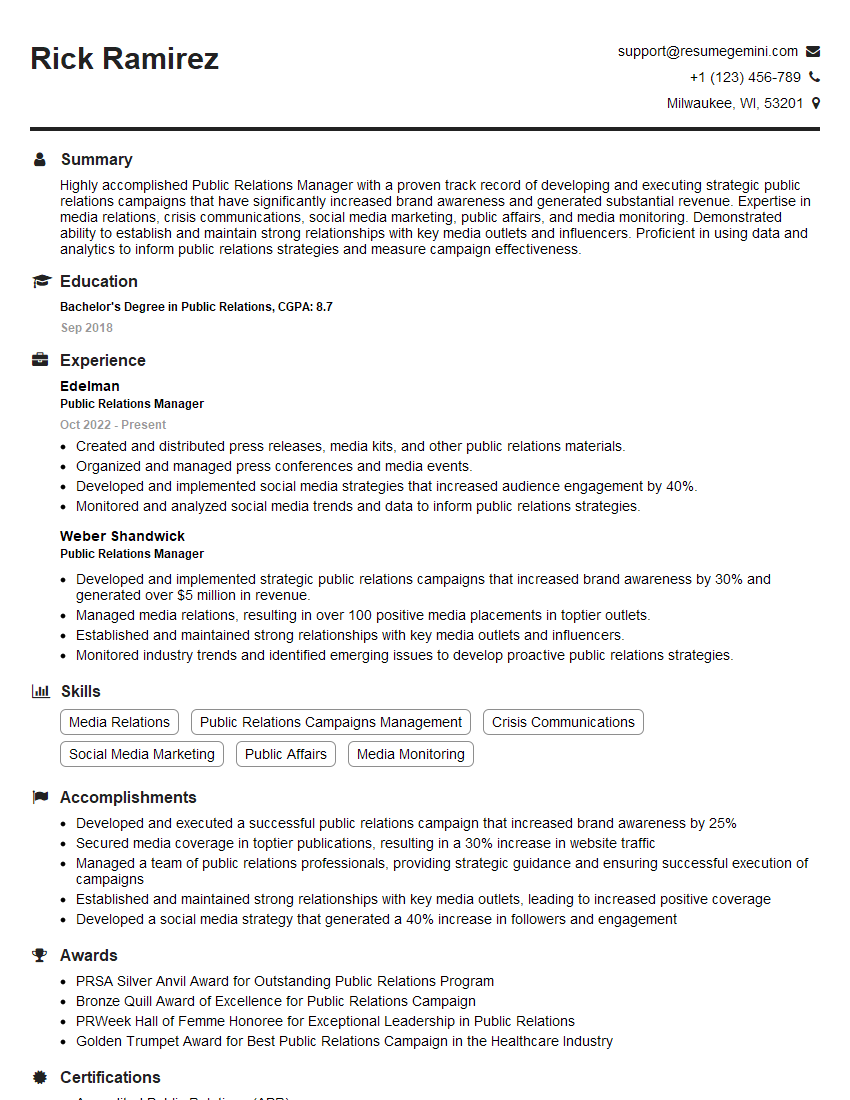
Public Relations Manager Resume Sample
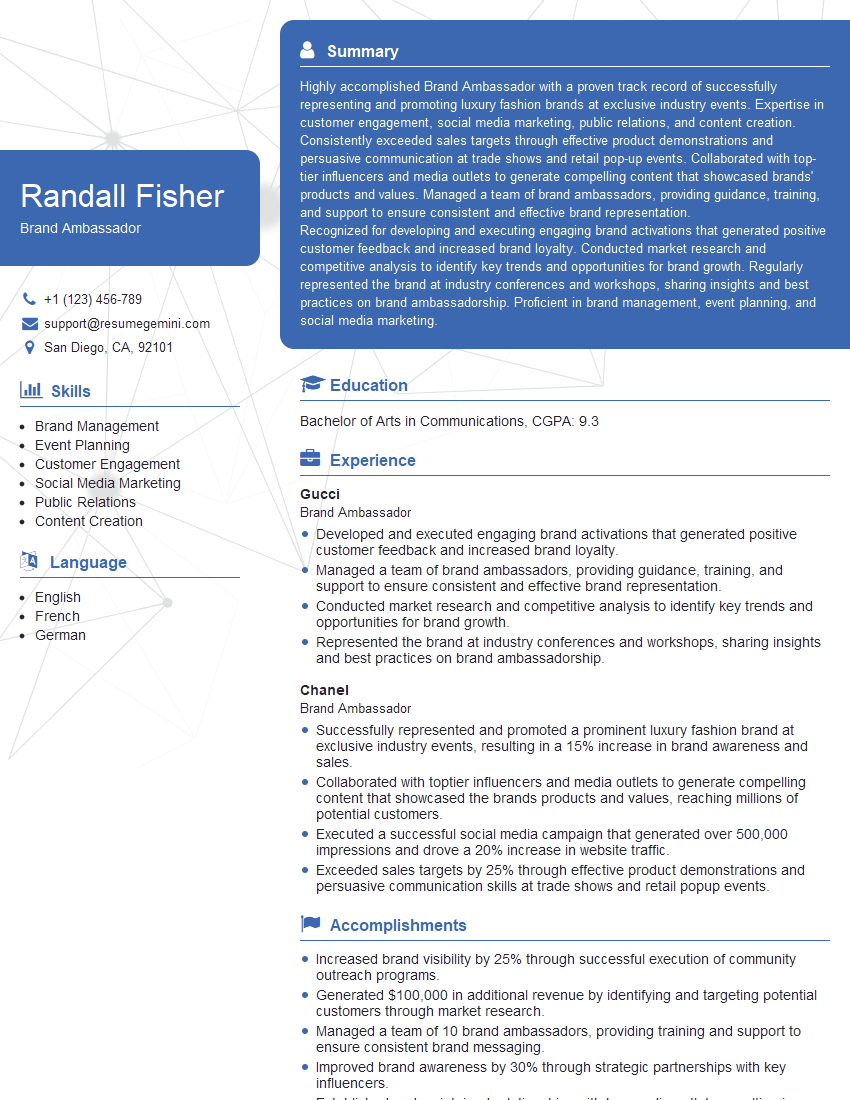
Brand Ambassador Resume Sample
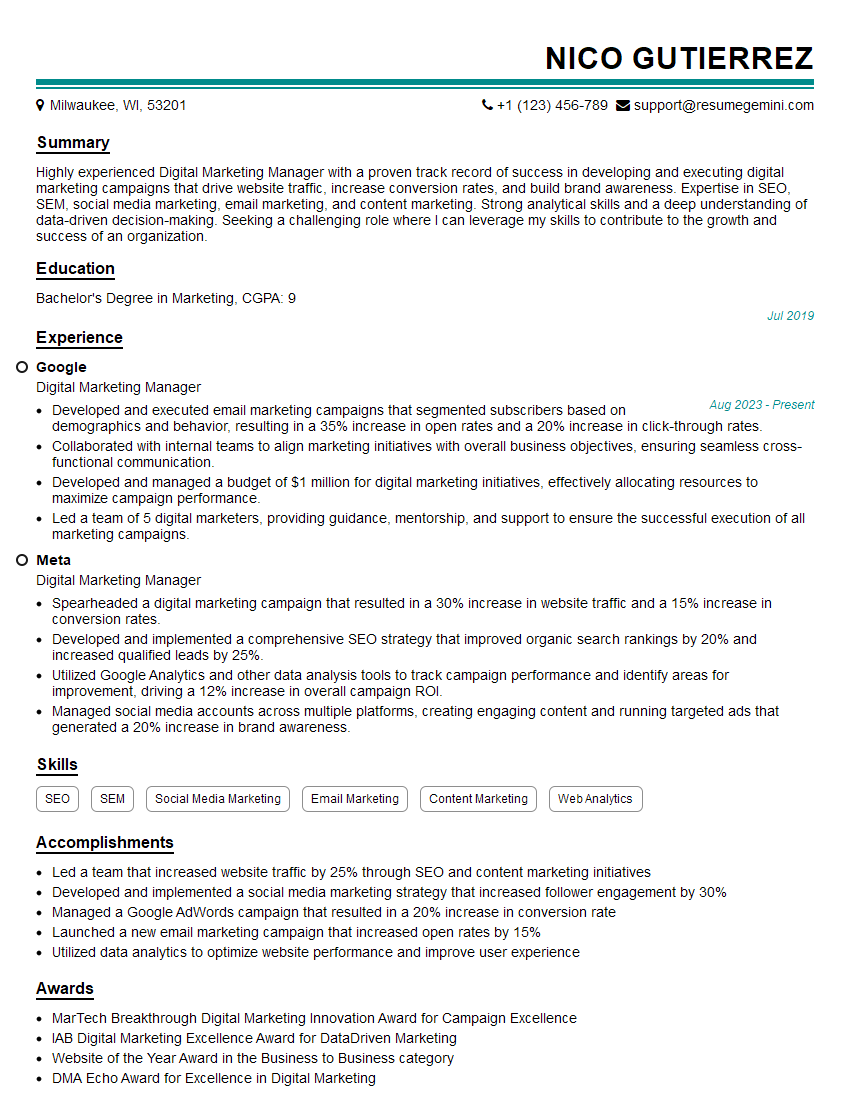
Digital Marketing Manager Resume Sample
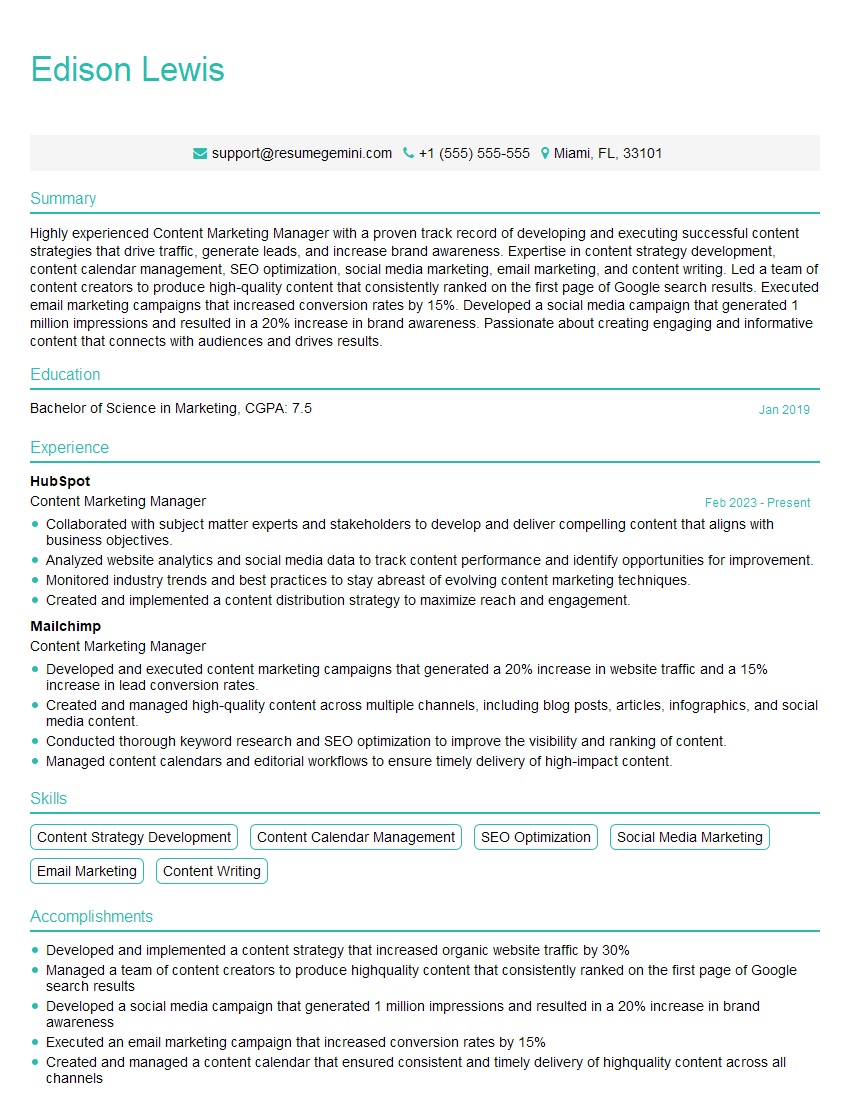
Content Marketing Manager Resume Sample
Explore more articles
Users Rating of Our Blogs
Share Your Experience
We value your feedback! Please rate our content and share your thoughts (optional).
What Readers Say About Our Blog
To the interviewgemini.com Webmaster.
Very helpful and content specific questions to help prepare me for my interview!
Thank you
To the interviewgemini.com Webmaster.
This was kind of a unique content I found around the specialized skills. Very helpful questions and good detailed answers.
Very Helpful blog, thank you Interviewgemini team.