Feeling uncertain about what to expect in your upcoming interview? We’ve got you covered! This blog highlights the most important Bridge Work interview questions and provides actionable advice to help you stand out as the ideal candidate. Let’s pave the way for your success.
Questions Asked in Bridge Work Interview
Q 1. Explain the different types of bridge structures and their applications.
Bridge structures are classified based on several factors, primarily their material, span length, and structural system. Let’s explore some common types:
- Beam Bridges: These are the simplest type, using horizontal beams supported by abutments or piers. Think of a simple wooden bridge over a small stream. They’re suitable for shorter spans and lighter loads.
- Girder Bridges: Similar to beam bridges but utilize larger, stronger girders, often made of steel or pre-stressed concrete. They can span longer distances and carry heavier traffic loads, common in highway overpasses.
- Truss Bridges: These bridges use a network of interconnected triangles to distribute loads efficiently, making them strong and lightweight for their span. The iconic ‘railroad bridge’ is often a truss bridge. Suitable for medium to long spans.
- Arch Bridges: These bridges use an arched structure to transfer loads to the abutments, effectively distributing weight. They are aesthetically pleasing and can span long distances. The Roman aqueducts are a testament to the enduring strength of arch bridges.
- Suspension Bridges: These are characterized by long spans held up by cables anchored to towers. The weight of the bridge deck is transferred to the towers via vertical cables. Examples include the Golden Gate Bridge and the Akashi Kaikyō Bridge, which represent the pinnacle of engineering.
- Cable-Stayed Bridges: Similar to suspension bridges, but the deck is supported by cables directly connected to towers. They offer a slightly shorter span compared to suspension bridges but are also very efficient.
The choice of bridge type depends on factors such as the span length, the anticipated load (traffic, environmental conditions), the site conditions (geology, topography), and the available budget. A small pedestrian bridge might be a simple beam bridge, whereas a major highway crossing might necessitate a complex suspension or cable-stayed bridge.
Q 2. Describe the process of bridge load rating and its importance.
Bridge load rating is a crucial process that determines the capacity of a bridge to safely carry various types of loads, including vehicular traffic, pedestrian loads, and environmental loads like snow and wind. It involves a detailed assessment of the bridge’s structural components and their ability to withstand these loads.
The process typically involves:
- Inventory and Appraisal: A thorough inspection of the bridge’s condition, including material degradation, cracking, and corrosion.
- Structural Analysis: Using engineering software and analysis methods to determine the bridge’s capacity under different load scenarios.
- Load Factor Calculations: Applying safety factors to account for uncertainties and variations in material strength and load magnitudes.
- Rating Report: Producing a formal report summarizing the bridge’s load capacity, identifying any deficiencies, and recommending any necessary maintenance or repairs.
The importance of load rating cannot be overstated. It ensures the safety of the public by preventing bridge collapses and minimizing the risk of accidents. It allows transportation agencies to manage their infrastructure effectively, prioritizing repairs and replacements based on load-carrying capacity. An accurate load rating is essential for managing traffic restrictions and ensuring the long-term serviceability of the bridge.
Q 3. What are the common causes of bridge failures and how can they be prevented?
Bridge failures are complex events that can stem from a variety of causes. Some common factors include:
- Material Degradation: Corrosion of steel components, deterioration of concrete due to freeze-thaw cycles, or timber decay are major causes.
- Design Deficiencies: Errors in the original design or inadequate consideration of environmental factors, such as seismic activity or extreme temperatures. This highlights the importance of rigorous design review and analysis.
- Construction Defects: Poor workmanship, use of substandard materials, or inadequate quality control during construction can lead to premature failure.
- Overloading: Exceeding the bridge’s design load capacity, either through unforeseen events or inadequate load rating and management.
- Lack of Maintenance: Neglecting regular inspections, repairs, and preventative maintenance can significantly reduce a bridge’s lifespan and lead to unexpected failures.
- Environmental Factors: Extreme weather events such as floods, earthquakes, or hurricanes can severely damage bridge structures.
Preventing bridge failures requires a multi-pronged approach involving:
- Proper Design and Construction: Adhering to rigorous design standards, employing quality materials, and employing skilled workers with strong quality control practices.
- Regular Inspections and Maintenance: Conducting routine inspections to detect potential problems early and implementing timely repairs.
- Load Monitoring and Management: Accurately assessing and managing bridge loads, implementing traffic restrictions when necessary.
- Resilient Design: Incorporating design features that enhance the bridge’s resistance to extreme weather events and other environmental hazards.
A proactive and comprehensive approach to bridge management is crucial to prevent failures and ensure public safety.
Q 4. Explain your experience with bridge design software (e.g., AutoCAD, Revit, etc.).
Throughout my career, I’ve extensively used AutoCAD, Revit, and other specialized bridge design software. AutoCAD provides excellent capabilities for 2D drafting and detailing, crucial for producing construction drawings. Revit’s BIM (Building Information Modeling) capabilities are invaluable for creating 3D models, facilitating collaboration, and performing complex structural analysis. I’m proficient in using these tools to model bridge geometry, analyze structural behavior under various load conditions, generate detailed design drawings, and coordinate with other disciplines.
For example, on a recent cable-stayed bridge project, I used Revit to develop a parametric model that allowed us to quickly explore different design options and optimize the geometry for structural efficiency and aesthetic appeal. AutoCAD was then used to produce detailed shop drawings for the fabrication of the steel components. My skills extend beyond simply using the software; I understand the underlying engineering principles and how to leverage the software’s features to solve complex design challenges. I can also utilize other specialized bridge design software such as LPILE for foundation analysis and MIDAS/GT for structural analysis to produce accurate results.
Q 5. Describe your experience with bridge construction methods and materials.
My experience encompasses a wide range of bridge construction methods and materials. I’ve worked on projects employing both conventional and innovative techniques.
- Materials: I’m familiar with the use of steel, reinforced concrete, prestressed concrete, timber, and composite materials in bridge construction. The selection of material depends on factors such as strength requirements, durability, cost-effectiveness, and environmental impact.
- Construction Methods: My experience includes in-situ casting of concrete, pre-cast concrete segmental construction, steel erection techniques (using cranes, etc.), and the installation of pre-fabricated bridge components. I’ve also been involved in projects using specialized construction methods such as launching girders, balanced cantilever construction, and incremental launching.
For instance, I was involved in a project using pre-stressed concrete girders. This method allowed for efficient construction, minimizing on-site work and reducing the project duration. In another project, we used a balanced cantilever method to construct a long-span bridge, minimizing the need for temporary supports and improving safety. Understanding the advantages and limitations of different construction methods and materials is crucial for effective project management and optimizing both cost and time.
Q 6. How do you ensure the quality and safety of bridge construction projects?
Ensuring quality and safety in bridge construction is paramount. My approach involves a multi-layered strategy:
- Rigorous Quality Control: Implementing comprehensive quality control procedures throughout the project lifecycle, from material selection and fabrication to construction and testing. This involves regular inspections, testing of materials, and adherence to strict quality standards.
- Safety Protocols: Developing and enforcing strict safety protocols on the construction site, including proper use of personal protective equipment (PPE), risk assessments, and regular safety meetings. A safe work environment is essential for preventing accidents and ensuring the well-being of workers.
- Detailed Documentation: Maintaining detailed records of all aspects of the construction process, including material tracking, inspection reports, and progress updates. This documentation is essential for quality assurance and also for future maintenance and repairs.
- Third-Party Inspections: Employing independent third-party inspectors to verify the quality of work and adherence to design specifications. This provides an unbiased assessment of the construction process.
- Regular Audits: Conducting regular audits to evaluate the effectiveness of the quality control and safety procedures, identifying areas for improvement, and ensuring that the project remains on track.
Ultimately, a culture of safety and quality must be fostered from the start of the project, involving all stakeholders – from the design team and construction crew to the client and regulatory authorities. Continuous improvement and learning from past experiences are crucial for achieving consistently high standards in bridge construction.
Q 7. What are the key considerations for bridge maintenance and repair?
Bridge maintenance and repair are crucial for ensuring the longevity and safety of these structures. Key considerations include:
- Regular Inspections: Routine inspections, ideally involving visual assessments, and more detailed inspections using advanced techniques like non-destructive testing (NDT), are vital to identify early signs of deterioration.
- Preventive Maintenance: Proactive measures to prevent deterioration, such as cleaning, painting, sealing cracks, and applying protective coatings.
- Repair Strategies: Developing and implementing effective repair strategies to address identified problems. This might range from minor repairs of cracks and spalling to major rehabilitation work involving strengthening or replacing components.
- Load Monitoring: Continuous monitoring of the bridge’s load capacity and traffic patterns to ensure it’s operating within its design limits.
- Environmental Protection: Implementing measures to mitigate environmental factors that contribute to deterioration, such as corrosion due to de-icing salts or erosion from water.
- Long-Term Planning: Developing a comprehensive long-term maintenance plan for the bridge, considering its life cycle and future needs. This helps in proactive budget allocation and resource planning.
Proper maintenance and repair strategies not only prolong the lifespan of bridges but are also essential to ensuring the safety and reliability of these vital transportation links. A well-maintained bridge is a cost-effective solution, preventing catastrophic failures and associated disruptions.
Q 8. How do you conduct a bridge inspection and what are the common deficiencies found?
Bridge inspection is a crucial process ensuring structural integrity and public safety. It involves a systematic visual examination, supplemented by non-destructive testing where necessary. The process begins with a thorough review of existing bridge plans and maintenance history. Then, a detailed on-site inspection follows, covering all structural elements: deck, superstructure, substructure, and approaches.
- Visual Inspection: This involves checking for cracks, corrosion, spalling (concrete deterioration), displacement of elements, scour at the abutments (erosion of soil around the bridge supports), and damage to bearings and expansion joints.
- Non-Destructive Testing (NDT): Techniques like ground-penetrating radar (GPR), ultrasonic testing, and magnetic particle inspection are employed to assess internal damage not visible to the naked eye. For example, GPR can detect voids or delaminations within the concrete deck.
Common deficiencies found include:
- Deck deterioration: Cracking, potholes, and corrosion of reinforcing steel are frequent issues, often stemming from freeze-thaw cycles and de-icing salt usage.
- Substructure damage: Scour at piers and abutments weakens the foundation, and corrosion of steel components in the substructure is a significant concern. I’ve seen several projects where neglected scour led to costly repairs.
- Superstructure problems: Deterioration of beams, girders, and other structural members, often due to corrosion or fatigue, requires attention. In one project, fatigue cracking in steel girders necessitated significant strengthening measures.
- Bearing and joint issues: Damaged bearings and expansion joints can lead to uneven load distribution and premature deterioration of other elements.
After the inspection, a comprehensive report is prepared, detailing the findings, severity of deficiencies, and recommended repair or maintenance strategies.
Q 9. Explain your understanding of bridge seismic design principles.
Bridge seismic design focuses on ensuring the structure can withstand the forces generated by earthquakes. It considers various factors, including the bridge’s location (seismic zone), soil conditions, and the bridge type. The key is to design a structure that can absorb seismic energy and avoid collapse.
Principles include:
- Ductility: Designing components with the ability to deform significantly without fracturing, allowing them to absorb seismic energy. This often involves using specific steel detailing and ductile concrete mixes.
- Energy Dissipation: Incorporating devices or structural systems that absorb seismic energy, such as dampers or seismic isolation bearings. These bearings essentially decouple the bridge deck from the substructure, reducing the transfer of ground motion.
- Redundancy: Providing multiple load paths within the structure, so if one element fails, others can still carry the load. This is similar to having backup systems in a computer; if one component fails, others take over.
- Foundation Design: Careful consideration of soil properties and the potential for liquefaction (loss of soil strength) during an earthquake is critical. Deep foundations or improved ground conditions may be necessary.
Modern seismic design often uses advanced computational methods, including finite element analysis (FEA), to simulate earthquake response and optimize the design for seismic performance.
Q 10. Describe your experience with bridge rehabilitation projects.
I have extensive experience in bridge rehabilitation, encompassing various techniques and materials. My work has involved projects ranging from minor repairs to major structural overhauls. A recent project involved the rehabilitation of a historically significant steel truss bridge, which required careful consideration of preservation aspects.
My experience includes:
- Concrete repair: Techniques such as crack injection, patching, and overlaying to restore the structural integrity and serviceability of deteriorated concrete elements. We used high-strength concrete repair mortars to address significant sections of concrete damage.
- Steel repair: Dealing with corrosion, fatigue cracking, and other issues in steel components through methods like cleaning, painting, strengthening, and even replacing damaged members.
- Strengthening techniques: Employing various methods to increase the load-carrying capacity of existing structures, including adding external reinforcement, using fiber-reinforced polymers (FRP), and jacketing steel columns.
- Substructure rehabilitation: Addressing foundation issues like scour and settlement through techniques such as foundation underpinning and pier repair.
Successful rehabilitation requires a thorough understanding of the existing structure, the causes of deterioration, and the selection of appropriate repair strategies. Each project is unique, requiring a tailored approach.
Q 11. How do you manage risks and uncertainties in bridge projects?
Risk management in bridge projects is a multi-faceted process that starts at the planning stage and continues throughout the project lifecycle. It requires a proactive approach, involving the identification, assessment, and mitigation of potential risks and uncertainties.
My approach involves:
- Risk Identification: A systematic process of identifying potential hazards, including design flaws, construction delays, environmental impacts, and budget overruns. We use brainstorming sessions and checklists tailored to the specific project.
- Risk Assessment: Evaluating the likelihood and potential impact of each identified risk. We use quantitative methods such as probability and consequence matrices to prioritize risks.
- Risk Mitigation: Developing and implementing strategies to reduce the likelihood or impact of identified risks. This may involve using alternative designs, employing contingency planning, implementing quality control measures, and securing insurance.
- Risk Monitoring and Control: Continuously monitoring risks and adjusting mitigation strategies as needed throughout the project lifecycle. Regular progress meetings and risk reviews are essential.
Utilizing a robust risk management plan helps to avoid cost overruns, schedule delays, and safety hazards. A well-defined plan is crucial for ensuring project success.
Q 12. What are your experiences in working with different stakeholders in bridge projects?
Collaboration with various stakeholders is critical to successful bridge projects. This includes working effectively with:
- Clients: Understanding their needs and expectations, keeping them informed throughout the project, and addressing their concerns promptly. Maintaining clear and open communication is essential.
- Design Teams: Collaborating with engineers, architects, and other specialists to ensure the design is feasible, safe, and meets all requirements. Effective teamwork is crucial here.
- Contractors: Coordinating the construction process, ensuring quality control, and resolving any conflicts that may arise. A collaborative approach fosters a positive working relationship.
- Regulatory Agencies: Working closely with authorities to ensure compliance with all regulations and obtaining necessary permits. Proactive communication prevents delays.
- Public: Involving the community, addressing their concerns about traffic disruptions, and maintaining public safety during construction. Transparency and effective communication are key.
Effective communication, active listening, and conflict resolution skills are paramount to managing relationships with all stakeholders. Building trust and mutual understanding is key to a successful project.
Q 13. Explain your understanding of bridge hydraulics and hydrology.
Bridge hydraulics and hydrology are crucial aspects of bridge design, particularly for bridges spanning waterways. Hydraulics deals with the flow of water, while hydrology focuses on the water cycle and its impact on the bridge. Understanding these factors prevents failure and ensures the bridge’s longevity.
Key considerations include:
- Flood Analysis: Determining the design flood water level to ensure that the bridge deck remains sufficiently above the highest expected flood level. This involves using hydrological models and statistical analysis of historical flood data.
- Scour Analysis: Assessing the potential for erosion around the bridge piers and abutments due to water flow. This requires understanding the characteristics of the river bed, flow velocity, and sediment transport. Mitigation measures might include using riprap (rock protection), pile foundations or other scour countermeasures.
- Waterway Opening: Ensuring sufficient waterway opening to allow for the passage of floodwaters without causing excessive backwater or increased flood levels upstream. This involves hydraulic modeling to determine the appropriate bridge span and pier configuration.
- Ice Effects: Considering the potential impact of ice jams and ice formation on the bridge structure, especially in colder climates. This might involve designing ice-resistant piers and structures.
Proper consideration of these factors ensures the bridge’s structural integrity and safe passage of water during extreme hydrological events.
Q 14. Describe your familiarity with relevant bridge design codes and standards (e.g., AASHTO).
I am thoroughly familiar with various bridge design codes and standards, most notably the American Association of State Highway and Transportation Officials (AASHTO) LRFD (Load and Resistance Factor Design) Bridge Design Specifications. These specifications provide detailed guidelines for bridge design, construction, and inspection.
My familiarity extends to understanding:
- Load factors: The AASHTO LRFD specification utilizes load and resistance factors to account for uncertainties in load estimation and material properties. This ensures a sufficient margin of safety.
- Design procedures: I am proficient in applying the design procedures outlined in AASHTO for various bridge types, including girder bridges, arch bridges, and suspension bridges. This includes calculations for structural capacity, serviceability, and fatigue life.
- Material specifications: I possess a strong understanding of the material properties and design criteria for various materials, including steel, concrete, and timber, as specified in AASHTO.
- Construction specifications: I am knowledgeable about AASHTO’s recommendations for construction practices and quality control measures to ensure that the completed bridge meets the design specifications.
Beyond AASHTO, I’m also familiar with other relevant standards and guidelines such as those from the Federal Highway Administration (FHWA) and local codes where applicable. Staying updated on the latest code revisions is crucial in my profession.
Q 15. How do you utilize geotechnical data in bridge design?
Geotechnical data is the bedrock of safe and efficient bridge design. It provides crucial information about the soil and rock conditions at the bridge site, influencing everything from foundation design to the overall structural stability. We use this data to determine things like bearing capacity, settlement potential, and groundwater levels.
For example, if we find a layer of soft clay near the surface, we know we can’t just build a shallow foundation. We might need deep foundations like piles or caissons to transfer the bridge’s weight to a stronger soil layer. Similarly, understanding groundwater levels helps us design effective drainage systems to prevent excessive water pressure on the foundations, which could cause instability. We use various techniques to analyze this data, including soil classification tests, in-situ testing (like Standard Penetration Tests or Cone Penetration Tests), and laboratory testing to determine shear strength and compressibility. This data feeds directly into our geotechnical models, which then inform our foundation design.
In one project, we discovered an unexpected bedrock layer at a much shallower depth than predicted. This allowed us to significantly optimize the foundation design, saving both time and money without compromising safety. It’s all about using the data to make informed decisions that minimize risks and maximize cost-effectiveness.
Career Expert Tips:
- Ace those interviews! Prepare effectively by reviewing the Top 50 Most Common Interview Questions on ResumeGemini.
- Navigate your job search with confidence! Explore a wide range of Career Tips on ResumeGemini. Learn about common challenges and recommendations to overcome them.
- Craft the perfect resume! Master the Art of Resume Writing with ResumeGemini’s guide. Showcase your unique qualifications and achievements effectively.
- Don’t miss out on holiday savings! Build your dream resume with ResumeGemini’s ATS optimized templates.
Q 16. Explain your experience with finite element analysis (FEA) in bridge design.
Finite Element Analysis (FEA) is an indispensable tool in modern bridge design. It allows us to simulate the behavior of a bridge under various load conditions, providing a detailed understanding of stresses, strains, and displacements within the structure. This helps us optimize designs, identify potential weaknesses, and ensure the bridge meets all safety and performance requirements.
My experience includes using FEA software packages such as ABAQUS and ANSYS to model complex bridge structures, including steel girder bridges, concrete box girder bridges, and arch bridges. We use FEA to analyze everything from static loads (like the bridge’s self-weight and traffic) to dynamic loads (like wind and seismic activity). The results of these analyses help us refine the structural design, optimizing member sizes, and ensuring the bridge can withstand anticipated loads.
For instance, in a recent project involving a long-span suspension bridge, FEA helped us identify areas of high stress concentration in the main cables under wind loads. This led to design modifications which ultimately strengthened the cable’s resistance to fatigue and failure.
Q 17. Describe your experience with bridge scour analysis and mitigation.
Bridge scour is the erosion of the soil around bridge foundations, which can lead to significant structural damage and even collapse. Analyzing and mitigating scour is critical to ensuring the long-term stability and safety of bridges. My experience involves performing scour assessments based on established hydraulic engineering principles and using specialized software to model water flow and erosion patterns. This often includes evaluating factors like river velocity, sediment characteristics, and the geometry of the bridge piers.
Mitigation strategies vary based on the level of scour risk. This can range from simple measures like riprap (placing rocks around the foundations) to more complex solutions, such as the construction of scour protection structures like drilled shafts or pile-supported cofferdams. We often use specialized software to model scour depth and design effective mitigation measures, ensuring sufficient protection to prevent foundation exposure.
In one project, we used advanced computational fluid dynamics (CFD) modeling to predict scour depths around bridge piers in a high-velocity river. The results guided the design of a robust scour countermeasure that provided ample protection, significantly reducing the risk of bridge failure due to erosion.
Q 18. What is your experience with bridge instrumentation and monitoring?
Bridge instrumentation and monitoring are crucial for understanding the actual behavior of a bridge in service. It allows us to track performance over time, identify potential problems early, and make informed decisions regarding maintenance and repair. My experience involves designing and implementing monitoring systems which utilize a variety of sensors to gather data on factors such as deflection, strain, vibration, and temperature.
We use this data to assess the bridge’s structural health and identify any deviations from expected behavior. This could be anything from minor cracking to significant settlement. The data is used to validate our initial design assumptions and make any necessary adjustments during the bridge’s operational life. We often use data acquisition systems and specialized software for data analysis and interpretation.
In one instance, our monitoring system detected a slight increase in deflection in a bridge deck. While this was initially small, it was indicative of a potential long-term issue. By detecting this early, we could proactively schedule repairs, preventing a more serious problem down the line and ensuring the continued safety of the public.
Q 19. How do you ensure compliance with environmental regulations in bridge projects?
Environmental compliance is paramount in any bridge project. We adhere to all relevant federal, state, and local regulations to minimize our impact on the environment. This includes conducting thorough environmental assessments to identify potential impacts, developing mitigation plans, and obtaining all necessary permits. Specific considerations often involve protecting water quality, avoiding habitat disruption, and mitigating greenhouse gas emissions.
This may involve things like implementing erosion and sediment control measures during construction, designing the bridge to minimize its impact on fish passage, and selecting environmentally friendly construction materials. Close coordination with regulatory agencies is critical throughout the project lifecycle, from the initial planning stages to project completion and beyond.
For example, in a recent project, we worked with environmental specialists to design a bridge that avoided sensitive wetland areas and minimized disruption to wildlife habitats during the construction phase. This resulted in an efficient project that minimized its environmental footprint.
Q 20. Describe your experience with the preparation of bridge construction drawings and specifications.
The preparation of bridge construction drawings and specifications is a crucial aspect of bridge design, ensuring that the project is built according to the design intent. My experience encompasses all phases of this process, from the creation of preliminary sketches and design development drawings to the final construction documents. This includes creating detailed drawings of the bridge’s structural elements, foundations, and other components, as well as preparing comprehensive specifications that detail materials, construction methods, and quality control measures.
These documents must be clear, concise, and unambiguous to ensure that contractors understand the design and can construct the bridge correctly. The precision of these documents is crucial to avoid costly errors and delays during construction. We utilize Computer-Aided Design (CAD) software, such as AutoCAD or MicroStation, for creating precise and detailed drawings, incorporating all relevant design features and details.
A key part of this process involves coordinating with other disciplines, such as geotechnical and hydraulic engineers, to ensure that all aspects of the design are properly integrated into the construction documents. We conduct rigorous reviews to ensure accuracy and completeness before releasing the drawings and specifications to the contractor.
Q 21. What is your experience with cost estimation and budgeting for bridge projects?
Accurate cost estimation and budgeting is essential for the successful completion of any bridge project. My experience includes developing comprehensive cost estimates that cover all aspects of the project, from design and permitting to construction and maintenance. This involves using various cost-estimating methodologies, including parametric estimating, unit pricing, and detailed quantity takeoff techniques.
We consider various factors in our cost estimates, including material costs, labor costs, equipment costs, contingency allowances, and project overhead. The accuracy of the estimate is crucial for securing funding, managing the project budget, and preventing cost overruns. We use specialized software to help automate parts of the cost estimation process, ensuring consistency and accuracy in calculations.
In a recent project, we developed a detailed budget that included contingency funds to mitigate potential risks, such as unforeseen site conditions or material price fluctuations. This proactive approach ensured that the project stayed within budget despite several challenges encountered during the construction process. A well-planned budget is not only important financially but also helps to streamline the project execution.
Q 22. How do you manage project schedules and deadlines effectively in bridge projects?
Effective bridge project scheduling relies on a multi-faceted approach. It begins with a thorough understanding of the project scope, including detailed design plans, material procurement timelines, and anticipated construction phases. I utilize critical path method (CPM) scheduling software to identify the most critical tasks and their dependencies. This allows us to visualize potential bottlenecks and proactively adjust the schedule to mitigate delays. For instance, in a recent project involving a cable-stayed bridge, we identified that the fabrication of the main cables was a critical path activity. By working closely with the fabricator and implementing a just-in-time delivery system, we avoided significant delays. Regular monitoring of progress against the schedule is crucial. I use earned value management (EVM) techniques to track performance, identify variances, and implement corrective actions. This proactive approach helps keep projects on track and within budget. Furthermore, regular stakeholder communication is key. Transparency regarding potential issues and proactive mitigation strategies builds trust and ensures everyone is aligned with the project timeline.
Q 23. Explain your experience with bridge demolition and removal.
My experience with bridge demolition and removal encompasses a wide range of techniques, from controlled implosion for larger structures to more precise dismantling methods for smaller bridges or those in sensitive environments. Safety is paramount in all demolition projects. Before any demolition begins, a detailed demolition plan is created, including site surveys, risk assessments, and environmental impact studies. We use specialized equipment such as excavators with hydraulic breakers, concrete crushers, and wire saws, selecting the appropriate tools based on the bridge’s design and materials. For instance, in one project involving a reinforced concrete arch bridge, we employed a phased demolition approach, starting with the removal of the superstructure before moving to the substructure to ensure safety and minimize impact on the surrounding environment. Proper waste management is another crucial aspect; we meticulously sort and recycle demolition debris, adhering to all environmental regulations.
Q 24. What is your experience with the use of BIM (Building Information Modeling) in bridge projects?
BIM (Building Information Modeling) has revolutionized bridge design and construction. My experience with BIM includes using software like Revit and AutoCAD to create detailed 3D models of bridges, incorporating geotechnical data, structural analysis results, and MEP (Mechanical, Electrical, and Plumbing) systems. This allows for efficient clash detection and coordination between different disciplines, avoiding costly rework later in the project. For example, in a recent project, the BIM model highlighted a conflict between the bridge’s pier foundation and the planned utility lines. This issue was identified and resolved early in the design phase, saving significant time and money. BIM also facilitates better visualization and communication with stakeholders, allowing them to understand the project better and contribute effectively to decision-making. Furthermore, the use of BIM for quantity takeoffs and cost estimation leads to greater accuracy and reduces the potential for errors.
Q 25. Describe your understanding of different types of bridge foundations.
Bridge foundations are critical to the structural integrity and longevity of the bridge. Different types of foundations are selected based on several factors, including soil conditions, the bridge’s load capacity, and environmental considerations. Some common types include:
- Shallow foundations: These include spread footings, strip footings, and raft foundations. They are suitable for stable soil conditions with relatively low loads.
- Deep foundations: These are used when shallow foundations are not feasible due to weak or unstable soil. Examples include piles (driven, bored, or cast-in-place), caissons, and piers.
- Drilled shafts: These are large-diameter drilled holes filled with concrete, providing high load-bearing capacity.
- Pile foundations: These consist of multiple piles driven into the ground to transfer loads to deeper, stronger soil layers. They are particularly useful in areas with soft or loose soil.
The selection of an appropriate foundation type requires detailed geotechnical investigations and structural analysis to ensure the foundation can withstand the anticipated loads and environmental conditions. I have extensive experience with all these foundation types and always prioritize the most suitable option based on a thorough site assessment.
Q 26. How do you handle unexpected challenges and problems in bridge projects?
Unexpected challenges are inevitable in bridge projects. My approach involves a structured problem-solving process. First, I focus on identifying the root cause of the problem through thorough investigation. This might involve reviewing design documents, conducting site inspections, and consulting with experts. Once the root cause is identified, I work with the project team to develop and evaluate several potential solutions. Risk assessment plays a significant role in this process, helping us evaluate the potential consequences of each solution. The chosen solution is then implemented, and progress is carefully monitored. Throughout the entire process, open communication with stakeholders is crucial. For example, on one project, unexpected bedrock conditions were encountered during excavation. By quickly assembling a team of geotechnical engineers, we developed a revised foundation design that minimized delays and cost overruns. Post-incident reviews are essential to learn from our experiences and prevent similar problems in future projects.
Q 27. Explain your experience with the use of new technologies in bridge design and construction.
The bridge engineering field is constantly evolving, and I’ve actively embraced the use of new technologies. This includes the use of advanced materials like high-performance concrete and fiber-reinforced polymers (FRP) to enhance structural performance and durability. Digital fabrication techniques, such as 3D printing for creating complex bridge components, offer exciting possibilities for efficiency and customization. I’ve also gained experience with advanced simulation and analysis software for more accurate structural modeling and improved design optimization. For example, on a recent project, we used advanced Finite Element Analysis (FEA) software to model the behavior of a long-span bridge under various loading conditions, leading to a more efficient and cost-effective design. Furthermore, the use of drones for site surveys and inspection significantly increases efficiency and safety compared to traditional methods.
Q 28. Describe your experience with bridge asset management.
Bridge asset management is crucial for ensuring the long-term safety and serviceability of bridge infrastructure. My experience in this area focuses on developing and implementing comprehensive asset management plans, including regular inspections, condition assessments, and life-cycle costing analyses. This involves using specialized software to track bridge conditions, predict future maintenance needs, and optimize maintenance schedules. For instance, I’ve been involved in projects where we’ve used structural health monitoring systems to track bridge performance in real-time, allowing for proactive maintenance and the avoidance of potential failures. Data-driven decision-making is key, leveraging collected data to prioritize maintenance activities and allocate resources effectively. This ensures that we maximize the lifespan and value of the bridge infrastructure while minimizing maintenance costs.
Key Topics to Learn for Bridge Work Interview
- Structural Analysis: Understanding load distribution, stress, and strain on bridge components. Practical application: Analyzing bridge designs for stability and safety under various load conditions.
- Material Science: Knowledge of the properties of materials used in bridge construction (e.g., concrete, steel, composites). Practical application: Selecting appropriate materials based on project requirements and environmental factors.
- Design Principles: Familiarity with different bridge types (e.g., beam, arch, suspension) and their design considerations. Practical application: Evaluating the suitability of various bridge designs for specific site conditions.
- Construction Methods: Understanding the processes and techniques involved in bridge construction. Practical application: Identifying potential challenges and developing mitigation strategies during construction.
- Maintenance and Inspection: Knowledge of bridge maintenance procedures and inspection techniques. Practical application: Developing effective maintenance plans to extend bridge lifespan and ensure safety.
- Sustainability and Environmental Impact: Understanding the environmental considerations in bridge design and construction. Practical application: Designing environmentally friendly bridges that minimize ecological impact.
- Project Management: Experience in managing bridge projects, including budgeting, scheduling, and resource allocation. Practical application: Successfully delivering bridge projects on time and within budget.
- Software Proficiency: Familiarity with relevant engineering software (e.g., structural analysis software). Practical application: Utilizing software to model and analyze bridge designs.
Next Steps
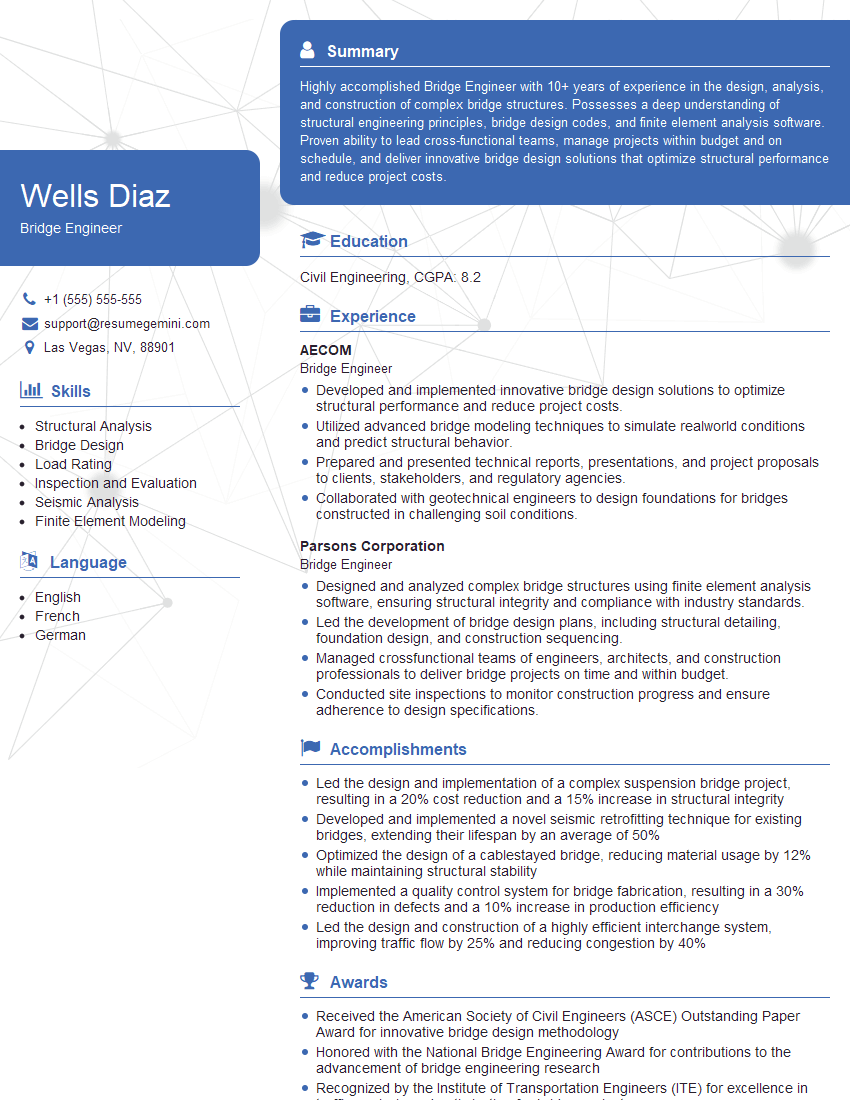
Mastering Bridge Work principles is crucial for advancing your career in civil engineering and securing exciting opportunities in this vital field. A strong foundation in these key areas will significantly enhance your interview performance and demonstrate your capabilities to potential employers. To maximize your job prospects, create an ATS-friendly resume that highlights your skills and experience effectively. We highly recommend using ResumeGemini, a trusted resource, to build a professional and impactful resume that stands out from the competition. Examples of resumes tailored to Bridge Work are available for your review.

Explore more articles
Users Rating of Our Blogs
Share Your Experience
We value your feedback! Please rate our content and share your thoughts (optional).
What Readers Say About Our Blog
To the interviewgemini.com Webmaster.
Very helpful and content specific questions to help prepare me for my interview!
Thank you
To the interviewgemini.com Webmaster.
This was kind of a unique content I found around the specialized skills. Very helpful questions and good detailed answers.
Very Helpful blog, thank you Interviewgemini team.