Preparation is the key to success in any interview. In this post, we’ll explore crucial Campaign Strategy interview questions and equip you with strategies to craft impactful answers. Whether you’re a beginner or a pro, these tips will elevate your preparation.
Questions Asked in Campaign Strategy Interview
Q 1. Describe your experience developing and executing integrated marketing campaigns.
Developing and executing integrated marketing campaigns requires a holistic approach, ensuring all marketing activities work synergistically to achieve a common goal. It’s not just about running separate social media, email, and advertising campaigns; it’s about creating a unified brand experience across all touchpoints.
My experience involves strategizing, planning, and executing campaigns encompassing various channels, including digital marketing (SEO, SEM, social media marketing, email marketing, content marketing), traditional marketing (print, broadcast, events), and public relations. For example, in a recent campaign for a sustainable clothing brand, we integrated influencer marketing on Instagram with targeted Facebook ads, email newsletters featuring exclusive content, and a PR campaign focused on securing features in relevant publications. The result was a cohesive brand narrative that resonated across all channels, significantly increasing brand awareness and driving sales.
This integration requires careful coordination, consistent messaging, and a deep understanding of each channel’s strengths and weaknesses. I use project management tools to track progress, maintain consistent branding guidelines across all materials, and ensure timely execution of all campaign elements.
Q 2. How do you define Key Performance Indicators (KPIs) for a campaign and how do you track them?
Key Performance Indicators (KPIs) are measurable values that demonstrate the effectiveness of a marketing campaign. They need to be carefully selected based on the campaign’s objectives. For example, a brand awareness campaign might focus on KPIs like reach, impressions, and website traffic, while a sales-driven campaign will prioritize KPIs such as conversion rate, revenue generated, and return on ad spend (ROAS).
The process involves:
- Defining Objectives: Clearly state what the campaign aims to achieve (e.g., increase brand awareness by 20%, generate 1000 leads, boost sales by 15%).
- Selecting Relevant KPIs: Choose KPIs directly linked to the objectives. For a lead generation campaign, relevant KPIs might include cost-per-lead (CPL), click-through rate (CTR), and lead conversion rate.
- Setting Targets: Establish realistic and measurable targets for each KPI.
- Tracking and Monitoring: Utilize analytics platforms like Google Analytics, social media analytics dashboards, and marketing automation tools to track KPIs in real-time.
- Reporting and Analysis: Regularly review KPI data to identify successes, areas for improvement, and inform future campaign strategies.
For instance, if our CPL is higher than expected, we might adjust our targeting or ad copy to improve efficiency.
Q 3. Explain your process for identifying target audiences for a marketing campaign.
Identifying the target audience is crucial for campaign success. A well-defined target audience allows for focused messaging and efficient resource allocation. My process is data-driven and involves:
- Market Research: Conduct thorough research to understand the market, including demographics, psychographics, behaviors, and needs.
- Customer Segmentation: Divide the market into distinct segments based on shared characteristics (e.g., age, location, income, interests, purchasing behavior).
- Persona Development: Create detailed profiles representing ideal customers within each segment, incorporating their demographics, psychographics, pain points, and motivations.
- Data Analysis: Leverage existing customer data (CRM, website analytics) to refine target audience profiles and identify potential opportunities.
- Competitive Analysis: Examine competitors’ target audiences to identify potential overlaps and unmet needs.
For example, when launching a new fitness app, we might identify target audiences such as ‘busy professionals seeking efficient workouts’ or ‘young adults interested in social fitness communities’. Creating personas for each group helps shape the messaging and channel selection, ensuring the right message reaches the right people at the right time.
Q 4. How do you allocate budget across different campaign channels?
Budget allocation across different channels depends on several factors, including the target audience, campaign objectives, and channel effectiveness. A data-driven approach is essential.
I typically employ a strategy that combines:
- Channel Performance Analysis: Evaluate past campaign data to determine which channels deliver the best ROI. Channels consistently underperforming might receive less budget in future campaigns.
- Target Audience Reach: Allocate more budget to channels where the target audience is most active. For instance, a younger target audience might warrant a larger budget allocated to social media platforms.
- Campaign Objectives: The campaign’s goals dictate channel prioritization. A brand awareness campaign might emphasize channels with broad reach, while a lead generation campaign might focus on channels with higher conversion rates.
- Testing and Optimization: A/B testing across different channels helps identify optimal budget allocation. By analyzing results, resources can be shifted to high-performing channels.
A common approach is to start with a percentage allocation based on historical data or industry benchmarks, then continually adjust based on performance analysis and A/B testing results. For instance, if email marketing consistently outperforms social media in terms of lead generation, a larger portion of the budget might be reallocated to email in subsequent campaigns.
Q 5. Describe a time you had to pivot a campaign strategy due to unforeseen circumstances.
During a campaign for a new software product launch, we experienced an unforeseen competitor’s aggressive marketing push just days before our launch. Their campaign significantly impacted our planned media coverage and early adoption.
Instead of sticking to the original plan, we quickly pivoted by:
- Competitive Analysis: We closely analyzed their messaging and tactics to understand their strengths and weaknesses.
- Message Adjustment: We refined our messaging to highlight our unique selling propositions and differentiate ourselves from the competitor.
- Channel Shift: We increased our investment in paid social media advertising to reach our target audience more effectively, compensating for the reduced media coverage.
- Content Amplification: We created targeted content pieces (blog posts, videos) directly addressing the competitor’s claims, strengthening our position in the market.
- Real-time Monitoring: We actively monitored social media conversations and customer feedback to address any concerns or misconceptions quickly.
This agile approach allowed us to overcome the unforeseen challenge and still achieve a successful product launch, demonstrating adaptability and decisive problem-solving skills.
Q 6. What is your experience with A/B testing and how do you use it to optimize campaigns?
A/B testing is a crucial part of campaign optimization. It involves creating two or more versions of a marketing asset (e.g., ad copy, email subject line, landing page) and comparing their performance to determine which version is more effective.
My experience includes A/B testing across various channels, including email, social media ads, and landing pages. The process involves:
- Hypothesis Definition: Clearly state the hypothesis you’re testing (e.g., ‘A subject line with a sense of urgency will result in a higher open rate’).
- Variation Creation: Create variations of the marketing asset, changing only one element at a time.
- Sample Size Determination: Ensure a large enough sample size to yield statistically significant results.
- Implementation: Deploy the variations to different segments of your audience.
- Data Analysis: Track key metrics and compare the performance of each variation.
- Iteration: Based on the results, iterate on the winning variation to further optimize performance.
For example, in an email campaign, we might A/B test different subject lines, call-to-action buttons, or email body copy to identify the combination that yields the highest click-through and conversion rates. This iterative approach allows for continuous improvement and maximization of campaign ROI.
Q 7. How do you measure the Return on Investment (ROI) of a marketing campaign?
Measuring the Return on Investment (ROI) of a marketing campaign is essential for demonstrating its effectiveness and justifying future investments. It involves comparing the net profit generated by the campaign against its total cost.
The calculation is usually expressed as a percentage: ROI = ((Revenue - Cost) / Cost) * 100
Calculating ROI requires careful tracking of both revenue generated and campaign expenses. For example, in a lead generation campaign, we would track the number of leads generated, the conversion rate of leads into customers, the average revenue per customer, and all campaign expenses (advertising, design, salaries, etc.). This allows us to determine the net profit generated by the campaign and calculate the ROI. Beyond simple financial ROI, we also consider qualitative factors such as brand awareness and customer engagement that are harder to quantify directly, but contribute significantly to long-term value. Attribution modeling helps to connect different marketing activities to revenue, giving a more accurate picture of ROI.
Q 8. How familiar are you with different campaign attribution models?
Campaign attribution models are crucial for understanding which marketing touchpoints contribute most to conversions. They help us allocate budget effectively and optimize campaigns. Different models assign credit differently.
- Last-Click Attribution: Simple; all credit goes to the last interaction before conversion. Think of it like the final push that sealed the deal. This is easy to understand but can undervalue earlier touchpoints like brand awareness campaigns.
- First-Click Attribution: The opposite; all credit to the initial interaction. This highlights the importance of initial engagement and brand discovery. It might overestimate the impact of early-stage activities.
- Linear Attribution: Evenly distributes credit across all touchpoints involved in the conversion path. Like sharing the winning prize equally among team members.
- Time Decay Attribution: Gives more weight to interactions closer to the conversion. Recent actions are deemed more influential. It’s a more sophisticated approach than last-click.
- Position-Based Attribution: Weights the first and last clicks more heavily, recognizing their significance in the customer journey.
- Algorithmic Attribution: Uses advanced statistical models (machine learning) to determine the contribution of each touchpoint based on historical data. This provides a data-driven and often the most accurate view.
Choosing the right model depends on your campaign goals and the customer journey. For example, a brand-building campaign might benefit from first-click or linear attribution, while a direct-response campaign might favor last-click or time decay.
Q 9. What is your experience with campaign reporting and analytics dashboards?
I have extensive experience building and interpreting campaign reporting and analytics dashboards. My focus is always on creating dashboards that are not only visually appealing but also provide actionable insights. I utilize data visualization techniques to highlight key performance indicators (KPIs) and trends.
For instance, I’ve built dashboards showing campaign performance across various channels, including website traffic, social media engagement, email open rates, conversion rates, and return on ad spend (ROAS). These dashboards usually include interactive elements, allowing for drilling down into specific data points for a deeper analysis. I use tools like Google Data Studio, Tableau, and Power BI to create these dashboards, tailoring them to meet specific stakeholder needs.
Beyond just creating visuals, I focus on setting up automated reporting. This ensures timely delivery of performance updates, which is crucial for quick decision-making. Regular reports help us to track progress against goals and identify areas needing optimization.
Q 10. How do you manage stakeholders’ expectations during a campaign?
Managing stakeholder expectations is vital for campaign success. I use a proactive, transparent approach.
- Clearly Defined Goals and Metrics: Before launching, I work collaboratively with stakeholders to establish clear, measurable, achievable, relevant, and time-bound (SMART) goals. We define the specific KPIs we’ll track and how success will be measured. This forms the basis for managing expectations.
- Regular Communication: I maintain consistent communication throughout the campaign lifecycle. I provide regular updates, highlighting successes and addressing challenges openly and honestly. This could involve weekly or bi-weekly status reports or even more frequent communication in crucial phases.
- Realistic Expectations: I carefully manage expectations by setting realistic goals based on past performance, market trends, and resource availability. Overpromising can lead to disappointment and erode trust.
- Transparency about Challenges: When challenges arise, I communicate them transparently, explaining the situation, proposed solutions, and potential impact on the campaign objectives. Open communication fosters trust.
- Contingency Planning: Having a solid contingency plan in place helps mitigate potential risks and build confidence among stakeholders.
Ultimately, my goal is to create a shared understanding of the campaign’s progress, challenges, and overall potential for success. Open and honest communication forms the foundation for this.
Q 11. Describe your experience with different marketing channels (e.g., social media, email, paid search).
I’ve worked extensively across diverse marketing channels, understanding their unique strengths and weaknesses. This experience allows me to craft integrated campaigns that leverage each channel’s potential.
- Social Media: I’m experienced in developing engaging content strategies across platforms like Facebook, Instagram, Twitter, LinkedIn, and TikTok. This includes targeted advertising, community management, and influencer marketing. I understand the nuances of each platform’s algorithm and user base.
- Email Marketing: I’m adept at crafting compelling email campaigns that drive engagement and conversions. My experience includes segmenting audiences for personalized messaging, A/B testing subject lines and content, and monitoring key email metrics like open rates, click-through rates, and conversions.
- Paid Search (PPC): I’m skilled in managing paid search campaigns on platforms such as Google Ads and Bing Ads. I understand keyword research, bid management, ad copywriting, and landing page optimization. I consistently strive to improve campaign ROI through continuous monitoring and optimization.
My approach always involves a data-driven strategy. I analyze campaign performance across channels, identifying areas of strength and weakness, and making adjustments to optimize overall ROI. I’m also well-versed in using different analytics tools to track and measure the effectiveness of each channel.
Q 12. What tools and technologies are you proficient in for campaign management?
I am proficient in a variety of tools and technologies for campaign management. My expertise spans across different categories:
- Marketing Automation Platforms: Marketo, HubSpot, Pardot. These platforms help automate repetitive tasks, personalize customer journeys, and track campaign performance across various touchpoints.
- Analytics Platforms: Google Analytics, Adobe Analytics. These are crucial for understanding website traffic, user behavior, and campaign effectiveness.
- CRM Systems: Salesforce, HubSpot CRM. These systems help manage customer data and interactions, providing valuable insights for targeted campaigns.
- Social Media Management Tools: Hootsuite, Buffer. These streamline social media content scheduling and monitoring.
- Ad Platforms: Google Ads, Facebook Ads, LinkedIn Ads, etc. These are used to manage paid advertising campaigns across different channels.
- Data Visualization Tools: Google Data Studio, Tableau, Power BI. These are essential for creating insightful dashboards and reports.
My proficiency extends to using these tools collaboratively and integrating data from various sources to gain a holistic view of campaign performance. I constantly adapt to new technologies and best practices to stay at the forefront of the field.
Q 13. How do you handle conflicting priorities or tight deadlines during a campaign?
Handling conflicting priorities and tight deadlines requires a structured and organized approach. My strategy typically involves:
- Prioritization: Using frameworks like MoSCoW (Must have, Should have, Could have, Won’t have) to prioritize tasks based on their importance and urgency. This ensures that the most critical activities are completed first.
- Resource Allocation: Evaluating available resources (time, budget, personnel) and allocating them effectively to the highest-priority tasks. This might involve re-allocating resources or seeking additional support if needed.
- Communication and Collaboration: Openly communicating with stakeholders about potential challenges and seeking their input on how to best manage priorities. Collaborating with the team to find solutions and ensure everyone is aligned.
- Time Management Techniques: Employing time management techniques like time blocking, the Pomodoro Technique, or task batching to maximize efficiency and meet deadlines.
- Agile Methodology: Applying agile principles, such as iterative development and continuous feedback, allows for flexibility and adaptability in managing evolving priorities and constraints. This enables responding to changes and adjusting plans as needed.
Proactive planning and effective communication are essential in navigating conflicting priorities and tight deadlines. My goal is always to deliver high-quality work while meeting deadlines, even under pressure.
Q 14. Describe a time you successfully launched a complex marketing campaign.
One successful campaign involved launching a new product line for a major client. The challenge was to generate significant brand awareness and drive sales within a short timeframe, with a limited budget. The product was innovative, but the market was saturated.
My strategy involved a multi-channel approach focusing on:
- Targeted Digital Advertising: We used highly targeted digital advertising campaigns on Google Ads and social media platforms to reach specific demographics and customer segments interested in similar products.
- Influencer Marketing: We collaborated with key influencers in the relevant industry to generate buzz and build credibility. This provided an authentic voice and increased reach to a receptive audience.
- Content Marketing: We developed compelling blog posts, videos, and infographics highlighting the unique features and benefits of the new product line. This positioned the product as an innovative solution within a crowded market.
- Public Relations: We secured media coverage in relevant publications and industry websites, amplifying the message and driving brand visibility.
We used a data-driven approach throughout the campaign, tracking key metrics and making adjustments as needed. The results exceeded expectations, exceeding sales targets by 25% and significantly boosting brand awareness. The success was attributed to a well-defined strategy, effective execution across multiple channels, and a data-driven approach to optimization.
Q 15. Explain your process for identifying and mitigating campaign risks.
Identifying and mitigating campaign risks is crucial for success. My process starts with a comprehensive risk assessment, identifying potential threats across various aspects of the campaign. This includes factors like market changes, competitor actions, technological failures, budget constraints, and internal team issues.
- Risk Identification: I use a combination of brainstorming sessions, SWOT analysis (Strengths, Weaknesses, Opportunities, Threats), and competitor research to pinpoint potential problems. For example, a new competitor launching a similar product could significantly impact our campaign’s reach and effectiveness.
- Risk Assessment: Each identified risk is evaluated based on its likelihood and potential impact. A high-likelihood, high-impact risk (like a major platform outage) requires immediate attention and mitigation planning.
- Mitigation Strategies: For each risk, I develop specific mitigation strategies. This could involve developing contingency plans (e.g., having backup marketing channels ready), allocating additional budget for unforeseen circumstances, or establishing clear communication protocols to address issues promptly. For example, if our primary influencer unexpectedly drops out, having a backup influencer lined up minimizes disruption.
- Monitoring and Adjustment: Throughout the campaign, I continuously monitor performance and adjust strategies as needed. Regular progress reviews and feedback loops help detect emerging risks early and implement necessary adjustments.
This proactive approach minimizes surprises and ensures that the campaign stays on track, even in the face of unexpected challenges.
Career Expert Tips:
- Ace those interviews! Prepare effectively by reviewing the Top 50 Most Common Interview Questions on ResumeGemini.
- Navigate your job search with confidence! Explore a wide range of Career Tips on ResumeGemini. Learn about common challenges and recommendations to overcome them.
- Craft the perfect resume! Master the Art of Resume Writing with ResumeGemini’s guide. Showcase your unique qualifications and achievements effectively.
- Don’t miss out on holiday savings! Build your dream resume with ResumeGemini’s ATS optimized templates.
Q 16. How do you ensure brand consistency across all campaign channels?
Maintaining brand consistency across all campaign channels is paramount for building a strong brand identity and customer recognition. This involves establishing a clear brand style guide, outlining key elements like logo usage, color palettes, typography, voice and tone, and messaging.
- Centralized Brand Guidelines: Creating a comprehensive style guide and making it accessible to everyone involved in the campaign ensures everyone is on the same page.
- Template Usage: Utilizing pre-designed templates for various marketing materials (social media posts, email newsletters, website banners) guarantees consistency in visuals and messaging.
- Regular Audits: Performing regular audits across all channels to ensure adherence to the brand guidelines is essential. This includes checking website content, social media posts, email marketing campaigns, and any other relevant touchpoints.
- Collaboration and Communication: Clear communication and collaboration among the marketing team, designers, and content creators are vital to maintaining consistency.
Imagine a coffee shop launching a campaign. Their brand is associated with warmth and relaxation. Ensuring the same color palette, friendly tone, and imagery are used across their Instagram, website, and email marketing builds a cohesive brand experience. Inconsistency, like using a jarring color scheme on Instagram, would break this carefully curated image.
Q 17. What is your understanding of the customer journey and how it informs campaign strategy?
Understanding the customer journey is fundamental to crafting effective campaign strategies. The customer journey maps out the steps a customer takes from initial awareness of a brand to becoming a loyal advocate. It encompasses every interaction and touchpoint.
- Awareness: How do customers first hear about our brand or product? This stage is crucial for building initial interest.
- Consideration: Once aware, what factors influence their decision to choose us over competitors? This involves addressing their needs and pain points effectively.
- Decision: What ultimately pushes them to make a purchase? This stage often involves offering compelling incentives or removing barriers to purchase.
- Action: What happens after they purchase? This includes delivering on promises, offering excellent customer service, and encouraging repeat business.
- Advocacy: Do they become loyal customers, recommending us to others? This involves nurturing relationships and building a strong community.
By understanding each stage, we can tailor messaging and offers to resonate at each point in the journey. For example, during the awareness stage, we might focus on broad reach through social media ads. During the decision stage, we might offer a limited-time discount or free shipping.
Q 18. How do you stay up-to-date on the latest trends and best practices in campaign strategy?
Staying current in campaign strategy requires continuous learning and adaptation. I leverage several methods to remain informed:
- Industry Publications and Blogs: Regularly reading reputable marketing publications, industry blogs, and newsletters keeps me updated on the latest trends and best practices.
- Conferences and Webinars: Attending industry conferences and webinars allows for networking and exposure to new ideas and strategies from leading experts.
- Online Courses and Certifications: Taking online courses and obtaining relevant certifications enhances my knowledge and skills in specific areas of campaign strategy.
- Competitor Analysis: Monitoring competitor campaigns helps me identify successful strategies and potential areas for improvement in our own campaigns.
- Data Analytics: Analyzing campaign data and performance metrics informs my understanding of what works and what doesn’t. This data-driven approach allows for continuous optimization.
Essentially, I embrace a mindset of continuous improvement, constantly seeking new knowledge and applying it to refine my strategies.
Q 19. How do you adapt your campaign strategy based on real-time data and performance insights?
Adapting campaign strategy based on real-time data is crucial for maximizing impact. I use a data-driven approach, consistently monitoring key metrics and making adjustments as needed.
- Real-time Monitoring Tools: Utilizing analytics platforms and dashboards provides real-time insights into campaign performance. This allows us to identify underperforming elements promptly.
- A/B Testing: Conducting A/B tests on various aspects of the campaign, such as ad copy, visuals, and targeting, helps optimize for better results.
- Data Analysis and Interpretation: Analyzing data from various sources – website analytics, social media engagement, email open rates – provides a comprehensive understanding of campaign effectiveness. This helps determine which strategies are most successful.
- Agile Methodology: Adopting an agile approach allows for iterative improvements based on data-driven insights. We make changes quickly and often, optimizing for continual progress. For example, if click-through rates on one ad are significantly lower, we can quickly replace it with a better-performing alternative.
This iterative approach, guided by data, ensures campaigns remain dynamic and responsive to market changes and audience behaviour.
Q 20. How would you approach creating a campaign for a new product launch?
Launching a new product requires a well-defined campaign strategy that generates excitement and drives sales. My approach would involve:
- Pre-Launch Buzz Building: Creating anticipation before the official launch is key. This might involve teaser campaigns on social media, influencer collaborations, email marketing, or exclusive previews for select customers.
- Targeted Marketing Campaigns: Identifying the target audience and tailoring the campaign to their specific interests and needs is crucial. This could include personalized email marketing, targeted social media ads, and content marketing focused on addressing specific customer pain points.
- Multiple Channel Approach: Utilizing a multi-channel approach – social media, email marketing, paid advertising, PR – maximizes reach and ensures broad exposure. Each channel should have a consistent message, yet cater to the nuances of that specific platform.
- Launch Event or Promotion: Organizing a launch event, offering special promotions, or creating a limited-edition product can generate initial excitement and drive sales.
- Post-Launch Monitoring and Optimization: Tracking key metrics like website traffic, sales, and customer feedback helps to assess campaign effectiveness and make necessary adjustments.
For example, a new tech gadget launch might involve a countdown timer on the website, influencer unboxing videos, and targeted ads highlighting unique features to reach early adopters.
Q 21. What is your approach to measuring the success of a social media campaign?
Measuring the success of a social media campaign goes beyond simple vanity metrics like likes and followers. A comprehensive approach considers several key performance indicators (KPIs):
- Reach and Impressions: How many unique users saw the campaign content? This demonstrates the campaign’s visibility.
- Engagement: How did users interact with the content? This includes likes, comments, shares, and clicks.
- Website Traffic: Did the campaign drive traffic to the website? This helps determine if the campaign successfully led users to take desired actions.
- Conversions: Did the campaign result in desired conversions, such as sales, sign-ups, or leads? This directly measures campaign effectiveness.
- Brand Mentions and Sentiment: Tracking brand mentions and analyzing sentiment (positive, negative, or neutral) provides valuable insights into brand perception.
- Return on Investment (ROI): Calculating the ROI of the campaign helps to determine its overall profitability.
Using a combination of these KPIs, along with qualitative data from user feedback, provides a holistic understanding of the campaign’s success. For example, high engagement but low conversions may indicate a need to improve call-to-action strategies.
Q 22. Explain your understanding of different campaign segmentation strategies.
Campaign segmentation is the art of dividing your target audience into smaller, more manageable groups based on shared characteristics. This allows for highly targeted messaging that resonates more deeply and improves campaign effectiveness. Think of it like tailoring a suit – you wouldn’t use the same pattern for everyone; you’d adjust for individual body types to get the best fit.
- Demographic Segmentation: Dividing your audience based on age, gender, income, location, education, etc. For example, a campaign for luxury cars would likely target higher-income demographics.
- Psychographic Segmentation: Categorizing audiences based on their values, interests, lifestyles, and attitudes. A campaign for sustainable products would focus on environmentally conscious consumers.
- Behavioral Segmentation: Grouping based on past actions, such as purchase history, website activity, or engagement with previous campaigns. An e-commerce site might segment customers based on their past purchases to recommend similar products.
- Geographic Segmentation: Targeting audiences based on their location, including region, city, or even zip code. A local restaurant might focus their marketing efforts on their immediate neighborhood.
Effectively segmenting your audience allows for personalized messaging, optimized channel selection, and improved ROI by avoiding wasted ad spend on irrelevant audiences.
Q 23. How do you ensure the ethical implications of your marketing campaigns are considered?
Ethical considerations are paramount in any marketing campaign. We must ensure our campaigns are truthful, transparent, and respectful of our audience. I adhere to a strict ethical framework that includes:
- Data Privacy: Complying with regulations like GDPR and CCPA, ensuring data is collected and used responsibly and ethically. This means obtaining explicit consent, being transparent about data usage, and providing mechanisms for data access and deletion.
- Transparency: Being upfront about the nature of our campaign and any potential biases. For instance, clearly labeling sponsored content or influencer marketing campaigns.
- Accuracy: Ensuring all claims made in our campaigns are verifiable and supported by evidence. Avoid misleading or deceptive advertising.
- Inclusivity and Diversity: Representing diverse groups fairly and avoiding stereotypes or biases. The imagery and language used should reflect the diversity of the target audience.
- Targeting Vulnerable Groups: Exercising particular caution when targeting vulnerable groups, such as children or the elderly, avoiding potentially manipulative tactics.
Regular ethical reviews and audits of campaigns are critical to ensure compliance and maintain consumer trust.
Q 24. How would you handle negative feedback or a crisis during a campaign?
Handling negative feedback or a crisis requires a swift, transparent, and empathetic response. My approach involves:
- Immediate Acknowledgement: Quickly acknowledge the issue and address the concerns raised publicly. Delaying response can escalate the situation.
- Empathetic Engagement: Respond with empathy and understanding, even if the feedback is harsh. This shows respect for the audience and their concerns.
- Transparency and Honesty: Be transparent about the situation and address the issues honestly. Avoid making excuses or deflecting blame.
- Solution-Oriented Approach: Focus on finding solutions and taking corrective actions. Demonstrate a commitment to resolving the issue and preventing future occurrences.
- Monitor and Adjust: Continuously monitor the situation and adapt the response as needed. The initial response may not be sufficient to fully address the situation.
For example, if a product has a defect, a prompt recall, a sincere apology, and a commitment to improvement will go a long way in mitigating the damage. Transparency and swift action are crucial in crisis management.
Q 25. Describe your experience with campaign budgeting and forecasting.
Campaign budgeting and forecasting are critical for success. My experience involves developing detailed budgets that encompass all aspects of the campaign, from media buying and creative development to talent fees and analytics. I utilize a variety of forecasting models, including:
- Top-down approach: Starting with overall marketing budget allocation and then distributing it across different campaigns based on their strategic importance.
- Bottom-up approach: Estimating costs for individual campaign activities and then aggregating these costs to determine the overall budget.
- Scenario planning: Developing multiple budget scenarios based on different assumptions about campaign performance and market conditions.
I use data-driven insights from past campaigns and market research to create realistic and accurate forecasts. Regular monitoring and adjustments are crucial to keep the campaign on track and within budget. Tools like Excel, dedicated marketing budgeting software, and financial modeling techniques are essential for accurate forecasting and tracking.
Q 26. How familiar are you with different marketing automation platforms?
I am proficient in several marketing automation platforms, including HubSpot, Marketo, Pardot, and Salesforce Marketing Cloud. My experience extends beyond basic functionalities to encompass advanced features like:
- Lead nurturing: Automating email sequences to nurture leads through the sales funnel.
- Campaign management: Using the platforms to plan, execute, and track campaign performance.
- Data analytics: Leveraging platform analytics to gain insights into campaign effectiveness and optimize performance.
- Integration with CRM systems: Seamlessly integrating the platforms with CRM systems for holistic customer data management.
- Personalization and segmentation: Using automation platforms to personalize messaging and deliver targeted content based on audience segmentation.
My understanding of these platforms extends beyond simply using them; I understand how to leverage them strategically to optimize campaign results and improve marketing efficiency.
Q 27. What is your experience with content marketing strategies within campaigns?
Content marketing is the backbone of many successful campaigns. My experience encompasses developing and implementing comprehensive content strategies that align with campaign goals. This involves creating valuable, engaging content that resonates with the target audience and drives desired actions. This includes:
- Content ideation and planning: Brainstorming content ideas based on audience needs, campaign objectives, and keyword research.
- Content creation: Developing various content formats, including blog posts, articles, videos, infographics, and social media content.
- Content distribution: Utilizing various channels to distribute content, including social media, email marketing, and paid advertising.
- Content optimization: Optimizing content for search engines (SEO) and other relevant metrics to maximize reach and engagement.
- Content analysis: Tracking key metrics such as engagement, conversion rates, and website traffic to measure content effectiveness and optimize future strategies.
A successful content strategy is not just about creating great content, but also about understanding your audience, identifying their pain points, and delivering relevant information that adds value to their lives.
Q 28. How do you collaborate effectively with cross-functional teams during campaign execution?
Effective cross-functional collaboration is crucial for campaign success. I approach this by:
- Clear Communication: Establishing clear communication channels and regular meetings to ensure everyone is on the same page. Tools like project management software (e.g., Asana, Trello) are invaluable.
- Shared Goals and Objectives: Ensuring everyone understands the campaign goals and their individual roles in achieving them.
- Respectful Collaboration: Fostering a collaborative environment where everyone feels valued and respected, ensuring open communication and constructive feedback.
- Defined Roles and Responsibilities: Clearly defining roles and responsibilities to avoid confusion and duplication of effort.
- Regular Progress Tracking: Regularly tracking progress and addressing any challenges or roadblocks proactively. This could involve using Gantt charts or project management dashboards.
By establishing clear communication, shared goals, and a collaborative environment, I ensure seamless integration between different teams, leading to a more efficient and effective campaign execution.
Key Topics to Learn for Campaign Strategy Interview
- Campaign Goal Setting & Objectives: Defining measurable, achievable, relevant, and time-bound (SMART) goals; aligning campaign objectives with overall business strategy.
- Target Audience Analysis: Understanding demographics, psychographics, and behavioral patterns; developing detailed buyer personas; segmenting audiences for targeted messaging.
- Messaging & Positioning: Crafting compelling narratives; developing key messages that resonate with target audiences; differentiating the brand or product from competitors.
- Channel Strategy & Selection: Identifying optimal channels (digital, social media, print, etc.) based on target audience and campaign objectives; optimizing channel mix for maximum impact.
- Budget Allocation & Resource Management: Developing and managing a realistic budget; allocating resources effectively across different channels and activities; tracking and optimizing spending.
- Campaign Measurement & Analytics: Defining key performance indicators (KPIs); tracking campaign progress; analyzing data to identify areas for improvement; demonstrating return on investment (ROI).
- Crisis Communication & Contingency Planning: Developing strategies to manage potential crises; anticipating and mitigating risks; creating a plan for responding to negative publicity.
- A/B Testing and Optimization: Implementing A/B testing methodologies to improve campaign performance; iteratively optimizing campaign elements based on data-driven insights.
- Ethical Considerations in Campaign Strategy: Understanding and adhering to ethical guidelines; ensuring transparency and accountability in campaign execution.
Next Steps
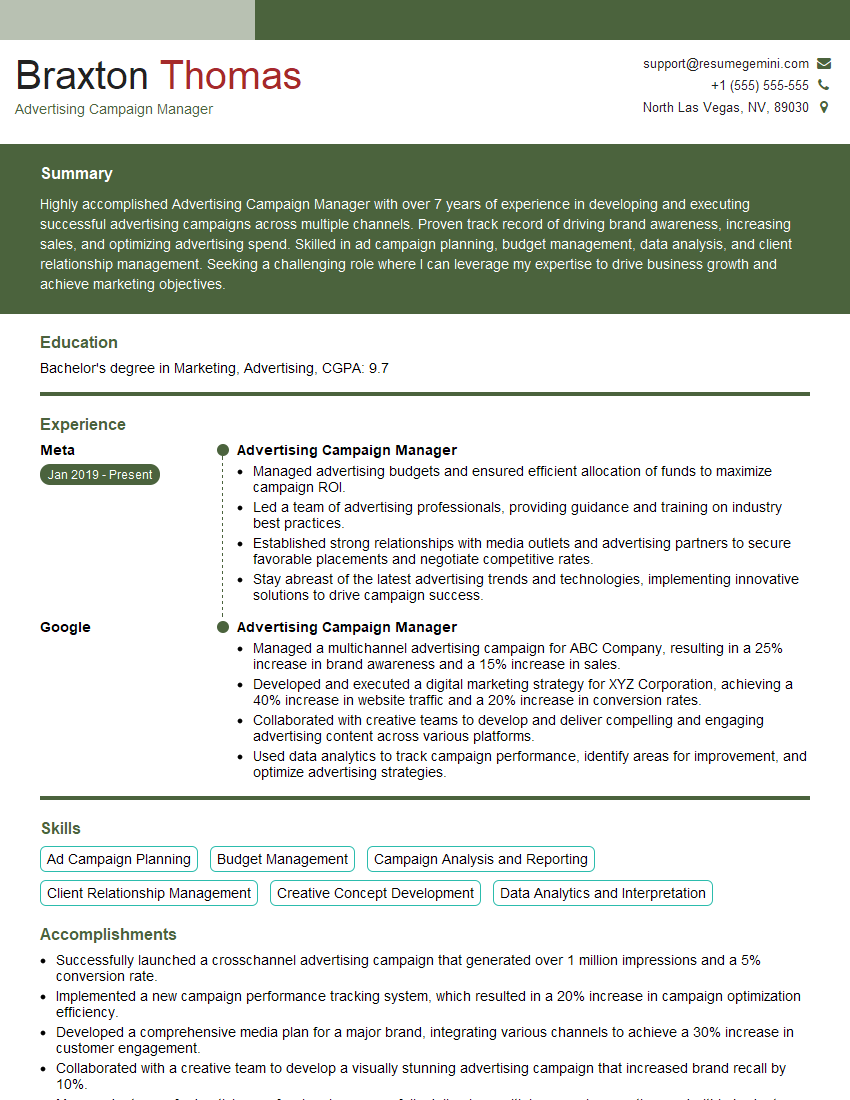
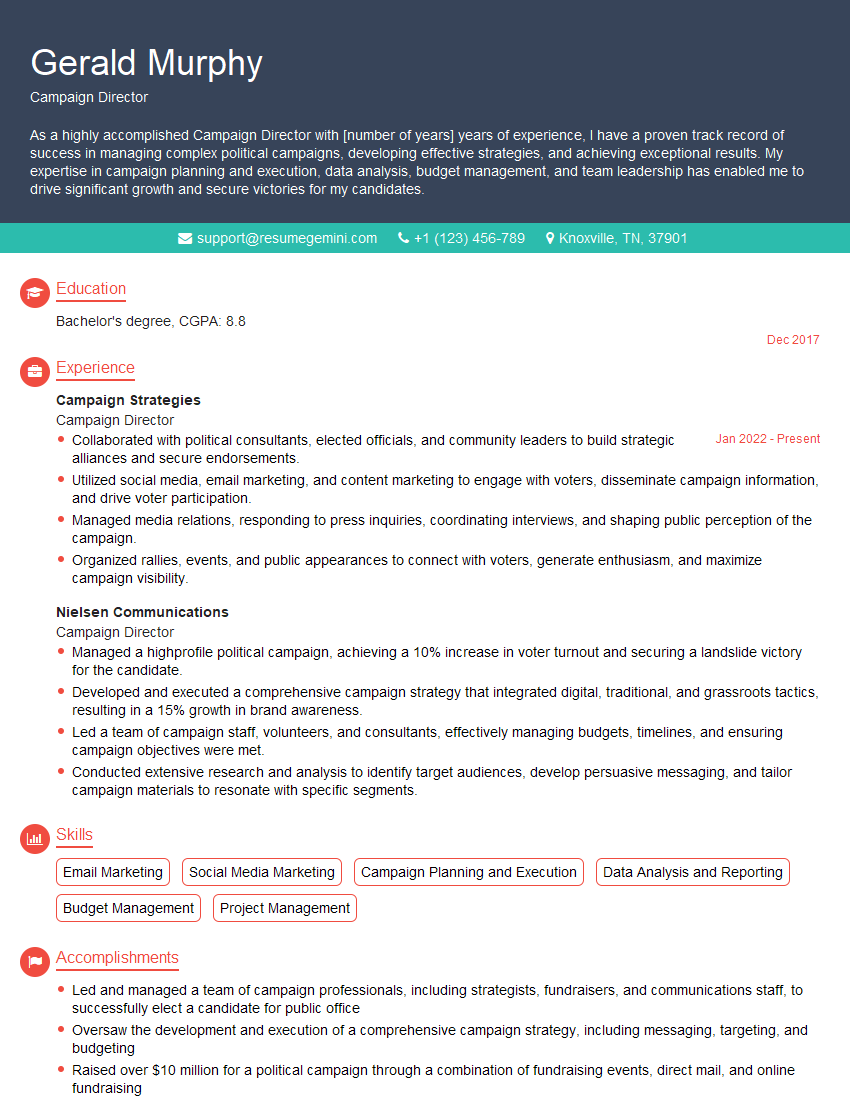
Mastering Campaign Strategy is crucial for career advancement in marketing and communications. A strong understanding of these concepts will significantly enhance your job prospects and open doors to exciting opportunities. To make your application stand out, create an ATS-friendly resume that highlights your skills and experience effectively. ResumeGemini can help you build a professional and impactful resume that catches the eye of recruiters. We offer examples of resumes tailored to Campaign Strategy roles to guide you. Invest in your future – craft a compelling resume that showcases your expertise in Campaign Strategy.
Explore more articles
Users Rating of Our Blogs
Share Your Experience
We value your feedback! Please rate our content and share your thoughts (optional).
What Readers Say About Our Blog
To the interviewgemini.com Webmaster.
Very helpful and content specific questions to help prepare me for my interview!
Thank you
To the interviewgemini.com Webmaster.
This was kind of a unique content I found around the specialized skills. Very helpful questions and good detailed answers.
Very Helpful blog, thank you Interviewgemini team.