Are you ready to stand out in your next interview? Understanding and preparing for Chemistry and Materials Science interview questions is a game-changer. In this blog, we’ve compiled key questions and expert advice to help you showcase your skills with confidence and precision. Let’s get started on your journey to acing the interview.
Questions Asked in Chemistry and Materials Science Interview
Q 1. Explain the difference between ionic and covalent bonding.
Ionic and covalent bonds are two fundamental types of chemical bonds that dictate how atoms interact to form molecules and materials. The key difference lies in how electrons are shared or transferred between atoms.
Ionic bonding involves the complete transfer of one or more electrons from one atom (typically a metal) to another (typically a non-metal). This creates ions: positively charged cations (electron donor) and negatively charged anions (electron acceptor). The electrostatic attraction between these oppositely charged ions forms the ionic bond. Think of it like a strong magnetic pull between two opposite poles. A classic example is sodium chloride (NaCl), or table salt, where sodium (Na) loses an electron to become Na+ and chlorine (Cl) gains an electron to become Cl–, forming a strong ionic bond.
Covalent bonding, on the other hand, involves the sharing of electrons between atoms, typically non-metals. These atoms share electrons to achieve a stable electron configuration, often resembling a noble gas. This shared pair of electrons forms a covalent bond. Imagine two people sharing a single item; they both benefit from having access to it. A simple example is the water molecule (H2O), where each hydrogen atom shares an electron with the oxygen atom, forming two covalent bonds.
In short: ionic bonds are formed by electron transfer and electrostatic attraction, while covalent bonds are formed by electron sharing.
Q 2. Describe the principles of chromatography.
Chromatography is a powerful separation technique used to isolate and analyze different components within a mixture. It’s based on the principle of differential partitioning: different components in a mixture have varying affinities for a stationary phase (a solid or liquid) and a mobile phase (a liquid or gas). This difference in affinity leads to separation as the mixture moves through the system.
Imagine a race where runners have different speeds and preferences for different terrains. The stationary phase is like the terrain, and the mobile phase is like the race track. Components with higher affinity for the stationary phase will move slower, while components with higher affinity for the mobile phase will move faster, leading to separation.
There are various types of chromatography, including:
- Gas Chromatography (GC): Uses a gas as the mobile phase and is ideal for separating volatile compounds.
- High-Performance Liquid Chromatography (HPLC): Employs a liquid mobile phase and offers high resolution for separating a wide range of compounds.
- Thin-Layer Chromatography (TLC): A simpler technique using a thin layer of adsorbent material as the stationary phase and is often used for quick qualitative analysis.
The choice of chromatography technique depends on the properties of the mixture and the desired level of separation.
Q 3. What are the different types of spectroscopy and their applications?
Spectroscopy is a powerful analytical technique that utilizes the interaction of electromagnetic radiation with matter to obtain information about its structure and composition. Different types of spectroscopy probe different aspects of matter, making them invaluable tools in various fields.
Here are some key types:
- UV-Vis Spectroscopy: Measures the absorption of ultraviolet and visible light. It’s commonly used for quantitative analysis of compounds and to determine the concentration of colored substances. Think of testing water quality using colorimetric measurements.
- Infrared (IR) Spectroscopy: Examines the absorption of infrared radiation, providing information about the functional groups present in a molecule. It acts like a fingerprint for molecules.
- Nuclear Magnetic Resonance (NMR) Spectroscopy: Exploits the magnetic properties of atomic nuclei to provide detailed structural information about molecules. It’s frequently used in determining the three-dimensional structure of proteins.
- Mass Spectrometry (MS): Measures the mass-to-charge ratio of ions to determine the molecular weight and identify compounds. It is often coupled with other techniques like gas chromatography (GC-MS).
These techniques have broad applications across various fields, including chemistry, biology, medicine, and materials science, aiding in identification, quantification and structural determination of molecules and materials.
Q 4. Explain the concept of Gibbs Free Energy and its relevance to chemical reactions.
Gibbs Free Energy (G) is a thermodynamic potential that measures the maximum reversible work that may be performed by a thermodynamic system at a constant temperature and pressure. It combines enthalpy (H), a measure of the total energy of a system, and entropy (S), a measure of disorder or randomness.
The equation is: ΔG = ΔH - TΔS, where:
ΔGis the change in Gibbs Free EnergyΔHis the change in enthalpyTis the absolute temperatureΔSis the change in entropy
The sign of ΔG determines the spontaneity of a reaction:
ΔG < 0: The reaction is spontaneous (occurs without external input).ΔG > 0: The reaction is non-spontaneous (requires external input to occur).ΔG = 0: The reaction is at equilibrium.
For example, a reaction with a negative ΔH (exothermic, releasing heat) and a positive ΔS (increasing disorder) will almost always have a negative ΔG and be spontaneous. Gibbs Free Energy is crucial for predicting the feasibility and equilibrium conditions of chemical reactions and is essential in various fields including chemical engineering and materials science.
Q 5. Describe the different types of crystalline structures.
Crystalline structures describe the ordered arrangement of atoms, ions, or molecules in a solid material. The arrangement is periodic, repeating in three dimensions. Several common types exist:
- Cubic: Atoms are arranged in a cube. There are three subtypes: simple cubic (SC), body-centered cubic (BCC), and face-centered cubic (FCC), differing in the number and location of atoms within the cube.
- Tetragonal: Similar to cubic, but one axis is longer or shorter than the others.
- Orthorhombic: All three axes have different lengths, and all angles are 90 degrees.
- Hexagonal: Has a hexagonal base and a single axis perpendicular to it.
- Rhombohedral (Trigonal): Has a rhombohedral unit cell.
- Monoclinic: Two axes are at 90 degrees, while the third is at an oblique angle.
- Triclinic: All three axes have different lengths, and none are at 90 degrees.
The type of crystal structure significantly influences the physical and chemical properties of the material, such as density, hardness, and electrical conductivity. For example, the FCC structure is common in metals like copper and aluminum, contributing to their ductility and malleability.
Q 6. What are the key properties of polymers and how are they determined?
Polymers are large molecules composed of repeating structural units called monomers. Their properties are determined by several factors:
- Type of monomer: Different monomers lead to polymers with different chemical and physical characteristics. For example, polyethylene (plastic bags) is made of repeating ethylene units, while nylon is composed of different monomers.
- Chain length (molecular weight): Longer chains generally result in stronger and more rigid materials. Think about the difference between thin and thick ropes.
- Chain branching: Branching affects the packing of polymer chains, influencing properties like density and crystallinity. Highly branched polymers are generally less dense and more flexible.
- Chain conformation: The arrangement of atoms within a polymer chain (e.g., linear, branched, cross-linked) significantly affects the overall properties.
- Intermolecular forces: Forces between polymer chains (e.g., van der Waals forces, hydrogen bonds) determine the strength, flexibility, and melting point of the polymer.
These properties are determined experimentally through techniques like viscosity measurements, thermal analysis (Differential Scanning Calorimetry, DSC, and Thermogravimetric Analysis, TGA), and mechanical testing (tensile strength, elongation).
Q 7. Explain the concept of diffusion in materials.
Diffusion in materials is the net movement of atoms, ions, or molecules from a region of higher concentration to a region of lower concentration. It's a fundamental process driven by the second law of thermodynamics, aiming to increase entropy (disorder) in the system.
Imagine dropping a sugar cube into a cup of tea. The sugar molecules initially concentrate near the cube, but over time, they spread out evenly throughout the tea due to diffusion. The rate of diffusion is influenced by several factors:
- Temperature: Higher temperatures increase the kinetic energy of particles, leading to faster diffusion.
- Concentration gradient: A steeper concentration gradient results in faster diffusion.
- Material properties: The structure and composition of the material influence how easily atoms or molecules can move through it. Crystalline materials generally have lower diffusion rates compared to amorphous materials.
- Particle size: Smaller particles diffuse faster than larger ones.
Diffusion is essential in many materials processes, such as doping semiconductors, heat treatments of metals, and the degradation of materials. Understanding and controlling diffusion is crucial for designing and optimizing materials with desired properties.
Q 8. What are common methods for characterizing materials' microstructure?
Characterizing a material's microstructure involves determining its internal structure and arrangement of phases at a microscopic level. This is crucial for understanding its properties and performance. Common methods employ various microscopy techniques and diffraction methods.
Optical Microscopy: A relatively simple technique using visible light. It's useful for observing large-scale features, grain boundaries, and surface textures. Think of it like using a magnifying glass to examine the surface of a rock.
Scanning Electron Microscopy (SEM): Uses a focused beam of electrons to create high-resolution images of the surface. It provides detailed information on surface morphology, composition (with EDX), and even crystallographic information.
Transmission Electron Microscopy (TEM): Uses a beam of electrons that passes through a very thin sample. It provides incredibly high resolution, allowing for the observation of individual atoms and crystal structures. Imagine seeing the individual bricks in a wall.
X-ray Diffraction (XRD): This technique utilizes the diffraction of X-rays by the crystal lattice to determine crystal structure, crystallite size, and phase composition. It’s like shining a light through a diffraction grating to understand the spacing between its lines.
Electron Backscatter Diffraction (EBSD): A technique used in SEM, allowing for the determination of crystallographic orientation at a microscopic level. This is invaluable in understanding texture and grain boundary character.
The choice of method depends on the material, the scale of features of interest, and the information required. For instance, XRD is ideal for determining the crystalline phases in a metal alloy, while SEM is often used for analyzing the surface morphology of a polymer.
Q 9. Discuss the different types of chemical reactions.
Chemical reactions are processes that involve the rearrangement of atoms and molecules. They are broadly categorized into several types:
Combination (Synthesis): Two or more substances combine to form a single, more complex substance. For example, the formation of water from hydrogen and oxygen:
2H₂ + O₂ → 2H₂ODecomposition: A single compound breaks down into two or more simpler substances. For example, the decomposition of calcium carbonate upon heating:
CaCO₃ → CaO + CO₂Single Displacement (Substitution): One element replaces another in a compound. For example, the reaction of zinc with hydrochloric acid:
Zn + 2HCl → ZnCl₂ + H₂Double Displacement (Metathesis): Two compounds exchange ions or groups of atoms. For example, the precipitation reaction between silver nitrate and sodium chloride:
AgNO₃ + NaCl → AgCl + NaNO₃Combustion: A rapid reaction with oxygen, often producing heat and light. For example, the burning of methane:
CH₄ + 2O₂ → CO₂ + 2H₂OAcid-Base Reactions (Neutralization): Reactions between acids and bases, producing salt and water. For example, the reaction between hydrochloric acid and sodium hydroxide:
HCl + NaOH → NaCl + H₂ORedox (Oxidation-Reduction): Reactions involving the transfer of electrons between species. For example, the rusting of iron:
4Fe + 3O₂ → 2Fe₂O₃
Understanding these classifications helps predict the products of reactions and design chemical processes.
Q 10. Explain the concept of equilibrium in chemical reactions.
Chemical equilibrium describes the state where the rates of the forward and reverse reactions are equal, resulting in no net change in the concentrations of reactants and products. Imagine a tug-of-war: when both teams pull with equal force, there's no movement – that's equilibrium.
Consider the reversible reaction: A + B ⇌ C + D. At equilibrium, the rate of the forward reaction (A + B → C + D) equals the rate of the reverse reaction (C + D → A + B). The concentrations of A, B, C, and D remain constant, but the reactions are still occurring.
The equilibrium constant (K) quantifies the relative amounts of reactants and products at equilibrium. A large K indicates that the equilibrium favors products, while a small K indicates that it favors reactants. Factors like temperature, pressure, and concentration can shift the equilibrium position, but the equilibrium constant remains unchanged at a constant temperature.
Understanding equilibrium is crucial in many industrial processes, such as ammonia synthesis (Haber-Bosch process), where controlling reaction conditions to maximize product yield is essential.
Q 11. Describe the principles of acid-base chemistry.
Acid-base chemistry deals with the properties of acids and bases and their reactions. Several theories describe these properties:
Arrhenius Theory: Defines acids as substances that produce H⁺ ions (protons) in aqueous solution and bases as substances that produce OH⁻ ions (hydroxide) in aqueous solution. This is a simple definition, but limited in scope.
Brønsted-Lowry Theory: A more general definition. It defines acids as proton (H⁺) donors and bases as proton acceptors. This expands the definition to include reactions without water.
Lewis Theory: The broadest definition. It defines acids as electron-pair acceptors and bases as electron-pair donors. This theory includes many reactions not covered by the previous theories.
The strength of an acid or base is determined by its tendency to donate or accept protons. Strong acids and bases completely dissociate in water, while weak acids and bases only partially dissociate. The pH scale, ranging from 0 to 14, measures the acidity or basicity of a solution. A pH of 7 is neutral, below 7 is acidic, and above 7 is basic.
Acid-base reactions are essential in many applications, from industrial chemical processes to biological systems, where maintaining the correct pH is critical for enzyme function.
Q 12. What are the different types of phase diagrams?
Phase diagrams are graphical representations of the phases of a substance as a function of temperature, pressure, and composition. Different types exist, depending on the number of components:
One-Component Phase Diagrams: Show the phases (solid, liquid, gas) of a single substance as a function of temperature and pressure. The most familiar example is the water phase diagram, showcasing the triple point (where all three phases coexist) and critical point (where the distinction between liquid and gas disappears).
Two-Component Phase Diagrams (Binary Phase Diagrams): Show the phases of a mixture of two components as a function of temperature and composition at constant pressure. These diagrams are crucial in materials science, showing the phase boundaries and compositions of alloys and other mixtures. Common examples include phase diagrams for metal alloys (e.g., Cu-Ni) or eutectic systems.
Three-Component Phase Diagrams (Ternary Phase Diagrams): Show the phases of a mixture of three components. These are often represented as triangular diagrams, with each corner representing a pure component and the interior points representing mixtures. These are useful in cement chemistry and other multi-component systems.
Phase diagrams are essential tools in materials science and engineering for designing materials with desired properties by controlling processing parameters.
Q 13. Explain the concept of activation energy.
Activation energy (Ea) is the minimum amount of energy required for a chemical reaction to occur. It's like the energy needed to push a rock over a hilltop; once it's over the top, it will roll down the other side. This 'hill' represents the activation energy barrier.
Molecules need sufficient energy to overcome the activation energy barrier and reach the transition state, an unstable high-energy state where bonds are breaking and forming. Once the transition state is reached, the reaction proceeds to form products.
Factors influencing activation energy include the nature of reactants, presence of catalysts, and temperature. Catalysts lower the activation energy by providing an alternative reaction pathway with a lower energy barrier. Increasing the temperature increases the kinetic energy of molecules, making it more likely that they will possess the required activation energy.
Understanding activation energy is fundamental in catalysis and reaction kinetics, where controlling reaction rates is crucial for many industrial processes and biological reactions.
Q 14. How do you determine the molecular weight of a polymer?
Determining the molecular weight of a polymer is more complex than for small molecules because polymers are not uniform in size. They consist of a distribution of chain lengths. Therefore, we usually talk about average molecular weights.
Number-Average Molecular Weight (Mn): This is the average molecular weight calculated by considering the number of molecules of each size. It is weighted more towards lower molecular weight species.
Weight-Average Molecular Weight (Mw): This accounts for the weight fraction of each molecular weight species. It is weighted more towards higher molecular weight species.
These average molecular weights are determined by various techniques:
End-group analysis: Useful for polymers with easily identifiable end groups. This method counts the number of end groups to determine the average chain length.
Osmometry: Measures the osmotic pressure of a polymer solution. This is related to the number of polymer molecules, allowing for the calculation of Mn.
Light scattering: Measures the scattering of light by polymer molecules. This technique is used to determine Mw.
Size exclusion chromatography (SEC or GPC): Separates polymers based on size, allowing for the determination of the molecular weight distribution and calculation of Mn and Mw. This is a widely used technique.
Viscosity measurements: Relates the solution viscosity to the average molecular weight.
The choice of method depends on the type of polymer, its molecular weight range, and the desired level of detail about its molecular weight distribution. Knowledge of the polymer's molecular weight is crucial for predicting its mechanical and other physical properties.
Q 15. Describe different methods for synthesizing nanoparticles.
Synthesizing nanoparticles involves creating particles with diameters ranging from 1 to 100 nanometers. Several methods exist, each with its advantages and disadvantages. These methods can be broadly classified into top-down and bottom-up approaches.
- Top-Down Approaches: These methods start with a bulk material and break it down into smaller nanoparticles. Examples include:
- Ball Milling: Mechanical grinding of a bulk material using high-energy collisions. Think of it like repeatedly smashing something until it’s incredibly tiny. This is a cost-effective method but can introduce impurities.
- Lithography: A high-resolution technique used to create patterns of nanoparticles on a substrate, commonly used in semiconductor manufacturing. It's precise but can be expensive and time-consuming.
- Bottom-Up Approaches: These methods involve assembling nanoparticles from atoms or molecules. This is typically done in a controlled chemical environment. Examples include:
- Chemical Vapor Deposition (CVD): A gaseous precursor is decomposed at high temperatures, depositing a thin film that can be subsequently broken down into nanoparticles. Used extensively in the fabrication of advanced materials and coatings.
- Sol-Gel Method: A wet-chemical technique involving the hydrolysis and condensation of a metal alkoxide precursor to form a gel, which is then dried and calcined to yield nanoparticles. Think of it as making nanoparticles from a liquid solution, much like making Jell-O.
- Co-precipitation: This method involves mixing solutions containing metal ions that react to form an insoluble precipitate of nanoparticles. It’s simple, but controlling particle size and shape can be challenging.
The choice of method depends on factors like the desired nanoparticle size, shape, composition, and required purity.
Career Expert Tips:
- Ace those interviews! Prepare effectively by reviewing the Top 50 Most Common Interview Questions on ResumeGemini.
- Navigate your job search with confidence! Explore a wide range of Career Tips on ResumeGemini. Learn about common challenges and recommendations to overcome them.
- Craft the perfect resume! Master the Art of Resume Writing with ResumeGemini's guide. Showcase your unique qualifications and achievements effectively.
- Don't miss out on holiday savings! Build your dream resume with ResumeGemini's ATS optimized templates.
Q 16. What are the common techniques used for surface analysis?
Surface analysis techniques are crucial for characterizing the surface chemistry and morphology of materials, especially at the nanoscale. They help us understand surface composition, structure, and reactivity. Common techniques include:
- X-ray Photoelectron Spectroscopy (XPS): This technique uses X-rays to excite core-level electrons, providing information about the elemental composition and chemical states of the surface atoms. It's like getting a detailed fingerprint of the surface.
- Auger Electron Spectroscopy (AES): Similar to XPS, AES uses electron beams to excite electrons, providing surface elemental composition information. It offers higher spatial resolution than XPS but is less sensitive.
- Scanning Electron Microscopy (SEM): Uses a focused beam of electrons to scan the surface, creating high-resolution images. It reveals surface morphology—the topography and texture—of the material. It's like having a super-powerful magnifying glass.
- Transmission Electron Microscopy (TEM): A more powerful microscopy technique than SEM, capable of imaging the internal structure of materials, including the arrangement of atoms. It’s akin to having an X-ray vision for materials.
- Atomic Force Microscopy (AFM): Uses a sharp tip to scan the surface and create images based on the force interactions between the tip and the surface. It is capable of providing high-resolution images, even at the atomic level.
The choice of technique depends on the specific information needed and the nature of the sample being analyzed.
Q 17. Explain the concept of doping in semiconductors.
Doping in semiconductors involves intentionally introducing impurities into a pure semiconductor crystal to alter its electrical properties. Think of it like adding spices to a dish to enhance its flavor. The impurities are called dopants.
In silicon (Si), a group IV element, adding a group V element (like phosphorus, P) creates an n-type semiconductor. The extra electron from the P atom becomes a mobile charge carrier, increasing conductivity. Conversely, adding a group III element (like boron, B) creates a p-type semiconductor. The B atom creates a “hole” (a missing electron) which acts as a positive charge carrier. This manipulation of conductivity is fundamental to the operation of transistors and integrated circuits.
The concentration of dopants significantly impacts the material's electrical characteristics. High doping levels lead to higher conductivity but may also impact other properties like carrier mobility.
Q 18. Describe the different types of defects in crystalline materials.
Crystalline materials, while having a regular arrangement of atoms, can contain various defects that impact their properties. These defects can be classified into several categories:
- Point Defects: These are imperfections at a single atomic site. Examples include:
- Vacancies: Missing atoms from their lattice sites.
- Interstitials: Extra atoms squeezed into the spaces between lattice sites.
- Substitutional Impurities: An atom of a different type replacing a lattice atom (as in doping).
- Line Defects (Dislocations): These are one-dimensional defects that disrupt the regular arrangement of atoms along a line. They are often associated with the mechanical properties of materials.
- Planar Defects: These are two-dimensional defects, including:
- Grain Boundaries: Boundaries separating regions of different crystallographic orientation in a polycrystalline material.
- Stacking Faults: Errors in the stacking sequence of atomic planes.
- Twin Boundaries: Regions where the crystal structure is a mirror image across a plane.
- Volume Defects: These are three-dimensional defects, such as:
- Voids: Empty spaces within the crystal.
- Precipitates: Clusters of different phases within the crystal.
These defects can drastically alter the material's mechanical, electrical, and optical properties. For example, dislocations weaken a material’s strength, while grain boundaries can act as barriers to dislocation movement.
Q 19. How do you determine the mechanical properties of a material?
Determining the mechanical properties of a material involves subjecting it to various tests to measure its response to applied forces. Common techniques include:
- Tensile Testing: A material is stretched until it breaks, measuring its strength, ductility, and Young's modulus (a measure of stiffness).
- Compression Testing: A material is squeezed to determine its compressive strength and yield strength.
- Hardness Testing: Measures the material's resistance to indentation using an indenter, providing an estimate of its strength.
- Bend Testing: A material is bent to assess its flexibility and resistance to fracture.
- Creep Testing: A material is subjected to a constant load at elevated temperatures to assess its tendency to deform over time.
- Fatigue Testing: A material is subjected to repeated cyclic loading to assess its resistance to failure under repeated stress.
The choice of test depends on the intended application of the material and the specific properties of interest. Data from these tests is essential for designing and selecting materials for engineering applications.
Q 20. Explain the concept of corrosion and its prevention.
Corrosion is the deterioration of a material, usually a metal, due to its reaction with its environment. It’s essentially the undesired eating away of a material. Rusting of iron is a classic example. Corrosion can lead to structural failure, economic losses, and safety hazards.
Corrosion prevention methods focus on minimizing the interaction between the material and its environment. These include:
- Protective Coatings: Applying a barrier coating (like paint or polymer film) to isolate the material from the environment. Think of painting a metal fence to prevent rust.
- Corrosion Inhibitors: Adding chemicals to the environment to slow down or prevent the corrosion reactions. These chemicals often form a protective layer on the material's surface.
- Cathodic Protection: Protecting a metal by connecting it to a more reactive metal (anode) that corrodes preferentially. This is like sacrificing one metal to save another, often used in pipelines.
- Material Selection: Choosing corrosion-resistant materials, like stainless steel or certain plastics, for the application.
- Design Modifications: Designing components to minimize crevices and stagnant areas where corrosion can easily occur.
The most effective approach often involves a combination of these methods, tailored to the specific material and its environment.
Q 21. Discuss the principles of electrochemistry.
Electrochemistry studies the relationship between electrical energy and chemical changes. It’s the science behind batteries, fuel cells, and electrochemical corrosion. Core principles include:
- Redox Reactions: Electrochemical reactions involve the transfer of electrons between species. One species is oxidized (loses electrons), while another is reduced (gains electrons). Think of it as a tug-of-war for electrons.
- Electrochemical Cells: These devices utilize redox reactions to convert chemical energy into electrical energy (galvanic cells) or vice versa (electrolytic cells). Batteries are a prime example of galvanic cells.
- Electrode Potentials: The tendency of an electrode to gain or lose electrons is quantified by its electrode potential. This potential difference drives the electron flow in electrochemical cells.
- Nernst Equation: This equation relates the electrode potential to the concentrations of reactants and products in an electrochemical cell.
- Faraday's Laws of Electrolysis: These laws describe the quantitative relationship between the amount of electricity passed through an electrolytic cell and the amount of substance produced or consumed.
Understanding electrochemistry is critical in various fields, including energy storage, materials science, and environmental chemistry. It governs processes like battery charging and discharging, metal plating, and electro-synthesis of chemicals.
Q 22. What are the different types of batteries and their working principles?
Batteries are electrochemical devices that convert chemical energy into electrical energy. Different types exist, categorized primarily by their chemistry and components.
- Primary Batteries (single-use): These are non-rechargeable. A classic example is the zinc-carbon battery, where the zinc anode oxidizes, releasing electrons that flow through an external circuit to a carbon cathode (acting as an electron collector for the reduction of manganese dioxide). The electrolyte, often an ammonium chloride paste, facilitates ion transport.
- Secondary Batteries (rechargeable): These can be recharged by reversing the electrochemical reactions.
- Lead-acid batteries: These use lead and lead dioxide electrodes in a sulfuric acid electrolyte. During discharge, lead is oxidized and lead dioxide is reduced, while the reverse happens during charging.
- Lithium-ion batteries: Widely used in portable electronics, these use a lithium-containing compound as the anode (e.g., graphite) and a lithium-metal oxide as the cathode (e.g., LiCoO2). During discharge, lithium ions migrate from the anode to the cathode through the electrolyte (e.g., lithium hexafluorophosphate in organic solvent), carrying charge.
- Nickel-metal hydride (NiMH) batteries: These employ a nickel oxyhydroxide cathode and a hydrogen-absorbing alloy anode. The electrochemical reactions involve the oxidation and reduction of nickel and hydrogen.
- Fuel cells: Though not strictly batteries, they convert chemical energy directly into electricity using a continuous supply of fuel (e.g., hydrogen) and oxidant (e.g., oxygen). They are highly efficient but require a continuous fuel source.
The working principle in all these cases involves redox reactions (reduction-oxidation reactions) where electrons are transferred between electrodes, creating an electrical potential difference that drives current flow. The choice of battery depends on factors like energy density, power density, cost, safety, and lifespan.
Q 23. Describe the different types of catalysts and their applications.
Catalysts are substances that increase the rate of a chemical reaction without being consumed in the process. They achieve this by lowering the activation energy of the reaction, providing an alternative reaction pathway. Catalysts are classified in several ways:
- Homogeneous catalysts: These exist in the same phase as the reactants (e.g., a liquid catalyst in a liquid reaction). A common example is sulfuric acid catalyzing the esterification of carboxylic acids with alcohols.
- Heterogeneous catalysts: These exist in a different phase from the reactants (e.g., a solid catalyst in a gas-phase reaction). These are crucial in industrial processes. A prime example is the use of platinum in catalytic converters to convert harmful exhaust gases into less harmful ones. The platinum provides active sites on its surface for the adsorption and reaction of the gases.
- Biocatalysts (enzymes): These are biological catalysts, usually proteins, that facilitate specific biochemical reactions. Enzymes are highly selective and efficient, exhibiting remarkable catalytic activity under mild conditions. For example, enzymes in our digestive system break down complex food molecules into simpler ones.
Applications of catalysts are widespread, spanning various industries:
- Petrochemical industry: Catalytic cracking and reforming of petroleum fractions.
- Chemical industry: Production of ammonia (Haber-Bosch process using an iron catalyst), methanol synthesis.
- Automotive industry: Catalytic converters in vehicles.
- Pharmaceutical industry: Synthesis of pharmaceuticals.
- Environmental remediation: Catalytic oxidation of pollutants.
Catalyst design is a crucial aspect of modern chemistry and materials science, focusing on improving activity, selectivity, stability, and recyclability.
Q 24. Explain the concept of sustainability in materials science.
Sustainability in materials science involves designing, manufacturing, and utilizing materials in a way that minimizes environmental impact and conserves resources for future generations. This encompasses several key aspects:
- Life cycle assessment (LCA): Evaluating the environmental impact of a material throughout its entire life cycle, from raw material extraction to disposal or recycling. This helps identify areas for improvement.
- Design for recyclability/reuse: Creating materials and products that are easily disassembled and recycled or repurposed at the end of their useful life. This reduces waste and reliance on virgin materials.
- Use of renewable resources: Employing materials derived from renewable sources (e.g., biomass, recycled materials) instead of finite resources (e.g., fossil fuels).
- Reduced energy consumption: Optimizing manufacturing processes to minimize energy consumption, reducing greenhouse gas emissions.
- Bio-based materials: Utilizing naturally occurring materials or those derived from biological processes, such as biodegradable plastics or cellulose-based composites.
- Toxicity reduction: Minimizing the use of hazardous materials and reducing the toxicity of waste streams.
For example, developing lightweight composite materials for automobiles can improve fuel efficiency and reduce CO2 emissions, promoting sustainability. The transition towards biodegradable plastics is another area of significant focus.
Q 25. How do you design experiments to test a hypothesis?
Designing experiments to test a hypothesis requires a systematic approach:
- Define the hypothesis: Clearly state the hypothesis to be tested. This should be a testable statement that predicts a relationship between variables.
- Identify variables: Determine the independent variable (what you manipulate), the dependent variable (what you measure), and control variables (factors kept constant to avoid confounding effects).
- Design the experimental procedure: Outline the steps involved in conducting the experiment, ensuring reproducibility. Consider sample size, replicates, and randomization to minimize bias.
- Data collection: Choose appropriate methods for collecting data, ensuring accuracy and precision. Consider using standardized procedures and calibrated instruments.
- Data analysis: Select appropriate statistical methods to analyze the data, determining if the results support or refute the hypothesis. Consider the possibility of type I and type II errors.
- Interpretation and conclusion: Interpret the results and draw conclusions based on the data analysis. Discuss limitations and potential sources of error. Suggest future studies based on the findings.
For instance, to test the hypothesis that a new catalyst improves reaction yield, you would vary the catalyst concentration (independent variable), measure the reaction yield (dependent variable), and control parameters like temperature and pressure. Statistical analysis would then be used to determine if there's a statistically significant difference in yield.
Q 26. Describe your experience with data analysis and interpretation.
My experience with data analysis and interpretation encompasses a wide range of techniques, including:
- Statistical analysis: I am proficient in using statistical software packages (e.g., R, SPSS) to perform hypothesis testing, regression analysis, ANOVA, and other relevant statistical techniques. This includes handling both parametric and non-parametric data.
- Data visualization: I can create various types of graphs and charts (e.g., scatter plots, histograms, bar charts) to effectively represent and interpret data. This facilitates identifying trends, patterns, and outliers.
- Error analysis: I understand the importance of assessing uncertainties and errors in measurements and calculations, and I use appropriate methods to propagate errors and assess the reliability of results.
- Data mining and machine learning: I have experience applying basic machine learning algorithms for pattern recognition and predictive modeling in materials data. This involves feature selection, model training, and performance evaluation.
In a recent project involving the synthesis of new catalysts, I employed regression analysis to model the relationship between catalyst composition and catalytic activity, leading to the optimization of the catalyst synthesis.
Q 27. Explain your approach to troubleshooting experimental problems.
My approach to troubleshooting experimental problems is systematic and involves:
- Careful observation and documentation: I meticulously record all aspects of the experiment, including procedures, observations, and any deviations from the plan. This helps identify potential sources of error.
- Systematic elimination of variables: I systematically test and eliminate possible sources of error one by one, modifying only one parameter at a time. This helps isolate the root cause.
- Consultation and collaboration: I actively seek help from colleagues and mentors to gain different perspectives and expertise. This can lead to identifying problems I might have overlooked.
- Review of literature: I consult relevant literature to understand previously reported issues and potential solutions. This can provide valuable insights.
- Control experiments: I design and conduct control experiments to validate the accuracy of my results and to rule out confounding factors.
- Refinement of experimental design: Based on the troubleshooting process, I refine the experimental design to improve accuracy and reliability.
For example, if a reaction yield is unexpectedly low, I might systematically check the purity of reactants, the accuracy of temperature control, and the completeness of the reaction time, iteratively eliminating potential causes until the problem is identified and solved.
Q 28. What are your career goals in Chemistry/Materials Science?
My career goals are to contribute to the advancement of sustainable materials and technologies. I am particularly interested in developing novel catalytic materials for energy-related applications, such as efficient hydrogen production and CO2 reduction. My long-term ambition is to lead a research group focused on developing innovative materials solutions to address pressing environmental and energy challenges. I am eager to combine my skills in materials synthesis, characterization, and data analysis to make a significant impact in this field. I am also keen to collaborate with industry partners to translate research findings into practical applications. This involves mentoring junior scientists and fostering a collaborative research environment.
Key Topics to Learn for Chemistry and Materials Science Interviews
- Chemical Thermodynamics and Kinetics: Understand equilibrium constants, reaction rates, and their applications in material synthesis and characterization. Consider practical applications like optimizing reaction conditions for improved yield or understanding material degradation.
- Structure-Property Relationships: Explore the correlation between the atomic/molecular structure of materials and their macroscopic properties (mechanical, electrical, optical, etc.). Think about examples like how crystal structure impacts strength or how doping affects conductivity.
- Materials Characterization Techniques: Familiarize yourself with common techniques like XRD, SEM, TEM, FTIR, and NMR. Understand their principles and applications in analyzing material composition, structure, and properties. Practice explaining how different techniques provide complementary information.
- Polymer Chemistry and Physics: If relevant to your target roles, delve into polymer synthesis, characterization, and processing techniques. Understand concepts like polymer morphology, crystallinity, and viscoelasticity and their impact on material performance.
- Material Selection and Design: Practice identifying suitable materials for specific applications based on their properties and limitations. This often involves trade-off considerations and understanding the lifecycle of a material.
- Computational Materials Science (if applicable): If your experience includes computational methods, be ready to discuss your proficiency in software packages and techniques used for materials modeling and simulation.
- Problem-Solving and Critical Thinking: Practice approaching complex problems systematically. Be prepared to articulate your thought process and justify your approach during the interview. Develop examples showcasing your analytical skills and problem-solving abilities.
Next Steps
Mastering Chemistry and Materials Science opens doors to exciting and impactful careers in various industries. A strong foundation in these areas is crucial for success in research, development, manufacturing, and quality control. To maximize your job prospects, create an ATS-friendly resume that effectively highlights your skills and experience. ResumeGemini is a trusted resource to help you build a professional and impactful resume that catches the eye of recruiters. We provide examples of resumes tailored to Chemistry and Materials Science to guide you through the process. Take advantage of these resources and present yourself as the ideal candidate!

Research Scientist Resume Sample

Chemical Engineer Resume Sample

Materials Engineer Resume Sample

Spectroscopist Resume Sample

Biochemist Resume Sample
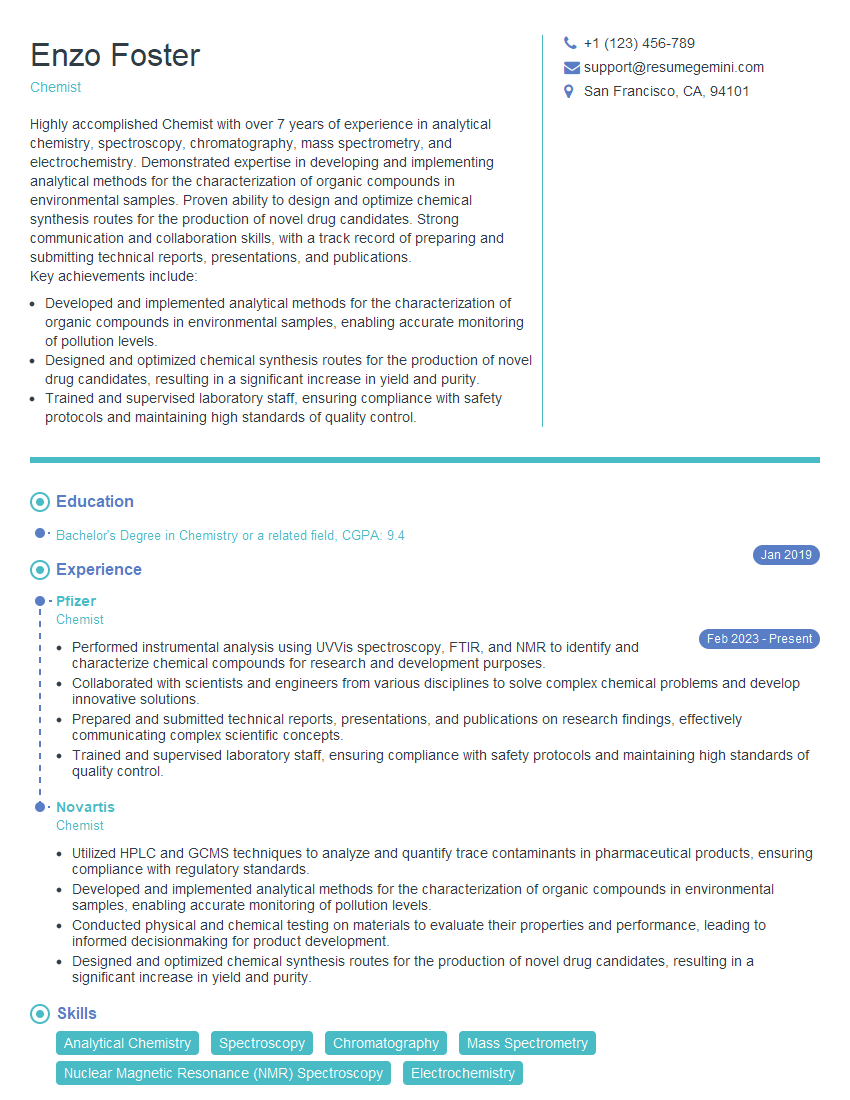
Chemist Resume Sample

Analytical Chemist Resume Sample

Electrochemist Resume Sample

Inorganic Chemist Resume Sample

Physical Chemist Resume Sample

Process Chemist Resume Sample

Senior Chemist Resume Sample

Materials Scientist Resume Sample
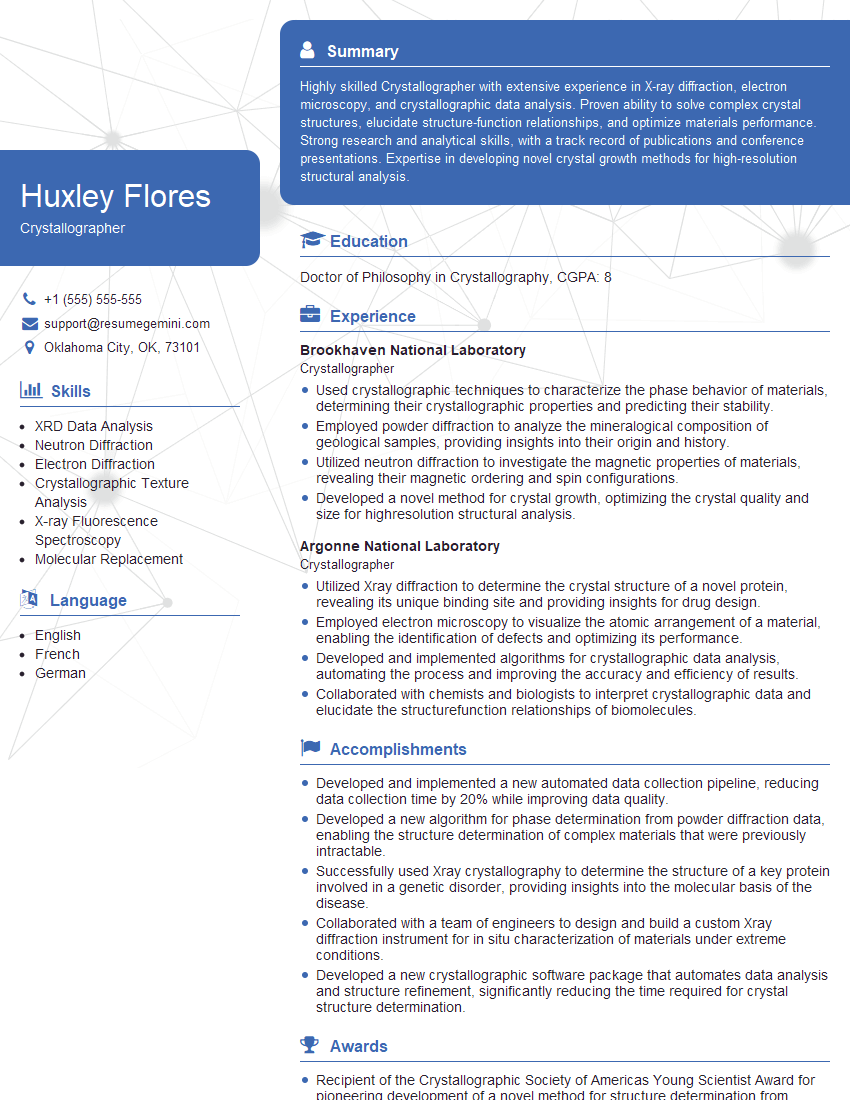
Crystallographer Resume Sample
Explore more articles
Users Rating of Our Blogs
Share Your Experience
We value your feedback! Please rate our content and share your thoughts (optional).
What Readers Say About Our Blog
To the interviewgemini.com Webmaster.
Very helpful and content specific questions to help prepare me for my interview!
Thank you
To the interviewgemini.com Webmaster.
This was kind of a unique content I found around the specialized skills. Very helpful questions and good detailed answers.
Very Helpful blog, thank you Interviewgemini team.