Preparation is the key to success in any interview. In this post, we’ll explore crucial Crevasse Rescue interview questions and equip you with strategies to craft impactful answers. Whether you’re a beginner or a pro, these tips will elevate your preparation.
Questions Asked in Crevasse Rescue Interview
Q 1. Describe the different types of crevasse rescue systems.
Crevasse rescue systems are categorized by their mechanical advantage and complexity. Simpler systems rely on direct hauling, while more complex systems utilize pulleys to reduce the force required by rescuers. Common types include:
- Simple Hauling Systems: These use ropes and direct pulling to lift the casualty. Effective for shallow crevasses and lighter casualties, but very strenuous for rescuers.
- Z-Pulley System: A highly efficient system using three pulleys to significantly reduce the pulling force required. It’s versatile and adaptable to various situations.
- A-Frame System: Employs an A-shaped frame (often constructed from ice axes or other sturdy materials) to provide a stable anchor point for hauling. Ideal for situations where establishing a secure anchor directly above the crevasse is challenging.
- Chest Harness System with Prusik: Used in conjunction with other systems. A prusik knot, adjustable using friction, allows for controlled lowering and hauling of the casualty. This is essential for complex rescues.
- Multi-pulley systems: These can involve more complex arrangements of pulleys to maximize mechanical advantage, especially useful for heavier casualties or deeper crevasses.
The choice of system depends heavily on the specific circumstances of the crevasse rescue, including the depth of the crevasse, the weight of the casualty, the available equipment, and the number of rescuers.
Q 2. Explain the process of assessing a crevasse rescue situation.
Assessing a crevasse rescue is a critical first step, demanding a calm and methodical approach. It involves:
- Scene Safety: Evaluate the immediate surroundings for potential hazards like unstable snow, ice bridges, or further crevasses. Ensure the safety of the rescue team before approaching the casualty.
- Casualty Assessment: Determine the casualty’s condition – are they conscious, breathing, and showing signs of injury? This dictates the urgency and approach of the rescue.
- Crevasse Assessment: Evaluate the crevasse’s depth, width, and stability. Look for potential hazards within the crevasse, such as hidden obstacles or unstable ice.
- Anchor Point Assessment: Identify suitable anchor points for securing the rescue system. These need to be strong enough to withstand the forces involved in the rescue. Ideally, locate at least two separate, independent anchor points.
- Resource Assessment: Determine the available personnel, equipment, and time. This informs the choice of rescue system and strategy.
Imagine a scenario where a climber falls into a deep crevasse. A quick assessment might show unstable snow above, a conscious but injured climber, and solid rock formations a distance away for anchor points. This would lead to prioritizing safety, using a Z-pulley system to minimize the effort needed, and establishing a secure anchor well away from the unstable snow.
Q 3. What are the critical safety considerations before attempting a crevasse rescue?
Safety is paramount. Before attempting a crevasse rescue, consider:
- Proper Training: All team members must possess adequate training in crevasse rescue techniques, including knot tying, system setup, and communication protocols.
- Equipment Check: Thoroughly inspect all equipment for damage or wear. Ropes, harnesses, carabiners, and pulleys must be in excellent condition.
- Team Communication: Establish clear communication protocols. Use hand signals and verbal commands to ensure coordinated actions. A poorly coordinated rescue can be more dangerous than the initial fall.
- Anchor Security: Confirm the strength and stability of chosen anchor points before loading the system. Failure of the anchor points could have fatal consequences.
- Backup Systems: Always consider backup plans and systems. Equipment failure is a real possibility; having contingency plans in place is critical.
- Self-Arrest Devices: Rescuers should be equipped with ice axes and self-arrest tools to prevent falls near the crevasse.
A real-world example: A team overlooking the thorough inspection of a carabiner could result in a catastrophic failure during the rescue. The carabiner must be correctly loaded, free of any damage, and correctly clipped into the system.
Q 4. How do you select appropriate equipment for a crevasse rescue?
Equipment selection depends heavily on the specific rescue situation but should generally include:
- Dynamic ropes: These ropes are designed to stretch and absorb some of the shock load during a fall, minimizing the force exerted on the casualty and the anchor points.
- Harnesses: Strong and durable harnesses for both the casualty and the rescuers are essential. They must fit properly and be in good condition.
- Carabiners: High-quality, locking carabiners are crucial for secure connections within the system. Use only those rated for rescue operations.
- Pulleys: Pulleys are used to increase mechanical advantage. Choose pulleys that are smooth-running and rated for the expected loads.
- Anchor points and slings: These are needed to establish secure attachment points.
- Ice axes and crampons: For rescuer protection and stability on potentially treacherous terrain.
- First-aid kit: Always carry a comprehensive first-aid kit.
For instance, rescuing a heavy casualty from a deep crevasse would require stronger ropes, more pulleys for greater mechanical advantage, and potentially a more complex system like an A-frame to distribute the load effectively.
Q 5. Explain the process of setting up a three-pulley z-pulley system.
Setting up a three-pulley Z-pulley system involves several steps:
- Establish Anchor Points: Securely establish at least two independent anchor points above the crevasse, using sturdy ice screws or other reliable anchors.
- Master Point: Create a master point by attaching a sling to both anchors, forming the top of the ‘Z’.
- First Pulley: Attach the first pulley to the master point.
- Second Pulley: Attach a second pulley to the rope running through the first pulley and attach the other end of this rope to a second anchor.
- Third Pulley: Attach the third pulley to the rope running through the second pulley, clipping it to a strong point. This forms the bottom of the ‘Z’.
- Rope Route: Run the rope through the system, creating the Z-shape. The end of the rope should now be available for hauling.
- Attach Casualty: Attach the casualty to the system using a robust harness and appropriate attachments.
- Hauling: Haul the casualty using the end of the rope. The three-pulley system drastically reduces the effort required compared to simple hauling.
Remember to check each connection and stage as you progress to ensure the system is secure and efficient before commencing the haul.
Q 6. How do you ensure the safety of the rescuer during a crevasse rescue?
Rescuer safety is paramount. Several measures ensure this:
- Belaying the Rescuer: If possible, a second rescuer should belay the primary rescuer during any work near the crevasse’s edge. This prevents a fall into the crevasse themselves.
- Secure Footings: Rescuers should maintain three points of contact at all times when working near the edge of a crevasse.
- Self-Arrest Techniques: Rescuers should be proficient in self-arrest techniques using ice axes and crampons to prevent falls.
- Protective Gear: Proper use of helmets, harnesses, and appropriate clothing is crucial to minimize injury risks.
- System Checks: Frequent checks of the system’s integrity throughout the rescue are essential to identify and address any potential problems before they escalate.
- Communication: Clear and continuous communication between rescuers is vital to coordinate actions and ensure the safety of all involved.
A common mistake is neglecting belaying a rescuer near the edge. A simple slip could lead to another casualty needing rescue, highlighting the crucial nature of this safety step.
Q 7. What are the limitations of different crevasse rescue systems?
Each crevasse rescue system has limitations:
- Simple Hauling: Extremely strenuous for rescuers, unsuitable for heavy casualties or deep crevasses. It also places high stress on the anchor points.
- Z-Pulley System: While highly efficient, it requires a suitable anchor point and enough rope. Inefficient in very narrow or wide crevasses.
- A-Frame System: Requires building an A-frame which can consume time and may not be feasible in all situations. It also adds to the complexity of the rescue.
- Multi-pulley Systems: Complex to set up, requiring extensive knowledge and expertise. The risk of system failure is increased with complexity.
Understanding these limitations is crucial for selecting the most appropriate system for a given rescue situation. Improperly choosing a system can compromise rescuer safety and rescue success.
Q 8. Describe the procedures for rescuing a victim from a crevasse using a rope.
Crevasse rescue using rope is a complex procedure requiring teamwork, precise technique, and calm decision-making. It involves several crucial steps, starting with assessing the situation. This includes determining the victim’s condition, the crevasse’s depth and stability, and the available resources. Then, we establish a secure anchor point, ideally away from the immediate crevasse edge to avoid triggering further collapses. This is often achieved using ice screws, snow anchors, or even sturdy rocks, ensuring redundancy for safety.
Next, we carefully lower a rescuer into the crevasse using a rope system with appropriate belaying techniques. This is often done with a system of multiple ropes for redundancy and safety. The rescuer assesses the victim, provides immediate first aid if necessary, and then prepares for the ascent. The ascent employs a haul system, usually involving a combination of ropes and pulleys, to minimize strain on the rescuers. The victim is secured in a harness and attached to the hauling system before being slowly and carefully raised to the surface. Throughout the entire process, clear communication and constant monitoring of the rope system and the snow conditions are paramount.
Example: Imagine a scenario where a climber falls into a crevasse. The team would establish a primary anchor point using several ice screws placed far from the crevasse edge. A rescuer would then be lowered with a belay device to assess the climber. If the climber is conscious and able, they would be harnessed and attached to a hauling system, ensuring several points of attachment. The rescuer would then ascend, followed by the victim. This is a simplified scenario; many factors, like crevasse depth and weather, would necessitate variations in technique.
Q 9. How do you communicate effectively in a crevasse rescue scenario?
Effective communication is absolutely critical in crevasse rescue, where seconds can mean the difference between life and death. This requires pre-planned communication protocols and clear, concise verbal instructions. It’s also useful to have visual signals in place (like hand signals) in case verbal communication is hampered by wind, distance, or the victim’s condition. We utilize a system that designates specific roles with responsibilities for communication. The team leader is responsible for managing the overall rescue, making strategic decisions, and communicating with all participants. The belayer communicates continuously with both the rescuer in the crevasse and the team at the surface.
Example: Before initiating a rescue, we would discuss and agree upon specific terminology for instructions such as ‘take up slack,’ ‘lower slowly,’ and ‘stop.’ Using pre-agreed signals minimizes the potential for confusion or misinterpretation under stressful conditions. We would also have a designated radio operator for long-distance communication, if necessary.
Communication Hierarchy: The order of precedence is: 1. Team Leader (oversight and strategic direction); 2. Belayer (controls rope and reports to team leader); 3. Crevasse Rescuer (reports to belayer and team leader); 4. Other Team Members (support and standby tasks).
Q 10. Explain how to manage multiple casualties in a crevasse rescue.
Managing multiple casualties in a crevasse rescue significantly increases the complexity and risk. The priority is to assess the situation immediately to determine the number of victims, their condition, and the crevasse’s stability. This will dictate the best approach. We would likely employ a tiered rescue plan where we prioritize the most critical casualties first. This will often involve more rescuers and potentially a more complex rope system with multiple hauling points. Each victim requires careful assessment, stabilization, and preparation before being brought to the surface.
Example: If two climbers fall into a crevasse, we might first send a rescuer down to assess the situation, determining whether both climbers are conscious and the extent of their injuries. The rescuer could then work on stabilizing one victim, perhaps using splints and padding, and preparing that victim for ascent before moving on to the second. This requires more equipment, manpower, and meticulous planning to maintain the safety of both victims and rescuers. Prioritizing which casualty is rescued first is crucial and usually based on their physiological state.
Q 11. Describe the use of different anchors in crevasse rescue.
Anchor selection in crevasse rescue is crucial for safety. The ideal anchor is strong, stable, and located away from the immediate crevasse edge to prevent further collapse. Several anchor types are used, often in combination for redundancy.
- Ice Screws: These are metal screws driven into solid ice. They provide excellent holding power but require good ice conditions.
- Snow Anchors: These can be simple, like a buried ice axe or shovel, or more complex systems involving several buried ice axes and rope. Their strength depends greatly on snow density and the correct technique for placement.
- Rock Anchors: If solid rock is available, this could form a strong anchor point; however, they are less common in glacial environments.
- Combination Anchors: Often, a combination of different anchor types is used to provide maximum security and redundancy. For instance, a primary anchor might be several ice screws, while a secondary anchor might be a snow anchor, each independently strong enough to hold the load.
Example: If we’re working on a relatively stable crevasse with good ice, we might use three ice screws as a primary anchor, supplemented by a snow anchor as a backup. The strength of the anchor points is critical; it is better to be overprepared than underprepared, and failure could be catastrophic. Correct placement and load testing of each anchor are essential steps.
Q 12. What are the signs of hypothermia in a crevasse rescue victim?
Hypothermia is a significant risk in crevasse rescue, as victims are often exposed to cold temperatures for extended periods. Recognizing the signs is essential for prompt treatment. The symptoms can vary in severity and may include:
- Shivering: Initially, shivering is a common sign, but it can cease in advanced hypothermia.
- Confusion and disorientation: The victim may become confused, disoriented, or slur their speech.
- Loss of coordination: Difficulty moving or stumbling may indicate hypothermia.
- Slowed heart rate and breathing: In severe cases, the heart rate and breathing may become slow and weak.
- Drowsiness and loss of consciousness: These are signs of severe hypothermia requiring immediate action.
Example: If a victim is found shivering uncontrollably, showing signs of confusion, and experiencing difficulty speaking, we should immediately begin warming procedures, ensuring protection from the elements. This may involve removing wet clothing, wrapping the victim in insulating materials, and providing warm, non-alcoholic fluids.
Q 13. How do you assess the stability of the snow around a crevasse?
Assessing snow stability around a crevasse is critical to prevent further collapses during a rescue. This involves a combination of visual observation and physical testing. Visual checks include looking for signs of recent snow instability, like cracking or slumping snow, cornices overhanging the crevasse, or signs of avalanche activity. This assessment should be made from a distance, initially. Physical testing may involve performing a snow stability test, such as a compression test, to evaluate the snowpack’s strength.
Example: If the snowpack appears loose or shows obvious signs of recent instability, we would use more caution, positioning ourselves further away from the crevasse. This would involve careful observation for signs of movement, checking for fresh cracks or slides, and ensuring that our anchor points are sufficiently distant and stable. We might even decide that a rescue is too dangerous at that moment and wait for conditions to improve.
It is very important to remember that snow stability can change quickly due to temperature fluctuations, wind loading, or other factors. Any suspicion of instability necessitates extreme caution. A premature attempt at rescue may lead to multiple casualties.
Q 14. Explain the importance of using a harness and appropriate personal protective equipment (PPE).
Using a harness and appropriate personal protective equipment (PPE) is paramount for safety in crevasse rescue. A harness distributes the load across the body, preventing injuries in the event of a fall or sudden strain on the rope system. PPE minimizes the risk of injury from falling objects, sharp edges, or exposure to the elements.
- Harness: A climbing harness is essential for both rescuers and victims. It provides secure attachment points for ropes and other equipment.
- Helmet: A helmet protects the head from falling ice, rocks, or equipment.
- Gloves: Insulated and waterproof gloves protect hands from the cold and sharp edges.
- Crampons and ice axe: These are essential for safe movement on glaciers and snow fields.
- Insulated clothing: This helps prevent hypothermia for both rescuers and victims.
Example: A rescuer without a harness entering a crevasse faces serious risk of injury should a load unexpectedly shift. Without a helmet, they are exposed to head injuries from falling ice or equipment. Properly fitted and appropriately rated equipment is critical for safety and a successful rescue.
Q 15. What are the potential hazards associated with crevasse rescue?
Crevasse rescue is inherently dangerous. Hazards include the obvious risk of further crevasse collapse, engulfing rescuers. The victim may suffer from hypothermia, injuries from the fall, or trauma. The rescue environment itself presents challenges: steep, icy terrain, unpredictable weather, and the ever-present risk of more crevasses hidden by snow bridges. Rescuers face risks of rope failure, equipment malfunction, and exhaustion. The psychological stress of working in a high-pressure, life-threatening situation can also be significant. Imagine the pressure of knowing someone’s life hangs in the balance while you’re battling the elements and precarious terrain. A single mistake can have devastating consequences. Therefore, meticulous planning, thorough training, and unwavering adherence to safety protocols are paramount.
- Crevasse Collapse: Further collapse is a constant threat, potentially burying both the victim and rescuers.
- Hypothermia/Injuries: Victims may suffer from severe cold exposure or injuries sustained during the fall.
- Terrain Hazards: Icy slopes, hidden crevasses, and difficult access contribute to the danger.
- Equipment Failure: Rope breakage, belay system failure, or ice axe slippage can result in serious accidents.
- Human Error: Fatigue, lack of experience, poor judgment, and communication breakdowns greatly increase risks.
Career Expert Tips:
- Ace those interviews! Prepare effectively by reviewing the Top 50 Most Common Interview Questions on ResumeGemini.
- Navigate your job search with confidence! Explore a wide range of Career Tips on ResumeGemini. Learn about common challenges and recommendations to overcome them.
- Craft the perfect resume! Master the Art of Resume Writing with ResumeGemini’s guide. Showcase your unique qualifications and achievements effectively.
- Don’t miss out on holiday savings! Build your dream resume with ResumeGemini’s ATS optimized templates.
Q 16. How do you manage a crevasse rescue in adverse weather conditions?
Managing a crevasse rescue in adverse weather is extremely challenging. Poor visibility drastically reduces situational awareness, making assessing the crevasse and the victim’s condition difficult. Strong winds can severely hamper rescue operations, making it harder to manage ropes and potentially causing further crevasse instability. Heavy snowfall can obscure the terrain, hiding crevasses and increasing the risk of falls. Low temperatures accelerate hypothermia in the victim and exhaustion in the rescuers. In such conditions, swift action is crucial. First, prioritize the safety of the rescue team. This means establishing a secure anchor point and using appropriate communication systems. If conditions deteriorate rapidly, it might be necessary to temporarily suspend the operation and reassess once conditions improve. Use specialized weather-resistant equipment, and prioritize maintaining body warmth and alertness within the rescue team. A crucial aspect is having a pre-planned weather contingency plan which is thoroughly discussed and practiced ahead of expeditions to ensure everyone is prepared for any eventuality.
For example, imagine a blizzard hitting during a rescue. We’d immediately focus on securing the victim, providing emergency shelter and warmth (e.g., bivy sack, emergency blankets), and then reassessing the feasibility of a complete extraction. We might have to wait out the storm’s worst before proceeding. Prioritizing safety, communication, and realistic assessment of the situation is key to survival.
Q 17. Describe the importance of teamwork in crevasse rescue.
Teamwork is absolutely crucial in crevasse rescue. It’s not just about having more hands; it’s about coordinated expertise and shared responsibility. Each team member plays a vital role, whether it’s securing the ropes, managing communication, providing medical assistance, or carrying equipment. Clear communication is paramount – miscommunication can easily lead to accidents in this high-stakes environment. A well-rehearsed team understands their roles instinctively, leading to efficient and safe operations. Efficient roles include the main rope team responsible for the actual rescue process and an equipment team for safe storage and handing of equipment. Roles should be defined and clearly understood. One person should be designated as the team leader to make crucial decisions. Regular practice and trust among team members are indispensable. Consider a scenario where one person is specialized in knots, another in medical aid, and another in belaying. Their coordinated actions form the backbone of a successful rescue. This synergy ensures safety and efficiency, drastically increasing the chance of a positive outcome. Lack of teamwork can lead to confusion, delays, and potential tragedies.
Q 18. Explain the process of packaging and evacuating a victim from a crevasse.
Packaging and evacuating a victim from a crevasse requires a systematic approach to minimize further injury. First, the victim is assessed for injuries and stabilized. Hypothermia is a major concern, so warming measures are applied where possible. The victim is then secured in a harness or rescue litter, ensuring their body is properly supported and aligned. The packaging method will vary based on the crevasse geometry and the victim’s condition. The goal is to minimize movement and prevent further injury during the extraction process. A hauling system—using ropes, pulleys, and potentially a rescue stretcher—is employed to lift the victim. Communication is vital throughout the extraction, ensuring the victim’s safety and the well-being of the rescue team. Once the victim reaches the surface, immediate medical care is administered, and evacuation to a medical facility is arranged, ideally using a helicopter or other rapid transport method. The process needs to be smooth and well-coordinated to prevent further trauma to the victim. The priority is a safe and efficient extraction that does not worsen pre-existing injuries. Each step, from assessment to transport, requires careful planning and execution.
Q 19. How do you conduct a post-incident analysis after a crevasse rescue?
A post-incident analysis is vital for learning from experience and preventing future accidents. This involves a thorough review of all aspects of the rescue, from the initial event to the final evacuation. The team discusses each stage, identifying what went well and what could be improved. Areas of focus include communication, equipment usage, decision-making, and the overall efficiency of the rescue. Any equipment malfunctions or issues are noted, and lessons are learned to refine procedures. This analysis should be documented formally, to serve as a resource for future training and improvement of rescue techniques. The goal is not to assign blame but to identify systemic weaknesses and implement corrective actions to ensure safer future operations. Debriefing creates a culture of continuous improvement, transforming challenges into opportunities for enhanced safety protocols and training practices.
Q 20. What are the ethical considerations in crevasse rescue?
Ethical considerations in crevasse rescue are paramount. The primary ethical principle is the preservation of life. Rescuers face difficult choices, sometimes needing to prioritize the safety of the rescue team when conditions become extremely hazardous. The decision to attempt a rescue versus waiting for more favorable conditions is a delicate balancing act. Ethical considerations extend to the allocation of resources; prioritizing the most critical cases when multiple incidents occur. Maintaining the dignity and privacy of the victim throughout the rescue and aftercare is also essential. Transparency and honesty with the victim’s family are crucial, as well. The ethical framework prioritizes the safety of both the victim and the rescue team, while always striving for the best possible outcome within the constraints of the situation. It is an area where difficult choices are often necessary.
Q 21. What are the legal considerations surrounding crevasse rescue operations?
Legal considerations involve several aspects. Rescue teams must operate within the relevant laws and regulations of the jurisdiction. Issues of liability, negligence, and duty of care are relevant. Detailed records should be kept for legal protection. These records should include the events of the rescue, decisions made, and any injuries sustained. Appropriate insurance and certifications are needed. The legal responsibilities vary greatly depending on the location of the rescue, the circumstances, and whether the rescue team is a private group or part of an official organization. Clear protocols and documentation provide crucial legal protection for both the rescuers and the organizations involved.
Q 22. How would you handle a crevasse rescue where the victim is injured?
Rescuing an injured victim from a crevasse is significantly more complex than a non-injured rescue. The priority shifts from speed to minimizing further injury. Imagine trying to extract someone with a broken leg – every move needs to be deliberate and gentle.
Initial Actions: First, ensure your own safety and the safety of the rescue team. Secure the scene, contacting emergency services if possible. Assess the victim’s injuries and provide immediate first aid if appropriate. This might involve stabilizing fractures, controlling bleeding, or treating for hypothermia. Communication is crucial: Calmly reassure the victim while simultaneously coordinating the rescue.
Rescue Techniques: The chosen rescue technique will depend on the crevasse’s width, depth, and the victim’s condition. For narrow crevasses, a simple haul system might suffice. However, wider crevasses may necessitate a more complex system involving multiple rescuers, ropes, and specialized equipment like a three-to-one or even a five-to-one mechanical advantage system to overcome the increased weight and friction. A litter or improvised stretcher might be needed for a severely injured victim.
Extraction: Extraction needs to be slow and controlled to prevent additional trauma. Each movement should be carefully planned and communicated within the rescue team. Once the victim is safely out, immediate transport to medical care is essential. The entire process requires a high level of skill, coordination, and teamwork, emphasizing careful assessment and management of the injured individual throughout the operation.
Q 23. Describe the role of a crevasse rescue leader.
The crevasse rescue leader is the linchpin of a successful rescue. They are responsible for overall safety, planning, and coordination. Think of them as the conductor of an orchestra, ensuring all instruments (team members) play in harmony to achieve a safe outcome.
Responsibilities: Their roles include: assessing the situation, selecting the appropriate rescue technique, assigning roles and responsibilities to team members, managing equipment, ensuring the safety of both the victim and the rescue team, and maintaining clear communication throughout the rescue operation. They must also have a strong understanding of risk management and decision-making under pressure. It’s essential they are experienced in crevasse rescue techniques and have the leadership skills to guide the team effectively.
Example: In a complex rescue, the leader might decide to employ a Z-pulley system for increased mechanical advantage. They would then delegate tasks like setting up anchor points, managing the ropes, and providing medical support, ensuring each team member understands their role and operates within safety guidelines.
Q 24. How do you identify potential crevasse hazards while traveling on a glacier?
Identifying crevasse hazards requires a keen eye and awareness of glacial terrain. Imagine looking for hidden traps in a snow-covered landscape. It’s not always obvious!
Visual Clues: Look for: Seracs (towering blocks of ice that can easily collapse), open crevasses (obviously dangerous), snow bridges (often deceptively strong, test them carefully), tension cracks (thin, often hidden fissures in the snow), changes in snow surface (unexpected dips or irregularities in the snowpack), wind-scoured areas (exposed ice usually indicating a crevasse below). These are often easier to spot in the early morning or late evening when shadows highlight the terrain.
Route Planning: Before venturing onto a glacier, study maps and aerial photos to assess potential hazards. Travel with experienced guides whenever possible. Following established routes reduces the risk of encountering uncharted dangers. Team members should maintain appropriate spacing and communicate any concerns or observations immediately.
Q 25. Explain the use of crevasse rescue devices such as ascenders and descenders.
Ascenders and descenders are essential pieces of crevasse rescue equipment. Imagine them as the gears in a sophisticated system, allowing for controlled movement up and down a rope.
Ascenders: These devices grip the rope when loaded, allowing for a controlled ascent. Examples include the Petzl Ascender or the Black Diamond ATC Guide. They are used to haul a victim from a crevasse or climb up to reach them. They work by mechanically clamping onto the rope, requiring force to move upward but preventing slippage downward.
Descenders: These devices control the descent of a person or load along a rope. Examples include the Petzl I’D or the Black Diamond ATC. They are used to lower rescuers into a crevasse or to lower a victim after they’ve been retrieved. They work by creating friction between the rope and the device, providing controlled deceleration.
Safe Use: Proper use requires training and practice. Misuse can be extremely dangerous. Always use descenders and ascenders in conjunction with proper belay techniques and backup systems to ensure redundancy and prevent accidental falls.
Q 26. How do you perform a self-rescue from a crevasse?
Self-rescue from a crevasse is a challenging and potentially life-threatening situation. The chances of success greatly depend on the type of crevasse and your equipment. It’s often a last resort after all other rescue attempts have failed.
Steps: If you fall into a crevasse and your team isn’t immediately able to retrieve you: Secure yourself to the crevasse wall using ice screws or other anchors. Check your equipment to make sure your rope is correctly attached to a secure anchor point above. Assess your injuries. Use your ice axe and crampons to create a stable platform. If possible, use your ascender to slowly climb out. If you cannot climb out, conserve your energy and stay calm, signaling for help. This emphasizes the critical importance of carrying personal crevasse rescue equipment, including ice screws, ascenders, slings, and a personal anchor system (PAS).
Important Note: Self-rescue should be a last resort. The focus should be on preventing falls, utilizing proper equipment and safety procedures, and relying on your team for rescue. The chance of successfully performing a self-rescue is greatly reduced without proper training and equipment.
Q 27. Explain the importance of ongoing training and professional development in crevasse rescue.
Ongoing training and professional development in crevasse rescue is paramount. The skills involved are highly technical and require constant refinement. Imagine a surgeon – years of training are needed to develop the expertise and confidence to perform complex procedures. Crevasse rescue is similar.
Why it’s crucial: Crevasse rescue techniques evolve; new equipment emerges, and best practices are refined based on accident analysis. Regular training keeps your skills sharp, introduces you to new techniques, and enhances your ability to work effectively as part of a team. This includes practical training in various rescue scenarios, using different equipment and techniques.
Benefits: Improved teamwork, increased confidence, enhanced decision-making skills, familiarity with the latest equipment and rescue techniques, and ultimately, a better chance of a successful rescue and improved safety for everyone involved. Professional development ensures you’re equipped to handle the unexpected challenges and evolving best practices within crevasse rescue.
Key Topics to Learn for Crevasse Rescue Interview
- Crevasse Identification and Assessment: Understanding crevasse formation, recognizing warning signs, and evaluating potential hazards.
- Self-Arrest Techniques: Mastering ice axe and crampon techniques for preventing falls into crevasses.
- Rescue System Setup and Operation: Understanding and applying various rope systems for crevasse rescue, including Z-pulleys and other mechanical advantage systems.
- Anchor Selection and Construction: Identifying and building secure anchors in challenging ice and snow conditions.
- Victim Assessment and Care: Prioritizing patient stabilization and providing appropriate first aid in a challenging environment.
- Teamwork and Communication: Effective communication and collaboration within a rescue team under pressure.
- Emergency Procedures and Contingency Planning: Developing strategies for managing unexpected complications and ensuring team safety.
- Equipment Knowledge and Maintenance: Familiarity with specialized crevasse rescue equipment and its proper care and use.
- Legal and Ethical Considerations: Understanding the responsibilities and potential liabilities associated with crevasse rescue operations.
- Environmental Awareness: Minimizing environmental impact during rescue operations.
Next Steps
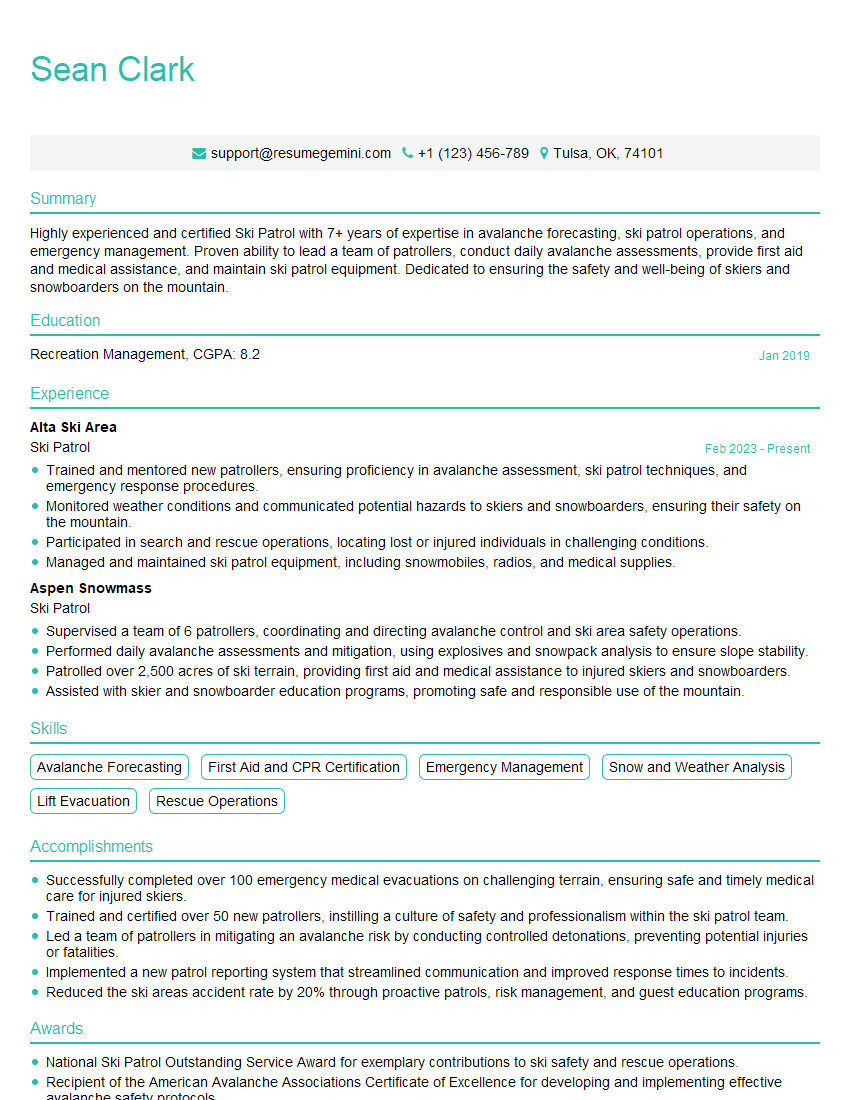
Mastering crevasse rescue techniques significantly enhances your value as a mountaineering professional, opening doors to advanced roles and leadership opportunities. A strong resume is crucial for showcasing these skills to potential employers. To maximize your job prospects, create an ATS-friendly resume that highlights your expertise in crevasse rescue and related disciplines. ResumeGemini is a trusted resource to help you build a professional and impactful resume. We offer examples of resumes tailored to Crevasse Rescue specialists to guide you in crafting your own compelling application materials.
Explore more articles
Users Rating of Our Blogs
Share Your Experience
We value your feedback! Please rate our content and share your thoughts (optional).
What Readers Say About Our Blog
To the interviewgemini.com Webmaster.
Very helpful and content specific questions to help prepare me for my interview!
Thank you
To the interviewgemini.com Webmaster.
This was kind of a unique content I found around the specialized skills. Very helpful questions and good detailed answers.
Very Helpful blog, thank you Interviewgemini team.