Preparation is the key to success in any interview. In this post, we’ll explore crucial Cross-Cultural Communication and Language Proficiency interview questions and equip you with strategies to craft impactful answers. Whether you’re a beginner or a pro, these tips will elevate your preparation.
Questions Asked in Cross-Cultural Communication and Language Proficiency Interview
Q 1. Describe your experience navigating communication challenges across different cultural contexts.
Navigating communication across cultures is like learning a new language, but instead of grammar, it’s understanding unspoken rules and nuances. My experience spans working with teams in Japan, Brazil, and Germany. In Japan, the emphasis on indirect communication and preserving harmony often meant reading between the lines to understand true concerns. In Brazil, a more expressive and emotionally-driven style contrasted sharply with the directness I encountered in Germany. Successfully bridging these differences required active listening, patience, and a willingness to adapt my approach.
- Japan: I learned to observe nonverbal cues like body language and tone more carefully, asking clarifying questions in a respectful and indirect way to avoid causing offense.
- Brazil: I adjusted to a more spontaneous and relational communication style, building rapport before discussing business matters.
- Germany: I ensured clear, concise, and direct communication, focusing on efficiency and factual information.
Q 2. Explain how you would adapt your communication style to effectively interact with individuals from diverse linguistic and cultural backgrounds.
Adapting communication style begins with cultural self-awareness – understanding my own biases and communication preferences. Then, I research the cultural norms of my audience. This might involve reading about communication styles in that culture, or if possible, speaking with someone familiar with the culture beforehand. I adjust my approach by considering:
- High-context vs. low-context communication: High-context cultures (like Japan) rely heavily on nonverbal cues and shared understanding, while low-context cultures (like Germany) value explicit and direct communication. I adjust the level of detail and directness accordingly.
- Direct vs. indirect communication: I tailor my message to match the preferred style. For instance, I would avoid giving negative feedback directly to someone from a culture that values saving face.
- Verbal vs. nonverbal communication: I pay close attention to both verbal and nonverbal cues, recognizing that their relative importance varies across cultures.
- Use of humor and formality: Humor can be tricky – what’s funny in one culture might be offensive in another. I err on the side of caution and adopt a respectful tone, adjusting the level of formality to match the context and audience.
Essentially, it’s about being flexible and empathetic, always prioritizing understanding and building trust.
Q 3. How would you handle a misunderstanding caused by cultural differences in a professional setting?
Misunderstandings are inevitable in cross-cultural communication. My approach involves a structured process:
- Acknowledge the misunderstanding: I begin by acknowledging the difference in understanding without placing blame.
- Active listening: I carefully listen to the other person’s perspective, seeking to understand their viewpoint and the reasons for the misunderstanding.
- Clarification: I use simple language and avoid jargon. I may ask clarifying questions to ensure complete comprehension. I also confirm my understanding of their viewpoint before offering my own.
- Cultural sensitivity: I reflect on whether cultural differences might have played a role. For example, was there a misinterpretation of nonverbal cues, or a clash in communication styles?
- Find a common ground: I work towards a mutually acceptable solution, focusing on common goals and objectives rather than dwelling on the source of the misunderstanding.
- Document and learn: After resolving the issue, I document the situation for future reference, learning from the experience to improve future cross-cultural interactions.
Q 4. What strategies do you employ to ensure clear and effective communication in multilingual teams?
Clear and effective communication in multilingual teams requires a multifaceted strategy:
- Establish a common language: Ideally, teams choose a single language for official communication. If this isn’t feasible, ensure translation and interpretation services are available.
- Use clear and concise language: Avoid jargon, idioms, and slang. Favor simple language and well-structured sentences.
- Utilize visual aids: Charts, graphs, and diagrams can bridge language barriers and make information more accessible.
- Provide language training: Encourage team members to learn basic phrases in each other’s languages.
- Embrace translation tools and technology: Leverage software and tools to facilitate real-time translation and interpretation during meetings.
- Establish clear communication protocols: Define methods and channels for communication and feedback, ensuring everyone understands the preferred ways to convey information.
- Foster a culture of open communication and respect: Encourage team members to openly share their perspectives and concerns, regardless of language barriers.
Q 5. Describe a situation where you had to interpret or translate information, and explain the challenges you encountered.
During a project with a Brazilian partner, I was responsible for interpreting a technical document related to software development. The challenge wasn’t just linguistic but also cultural. The Brazilian document used a lot of informal language and implied meanings that weren’t explicit. Direct translation would have missed crucial nuances and potentially led to misunderstandings. My solution was to focus on conveying the meaning behind the words rather than a literal translation. This required understanding the context and the underlying assumptions implicit in the Brazilian document. It also involved cross-checking the interpretation with Brazilian colleagues to ensure accuracy and cultural sensitivity.
In addition, technical terminology posed a significant challenge. Ensuring the chosen English equivalents were not only accurate but also understood by the project’s English-speaking team required consultation with technical experts to guarantee precision.
Q 6. How proficient are you in [Specific Language]? Provide examples of your usage in professional contexts.
I am proficient in Spanish (Native), English (Fluent), and possess intermediate proficiency in Mandarin Chinese.
Examples of professional usage:
- Spanish: I’ve conducted numerous client meetings and presentations entirely in Spanish, negotiating contracts and delivering training sessions. This proficiency also extends to writing professional reports and correspondence.
- English: My primary professional language. I’ve prepared detailed technical documentation, written scientific publications, and presented research findings at international conferences.
- Mandarin Chinese: I have used my Mandarin skills in conducting initial research interviews, interpreting for short meetings involving Chinese-speaking partners, and facilitating internal team communication between native Mandarin and English speakers.
Q 7. How do you ensure accuracy and cultural sensitivity when translating or interpreting?
Accuracy and cultural sensitivity are paramount in translation and interpretation. To ensure these, I employ several strategies:
- Deep understanding of both source and target cultures: This includes familiarity with cultural norms, values, and communication styles. I avoid direct translation of idioms or phrases that might not translate well.
- Thorough research: I research any unfamiliar terminology or concepts. If there’s a lack of a direct equivalent, I find a culturally appropriate alternative.
- Focus on conveying meaning, not just words: The goal is to accurately convey the message, even if this means paraphrasing or using different sentence structures.
- Back-translation: To verify the accuracy of my translation, I often have it back-translated into the original language by a different translator. This helps detect any potential inconsistencies or errors.
- Consult with subject matter experts: If the text involves technical or specialized content, I consult with experts to ensure accuracy and avoid misinterpretations.
- Review and editing: I always allow time for thorough review and editing to ensure clarity, consistency, and cultural sensitivity.
Q 8. Explain the concept of high-context vs. low-context communication and provide examples.
High-context and low-context communication describe the way information is implicitly or explicitly conveyed in a message. In high-context communication, much of the meaning is implicit and understood through shared cultural background, nonverbal cues, and context. Little is explicitly stated. Think of it like an iceberg – the majority of the message lies beneath the surface. In low-context communication, the message is explicit and direct, with little reliance on shared understanding or nonverbal cues. The meaning is primarily conveyed through words.
- High-context example: In Japan, a subtle nod or a pause in conversation might convey more meaning than a lengthy verbal explanation. The shared cultural understanding dictates the interpretation.
- Low-context example: A direct email outlining project deadlines and expectations in the US is a clear example. The message relies on explicitly stated information.
Understanding this distinction is crucial for effective cross-cultural communication. Misunderstandings can easily arise if someone from a high-context culture interacts with someone from a low-context culture, assuming the other person understands the unspoken aspects of the message.
Q 9. Discuss the importance of nonverbal communication in cross-cultural interactions.
Nonverbal communication – encompassing body language, facial expressions, gestures, eye contact, personal space, and tone of voice – plays a significantly more important role in cross-cultural interactions than in interactions within the same culture. What might be considered polite in one culture can be offensive in another. For instance, direct eye contact is seen as respectful in some cultures, while in others, it can be perceived as aggressive or challenging.
- Example: The use of personal space varies widely. In some cultures, close proximity during conversation is considered normal and friendly, whereas in others, it is seen as invasive and uncomfortable.
Ignoring nonverbal cues can lead to misinterpretations and hinder effective communication. Developing cultural sensitivity and observing nonverbal cues carefully are essential to navigate cross-cultural interactions successfully. Active listening and asking clarifying questions are crucial to avoid misunderstandings.
Q 10. How do you identify and address potential cultural biases in your communication?
Identifying and addressing cultural biases requires constant self-reflection and a commitment to learning. It starts with acknowledging that everyone holds unconscious biases. This isn’t about blaming individuals but rather about recognizing that our experiences shape our perceptions.
- Self-reflection: Regularly examine your own beliefs, assumptions, and stereotypes about different cultures. Ask yourself: What are my assumptions about this culture? Are these assumptions accurate, or based on stereotypes?
- Active listening and seeking diverse perspectives: Actively listen to people from different cultural backgrounds, and seek out diverse perspectives to challenge your own assumptions. Engage with individuals and resources that offer insights into cultures different from your own.
- Using inclusive language: Choose language carefully. Avoid generalizations and stereotypes, using instead specific and respectful language when referring to individuals and groups.
- Seeking feedback: Ask for feedback from others, especially those from different cultural backgrounds, to check for potential biases in your communication.
Addressing biases is an ongoing process, not a destination. Continuous learning and self-reflection are key to fostering culturally sensitive communication.
Q 11. How do you manage conflict effectively in a cross-cultural team setting?
Managing conflict in a cross-cultural team requires a nuanced approach. The strategies used to resolve conflict within a single cultural context may not be effective across different cultures. Direct confrontation, for example, might be acceptable in some cultures but highly offensive in others.
- Understanding cultural conflict styles: Recognize that individuals from different cultures may approach conflict resolution differently. Some cultures value direct confrontation, while others prefer mediation or avoidance.
- Active listening and empathy: Start by actively listening to all parties involved and trying to understand their perspectives from their cultural context. Show empathy and acknowledge their feelings.
- Neutral ground and mediators: If possible, conduct conflict resolution discussions on neutral ground and consider using a neutral mediator who understands the cultural nuances.
- Focus on shared goals: Remind everyone of the shared objectives and how resolving the conflict benefits the team as a whole. This helps to refocus on collaboration.
- Clear and respectful communication: Use clear and concise language, and avoid using jargon or idioms that might not be understood across cultures. Maintain respectful communication throughout the process.
Patience and flexibility are essential. Resolving cross-cultural conflict often takes longer than resolving conflicts within a homogenous group.
Q 12. Describe your understanding of Hofstede’s cultural dimensions.
Hofstede’s cultural dimensions are a framework for understanding cultural differences across nations. Geert Hofstede’s research identified six key dimensions:
- Power Distance Index (PDI): The extent to which less powerful members of a society accept and expect that power is distributed unequally.
- Individualism vs. Collectivism (IDV): The degree to which individuals are integrated into groups.
- Masculinity vs. Femininity (MAS): The distribution of roles between the genders.
- Uncertainty Avoidance Index (UAI): A society’s tolerance for uncertainty and ambiguity.
- Long-Term Orientation vs. Short-Term Orientation (LTO): Focus on future rewards or present results.
- Indulgence vs. Restraint (IND): The extent to which people try to control their desires and impulses.
Understanding these dimensions helps to anticipate cultural differences and potential communication challenges. For instance, a high-power distance culture might expect deference to authority, while a low-power distance culture might value egalitarianism. This framework is a valuable tool for improving cross-cultural understanding and communication.
Q 13. Explain how cultural differences can impact negotiation strategies.
Cultural differences significantly impact negotiation strategies. What is considered an effective negotiation tactic in one culture may be perceived as offensive or ineffective in another. For instance, direct and assertive approaches may be successful in some cultures, but viewed as rude and aggressive in others.
- Communication styles: Direct vs. indirect communication styles greatly impact negotiations. Some cultures value direct and explicit communication, while others favor indirect and nuanced approaches.
- Time perception: Cultures vary in their perception of time. Some prioritize long-term relationships and building trust, while others focus on immediate results. Negotiation timelines and pacing need to be adjusted accordingly.
- Decision-making processes: Decision-making processes vary greatly across cultures. In some cultures, decisions are made quickly by individuals, whereas in others, decisions are made collectively after extensive consultations.
- Relationship building: In some cultures, building trust and rapport is an important part of negotiations, while in others, the focus is purely on the business deal.
Successful cross-cultural negotiation requires adapting your approach to the specific cultural context, demonstrating respect for the other party’s culture, and building strong relationships before diving into business negotiations. Researching and understanding the other party’s culture is paramount to effective negotiation.
Q 14. How do you adapt your presentation style to cater to diverse audiences?
Adapting a presentation style to cater to diverse audiences requires careful consideration of cultural preferences and communication styles. A presentation effective in one cultural context might be ineffective or even offensive in another.
- Content adaptation: Tailor the content to resonate with the audience’s cultural background, knowledge level, and interests. Use relevant examples and analogies.
- Communication style: Adjust your communication style to match the audience’s expectations. In some cultures, a formal and structured presentation is preferred, while in others, a more informal and interactive approach might be more effective.
- Visual aids: Use visuals that are culturally appropriate and easy to understand. Avoid using images or symbols that might be offensive or misinterpreted.
- Language: If possible, use the audience’s native language or a language they are comfortable with. If this is not possible, ensure your language is simple, clear, and avoids jargon.
- Nonverbal communication: Be mindful of your nonverbal cues. Adjust your body language, tone of voice, and eye contact to be respectful and appropriate.
- Audience engagement: Incorporate interactive elements such as Q&A sessions or group discussions to encourage audience participation and create a more inclusive environment.
Researching your audience and considering their cultural backgrounds beforehand is essential for delivering an effective and engaging presentation. This includes understanding their communication preferences and tailoring your approach accordingly.
Q 15. How familiar are you with different communication styles across various cultures?
My familiarity with diverse communication styles across cultures is extensive. I understand that communication isn’t just about the words used, but also the context, nonverbal cues, and underlying cultural values. For example, direct communication is valued in some cultures (like Germany or the US), where explicitness is preferred. In contrast, indirect communication is more common in high-context cultures (like Japan or many Latin American countries), where meaning is often implied and reading between the lines is crucial. I’m knowledgeable about high and low power distance cultures, individualistic versus collectivistic societies, and the impact of cultural dimensions like uncertainty avoidance and masculinity/femininity on communication patterns. My understanding encompasses verbal and non-verbal aspects, including variations in body language, eye contact, personal space, and even the use of silence.
- High-context cultures: Meaning is heavily reliant on the context and shared understanding. Silence can be meaningful.
- Low-context cultures: Meaning is primarily conveyed through explicit verbal communication.
- High-power distance cultures: Communication is hierarchical; subordinates may be hesitant to directly challenge superiors.
- Low-power distance cultures: Communication is more egalitarian; open dialogue is encouraged.
Career Expert Tips:
- Ace those interviews! Prepare effectively by reviewing the Top 50 Most Common Interview Questions on ResumeGemini.
- Navigate your job search with confidence! Explore a wide range of Career Tips on ResumeGemini. Learn about common challenges and recommendations to overcome them.
- Craft the perfect resume! Master the Art of Resume Writing with ResumeGemini’s guide. Showcase your unique qualifications and achievements effectively.
- Don’t miss out on holiday savings! Build your dream resume with ResumeGemini’s ATS optimized templates.
Q 16. Describe a time you had to adapt your communication to a specific cultural nuance.
During a negotiation with a potential client from Saudi Arabia, I realized that building rapport and trust was paramount before discussing business specifics. In my own culture, I’m accustomed to a more direct and task-oriented approach. However, I quickly learned that in Saudi Arabian culture, strong interpersonal relationships are foundational to successful business dealings. Therefore, I adapted my communication style. Instead of immediately diving into the details of the contract, I spent considerable time engaging in small talk, showing genuine interest in their culture and family, and establishing a personal connection. This approach, although initially deviating from my typical communication style, ultimately led to a successful negotiation and a long-term business relationship.
Q 17. What resources do you utilize to improve your cross-cultural communication skills?
To enhance my cross-cultural communication skills, I continuously utilize a variety of resources. This includes:
- Academic research: I regularly read peer-reviewed articles and books on intercultural communication, focusing on specific cultural contexts and communication theories.
- Online courses and workshops: Platforms like Coursera and edX offer excellent courses on cross-cultural communication, conflict resolution, and language learning.
- Cultural immersion experiences: Whenever possible, I engage in activities that allow me to immerse myself in different cultures, such as traveling, attending cultural events, and interacting with people from diverse backgrounds.
- Language learning apps and resources: I actively learn new languages, using apps like Duolingo and Babbel to enhance my understanding of different linguistic nuances and cultural perspectives.
- Mentorship and networking: I regularly connect with professionals who have extensive experience working in international settings and benefit from their guidance and experiences.
Q 18. How do you handle communication barriers when working with individuals who have limited language proficiency?
When working with individuals who have limited language proficiency, I employ a multifaceted approach that prioritizes clarity and understanding. This includes:
- Using simple language and avoiding jargon: I avoid complex sentence structures and technical terms, opting for clear and concise vocabulary.
- Visual aids: Images, diagrams, and other visual aids can significantly enhance communication and bridge language gaps.
- Translation tools and interpreters: I utilize professional translation services when necessary, ensuring accuracy and cultural sensitivity.
- Nonverbal communication: I pay close attention to body language and nonverbal cues to better understand their responses and intentions.
- Patience and empathy: I maintain patience, recognizing that communication may take longer and require repeated clarification.
- Active listening: I focus on understanding the individual’s perspective and message rather than solely focusing on my own message.
Q 19. Explain your approach to building rapport with individuals from diverse cultural backgrounds.
Building rapport with individuals from diverse cultural backgrounds relies on demonstrating respect, empathy, and genuine interest. I begin by actively listening to their perspectives and showing genuine interest in their experiences and cultural background. I avoid making assumptions and actively seek to understand their communication styles. I adapt my own communication to be respectful of their cultural norms and preferences. This includes being mindful of personal space, eye contact, and other nonverbal cues. I also make an effort to learn basic phrases in their native language to show respect and build trust.
For example, when working with colleagues from Japan, I learned about the importance of bowing as a respectful greeting and incorporated this gesture into my interactions. This small act of cultural awareness fostered trust and helped to establish a positive working relationship.
Q 20. How do you ensure inclusivity and equity in your communications?
Ensuring inclusivity and equity in communication is crucial. My approach focuses on:
- Using inclusive language: I avoid gendered or other biased language, using terms that are inclusive and respectful of all genders, ethnicities, and backgrounds.
- Active listening and validation: I actively listen to the perspectives of individuals from marginalized groups and validate their experiences.
- Seeking diverse perspectives: I actively solicit input and perspectives from individuals from different backgrounds to ensure that all voices are heard and considered.
- Accessibility: I use clear and concise language, and provide alternative formats for information as needed.
- Cultural sensitivity training: I actively participate in cultural sensitivity training to enhance my awareness and understanding of biases.
For instance, in team meetings, I always encourage participation from all members and make sure everyone feels comfortable sharing their ideas, ensuring that the communication environment is safe and respectful for everyone involved.
Q 21. Describe your experience working on projects with international teams.
I have extensive experience working on projects with international teams. In one instance, I worked on a software development project with team members located in India, the UK, and the US. The project’s success hinged on effective communication across time zones and cultures. We established clear communication protocols, including regular video conferences, utilizing project management software for transparent task assignments, and being mindful of the different time zones. We also made a concerted effort to understand and accommodate individual communication styles and preferences. This involved regular check-ins to address any cultural misunderstandings or communication barriers promptly. The result was a successfully delivered product, on time and within budget, and a strong, cohesive team despite geographical and cultural differences. This project reinforced the importance of planning, clear communication strategies, empathy, and respect in managing international teams.
Q 22. How do you leverage technology to facilitate cross-cultural communication?
Technology is indispensable in facilitating cross-cultural communication. It bridges geographical distances and cultural gaps, offering tools for real-time interaction and asynchronous communication. I leverage several technologies:
Video conferencing platforms (Zoom, Google Meet, Microsoft Teams): These tools enable face-to-face interactions, crucial for observing nonverbal cues which often hold significant cultural weight. For example, maintaining appropriate eye contact differs greatly across cultures; these platforms allow for visual observation and adaptation.
Translation and interpretation services (Google Translate, professional interpreters): While machine translation has limitations, it can aid comprehension in initial interactions. However, I always prioritize professional human interpreters for critical discussions where nuance and cultural context are paramount. The subtle differences in meaning lost in direct translation can lead to serious misunderstandings.
Project management software (Asana, Trello): These platforms facilitate collaborative work across diverse teams, ensuring clarity and transparency in communication and task delegation. Clear task assignments and shared documentation minimize the likelihood of miscommunication due to cultural differences in communication styles.
Social media and online forums (with caution): These can offer insights into different cultural norms and perspectives. However, it’s vital to critically evaluate information found online, recognizing potential biases and stereotypes.
The key is to select the right technology for the specific context and to be mindful of potential limitations. Technology assists, but strong intercultural competency remains the foundation of effective communication.
Q 23. What are some common cultural misunderstandings you’ve encountered and how did you resolve them?
One common misunderstanding I encountered involved differing perceptions of punctuality. In a meeting with a team from Latin America, a perceived lateness led to initial tension. I realized their understanding of “on time” was more flexible than my own, rooted in a more rigid North American cultural norm. Resolving this involved clarifying expectations upfront, emphasizing the importance of time management within the project framework, but also acknowledging the cultural nuances of time perception. Open communication, empathy, and a willingness to understand different perspectives were crucial in bridging this cultural gap.
Another example involved the interpretation of silence during negotiations. In a business deal with an Asian team, periods of silence were initially interpreted as disagreement or disapproval. However, I learned that, in their culture, silence can reflect contemplation and consideration, not necessarily a negative reaction. This understanding significantly altered my approach, emphasizing active listening and allowing for extended periods of quiet reflection during the negotiations.
Q 24. How do you navigate differences in communication styles related to formality and directness?
Navigating differences in formality and directness requires a high degree of cultural sensitivity and adaptability. High-context cultures (like many East Asian cultures) often favor indirect communication and nuanced language, valuing harmony and saving face. Low-context cultures (like many North American and Western European cultures) tend towards direct and explicit communication. My approach involves:
Careful observation: I pay close attention to the communication style of the other party, adapting my own approach accordingly. This might mean using more formal language in some interactions and a more direct style in others.
Active listening: I listen carefully to what is being said, both verbally and nonverbally, to ensure accurate understanding. Paying close attention to subtle cues like body language and tone is critical in high-context cultures.
Clarification: If unsure about the meaning of something, I ask clarifying questions to avoid misunderstandings. This approach works across all cultures, demonstrating respect and a commitment to mutual understanding.
Contextual awareness: I tailor my communication style to the context – a formal business meeting requires a different approach than an informal team lunch. The level of formality and directness needed is entirely dependent on the situation.
Essentially, it’s about being flexible and respectful, avoiding assumptions and prioritizing clear and considerate communication.
Q 25. Discuss the challenges of managing cross-cultural relationships in the workplace.
Managing cross-cultural relationships in the workplace presents several challenges, including:
Communication barriers: Differences in language, communication styles, and nonverbal cues can lead to misinterpretations and misunderstandings.
Conflicting work styles: Different cultures have different approaches to teamwork, task completion, and decision-making, which can create conflict if not properly addressed.
Varying power dynamics: Hierarchical structures and expectations of authority vary across cultures, leading to potential misunderstandings and discomfort if not managed carefully.
Cultural biases and stereotypes: Unconscious biases can influence perceptions and interactions, negatively affecting teamwork and collaboration.
Differing conflict resolution styles: Cultures vary widely in how they approach and resolve conflict. Direct confrontation may be acceptable in some cultures, while others prefer more indirect methods.
Effective management requires fostering open communication, establishing clear expectations, providing cross-cultural training, promoting mutual respect and understanding, and implementing conflict resolution strategies that are sensitive to cultural differences.
Q 26. How do you ensure that your communication is culturally appropriate and respectful?
Ensuring culturally appropriate and respectful communication is a continuous process requiring mindful engagement and learning. My strategies include:
Research and self-education: Before interacting with individuals from different cultures, I dedicate time to understanding their cultural norms, values, and communication styles through research and readings.
Active listening and empathy: I actively listen to understand their perspectives, acknowledging their experiences and validating their feelings.
Avoiding generalizations and stereotypes: I treat each individual as a unique person, avoiding broad generalizations based on cultural background.
Using inclusive language: I consciously choose language that is inclusive and avoids jargon or slang that might not be understood or appreciated by everyone.
Seeking feedback: I regularly ask for feedback to ensure that my communication is being received as intended and make adjustments as needed.
Respecting nonverbal communication: I’m mindful of my own nonverbal cues, and equally attentive to those of others, acknowledging that nonverbal communication holds significant cultural meaning.
Essentially, it’s a commitment to ongoing learning and adaptability, valuing the diversity of perspectives and always showing respect.
Q 27. Describe a time you had to adapt your communication style due to a difference in power dynamics.
During a project with a senior executive from a hierarchical culture, I had to adapt my communication style to reflect the power dynamics. While my usual approach is collaborative and participatory, I realized that a more formal and deferential tone was appropriate given the context. I ensured my communication was clear, concise, and respectful of their seniority, providing information in a structured manner without challenging their authority directly. Instead of directly proposing solutions, I presented options for consideration, acknowledging their expertise and experience. This approach not only ensured effective communication but also built rapport and trust, demonstrating my sensitivity to cultural expectations surrounding power dynamics.
Q 28. What are your strategies for overcoming cultural differences in decision-making processes?
Overcoming cultural differences in decision-making processes requires a multifaceted approach:
Understanding decision-making styles: Some cultures value consensus-building, while others favor a more top-down approach. I first aim to understand the preferred approach within the specific cultural context.
Clear communication of expectations and processes: This involves explicitly outlining the decision-making process from the outset, ensuring that all parties understand the steps involved, roles, and timelines.
Facilitating open dialogue and collaboration: Creating a safe space where all voices are heard and valued is essential. This might involve using techniques such as brainstorming or structured problem-solving sessions to encourage participation.
Respecting differing perspectives: Acknowledging and respecting different viewpoints, even if they differ from my own, is paramount. This involves active listening and seeking clarification to reach a shared understanding.
Finding common ground: Focusing on shared goals and objectives helps navigate differences and build consensus. This might involve highlighting the mutual benefits of a specific decision.
The key is to find a balance between respecting cultural differences in decision-making styles and ensuring efficient and effective outcomes. Flexibility, clear communication, and a commitment to collaboration are essential ingredients for success.
Key Topics to Learn for Cross-Cultural Communication and Language Proficiency Interview
- Understanding Cultural Dimensions: Explore frameworks like Hofstede’s cultural dimensions and their impact on communication styles, negotiation strategies, and conflict resolution. Consider how high-context vs. low-context communication affects interactions.
- Nonverbal Communication: Analyze the role of body language, gestures, eye contact, and personal space in different cultures. Practice recognizing and interpreting nonverbal cues to avoid miscommunication.
- High-Impact Communication Strategies: Learn techniques for clear and concise communication across cultures, including active listening, adapting your language style, and employing empathy in diverse settings.
- Cross-Cultural Conflict Management: Develop strategies for resolving conflicts sensitively and effectively, taking into account cultural nuances and perspectives. Understand how to navigate disagreements while building and maintaining positive relationships.
- Language Proficiency & its Applications: Discuss your fluency levels in relevant languages and showcase practical applications demonstrating your ability to adapt your communication effectively based on audience and context. Highlight experiences using language skills in professional settings.
- Ethical Considerations: Demonstrate awareness of ethical considerations in cross-cultural communication, such as cultural sensitivity, avoiding stereotypes, and promoting inclusivity.
- Practical Case Studies: Prepare examples from your experience (work, volunteer, academic) to illustrate how you’ve successfully navigated cross-cultural communication challenges. Focus on problem-solving and demonstrating your skills.
Next Steps
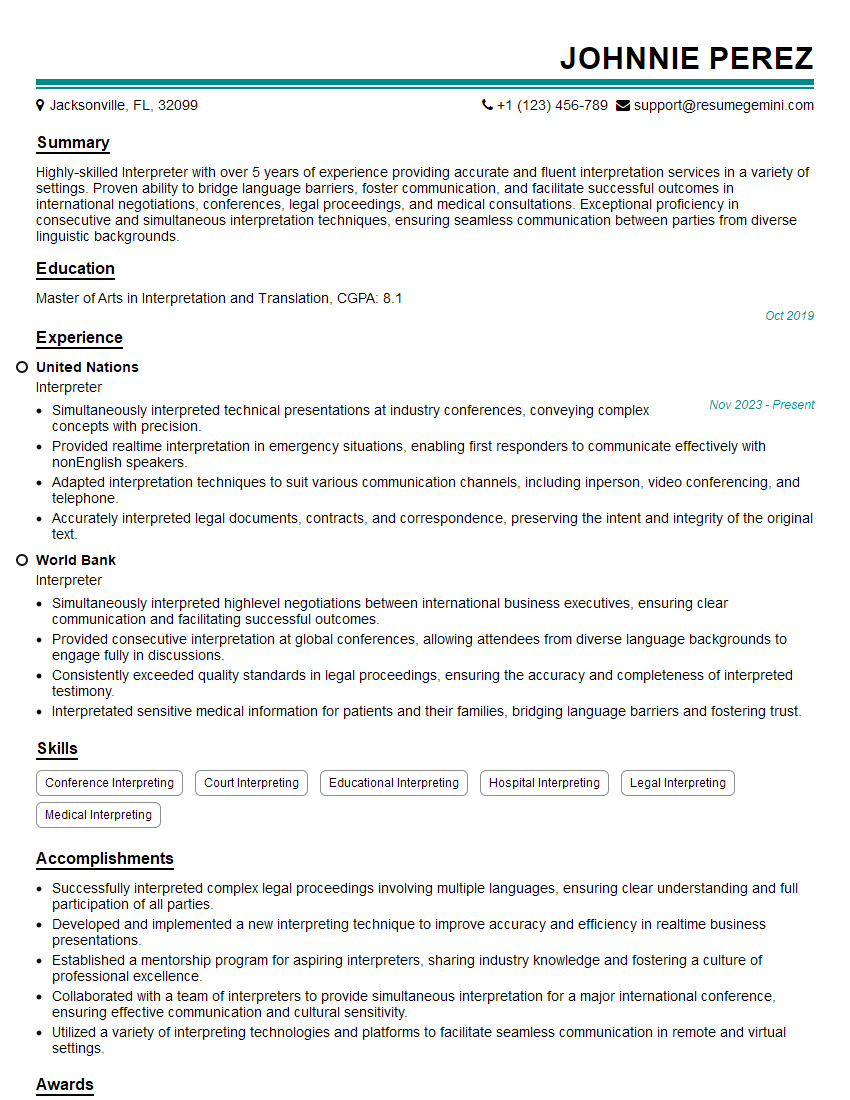
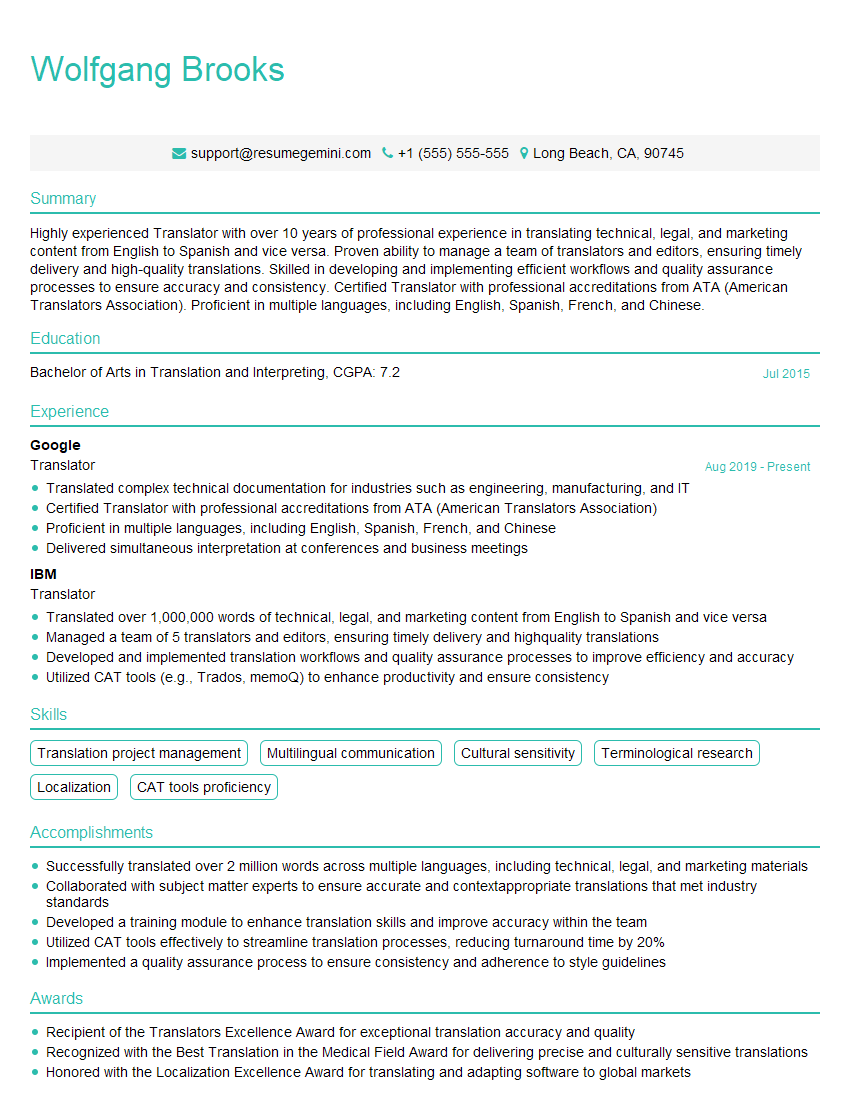
Mastering cross-cultural communication and language proficiency is increasingly vital for career success in today’s globalized world. It demonstrates adaptability, empathy, and valuable problem-solving skills, opening doors to diverse opportunities and enriching professional collaborations. To significantly boost your job prospects, crafting an ATS-friendly resume is crucial. ResumeGemini is a trusted resource to help you build a professional resume that highlights your unique skills and experiences. We provide examples of resumes tailored to Cross-Cultural Communication and Language Proficiency to help you get started.
Explore more articles
Users Rating of Our Blogs
Share Your Experience
We value your feedback! Please rate our content and share your thoughts (optional).
What Readers Say About Our Blog
To the interviewgemini.com Webmaster.
Very helpful and content specific questions to help prepare me for my interview!
Thank you
To the interviewgemini.com Webmaster.
This was kind of a unique content I found around the specialized skills. Very helpful questions and good detailed answers.
Very Helpful blog, thank you Interviewgemini team.