Every successful interview starts with knowing what to expect. In this blog, we’ll take you through the top DC and AC Electrical Calculations interview questions, breaking them down with expert tips to help you deliver impactful answers. Step into your next interview fully prepared and ready to succeed.
Questions Asked in DC and AC Electrical Calculations Interview
Q 1. Explain the difference between AC and DC electricity.
The fundamental difference between AC and DC electricity lies in the direction of electron flow. In DC (Direct Current), electrons flow consistently in one direction, like a river flowing downstream. This is the type of electricity produced by batteries. In contrast, AC (Alternating Current), electrons periodically reverse their direction of flow, oscillating back and forth like a pendulum. This is the type of electricity that powers our homes and businesses, supplied by power grids.
Think of it like this: DC is like a steady stream, always flowing in the same direction, while AC is like a wave, constantly changing direction. This difference has significant implications for how we generate, transmit, and utilize electricity.
Q 2. What is Ohm’s Law and how is it applied in DC circuits?
Ohm’s Law is a fundamental principle in electrical circuits stating that the current (I) flowing through a conductor is directly proportional to the voltage (V) applied across it and inversely proportional to its resistance (R). Mathematically, it’s represented as: V = I * R
In DC circuits, Ohm’s Law is crucial for calculating voltage, current, or resistance if two of the three parameters are known. For example, if you know the voltage across a resistor and its resistance, you can easily calculate the current flowing through it. Let’s say you have a 12V battery connected to a 4Ω resistor. Using Ohm’s Law: I = V / R = 12V / 4Ω = 3A. Therefore, a current of 3 Amperes will flow through the resistor.
Ohm’s Law is extensively used in circuit design and troubleshooting. It allows engineers to predict the behavior of circuits and ensures components are appropriately sized to avoid damage or malfunction.
Q 3. How do you calculate the total resistance in a series and parallel DC circuit?
Calculating total resistance depends on whether the resistors are connected in series or parallel.
- Series Circuit: In a series circuit, resistors are connected end-to-end, forming a single path for current flow. The total resistance (Rtotal) is simply the sum of the individual resistances:
Rtotal = R1 + R2 + R3 + ...For example, if you have three resistors (2Ω, 3Ω, and 5Ω) connected in series, the total resistance is 2Ω + 3Ω + 5Ω = 10Ω.
- Parallel Circuit: In a parallel circuit, resistors are connected across each other, providing multiple paths for current flow. The total resistance is calculated using the reciprocal formula:
1/Rtotal = 1/R1 + 1/R2 + 1/R3 + ...For the same resistors (2Ω, 3Ω, and 5Ω) in parallel:
1/Rtotal = 1/2 + 1/3 + 1/5 = 31/30. Therefore,Rtotal = 30/31 Ω ≈ 0.97Ω. Notice that the total resistance in a parallel circuit is always less than the smallest individual resistance.
Q 4. Explain Kirchhoff’s Voltage and Current Laws.
Kirchhoff’s Laws are fundamental laws used to analyze complex electrical circuits.
- Kirchhoff’s Voltage Law (KVL): The sum of the voltages around any closed loop in a circuit is always zero. This is based on the principle of energy conservation; the energy gained by a charge as it moves through a voltage source must be equal to the energy lost as it moves through the resistors in the loop. Imagine tracing a loop in a circuit. Some components will add voltage (like batteries), while others will subtract voltage (like resistors). The sum must always equal zero.
- Kirchhoff’s Current Law (KCL): The sum of currents entering a junction (node) in a circuit is equal to the sum of currents leaving that junction. This is based on the principle of charge conservation; the amount of charge entering a junction must equal the amount of charge leaving it. This means current is neither created nor destroyed at a junction.
KVL and KCL are essential tools for analyzing complex networks, solving for unknown voltages and currents in circuits that can’t be easily simplified using Ohm’s Law alone.
Q 5. Describe different types of DC motors and their applications.
DC motors convert electrical energy into mechanical energy. Several types exist, each with specific applications:
- Permanent Magnet DC Motors: These motors use permanent magnets to create the magnetic field, offering simplicity and cost-effectiveness. They’re commonly found in small appliances, toys, and hobbyist projects.
- Series Wound DC Motors: In this type, the armature and field windings are connected in series. They have high starting torque but can reach dangerously high speeds under no-load conditions. They’re often used in applications requiring high torque at low speeds, such as electric vehicles.
- Shunt Wound DC Motors: Here, the armature and field windings are connected in parallel. They offer relatively constant speed under varying loads and are used in applications requiring speed regulation, like pumps and conveyors.
- Compound Wound DC Motors: These motors combine series and shunt windings, blending the characteristics of both. They offer high starting torque and relatively constant speed, finding use in elevators and cranes.
Q 6. What are the advantages and disadvantages of using AC and DC power?
Both AC and DC power have advantages and disadvantages:
| Feature | AC | DC |
|---|---|---|
| Generation | Easier and more efficient for long-distance transmission | Requires specialized equipment for high-voltage transmission |
| Transmission | Efficient over long distances using transformers | Less efficient over long distances, significant voltage drop |
| Safety | Generally safer due to lower voltage levels in household applications | Can be more dangerous due to higher voltage in some industrial applications |
| Applications | Household appliances, industrial machinery, power grids | Batteries, electronic devices, some industrial applications |
| Cost | Generally less expensive infrastructure for widespread distribution | Higher cost for long distance transmission, specialized equipment |
The choice between AC and DC depends on the specific application. AC is dominant in power grids due to its efficient transmission capabilities, while DC is often preferred for electronic devices and batteries due to its suitability for powering sensitive electronics.
Q 7. Explain the concept of impedance in AC circuits.
In AC circuits, impedance (Z) is the measure of opposition to the flow of current. Unlike resistance in DC circuits, impedance considers not only resistance (R) but also the effects of capacitance (C) and inductance (L). These components store energy and release it, creating a phase shift between voltage and current.
Impedance is a complex number expressed as: Z = R + jX, where R is resistance and X is reactance (the combined effect of capacitive and inductive reactance, XC and XL respectively).
XL = 2πfL (Inductive reactance, where f is frequency and L is inductance)
XC = 1/(2πfC) (Capacitive reactance, where f is frequency and C is capacitance)
The total reactance is X = XL - XC. Impedance is crucial in AC circuit analysis, as it determines the current flow and power dissipation in circuits containing capacitors and inductors. Understanding impedance is vital for designing efficient and stable AC circuits, such as power filters and resonant circuits used in radio and communication systems.
Q 8. How do you calculate the impedance of a series RLC circuit?
Calculating the impedance of a series RLC circuit involves understanding the individual impedances of resistors (R), inductors (L), and capacitors (C) and how they combine. Resistors offer purely resistive impedance (ZR = R), while inductors and capacitors introduce reactance, an opposition to current flow that depends on frequency. Inductive reactance (XL = 2πfL) is positive, and capacitive reactance (XC = 1/(2πfC)) is negative.
In a series RLC circuit, the total impedance (Z) is a complex number representing the combined effect of resistance and reactance. It’s calculated using the following formula:
Z = R + j(XL - XC)where ‘j’ is the imaginary unit (√-1). The magnitude of the impedance is given by:
|Z| = √(R² + (XL - XC)²)Example: Consider a series circuit with R = 100Ω, L = 10mH, C = 1µF, and a frequency (f) of 1kHz.
First, calculate the reactances:
XL = 2π(1000Hz)(0.01H) ≈ 62.83ΩXC = 1/(2π(1000Hz)(10-6F)) ≈ 159.15ΩThen, calculate the impedance:
Z = 100 + j(62.83 - 159.15) = 100 - j96.32ΩThe magnitude of the impedance is:
|Z| = √(100² + (-96.32)²) ≈ 139.2ΩThis calculation helps determine the current flow and voltage drops across each component in the circuit, crucial for circuit design and analysis.
Q 9. What is resonance in an AC circuit and how is it calculated?
Resonance in an AC circuit occurs when the inductive reactance (XL) and capacitive reactance (XC) are equal in magnitude. At this frequency, the impedance is purely resistive (Z = R), leading to a maximum current for a given voltage. Think of it like pushing a child on a swing – you need to push at the right frequency (resonance) to achieve the maximum amplitude.
The resonant frequency (fr) is calculated using the following formula:
fr = 1/(2π√(LC))Example: For the same RLC circuit from the previous question (L = 10mH, C = 1µF), the resonant frequency is:
fr = 1/(2π√(0.01H * 10-6F)) ≈ 1591.5HzAt this frequency, the impedance is minimized, and the current is maximized. Resonance is a key concept in designing tuned circuits, such as those used in radio receivers to select specific frequencies.
Q 10. Describe different types of AC motors and their applications.
AC motors are broadly categorized into several types, each suited for specific applications. Some common types include:
- Induction Motors: These are the most common type, simple and robust. They work on the principle of electromagnetic induction, where a rotating magnetic field in the stator induces current in the rotor, causing it to rotate. Subtypes include squirrel-cage and wound-rotor induction motors, with applications ranging from fans and pumps to industrial machinery.
- Synchronous Motors: These motors run at a constant speed determined by the frequency of the AC power supply. They require a separate excitation system and are often used in applications requiring precise speed control, like clocks and high-precision machinery.
- Stepper Motors: Stepper motors rotate in discrete steps, controlled by pulses. They offer precise positional control and are widely used in robotics, 3D printers, and other applications requiring accurate movement.
- Servomotors: These motors are used in feedback control systems, incorporating sensors to maintain precise speed and position. They are vital in applications requiring high accuracy and responsiveness, such as automated manufacturing and robotics.
- Universal Motors: These can operate on both AC and DC power, making them versatile. They are frequently found in hand-held appliances like blenders and vacuum cleaners.
The choice of motor depends on factors like required speed, torque, accuracy, cost, and operating environment. For example, a high-torque induction motor is suitable for a conveyor belt, while a precise stepper motor is ideal for a robotic arm.
Q 11. Explain the concept of power factor and its importance.
The power factor is the cosine of the angle between the voltage and current waveforms in an AC circuit. It represents the efficiency of power usage. A power factor of 1 (or 100%) indicates that the voltage and current are perfectly in phase, meaning all the power is used effectively. A lower power factor indicates that a significant portion of the current is not contributing to real power, but rather to reactive power (associated with inductors and capacitors).
Importance: A low power factor leads to several problems:
- Increased current: To deliver the same amount of real power, a lower power factor requires a higher current, leading to increased losses in wiring and equipment.
- Higher energy bills: You pay for real power, but the higher current due to reactive power still stresses the system and increases the cost.
- Reduced equipment capacity: Overloaded equipment due to higher current can lead to premature failure.
Improving the power factor is crucial for efficient energy use and reducing operational costs.
Q 12. How do you improve the power factor in an AC circuit?
Improving the power factor involves reducing the reactive power in the circuit. This is typically done by adding power factor correction capacitors. These capacitors supply the reactive power required by inductive loads (like motors), reducing the reactive component of the current and bringing the power factor closer to 1.
The size of the capacitor needed depends on the amount of reactive power and the desired power factor improvement. Power factor correction calculations often involve complex number arithmetic and power triangle analysis. Specialized software or engineering expertise is often used for detailed calculations in industrial settings. Simple scenarios can be handled with readily available online calculators.
Example: In a factory with many induction motors, adding capacitor banks to the power supply can significantly improve the overall power factor, reducing energy consumption and the strain on the electrical system. This translates to cost savings and improved reliability.
Q 13. Explain the difference between single-phase and three-phase AC power.
The key difference between single-phase and three-phase AC power lies in the number of phases and their arrangement. Single-phase AC power has one voltage waveform, while three-phase AC power has three voltage waveforms, each 120 degrees out of phase with the others.
Single-phase: Typically used for residential applications, it’s simpler and less expensive, but it produces a pulsating power delivery which can cause fluctuations in some applications.
Three-phase: Commonly used for industrial and commercial applications, it provides a more constant power delivery with reduced fluctuations. This results in smoother operation of motors, higher efficiency, and greater power capacity for the same amount of current compared to single-phase. Three-phase systems also allow for more efficient power transmission over longer distances.
In essence, three-phase provides a more robust and efficient power delivery system, better suited for high-power applications and industrial settings, while single-phase is adequate and cost-effective for residential needs.
Q 14. What is a transformer and how does it work?
A transformer is a passive electrical device that transfers electrical energy between two or more circuits through electromagnetic induction. It consists of two or more coils of wire wound around a ferromagnetic core. The core facilitates the magnetic coupling between the coils.
How it Works: When an alternating current flows through one coil (the primary winding), it creates a changing magnetic field in the core. This changing magnetic field induces an electromotive force (EMF) in the other coil(s) (the secondary winding(s)). The voltage induced in the secondary winding is proportional to the ratio of the number of turns in the primary and secondary windings (turns ratio).
Transformers are used to step up (increase) or step down (decrease) voltage levels in AC circuits. Step-up transformers have more turns in the secondary winding than in the primary, while step-down transformers have fewer turns in the secondary winding. They are essential components in power distribution systems, enabling efficient transmission of electricity over long distances at high voltage and subsequent reduction to safer levels for domestic use.
Q 15. How do you calculate the voltage and current transformations in a transformer?
Voltage and current transformations in a transformer are governed by the turns ratio. Imagine a transformer as a voltage-scaling device. The ratio of the number of turns in the primary coil (Np) to the number of turns in the secondary coil (Ns) determines the voltage transformation. The voltage on the secondary side (Vs) is related to the primary voltage (Vp) by the equation: Vs / Vp = Ns / Np. This is the fundamental principle behind step-up (Ns > Np) and step-down (Ns < Np) transformers.
Current transformation follows the principle of conservation of power (ignoring losses). Assuming an ideal transformer (no energy loss), the power in the primary coil (Pp) equals the power in the secondary coil (Ps): Pp = Ps. Since power is the product of voltage and current (P = VI), we can derive the current relationship: Is / Ip = Np / Ns. Notice that the current ratio is the inverse of the voltage ratio. A step-up transformer increases voltage but decreases current, and vice-versa for a step-down transformer. Real-world transformers have some losses due to resistance and core losses, but this idealized model provides a good starting point for understanding the core principle.
Example: A transformer with 100 turns on the primary and 200 turns on the secondary (Np = 100, Ns = 200) has a turns ratio of 1:2. If the primary voltage is 120V, the secondary voltage will be 240V. If the primary current is 10A, the secondary current will be 5A. Note that the power remains approximately constant (1200W in both cases, ignoring losses).
Career Expert Tips:
- Ace those interviews! Prepare effectively by reviewing the Top 50 Most Common Interview Questions on ResumeGemini.
- Navigate your job search with confidence! Explore a wide range of Career Tips on ResumeGemini. Learn about common challenges and recommendations to overcome them.
- Craft the perfect resume! Master the Art of Resume Writing with ResumeGemini’s guide. Showcase your unique qualifications and achievements effectively.
- Don’t miss out on holiday savings! Build your dream resume with ResumeGemini’s ATS optimized templates.
Q 16. Explain the concept of reactive power and apparent power.
In AC circuits, power is more complex than in DC because of the presence of reactive components (capacitors and inductors). Apparent power (S) is the total power supplied to a circuit, represented by the product of voltage and current (S = VI). It is measured in Volt-Amperes (VA). However, not all of this apparent power is used to do useful work. Some of it is stored and released by reactive components, contributing to what’s called reactive power (Q). Reactive power is the power that oscillates between the source and the reactive components, never actually being consumed. It’s measured in Volt-Ampere Reactive (VAR).
Real power (P), measured in Watts (W), is the actual power used to do work, like powering a motor or lighting a bulb. The relationship between these three powers is described by the power triangle: S2 = P2 + Q2. The power factor (PF) is the cosine of the angle in this triangle, representing the ratio of real power to apparent power (PF = P/S). A low power factor indicates a significant amount of reactive power, leading to inefficiencies in the system.
Example: Imagine a motor drawing 10A at 240V. The apparent power is 2400VA. However, if the motor has a power factor of 0.8, the real power consumed is only 1920W, while 1536VAR are exchanged reactively. Improving power factor is crucial in industrial settings to minimize energy losses and improve efficiency.
Q 17. Describe different types of capacitors and their applications in AC circuits.
Capacitors are passive components that store energy in an electric field. Different types are characterized by their dielectric material and construction.
- Ceramic Capacitors: Common, inexpensive, and come in various sizes and capacitances. Used widely in electronic circuits for coupling, decoupling, and filtering.
- Electrolytic Capacitors: High capacitance in a small package but have polarity (positive and negative terminals) and limited voltage ratings. Commonly used for power supply filtering and energy storage.
- Film Capacitors: Offer good stability, high accuracy, and lower losses compared to ceramic or electrolytic types. Applications include high-frequency circuits, timing circuits, and signal processing.
- Variable Capacitors: Allow adjustment of capacitance, often used in tuning circuits (e.g., radio receivers).
Applications in AC circuits:
- Filtering: Capacitors block DC and pass AC signals, essential in power supplies and signal processing.
- Power factor correction: Large capacitors are used in industrial settings to compensate for inductive loads, improving power factor and reducing energy losses.
- Resonant circuits: Capacitors combined with inductors create resonant circuits used in oscillators, filters, and radio frequency applications.
- Timing circuits: Capacitors charge and discharge at specific rates, used for timing and wave shaping in various circuits.
Q 18. Describe different types of inductors and their applications in AC circuits.
Inductors are passive components that store energy in a magnetic field. Their behavior in AC circuits is characterized by inductance (measured in Henries). Different types are categorized based on their core material and construction:
- Air-core inductors: Simple coils with air as the core material. Have low inductance but high Q factor (measure of efficiency), ideal for high-frequency applications.
- Iron-core inductors: Use iron or ferrite cores to increase inductance. More efficient for lower frequencies but can introduce core losses.
- Toroidal inductors: Coils wound around a toroidal core, minimizing magnetic field leakage and offering higher efficiency.
Applications in AC circuits:
- Filtering: Inductors block high-frequency signals while passing low-frequency signals, a crucial function in power supplies and audio applications.
- Energy storage: In switching power supplies and inductive energy storage systems.
- Resonant circuits: Combination with capacitors in oscillators, filters, and tuning circuits.
- Chokes: Used to suppress unwanted AC noise or current fluctuations in DC circuits.
- Transformers: Fundamental components in AC power systems, stepping up or down voltages.
Q 19. Explain the concept of phase shift in AC circuits.
Phase shift in AC circuits refers to the time difference between two or more sinusoidal waveforms of the same frequency. It’s measured in degrees or radians. This time difference arises from the different behavior of resistive, inductive, and capacitive components.
Resistors: Voltage and current are in phase across a resistor; they reach their peak and zero values simultaneously. Inductors: The current through an inductor lags the voltage across it by 90 degrees (π/2 radians). This is because inductors resist changes in current. Capacitors: The current through a capacitor leads the voltage across it by 90 degrees (π/2 radians). This is because capacitors resist changes in voltage.
In circuits containing combinations of R, L, and C components, the phase difference between voltage and current will be between -90 degrees and +90 degrees, depending on the component values and their arrangement. The overall phase shift affects the power factor and overall circuit behavior.
Example: In an RL circuit (resistor and inductor in series), the current lags the voltage. In an RC circuit (resistor and capacitor in series), the current leads the voltage. The phase shift is important when analyzing power, impedance, and resonance in AC circuits.
Q 20. How do you analyze a complex AC circuit using phasor diagrams?
Phasor diagrams are graphical representations of AC circuit quantities (voltage, current, impedance) as vectors. Each vector’s length represents the magnitude of the quantity, and its angle represents the phase relative to a reference. Analyzing complex AC circuits using phasor diagrams simplifies calculations and provides a visual understanding of circuit behavior.
Steps for Analysis:
- Represent each component as a phasor: Resistors are represented by a vector along the real axis (0-degree phase). Inductors have a vector along the positive imaginary axis (+90 degrees), and capacitors have a vector along the negative imaginary axis (-90 degrees). The length of the vector corresponds to the component’s impedance (R for resistor, XL for inductor, XC for capacitor).
- Combine impedances: For series circuits, impedances add vectorially. For parallel circuits, admittances (reciprocals of impedance) add vectorially.
- Determine the total impedance (Z): The length and angle of the resultant vector represents the magnitude and phase of the total impedance.
- Calculate current (I): Using Ohm’s law:
I = V / Z, where V is the source voltage, represented as a phasor. - Calculate voltage drops across individual components: Using Ohm’s law and the individual component impedances.
The resulting phasor diagram visually shows the magnitude and phase relationships between voltage, current, and impedance across different components and branches of the circuit.
Q 21. What are the different methods for analyzing AC circuits (e.g., nodal analysis, mesh analysis)?
Several methods exist for analyzing complex AC circuits, each with strengths and weaknesses:
- Nodal Analysis: Focuses on the node voltages in the circuit. It’s particularly useful for circuits with many parallel branches. The process involves writing KCL (Kirchhoff’s Current Law) equations at each node and solving for the unknown node voltages. Then, branch currents can be calculated.
- Mesh Analysis: Focuses on the loop currents in the circuit. It’s well-suited for circuits with many series branches. The process involves writing KVL (Kirchhoff’s Voltage Law) equations for each mesh (loop) and solving for the unknown loop currents. Then, branch voltages can be calculated.
- Superposition Theorem: For circuits with multiple AC sources, this theorem allows analyzing the circuit’s response to each source individually and then summing the results to get the overall response. This simplification is particularly useful in linear circuits.
- Thevenin’s Theorem and Norton’s Theorem: These are powerful theorems used to simplify complex circuits. Thevenin’s Theorem replaces a complex network with a single voltage source and series impedance, and Norton’s theorem uses a current source and parallel impedance. These simplified equivalents make circuit analysis much simpler.
The choice of method depends on the complexity of the circuit and the specific information sought. Software tools are widely used for complex circuits, often employing numerical techniques to solve the equations.
Q 22. Explain the use of Thevenin’s and Norton’s theorems in AC circuit analysis.
Thevenin’s and Norton’s theorems are invaluable tools for simplifying complex AC circuits. They allow us to replace a complicated network with a much simpler equivalent circuit, making analysis significantly easier. Imagine trying to analyze a circuit with dozens of components – a nightmare! These theorems help us reduce that complexity.
Thevenin’s Theorem states that any linear circuit, no matter how complex, can be replaced by a single voltage source (Vth) in series with a single impedance (Zth). To find Vth, we calculate the open-circuit voltage across the terminals where we want to simplify the circuit. Zth is found by deactivating all independent sources (shorting voltage sources and opening current sources) and calculating the impedance looking into the terminals.
Norton’s Theorem provides an alternative equivalent circuit: a single current source (IN) in parallel with a single impedance (ZN). IN is the short-circuit current flowing through the terminals, and ZN is identical to Zth in Thevenin’s theorem.
Example: Consider a complex AC circuit powering a load. Using Thevenin’s theorem, we can find the equivalent voltage and impedance ‘seen’ by the load, simplifying the power calculations significantly. This is routinely used in power system analysis to simplify the network seen by a particular load.
Both theorems are equally valid; the choice between them often depends on which is more convenient for a given problem. They are frequently employed in circuit design and analysis to simplify calculations and improve understanding of circuit behavior.
Q 23. Describe different types of AC circuit protection devices (e.g., fuses, circuit breakers).
AC circuit protection devices are crucial for ensuring the safety of equipment and personnel. They prevent damage from overcurrents, short circuits, and other faults. Common types include:
- Fuses: These are simple, inexpensive devices containing a wire that melts and breaks the circuit when excessive current flows. They are one-time use devices and require replacement after blowing. They offer fast protection against overloads and short circuits. There are various fuse types for different applications, such as slow-blow fuses, which are better for transient overloads.
- Circuit Breakers: These are more sophisticated than fuses, as they can be reset after tripping. They contain a mechanism that detects overcurrent or short circuits and opens the circuit automatically. Circuit breakers offer different trip characteristics (e.g., thermal-magnetic, electronic) allowing for tailored protection based on the circuit requirements. They are reusable and typically provide a visible indication of their status.
- Ground Fault Circuit Interrupters (GFCIs): These are designed to protect against ground faults, which occur when a live wire touches ground. They rapidly detect imbalances in current between the hot and neutral wires, indicating a potential ground fault and immediately shutting down the power to prevent electric shocks.
The choice of protection device depends on factors such as the current rating of the circuit, the type of load, and the required level of protection. In many installations, a combination of these devices is used to provide comprehensive protection.
Q 24. Explain the importance of grounding in electrical systems.
Grounding in electrical systems is absolutely essential for safety and reliable operation. It provides a low-impedance path for fault currents to flow to the earth, preventing dangerous voltage buildup on equipment and protecting personnel from electric shock. Think of it as a safety valve for the electrical system.
Grounding serves several vital functions:
- Personnel Safety: If a fault occurs, grounding provides a path for fault current to flow to the earth, minimizing the risk of electric shock.
- Equipment Protection: Grounding helps to prevent voltage surges and transients from damaging equipment. It provides a reference point for the electrical system, ensuring that voltages remain within safe limits.
- Lightning Protection: Grounding helps to divert lightning strikes safely to the earth, preventing damage to buildings and equipment.
- Noise Reduction: Grounding can help to reduce electrical noise and interference in sensitive circuits.
Proper grounding involves connecting the metal enclosures of electrical equipment to a ground electrode that is buried in the earth. The design of the grounding system is crucial for ensuring its effectiveness and safety. The system needs to be regularly inspected to guarantee its integrity and low resistance to earth.
Q 25. How do you calculate the power dissipated in a resistor in an AC circuit?
Calculating power dissipated in a resistor in an AC circuit involves using the concept of RMS (Root Mean Square) values. Unlike DC circuits where power is simply P = I²R or P = V²/R, AC circuits require considering the fluctuating nature of the voltage and current.
The average power dissipated in a resistor in an AC circuit is given by:
P = Irms²R = Vrms²/R
Where:
Pis the average power in wattsIrmsis the root mean square current in amperesVrmsis the root mean square voltage in voltsRis the resistance in ohms
For a sinusoidal waveform, the RMS value is related to the peak value by a factor of 1/√2. For instance, if the peak voltage is Vpeak, then Vrms = Vpeak/√2.
Example: If a resistor of 10 ohms has an RMS voltage of 120 volts across it, the power dissipated is:
P = (120 V)² / 10 Ω = 1440 W
Q 26. Explain the concept of skin effect in AC circuits.
The skin effect is a phenomenon where alternating current tends to flow near the surface of a conductor, rather than being uniformly distributed throughout its cross-section. This effect becomes more pronounced at higher frequencies.
At low frequencies, current distributes fairly evenly within the conductor. But as the frequency increases, the magnetic field induced by the current itself creates eddy currents which oppose the flow of the main current near the centre. This leads to a higher current density near the surface and a reduced effective cross-sectional area for current flow, which increases resistance.
The depth of current penetration, called the skin depth (δ), depends on the frequency (f), permeability (μ), and conductivity (σ) of the conductor material:
δ = 1 / √(πfμσ)
This means that at higher frequencies, the skin depth is smaller, leading to a more pronounced skin effect. This is a significant consideration in high-frequency applications and power transmission lines where larger conductors might be necessary to counteract the increase in resistance.
To mitigate the skin effect, conductors with increased surface area like hollow conductors or litz wire (strands of insulated wires) are often used. This provides a larger area for current to flow, reducing the overall resistance.
Q 27. Describe different types of filters used in AC circuits (e.g., low-pass, high-pass).
Filters are essential components in AC circuits used to selectively pass or block certain frequencies. They are widely used in various applications, such as audio systems, power supplies, and communication systems. Some common filter types include:
- Low-pass filters: These allow low-frequency signals to pass through while attenuating high-frequency signals. A simple RC low-pass filter consists of a resistor and a capacitor in series. The capacitor acts as an open circuit at low frequencies and a short circuit at high frequencies.
- High-pass filters: These allow high-frequency signals to pass through while attenuating low-frequency signals. A simple RC high-pass filter consists of a resistor and a capacitor in parallel. The capacitor acts as a short circuit at high frequencies and an open circuit at low frequencies.
- Band-pass filters: These allow a specific range of frequencies to pass through while attenuating frequencies outside that range. These are often implemented using a combination of low-pass and high-pass filters.
- Band-stop filters (notch filters): These attenuate a specific range of frequencies while allowing frequencies outside that range to pass through. These are used to remove unwanted noise or interference from a signal.
The design of filters depends on the required frequency response and the application. Active filters, which incorporate operational amplifiers, can provide better performance and flexibility than passive filters, which consist solely of passive components such as resistors and capacitors.
Q 28. How do you perform fault calculations in power systems?
Fault calculations in power systems are critical for ensuring the safety and reliability of the electrical grid. These calculations determine the magnitude and duration of fault currents that may occur due to short circuits or other faults. This information is essential for selecting appropriate protection devices, sizing conductors, and designing the overall power system.
Fault calculations typically involve using a symmetrical component approach, which breaks down the unbalanced fault currents into symmetrical components. This simplification is crucial to solving complex three-phase systems. Software programs such as ETAP or PSCAD are commonly used to perform these complex calculations. The process typically involves:
- Developing a single-line diagram: A simplified representation of the power system showing the major components.
- Determining fault locations: Identifying possible locations where faults might occur.
- Applying fault models: Using appropriate models for different types of faults (e.g., three-phase fault, line-to-ground fault, line-to-line fault).
- Using impedance matrices or network analysis techniques: To solve for the fault currents, this process often involves solving simultaneous equations or using specialized software.
- Analyzing results: Evaluating the calculated fault currents to ensure that the protective devices are properly sized and coordinated.
Fault current calculations are critical to ensure system safety and reliability, preventing cascading failures and ensuring efficient operation.
Key Topics to Learn for DC and AC Electrical Calculations Interview
- DC Circuit Analysis: Ohm’s Law, Kirchhoff’s Laws, series and parallel circuits, voltage dividers, power calculations in DC circuits. Practical application: Troubleshooting simple DC circuits in electronic devices.
- AC Circuit Analysis: Understanding sinusoidal waveforms, impedance, reactance (capacitive and inductive), phase angles, power factor, series and parallel RLC circuits. Practical application: Analyzing power distribution systems and designing AC filters.
- Power Calculations (DC & AC): Calculating power, apparent power, real power, and reactive power. Understanding power factor correction techniques. Practical application: Optimizing energy efficiency in electrical systems.
- Three-Phase Systems: Understanding Y and Delta configurations, line and phase voltages and currents, power calculations in three-phase systems. Practical application: Analyzing industrial power distribution networks.
- Transformers: Understanding transformer principles, turns ratio, voltage and current transformations, efficiency calculations. Practical application: Designing and analyzing power supply circuits.
- Network Theorems (Thevenin & Norton): Applying these theorems to simplify complex circuits for analysis. Practical application: Simplifying circuit analysis for troubleshooting and design.
- Resonance in AC Circuits: Understanding resonant frequency, bandwidth, and quality factor (Q). Practical application: Designing resonant circuits for filtering and signal processing.
- Problem-Solving Techniques: Develop strong skills in using schematic diagrams, applying fundamental laws, and systematically approaching complex problems. Practical application: Efficiently resolving electrical engineering challenges.
Next Steps
Mastering DC and AC electrical calculations is crucial for a successful career in electrical engineering, opening doors to exciting opportunities and higher earning potential. A strong foundation in these concepts demonstrates a key skillset highly sought after by employers. To significantly boost your job prospects, it’s essential to create a resume that’s both impressive and easily parsed by Applicant Tracking Systems (ATS). ResumeGemini is a trusted resource that can help you craft a professional and impactful resume tailored to highlight your expertise in DC and AC electrical calculations. Examples of resumes tailored specifically to this area are available to guide you. Take the next step towards your dream career; build a powerful resume with ResumeGemini today.

Energy Auditor Resume Sample

Automation Engineer Resume Sample

Commissioning Engineer Resume Sample

Electronics Engineer Resume Sample

Controls Engineer Resume Sample

Electrical Engineer Resume Sample

Instrumentation Engineer Resume Sample

Power Systems Engineer Resume Sample

Circuit Design Engineer Resume Sample

Renewable Energy Engineer Resume Sample

Robotics Engineer Resume Sample

Electrical Drafter Resume Sample

Electrical Technician Resume Sample
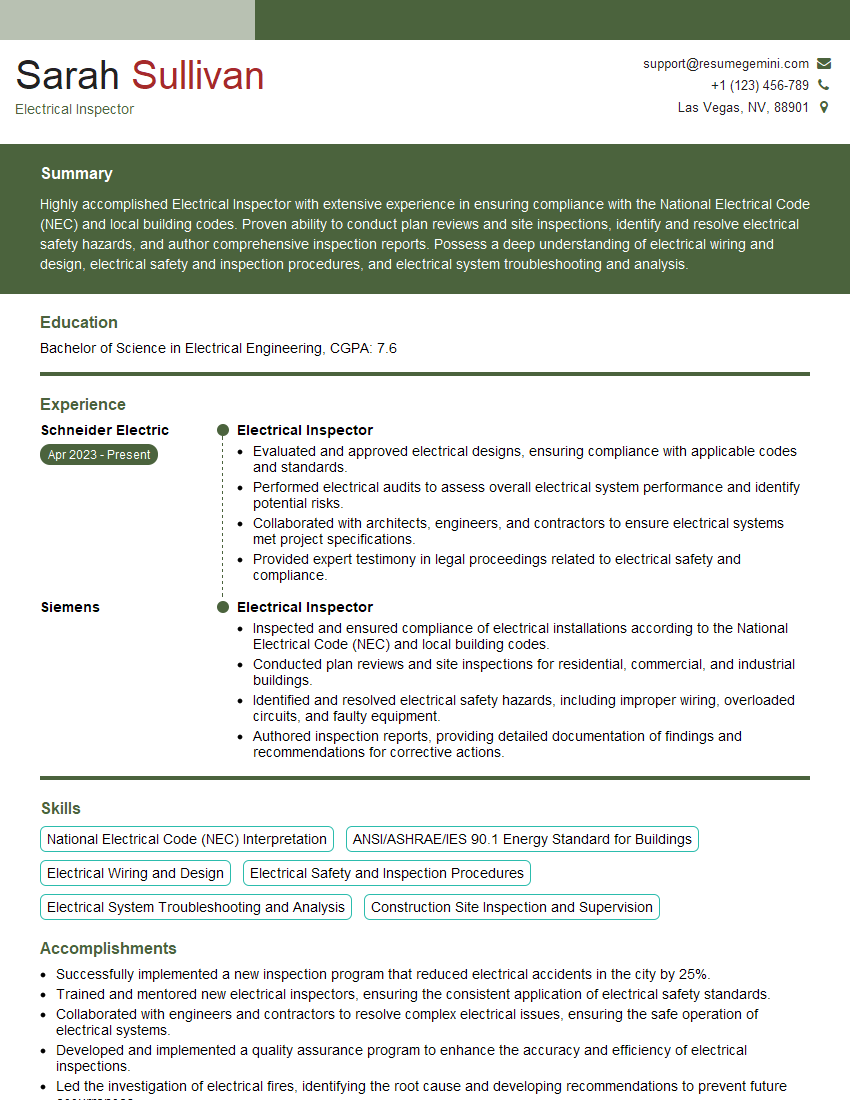
Electrical Inspector Resume Sample
Explore more articles
Users Rating of Our Blogs
Share Your Experience
We value your feedback! Please rate our content and share your thoughts (optional).
What Readers Say About Our Blog
To the interviewgemini.com Webmaster.
Very helpful and content specific questions to help prepare me for my interview!
Thank you
To the interviewgemini.com Webmaster.
This was kind of a unique content I found around the specialized skills. Very helpful questions and good detailed answers.
Very Helpful blog, thank you Interviewgemini team.