The thought of an interview can be nerve-wracking, but the right preparation can make all the difference. Explore this comprehensive guide to Design and installation of photovoltaic (PV) solar systems interview questions and gain the confidence you need to showcase your abilities and secure the role.
Questions Asked in Design and installation of photovoltaic (PV) solar systems Interview
Q 1. Explain the different types of solar panels and their applications.
Solar panels come in various types, primarily categorized by their cell technology. The most common are monocrystalline, polycrystalline, and thin-film.
- Monocrystalline silicon panels: These are made from a single silicon crystal, resulting in high efficiency (typically 18-22%) and a sleek, all-black appearance. They’re ideal for space-constrained installations where maximizing energy output is crucial, such as rooftops in urban areas.
- Polycrystalline silicon panels: Manufactured from multiple silicon crystals, these panels have slightly lower efficiency (around 15-17%) than monocrystalline but are generally more affordable. They are a popular choice for large-scale projects or where budget is a significant factor.
- Thin-film solar panels: These panels use a thin layer of photovoltaic material deposited on a substrate, like glass or plastic. They offer flexibility and are lighter than crystalline silicon panels, making them suitable for integration into building materials or curved surfaces. However, their efficiency is generally lower (8-13%), and they typically have a shorter lifespan.
Choosing the right panel type depends on factors like budget, available roof space, aesthetic preferences, and the desired energy output. For instance, a client with limited roof space and a high energy demand would benefit from monocrystalline panels, while someone with a larger area and budget constraints might opt for polycrystalline.
Q 2. Describe the process of designing a solar PV system for a residential building.
Designing a residential solar PV system involves a systematic process:
- Site Assessment: This includes evaluating the roof’s orientation, shading (from trees, buildings, or chimneys), and structural integrity. We use specialized software and on-site measurements to determine the optimal panel placement and system size.
- Energy Audit: We analyze the household’s energy consumption patterns to determine the kilowatt-hour (kWh) demand. This data, along with the site assessment, helps in calculating the required system size. For example, a house with high energy usage will require a larger system than one with low energy demand.
- System Design: Based on the energy audit and site assessment, we design the system, specifying the number and type of panels, inverters, mounting system, and wiring. We create detailed schematics and 3D models to visualize the installation.
- Permitting and Approvals: Obtaining necessary permits from local authorities is crucial before starting the installation. This process involves submitting detailed system designs and compliance documents.
- Equipment Procurement: Sourcing high-quality, reliable components from reputable manufacturers. We consider warranties, performance guarantees, and certifications when choosing equipment.
- Installation and Commissioning: This phase involves physically mounting the panels, connecting the wiring, installing the inverter, and connecting to the electrical grid. Once installed, we perform a comprehensive system test and commissioning to ensure optimal performance.
Throughout the entire design process, we prioritize safety, code compliance, and maximizing the system’s efficiency and return on investment for the client.
Q 3. What are the key considerations for selecting the appropriate inverter for a solar system?
Selecting the right inverter is critical for a solar system’s performance and longevity. Key considerations include:
- Inverter size (power rating): The inverter must be appropriately sized to handle the total power output of the solar panels. An undersized inverter will limit the system’s performance, while an oversized one is inefficient and unnecessary.
- Inverter type: String inverters are simpler and more affordable, suitable for smaller systems, while microinverters offer greater flexibility and performance monitoring at the panel level. Hybrid inverters allow for battery storage integration. The choice depends on the system’s scale, complexity, and future needs.
- Efficiency: Higher efficiency inverters translate to more energy being fed to the grid or utilized in the home, reducing energy losses. We look for inverters with high peak efficiency and good European efficiency ratings.
- Safety features: Safety features like ground fault protection, overcurrent protection, and arc fault detection are crucial to ensure the system’s safety and reliability. We prioritize inverters with robust safety certifications.
- Monitoring capabilities: Many modern inverters have built-in monitoring capabilities, providing data on energy production, system health, and potential issues. This enables proactive maintenance and troubleshooting.
For example, a large residential system with diverse roof orientations might benefit from microinverters due to their ability to independently optimize each panel’s output. A smaller system might be best served by a high-efficiency string inverter to minimize cost.
Q 4. How do you calculate the energy output of a solar PV system?
Calculating the energy output of a solar PV system involves several factors:
- Panel power rating (Wp): This is the peak power output of a single solar panel, typically expressed in watts (W).
- Number of panels: The total number of panels in the system.
- System efficiency: This accounts for losses in the system, including those from wiring, inverter, and panel performance degradation.
- Solar irradiance: This refers to the amount of solar energy received at the location, varying by location, season, and weather conditions. We use solar resource maps and historical data to estimate average daily sun hours.
- Derating factor: This factor (typically between 0.75 and 0.85) accounts for various system losses and ensures a realistic energy output estimate.
The calculation can be simplified as follows: Total Energy Output (kWh/year) = (Panel Power Rating (Wp) * Number of Panels * System Efficiency * Solar Irradiance (kWh/m²/year) * Derating Factor) / 1000
For example, a system with 10 panels, each rated at 300 Wp, with a 0.8 system efficiency, and an average solar irradiance of 1500 kWh/m²/year, and a derating factor of 0.8 would produce approximately: (300 * 10 * 0.8 * 1500 * 0.8) / 1000 = 2880 kWh/year. This is just an estimate; actual output can vary.
Q 5. What are the safety precautions you take when working with solar panels?
Safety is paramount when working with solar panels. We adhere to strict safety protocols, including:
- Lockout/Tagout procedures: Disconnecting the system from the electrical grid before any work is done, using lockout/tagout devices to prevent accidental energization.
- Personal Protective Equipment (PPE): Wearing appropriate PPE such as safety glasses, gloves, and insulated tools to protect against electrical hazards and falls.
- Fall protection: Using appropriate fall protection equipment, such as harnesses and safety lines, when working at heights.
- Arc flash protection: Utilizing arc flash personal protective equipment (PPE) when working near energized circuits to protect against electrical arc flash hazards.
- Proper grounding: Ensuring that the system is properly grounded to prevent electrical shocks and damage. This is done throughout the installation process, and ground fault circuit interrupters (GFCIs) are used in the system’s wiring.
- Regular safety training: Ongoing training and refresher courses ensure our technicians are always aware of updated safety standards and best practices.
We also make sure the work area is clear of obstructions and that all workers are informed about potential hazards. Our commitment to safety prevents accidents and ensures the long-term reliability of the installed system.
Q 6. Explain the different types of mounting systems for solar panels.
Solar panel mounting systems are chosen based on the roof type, building structure, and aesthetic preferences. Common types include:
- Roof-mount systems: These systems are designed for mounting panels directly onto rooftops. They can be further categorized into:
- Rack mounting systems: These are versatile and suitable for various roof types, using rails and clamps to secure panels.
- Integrated mounting systems: These systems are integrated into the roof itself, offering a more streamlined and aesthetically pleasing appearance.
- Tile-in mounting systems: Designed to fit seamlessly into a tile roof.
- Ground-mount systems: These systems mount panels on the ground, typically using poles or racks. They are suitable for large-scale installations or situations where rooftop mounting is not feasible.
- Ballast mounting systems: These are often used for flat roofs, employing ballast like concrete blocks to secure the panels, without penetration.
- Wall-mount systems: Panels are directly mounted onto a building’s exterior walls.
The choice of mounting system depends on numerous factors. For example, a sloped tile roof might require a specialized rack-mounting system, while a flat commercial building might be ideal for a ground-mounted system. Each option needs careful consideration of wind load, snow load, and structural integrity.
Q 7. Describe your experience with troubleshooting solar PV systems.
Troubleshooting solar PV systems requires a systematic approach. I’ve encountered various issues, including:
- Low energy production: This can stem from shading, faulty panels, wiring issues, or inverter problems. We utilize diagnostic tools like multimeters and solar panel testers to pinpoint the problem. For example, a thorough inspection might reveal a panel partially blocked by a tree branch or a broken connection.
- Inverter malfunctions: These can manifest as system shutdowns, error codes, or reduced output. We check for error codes, verify power supply, and consider replacing the faulty inverter.
- Wiring faults: Loose connections, damaged wiring, or corrosion can reduce energy production or create safety hazards. Careful inspection and testing of wiring and connections using a multimeter are essential.
- Panel defects: Cracked cells, hotspots, or damaged modules can affect individual panel performance. Visual inspection, thermal imaging, and electrical testing help diagnose these problems.
I use a combination of technical expertise, diagnostic tools, and experience to effectively troubleshoot these issues. Our process starts with a thorough inspection and testing, followed by targeted repairs or replacements, culminating in thorough system verification to confirm optimal performance. A good record-keeping system is also vital for tracking historical data and aiding future troubleshooting.
Q 8. How do you determine the optimal tilt angle and azimuth for solar panels?
Determining the optimal tilt and azimuth angles for solar panels is crucial for maximizing energy production. The tilt angle refers to the angle of the panel relative to the horizontal, while the azimuth angle refers to the compass direction the panel faces. The ideal angles depend on several factors, primarily the geographical location and the time of year.
For optimal performance throughout the year, we generally aim for a tilt angle equal to the latitude of the location. For instance, a system in Denver, Colorado (latitude approximately 40 degrees) might benefit from a 40-degree tilt. However, this is a simplification. Software tools and online calculators are used for precise calculation considering factors like shading from nearby buildings or trees. We also consider seasonal variations; in areas with significant snowfall, a steeper angle might be preferred to minimize snow accumulation. The azimuth angle is typically due south (180 degrees) in the Northern Hemisphere for maximum solar exposure during peak hours. However, East-West orientation can be used for specific power generation profile requirements.
In practice: We use specialized software to model the sun’s path throughout the year at the specific installation location, factoring in any shading analysis through 3D modeling. This modeling enables us to optimize the tilt and azimuth angles for maximum energy yield, minimizing losses due to sub-optimal positioning.
Q 9. What are the different types of wiring used in solar installations?
Solar installations utilize various wiring types, each with specific roles and requirements. The most common are:
- Solar Cable (PV Wire): This is a specialized cable designed for outdoor use, often UV resistant and with high temperature ratings. It connects individual solar panels in series and parallel strings. It often has multiple conductors within a single jacket. We use different gauges (thicknesses) depending on the current carrying requirements.
- Grounding Wire: Bare copper wire is typically used for grounding, connecting various components of the system to the earth to ensure safety and prevent electrical shock or equipment damage. Grounding is absolutely critical for safety.
- AC Wiring: Standard building wiring is used to connect the inverter (which converts DC power from the panels to AC power) to the electrical panel of the building. This typically follows local electrical codes and usually includes protective devices like circuit breakers.
- DC Wiring: This connects the solar panels to the inverter. It must be appropriately sized to handle the current produced by the panels, considering both voltage and amperage. Careful planning here is essential for efficiency and safety.
Example: In a typical residential system, we’d use thicker gauge solar cable to connect panels in series, then a slightly thinner gauge for the main string runs to the inverter, and standard building wiring from the inverter to the main panel. The grounding wire runs throughout the system, connecting all metal components and the inverter to an earth ground.
Q 10. Explain the process of grounding a solar PV system.
Grounding a solar PV system is a critical safety measure designed to prevent electrical shock and equipment damage. It provides a low-resistance path for fault currents to flow to the earth, preventing dangerous voltage build-up. The process generally involves several steps:
- Grounding the Array: Each solar panel’s metal frame is connected to a grounding wire, usually at multiple points for redundancy. This ensures that the entire array is grounded.
- Grounding the Inverter: The inverter’s metal enclosure is also grounded, using a dedicated grounding wire connected to the main grounding system.
- Grounding the Mounting Structure: If the mounting structure is metal, it should also be grounded to prevent potential hazards.
- Connecting to the Earth Ground: All grounding wires are ultimately connected to a suitable earth ground, often a grounding rod driven into the earth or a metallic water pipe. The resistance of the ground connection is very important and should be measured to ensure it meets the code requirements (typically less than 5 ohms).
- Ground Fault Protection: Ground fault circuit interrupters (GFCIs) are incorporated at various points in the system to detect and interrupt any fault currents flowing to the ground, further enhancing safety.
Practical Application: We always use a ground rod to establish an earth connection and verify the ground resistance with a specialized meter. Poor grounding can lead to serious electrical hazards, and proper grounding is a cornerstone of safe and compliant solar PV system design. It is a critical aspect of our quality control process.
Q 11. What is the importance of NEC compliance in solar installations?
Compliance with the National Electrical Code (NEC) is paramount in solar installations. The NEC provides a set of safety standards that ensure the proper design, installation, and operation of electrical systems, including solar PV systems. Non-compliance can lead to serious consequences, including:
- Electrical shocks and fires: Incorrect wiring, inadequate grounding, or improper installation can create hazardous conditions.
- Equipment damage: Non-compliance can damage expensive equipment, leading to costly repairs or replacements.
- Insurance issues: Insurance companies might not cover damages caused by non-compliant installations.
- Legal liability: Installers can face legal liability for injuries or damages resulting from non-compliant installations.
NEC Compliance ensures:
- Safety: Protecting occupants from electrical hazards
- Reliability: Ensuring the long-term performance and safety of the system.
- Code Adherence: Meeting all legally mandated standards for electrical installations.
In our work: We meticulously follow the relevant NEC articles for solar PV systems throughout the entire design and installation process. We maintain detailed documentation to demonstrate our compliance and undergo regular training to stay updated on the latest code requirements.
Q 12. How do you ensure the safety of electrical connections in a solar PV system?
Ensuring the safety of electrical connections is critical for reliable and safe solar PV system operation. We implement several measures to achieve this:
- Use of appropriate connectors: Employing high-quality, weatherproof connectors designed for outdoor use is fundamental. These connectors should be rated for the voltage and current of the system.
- Proper wire stripping and crimping: Accurate wire stripping and secure crimping of connectors are essential to ensure a good electrical connection and prevent overheating. We use specialized tools to guarantee consistent and reliable connections.
- Use of torque wrenches: When tightening bolts and screws on connectors, torque wrenches ensure appropriate tightening, preventing damage to the connections and providing a consistent level of security. Over-tightening can damage the connectors, and under-tightening can lead to loose connections.
- Visual inspection: A thorough visual inspection of all connections, including terminals and wiring, is done to identify any loose connections, signs of overheating or damage. This should be done at each stage of the installation, especially before energizing the system.
- Use of disconnect switches: Proper disconnect switches ensure easy isolation of the system for maintenance and repair. This is critical for safety when working on any live electrical components.
Example: We never compromise on the quality of connectors and always double-check every connection visually before and after crimping. We use torque wrenches to precisely tighten terminal blocks to ensure electrical continuity and mechanical integrity.
Q 13. Describe the process of commissioning a solar PV system.
Commissioning a solar PV system is a crucial step that involves verifying the system’s performance and safety before putting it into operation. This process usually involves:
- Visual inspection: A thorough visual inspection of all components, wiring, and connections is done to confirm that everything is installed correctly and according to the design specifications. This includes checking for any damage or loose connections.
- Testing of individual components: We test each individual component to confirm they are operating correctly; this includes testing individual panels for power output using a multimeter. We verify the inverter and its communication with monitoring devices.
- System performance testing: Once all components are verified, the entire system is tested to measure its overall performance. This includes checking the voltage, current, and power output of the system under various operating conditions.
- Grounding resistance testing: A ground resistance test ensures that the system is properly grounded, preventing potential electrical hazards. This involves checking the resistance of the grounding connection between various system components and the earth using specialized equipment.
- Safety testing: We conduct various safety tests to confirm the absence of any electrical hazards, often including insulation resistance testing. These tests confirm that the system is safe to operate.
- Documentation: All test results and observations are documented thoroughly. This documentation is critical for both warranty claims and ongoing maintenance.
Outcome: Successful commissioning ensures that the system meets the design specifications and is safe and ready for operation. A signed commissioning report is provided to the client. This process ensures the system will perform optimally and reliably.
Q 14. What are the common causes of solar PV system failure?
Solar PV system failures can stem from various causes, broadly categorized into:
- Panel Degradation: Over time, solar panels lose efficiency due to factors like UV exposure, temperature changes, and micro-cracks. This is a natural process, but can be accelerated by extreme conditions.
- Wiring Issues: Loose connections, corrosion, or damage to the wiring can lead to reduced power output or complete system failure. Proper installation and regular inspections are crucial here.
- Inverter Malfunctions: Inverters are susceptible to failures due to overheating, component degradation, or power surges. Regular maintenance and quality inverters can mitigate this.
- Shading: Even partial shading of a panel can significantly reduce its output, potentially affecting the entire string. Proper panel placement and potentially using microinverters can address this.
- Environmental Factors: Extreme weather conditions, such as hailstorms or strong winds, can cause physical damage to panels, mounting structures, or wiring. Robust designs that meet local building code are critical here.
- Grounding Issues: Poor grounding can cause safety hazards and potentially damage system components. Regular grounding resistance checks are important.
Troubleshooting: We diagnose failures through systematic checks, starting with visual inspections, then using multimeters to check voltages and currents at various points in the system. Data loggers and monitoring systems help to pinpoint the issue. Understanding the typical failure modes of each component enables us to address the issues efficiently and effectively.
Q 15. How do you perform preventative maintenance on a solar PV system?
Preventative maintenance on a solar PV system is crucial for maximizing its lifespan and energy production. Think of it like regular check-ups for your car – it keeps things running smoothly and prevents major problems down the line. My approach involves a multi-faceted strategy focusing on both visual inspection and performance monitoring.
- Visual Inspection: This includes checking for loose connections, damaged wiring, debris buildup on panels (leaves, bird droppings), and signs of corrosion or physical damage to the panels, racking, and inverters. I use thermal imaging cameras to detect hotspots on panels which could indicate cell degradation or shading issues.
- Performance Monitoring: I regularly review the system’s performance data using monitoring software. This allows me to track energy production, identify anomalies such as underperforming panels or inverter issues, and ensure the system is operating at peak efficiency. A sudden drop in energy production, for instance, could point towards a problem needing immediate attention.
- Cleaning: Regularly cleaning the panels, especially in dusty or high-pollen areas, is critical. Dirty panels reduce energy output significantly. I use soft brushes, deionized water, and appropriate safety equipment for this task.
- Grounding and Bonding Checks: Regular inspection of the grounding and bonding systems ensures electrical safety and protects against lightning strikes.
- Inverter Maintenance: Inverters are a critical component; regular checks on their cooling fans, internal components, and overall functionality are important. Manufacturer guidelines should always be followed.
For example, during a recent inspection, I identified a loose connection on a panel array using thermal imaging. A simple tightening resolved the issue and prevented a potential fire hazard and performance loss. A preventative maintenance schedule, tailored to the system’s location and environmental conditions, is key to its long-term success.
Career Expert Tips:
- Ace those interviews! Prepare effectively by reviewing the Top 50 Most Common Interview Questions on ResumeGemini.
- Navigate your job search with confidence! Explore a wide range of Career Tips on ResumeGemini. Learn about common challenges and recommendations to overcome them.
- Craft the perfect resume! Master the Art of Resume Writing with ResumeGemini’s guide. Showcase your unique qualifications and achievements effectively.
- Don’t miss out on holiday savings! Build your dream resume with ResumeGemini’s ATS optimized templates.
Q 16. Explain the concept of net metering.
Net metering is a billing mechanism that allows solar energy system owners to send excess electricity generated by their systems back to the grid and receive credits on their utility bill. Imagine it like having a two-way meter for electricity. When your solar panels produce more power than you’re using, the excess flows back to the grid, and your meter spins backward, essentially giving you credit. When your solar production is less than your consumption, you draw power from the grid and the meter spins forward, using those credits to offset your electricity bill.
This is beneficial because it allows homeowners and businesses to offset their electricity costs and potentially reduce or even eliminate their utility bills. However, net metering policies vary by location; some jurisdictions may have limits on the amount of excess energy you can send back to the grid, or they may offer different credit rates. It’s vital to understand your local net metering rules before investing in a solar PV system.
Q 17. What are the permitting requirements for installing a solar PV system?
Permitting requirements for installing a solar PV system vary significantly by location – city, county, and state regulations all play a role. It’s not a one-size-fits-all situation. Generally, the process usually involves several steps:
- Application Submission: You typically need to submit detailed plans to the relevant authorities, including system specifications, site layout, and electrical diagrams. These often include engineering reports demonstrating the system’s safety and compliance.
- Site Inspection: After reviewing the application, building inspectors will likely visit your property to verify site conditions and ensure compliance with building codes and safety regulations.
- Building Permits: Obtaining building permits is often a necessary step, proving that the installation conforms to all relevant safety standards and local regulations.
- Electrical Permits: Similar to building permits, these ensure the electrical work meets all local codes and is performed by licensed electricians.
- Interconnection Agreement: If you’re connecting your system to the grid, you’ll need an interconnection agreement with your utility company. This outlines how the system will interact with the grid and guarantees its safe operation.
Ignoring these steps can lead to significant delays, fines, or even system disconnections. Working with a reputable installer that has experience navigating the permitting process in your specific area is highly recommended.
Q 18. How do you determine the appropriate size of a solar battery storage system?
Determining the appropriate size of a solar battery storage system depends on several factors, and it’s more of an art than a simple calculation. The goal is to find a balance between cost and desired functionality.
- Energy Consumption: This is the most critical factor. You need to carefully analyze your household or business energy usage patterns to understand your daily and peak energy demands. Utility bills and smart meter data are invaluable here.
- Backup Power Needs: How much power do you need to support essential appliances during a power outage? This dictates the minimum storage capacity you’ll need.
- Self-Consumption Goals: Do you want to maximize the use of your solar energy without relying on the grid? Higher self-consumption goals require more storage capacity.
- Budget: Battery storage systems can be expensive. Setting a realistic budget helps determine the size and technology that are feasible.
- Available Space: Battery systems need physical space for installation; you need to consider the available room.
For example, a household with high energy consumption and a desire for complete backup power during outages might require a larger battery system than a household with lower consumption and only backup for essential appliances. A detailed load analysis, in conjunction with the client’s needs and budget, is crucial for making the right decision.
Q 19. What are the environmental impacts of solar PV systems?
While solar PV systems are undeniably a clean energy source, it’s important to acknowledge their environmental impacts throughout their lifecycle.
- Manufacturing: The manufacturing process requires energy and resources, producing greenhouse gas emissions and waste. However, the emissions associated with manufacturing are becoming increasingly less significant as technology improves and manufacturing processes become more efficient.
- Transportation: Transporting the components from manufacturing facilities to installation sites generates emissions.
- Land Use: Large-scale solar farms can require significant land areas, potentially impacting ecosystems. However, rooftop installations minimize this impact.
- End-of-Life Disposal: The disposal of solar panels at the end of their lifespan is a growing concern. Recycling infrastructure for solar panels is still developing, but significant advances are being made in this area to recover valuable materials.
- Water Usage: Manufacturing some solar panel components may require significant water resources. However, some PV technologies require less water than others.
The overall environmental benefits of solar PV systems, however, significantly outweigh the negative impacts, especially when compared to fossil fuel-based electricity generation. Life cycle assessments are increasingly used to evaluate and minimize the environmental footprint of solar PV systems.
Q 20. Describe your experience with different types of solar trackers.
My experience with solar trackers encompasses various types, each with its strengths and weaknesses. Trackers are used to maximize energy production by orienting the solar panels towards the sun throughout the day.
- Single-Axis Trackers: These trackers rotate along a single axis, either east-west (azimuth tracking) or north-south (altitude tracking). They’re relatively simple and cost-effective, offering a good balance between performance improvement and cost.
- Dual-Axis Trackers: These trackers rotate along both the azimuth and altitude axes, providing the most precise sun tracking and potentially the highest energy yield. They are more complex and expensive than single-axis trackers.
- Fixed-Tilt Systems: While not trackers in the traditional sense, fixed-tilt systems offer a simpler and less expensive alternative. Their performance is optimized for a specific latitude, and their energy output is slightly lower than trackers.
In one project, we used dual-axis trackers in a large-scale solar farm in a region with abundant sunshine. The increased energy yield justified the higher initial investment. In another project with budget constraints, single-axis trackers provided an excellent balance between cost and performance enhancement. Choosing the right tracker type depends critically on factors such as site conditions, budget, and project goals.
Q 21. How do you ensure optimal performance of a solar PV system in different weather conditions?
Ensuring optimal performance of a solar PV system in diverse weather conditions requires a multifaceted approach.
- Panel Selection: Choosing panels with high efficiency and good performance in low-light conditions is crucial. Some panels perform better in specific temperature ranges.
- System Design: Proper system design accounts for shading and snow accumulation. Shading from trees or buildings can significantly reduce energy output. Panel layout and orientation should minimize the impact of shading.
- Temperature Considerations: Solar panels’ efficiency is affected by temperature. Proper ventilation and cooling strategies, like panel spacing, help maintain optimal operating temperatures.
- Monitoring and Adjustments: Regular monitoring of the system’s performance helps identify issues caused by weather events like hail or high winds. Maintenance and repairs should be promptly addressed.
- Weather Forecasting: Incorporating weather forecasts into system performance predictions allows for proactive adjustments and maintenance planning.
For example, in snowy climates, we install panels with a higher snow-load rating and consider the angle of the panels to facilitate snow shedding. In areas prone to hail, we select panels with high hail impact resistance. Adapting the system design and maintenance schedule to local weather patterns is key to maintaining optimal performance throughout the year.
Q 22. Explain the concept of maximum power point tracking (MPPT).
Maximum Power Point Tracking (MPPT) is a crucial technique in photovoltaic (PV) systems that maximizes the power harvested from solar panels. Solar panels don’t produce constant power; their output depends heavily on sunlight intensity and temperature. The voltage and current at which a panel produces its maximum power (the maximum power point) changes constantly throughout the day. MPPT algorithms constantly monitor the panel’s voltage and current, adjusting the load to find and maintain this optimal operating point. Think of it like a gardener carefully adjusting the amount of water and sunlight a plant receives to help it grow to its full potential.
This is achieved using sophisticated electronic circuits within the solar charge controller or inverter. These circuits analyze the current-voltage (I-V) curve of the solar panel, a curve that shows the relationship between the voltage and current produced by the panel at different operating points. The MPPT algorithm dynamically adjusts the operating point to stay at the peak of this curve, ensuring maximum power extraction regardless of fluctuating weather conditions.
Q 23. What are the advantages and disadvantages of different solar panel technologies?
Several solar panel technologies exist, each with its own set of advantages and disadvantages:
- Crystalline Silicon (c-Si): This is the most common type, further categorized into monocrystalline and polycrystalline. Monocrystalline panels are more efficient (around 18-22%) but more expensive, while polycrystalline panels are less efficient (around 15-17%) but cheaper. They are durable and readily available.
- Thin-Film Solar Panels: These include amorphous silicon (a-Si), cadmium telluride (CdTe), and copper indium gallium selenide (CIGS). They are lighter, flexible, and can be more aesthetically pleasing than crystalline silicon panels. However, their efficiency is generally lower (8-15%) and their lifespan can be shorter.
- Perovskite Solar Cells: A relatively newer technology with high potential. They boast potentially higher efficiencies than c-Si and are cheaper to manufacture. However, long-term stability and scalability are still under development, posing challenges for widespread adoption.
The choice depends on factors like budget, available roof space, aesthetic preferences, and desired lifespan. For example, a client prioritizing cost-effectiveness might opt for polycrystalline panels, while one emphasizing efficiency might choose monocrystalline panels. Thin-film panels might be chosen for a building integration project due to their flexibility.
Q 24. Describe your experience working with different types of inverters (e.g., string inverters, microinverters).
I have extensive experience with various inverter types. String inverters are the most common and cost-effective; they connect multiple solar panels in series (a string) and convert the DC power to AC power. They are simple to install and maintain, but a single fault in a string can affect the entire string’s output. I’ve worked with hundreds of installations using string inverters from leading manufacturers like SMA, SolarEdge, and Enphase.
Microinverters, on the other hand, are smaller inverters located on each individual panel. This offers several advantages; Each panel operates independently, maximizing energy production even if others are shaded or faulty. They also allow for easier troubleshooting and monitoring at the panel level. However, they are more expensive per watt and require more installation time compared to string inverters. I’ve successfully implemented microinverter systems in situations where maximizing individual panel performance was crucial, for example, in installations with complex roof geometries or significant shading.
Q 25. How do you assess the suitability of a roof for a solar PV system?
Assessing roof suitability for solar PV systems involves a multi-step process:
- Roof Orientation and Angle: South-facing roofs (in the Northern Hemisphere) are ideal; however, East and West-facing roofs are also viable. The optimal roof angle maximizes sunlight exposure throughout the day. We use specialized software to calculate potential energy production based on roof orientation and angle.
- Shading Analysis: Trees, buildings, or other obstructions can significantly reduce solar energy production. We conduct a thorough shading analysis using satellite imagery and on-site assessments to identify potential shading issues. This analysis often involves using specialized software to simulate the shading throughout the year.
- Roof Structure and Condition: The roof must be structurally sound to support the weight of the solar panels and mounting system. We carefully examine the roof’s material, age, and overall condition. Any necessary repairs or reinforcements are identified and planned.
- Electrical Considerations: We assess the existing electrical system to ensure it can handle the additional power generated by the solar PV system. This involves analyzing panel capacity, inverter output, and existing electrical load.
- Building Codes and Permits: We review relevant building codes and local regulations to ensure compliance. We assist clients in obtaining the necessary permits for installation.
Q 26. What software or tools do you use for solar system design and simulation?
For solar system design and simulation, I utilize several industry-standard software tools. PVsyst is a comprehensive software package that allows for detailed simulations of system performance, including shading analysis, energy yield calculations, and equipment sizing. Helioscope is another powerful tool for designing and visualizing solar arrays, and it offers excellent shading analysis capabilities. We also use AutoCAD for detailed drawings and system layouts. These tools help us to optimize system design, ensuring optimal performance and cost-effectiveness for each project.
Q 27. Describe a challenging solar installation project you’ve worked on and how you overcame the challenges.
One challenging project involved installing a solar PV system on a historic building with a complex, multi-faceted roof. The roof’s intricate design and the presence of numerous chimneys and dormers made it difficult to optimize panel placement for maximum energy production. Moreover, strict historical preservation regulations limited the types of mounting systems we could use.
To overcome these challenges, we employed a combination of 3D modeling software, detailed on-site surveys, and extensive collaboration with the building’s architects and preservation specialists. We designed a custom mounting system that integrated seamlessly with the roof’s architectural features while ensuring the structural integrity of the building. The result was a successful installation that met both energy production goals and historical preservation standards. It was a testament to our adaptability and problem-solving capabilities.
Q 28. What are your strategies for managing a solar installation project on time and within budget?
Managing solar installation projects on time and within budget requires a structured approach:
- Detailed Project Planning: We develop a comprehensive project plan that includes timelines, resource allocation, and contingency planning. This plan includes clear milestones and responsibilities for each team member.
- Efficient Procurement: We establish relationships with reliable suppliers to ensure timely procurement of materials and equipment. This involves proactive sourcing and careful inventory management to minimize delays.
- Effective Communication: We maintain clear and consistent communication with clients, subcontractors, and inspectors throughout the project. This keeps everyone informed and prevents misunderstandings.
- Rigorous Quality Control: We implement strict quality control procedures at each stage of the installation process. This ensures that the system is installed to the highest standards and meets all safety regulations.
- Change Management: We have a process for managing unforeseen changes or challenges. This helps to maintain the project timeline and budget while mitigating risks.
By adhering to this disciplined approach, we consistently deliver solar installation projects on time and within budget, creating satisfied clients and building trust.
Key Topics to Learn for Design and Installation of Photovoltaic (PV) Solar Systems Interviews
- Site Assessment and System Design: Understanding site conditions (shading, roof orientation, etc.) and using software to design optimal PV system layouts.
- Electrical Design and Calculations: Calculating system voltage, current, and power; sizing inverters and other components; understanding NEC codes and safety regulations.
- Component Selection and Procurement: Choosing appropriate PV modules, inverters, racking systems, and other components based on project requirements and budget.
- Installation Techniques and Best Practices: Safe and efficient installation procedures for PV modules, wiring, grounding, and racking systems; adhering to industry standards.
- Testing and Commissioning: Performing thorough testing and commissioning to ensure system performance and safety; using diagnostic tools and interpreting results.
- Troubleshooting and Maintenance: Identifying and resolving common PV system issues; performing routine maintenance tasks to ensure optimal system operation.
- Solar Energy Fundamentals: Understanding photovoltaic effect, solar irradiance, energy production calculations, and system efficiency.
- Grid-Tied vs. Off-Grid Systems: Differences in design, installation, and operation; understanding the advantages and disadvantages of each system type.
- Permitting and Codes Compliance: Navigating the permitting process; ensuring compliance with relevant building codes and safety regulations.
- Project Management and Communication: Planning and scheduling projects; managing budgets and timelines; effectively communicating with clients and stakeholders.
Next Steps
Mastering the design and installation of photovoltaic (PV) solar systems opens doors to a rewarding and in-demand career in a growing industry. Your expertise will be highly sought after by companies committed to sustainable energy solutions. To maximize your job prospects, creating a strong, ATS-friendly resume is crucial. ResumeGemini is a trusted resource that can help you build a professional and effective resume tailored to highlight your skills and experience. Examples of resumes specifically designed for Design and Installation of Photovoltaic (PV) Solar Systems professionals are available to guide you.
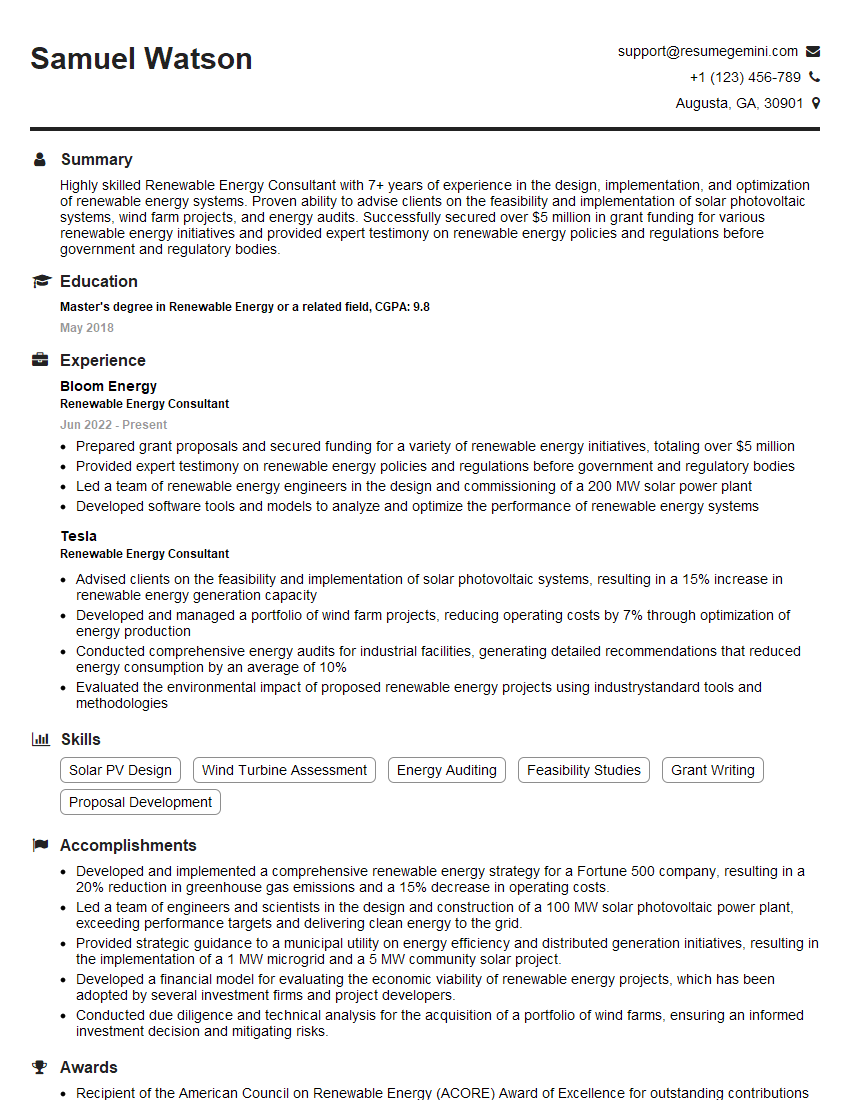
Renewable Energy Consultant Resume Sample
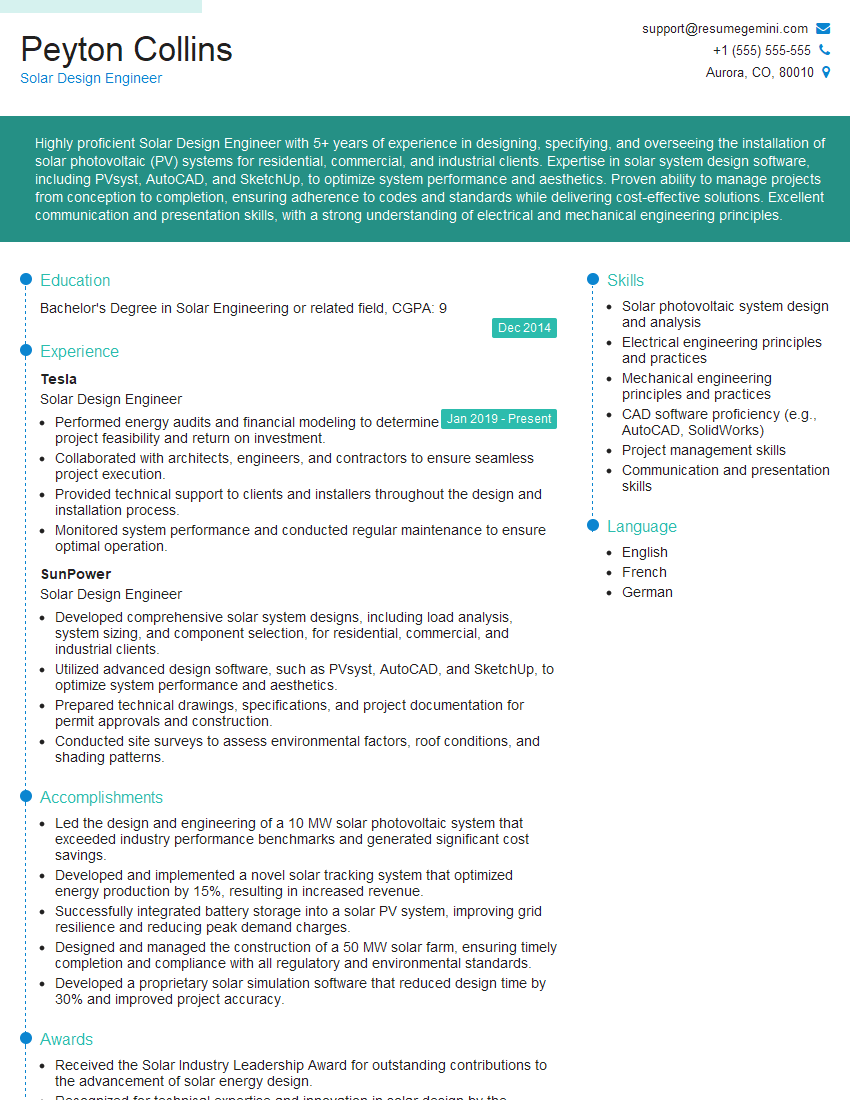
Solar Design Engineer Resume Sample
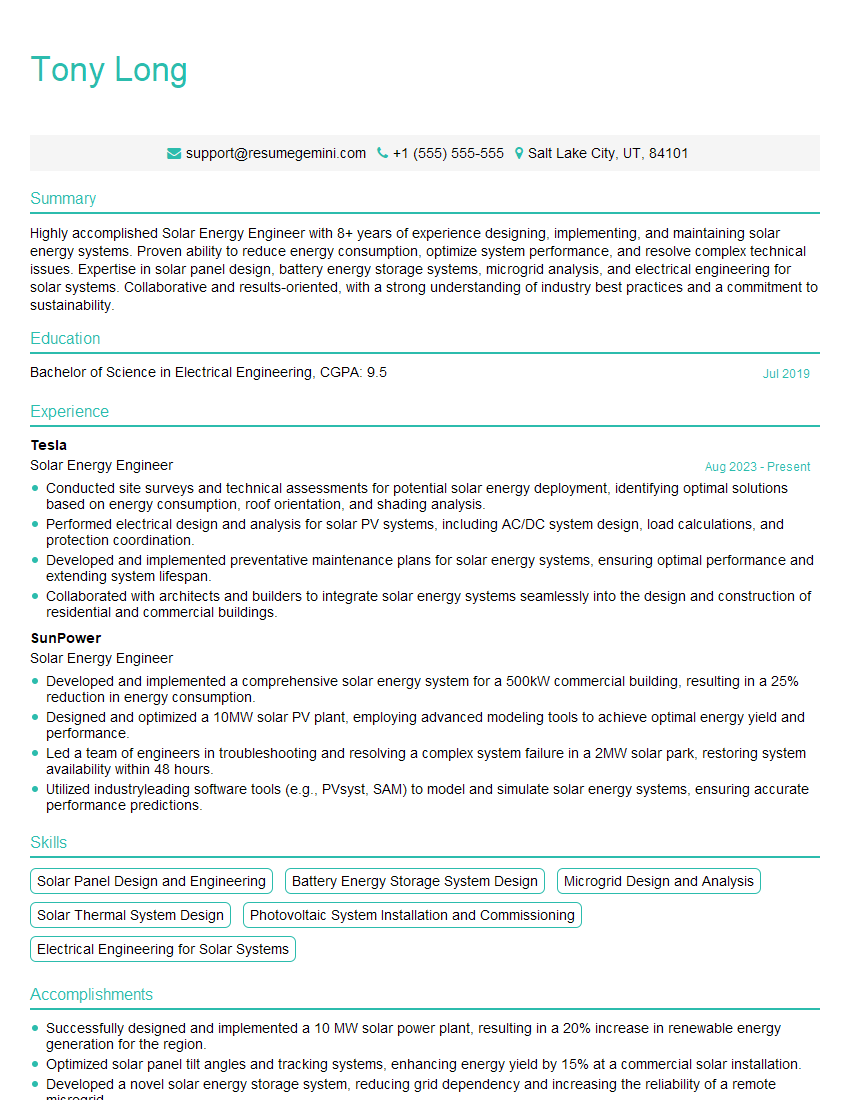
Solar Energy Engineer Resume Sample
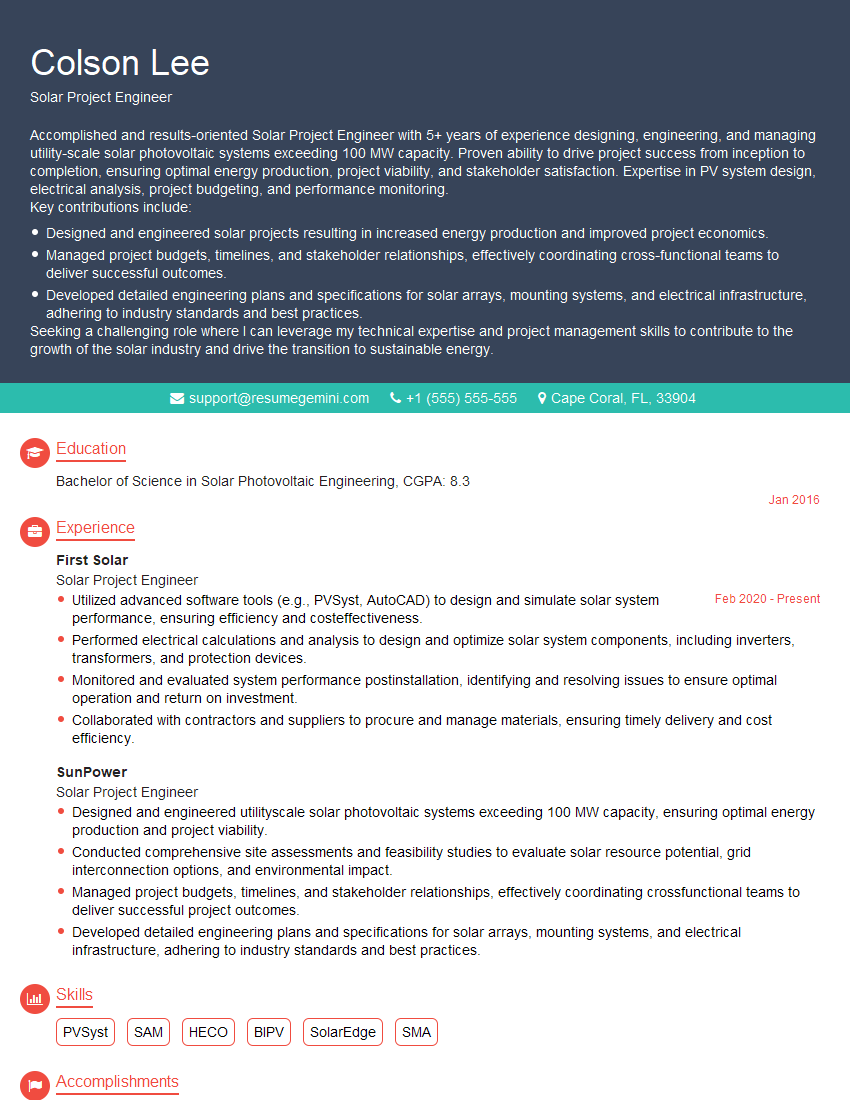
Solar Project Engineer Resume Sample

Solar System Designer Resume Sample

Solar Energy Technician Resume Sample
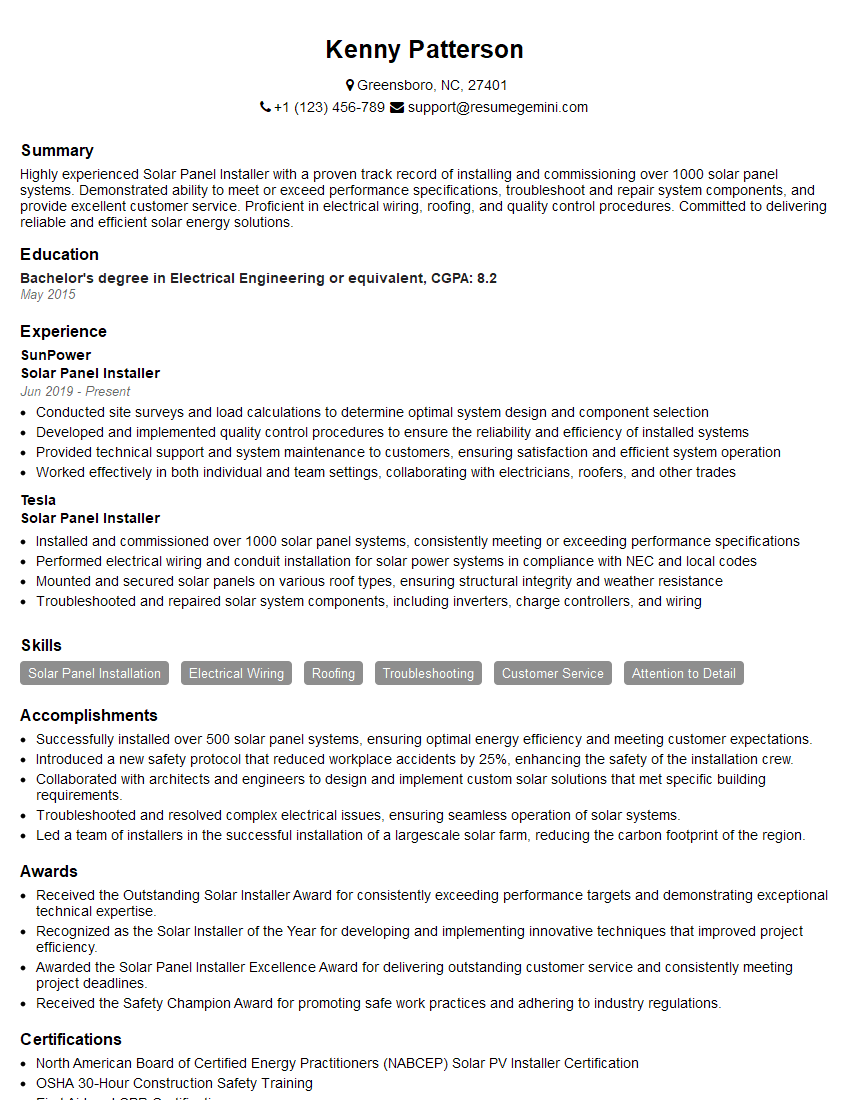
Solar Panel Installer Resume Sample
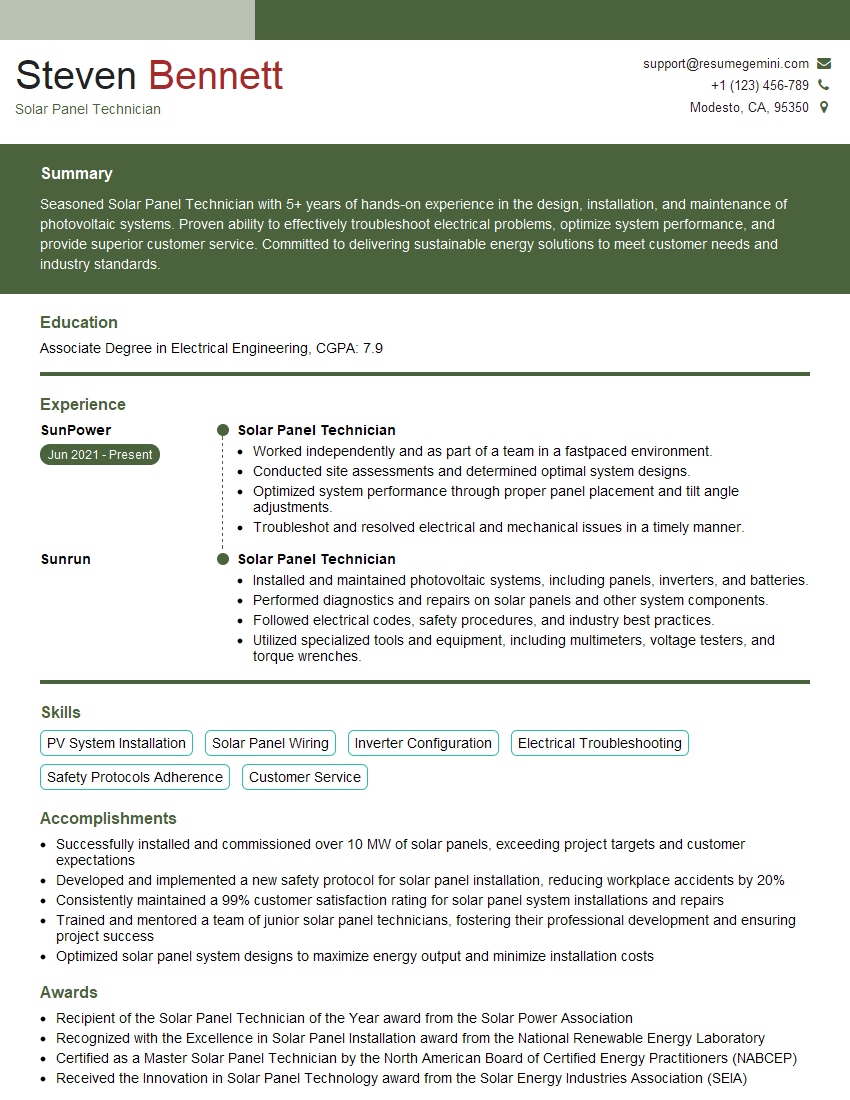
Solar Panel Technician Resume Sample
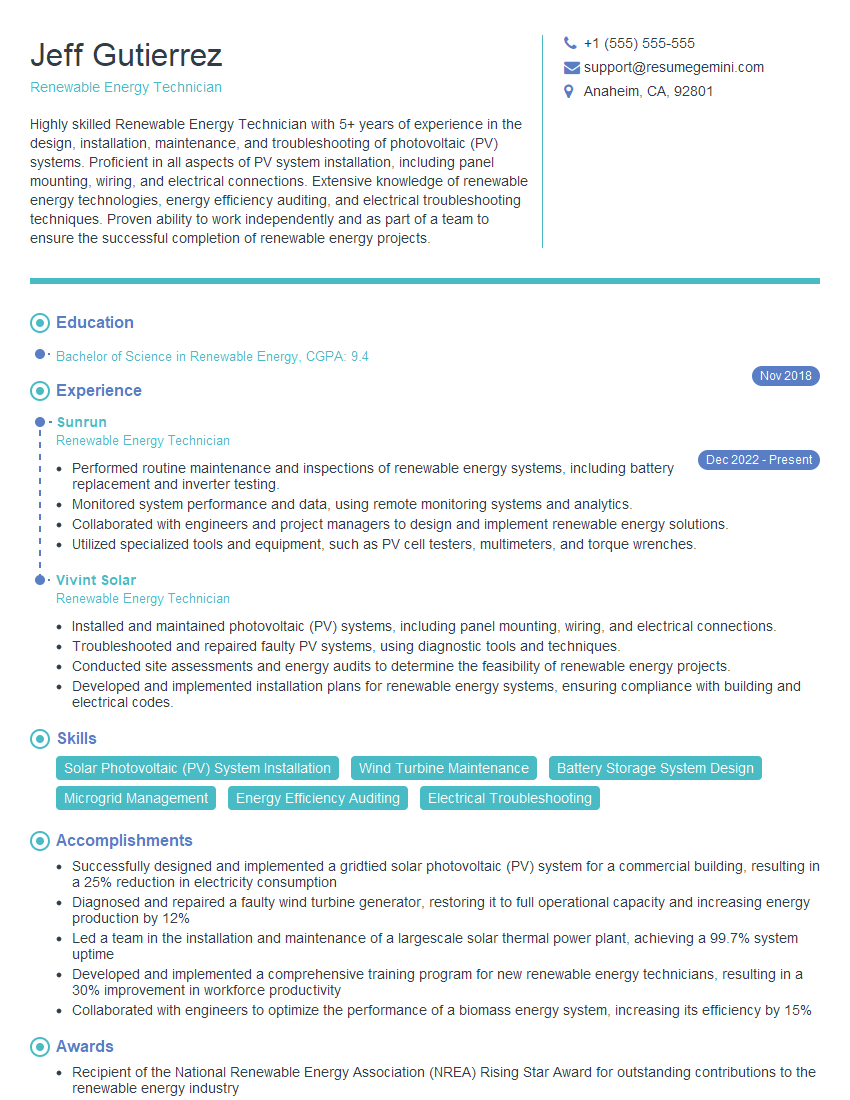
Renewable Energy Technician Resume Sample
Explore more articles
Users Rating of Our Blogs
Share Your Experience
We value your feedback! Please rate our content and share your thoughts (optional).
What Readers Say About Our Blog
To the interviewgemini.com Webmaster.
Very helpful and content specific questions to help prepare me for my interview!
Thank you
To the interviewgemini.com Webmaster.
This was kind of a unique content I found around the specialized skills. Very helpful questions and good detailed answers.
Very Helpful blog, thank you Interviewgemini team.