Interviews are more than just a Q&A session—they’re a chance to prove your worth. This blog dives into essential Distribution Line Design interview questions and expert tips to help you align your answers with what hiring managers are looking for. Start preparing to shine!
Questions Asked in Distribution Line Design Interview
Q 1. Explain the difference between overhead and underground distribution lines.
Overhead and underground distribution lines represent two fundamentally different approaches to delivering electricity to consumers. Overhead lines, the more common type, utilize conductors suspended from poles or towers, offering a relatively inexpensive and easy-to-access method for construction and maintenance. However, they are susceptible to damage from weather events (like storms and ice) and pose safety risks. Underground lines, conversely, bury the conductors beneath the ground, offering superior protection from the elements and enhanced safety. This increased reliability comes at a higher initial cost, due to excavation, specialized cable installation, and more complex repair procedures. Think of it like this: overhead lines are like above-ground pipes – easily accessible but vulnerable, while underground lines are like buried pipes – more protected but harder to access.
- Overhead: Cost-effective, easy access for maintenance, but vulnerable to weather and safety concerns.
- Underground: Higher initial cost, increased reliability and safety, but more complex maintenance and repairs.
Q 2. Describe the factors influencing conductor selection for distribution lines.
Conductor selection is crucial in distribution line design. The optimal conductor must balance several competing factors: cost, electrical performance, and mechanical strength. Here’s a breakdown:
- Current Carrying Capacity (Ampacity): The conductor must carry the expected current without overheating. This depends on the conductor’s material (aluminum, copper), size (cross-sectional area), and environmental conditions (ambient temperature, wind).
- Voltage Drop: Excessive voltage drop leads to energy loss and poor performance of connected loads. Lower resistance conductors minimize voltage drop. Copper has lower resistance than aluminum, but aluminum is lighter and cheaper.
- Mechanical Strength: The conductor must withstand mechanical stresses from sag, wind, and ice loading. Steel-reinforced aluminum conductors (ACSR) are commonly used for their balance of strength and conductivity.
- Cost: Balancing material cost, installation cost, and energy loss is critical for economic feasibility.
For example, a long, heavily loaded line might necessitate ACSR with a larger cross-sectional area to manage voltage drop and mechanical stress, while a shorter, lightly loaded line might use a smaller, less expensive aluminum conductor.
Q 3. How do you calculate voltage drop in a distribution line?
Voltage drop calculation is essential to ensure adequate voltage at the load end of a distribution line. The most common method uses the following formula:
VD = 2 * I * L * R / 1000Where:
VD= Voltage drop (volts)I= Load current (amperes)L= Length of the line (meters)R= Resistance of the conductor (ohms per kilometer). This accounts for the line’s length and the conductor material’s resistivity.
This formula accounts for the line’s length and the conductor material’s resistivity.
For more complex scenarios (like parallel conductors or unequal load distribution), more advanced calculations, often involving complex software, may be required. For instance, different software considers factors like the line’s temperature, skin effect at high frequencies, and proximity effects.
Q 4. What are the common types of insulators used in distribution lines?
Distribution lines employ various insulators to prevent current leakage to the ground or between conductors. The choice depends on the voltage level and environmental conditions.
- Pin Insulators: Simple and inexpensive, used for lower voltage lines. They’re essentially ceramic or glass discs strung on a pin on the cross-arm of a pole.
- Suspension Insulators: Used for higher voltage lines, these are strings of individual porcelain or composite insulators that share the voltage stress, enhancing safety and reliability.
- Strain Insulators: Designed to withstand high tensile forces at line ends or angles, these are larger and stronger than regular insulators.
- Post Insulators: These are single-piece units used for higher voltages where a compact design is needed. They’re typically made of porcelain or polymeric materials.
The selection of insulators considers factors such as voltage rating, mechanical strength, creepage distance (to prevent flashover), and environmental factors such as pollution and temperature.
Q 5. Explain the concept of sag and tension in overhead conductors.
Sag and tension are inherent characteristics of overhead conductors due to their weight and the applied tension. Sag refers to the vertical distance between the conductor and its support points. Tension is the force applied to the conductor to keep it taut. These two factors are interconnected. Increased tension reduces sag, but excessive tension can damage the conductor. Conversely, higher temperatures cause increased sag, requiring more support or higher tension.
The interaction between sag and tension is crucial for design. Excessive sag can result in ground clearance issues, interference with vegetation, or even conductor-to-conductor contact, leading to short circuits. Too little sag can put undue stress on the conductor, leading to potential breakage.
Calculations for sag and tension consider the conductor’s weight, length, material properties, temperature variations, and wind load, with this process often implemented using specialized software and considering the worst case scenario.
Q 6. How do you determine the appropriate spacing between conductors?
Conductor spacing is critical for safety and preventing flashovers (electrical discharges between conductors). Several factors influence the spacing:
- Voltage Level: Higher voltages require greater spacing to avoid insulation breakdown in the air.
- Environmental Conditions: High humidity, pollution, and altitude affect the air’s insulation strength, demanding wider spacing.
- Safety Clearance: Sufficient space must be maintained between conductors to prevent accidental contact with each other or with other objects. Regulations and standards dictate minimum spacing.
- Mechanical Considerations: Swinging in the wind should not cause conductors to touch.
Calculations often involve empirical formulas and tables based on standard clearances and safety factors, sometimes dependent on local weather conditions. In short, it’s a balance between safety, efficiency, and practical considerations, often involving regulatory compliance.
Q 7. Describe the different types of distribution system configurations (radial, loop, etc.).
Distribution systems use various configurations to provide reliable electricity delivery. Common types include:
- Radial System: The simplest form, with power flowing from a substation along a single feeder line to various consumers. Cost-effective but vulnerable; a fault anywhere on the feeder interrupts power to all downstream customers. Think of it like a tree with branches.
- Loop System: Provides redundancy by having two supply paths to each consumer. If one feeder fails, the other can supply power. More expensive than radial but provides enhanced reliability. Think of it as a circular pathway.
- Network System: Highly interconnected, offering resilience against faults. Power can be supplied from multiple substations, and the system can automatically reroute power in case of a failure. Extremely reliable but complex and costly.
- Primary Selective System: A combination of radial and loop systems, with sections of radial feeders looped to form a ring. This provides some backup feeds and reduces outages. It has a better balance between cost and reliability than just radial.
The choice of configuration depends on factors like cost, reliability requirements, load density, and area topology. Rural areas might suffice with a radial system, while densely populated urban areas benefit from a more resilient network system.
Q 8. What are the advantages and disadvantages of each distribution system configuration?
Distribution system configurations, primarily radial, loop, and network, each offer unique advantages and disadvantages. Let’s break them down:
Radial System: This is the simplest configuration, resembling a tree with a single source feeding multiple branches.
- Advantages: Simple to design and operate; requires less protective equipment.
- Disadvantages: Single point of failure; outages affect large areas; limited power capacity.
Loop System: Two sources feed the same load through two separate paths creating a loop.
- Advantages: Improved reliability; automatic switching allows for quick restoration after faults.
- Disadvantages: More complex to design and operate; requires more protective equipment; higher initial investment.
Network System: A more complex, interconnected grid of multiple sources and paths supplying the load. Think of it like a web.
- Advantages: Highest reliability; redundancy minimizes outage impact; increased power capacity.
- Disadvantages: Most complex and expensive to implement; sophisticated protection schemes are essential; requires highly trained personnel.
Example: Imagine a small village (radial), a small town (loop), and a large city (network). The complexity and reliability needs directly influence the chosen configuration.
Q 9. Explain the importance of grounding in distribution systems.
Grounding in distribution systems is crucial for safety and efficient operation. It provides a low-impedance path for fault currents to flow to the earth, preventing dangerous voltage buildup and protecting equipment and personnel.
Think of grounding as a safety valve. Without it, a fault could lead to dangerously high voltages on exposed metal parts, posing a severe shock hazard. Grounding also helps to minimize the impact of lightning strikes and other transient events. It aids in voltage regulation and reduces the risk of equipment damage.
Different grounding techniques exist, including solid grounding, resistance grounding, and reactance grounding, each chosen based on system characteristics and requirements. The choice of grounding system significantly influences the protection scheme.
Q 10. How do you design for lightning protection in distribution lines?
Lightning protection in distribution lines involves a multi-faceted approach aiming to divert the enormous current of a lightning strike away from the valuable equipment. This is achieved using various methods:
- Overhead Ground Wires (OGWs): These wires run along the top of the transmission towers, acting as a lightning rod, intercepting strikes before they reach the conductors.
- Surge Arresters: These are devices installed at substations and along the line to shunt high-voltage surges to ground, protecting transformers and other equipment from damage.
- Insulation Coordination: This involves selecting insulators with sufficient strength to withstand lightning-induced overvoltages. Proper insulation ensures the line doesn’t flash over during a strike.
- Shielding Angle: This refers to the angle subtended by the OGW and the phase conductors, influencing the effectiveness of lightning interception.
Example: A well-designed protection scheme would include OGWs on tall transmission towers, surge arresters protecting transformers, and insulators rated for high impulse voltages. The shielding angle is carefully calculated to ensure maximum lightning protection.
Q 11. Describe different fault types in distribution systems and their protection schemes.
Distribution systems face various fault types, each requiring specific protection schemes:
- Phase-to-Ground Faults: A phase conductor makes contact with the ground. Protection is achieved through ground fault relays and overcurrent relays.
- Phase-to-Phase Faults: Two phase conductors come into contact. Overcurrent relays and distance relays provide protection.
- Three-Phase Faults: All three phases are shorted together. This is typically a high-current fault, readily detected by overcurrent relays.
- Open Conductor Faults: A conductor breaks, interrupting service. These are usually detected by line protection relays that monitor current imbalances.
Protection Schemes: Overcurrent relays are commonly used for most fault types, tripping circuit breakers to isolate the fault. Distance relays measure the impedance to the fault, providing faster protection for long lines. Ground fault relays are specifically designed to detect faults involving ground contact.
Example: A phase-to-ground fault might trigger a ground fault relay, while a three-phase fault would activate overcurrent relays in multiple locations, isolating the fault quickly and effectively.
Q 12. What are the common methods for protecting distribution transformers?
Protecting distribution transformers is vital to ensure grid reliability and prevent costly repairs or replacements. Several methods are employed:
- Fuses: Simple, inexpensive, and reliable, fuses melt when excessive current flows, disconnecting the transformer.
- Circuit Breakers: More sophisticated than fuses, circuit breakers can trip faster and can be reset, allowing for quicker service restoration.
- Overcurrent Relays: These monitor transformer current and trip the circuit breaker or fuse if overcurrents occur, protecting against overloads and short circuits.
- Buchholz Relays: These are pressure-sensitive relays installed within the transformer tank, detecting faults such as internal arcing or gas generation and triggering an alarm or tripping the breaker.
- Differential Relays: These compare the currents entering and leaving the transformer; any discrepancy indicates an internal fault triggering a shutdown.
The choice of protection depends on the transformer’s size, location, and criticality. A small transformer might only need a fuse, whereas a large substation transformer would require a more elaborate protection scheme with multiple relays and breakers.
Q 13. Explain the role of protective relays in distribution systems.
Protective relays are the brain of the distribution system’s protection scheme. They continuously monitor various parameters like voltage, current, and impedance, detecting faults rapidly and initiating appropriate responses. They act as the intelligent guardians of the system.
Different relay types target specific fault scenarios: overcurrent relays for excessive currents, distance relays for faults along transmission lines, differential relays for transformer internal faults, and ground fault relays for grounding faults. These relays provide fast, selective tripping actions minimizing the impact of faults. They can also perform various functions like logging fault information, data analysis, and providing system status information.
Example: A distance relay on a long transmission line might detect a fault many kilometers away and isolate the affected section, limiting the outage’s impact to a smaller area, unlike the slower overcurrent relay.
Q 14. How do you perform load flow analysis for a distribution system?
Load flow analysis in a distribution system determines the voltage, current, and power flow at each node (bus) and branch of the system under a given load condition. It’s crucial for planning, operation, and expansion.
This is typically achieved using iterative numerical methods, like Gauss-Seidel or Newton-Raphson methods. These methods solve a set of power flow equations which relate voltage magnitudes, voltage angles, and power injections. Modern software packages automate the entire process, taking as input the system topology, load characteristics, and generation data. The output provides insights into voltage profiles, line loadings, and power losses. This information is essential for identifying potential bottlenecks, areas requiring voltage support, and assessing the system’s capacity for future growth.
Example: Before adding a new load to the system, a load flow analysis would predict the impact on voltages and line loadings to ensure the system can handle the added load without exceeding its limits or compromising voltage quality.
Q 15. What software tools are you familiar with for distribution line design?
My experience encompasses a range of software tools crucial for distribution line design. This includes industry-standard packages like CYME, EasyPower, and PLS-CADD. CYME, for instance, is excellent for load flow and fault analysis, allowing me to simulate various operating conditions and identify potential vulnerabilities. EasyPower provides a user-friendly interface for system modeling and analysis, simplifying complex calculations. PLS-CADD is indispensable for detailed conductor and structure design, ensuring compliance with safety standards and optimizing line performance. I’m also proficient in using specialized GIS software, which I’ll elaborate on in the next answer.
Beyond these, I’m comfortable with various spreadsheet programs like Excel for data management and calculations, and I have experience using programming languages like Python for automation of repetitive tasks and custom analysis scripts.
Career Expert Tips:
- Ace those interviews! Prepare effectively by reviewing the Top 50 Most Common Interview Questions on ResumeGemini.
- Navigate your job search with confidence! Explore a wide range of Career Tips on ResumeGemini. Learn about common challenges and recommendations to overcome them.
- Craft the perfect resume! Master the Art of Resume Writing with ResumeGemini’s guide. Showcase your unique qualifications and achievements effectively.
- Don’t miss out on holiday savings! Build your dream resume with ResumeGemini’s ATS optimized templates.
Q 16. Explain your experience with GIS software in power system design.
GIS software is fundamental to modern power system design. I’ve extensively used ArcGIS and similar platforms to map existing and proposed distribution lines, integrate spatial data from various sources (like land surveys, environmental data, and demographic information), and perform spatial analysis. For example, I’ve used GIS to identify optimal routes for new lines, minimizing environmental impact and land acquisition costs. Imagine needing to plan a new feeder line through a densely populated area – GIS allows me to visually assess proximity to buildings, roads, and other critical infrastructure, ensuring efficient planning and minimizing disruption.
Furthermore, I’ve used GIS capabilities to conduct ‘what-if’ scenarios. By integrating load data with geographical information, I can model the impact of different line configurations and assess their reliability and capacity. This helps in preemptively addressing potential bottlenecks and ensuring system stability even with future load growth.
Q 17. How do you consider environmental impacts when designing distribution lines?
Environmental considerations are paramount in distribution line design. My approach involves a multi-faceted strategy that begins with careful route selection using GIS to avoid environmentally sensitive areas like wetlands, protected forests, and endangered species habitats. We use detailed environmental impact assessments (EIAs) to identify and mitigate potential impacts, such as habitat fragmentation and visual intrusion.
We explore ways to minimize land clearing and utilize techniques like undergrounding in particularly sensitive areas, though this often involves trade-offs in terms of cost and technical challenges. We also investigate the use of eco-friendly materials, such as recycled conductors or sustainable pole construction, and incorporate strategies to reduce the electromagnetic field (EMF) levels around transmission lines to protect both wildlife and the human population. Compliance with all relevant environmental regulations is strictly adhered to throughout the entire design process.
Q 18. Describe your experience with distribution system automation and smart grid technologies.
I have significant experience with distribution system automation and smart grid technologies. I’ve worked on projects integrating advanced metering infrastructure (AMI), which provides real-time data on energy consumption, enabling better load forecasting and demand-side management. This data is crucial for optimizing system operations and reducing peak demand. I’m also familiar with the deployment of intelligent electronic devices (IEDs), such as smart switches and reclosers, which enhance system reliability and fault response. For instance, a smart recloser can automatically isolate a faulted section of the line while keeping the rest of the system in operation, minimizing outage duration.
My experience also includes designing and implementing communication networks for smart grid applications, using various technologies such as power line carrier communication (PLCC) and cellular networks to ensure seamless data transmission between field devices and control centers. These technologies are crucial for enabling real-time monitoring and control of the distribution system, resulting in improved system performance and enhanced customer satisfaction.
Q 19. How do you ensure the reliability of a distribution system?
Ensuring distribution system reliability is a core aspect of my work, and it’s achieved through a holistic approach encompassing multiple strategies. Redundancy is key; we design systems with backup feeds and alternate supply routes to minimize the impact of outages. Regular maintenance, including inspections, testing, and timely replacement of aging equipment, plays a crucial role in preventing failures. Advanced protective relaying and fault location systems help quickly identify and isolate faults, minimizing their impact on the system.
Properly sized conductors, transformers, and other equipment are crucial in preventing overloading and cascading failures. Sophisticated load flow and fault analysis using software like CYME and EasyPower help to identify potential weak points in the system, allowing for proactive upgrades or improvements. Furthermore, effective communication networks are essential to promptly respond to and restore service during disruptions.
Q 20. What are the key considerations for designing distribution lines in different terrains?
Terrain significantly impacts distribution line design. In flat, open areas, line design is relatively straightforward, with long spans possible, leading to cost savings. However, mountainous regions require careful consideration of elevation changes, requiring shorter spans and specialized structures to ensure stability and safety. This often leads to higher construction costs and more complex designs. Similarly, dense urban areas present challenges due to limited right-of-way access, requiring creative solutions such as undergrounding or utilizing existing infrastructure.
Coastal areas demand robust protection against corrosion and high winds, necessitating the use of corrosion-resistant materials and stronger structures. Each terrain presents unique challenges, and a thorough understanding of the local conditions and regulatory requirements is paramount to ensure the safety, reliability, and cost-effectiveness of the distribution line.
Q 21. Explain your understanding of distribution system optimization techniques.
Distribution system optimization involves employing various techniques to improve efficiency, reliability, and cost-effectiveness. This includes using optimization algorithms to determine the optimal location and sizing of substations, transformers, and other equipment. Load flow and fault analysis software is used extensively to identify potential bottlenecks and ensure the system can handle anticipated loads and withstand faults. Advanced techniques like state estimation utilize real-time data to accurately model the system’s state and identify unusual conditions.
Furthermore, techniques like loss reduction analysis help to identify opportunities to minimize energy losses within the system. This might involve replacing aging equipment, optimizing conductor sizing, or implementing advanced voltage regulation strategies. The goal is to create a distribution system that is not only reliable and resilient but also operates at maximum efficiency while minimizing environmental impact and cost. This often requires an iterative process of design, analysis, and refinement.
Q 22. How do you handle unexpected challenges during a distribution line project?
Unexpected challenges are inevitable in distribution line projects. My approach involves a proactive risk management strategy, starting with a thorough understanding of the project scope, site conditions, and potential obstacles. This includes considering factors like unforeseen geological conditions, permit delays, or equipment shortages.
When a challenge arises, I follow a structured problem-solving process:
- Identify the Problem: Clearly define the nature and scope of the challenge.
- Analyze the Impact: Assess the consequences on project timelines, budget, and safety.
- Develop Solutions: Brainstorm multiple solutions, weighing their feasibility, cost-effectiveness, and impact on the project goals.
- Select and Implement: Choose the best solution based on a thorough risk assessment and implement it efficiently.
- Monitor and Evaluate: Track the effectiveness of the implemented solution and make necessary adjustments.
For example, during a recent project, unexpected bedrock was encountered during excavation. Instead of halting the project, we quickly assessed the situation, consulted geotechnical experts, and implemented a revised excavation plan using specialized equipment. This added some time and cost, but prevented major delays and ensured project safety.
Q 23. Describe your experience with regulatory compliance in distribution line design.
Regulatory compliance is paramount in distribution line design. My experience encompasses a deep understanding of local, state, and federal regulations, including those related to safety, environmental impact, and right-of-way access. I’m familiar with codes like the National Electrical Safety Code (NESC) and relevant environmental protection regulations.
I ensure compliance by:
- Thorough Due Diligence: Conducting comprehensive research on all applicable regulations at the project’s outset.
- Incorporating Compliance into Design: Integrating regulatory requirements into every stage of the design process, from initial planning to final construction drawings.
- Permitting and Approvals: Preparing and submitting all necessary permit applications and working closely with regulatory agencies to secure approvals.
- Documentation and Auditing: Maintaining thorough documentation of all regulatory compliance efforts for future audits and inspections.
In one instance, we encountered stringent regulations concerning protected bird species nesting habitats near a proposed transmission line route. We adapted the design to avoid these areas, resulting in minor cost increases but avoiding costly delays and potential legal ramifications.
Q 24. How do you incorporate renewable energy sources into distribution system design?
Integrating renewable energy sources, such as solar and wind power, into distribution system design is crucial for a sustainable energy future. This involves careful consideration of several factors:
- Resource Assessment: Evaluating the availability and potential output of renewable energy resources at the site.
- Interconnection Studies: Analyzing the impact of renewable energy generation on the distribution system’s stability and reliability.
- System Capacity: Ensuring the distribution system has the capacity to handle the additional power generated.
- Grid Integration: Designing the optimal interconnection strategy, including protection and control systems, to ensure seamless integration.
- Energy Storage: Considering the use of energy storage solutions to manage the intermittency of renewable sources.
For example, in designing a microgrid for a community, we incorporated rooftop solar panels and battery storage. The simulation showed that this significantly reduced the community’s reliance on the main grid while enhancing resilience during outages.
Q 25. Explain your understanding of power quality issues in distribution systems.
Power quality issues, such as voltage sags, surges, harmonics, and flicker, can significantly impact the performance and reliability of distribution systems. My understanding covers identifying, analyzing, and mitigating these issues.
Common power quality problems and their impact:
- Voltage Sags: Temporary reductions in voltage, causing equipment malfunction or data loss.
- Voltage Surges: Temporary increases in voltage, damaging sensitive equipment.
- Harmonics: Non-linear loads generating harmonic currents, increasing losses and equipment stress.
- Flicker: Unwanted voltage fluctuations, causing lighting to fluctuate and affecting sensitive equipment.
Mitigation strategies often involve using power quality equipment, such as surge arresters, harmonic filters, and voltage regulators. Proper grounding and shielding are also crucial.
During a project with a large industrial facility, we identified significant harmonic distortion due to the factory’s equipment. We addressed this by incorporating passive harmonic filters in the design, ensuring the power quality met the customer’s requirements and avoiding potential equipment damage and operational disruptions.
Q 26. Describe your experience with distribution system modeling and simulation.
Distribution system modeling and simulation are crucial for planning, analysis, and optimization. My experience includes using various software packages like OpenDSS, PSS/E, and ETAP to create accurate models of distribution networks. These models are used to:
- Analyze system performance: Simulate different operating conditions and assess voltage profiles, power flows, and losses.
- Plan system upgrades: Evaluate the impact of proposed upgrades or new equipment on the overall system performance.
- Assess reliability: Determine system vulnerability to faults and outages and optimize protection schemes.
- Optimize operations: Identify opportunities to improve efficiency and reduce operating costs.
For example, before upgrading a substation, we built a detailed model of the distribution system using OpenDSS. This allowed us to simulate various upgrade scenarios and select the optimal configuration that minimized costs while maximizing reliability and efficiency. The model also helped us predict the impact on the system during peak demand periods.
Q 27. How do you stay updated on the latest advancements in distribution line design?
Staying updated in this rapidly evolving field requires a multi-faceted approach:
- Professional Organizations: Active membership in organizations like IEEE Power & Energy Society provides access to conferences, journals, and networking opportunities.
- Industry Publications: Regularly reading industry publications and journals keeps me abreast of the latest trends and advancements.
- Conferences and Workshops: Attending industry conferences and workshops allows me to learn from leading experts and engage with new technologies.
- Online Courses and Webinars: Utilizing online platforms for continuing education helps me stay current with new software and design techniques.
- Collaboration and Networking: Discussing challenges and solutions with colleagues and peers enhances my knowledge and provides valuable insights.
For instance, I recently completed an online course on advanced distribution system state estimation, which enhanced my ability to analyze system data and optimize operations using more sophisticated algorithms. Continuous learning ensures that I remain at the forefront of distribution line design practices.
Key Topics to Learn for Distribution Line Design Interview
- Power System Analysis: Understanding load flow studies, fault calculations, and voltage regulation techniques is crucial. Practical application includes optimizing line configurations for efficient power delivery.
- Line Design Standards and Codes: Familiarity with relevant industry codes (e.g., NESC) and best practices for safety, reliability, and environmental considerations. This ensures designs meet regulatory requirements and minimize risks.
- Conductor Selection and Sizing: Choosing appropriate conductors based on ampacity, voltage drop, and cost-effectiveness. Practical application involves balancing performance with budgetary constraints.
- Protection and Coordination: Understanding protective relaying schemes and their coordination to isolate faults quickly and safely. This ensures system reliability and minimizes outage durations.
- Insulator Selection and Stringing: Choosing insulators based on voltage level, pollution, and environmental factors. Practical application involves designing for appropriate creepage and clearance distances.
- Sag and Tension Calculations: Accurate calculation of conductor sag and tension under various load and temperature conditions. This is critical for ensuring line stability and avoiding damage.
- Substation Design Integration: Understanding the interaction between distribution lines and substations, including switching schemes and protection coordination. This enables a holistic approach to system design.
- Economic Analysis and Cost Optimization: Evaluating different design options based on lifecycle costs, considering factors like material costs, installation, and maintenance. This ensures efficient resource allocation.
- GIS and CAD Software: Proficiency in using GIS and CAD software for line design, modeling, and analysis. This enables efficient design and documentation processes.
- Renewable Energy Integration: Understanding the challenges and solutions for integrating renewable energy sources (solar, wind) into existing distribution systems. This reflects current industry trends and demands.
Next Steps
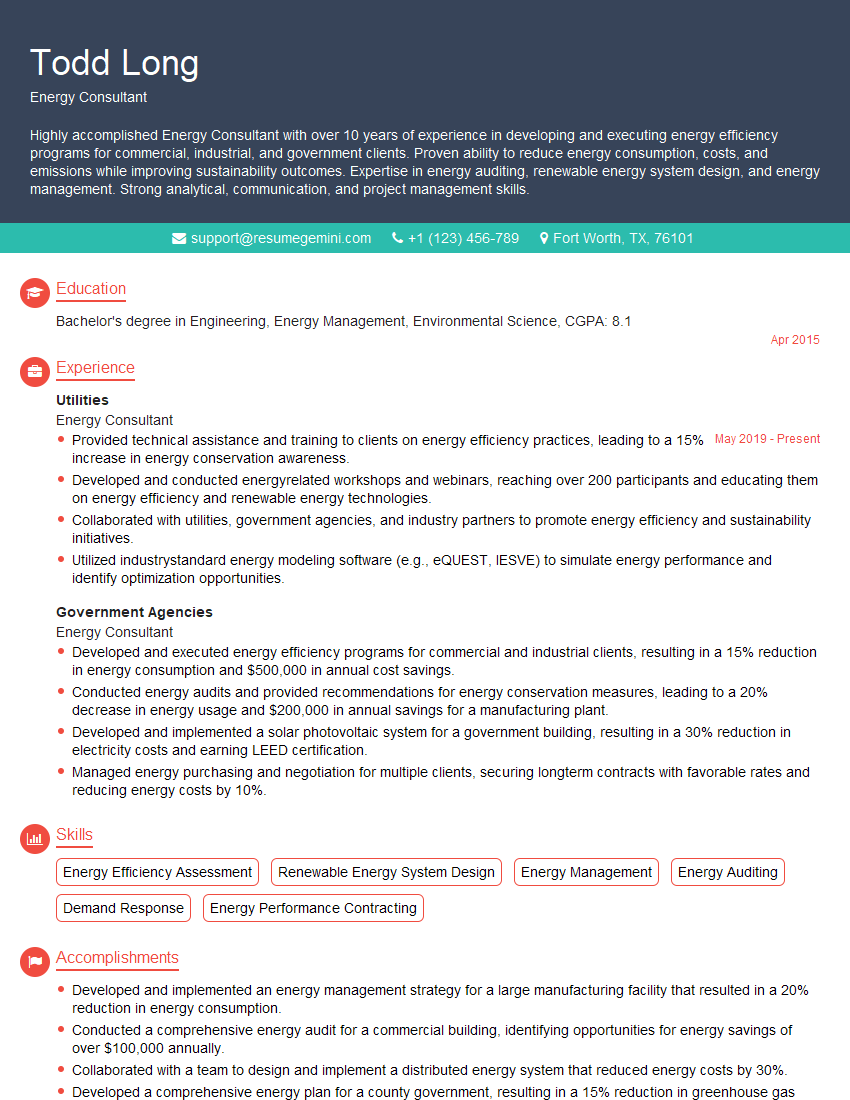
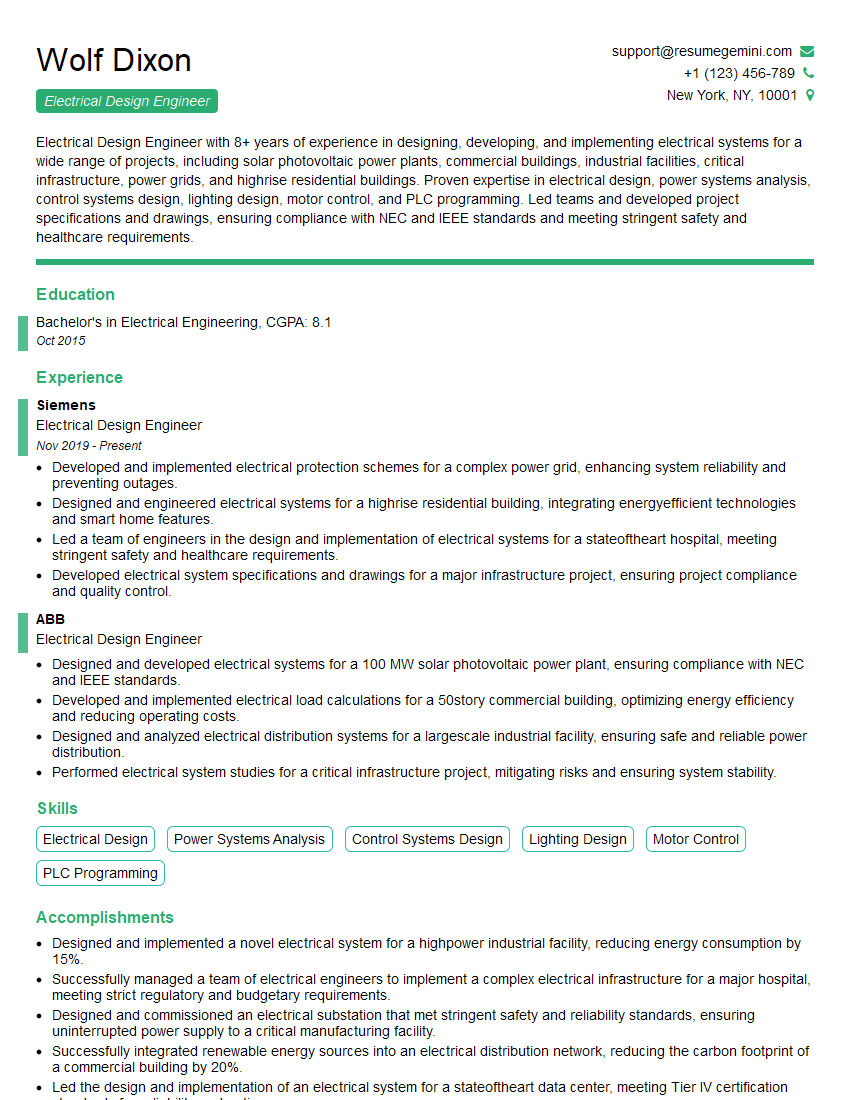
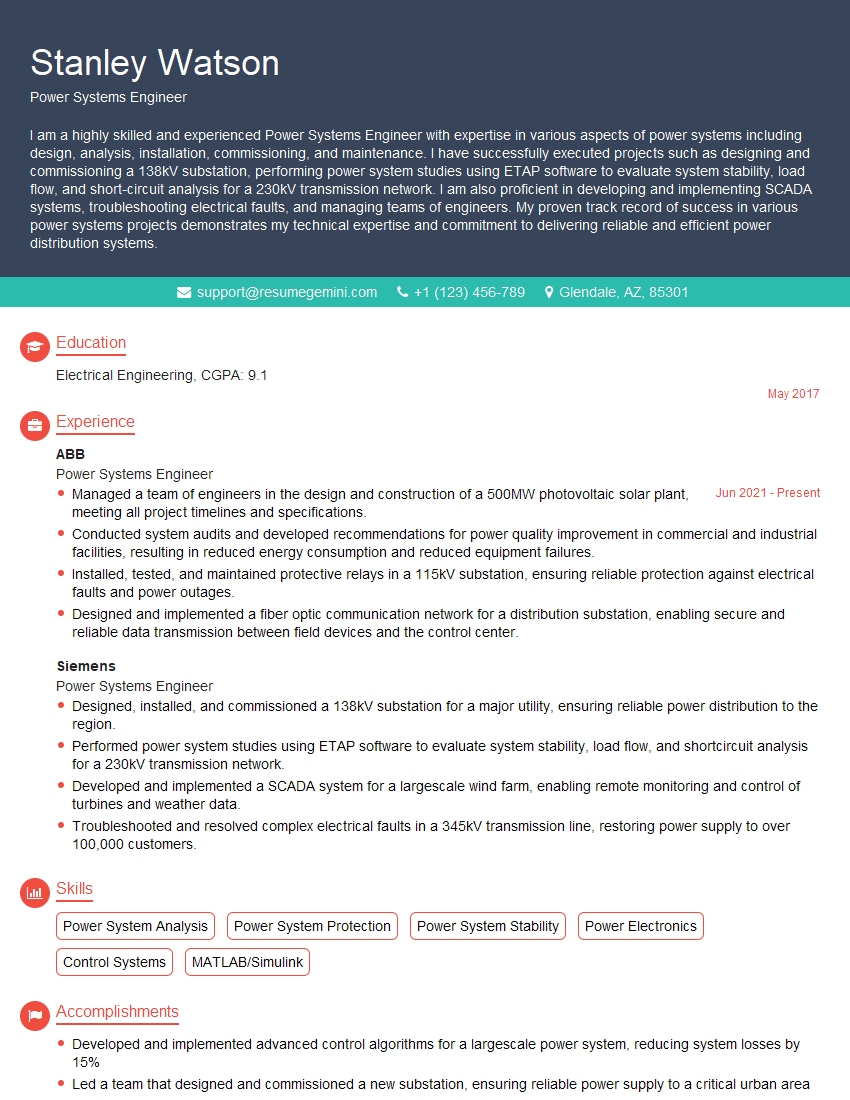
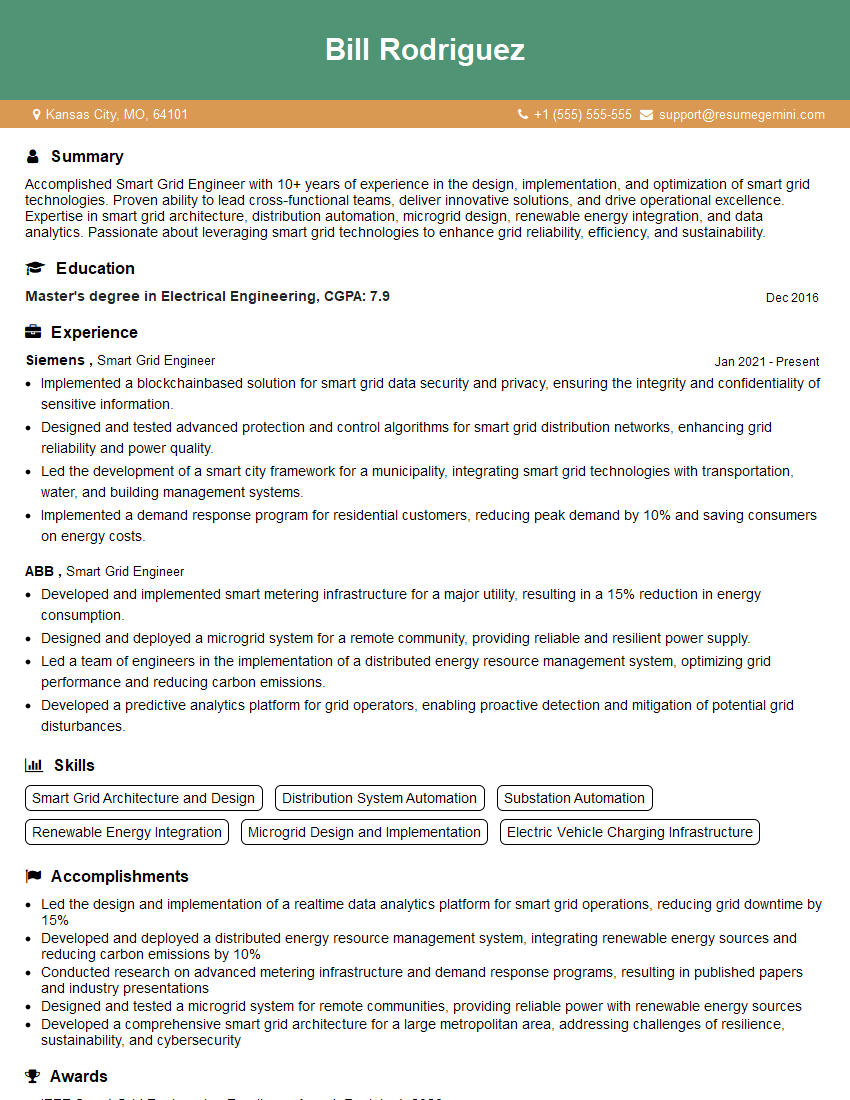
Mastering Distribution Line Design opens doors to exciting career opportunities with significant growth potential in the power industry. A well-crafted resume is your key to unlocking these opportunities. Make sure your resume is ATS-friendly to maximize its visibility to potential employers. ResumeGemini is a trusted resource that can help you build a professional and impactful resume. We provide examples of resumes tailored specifically to Distribution Line Design to help you get started.
Explore more articles
Users Rating of Our Blogs
Share Your Experience
We value your feedback! Please rate our content and share your thoughts (optional).
What Readers Say About Our Blog
To the interviewgemini.com Webmaster.
Very helpful and content specific questions to help prepare me for my interview!
Thank you
To the interviewgemini.com Webmaster.
This was kind of a unique content I found around the specialized skills. Very helpful questions and good detailed answers.
Very Helpful blog, thank you Interviewgemini team.