Cracking a skill-specific interview, like one for Distribution System Protection and Control, requires understanding the nuances of the role. In this blog, we present the questions you’re most likely to encounter, along with insights into how to answer them effectively. Let’s ensure you’re ready to make a strong impression.
Questions Asked in Distribution System Protection and Control Interview
Q 1. Explain the principle of overcurrent protection.
Overcurrent protection is a fundamental principle in power system protection. It relies on the fact that faults, such as short circuits, cause a significant increase in current flow. Overcurrent relays detect this excessive current and initiate a trip signal to disconnect the faulty section of the system, preventing damage and ensuring safety. Think of it like a circuit breaker in your home – if the current exceeds a safe limit, the breaker trips, preventing a fire.
The principle works by comparing the measured current against a pre-set threshold. If the measured current exceeds this threshold, the relay operates, sending a trip signal to the circuit breaker. The threshold is carefully chosen based on the normal operating current and the expected fault current levels for that specific part of the power system. This ensures that the protection system is sensitive enough to detect faults quickly while avoiding nuisance tripping during normal operation.
For example, if a line has a normal operating current of 100 amps, the overcurrent relay might be set to trip at 200 amps. If a fault occurs and the current surges to 500 amps, the relay will quickly detect this and initiate a trip, isolating the fault.
Q 2. Describe different types of protective relays and their applications.
Protective relays are the brains of a power system’s protection scheme. They monitor various parameters like current, voltage, and impedance, comparing them against pre-defined settings. Different types cater to specific protection needs:
- Overcurrent Relays: These are the simplest and most common, responding to excessive current as explained earlier. They can be further classified into instantaneous and time-delayed types. Instantaneous relays operate very quickly for immediate fault clearing, while time-delayed relays allow coordination between multiple relays.
- Differential Relays: These compare the currents entering and leaving a protected zone (e.g., a transformer). Any significant difference indicates an internal fault, triggering a trip signal. We’ll explore this in more detail later.
- Distance Relays: These measure the impedance to a fault along a transmission line. By calculating the impedance, they can determine the location of the fault and isolate only the affected section. This is crucial for long transmission lines.
- Directional Relays: These determine the direction of fault current flow. They are frequently used in conjunction with other relays to prevent tripping on faults outside the protected zone.
- Busbar Protection: Dedicated relays ensure the protection of critical busbars, often using differential protection schemes with multiple current transformers measuring current flow to and from different feeders.
The choice of relay depends on the application and the characteristics of the equipment being protected. For instance, distance relays are ideal for long transmission lines, while differential relays are best for transformers and generators.
Q 3. How does a differential relay work?
A differential relay works on the principle of comparing the currents entering and leaving a protected zone. Imagine a transformer: the current entering the primary winding should ideally equal the current leaving the secondary winding (accounting for transformer ratio). A differential relay uses current transformers (CTs) to measure these currents. The relay then compares the two currents. If there’s a significant difference, it indicates that current is flowing internally within the transformer, signaling a fault like a winding short circuit. The relay then initiates a trip signal.
Current_Primary - (Current_Secondary * Transformer_Ratio) = Difference
If the ‘Difference’ exceeds a certain threshold (the relay’s setting), the relay trips. This is a highly sensitive and selective protection scheme, as it only trips for internal faults. External faults will not typically cause a significant difference in the measured currents.
To handle inrush current during transformer energization or magnetizing inrush, which can also cause a large current difference, differential relays incorporate features like percentage differential or harmonic restraint to avoid unnecessary trips.
Q 4. What are the different types of distance protection schemes?
Distance protection schemes measure the impedance to the fault along a transmission line. This allows for rapid fault location and isolation. Several schemes exist, each with varying levels of sophistication and accuracy:
- Impedance Relay: This is a basic scheme that measures the impedance to the fault. It operates when the measured impedance falls within a pre-defined zone.
- Reactance Relay: This is similar to the impedance relay, but it only considers the reactive component of the impedance.
- Mho Relay: This uses a circular characteristic in the R-X (resistance-reactance) plane. It is more sophisticated and provides better discrimination than impedance relays.
- Offset Mho Relay: This is an improvement over the basic Mho relay, featuring a circle offset from the origin to improve performance with line-end faults.
- Lenticular Relay: This uses a lens-shaped characteristic to improve sensitivity and reduce the impact of line capacitance on relay operation.
The choice of scheme depends on the specific line characteristics and the desired level of protection. Modern distance relays often use sophisticated algorithms that combine multiple schemes to enhance accuracy and reliability.
Q 5. Explain the concept of directional overcurrent relay.
A directional overcurrent relay not only detects overcurrent but also determines the direction of current flow. It’s crucial for preventing cascading outages. Imagine a line feeding power from substation A to substation B. If a fault occurs on a line fed from substation B to substation C, a conventional overcurrent relay at substation A would also see high current and might trip. However, the fault is not on the line protected by that relay at substation A. A directional relay at substation A would sense the current flow direction is towards substation A (a reverse current) and would remain unaffected. It only trips if the overcurrent is flowing in the direction the relay is set to protect.
Directional relays use a polarized mho or similar characteristic to determine direction. They’re commonly used in conjunction with other relays for improved selectivity and coordination.
Q 6. What is the purpose of a transformer protection scheme?
A transformer protection scheme is essential because transformers are expensive and critical components. The scheme aims to detect and isolate faults within the transformer quickly to minimize damage and downtime. Common protection elements include:
- Differential Protection: This is the primary protection method, comparing currents entering and leaving the transformer, as discussed earlier.
- Overcurrent Protection: Provides backup protection in case differential protection fails.
- Buchholz Relay: This is a gas-operated relay that detects faults within the transformer tank, such as insulation failure.
- Winding Temperature Monitoring: Monitors the temperature of the windings to prevent overheating.
These elements work together to ensure comprehensive protection of the transformer. The specific scheme will vary depending on the transformer’s size, type, and application.
Q 7. How does a busbar protection scheme work?
Busbar protection is critical because a busbar is the central point of connection in a substation. A fault on a busbar can disrupt the entire substation. The most common scheme uses differential protection, comparing the currents flowing into and out of the busbar. Multiple current transformers are installed on each feeder connected to the busbar. The currents are summed, and any significant difference indicates an internal busbar fault.
High-impedance busbars present a challenge for traditional differential protection due to the small current differences. Therefore, advanced protection schemes are often implemented, sometimes incorporating monitoring of busbar voltage and zero-sequence currents. This added complexity ensures rapid and reliable detection of busbar faults.
Backup protection schemes are also necessary for busbar protection in case of failure of the main differential system. These might include overcurrent protection and distance protection applied to the individual feeders.
Q 8. Describe the function of a generator protection scheme.
A generator protection scheme is a crucial safety net for power generation equipment, designed to quickly detect and isolate faults to prevent damage and ensure the continued stability of the power system. Think of it as a sophisticated alarm system and automatic fire suppression for a power plant. It’s designed to protect the generator itself and the connected system from various internal and external faults.
These schemes typically include protections against:
- Overcurrent: Protects against excessive current flow, often due to short circuits.
- Overvoltage: Protects against excessively high voltage levels that can damage insulation.
- Undervoltage: Detects dangerously low voltage levels indicating potential system problems.
- Loss of excitation: Detects the failure of the generator’s excitation system, leading to loss of output.
- Reverse power: Detects power flowing back into the generator, which can be damaging.
- Over-speed: Protects against dangerously high rotational speeds of the generator rotor.
- Differential protection: Compares the current entering and leaving the generator; any discrepancy suggests an internal fault.
For example, if a short circuit occurs within the generator windings, the overcurrent protection will quickly trip the generator circuit breaker, isolating the fault and preventing further damage. Similarly, loss of excitation protection will initiate a shutdown if the generator loses its magnetic field, preventing instability and potential damage to other connected equipment.
Q 9. Explain the role of SCADA in distribution system protection.
SCADA (Supervisory Control and Data Acquisition) plays a vital role in distribution system protection by providing real-time monitoring, control, and data analysis capabilities. Imagine it as the central nervous system of the power grid, allowing operators to oversee the entire system and respond to events effectively.
SCADA achieves this through:
- Real-time monitoring: SCADA continuously monitors the status of various equipment like circuit breakers, transformers, and protective relays, providing valuable insights into system health.
- Remote control: Operators can remotely control circuit breakers and other devices through SCADA, allowing for quick isolation of faults and restoration of power.
- Alarm management: SCADA systems provide immediate alerts of abnormal conditions or faults, enabling rapid response.
- Data logging and analysis: SCADA systems record vast amounts of data, providing valuable information for post-fault analysis, performance evaluation and system optimization.
- Integration with protection systems: SCADA integrates seamlessly with protection schemes, providing a centralized platform to monitor and control protective devices.
For instance, if a fault occurs on a feeder, protective relays will trip the relevant circuit breaker. SCADA will detect this event, log the details, display an alert on the operator’s screen, and allow the operator to investigate the cause and potentially restore power through remote control operations.
Q 10. What are the communication protocols used in substation automation?
Substation automation relies on several communication protocols to ensure seamless data exchange between various devices. Think of these protocols as different languages used by various parts of the system to communicate effectively. The choice of protocol often depends on factors like reliability, speed, and distance.
Some common protocols include:
- IEC 61850: This is a widely adopted standard for substation automation, enabling interoperability between devices from different manufacturers. It uses Ethernet and provides a high level of integration and functionality.
- Modbus: A simpler, widely used protocol, particularly for serial communication, offering cost-effective solutions but generally limited to smaller systems.
- DNP3 (Distributed Network Protocol 3): A robust protocol designed for utility applications, well-suited for harsh environmental conditions and offering good reliability and security features.
- PROFINET: An industrial Ethernet protocol increasingly used in substation automation for its high-speed data transmission capabilities.
In a typical substation, different protocols might be used depending on the application. For example, IEC 61850 might be used for critical protection and control functions, while Modbus might be used for less critical monitoring tasks.
Q 11. How does a fault location algorithm work?
A fault location algorithm uses measured data from the power system to pinpoint the location of a fault along a transmission or distribution line. It’s like a detective investigating a crime scene, using clues (data) to find the culprit (fault location). Different algorithms exist, with varying levels of complexity and accuracy.
A common approach is the impedance-based method, which uses the measured impedance seen by the protection relay. The algorithm compares this impedance to a known impedance profile of the line and calculates the distance to the fault. Other methods use traveling wave techniques, analyzing the propagation of fault-generated waves along the line to estimate the fault location.
The algorithm typically involves:
- Data Acquisition: The algorithm gathers data from protective relays, such as current and voltage waveforms.
- Pre-fault Analysis: It determines the pre-fault system parameters (impedance, line constants, etc.).
- Fault Detection and Classification: It determines if a fault has occurred and identifies its type (e.g., single-line-to-ground, three-phase).
- Fault Location Calculation: Using the acquired data and pre-fault parameters, the algorithm applies mathematical equations to estimate the distance to the fault.
- Results Presentation: The algorithm displays the estimated fault location, providing crucial information for maintenance crews.
The accuracy of the fault location algorithm is affected by several factors including the accuracy of the measured data, the quality of the system model, and the type of fault.
Q 12. Describe different types of grounding systems and their impact on protection.
Grounding systems are essential for protecting equipment and personnel from electrical hazards and ensuring the stability of the power system. They act like safety valves, providing a low-impedance path for fault currents to flow to earth, limiting the voltage rise and preventing damage. Different grounding systems exist, each with its own advantages and disadvantages regarding protection.
Common types include:
- Solid grounding: This is a direct connection to the earth with very low impedance, effectively grounding neutral points. This offers good protection against overvoltages but may lead to high fault currents.
- Resistance grounding: A resistor is inserted between the neutral point and earth, limiting the fault current but compromising some protection against overvoltages.
- Reactance grounding: A reactor is used instead of a resistor, offering more controlled fault current limiting and better overvoltage protection than resistance grounding.
- Peterson coil grounding: This method uses a tuned reactor to neutralize the capacitive charging current of the transmission line, essentially eliminating the fault current. This provides effective protection with minimum fault current.
The choice of grounding system significantly impacts protection scheme design. For example, with solid grounding, overcurrent relays might need to have higher settings to handle high fault currents, while resistance grounding may require special voltage-sensitive relays to provide reliable fault detection.
Q 13. What are the common challenges in distribution system protection?
Distribution system protection faces unique challenges due to the dispersed nature of the network, high fault frequency, and diverse equipment. Imagine trying to protect a vast and complex network of roads – it’s a challenging task.
Common challenges include:
- High fault incidence: Distribution networks experience more frequent faults compared to transmission systems, demanding robust and reliable protection schemes.
- System complexity: The distributed nature of the network and the increasing integration of distributed generation sources (e.g., solar panels, wind turbines) make it difficult to accurately model the system and design effective protection schemes.
- Coordination difficulties: Ensuring proper coordination between various protection devices is crucial to prevent cascading outages. Incorrect coordination can lead to unnecessary tripping and longer outage durations.
- Limited communication infrastructure: In many areas, communication infrastructure for remote monitoring and control might be limited or unreliable, affecting the effectiveness of protection systems.
- Aging infrastructure: Older protection devices might require upgrades or replacement, posing challenges for maintenance and cost optimization.
- Cybersecurity threats: The increasing use of digital communication and control systems makes distribution systems vulnerable to cyberattacks, which can disrupt operations and compromise security.
Overcoming these challenges requires advanced protection technologies, robust communication networks, and effective maintenance strategies.
Q 14. Explain the concept of power system stability and its relevance to protection.
Power system stability refers to the ability of the system to maintain synchronism and operate steadily after a disturbance. It’s akin to a group of dancers maintaining a graceful performance even when an unexpected event occurs. Loss of stability can lead to widespread blackouts and significant economic losses.
Power system stability is intrinsically linked to protection. Protection systems are designed not only to isolate faults but also to minimize the impact of disturbances on system stability. Uncoordinated or delayed protection actions can exacerbate system instability, leading to cascading outages. Protection systems contribute to stability by:
- Rapid fault clearance: Quick isolation of faults limits the impact on system dynamics, reducing the likelihood of cascading outages.
- Islanding schemes: These allow for the separation of faulty sections of the network, isolating the disturbance and maintaining stability in the remaining parts of the system.
- Underfrequency load shedding: This automatically sheds load in response to underfrequency conditions, preventing system collapse.
- Protection coordination: Proper coordination of protection devices ensures that faults are cleared efficiently and without triggering unnecessary tripping of healthy parts of the system.
For example, a large fault might cause a drop in system frequency. Underfrequency load shedding, triggered by protection, will help restore frequency, thus improving stability and averting a larger blackout. Protection systems’ rapid and well-coordinated response is paramount in maintaining system stability and preventing catastrophic power outages.
Q 15. Describe different types of protective relay settings and how they are determined.
Protective relay settings are crucial for ensuring the selective and rapid isolation of faults in a power system. They define the operating characteristics of the relay, determining when and how it will trip. These settings are specific to the type of relay and the protected equipment.
- Overcurrent Relays: These are the most common type, tripping when the current exceeds a pre-defined threshold. Settings include current pickup (Ipickup), time delay (time dial setting), and potentially inverse time characteristics (different slopes of the time vs current curve). For instance, a setting of 5A pickup with a 0.5-second delay means the relay trips when the current exceeds 5A and after a 0.5 second delay.
- Differential Relays: These compare currents entering and leaving a protected zone (e.g., a transformer). Settings include percentage differential, harmonic restraint, and differential bias. They are much more sensitive to internal faults than external ones. The percentage differential setting sets a tolerance for the difference in currents; if the difference exceeds the tolerance, the relay trips.
- Distance Relays: These measure the impedance to the fault location. Settings include zone reach, and angle characteristics. Each Zone has specific impedance settings to cover a specific portion of the line.
- Ground Relays: These protect against ground faults. Settings include ground current pickup and time delay.
Determining these settings requires careful analysis of the power system, considering fault current contributions, relay characteristics, and coordination with other protective devices. Sophisticated software tools perform these calculations, simulating various fault conditions and ensuring proper selectivity and speed of operation. We often use symmetrical component analysis to determine the fault current levels and the influence of network impedances on the relay operation.
Career Expert Tips:
- Ace those interviews! Prepare effectively by reviewing the Top 50 Most Common Interview Questions on ResumeGemini.
- Navigate your job search with confidence! Explore a wide range of Career Tips on ResumeGemini. Learn about common challenges and recommendations to overcome them.
- Craft the perfect resume! Master the Art of Resume Writing with ResumeGemini’s guide. Showcase your unique qualifications and achievements effectively.
- Don’t miss out on holiday savings! Build your dream resume with ResumeGemini’s ATS optimized templates.
Q 16. What is the significance of coordination between protective relays?
Coordination between protective relays is paramount for ensuring that the correct relay trips during a fault, isolating the faulty section while leaving the rest of the system operational. Without proper coordination, multiple relays might trip, leading to widespread outages and unnecessary service interruptions, or worse, a relay might fail to operate, causing damage to equipment.
Coordination is achieved by setting the operating times and current settings of different relays in a hierarchical manner. For example, a downstream relay (closer to the fault) will have a faster operating time than an upstream relay (further from the fault). This ensures that the closest relay to the fault clears the fault first, preventing unnecessary tripping of upstream protection. The goal is to achieve selective tripping. Imagine a chain of relays – the first link in the chain (closest to the fault) breaks, stopping the fault without affecting the others.
This coordination is typically achieved through time-current curves for the relays, graphically demonstrating the relationship between fault current and tripping time. Software tools assist with this coordination study.
Q 17. How do you test and maintain protective relays?
Testing and maintaining protective relays is crucial for reliable system operation. This involves regular inspections, functional tests, and calibration to ensure their accurate and timely response to faults.
- Routine Inspections: This includes visual checks for physical damage, loose connections, and cleanness of the relay. It also involves checking the relay’s communication and logging functions.
- Functional Tests: These use test sets that simulate different fault conditions (e.g., overcurrent, ground fault, etc.), verifying the relay’s response times and tripping characteristics. These tests confirm that the relay operates within its defined settings.
- Calibration: This ensures that the relay’s internal components are accurately measuring and processing signals. Calibration involves using standardized equipment to adjust and verify the accuracy of the measurements.
A comprehensive testing strategy typically involves a combination of these methods. Modern relays have self-diagnostic capabilities that provide insights into their operational status and potential issues. These self-tests can identify potential problems before they escalate into larger issues. Regular, documented testing is essential to comply with safety regulations and to ensure the protection system’s reliability.
Q 18. Explain the concept of arc flash and its mitigation strategies.
An arc flash is a dangerous electrical explosion that occurs when an electrical fault causes a high-current arc. This arc produces intense heat, light, and pressure, posing serious risks of burns, blindness, and even death to personnel working near energized equipment. Arc flash incidents can happen in various settings, from industrial plants to utility substations.
Mitigation strategies focus on preventing arc flash incidents or minimizing their severity:
- Engineering Controls: These are the most effective approach, aiming to eliminate or reduce the risk at the source. Examples include using equipment with arc flash reduction features (such as arc resistant switchgear), proper grounding, and the use of protective devices that limit fault current (e.g., current-limiting fuses).
- Administrative Controls: These involve implementing safe work practices, such as lockout/tagout procedures, proper training, and the use of personal protective equipment (PPE). Regular safety audits and training programs are part of this approach.
- Personal Protective Equipment (PPE): This is the last line of defense, used when engineering and administrative controls cannot fully eliminate the risk. This includes flame-resistant clothing, arc flash suits, and face shields, all selected based on incident energy calculations.
Arc flash risk assessments are essential for identifying potential hazards and determining the appropriate mitigation strategies based on incident energy levels.
Q 19. How does a recloser work and what are its advantages?
A recloser is an automatic switching device that can repeatedly open and close a circuit breaker. It’s strategically placed on distribution lines to automatically interrupt and restore power during transient faults, such as temporary short circuits caused by trees or animals contacting the lines. Unlike a conventional circuit breaker, which trips permanently upon detecting a fault, a recloser can attempt to automatically reclose the circuit after a short delay, providing temporary fault interruption and self-healing of the system.
Advantages of Reclosers:
- Reduced Outage Time: Reclosers minimize outage duration by automatically restoring power if the fault is temporary.
- Improved System Reliability: They enhance system reliability and reduce the number of sustained outages.
- Cost Savings: They can reduce the need for manual intervention, saving on labor costs.
- Improved System Protection: By isolating faulty sections quickly, they prevent damage to equipment.
Reclosers are equipped with various settings to control their operating characteristics, including the number of reclosing attempts, the time intervals between reclosing attempts, and the overall operating time. They also often incorporate fault detection capabilities, enabling faster and more intelligent operation.
Q 20. What are the benefits of using intelligent electronic devices (IEDs)?
Intelligent Electronic Devices (IEDs) are digitally controlled protective relays and other equipment used in power systems. They offer significant advantages over traditional electromechanical relays.
- Advanced Communication Capabilities: IEDs can communicate over various networks, allowing for remote monitoring, control, and diagnostics of the power system. This enables remote troubleshooting and faster responses to faults.
- Enhanced Protection Functions: They provide more sophisticated protection algorithms and settings, leading to more accurate fault detection and isolation.
- Self-Diagnostics and Monitoring: IEDs offer built-in self-diagnostic functions, enabling proactive identification of potential problems and improved maintenance scheduling.
- Flexibility and Adaptability: Settings can be changed remotely and easily, accommodating changing system conditions or operational requirements. This facilitates ease of upgrades and system modifications.
- Data Acquisition and Analysis: IEDs can collect vast amounts of data on system performance, which can be analyzed to improve reliability and optimize system operations.
The use of IEDs makes power systems more efficient, reliable, and easier to manage. They form the basis for modern smart grids and advanced power system management systems.
Q 21. Explain the concept of phasor measurement units (PMUs).
Phasor Measurement Units (PMUs) are highly accurate devices that synchronize the measurement of voltage and current phasors across a power system. Unlike traditional protection relays that rely on local measurements, PMUs provide synchronized measurements across a wide geographic area using GPS timing signals. This synchronized data enables a much more comprehensive view of the power system’s dynamic state.
Applications of PMUs:
- Wide-Area Monitoring (WAM): PMUs enable the real-time monitoring of the entire power system, enhancing situational awareness and enabling faster responses to disturbances.
- State Estimation: The synchronized data from multiple PMUs improves the accuracy of power system state estimation, providing a more detailed picture of system conditions.
- Dynamic System Simulation: PMU data is used to improve the accuracy and realism of power system simulation models.
- Advanced Protection Schemes: PMU data enables advanced protection schemes, such as wide-area protection and fault location estimation.
PMUs are revolutionizing the way power systems are monitored, protected, and controlled, paving the way for more resilient and efficient power grids. They are particularly important for managing large and complex power systems where synchronized information is essential for efficient operation and fault mitigation.
Q 22. Describe the role of a distribution management system (DMS).
A Distribution Management System (DMS) is the brain of a power distribution network. Think of it as an advanced control center that monitors, controls, and optimizes the entire distribution system in real-time. It integrates data from various sources like SCADA (Supervisory Control and Data Acquisition), outage management systems, and advanced metering infrastructure (AMI) to provide a holistic view of the grid’s health and performance.
Its core functions include:
- State Estimation: Accurately determining the real-time operating conditions of the system, including voltage, current, and power flow.
- Outage Management: Quickly identifying and isolating faults, minimizing the impact on customers, and restoring power efficiently. This often involves automated switching and restoration schemes.
- Network Monitoring: Continuously tracking the health of equipment and lines, predicting potential problems, and providing early warnings.
- Planning and Optimization: Using sophisticated algorithms to optimize power flow, reduce losses, and improve the overall efficiency of the distribution network.
- Fault Location, Isolation, and Service Restoration (FLISR): Automating the process of identifying fault locations and restoring service to affected customers as quickly as possible.
For example, a DMS can automatically reroute power around a faulty section of the network, minimizing the impact of an outage on customers. It also helps in proactive maintenance by identifying equipment that is approaching its end-of-life or showing signs of degradation.
Q 23. How are cybersecurity threats addressed in substation automation?
Cybersecurity is paramount in substation automation, as a breach could have catastrophic consequences, from widespread outages to potential physical damage. We address these threats through a multi-layered approach:
- Network Segmentation: Isolating different parts of the network to limit the impact of a successful attack. This prevents a compromise in one area from spreading to the entire system. Think of it like having firewalls within a building, preventing a fire in one room from destroying the whole structure.
- Intrusion Detection and Prevention Systems (IDPS): Implementing systems that monitor network traffic for suspicious activity and automatically block or alert on potential threats. This is like having security guards monitoring cameras and actively intervening to prevent intrusions.
- Access Control: Restricting access to sensitive systems and data based on the principle of least privilege. Only authorized personnel with a valid need should have access. This is like using keycards to control access to different areas of a building.
- Regular Security Audits and Penetration Testing: Proactively identifying vulnerabilities and ensuring the effectiveness of security measures. This is analogous to regularly inspecting and maintaining the building’s security system.
- Secure Communication Protocols: Employing encryption and authentication protocols to protect communication between devices. This ensures only authorized devices can communicate securely.
- Firmware Updates and Patch Management: Regularly updating firmware and software to address known vulnerabilities. This is like keeping the building’s software and systems updated with the latest security patches.
For instance, using strong encryption for communication between intelligent electronic devices (IEDs) within a substation prevents eavesdropping and manipulation of data.
Q 24. Explain the impact of renewable energy sources on distribution system protection.
The increasing integration of renewable energy sources (RES) like solar and wind power significantly impacts distribution system protection. The intermittent and unpredictable nature of RES poses unique challenges:
- Reverse Power Flow: RES can inject power back into the grid, potentially causing unexpected voltage rises and overloading protection equipment designed for unidirectional flow. We need to adjust protection settings to accommodate this.
- Fault Current Contributions: RES inverters can contribute fault currents, requiring protection schemes to account for this variable contribution. This makes traditional protection schemes inadequate without modification.
- Increased System Complexity: The distributed nature of RES generation adds complexity to the distribution network, making it more challenging to predict and manage fault scenarios.
- Islanding Protection: When a portion of the grid becomes isolated (islanding) due to a fault, RES can continue to supply power, posing safety risks to utility workers. Islanding protection schemes are crucial.
For example, a traditional overcurrent relay might not be suitable for a feeder with significant solar PV generation because the reverse power flow could trigger unnecessary tripping. We might need to use more sophisticated protection schemes like directional overcurrent relays or fault current limiters.
Q 25. What are the advantages and disadvantages of different types of protection schemes?
Various protection schemes exist, each with its advantages and disadvantages:
- Overcurrent Relays: These are simple and inexpensive, but can be prone to nuisance tripping due to inrush currents or load variations. They are effective for detecting short circuits.
- Differential Relays: Highly sensitive and selective, accurately detecting internal faults within protected equipment like transformers. However, they are more complex and expensive to implement.
- Distance Relays: Measure the impedance to a fault, allowing for faster tripping and improved selectivity. They are suitable for long transmission lines but require accurate impedance measurements.
- Pilot Wire Protection: Uses communication lines to detect faults along long transmission lines, providing high speed and selectivity. However, it is susceptible to communication failures.
- Busbar Protection: Protects the main busbar from faults, using differential or current transformer-based schemes. It ensures the safety of the main power distribution point.
The choice of protection scheme depends on several factors, including the type of equipment being protected, the fault current levels, and the required level of selectivity and speed. For instance, a high-voltage transmission line might use distance relays due to their ability to detect faults quickly over long distances, while a transformer might employ differential relays for precise fault detection within its windings.
Q 26. How do you troubleshoot a malfunctioning protective relay?
Troubleshooting a malfunctioning protective relay involves a systematic approach:
- Gather Information: Collect data from event recorders, oscilloscopes, and relay logs to understand the circumstances surrounding the malfunction. Note the time of the event and any unusual behavior preceding it.
- Visual Inspection: Inspect the relay for any signs of physical damage, loose connections, or burnt components. Pay attention to any indicators on the relay itself.
- Check Wiring and Connections: Verify that all connections are secure and that the wiring is correct. Incorrect wiring can lead to malfunction.
- Test the Relay: Use a relay test set to perform comprehensive tests, including checking the relay’s settings, measuring its response to various inputs (fault currents), and verifying its operational characteristics. This ensures the relay’s settings are correct and its internal circuits are functioning.
- Analyze Test Results: Compare test results with the manufacturer’s specifications. Identify any deviations and investigate their causes.
- Check Secondary System: Ensure that the current transformers (CTs) and potential transformers (PTs) supplying signals to the relay are functioning correctly. Faulty CTs/PTs can lead to incorrect relay operation.
- Review Relay Settings: Verify the relay’s settings are appropriate for the protected equipment and system parameters. Incorrect settings can lead to incorrect operation.
- Consult Documentation: Refer to the manufacturer’s manuals and technical specifications for troubleshooting guidance.
For example, if a relay is tripping unnecessarily, a thorough testing process might reveal a problem in CT saturation which is distorting the input signal causing false trips.
Q 27. Describe your experience with protection relay settings calculation software.
I have extensive experience using various protection relay settings calculation software, including but not limited to EasyPower, SKM PowerTools, and CAPE. These tools are invaluable for accurately determining optimal relay settings, ensuring reliable and selective protection. My experience encompasses:
- Developing models of electrical networks: Using the software to build accurate representations of power systems, including various equipment like transformers, generators, and lines.
- Performing short-circuit studies: Calculating fault currents and voltage levels under various fault conditions to determine appropriate relay settings. This ensures that the relays operate within their intended parameters and that protection is coordinated.
- Coordinating protection settings: Ensuring the proper sequence of operation of multiple relays to protect equipment and avoid cascading outages. Proper coordination ensures that faults are isolated quickly but without unnecessary tripping of other devices.
- Generating relay setting reports: Producing comprehensive reports documenting the calculated settings, ensuring compliance with standards and facilitating effective communication.
- Analyzing results and fine-tuning settings: Iteratively refining settings based on analysis of results from simulations and field tests.
For instance, I recently used EasyPower to model a distribution network to calculate protective relay settings for a new substation, taking into account the anticipated fault currents and load levels. This ensures that the new protection system efficiently and reliably safeguards the new substation and its connected network.
Q 28. Explain your understanding of the latest trends in distribution system protection.
Several key trends are shaping the future of distribution system protection:
- Increased Automation and AI: The use of artificial intelligence (AI) and machine learning (ML) to enhance protection system performance, automate fault diagnosis, and predict potential issues. AI allows for sophisticated analysis of large data sets to improve the accuracy and speed of protection and control.
- Wide-Area Monitoring Systems (WAMS): Employing WAMS to enhance situational awareness and coordination of protection schemes across a wider geographic area. This is essential for managing large, complex power systems.
- Smart Sensors and IoT: Integrating smart sensors and Internet of Things (IoT) devices to monitor the health of distribution equipment in real time, providing enhanced data for faster fault detection and more precise protection.
- Phasor Measurement Units (PMUs): Utilizing PMUs for high-precision measurements of voltage and current phasors, providing more accurate fault location and improved protection coordination.
- Cybersecurity Enhancements: Implementing robust cybersecurity measures to protect the integrity and security of distribution protection systems. This is critical given the increasing reliance on networked devices.
- Integration of Renewable Energy Resources: Developing protection schemes that effectively manage the unique challenges posed by RES, ensuring grid stability and reliability.
For example, the use of AI-driven diagnostic tools can analyze data from numerous sources to quickly identify and isolate faults, leading to significantly faster restoration times and reduced outage impacts. This trend will continue to increase in the future.
Key Topics to Learn for Distribution System Protection and Control Interview
- Protective Relaying Principles: Understand the fundamental operation of various protective relays (overcurrent, distance, differential) and their application in distribution systems. Consider the impact of different relay settings on system performance.
- Fault Location and Isolation: Explore techniques for quickly identifying and isolating faults within a distribution network. This includes understanding fault detection methods and the role of SCADA systems.
- Distribution Automation: Become familiar with automated systems for fault detection, isolation, and restoration. Consider the benefits and challenges of implementing these systems, including cybersecurity considerations.
- Power System Stability and Control: Grasp the concepts of voltage regulation and power flow control in distribution networks. Understand the impact of distributed generation (DG) on system stability and control.
- Protection Coordination: Learn about the process of coordinating protective devices to ensure selective tripping and minimize service interruptions during faults.
- Communication Networks: Explore the role of communication networks (e.g., IEC 61850) in supporting modern distribution system protection and control schemes.
- Smart Grid Technologies: Understand the integration of smart grid technologies, such as advanced metering infrastructure (AMI) and phasor measurement units (PMUs), into distribution system protection and control.
- Practical Application: Be prepared to discuss real-world examples of how these concepts have been applied to solve problems in distribution system operation and maintenance.
- Problem-Solving: Practice solving problems related to relay settings, fault analysis, and protection coordination using relevant software tools or simulations.
Next Steps
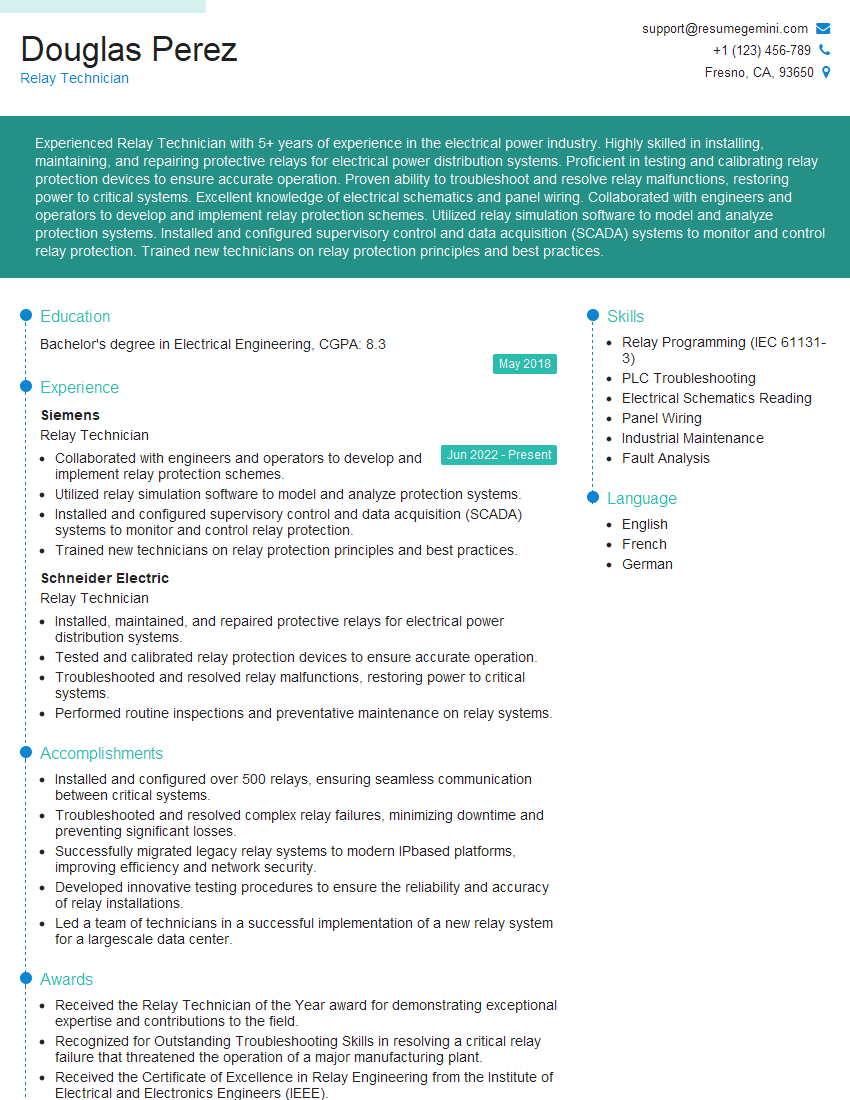
Mastering Distribution System Protection and Control is crucial for advancing your career in the power industry, opening doors to specialized roles and leadership opportunities. A strong resume is essential for showcasing your skills and experience to potential employers. Creating an ATS-friendly resume increases your chances of getting your application noticed and considered. ResumeGemini is a trusted resource to help you build a professional and impactful resume that highlights your expertise in this field. Examples of resumes tailored to Distribution System Protection and Control are available to help guide you in this process.
Explore more articles
Users Rating of Our Blogs
Share Your Experience
We value your feedback! Please rate our content and share your thoughts (optional).
What Readers Say About Our Blog
To the interviewgemini.com Webmaster.
Very helpful and content specific questions to help prepare me for my interview!
Thank you
To the interviewgemini.com Webmaster.
This was kind of a unique content I found around the specialized skills. Very helpful questions and good detailed answers.
Very Helpful blog, thank you Interviewgemini team.