Are you ready to stand out in your next interview? Understanding and preparing for Earth Observation System interview questions is a game-changer. In this blog, we’ve compiled key questions and expert advice to help you showcase your skills with confidence and precision. Let’s get started on your journey to acing the interview.
Questions Asked in Earth Observation System Interview
Q 1. Explain the difference between active and passive remote sensing.
The core difference between active and passive remote sensing lies in how they acquire data about the Earth’s surface. Passive remote sensing systems, like cameras, detect naturally emitted or reflected energy, primarily from the sun. Think of it like taking a photograph – you’re capturing the light already present. Examples include Landsat and MODIS satellites, which measure reflected sunlight to map vegetation, land use, and other features.
Active remote sensing, on the other hand, emits its own energy source and then measures the energy reflected back. This is like shining a flashlight and observing how much light bounces back. Radar and LiDAR are excellent examples. Radar satellites, such as Sentinel-1, send out microwave signals and record their return, allowing us to see through clouds and penetrate vegetation, making it useful for mapping topography even in inclement weather. LiDAR, using laser pulses, provides highly accurate elevation data, crucial for things like urban planning and disaster response.
Q 2. Describe various types of satellite orbits and their applications.
Satellite orbits are categorized by their altitude, inclination, and type of path. The choice of orbit significantly impacts the satellite’s capabilities and applications.
- Low Earth Orbit (LEO): These orbits are relatively close to the Earth (typically 200-2000 km). LEO satellites provide high spatial resolution but require more frequent passes to cover the entire Earth’s surface. They’re ideal for Earth observation applications requiring detailed imagery, like high-resolution mapping and environmental monitoring (e.g., Landsat, Sentinel-2).
- Medium Earth Orbit (MEO): Situated at altitudes between 2000 and 36,000 km, MEO orbits are utilized for navigation systems like GPS. The satellites move slower, providing wider coverage than LEO but with lower spatial resolution.
- Geostationary Orbit (GEO): At approximately 36,000 km above the equator, GEO satellites appear stationary relative to the Earth’s surface. This continuous view of a specific area is vital for weather forecasting and communications, as exemplified by GOES (Geostationary Operational Environmental Satellites).
- Polar Orbits: These orbits pass over the Earth’s poles, offering comprehensive coverage of the entire globe. Many Earth observation satellites use this type of orbit to systematically monitor changes over time. A sun-synchronous polar orbit, a specific type of polar orbit, ensures that the satellite passes over the same area at the same solar time each day, minimizing variations in illumination.
Q 3. What are the key atmospheric effects that impact remote sensing data?
Atmospheric effects can significantly degrade the quality of remote sensing data. Key impacts include:
- Atmospheric scattering: Air molecules and particles scatter incoming solar radiation, reducing image contrast and clarity, especially in shorter wavelengths (blue light). This is more pronounced in hazy or cloudy conditions.
- Atmospheric absorption: Certain atmospheric gases, like water vapor and carbon dioxide, absorb specific wavelengths of electromagnetic radiation, leading to gaps or distortions in the spectral information recorded. This makes certain wavelengths less useful for specific applications.
- Rayleigh scattering: Scattering caused by very small particles (smaller than the wavelength of light), primarily impacting shorter wavelengths. This explains why the sky is blue.
- Mie scattering: Scattering by larger particles such as dust and aerosols, affecting longer wavelengths as well. This contributes to hazy conditions.
These atmospheric effects can be minimized using atmospheric correction techniques, which involve complex algorithms to estimate and remove the atmospheric influence from the raw satellite data.
Q 4. How do you correct for geometric distortions in satellite imagery?
Geometric distortions in satellite imagery arise from various sources, including the Earth’s curvature, satellite sensor orientation, and platform motion. Correcting for these distortions is crucial for accurate analysis. Common methods include:
- Geometric Rectification: This involves transforming the image to a map projection, aligning it with a known coordinate system. Ground control points (GCPs), which are points with known coordinates in both the image and on the ground, are used to establish the transformation parameters.
- Orthorectification: This goes a step further by correcting for relief displacement, which occurs due to variations in elevation. A Digital Elevation Model (DEM) is necessary for orthorectification, providing the elevation data needed to remove the distortions caused by terrain.
- Sensor Modelling: Sophisticated techniques use detailed sensor models to mathematically remove geometric distortions based on sensor parameters and satellite trajectory data. This method requires extensive knowledge of the sensor’s characteristics.
The choice of method depends on the accuracy required, the availability of GCPs and DEMs, and the complexity of the terrain.
Q 5. Explain the concept of spatial resolution and its importance.
Spatial resolution refers to the smallest discernible detail in an image. It’s essentially the size of the smallest square on the ground that is represented by a single pixel in the satellite image. A high spatial resolution image shows fine details, while a low spatial resolution image appears coarser.
Imagine looking at a photograph of a forest. A high spatial resolution image would allow you to distinguish individual trees, while a low spatial resolution image might only show the overall forest canopy. The importance of spatial resolution depends entirely on the application. For mapping individual buildings, high spatial resolution is crucial. For monitoring large-scale deforestation, lower resolution might suffice.
Q 6. What are the different types of spectral resolutions and their uses?
Spectral resolution describes the number and width of wavelength bands (or channels) recorded by the sensor. Different types exist:
- Broadband: Sensors like Landsat MSS initially used broad spectral bands, providing limited information on specific features.
- Narrowband/Hyperspectral: Hyperspectral sensors acquire data across hundreds of very narrow, contiguous spectral bands. This allows for much more detailed analysis of the spectral signature of materials, which is crucial for identifying specific minerals, vegetation types, or pollutants. This level of detail is particularly useful in areas such as precision agriculture, geology, and environmental monitoring.
- Multispectral: Multispectral sensors capture data in multiple, but wider, spectral bands. These bands are carefully selected to enhance information about certain features, like vegetation (red and near-infrared) or water (shortwave infrared).
The choice of spectral resolution depends on the application. While hyperspectral data offers unparalleled spectral detail, it is often more expensive and computationally intensive to process compared to multispectral data.
Q 7. Describe your experience with image classification techniques.
My experience with image classification techniques is extensive. I’ve worked extensively with both supervised and unsupervised methods.
Supervised classification involves training a classifier using labeled data (ground truth information). I’ve used various algorithms including Maximum Likelihood Classification (MLC), Support Vector Machines (SVM), and Random Forest. For example, I used MLC to classify land cover types in a coastal region using Landsat data, achieving an overall accuracy of over 90%. This involved carefully selecting training samples representing different land cover classes and then using the classifier to assign each pixel to a specific class.
Unsupervised classification, such as K-means clustering, is used when labeled data is unavailable. I’ve utilized this for preliminary analysis of hyperspectral data to identify potential spectral clusters representing distinct materials. This served as an initial step before more targeted supervised analysis.
Additionally, I have experience with object-based image analysis (OBIA), which combines image segmentation with classification. OBIA allows for more accurate classification by considering the spatial context of pixels, leading to improved results, particularly in complex landscapes. I have successfully applied OBIA techniques to map urban infrastructure using high-resolution imagery.
Q 8. Explain the process of orthorectification.
Orthorectification is the process of geometrically correcting a satellite image to remove distortions caused by terrain relief, sensor viewing angles, and Earth curvature. Imagine taking a picture of a mountain range from an airplane – the peaks appear closer together than they actually are. Orthorectification makes the image appear as if it were taken directly overhead, creating a map-like projection.
The process typically involves these steps:
- Acquiring elevation data: This is usually done using a Digital Elevation Model (DEM), which provides height information for each point on the Earth’s surface. Sources include LiDAR, SRTM (Shuttle Radar Topography Mission), or other elevation datasets.
- Geometric correction: The software uses the DEM and the image’s metadata (information about the sensor’s position and viewing angles) to calculate the precise ground coordinates for each pixel.
- Resampling: Pixel values are then assigned to their new locations on the orthorectified image, using techniques like nearest neighbor, bilinear, or cubic convolution. The choice of resampling method influences the accuracy and smoothness of the result.
The outcome is a geometrically accurate image where distances and areas are correctly represented, suitable for precise measurements and analysis, crucial for tasks like land cover mapping, urban planning, and precision agriculture.
Q 9. How do you handle cloud cover in satellite imagery analysis?
Cloud cover is a major challenge in satellite imagery analysis because clouds obscure the ground features we’re trying to study. There are several strategies for handling cloud cover:
- Image selection: The simplest approach is to choose images with minimal cloud cover. This requires access to multiple images acquired at different times.
- Cloud masking: Algorithms identify cloudy pixels based on their spectral characteristics (e.g., high reflectance in near-infrared wavelengths). These pixels are then masked or removed from the analysis.
- Cloud filling/interpolation: More sophisticated techniques use neighboring cloud-free pixels to estimate the values of the obscured areas. This can involve techniques like spatial interpolation or using data from different dates or sensors.
- Temporal compositing: Combining multiple images taken over time can allow us to create a composite image where cloud-free pixels are chosen from each date, effectively reducing cloud cover impacts. For example, we can select the clearest observation for each pixel from a time series.
The best approach depends on the specific application and the availability of data. For critical applications, combining multiple strategies is often necessary. For example, I might use cloud masking to remove the obvious clouds, then use temporal compositing to fill in any remaining gaps.
Q 10. What are the advantages and disadvantages of LiDAR data?
LiDAR (Light Detection and Ranging) uses laser pulses to measure distances to the Earth’s surface, providing highly accurate three-dimensional point cloud data.
Advantages:
- High accuracy: LiDAR offers centimeter-level accuracy in elevation measurements, far surpassing traditional methods.
- Penetration capability: LiDAR can penetrate some vegetation canopies, allowing for the mapping of ground features under forests.
- Dense point clouds: LiDAR provides a massive amount of detailed data, offering rich information about terrain features.
Disadvantages:
- Cost: LiDAR data acquisition is expensive compared to other remote sensing methods.
- Data processing: Processing LiDAR point clouds requires specialized software and expertise.
- Weather dependence: Similar to other optical remote sensing, LiDAR data acquisition is sensitive to weather conditions.
- Limited penetration: While LiDAR can penetrate some vegetation, dense forests or urban areas may still present challenges.
I’ve used LiDAR extensively for projects involving digital terrain modelling, hydrological modelling and precision agriculture.
Q 11. Explain your experience with GIS software (e.g., ArcGIS, QGIS).
I have extensive experience with both ArcGIS and QGIS, using them for various geospatial analyses throughout my career. In ArcGIS, I’m proficient in tasks such as geoprocessing, spatial analysis, map creation, and data management using ArcMap, ArcPro and ModelBuilder. I’ve leveraged its extensive toolbox for tasks ranging from raster analysis (e.g., image classification, change detection) to vector analysis (e.g., network analysis, overlay analysis). For instance, I developed a model in ModelBuilder to automate the process of classifying land cover using satellite imagery and ancillary data.
My experience with QGIS is focused on open-source solutions and cost-effective workflows. QGIS’s versatility and extensibility, particularly through its plugin architecture, have been valuable for customizing analyses and integrating various data sources. For example, I used QGIS to process and analyze large LiDAR datasets, utilizing its processing capabilities to efficiently create DEMs and orthomosaics. I prefer QGIS for certain tasks because of its flexibility and the ability to rapidly prototype and test solutions.
Q 12. How do you perform change detection analysis using remote sensing data?
Change detection analysis involves identifying differences in land cover or other features over time using remote sensing data. A common approach involves comparing two images acquired at different dates.
Here’s a typical workflow:
- Image preprocessing: This includes geometric correction, atmospheric correction, and radiometric normalization to ensure that the images are comparable.
- Image registration: The images must be spatially aligned to accurately compare corresponding pixels.
- Change detection method: Several methods exist, including:
- Image differencing: Subtracting the pixel values of one image from the other. Significant differences indicate change.
- Image rationing: Dividing the pixel values of one image by the other. This is often preferred as it reduces the effect of illumination variations.
- Post-classification comparison: Classifying each image separately and then comparing the resulting land cover maps to identify changes.
- Change interpretation and validation: The detected changes are then interpreted and validated using ground truth data or other ancillary information.
For instance, I used image differencing to monitor deforestation in a tropical rainforest. By comparing Landsat images from different years, I could identify areas where forest cover had been lost and quantify the extent of deforestation.
Q 13. Describe your experience with different image processing software.
My experience encompasses a wide range of image processing software, including ENVI, ERDAS IMAGINE, and SNAP (Sentinel Application Platform). ENVI is a powerful commercial software particularly well-suited for hyperspectral data analysis, which I’ve used for mineral mapping and vegetation studies. Its advanced capabilities for spectral unmixing and classification are invaluable. ERDAS IMAGINE offers a robust suite of tools for image processing, including orthorectification, mosaicking, and classification. I’ve used it for large-scale projects requiring efficient processing of numerous images. SNAP is an excellent open-source option that allows for the processing of Sentinel data and I have frequently used it for this purpose, appreciating its capabilities in geometric correction and atmospheric correction specific to Sentinel data.
The choice of software depends on the specific data type, the project requirements, and budget constraints.
Q 14. Explain your understanding of different map projections.
Map projections are mathematical methods used to represent the three-dimensional curved surface of the Earth on a two-dimensional plane. Because it’s impossible to perfectly represent a sphere on a flat surface without distortion, different projections are designed to minimize certain types of distortion while accepting others.
Key types of map projections include:
- Cylindrical projections: These project the Earth’s surface onto a cylinder. Examples include Mercator and Transverse Mercator. Mercator projections are widely used for navigation because they preserve direction but distort area significantly at higher latitudes. Transverse Mercator projections minimise distortion in a particular zone.
- Conic projections: These project the Earth’s surface onto a cone. They are useful for mapping mid-latitude regions and preserve area relatively well but distort direction near the edges.
- Azimuthal projections: These project the Earth’s surface onto a plane that is tangent to a point on the Earth. They are useful for representing polar regions.
The choice of projection depends on the application. For example, a Mercator projection is suitable for navigation, while an equal-area projection is better for accurately representing area measurements. Understanding the strengths and limitations of each projection is critical for accurate spatial analysis and interpretation.
Q 15. How do you assess the accuracy of remote sensing data?
Assessing the accuracy of remote sensing data is crucial for reliable analysis. It involves comparing the data obtained from sensors with known ground truth values. This process, known as validation, can be approached in several ways.
- Ground truthing: This involves collecting in-situ measurements at specific locations corresponding to the satellite imagery. For example, we might measure the actual height of vegetation at several points in a field, then compare these to the vegetation height extracted from a LiDAR dataset.
- Accuracy Assessment Metrics: We use various metrics to quantify the accuracy. These include Root Mean Square Error (RMSE), which measures the average difference between the estimated and true values; overall accuracy, which represents the percentage of correctly classified pixels; and the Kappa coefficient, which accounts for the agreement expected by chance.
- Cross-validation techniques: To avoid bias, we can split the data into training and testing sets. The model is trained on one set and tested on the other, providing a more objective accuracy assessment.
For instance, in a project assessing deforestation using satellite imagery, we’d compare the areas identified as deforested by the satellite data with field surveys conducted to confirm deforestation events. Discrepancies would then be analyzed to understand the sources of error, such as cloud cover affecting satellite imagery, or inaccuracies in the ground survey itself.
Career Expert Tips:
- Ace those interviews! Prepare effectively by reviewing the Top 50 Most Common Interview Questions on ResumeGemini.
- Navigate your job search with confidence! Explore a wide range of Career Tips on ResumeGemini. Learn about common challenges and recommendations to overcome them.
- Craft the perfect resume! Master the Art of Resume Writing with ResumeGemini’s guide. Showcase your unique qualifications and achievements effectively.
- Don’t miss out on holiday savings! Build your dream resume with ResumeGemini’s ATS optimized templates.
Q 16. What are the ethical considerations in using Earth Observation data?
Ethical considerations in using Earth Observation data are paramount. The data often contains sensitive information, raising concerns about privacy, security, and responsible use.
- Privacy: High-resolution imagery can potentially identify individuals or private properties, necessitating anonymization techniques or careful data handling to prevent breaches of privacy.
- Data Security: Protecting the data from unauthorized access and misuse is critical. Robust security measures, including encryption and access control protocols, are essential.
- Bias and Fairness: Algorithms used to process and interpret the data can inadvertently reflect societal biases, leading to unfair or discriminatory outcomes. Careful algorithm design and validation are necessary to minimize bias.
- Data Transparency and Accessibility: Ensuring open access to data, where appropriate, promotes transparency and reproducibility. However, it must be balanced with considerations of data security and intellectual property rights.
- Responsible Use: The data should not be used for purposes that could cause harm or contribute to unethical activities, such as surveillance or the targeting of vulnerable populations.
For example, in using EO data for urban planning, we must anonymize images before publishing to protect individual privacy. Or, when developing models for agricultural monitoring, we need to ensure the algorithms are free from biases that might unfairly target certain farmers or regions.
Q 17. Explain your experience with data visualization techniques for Earth Observation data.
My experience with data visualization techniques for Earth Observation data is extensive. I’m proficient in various tools and techniques, utilizing them to effectively communicate complex spatial information.
- Geographic Information Systems (GIS) software: I utilize ArcGIS and QGIS extensively to create maps, charts, and 3D visualizations that showcase patterns and trends in Earth Observation data. For instance, I can generate interactive maps to display changes in land use over time.
- Programming Languages: I use Python libraries such as Matplotlib, Seaborn, and Cartopy to create custom visualizations tailored to specific needs. This allows me to generate publication-quality figures and interactive dashboards.
- Web Mapping Platforms: I have experience using platforms like Leaflet and OpenLayers to create interactive web maps accessible to a broader audience. This enables sharing of results through online dashboards and collaborative platforms.
In a recent project, I used time-series animation to illustrate glacier melt dynamics over several decades using Landsat data. This dynamic visualization clearly highlighted the extent and rate of glacier retreat, communicating the impact of climate change much more effectively than static imagery.
Q 18. Describe your familiarity with different remote sensing platforms (e.g., Landsat, Sentinel).
I’m highly familiar with numerous remote sensing platforms, each offering unique capabilities and data characteristics.
- Landsat: Landsat provides a long and continuous archive of Earth imagery, offering valuable data for long-term monitoring of environmental changes. Its multispectral bands are useful for vegetation analysis, land cover classification, and urban expansion monitoring.
- Sentinel (Sentinel-1, Sentinel-2): The Sentinel missions, part of the Copernicus program, provide high-resolution and frequent data acquisition. Sentinel-2 is particularly useful for high-resolution optical imagery, while Sentinel-1’s radar data is excellent for monitoring in all weather conditions, crucial for applications such as flood mapping and sea ice monitoring.
- MODIS (Moderate Resolution Imaging Spectroradiometer): MODIS data excels in providing global coverage at moderate spatial resolution, ideal for large-scale monitoring of climate variables, vegetation health, and fire detection.
My experience extends to understanding the specific spectral and spatial resolutions of these platforms and selecting the appropriate platform based on the research question and available resources. For instance, for a high-resolution study of urban land cover change, Sentinel-2 would be the preferred choice, while for monitoring deforestation across a large region, Landsat’s extensive archive would be more suitable.
Q 19. How do you handle large datasets in Earth Observation analysis?
Handling large Earth Observation datasets requires efficient strategies and tools. The sheer volume of data necessitates specialized techniques.
- Cloud Computing: Utilizing cloud platforms like Google Earth Engine, AWS, or Azure allows for processing and analysis of massive datasets without the need for substantial local computational resources. These platforms offer parallel processing capabilities that dramatically reduce processing time.
- Big Data Technologies: Employing tools such as Hadoop and Spark allows for distributed processing and storage of large datasets. This is especially important when dealing with petabyte-scale datasets from multiple sensors and time periods.
- Data Subsetting and Aggregation: Before processing, I often subset the data to focus on the region of interest and specific time periods. Aggregation techniques, such as creating coarser resolution composites, can also significantly reduce processing demands without losing critical information.
- Optimized Algorithms: Selecting computationally efficient algorithms and data structures significantly affects the processing time for large datasets. Vectorization, for instance, can dramatically accelerate computations.
In a recent project involving analyzing global forest cover change over several decades, using Google Earth Engine’s cloud computing capabilities was crucial. The platform’s parallel processing capability allowed us to process terabytes of Landsat data in a reasonable timeframe, something that would have been practically impossible using traditional computing methods.
Q 20. What is your experience with time-series analysis of remote sensing data?
Time-series analysis of remote sensing data is a core part of my expertise. It involves analyzing data acquired over time to understand changes and trends. The methods used depend on the specific research question.
- Change Detection Techniques: These techniques identify changes between different time points. Simple differencing or image ratios can highlight changes, while more advanced methods, such as post-classification comparison and spectral mixture analysis, can provide more detailed information.
- Time-Series Decomposition: Breaking down time-series data into trend, seasonal, and residual components allows for a better understanding of underlying patterns. This is particularly useful for monitoring vegetation growth or water level fluctuations.
- Statistical Modeling: Regression analysis, ARIMA models, and other statistical techniques can be used to model temporal changes and make predictions. This can be applied to forecasting crop yields or predicting the spread of wildfires.
- Data Smoothing and Filtering: To remove noise and highlight trends, I use various smoothing and filtering techniques, such as moving averages or Savitzky-Golay filters.
For example, in a study on agricultural drought monitoring, I used time-series analysis of Normalized Difference Vegetation Index (NDVI) data to identify periods of drought stress in crops and assess the impact on yield.
Q 21. Explain your understanding of different data formats used in Earth Observation (e.g., GeoTIFF, NetCDF).
Earth Observation data is often stored in various formats, each with its strengths and weaknesses.
- GeoTIFF: This is a widely used raster format that integrates geospatial information directly into the image file. It’s suitable for storing imagery and is easily integrated into GIS software. The spatial location of each pixel is explicitly defined within the file.
- NetCDF (Network Common Data Form): NetCDF is a self-describing, machine-independent data format commonly used for storing multidimensional array-oriented scientific data, often including time series data. It’s highly efficient for storing climate data, oceanographic data, and atmospheric data.
- HDF (Hierarchical Data Format): HDF is another versatile format designed for storing and managing large, complex datasets. It supports both raster and vector data and allows for efficient data compression and access.
Understanding these formats is critical for efficient data processing. For instance, when dealing with large climate datasets, NetCDF is often preferred due to its efficient handling of multidimensional data. Conversely, for readily integrating satellite imagery into a GIS workflow, GeoTIFF is generally the more suitable choice.
Q 22. How do you select appropriate sensors for a specific Earth Observation task?
Selecting the right sensor for an Earth Observation task is crucial for successful data acquisition. It’s akin to choosing the right tool for a job – a hammer wouldn’t be ideal for screwing in a screw! The process involves carefully considering several factors:
- Spatial Resolution: This refers to the size of the smallest discernible detail on the ground. High spatial resolution (e.g., < 1 meter) is needed for detailed analysis like individual tree identification, while lower resolution (e.g., 10s of meters) suffices for large-scale land cover mapping. For example, a high-resolution sensor like WorldView-3 is perfect for urban planning, whereas Landsat 8 is more suitable for monitoring deforestation.
- Spectral Resolution: This refers to the number and width of electromagnetic spectral bands captured by the sensor. More bands provide more detailed information about the Earth’s surface. Hyperspectral sensors, with hundreds of bands, are excellent for mineral identification, while multispectral sensors with fewer bands (like Landsat’s 11 bands) are better suited for vegetation monitoring.
- Temporal Resolution: This indicates how frequently the sensor acquires data over the same area. Daily or near-daily acquisition is important for monitoring rapidly changing events like floods, while less frequent acquisitions may be sufficient for longer-term monitoring of land use change. Sentinel-2, with its 5-day revisit time, is ideal for monitoring agricultural crops, whereas MODIS with its daily global coverage is more suited to tracking large scale weather patterns.
- Radiometric Resolution: This refers to the sensor’s ability to distinguish subtle differences in radiance or reflectance. Higher radiometric resolution (more bits per pixel) allows for more accurate measurements and analysis.
- Mission Objectives: The specific research question or application directly drives sensor selection. Are we interested in vegetation health? Water quality? Urban expansion? The answer determines the required spatial, spectral, temporal and radiometric resolution.
In essence, sensor selection is an iterative process involving evaluating these factors, researching available sensors, and determining the best fit for the project’s budget and technical requirements.
Q 23. What is your experience with programming languages used in Earth Observation (e.g., Python, R)?
I’m highly proficient in Python and R, both essential tools in the Earth Observation field. Python, with its rich libraries like GDAL, Rasterio, Scikit-learn, and xarray, is my primary language for geospatial data processing, analysis, and visualization. I use it for tasks ranging from pre-processing raw satellite imagery (geometric correction, atmospheric correction) to performing complex machine learning algorithms for classification and regression. For instance, I’ve used scikit-learn to develop a Random Forest classifier for mapping urban land cover from Sentinel-2 imagery.
# Example Python code snippet for reading a GeoTIFF using Rasterio import rasterio with rasterio.open('image.tif') as src: array = src.read() profile = src.profileR, with its powerful statistical packages like sp and raster, is my go-to for statistical analysis and creating publication-quality visualizations. I frequently employ R for exploring the statistical properties of Earth Observation data, creating maps, and performing advanced statistical analyses.
# Example R code snippet for plotting spatial data library(raster) library(sp) r <- raster('image.tif') plot(r)My experience encompasses developing automated workflows using these languages, enabling efficient processing of large datasets, a crucial aspect of many Earth Observation projects. I am also comfortable utilizing other languages such as MATLAB and IDL when specific project requirements demand it.
Q 24. Describe your experience with object-based image analysis (OBIA).
Object-Based Image Analysis (OBIA) is a powerful technique that moves beyond traditional pixel-based approaches. Instead of analyzing individual pixels, OBIA analyzes groups of pixels (objects) that share similar characteristics. Think of it like grouping similar LEGO bricks to build a larger structure, rather than analyzing each individual brick separately. This allows for more context-rich and accurate interpretations.
My experience with OBIA spans various applications, including urban mapping, forest inventory, and agricultural monitoring. I have extensive experience using software such as eCognition and Orfeo Toolbox to segment imagery into meaningful objects based on spectral, spatial, and contextual information. For example, in a project mapping mangrove forests, I used OBIA to segment the imagery based on spectral signatures and shape characteristics to delineate individual mangrove trees and assess their health. This method yielded significantly improved results compared to traditional pixel-based classification because it considered the spatial context and eliminated noisy pixels.
The key steps in my OBIA workflow typically include image segmentation, object feature extraction (texture, shape, spectral indices), object classification using machine learning or rule-based methods, and accuracy assessment. I frequently leverage the power of OBIA to tackle complex landscape features where pixel-based methods fall short.
Q 25. Explain your understanding of different radiative transfer models.
Radiative transfer models (RTMs) are essential tools for understanding how electromagnetic radiation interacts with the Earth's atmosphere and surface. They simulate the path of radiation from the sun, through the atmosphere, and to the sensor, accounting for scattering, absorption, and reflection. This is critical for accurate interpretation of remotely sensed data because atmospheric effects can significantly alter the signals measured by the sensor.
I have experience with several RTMs, including MODTRAN and 6S. These models allow for the correction of atmospheric effects (atmospheric correction) to obtain more accurate surface reflectance values. For example, MODTRAN is used to model atmospheric scattering and absorption effects to estimate atmospheric transmittance, which is then used to convert top-of-atmosphere reflectance to surface reflectance. This is particularly important when comparing data across different times and sensors, ensuring consistency and comparability.
Understanding RTMs is crucial for advanced remote sensing applications like retrieving biophysical parameters (e.g., leaf area index, chlorophyll content) from satellite data. The choice of RTM often depends on the sensor, the atmospheric conditions, and the specific application. My expertise allows me to select and apply appropriate RTMs to achieve accurate and reliable results.
Q 26. How do you validate your results from Earth Observation analysis?
Validating results from Earth Observation analysis is crucial for ensuring reliability and credibility. This involves comparing the results with independent, ground-truth data. Think of it like double-checking your work with a different method to confirm your findings. The process generally involves several steps:
- Ground Truthing: This is the most important step, involving collecting field data that directly corresponds to the remotely sensed data. For example, conducting field surveys to measure vegetation height, soil moisture, or land cover types at specific locations to compare with satellite-derived estimates.
- Accuracy Assessment: This involves comparing the classified or derived information with the ground truth data using metrics such as overall accuracy, producer's accuracy, user's accuracy, and kappa coefficient. These metrics provide quantitative measures of the accuracy of the classification.
- Uncertainty Analysis: Acknowledging and quantifying uncertainties associated with the data and analysis methods is crucial. Uncertainty can arise from various sources, such as sensor limitations, atmospheric effects, and classification errors. This helps provide a comprehensive understanding of the reliability of the results.
- Sensitivity Analysis: This helps understand how sensitive the results are to changes in inputs or parameters. If small changes result in large changes in the output, it indicates a limitation in the reliability of the outcome.
In practice, I use a variety of techniques for validation, including statistical analyses and visual comparisons of maps and ground truth data. Rigorous validation is essential for building confidence in the results and ensuring their application in real-world decision-making.
Q 27. Describe a challenging project involving Earth Observation data and how you overcame it.
One particularly challenging project involved mapping deforestation in a remote Amazonian region using Landsat data. The challenge stemmed from the dense cloud cover that frequently obscured the land surface. This limited the availability of cloud-free images, making it difficult to create a comprehensive map. Traditional methods struggled to provide a robust and reliable product.
To overcome this, I employed a multi-faceted approach:
- Cloud Masking: I implemented advanced cloud masking techniques to identify and remove cloud-contaminated pixels from the imagery using various algorithms and indices.
- Temporal Data Fusion: To compensate for missing data due to persistent cloud cover, I used a temporal data fusion technique combining data from multiple years. This leveraged information from periods with clearer skies to infill gaps in the data.
- Machine Learning: I developed a sophisticated machine-learning classifier that integrated both spectral and spatial information, along with contextual information (e.g., proximity to roads) to improve classification accuracy in areas with limited cloud-free data.
- Uncertainty Assessment: I conducted a comprehensive uncertainty analysis to quantify the impact of the cloud cover on the accuracy of the deforestation map.
This integrated strategy yielded a more accurate and complete deforestation map than would have been possible with traditional approaches. The project highlighted the importance of combining various techniques and methodologies to tackle complex challenges in Earth Observation.
Key Topics to Learn for Earth Observation System Interview
- Remote Sensing Fundamentals: Understanding various sensor types (optical, radar, lidar), spectral signatures, and image acquisition principles. Consider exploring different spatial, spectral, and temporal resolutions and their implications.
- Data Processing and Analysis: Familiarize yourself with common preprocessing techniques (atmospheric correction, geometric correction), image classification methods (supervised, unsupervised), and change detection analysis. Practical experience with software like ENVI, ArcGIS, or QGIS is highly valuable.
- Earth Observation Platforms: Gain a solid understanding of different satellite platforms (Landsat, Sentinel, MODIS), their capabilities, and data accessibility. Knowing the strengths and limitations of various platforms is crucial.
- Specific Applications of Earth Observation: Explore applications relevant to your target roles. This could include precision agriculture, environmental monitoring (deforestation, pollution), disaster management, urban planning, or climate change research. Be prepared to discuss specific case studies.
- GIS and Geospatial Analysis: Mastering GIS software and techniques for spatial data handling, analysis, and visualization is essential. Understanding concepts like coordinate systems, projections, and spatial statistics will be advantageous.
- Data Interpretation and Problem-Solving: Develop your ability to interpret Earth observation data, identify patterns, and draw meaningful conclusions. Practice formulating hypotheses, designing experiments (where applicable), and presenting your findings effectively.
- Ethical Considerations and Data Management: Understand the ethical implications of using Earth observation data and be familiar with best practices for data management, including metadata standards and data sharing protocols.
Next Steps
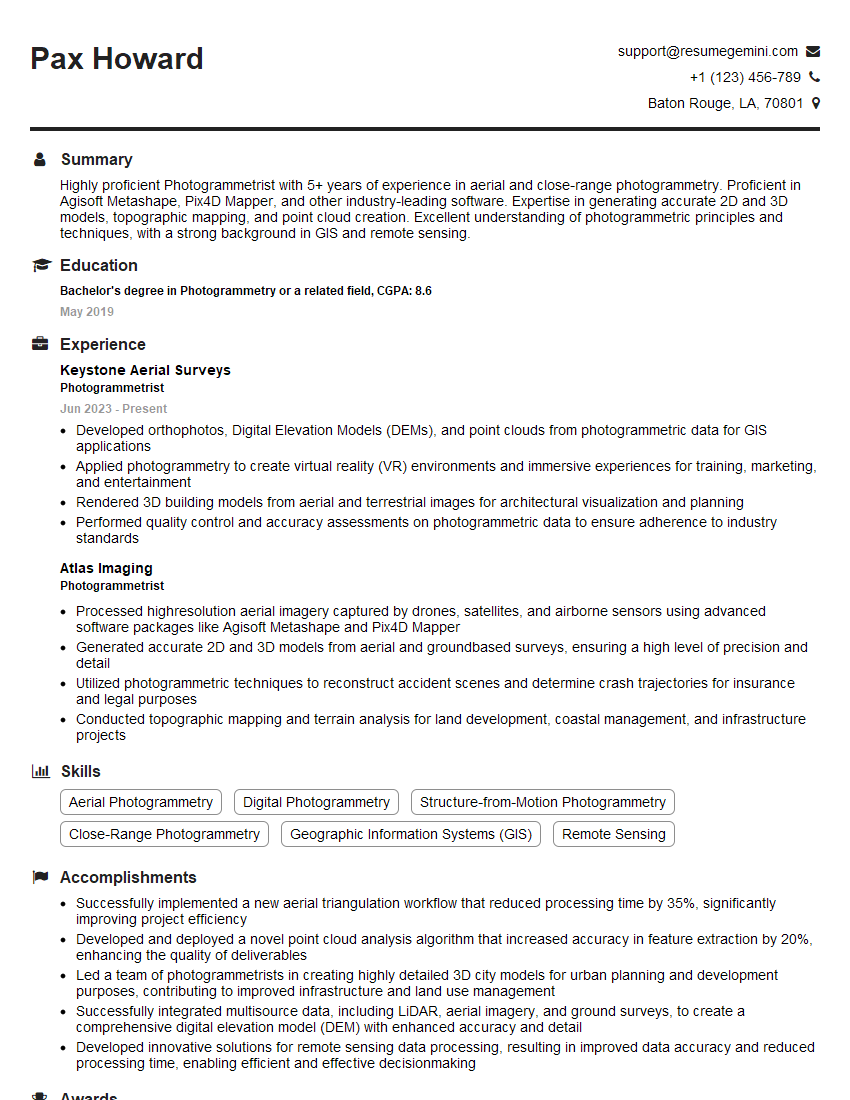
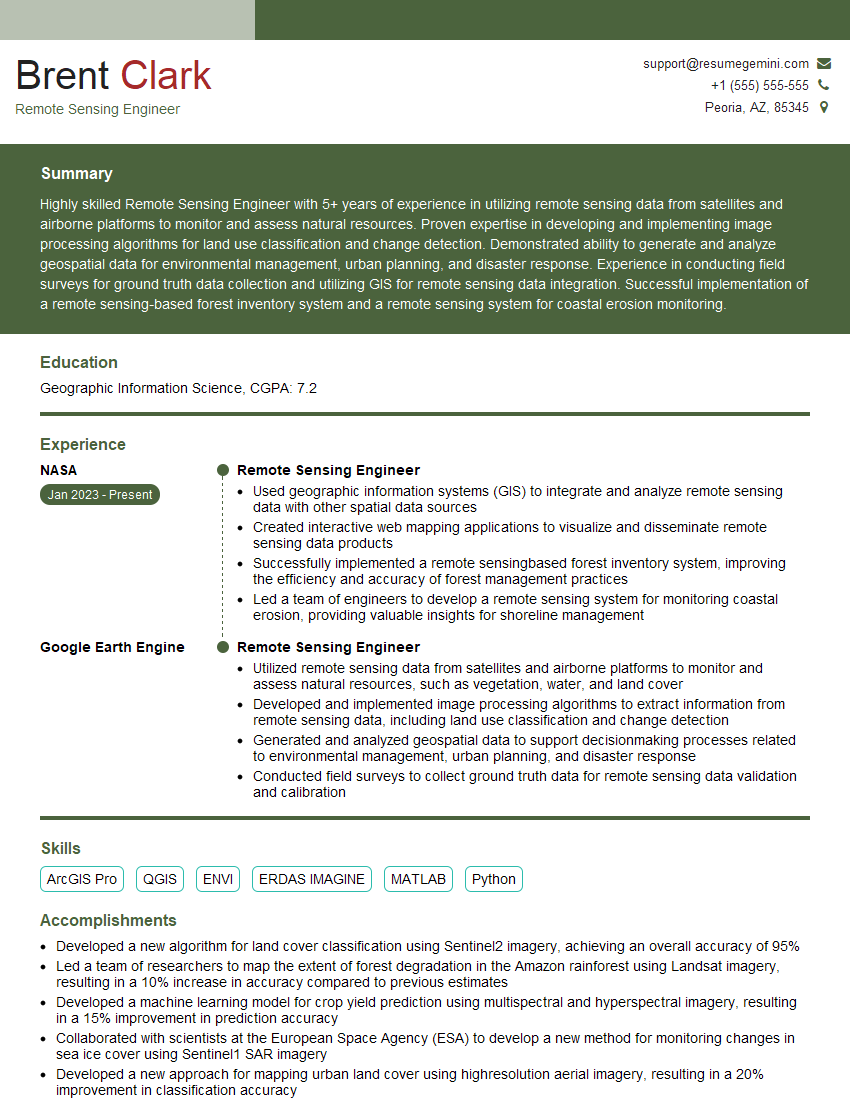
Mastering Earth Observation System principles opens doors to exciting and impactful careers in various sectors. To maximize your job prospects, crafting a strong, ATS-friendly resume is paramount. ResumeGemini is a trusted resource that can help you build a professional and effective resume, ensuring your skills and experience shine through to potential employers. Examples of resumes tailored to the Earth Observation System field are available within ResumeGemini to help guide your creation process. Invest time in showcasing your expertise effectively – your future self will thank you!

Explore more articles
Users Rating of Our Blogs
Share Your Experience
We value your feedback! Please rate our content and share your thoughts (optional).
What Readers Say About Our Blog
To the interviewgemini.com Webmaster.
Very helpful and content specific questions to help prepare me for my interview!
Thank you
To the interviewgemini.com Webmaster.
This was kind of a unique content I found around the specialized skills. Very helpful questions and good detailed answers.
Very Helpful blog, thank you Interviewgemini team.