The thought of an interview can be nerve-wracking, but the right preparation can make all the difference. Explore this comprehensive guide to Electrical Code Compliance (NEC) interview questions and gain the confidence you need to showcase your abilities and secure the role.
Questions Asked in Electrical Code Compliance (NEC) Interview
Q 1. What are the main differences between NEC Article 210 and Article 220?
NEC Article 210, Branch Circuits, covers the wiring and protection of individual circuits supplying lighting, appliances, and receptacles in a building. Think of it as the ‘last mile’ of electricity delivery to your outlets and lights. Article 220, Branch-Circuit, Feeder, and Service Calculations, on the other hand, deals with the sizing of the entire electrical system – calculating the load requirements for the entire building or a section of it to ensure the service and feeders can handle the total expected demand. It’s the ‘highway system’ planning the overall electricity flow.
In essence, Article 210 dictates the *individual circuit* requirements (wire size, overcurrent protection, etc.), while Article 220 determines the *overall system* capacity (service size, feeder size, etc.). For instance, Article 210 might specify a 20-amp breaker and 12 AWG wire for a kitchen countertop circuit, while Article 220 would calculate the total load for the entire kitchen to ensure the feeder supplying power to that kitchen is appropriately sized.
Q 2. Explain the requirements for grounding and bonding according to the NEC.
Grounding and bonding are crucial for safety, ensuring that unintended electrical currents find a path to the earth, preventing dangerous shocks and equipment damage. Grounding connects non-current-carrying metal parts of the electrical system to the earth, while bonding connects non-current-carrying metal parts together. Imagine grounding as a safety valve releasing excess electrical energy to the ground and bonding as connecting multiple safety valves together for a more robust system.
- Grounding: NEC requires grounding of electrical systems to provide a low-impedance path for fault currents to earth. This is typically achieved by driving a ground rod into the earth and connecting it to the electrical system’s grounding electrode conductor.
- Bonding: This connects metal parts of the system that are not normally energized to each other, to ensure they are all at the same electrical potential. This prevents voltage differences that could cause dangerous shocks if a fault occurs. Examples include bonding metal water pipes to the electrical system’s grounding electrode system.
Failure to properly ground and bond can lead to dangerous electrical shocks and equipment malfunctions. The specific requirements depend on the type of electrical system, location, and other factors, but the overarching goal is to create a safe and reliable electrical system.
Q 3. Describe the different types of overcurrent protection devices and their applications.
Overcurrent protection devices prevent overheating and potential fires by interrupting the circuit when the current exceeds a safe level. Common types include:
- Fuses: These melt and break the circuit when the current surpasses their rating. They are one-time use devices and need replacement after they blow.
- Circuit Breakers: These are reusable devices that automatically trip and open the circuit when excessive current flows. They can be thermal-magnetic (responding to both heat and magnetic field strength), or electronic (utilizing more sophisticated sensors).
- Ground Fault Circuit Interrupters (GFCIs): These detect small imbalances in current between the hot and neutral conductors, indicating a possible ground fault. They are commonly used in wet locations and areas where electrical shock risk is higher. (This type is covered in more detail in the next question.)
- Arc-Fault Circuit Interrupters (AFCIs): These detect and interrupt arcing faults which can cause electrical fires. They are required in specific locations per NEC (also discussed in the next question).
The choice of overcurrent protection device depends on the application, current rating, and type of circuit. For example, a 15-amp circuit breaker is commonly used for general-purpose branch circuits, while a GFCI is required in bathrooms and outdoor receptacles.
Q 4. What are the NEC requirements for arc-fault circuit interrupters (AFCIs)?
The NEC mandates the use of AFCIs in specific locations to mitigate the risk of arc-fault fires. These are typically required in bedrooms and hallways. There are two types of AFCIs: combination-type AFCIs that also provide overcurrent protection and dedicated AFCIs that function as AFCI protection only.
The exact requirements can vary slightly by NEC cycle, but the primary focus is on protecting areas where arc faults are more likely to start undetected and pose significant fire hazards. Improperly installed or malfunctioning AFCIs, however, can cause nuisance tripping. Regular inspection and testing are essential to ensure they function correctly.
Q 5. How do you determine the appropriate size of conductors for a given load?
Determining the appropriate conductor size involves several steps, starting with calculating the load and then consulting NEC tables for the appropriate ampacity (current-carrying capacity) of the conductor based on the installation conditions (ambient temperature, derating factors, etc.).
- Calculate the total load: This involves summing up the wattage of all connected appliances and lighting fixtures, adjusting for the diversity factor (since not all appliances run at the same time) and using Table 220.18 to determine the demand load.
- Determine the required ampacity: Divide the total load (in watts) by the voltage (usually 120V or 240V) to get the required amperage. Add a safety margin if needed.
- Consult NEC Table 310.15(B)(16): This table lists the ampacity of various conductors under different installation conditions. Consider factors such as the number of conductors in the raceway, ambient temperature, and any derating factors.
- Select the appropriate conductor size: Choose a conductor with an ampacity equal to or greater than the required ampacity calculated in step 2. You may need to consult other NEC tables to ensure the selected conductor is appropriate for the voltage and installation method.
For example, if a circuit is designed for 15 amps, then you’d need at least 14 AWG copper conductor, but 12 AWG might be a more appropriate choice if you want some headroom for future loads.
Q 6. Explain the NEC requirements for installing electrical equipment in wet locations.
Installing electrical equipment in wet locations requires special considerations to prevent electric shock and equipment failure. The NEC mandates the use of weatherproof or watertight enclosures and fittings rated for wet locations, identified by a specific marking. This typically involves using equipment with a NEMA rating appropriate for the specific conditions (e.g., NEMA 4 for outdoor use, NEMA 3R for rainproof).
Imagine a standard light switch versus a switch rated for outdoor use – the outdoor switch has a protective seal that stops water intrusion and keeps the switch operational. Similarly, the conduits and boxes used must be adequately sealed to prevent moisture from entering and causing short circuits.
Furthermore, the location of the installation must be carefully considered. Special attention should be paid to ensuring proper drainage and avoiding the accumulation of water around electrical equipment. Regular inspections are crucial for preventative maintenance to ensure the equipment remains functioning properly and safe in these potentially damaging conditions.
Q 7. What are the requirements for installing raceways and conduits?
Installing raceways and conduits requires adherence to several NEC rules to ensure safety and efficient current flow. These rules focus on proper sizing, bending, support, and protection.
- Proper Sizing: Conduits must be large enough to accommodate the number and size of conductors, as well as any required pulling ropes.
- Bending Radius: Minimum bending radii must be followed based on conduit type and size to prevent damage to the conduit and conductors.
- Secure Support: Conduit must be adequately supported at intervals, typically every 10 feet or less, depending on conduit type and size to prevent sagging or damage.
- Protection from Damage: Conduits need protection from physical damage, such as being installed in walls with sufficient protection or using appropriate fittings at penetrations through walls or floors.
- Proper Fittings: Appropriate fittings must be used at every connection and turn to ensure continuity and a secure, unbroken current path.
Ignoring these rules could lead to damage to conductors, overheating, difficult installation, and overall compromised system safety. A well-installed raceway system is essential for a reliable and safe electrical installation.
Q 8. Describe the NEC requirements for working with different types of metallic and non-metallic conduits.
The NEC outlines specific requirements for various conduit types, focusing on safety and proper installation. Metallic conduits, like rigid metal conduit (RMC), intermediate metal conduit (IMC), and electrical metallic tubing (EMT), offer superior protection against physical damage and fire. Their installation necessitates proper grounding to ensure safety. Non-metallic conduits, such as PVC conduit, are generally less expensive and easier to work with, but their application is restricted to specific environments where they can withstand the required conditions.
- Metallic Conduits: RMC, IMC, and EMT all require proper grounding; connections must be made with approved fittings and methods to ensure electrical continuity and a path to ground. Bends must meet specific radius requirements to avoid damage to the conductors within. They are often preferred in areas with potential physical damage or where fire protection is paramount.
- Non-Metallic Conduits: PVC conduit is commonly used in dry locations but is not suitable for wet or hazardous locations without specific considerations. It cannot be used in areas where the temperature exceeds its rating. Proper support and secure fastening are crucial to prevent sagging and damage.
- Important Considerations: Regardless of the conduit type, proper sizing is vital to accommodate the number and size of conductors. Overfilling conduits can lead to excessive heat build-up and potential fire hazards. Always refer to the NEC tables for proper fill calculations.
For example, in a commercial building renovation, we might choose RMC for the main service entrance due to its durability and fire resistance, while EMT could be suitable for less critical areas. PVC might be suitable for less demanding applications in a dry, climate-controlled environment, such as an office building.
Q 9. What are the requirements for grounding electrical systems?
Grounding electrical systems is a critical safety measure to protect against electrical shocks and equipment damage. The NEC mandates a low-impedance path to ground for all electrical systems, effectively diverting fault currents away from people and equipment. This is achieved through a grounding electrode system, typically a ground rod driven into the earth, and bonding of various metallic components.
- Grounding Electrode System: This provides the primary connection to earth. Multiple ground rods may be required to meet resistance requirements. The NEC specifies acceptable grounding electrode materials and installation methods.
- Bonding: Metallic components of the electrical system, such as conduit, equipment enclosures, and metal raceways, must be bonded together to create a continuous grounding path. This ensures that all metal parts are at the same potential, minimizing the risk of shock.
- Grounding Conductors: These conductors connect the grounding electrode system to the electrical system’s grounding point. They must be sized appropriately to carry fault currents safely.
Imagine a scenario where a fault occurs in a piece of equipment. Without proper grounding, the metal casing of that equipment could become energized, posing a significant shock hazard. A properly grounded system will divert the fault current to the ground, immediately tripping the circuit breaker or fuse, protecting personnel and preventing potential fires.
Q 10. What are the NEC requirements for electrical installations in hazardous locations?
The NEC has stringent requirements for electrical installations in hazardous locations, classified by the presence of flammable gases, dusts, or fibers. These areas necessitate special equipment and wiring methods designed to minimize the risk of ignition. Classifications are based on the type and severity of the hazard (Class I, II, III) and the potential for ignition (Division 1, Division 2).
- Hazardous Location Classifications: Class I covers flammable gases or vapors; Class II covers combustible dusts; and Class III covers easily ignitable fibers or flyings. Divisions 1 and 2 represent the likelihood of the presence of flammable materials.
- Equipment Selection: Specific types of equipment with explosion-proof or intrinsically safe designs are required. These are designed to prevent the ignition of flammable materials. They typically have special seals and construction to prevent sparks or arcs from escaping.
- Wiring Methods: Approved wiring methods, often including conduit systems with special seals and fittings, are necessary to prevent the spread of flames and the entry of flammable materials.
For instance, an area where gasoline is stored or handled would likely be classified as Class I, Division 1, requiring intrinsically safe equipment and special wiring methods. A grain processing facility might be classified as Class II, Division 2, needing explosion-proof equipment and proper wiring techniques.
Q 11. How do you calculate voltage drop in a circuit?
Voltage drop is the reduction in voltage between the source and the load in an electrical circuit. It’s critical to keep voltage drop within acceptable limits to ensure equipment operates correctly and efficiently. The calculation involves the current, the distance, and the resistance of the conductors.
The formula for voltage drop is:
VD = 2 × I × L × R / 1000Where:
VD= Voltage drop (volts)I= Current (amperes)L= One-way circuit length (feet)R= Resistance of the conductor (ohms per 1000 feet)
The resistance (R) can be found in NEC Chapter 9, Table 8. You’ll need to consider the size and material of the conductor. It’s crucial to remember that this calculation uses the one-way circuit length, not the total length.
For example, let’s say we have a 100-amp circuit, 100 feet long, using #2 AWG copper conductors. Using the NEC tables, we find the resistance per 1000 feet. Plugging the values into the formula, we can calculate the voltage drop. If the voltage drop exceeds the acceptable limit (typically 3% for lighting circuits, and 5% for power circuits), you will need to increase the conductor size to reduce the resistance and lower the voltage drop.
Q 12. Explain the NEC requirements for installing and maintaining electrical services.
The NEC details extensive requirements for electrical services, encompassing the entire process from the utility connection to the service entrance equipment within a building. This includes aspects like service conductors, equipment grounding, and overcurrent protection.
- Service Entrance Conductors: These conductors connect the utility’s supply to the building’s service equipment. The NEC specifies the minimum size and type based on the service’s capacity. Proper insulation, support, and protection from damage are also necessary.
- Service Equipment: This includes the main disconnect (breaker or fuse box) and meter. The location and installation of these components need to comply with safety requirements, ensuring accessibility for maintenance and disconnection in emergencies. Grounding of service equipment is a critical aspect, protecting against electrical shocks.
- Overcurrent Protection: Circuit breakers or fuses are mandatory, sized appropriately to protect the service conductors and equipment from excessive current. Proper installation and maintenance of this protective equipment is vital to prevent fires and equipment damage.
Consider a new residential construction project. The electrical service must be sized correctly for the home’s load, ensuring sufficient capacity for all appliances and equipment. The service conductors must be routed safely and properly grounded. The main panel must be installed according to NEC guidelines, easily accessible and properly labeled.
Q 13. What are the NEC requirements for lighting fixtures?
Lighting fixtures must meet specific requirements to ensure safety and proper operation. The NEC covers various aspects of lighting fixture installation and design.
- Fixture Type: Fixtures must be suitable for their intended location and environment. For example, fixtures in damp or wet locations require specific construction and seals to prevent water ingress. Outdoor fixtures must withstand weather conditions.
- Mounting: Proper mounting techniques are essential to ensure stability and prevent falls. The fixture’s mounting hardware must be correctly installed and secured, complying with the manufacturer’s specifications.
- Wiring: Wiring connections within the fixture must be secure, using appropriately rated wire nuts or connectors. The conductors must be properly sized for the load and protected from damage.
- Clearances: Adequate clearances are required from other electrical components, flammable materials, and potential sources of damage.
For instance, a bathroom fixture must be specifically designed for damp locations, with appropriate grounding and sealing to prevent electric shock. In a commercial setting, proper spacing of recessed lighting fixtures ensures adequate ventilation and prevents overheating.
Q 14. Explain the NEC requirements for electrical wiring methods.
The NEC provides a comprehensive list of approved wiring methods, each with its own set of requirements and limitations. The choice of wiring method depends on factors such as the environment, the type of building, and the amount of wiring needed.
- Conduit Systems: These systems, including RMC, IMC, EMT, and PVC conduit, enclose conductors and protect them from physical damage. Proper grounding, bending radii, and support are critical for safe installation.
- Cable Systems: These include various types of cables, such as armored cable (BX), non-metallic sheathed cable (NM), and service-entrance cable (SE). Each type has specific usage restrictions and installation requirements.
- Raceways: These are channels or enclosures used to route conductors. They can be metallic or non-metallic and must meet specific size and support requirements.
- Other Methods: Other approved methods include open wiring on insulators and underfloor raceways. These are less commonly used but are appropriate in certain circumstances.
Selecting the appropriate wiring method is crucial for safety and compliance. For example, NM cable might be suitable for residential applications, while conduit systems are often preferred in commercial or industrial settings due to the increased protection they offer. The choice always depends on the specific circumstances and compliance with the NEC.
Q 15. What are the requirements for using GFCIs and AFCIs?
Ground Fault Circuit Interrupters (GFCIs) and Arc-Fault Circuit Interrupters (AFCIs) are crucial safety devices mandated by the National Electrical Code (NEC) to protect against electrical hazards. GFCIs protect against ground faults, while AFCIs protect against arc faults. Their usage depends on the location and type of circuit.
GFCIs: Required in locations where electrical shock is a risk, such as bathrooms, kitchens, garages, outdoors, and anywhere near water sources. Specific NEC articles detail these requirements. Think of a GFCI as a lifeguard for your electrical system – it instantly cuts off power if it detects a current leakage to ground.
AFCIs: Required in bedrooms and other specified locations to mitigate the risk of arc faults, which are dangerous electrical arcs that can cause fires. The NEC specifies which circuits require AFCI protection, often in dwelling units. An AFCI is like a smoke detector for your wiring – it senses abnormal electrical arcing that could lead to a fire and trips the breaker.
Failure to comply with these requirements can lead to serious injury or property damage and is a violation of the NEC.
Career Expert Tips:
- Ace those interviews! Prepare effectively by reviewing the Top 50 Most Common Interview Questions on ResumeGemini.
- Navigate your job search with confidence! Explore a wide range of Career Tips on ResumeGemini. Learn about common challenges and recommendations to overcome them.
- Craft the perfect resume! Master the Art of Resume Writing with ResumeGemini’s guide. Showcase your unique qualifications and achievements effectively.
- Don’t miss out on holiday savings! Build your dream resume with ResumeGemini’s ATS optimized templates.
Q 16. Describe the differences between a GFCI and an AFCI.
While both GFCIs and AFCIs are designed to enhance electrical safety, they protect against different hazards:
GFCI (Ground Fault Circuit Interrupter): Detects imbalances in current flow between the hot and neutral conductors. Even a tiny leakage to ground (like a person touching a faulty appliance) is enough to trip the GFCI. It’s primarily concerned with shock hazard.
AFCI (Arc-Fault Circuit Interrupter): Detects and responds to abnormal electrical arcs or sparks within the circuit. These arcs, often silent and invisible, can generate significant heat and ignite flammable materials, resulting in fire. AFCIs primarily focus on fire hazard.
Imagine a GFCI as a sensitive scale that detects even slight imbalances, while an AFCI is a heat sensor detecting abnormal temperature increases due to arcing.
Q 17. How do you interpret NEC Tables and other referenced documents?
Interpreting NEC tables and referenced documents requires a systematic approach. It’s not just about reading numbers; it’s about understanding the context and applying the information correctly.
Understand the Table’s Purpose: Each table addresses a specific aspect of the code. Determine what the table is trying to convey – conductor ampacity, voltage drop, equipment requirements, etc.
Identify the Applicable Columns and Rows: The information in the table is organized based on various factors (conductor type, installation method, ambient temperature, etc.). Carefully identify the relevant parameters of your specific installation to locate the correct value.
Consider Notes and Footnotes: The NEC often includes notes and footnotes that modify or clarify the values within the table. Overlooking these can lead to misinterpretations.
Refer to Other Sections: Tables often refer to other articles within the NEC for further clarification or exceptions. Always cross-reference the relevant sections to fully understand the requirements.
For example, Table 314.16(A) gives conductor ampacities. You must know the conductor type, insulation type, installation method (e.g., in conduit, in free air), and ambient temperature to find the correct ampacity.
Q 18. Explain the NEC requirements for electrical panelboards.
The NEC outlines stringent requirements for electrical panelboards to ensure safety and proper operation. These requirements cover various aspects:
Location: Panelboards must be installed in accessible locations, free from obstructions and hazards. They should be easily accessible for inspection and maintenance.
Clearances: Adequate clearances are essential around the panelboard to prevent overheating and ensure safe access. These clearances are specified in the NEC.
Wiring Methods: Panelboards must be wired in accordance with NEC guidelines. This includes proper wire sizing, termination methods, and the use of appropriate connectors.
Overcurrent Protection: Each circuit must be protected by an overcurrent device (circuit breaker or fuse) sized appropriately for the circuit’s load. This prevents overheating and potential fire hazards.
Grounding: Panelboards must be properly grounded to provide a safe path for fault currents to flow to the earth, minimizing shock hazards.
Enclosures: Panelboards must be enclosed in appropriately sized and rated enclosures to protect against physical damage and electrical hazards.
Failure to adhere to these requirements can lead to equipment malfunction, fire hazards, or electrical shocks.
Q 19. What are the requirements for installing and maintaining emergency power systems?
Emergency power systems, such as standby generators, are designed to provide power during outages. The NEC dictates strict requirements for their installation and maintenance to ensure reliability and safety:
Capacity: Generators must be sized to supply the critical loads during an outage.
Transfer Switches: Automatic transfer switches are typically required to seamlessly transfer loads from the normal power source to the generator.
Overcurrent Protection: Generators and associated circuits must have appropriate overcurrent protection.
Grounding: Proper grounding is crucial for safety.
Maintenance: Regular testing and maintenance are mandated to verify proper operation and prevent failures during emergencies. This typically includes periodic load testing and inspection.
Regular maintenance is critical, as a malfunctioning generator during an emergency can have severe consequences. Think of hospitals or data centers – their reliance on emergency power necessitates rigorous compliance.
Q 20. Describe the NEC requirements for installing and maintaining transformers.
Transformers play a vital role in power distribution, stepping voltage up or down. The NEC provides specific requirements for their installation and maintenance to ensure safety and efficiency:
Clearances: Sufficient clearances are required around transformers to prevent overheating and accidental contact. These clearances vary depending on voltage and other factors.
Grounding: Transformers must be grounded to protect against electrical shocks and prevent potential damage.
Overcurrent Protection: Appropriate overcurrent protection is necessary to prevent damage in case of a fault.
Mounting: Transformers must be mounted securely and in accordance with the manufacturer’s instructions.
Inspection: Regular inspection and maintenance are necessary to identify and address any potential problems.
Improper installation or maintenance can lead to overheating, fire hazards, and equipment failure, potentially causing widespread power disruptions.
Q 21. What is the importance of proper documentation in electrical installations?
Proper documentation is paramount in electrical installations. It’s not merely a bureaucratic requirement; it’s essential for safety, maintenance, and future modifications.
Safety: Accurate documentation aids in troubleshooting and identifying potential hazards. Knowing the exact wiring configuration can be vital in an emergency.
Maintenance: Complete records allow electricians to quickly understand the system, facilitating efficient maintenance and repairs. This minimizes downtime and safety risks.
Modifications: When modifications are needed, proper documentation ensures that changes are made safely and without compromising the integrity of the system.
Legal Compliance: Thorough documentation demonstrates compliance with the NEC and other relevant regulations, protecting the installer and owner from legal liabilities.
Think of it like a building’s blueprint – without it, any future work becomes significantly more difficult and risky. Comprehensive documentation, including diagrams, specifications, and test results, is crucial for the longevity and safety of any electrical installation.
Q 22. How do you handle discrepancies between the NEC and local codes?
When discrepancies arise between the National Electrical Code (NEC) and local codes, the more stringent code always takes precedence. Think of it like this: the NEC sets a minimum safety standard, but local jurisdictions can implement stricter rules to address specific regional concerns or unique hazards. For example, the NEC might allow a certain type of wiring in a specific application, but a local code might prohibit it due to a history of issues in that area.
To handle these discrepancies, I meticulously review both the NEC and the local jurisdiction’s adopted electrical code. I carefully compare the relevant sections to identify the stricter requirements. I document my findings, clearly indicating which code section governs the specific situation. This documentation is essential for both compliance and potential future audits. If there’s ambiguity, I consult with the local authority having jurisdiction (AHJ) to ensure a clear understanding and avoid costly rework.
Q 23. Explain your experience with electrical code inspections.
I have extensive experience with electrical code inspections, having conducted hundreds of inspections across various project types, including residential, commercial, and industrial settings. My inspections encompass everything from new construction and renovations to service upgrades and tenant improvements. I thoroughly evaluate the electrical systems for compliance with the NEC and all applicable local codes, paying close attention to details like proper grounding, wire sizing, overcurrent protection, and installation methods. I use a systematic approach, reviewing blueprints, checking labeling, and conducting both visual and functional testing where appropriate. I’m proficient in identifying potential hazards and communicating those findings effectively to contractors and clients.
For instance, I recently inspected a new commercial building where the contractor had incorrectly sized the service conductors, creating a potential overload risk. I immediately identified this issue, explained the code violation, and facilitated a correction with the contractor, preventing a future fire hazard.
Q 24. Describe a challenging NEC code issue you solved.
One of the most challenging NEC code issues I encountered involved a complex renovation project in a historic building. The original wiring was outdated and inadequate for the planned upgrades. The challenge lay in balancing the need for code compliance with the preservation of the building’s historical integrity. We couldn’t just rip everything out and start fresh.
My solution involved a multi-step approach: We first thoroughly assessed the existing wiring to determine its condition and capabilities. Next, we carefully planned the upgrade to minimize disruption to the building’s structure. This involved selectively replacing portions of the wiring, incorporating modern safety features without compromising the building’s aesthetic appeal, and using techniques like conduit routing to minimize the visual impact. Extensive documentation, including detailed photographic records, was vital to demonstrate compliance with both the NEC and the historical preservation requirements. The AHJ was kept informed throughout the entire process, ensuring their approval at each critical stage.
Q 25. How do you stay updated with the latest NEC changes and amendments?
Staying current with NEC changes is paramount. I achieve this through a multi-pronged approach. I subscribe to professional organizations like the NFPA (National Fire Protection Association), which publishes the NEC, and regularly access their online resources, including updates and interpretation documents. I attend NEC code seminars and workshops presented by recognized experts and industry professionals. Furthermore, I actively participate in industry forums and online communities dedicated to electrical code discussions, allowing me to benefit from the collective knowledge and experience of other professionals.
I also maintain a comprehensive library of NEC publications, including the current edition and relevant past editions, to trace the evolution of particular code sections and their rationale.
Q 26. Explain the process of obtaining permits for electrical work.
The process for obtaining permits for electrical work typically starts with submitting a complete application to the local AHJ. This application usually includes detailed plans, specifications, and calculations demonstrating compliance with all applicable codes. The application must specify the type of work, its location, and the scope of the project. Following submission, the AHJ reviews the application for completeness and compliance. If approved, they issue a permit allowing the work to commence.
Throughout the project, regular inspections are conducted by the AHJ to verify compliance with the approved plans and the NEC. Upon completion, a final inspection is performed; only after successful completion of the final inspection will the AHJ issue a certificate of occupancy, allowing the project to be occupied or used legally.
Q 27. What safety measures do you follow during electrical inspections?
Safety is my utmost priority during electrical inspections. I always adhere to the following measures:
- Lockout/Tagout procedures: Before accessing any energized equipment, I ensure proper lockout/tagout procedures are in place to prevent accidental energization.
- Personal Protective Equipment (PPE): I always wear appropriate PPE, including safety glasses, gloves, and insulated tools.
- Voltage testing: I utilize calibrated voltage testers to verify that equipment is de-energized before any physical inspection is undertaken.
- Awareness of surroundings: I remain alert to potential hazards in the inspection environment, such as overhead obstructions, trip hazards, and confined spaces.
- Teamwork and communication: If working with others, clear communication is critical to ensure everyone’s safety.
These procedures ensure my safety and that of the contractors or others present during the inspection.
Q 28. Describe your experience working with electrical contractors.
I’ve worked collaboratively with numerous electrical contractors throughout my career. Effective communication and a mutual respect for expertise are key to successful collaborations. I appreciate that contractors often have practical, on-the-ground knowledge that complements my code interpretation. My role is to ensure their work adheres to code, and open communication allows us to find solutions when challenges arise.
I find that building a strong professional rapport with contractors is critical. Clear explanations of code requirements, proactive feedback during the project, and a willingness to answer questions foster a productive partnership. Ultimately, our shared goal is to ensure safe and code-compliant electrical installations.
Key Topics to Learn for Electrical Code Compliance (NEC) Interview
Ace your Electrical Code Compliance (NEC) interview by mastering these key areas. Remember, understanding the “why” behind the code is just as important as knowing the “what”.
- Wiring Methods and Materials: Understand the various types of wiring (e.g., NM, BX, conduit), their applications, and limitations as outlined in the NEC. Be prepared to discuss proper installation techniques and code compliance considerations for each.
- Overcurrent Protection: This is fundamental. Know how to select appropriate circuit breakers and fuses based on load calculations, wire sizes, and equipment ratings. Practice applying NEC calculations to real-world scenarios.
- Grounding and Bonding: Master the principles of grounding and bonding to ensure electrical safety. Understand the different grounding methods and their applications. Be ready to explain the importance of proper grounding for equipment and systems.
- Branch Circuits and Panelboards: This involves understanding circuit calculations, load balancing, and the proper sizing of panelboards. Be able to explain code requirements for branch circuit protection and design.
- Motors, Motor Controls, and Generators: Familiarize yourself with NEC requirements for motor installations, including overcurrent protection, wiring methods, and disconnect requirements. Understand generator interconnection.
- Lighting Systems: Know the code requirements for various lighting systems, including fixtures, wiring, and safety considerations. This includes understanding lighting load calculations and appropriate circuit protection.
- Troubleshooting and Problem-Solving: Develop your ability to diagnose common electrical code violations and propose solutions that adhere to the NEC. Think critically about how you would approach real-world challenges.
- Code Interpretations and Updates: Stay abreast of the latest NEC updates and be prepared to discuss different interpretations of the code and how to resolve discrepancies.
Next Steps
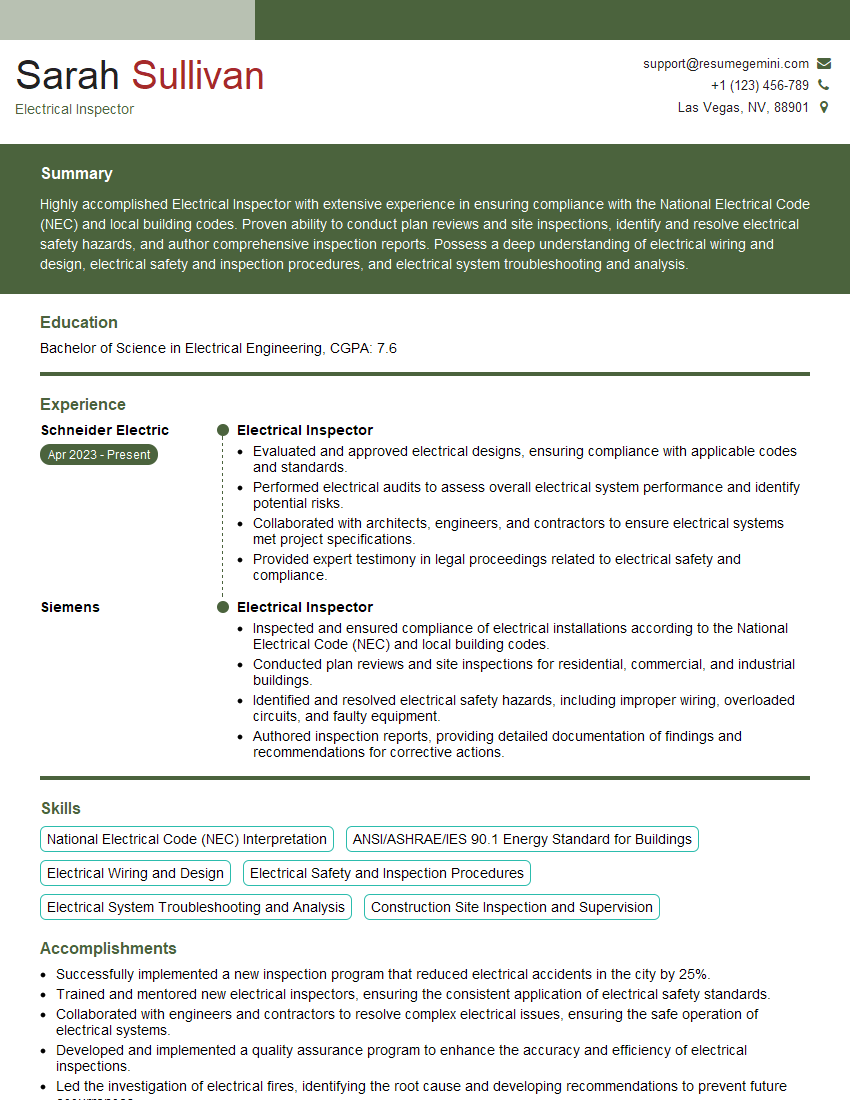
Mastering the NEC opens doors to exciting career opportunities and higher earning potential. A strong understanding of electrical code compliance demonstrates expertise and commitment to safety, making you a highly valuable asset to any organization. To maximize your job prospects, create an ATS-friendly resume that highlights your skills and experience effectively. ResumeGemini is a trusted resource for building professional resumes that grab recruiters’ attention. Take advantage of the example resumes tailored to Electrical Code Compliance (NEC) roles provided to help you build your perfect resume and showcase your abilities!
Explore more articles
Users Rating of Our Blogs
Share Your Experience
We value your feedback! Please rate our content and share your thoughts (optional).
What Readers Say About Our Blog
To the interviewgemini.com Webmaster.
Very helpful and content specific questions to help prepare me for my interview!
Thank you
To the interviewgemini.com Webmaster.
This was kind of a unique content I found around the specialized skills. Very helpful questions and good detailed answers.
Very Helpful blog, thank you Interviewgemini team.