Preparation is the key to success in any interview. In this post, we’ll explore crucial Electrical Power Transmission interview questions and equip you with strategies to craft impactful answers. Whether you’re a beginner or a pro, these tips will elevate your preparation.
Questions Asked in Electrical Power Transmission Interview
Q 1. Explain the difference between overhead and underground transmission lines.
Overhead and underground transmission lines differ primarily in their physical construction and operational characteristics. Overhead lines, as the name suggests, use towers and poles to support conductors high above the ground, while underground lines bury their conductors beneath the earth’s surface.
- Overhead Lines: These are generally cheaper to build and easier to maintain, allowing for quicker repairs and inspections. However, they are susceptible to weather damage (lightning strikes, ice storms, strong winds), environmental concerns (visual impact), and outages from falling trees or accidental contact. They also tend to have higher power losses due to corona effects.
- Underground Lines: These are more expensive to install and maintain, requiring specialized equipment and techniques for excavation and repair. They are, however, less vulnerable to weather events and are aesthetically more pleasing. They also generally experience lower power losses compared to overhead lines. However, fault location and repair can be more complex and time-consuming.
In summary: The choice between overhead and underground lines depends on several factors, including cost, reliability requirements, environmental considerations, and the specific geographical and climatic conditions.
Q 2. Describe the principle of operation of a transformer.
A transformer operates on the principle of electromagnetic induction. It uses two or more coils of wire wound around a common ferromagnetic core to change the voltage of an alternating current (AC) power supply. This change is accomplished by varying the magnetic flux through the coils.
When an alternating current flows through the primary coil, it generates a fluctuating magnetic field in the core. This magnetic field, in turn, induces a voltage in the secondary coil. The ratio of the voltage in the primary coil to the voltage in the secondary coil is directly proportional to the ratio of the number of turns in the primary and secondary windings (turns ratio).
Vprimary / Vsecondary = Nprimary / Nsecondary
Where:
Vprimaryis the voltage on the primary coilVsecondaryis the voltage on the secondary coilNprimaryis the number of turns in the primary coilNsecondaryis the number of turns in the secondary coil
Transformers are crucial in power transmission systems as step-up transformers increase voltage for efficient long-distance transmission, while step-down transformers lower voltage to safer and usable levels for distribution and consumption.
Q 3. What are the different types of transmission line configurations?
Transmission line configurations refer to the arrangement of conductors used to transmit power. The most common configurations include:
- Single-circuit line: A single set of conductors is used for power transmission.
- Double-circuit line: Two sets of conductors are used, often running parallel to each other, which increases the capacity and redundancy of the transmission line.
- Horizontal configuration: Conductors are arranged horizontally, one above the other, and usually provides the best mechanical stability
- Vertical configuration: Conductors are arranged vertically, sometimes more suitable for particular terrain and situations.
- Transposed configuration: Conductors are periodically transposed or interchanged to equalize inductive and capacitive reactances and mitigate the effects of unbalanced currents and voltages.
The choice of configuration is influenced by factors such as power capacity requirements, environmental considerations, right-of-way limitations, and voltage level.
Q 4. Explain the concept of power factor and its importance in transmission systems.
The power factor is the cosine of the angle between the voltage and current waveforms in an AC circuit. Ideally, the power factor should be 1 (unity), meaning the voltage and current are in phase, and all the power is being effectively used. However, in reality, inductive loads (like motors) cause the current to lag behind the voltage, resulting in a lagging power factor (less than 1).
A low power factor means that a larger current is required to deliver the same amount of real power, leading to increased losses in transmission lines (I²R losses) and higher costs. It also reduces the system’s efficiency and capability to deliver power.
Improving the power factor is essential for efficient power transmission. Methods include using power factor correction capacitors to compensate for the lagging current, and employing power factor correction equipment (such as capacitor banks) to bring the power factor closer to unity.
Q 5. What are the various methods for controlling voltage in a transmission system?
Voltage control in transmission systems is crucial for maintaining the stability and reliability of the grid. Various methods are used, including:
- Tap-changing transformers: These transformers allow for adjustment of the turns ratio under load, providing a means of adjusting the voltage levels. They are commonly employed at substations.
- Automatic Voltage Regulators (AVRs): These devices automatically adjust the excitation of generators to maintain a constant voltage output irrespective of changes in load conditions.
- Static VAR Compensators (SVCs): These systems use thyristors to control reactive power flow, thus regulating the voltage profile of the transmission line.
- Synchronous Condensers: These are synchronous motors that operate without a mechanical load to provide or absorb reactive power, thereby maintaining voltage stability.
- Series and Shunt Compensation: Series compensation (inductors or capacitors) reduces the line reactance and increases power transfer capability; shunt compensation (capacitors or reactors) improves voltage profile.
The choice of voltage control method depends on factors such as the scale of the system, the desired level of precision, and cost considerations.
Q 6. Describe different types of protective relays used in power transmission.
Protective relays are crucial for detecting and isolating faults in power transmission systems to prevent cascading failures and damage to equipment. Different types of relays cater to various fault conditions:
- Overcurrent relays: These detect excessive current flow due to short circuits or overloads. They are simple, reliable, and widely used.
- Differential relays: These compare the currents entering and leaving a protected zone (e.g., a transformer or a busbar). Any imbalance indicates an internal fault.
- Distance relays: These measure the impedance to the fault location and operate if the impedance is within a predetermined range. They are particularly useful for long transmission lines.
- Pilot relays: These use communication channels to compare currents or voltages at both ends of a transmission line, allowing for fast fault detection and isolation.
- Ground fault relays: These specifically detect faults involving ground. They are vital for safety and preventing damage from earth faults.
Modern protection systems often use microprocessor-based relays that provide advanced features like fault analysis, communication capabilities, and self-diagnostics. The selection of relays depends on the specific application and the characteristics of the protected equipment.
Q 7. Explain the concept of impedance and admittance in transmission lines.
Impedance and admittance are fundamental concepts describing the opposition to current flow in transmission lines. They are frequency-dependent and represent the combined effect of resistance, inductance, and capacitance.
- Impedance (Z): This represents the total opposition to the flow of current, expressed in ohms (Ω). It’s a complex quantity with both real (resistance) and imaginary (reactance) components.
Z = R + jX, where R is resistance and X is reactance (inductive or capacitive). - Admittance (Y): This is the reciprocal of impedance, representing the ease with which current flows. It’s also a complex quantity measured in Siemens (S).
Y = 1/Z = G + jB, where G is conductance and B is susceptance (inductive or capacitive).
Understanding impedance and admittance is crucial for accurate modeling and analysis of transmission line behavior, including voltage and current calculations, power flow analysis, and fault studies. For example, high impedance can lead to voltage drops and power losses, while high admittance can cause instability and resonance issues.
Q 8. How do you calculate transmission line losses?
Transmission line losses represent the energy dissipated as heat within the conductors and surrounding environment during power transmission. These losses are primarily due to resistance (I²R losses) and are significant contributors to inefficiency. Calculating these losses involves understanding the line’s parameters and the current flowing through it.
The most common method involves using the formula: Losses = I² * R, where ‘I’ is the current flowing through the line and ‘R’ is the resistance of the conductor. However, this is a simplified approach. In reality, the resistance itself varies with temperature and the skin effect (at higher frequencies, current concentrates near the conductor’s surface, increasing effective resistance). To get a more accurate calculation, we need to consider:
- Conductor Resistance: This is affected by the material’s resistivity, length, cross-sectional area, and temperature. We often use tables or specialized software for accurate values, considering temperature corrections.
- Skin Effect: At high voltages and frequencies, the effective resistance increases due to the non-uniform current distribution within the conductor. This requires adjustments to the simple I²R formula.
- Proximity Effect: When conductors are close together, the magnetic fields they generate interact, increasing their effective resistance. This is another factor that needs to be included for more precise calculations.
- Corona Loss: At very high voltages, ionization of the air surrounding the conductors can lead to corona discharge, resulting in energy loss. This is typically considered separately, as its calculation is complex and often relies on empirical equations.
For complex transmission lines, specialized software packages employing advanced models are utilized to accurately simulate and predict these losses, incorporating all the factors mentioned above. Accurate loss calculations are crucial for optimizing transmission line design, economic analysis, and efficient power delivery.
Q 9. What is the purpose of a surge arrester?
A surge arrester, also known as a lightning arrester, is a protective device designed to safeguard electrical equipment from voltage surges caused by lightning strikes, switching operations, or other transient events. Think of it as a safety valve for your power system.
Its primary function is to divert excessive voltage to the ground, preventing damage to expensive transformers, generators, and other sensitive components. Surge arresters typically employ metal oxide varistors (MOVs) as their core component. MOVs have a unique voltage-current characteristic; they exhibit high resistance at normal operating voltages but drastically reduce their resistance when a surge exceeds a specific threshold. This allows the surge current to be safely channeled to the ground, protecting the equipment.
Imagine a dam with a spillway. Under normal conditions, the water (current) flows through the dam (transmission line). However, if a sudden flood (surge) occurs, the spillway opens, diverting the excess water to prevent the dam from overflowing (damaging equipment). This is analogous to how a surge arrester protects the power system.
Q 10. Explain the operation of a circuit breaker.
A circuit breaker is an essential safety device in electrical power systems, designed to automatically interrupt the flow of current when a fault occurs. This prevents damage to equipment, fire hazards, and ensures the safety of personnel. They act as a crucial protective element in both low and high voltage systems.
The operation typically involves several stages:
- Fault Detection: Various sensors within the circuit breaker detect abnormal conditions like overcurrent, short circuits, or ground faults.
- Trip Signal Generation: Once a fault is detected, a trip signal is generated, initiating the interruption process.
- Contact Separation: A mechanism within the circuit breaker separates the contacts, breaking the electrical circuit and interrupting the flow of current. This is often achieved using powerful springs or electromagnetic forces.
- Arc Quenching: When the contacts separate, an electric arc forms. The circuit breaker incorporates arc quenching mechanisms (such as air blast, oil, or vacuum) to extinguish the arc quickly and safely. This prevents reignition and ensures complete current interruption.
- Post-Fault Condition: After the fault is cleared, the circuit breaker can be manually or automatically reset to restore power.
Circuit breakers are classified based on their voltage rating, interrupting capacity, and arc quenching mechanism. Their selection depends on the specific application and the requirements of the power system. They’re a critical component ensuring reliability and safety across the grid.
Q 11. What are the advantages and disadvantages of HVDC transmission?
High-Voltage Direct Current (HVDC) transmission offers distinct advantages and disadvantages compared to traditional High-Voltage Alternating Current (HVAC) transmission.
Advantages:
- Long-Distance Transmission: HVDC is more efficient for transmitting power over long distances (typically greater than 500 km) due to lower line losses and reduced reactive power requirements.
- Asynchronous Operation: HVDC systems can connect power grids with different frequencies, enabling greater power system stability and flexibility.
- Power Flow Control: HVDC transmission allows for precise control of power flow, enhancing grid stability and managing power imbalances between regions.
- Reduced Line Construction Costs: HVDC lines often require fewer conductors compared to HVAC lines, potentially lowering construction costs.
- Lower Environmental Impact (in some cases): HVDC can reduce transmission line right-of-way requirements and potentially reduce some environmental impacts compared to HVAC.
Disadvantages:
- High Converter Costs: HVDC systems require expensive converter stations at both ends of the transmission line to convert AC to DC and vice-versa.
- Complexity: HVDC systems are more complex to design, operate, and maintain compared to HVAC systems.
- Fault Location and Repair: Identifying and repairing faults in HVDC systems can be more challenging.
- Harmonics: HVDC converter stations can generate harmonics that can interfere with other electrical systems.
The choice between HVDC and HVAC depends on specific project requirements, considering factors like distance, power capacity, environmental considerations, and cost-benefit analysis.
Q 12. Describe the different types of insulators used in transmission lines.
Insulators in transmission lines are crucial for maintaining electrical isolation between the conductors and the supporting structures (towers or poles), preventing current leakage and ensuring safety. Various types exist, categorized based on their material and design:
- Pin-Type Insulators: These are relatively simple and economical, suitable for lower voltages. They consist of a porcelain or glass insulator with a groove for attaching the conductor.
- Suspension Insulators: Used for higher voltages, these consist of a string of individual disc insulators connected in series. This design distributes the voltage stress across multiple units, improving performance and reliability.
- Strain Insulators: Used at points of high mechanical stress in the transmission line, these are typically larger and stronger than standard insulators. They withstand the tensile forces from the conductors.
- Post-Type Insulators: A more robust design suited for high-voltage applications, these are typically made of porcelain or composite materials and provide excellent mechanical strength and high creepage distance (the distance the current must travel along the insulator’s surface to reach the ground).
- Polymer Insulators: Increasingly popular due to their lightweight nature, high strength, and resistance to environmental factors like pollution and UV degradation. They’re a compelling alternative to traditional porcelain or glass insulators.
The selection of insulators depends on factors such as voltage level, environmental conditions, mechanical stresses, and cost considerations. Regular inspection and maintenance are essential to ensure their continued effectiveness and safety.
Q 13. What is the importance of grounding in a transmission system?
Grounding, or earthing, in a transmission system is the process of connecting parts of the system to the earth, providing a low-resistance path for fault currents to flow. This is crucial for safety and system stability.
Its importance can be seen in several aspects:
- Safety: Grounding protects personnel from electric shock by providing a path for fault currents to return to the earth, preventing dangerous voltages from appearing on exposed metal parts.
- System Protection: Grounding helps in faster fault detection and clearing, limiting damage to equipment and minimizing interruptions to power supply. It allows protective relays and circuit breakers to operate effectively.
- Voltage Stabilization: Grounding helps to stabilize the voltage levels within the transmission system by providing a reference point for potential. This is particularly important for preventing voltage surges and oscillations.
- Lightning Protection: Grounding provides a path for lightning currents to dissipate harmlessly into the earth, preventing damage to transmission towers, equipment, and conductors.
Effective grounding requires careful design and installation of grounding electrodes (typically rods or plates buried in the earth) and low-resistance conductors. Regular testing and maintenance of the grounding system are vital for ensuring its continued effectiveness.
Q 14. Explain the concept of reactive power compensation.
Reactive power compensation involves controlling the reactive power flow in a power system to improve voltage stability, reduce transmission losses, and enhance overall system efficiency. Reactive power is the power that flows back and forth in the system, not contributing to actual work. It’s often visualized as the ‘imaginary’ part of apparent power.
In transmission lines, inductive reactance dominates, consuming reactive power. This can lead to voltage drops and reduced power transfer capability. Reactive power compensation aims to counteract this effect.
Methods for reactive power compensation include:
- Shunt Capacitors: These are connected in parallel with the transmission line and supply reactive power, compensating for the inductive reactance. This improves voltage regulation and increases power transfer capability. They are like ‘reactive power sources’ and are widely used in substations.
- Synchronous Condensers: These are synchronous motors running without a mechanical load; they can be operated to supply or absorb reactive power as needed, providing flexible compensation. They offer more control than static capacitors.
- Static Synchronous Compensators (STATCOMs): These are advanced electronic devices that provide fast and precise reactive power compensation. They offer superior controllability and response times compared to traditional methods.
- Series Capacitors: These are connected in series with the transmission line to reduce the overall line reactance. This is particularly effective for improving power transfer capabilities on long transmission lines. However, careful design is needed to manage potential resonance issues.
The choice of compensation method depends on factors such as the system’s voltage level, power flow requirements, and cost considerations. Appropriate reactive power compensation is crucial for maintaining a robust and efficient transmission system.
Q 15. Describe the role of SCADA in power transmission systems.
SCADA, or Supervisory Control and Data Acquisition, is the brain of a power transmission system. Think of it as a central nervous system, constantly monitoring and controlling the entire network. It uses a network of Remote Terminal Units (RTUs) and Programmable Logic Controllers (PLCs) placed at substations and other critical points to collect real-time data like voltage, current, power flow, and equipment status. This data is then transmitted to a central control center where operators can visualize the entire system and take necessary actions.
For example, if a fault occurs on a transmission line, RTUs at the affected location detect the anomaly and automatically send data to the SCADA system. The operator at the control center receives alerts, sees the affected area on a graphical display, and can remotely initiate protective actions, such as tripping circuit breakers to isolate the fault and prevent wider system disruption. This rapid response minimizes damage and ensures system stability.
SCADA systems also facilitate preventative maintenance by enabling predictive analytics. By continuously monitoring equipment performance, anomalies can be identified early, allowing for timely repairs and preventing potential failures.
Career Expert Tips:
- Ace those interviews! Prepare effectively by reviewing the Top 50 Most Common Interview Questions on ResumeGemini.
- Navigate your job search with confidence! Explore a wide range of Career Tips on ResumeGemini. Learn about common challenges and recommendations to overcome them.
- Craft the perfect resume! Master the Art of Resume Writing with ResumeGemini’s guide. Showcase your unique qualifications and achievements effectively.
- Don’t miss out on holiday savings! Build your dream resume with ResumeGemini’s ATS optimized templates.
Q 16. How do you perform fault analysis in a transmission system?
Fault analysis in a transmission system is crucial for ensuring grid reliability and safety. It involves identifying the cause, location, and extent of a fault, allowing for effective remedial actions. This is often done using a combination of techniques:
- Protective Relaying Data: Protective relays at substations record detailed information about fault events, including fault current magnitude, duration, and phase involved. Analyzing these recordings helps pinpoint the fault’s location and type.
- Power Flow Studies: By modeling the system’s pre-fault and post-fault conditions, we can determine the impact of the fault and the effectiveness of the protection system.
- Digital Fault Recorders (DFRs): DFRs provide high-resolution recordings of various system parameters, enabling detailed analysis of fault transients and aiding in accurate fault location determination.
- Simulation Software: Specialized software packages allow us to simulate various fault scenarios and test the performance of the protection system, helping to identify potential weaknesses and improve system resilience.
Imagine a scenario where a lightning strike causes a fault on a transmission line. By analyzing relay data and DFR recordings, we can determine the fault’s location (e.g., milepost 15 on line XYZ), its type (e.g., single-line-to-ground), and its magnitude. This allows for targeted repairs and prevents future similar events.
Q 17. Explain the concept of power flow studies.
Power flow studies are crucial for analyzing the steady-state operation of a power system. They determine the voltage, current, and power flow at various points in the network under normal operating conditions. This allows us to understand how power is generated, transmitted, and distributed across the system. Power flow analysis uses sophisticated algorithms to solve a set of nonlinear equations that describe the network’s behavior. Results are crucial for planning, operation, and expansion of the power system.
Think of it like a map of the electrical highway system. A power flow study shows us the traffic flow (power flow) on each road (transmission line), the speed limits (voltage levels), and whether any roads are congested (overloaded lines). This information helps us identify potential bottlenecks, predict system performance under various load conditions, and optimize power dispatch to improve efficiency and reliability.
These studies are commonly performed using software tools like PowerWorld Simulator or ETAP. The input data includes the network topology, generator capabilities, load demands, and line parameters. The output provides detailed information about voltage magnitudes and angles, real and reactive power flows, and line loadings. This information is essential for making informed decisions regarding transmission system planning and operation.
Q 18. What are the different types of stability studies performed in power systems?
Stability studies are critical for ensuring the reliable operation of power systems. They analyze the system’s ability to maintain synchronism after disturbances. Several types exist:
- Angle Stability (Rotor Angle Stability): This assesses the system’s ability to maintain synchronism between generators following large disturbances, like a fault. It’s concerned with the rotor angles of synchronous generators.
- Frequency Stability: This examines the system’s ability to maintain frequency following disturbances affecting power balance, such as sudden loss of generation. It’s crucial for preventing widespread blackouts.
- Voltage Stability: This assesses the system’s capacity to maintain acceptable voltage levels following disturbances. Voltage collapses can lead to widespread outages.
- Transient Stability: This focuses on the system’s behavior in the first few seconds following a large disturbance, like a fault. This is often simulated using time-domain simulations.
- Small-Signal Stability: This focuses on the system’s response to small disturbances and assesses its susceptibility to oscillations.
For example, a transient stability study might simulate the effect of a three-phase fault on a transmission line. The study would determine whether generators remain synchronized after the fault is cleared, and it would help identify areas for system strengthening.
Q 19. Describe the impact of renewable energy sources on power transmission systems.
The integration of renewable energy sources (RES) like solar and wind power significantly impacts power transmission systems. While beneficial for environmental sustainability, it poses both challenges and opportunities.
- Intermittency: RES output fluctuates based on weather conditions, requiring grid operators to manage unpredictable power injections. This necessitates sophisticated forecasting and control strategies.
- Increased Distributed Generation: RES often involves distributed generation, meaning power is generated closer to consumption points. This changes the traditional centralized generation model and requires grid upgrades to handle bi-directional power flows.
- Power Quality Issues: The intermittent nature of RES can cause voltage fluctuations and harmonic distortions, impacting power quality. Advanced power electronics are needed to mitigate these issues.
- Need for Grid Modernization: Integrating large amounts of RES requires strengthening transmission lines, upgrading substations, and installing advanced monitoring and control systems.
For instance, a large-scale solar farm connected to the grid can cause voltage fluctuations during peak solar radiation unless appropriate reactive power compensation is implemented. Similarly, wind farms might require upgraded transmission lines to handle the increased power capacity.
Q 20. Explain the concept of smart grids and their benefits.
Smart grids are modernized electricity networks that leverage advanced technologies to improve efficiency, reliability, and sustainability. They utilize advanced sensors, communication networks, and data analytics to optimize grid operations and enhance interactions with consumers.
- Improved Grid Monitoring and Control: Real-time monitoring enables faster fault detection and restoration, minimizing outage durations.
- Enhanced Grid Flexibility and Reliability: Advanced control systems can better manage fluctuating renewable energy sources and optimize power flow.
- Demand-Side Management: Smart grids allow utilities to interact with customers to manage demand and reduce peak loads, improving efficiency and reducing costs.
- Increased Renewable Energy Integration: Smart grid technologies facilitate seamless integration of RES by managing their intermittent nature.
- Improved Grid Security: Advanced cybersecurity measures protect the grid from cyberattacks.
Imagine a scenario where a tree falls on a power line. In a smart grid, sensors automatically detect the outage, instantly notifying the utility. The system then automatically reroutes power to minimize disruption, and repair crews are dispatched promptly. This speed and precision are hallmarks of a smart grid.
Q 21. What are the challenges in integrating renewable energy into the existing grid?
Integrating renewable energy into existing grids presents several challenges:
- Intermittency and Variability: The unpredictable nature of solar and wind power requires sophisticated forecasting and grid management techniques to maintain stability and reliability.
- Transmission Infrastructure Limitations: Existing grids may lack the capacity to handle the increased power flows from remote renewable energy sources, necessitating upgrades and expansions.
- Power Quality Issues: Variable renewable energy sources can lead to voltage fluctuations and harmonic distortions, requiring power electronics solutions for mitigation.
- Grid Stability Concerns: The decentralized nature of renewable energy generation can pose challenges to grid stability, requiring advanced control systems and grid-forming inverters.
- Cost of Integration: Upgrading transmission infrastructure and implementing smart grid technologies can be costly.
For instance, integrating a large wind farm far from load centers requires significant investment in new transmission lines to avoid overloading existing infrastructure. Also, dealing with the variable nature of solar power necessitates the use of advanced energy storage solutions or flexible generation resources to ensure grid stability.
Q 22. How do you ensure the reliability and security of a power transmission system?
Ensuring the reliability and security of a power transmission system is paramount. It involves a multi-faceted approach encompassing robust design, preventative maintenance, and sophisticated monitoring systems. Think of it like building a bridge – you need strong materials, regular inspections, and early warning systems to prevent collapses.
Redundancy: Designing the system with backup lines and equipment. If one component fails, others can take over, minimizing outages. For instance, having multiple transformer banks at a substation ensures continued power flow even if one fails.
Protection Schemes: Implementing sophisticated relays and circuit breakers that quickly isolate faults. These act like circuit breakers in your home, but on a much larger scale and with lightning-fast response times. They identify and isolate faults within milliseconds, preventing widespread blackouts.
Predictive Maintenance: Using data analytics and sensor technologies to predict potential failures before they occur. Imagine having a system that analyzes the vibration patterns of a transmission tower and alerts you to potential issues before they lead to a structural problem. This allows for timely repairs and avoids costly disruptions.
Cybersecurity: Protecting the system from cyberattacks that could disrupt operations or cause damage. This includes implementing firewalls, intrusion detection systems, and secure communication protocols.
Regular Inspections: Conducting routine inspections of towers, lines, and equipment to identify and address potential issues early on. This is crucial for detecting things like corrosion, wear and tear, or vegetation encroachment.
Q 23. Describe the different types of transmission towers and their applications.
Transmission towers come in various types, each designed to meet specific needs based on voltage levels, terrain, and environmental conditions. Think of them as specialized buildings, each designed for a particular purpose.
Lattice Towers: These are the most common type, composed of interconnected steel members forming a lattice structure. They’re versatile, relatively inexpensive, and suitable for a wide range of applications, from lower to higher voltage lines. Their open design allows for good wind flow and visibility.
Tubular Steel Towers: These use steel tubes as primary members, offering greater strength and stiffness compared to lattice towers. They are often preferred for higher voltage lines and areas with challenging terrain or high winds.
Guyed Towers: These tall, slender towers are supported by guy wires anchored to the ground. This design is cost-effective for very high voltage lines in areas where a more substantial structure isn’t feasible or necessary.
Self-Supporting Towers: As the name suggests, these towers are designed to stand independently without guy wires. They are generally more robust and are commonly used in areas with restricted access or difficult terrain where anchoring guy wires is impractical.
The choice of tower type depends on several factors, including the voltage level of the transmission line, the terrain, the environmental conditions (wind, ice loading), and cost considerations.
Q 24. What are the regulatory requirements for power transmission projects?
Regulatory requirements for power transmission projects vary depending on the location and governing bodies but generally cover several key aspects, ensuring safety, environmental protection, and grid stability.
Environmental Impact Assessments (EIAs): Thorough assessments are required to evaluate the potential environmental impacts of the project, including habitat disruption, visual impact, and potential effects on wildlife. Mitigation measures must be put in place to minimize these impacts.
Right-of-Way Acquisition: Securing the necessary land easements or rights-of-way for the transmission lines is critical. This involves navigating complex land ownership issues and potential negotiations with landowners.
Safety Standards: Adhering to strict safety standards to protect workers during construction and operation, as well as the public. This includes regulations around grounding, insulation, and clearances.
Grid Integration Studies: Detailed studies must be conducted to ensure the seamless integration of the new transmission lines into the existing grid. This often involves simulations to predict the impact on system stability and reliability.
Permitting and Licensing: Obtaining the necessary permits and licenses from various regulatory agencies is a crucial step, often a lengthy process involving various levels of government.
Non-compliance can result in significant delays, penalties, and even project cancellation. Therefore, a deep understanding and meticulous adherence to regulations are crucial for the successful completion of any power transmission project.
Q 25. Explain the concept of FACTS devices and their applications.
Flexible AC Transmission Systems (FACTS) devices are power electronic-based systems that enhance the controllability and efficiency of AC transmission systems. Imagine them as smart valves within the electrical grid, allowing for more precise control of power flow.
Static Synchronous Compensator (STATCOM): Provides reactive power compensation to improve voltage stability and control. It’s like a voltage regulator for the entire transmission line.
Thyristor-Controlled Series Capacitor (TCSC): Controls the impedance of the transmission line, allowing for improved power flow and stability. Think of it as a dynamically adjustable resistance in the line, allowing for optimized power transfer.
Unified Power Flow Controller (UPFC): A more sophisticated device capable of controlling both active and reactive power flow. It provides more comprehensive control over the transmission line compared to STATCOM or TCSC.
FACTS devices are crucial for enhancing the capacity and reliability of existing transmission lines, enabling the integration of renewable energy sources, and improving the overall efficiency of the power grid. They are particularly useful in managing power flow in long-distance transmission lines and situations where voltage fluctuations are a concern.
Q 26. Describe your experience with power system simulation software.
I have extensive experience with various power system simulation software packages, including PSS/E, PowerWorld Simulator, and ETAP. These tools are indispensable for planning, designing, and analyzing power transmission systems. They allow us to model complex scenarios and predict system behavior under various operating conditions.
For example, I recently used PSS/E to model the impact of a new solar farm on an existing transmission network. The simulation allowed us to identify potential voltage instability issues and design appropriate mitigation strategies before the solar farm was even connected. This prevented potential disruptions and ensured a smooth integration of renewable energy into the grid.
My expertise extends to utilizing these tools for various tasks, including short-circuit analysis, transient stability studies, load flow analysis, and harmonic analysis. I’m proficient in creating detailed models that accurately reflect the characteristics of transmission lines, transformers, generators, and other system components.
Q 27. How do you handle emergencies in a power transmission system?
Handling emergencies in a power transmission system requires a well-defined protocol and rapid response. It’s like having a fire drill – preparation and efficient execution are key.
Fault Detection and Isolation: The first step is quickly identifying the location and nature of the fault using SCADA (Supervisory Control and Data Acquisition) systems and protection relays. These systems automatically detect problems and activate protective devices.
Restoration Procedures: Implementing pre-planned restoration procedures to restore power as quickly and safely as possible. This often involves switching power around the fault using remote control systems.
Communication and Coordination: Effective communication between control centers, field crews, and other stakeholders is critical. Everyone needs to be on the same page.
Damage Assessment: Once the immediate emergency is over, a thorough assessment of the damage must be conducted to determine the extent of repairs needed and to implement measures to prevent similar events in the future.
Regular training exercises and drills are critical to ensure the team is well-prepared to handle emergencies effectively and efficiently, minimizing downtime and ensuring the safety of personnel and equipment.
Q 28. What are the latest trends and technologies in power transmission?
The power transmission sector is undergoing a rapid transformation driven by several key trends and technologies.
High-Voltage Direct Current (HVDC) Transmission: HVDC is gaining popularity for long-distance power transmission and integrating offshore wind farms. It offers advantages in terms of efficiency and stability compared to traditional AC transmission.
Smart Grid Technologies: The increasing deployment of smart grid technologies, including advanced sensors, communication networks, and data analytics, enhances the grid’s efficiency, reliability, and resilience.
Integration of Renewable Energy: The massive integration of renewable energy sources, such as solar and wind power, requires significant upgrades to the transmission infrastructure to handle the intermittent nature of these resources.
Advanced Materials: The use of advanced materials, such as high-strength composites and superconducting cables, is improving the efficiency and capacity of transmission lines.
Artificial Intelligence (AI) and Machine Learning (ML): AI and ML are being applied to improve grid management, optimize power flow, predict equipment failures, and enhance cybersecurity.
These advancements are shaping the future of power transmission, paving the way for a more efficient, reliable, and sustainable energy system.
Key Topics to Learn for Electrical Power Transmission Interview
- Power System Analysis: Understanding steady-state and transient stability, load flow studies, fault analysis, and power system protection schemes. Practical application includes optimizing grid performance and ensuring reliable electricity delivery.
- Transmission Line Parameters and Modeling: Calculating impedance, capacitance, and inductance of transmission lines; applying different line models (short, medium, long) based on line length. Practical application includes accurate power flow calculations and efficient network design.
- High Voltage Engineering: Understanding insulation coordination, switching surges, lightning protection, and the operation of high-voltage equipment like transformers and circuit breakers. Practical application includes ensuring safety and reliability of high-voltage transmission systems.
- Power System Protection and Control: Knowledge of relays, circuit breakers, and protective schemes used to isolate faults and maintain system stability. Practical application includes minimizing downtime and preventing cascading failures.
- FACTS Devices and Power Flow Control: Understanding the operation and applications of Flexible AC Transmission Systems (FACTS) devices like SVCs and STATCOMs for enhancing power system control and stability. Practical application includes improving power transfer capability and voltage regulation.
- Renewable Energy Integration: Understanding the challenges and solutions associated with integrating renewable energy sources (solar, wind) into existing transmission systems. Practical application includes designing and operating a more sustainable and resilient power grid.
- Power System Economics and Planning: Understanding the economic aspects of transmission system planning, including cost-benefit analysis and optimal power flow. Practical application includes making informed decisions about infrastructure investment and expansion.
Next Steps
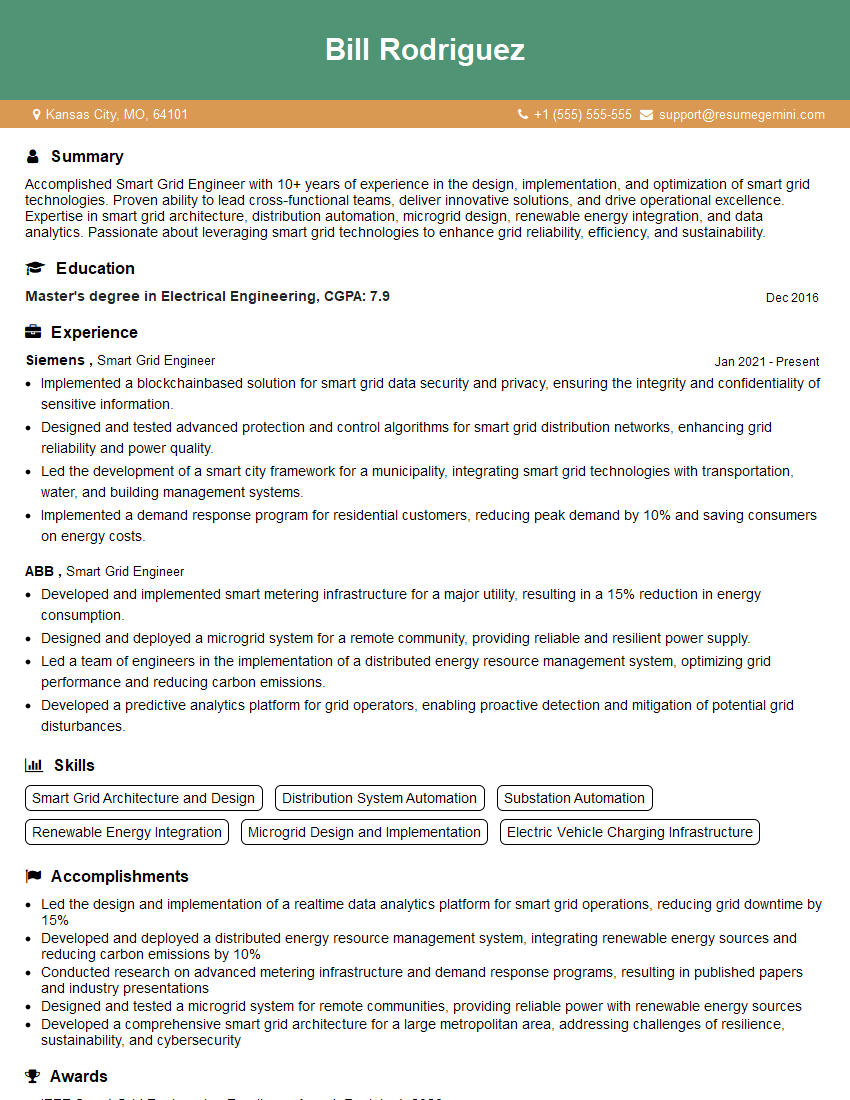
Mastering Electrical Power Transmission opens doors to exciting career opportunities in a constantly evolving field. A strong understanding of these concepts is crucial for success in this competitive industry. To maximize your job prospects, creating a compelling and ATS-friendly resume is paramount. ResumeGemini is a trusted resource that can help you build a professional resume tailored to highlight your skills and experience in Electrical Power Transmission. Examples of resumes specifically designed for this field are available to provide you with inspiration and guidance. Invest in your future – invest in a well-crafted resume.
Explore more articles
Users Rating of Our Blogs
Share Your Experience
We value your feedback! Please rate our content and share your thoughts (optional).
What Readers Say About Our Blog
To the interviewgemini.com Webmaster.
Very helpful and content specific questions to help prepare me for my interview!
Thank you
To the interviewgemini.com Webmaster.
This was kind of a unique content I found around the specialized skills. Very helpful questions and good detailed answers.
Very Helpful blog, thank you Interviewgemini team.