The right preparation can turn an interview into an opportunity to showcase your expertise. This guide to Environmental Systems Research Institute (ESRI) ArcGIS interview questions is your ultimate resource, providing key insights and tips to help you ace your responses and stand out as a top candidate.
Questions Asked in Environmental Systems Research Institute (ESRI) ArcGIS Interview
Q 1. Explain the difference between vector and raster data.
The fundamental difference between vector and raster data lies in how they represent spatial features. Think of it like this: vector data is like drawing a map with precise lines and points, while raster data is like a mosaic made of tiny squares (pixels).
Vector data stores geographic features as points, lines, and polygons. Each feature has precise coordinates defining its location and shape. This makes it ideal for representing discrete features like roads, buildings, or boundaries. Vector datasets are typically smaller in file size compared to raster datasets of the same area.
Raster data represents geographic features as a grid of cells or pixels. Each cell has a value representing a specific attribute, such as elevation, land cover type, or temperature. This makes it ideal for representing continuous phenomena like elevation or satellite imagery. Raster datasets are usually larger in file size than comparable vector datasets.
- Example: A vector dataset might store the boundary of a park as a polygon, while a raster dataset might store the different vegetation types within that park using different pixel values.
Choosing between vector and raster depends entirely on the application. If precise boundaries are critical, vector is better. If continuous surface information is needed, raster is the choice.
Q 2. Describe your experience with geoprocessing tools in ArcGIS.
My experience with geoprocessing tools in ArcGIS is extensive. I’ve used them across a variety of projects, from analyzing land-use change to modeling flood inundation. I’m proficient in using the ModelBuilder for creating automated workflows and chaining multiple tools together for complex analyses.
For instance, in one project, I used a series of geoprocessing tools to automate the process of identifying suitable locations for new wind turbines. This involved incorporating terrain analysis tools (slope, aspect), proximity analysis to existing infrastructure, and overlay analysis to identify areas meeting specific criteria. The ModelBuilder allowed me to easily repeat this analysis with updated datasets and parameters. I’m comfortable with tools such as:
Buffer: Creating buffer zones around features.Intersect: Identifying areas of overlap between datasets.Union: Combining multiple datasets into a single dataset.Clip: Extracting a portion of a dataset.Spatial Join: Adding attributes from one dataset to another based on spatial relationships.
I also have experience using Python scripting within ArcGIS to automate geoprocessing tasks and extend the functionality of existing tools. This allows for more customized and efficient workflows tailored to specific project needs.
Q 3. How do you perform spatial analysis using ArcGIS?
Spatial analysis in ArcGIS involves using various tools and techniques to analyze the spatial relationships between geographic features and phenomena. It goes beyond simply visualizing data; it’s about uncovering patterns, trends, and insights that wouldn’t be apparent from just looking at a map.
My approach typically involves a series of steps:
- Defining the research question: Clearly articulating what I want to learn from the analysis.
- Data acquisition and preparation: Gathering and cleaning the necessary datasets, ensuring data consistency and accuracy.
- Selecting appropriate spatial analysis tools: Choosing the right tools based on the research question and the nature of the data (vector or raster). This could involve overlay analysis, proximity analysis, network analysis, or other techniques.
- Performing the analysis: Running the chosen tools and analyzing the results.
- Interpreting the results: Drawing conclusions based on the analysis and communicating the findings effectively using maps, charts, and reports.
Example: To analyze the relationship between proximity to green spaces and property values, I would use spatial join to link property data with distance from parks and then conduct statistical analysis (regression) to examine the correlation.
I use both built-in ArcGIS tools and Python scripting for more complex analyses, ensuring a robust and efficient workflow.
Q 4. What are the different types of map projections and when would you use each?
Map projections are essential for representing the three-dimensional Earth on a two-dimensional map. This process inevitably involves distortions, and different projections minimize different types of distortion. The choice of projection is crucial and depends entirely on the purpose of the map.
Some common projections include:
- Equirectangular Projection: Simple projection with minimal distortion near the equator, ideal for world maps showing general locations but highly distorted at the poles.
- Mercator Projection: Preserves direction and shape, widely used for navigation, but severely distorts area at high latitudes (e.g., Greenland appearing much larger than it actually is).
- Albers Equal-Area Conic Projection: Preserves area accurately, ideal for mapping large regions with minimal east-west extent, but distorts shape and direction.
- Lambert Conformal Conic Projection: Preserves shape and direction, commonly used for aviation charts and topographic maps of mid-latitude regions. It has less distortion than Mercator in high latitudes.
- UTM (Universal Transverse Mercator): A cylindrical projection divided into zones, minimizing distortion within each zone and widely used for large-scale mapping.
When to use each: The choice depends on the spatial extent of the map, the features being mapped, and the desired properties (area, shape, distance, direction). For instance, a world map displaying population density would benefit from an equal-area projection, while a navigational chart requires a projection that preserves direction.
Q 5. Explain your experience with data management in ArcGIS.
Data management in ArcGIS is a critical aspect of my work, ensuring data quality, accessibility, and efficiency throughout the project lifecycle. This involves various aspects, from importing and organizing data to implementing metadata standards.
My experience includes:
- Data import and conversion: Converting data from various formats (shapefiles, GeoTIFFs, CAD files) into a consistent format for analysis. I’m familiar with the intricacies of different data formats and their limitations.
- Data cleaning and preprocessing: Identifying and correcting inconsistencies or errors in datasets, such as spatial errors, attribute errors, or missing data. I utilize tools like the ArcGIS Data Reviewer for systematic quality control.
- Data organization and storage: Implementing robust file naming conventions and folder structures to manage large datasets efficiently. I also utilize geodatabases for structured data management.
- Metadata management: Creating and maintaining comprehensive metadata for datasets, ensuring discoverability, understandability, and compliance with standards (e.g., FGDC).
Efficient data management is crucial not only for project success but also for reproducibility and collaboration. I actively employ best practices to ensure data quality and ease of use for myself and other stakeholders.
Q 6. How do you handle data discrepancies and errors in a GIS dataset?
Handling data discrepancies and errors is a common challenge in GIS. My approach involves a multi-step process:
- Data validation and quality checks: Thoroughly inspecting data for inconsistencies, outliers, and errors using tools like ArcGIS Data Reviewer and Python scripting. This often includes checking attribute values against known ranges and identifying topological errors.
- Error identification: Identifying the source of the errors (data acquisition, processing, or entry errors) to prevent recurrence. This may involve comparing data against reliable sources or reviewing data collection methodologies.
- Error correction: Correcting the errors using appropriate methods. This might involve editing feature geometries, updating attribute values, or employing spatial analysis tools to detect and correct inconsistencies.
- Data reconciliation: When discrepancies arise from merging multiple datasets, I use techniques like spatial joins or overlay analysis to resolve conflicts and create a consistent dataset. Decisions often require considering the reliability of the various data sources.
- Documentation: Thoroughly documenting the methods used for error detection and correction, ensuring transparency and repeatability.
A crucial aspect is understanding the implications of errors and choosing the best correction strategy. Sometimes, removing or flagging erroneous data is the best approach rather than attempting a correction that might introduce further inaccuracies.
Q 7. Describe your experience with creating and managing geodatabases.
Geodatabases are the optimal way to manage GIS data in a structured and efficient manner. My experience encompasses creating and managing various types of geodatabases, including file geodatabases and enterprise geodatabases.
My experience includes:
- Geodatabase design: Designing geodatabases based on project requirements, including determining appropriate feature classes, attribute tables, and relationships between datasets. I consider data volume, usage patterns, and anticipated future needs when making design decisions.
- Data import and organization: Organizing data within the geodatabase using appropriate schemas and feature datasets to ensure efficient storage and retrieval. I strive to create a clear and logical organization to enhance usability and maintainability.
- Data versioning and concurrency: Implementing versioning to manage concurrent edits in collaborative projects. This ensures data integrity and prevents conflicts among multiple users working on the same data simultaneously. In enterprise settings, I have experience with workflows for versioned geodatabases.
- Data replication and backup: Implementing strategies for replicating and backing up geodatabase data to ensure data safety and availability. This often involves implementing versioning and using robust backup procedures.
Geodatabases provide a superior data management solution compared to simple shapefile collections because of their inherent structure, data integrity tools, and support for complex relationships. They are essential for managing large and complex GIS projects.
Q 8. How familiar are you with ArcGIS Pro compared to ArcMap?
I’m highly proficient in both ArcGIS Pro and ArcMap, having used them extensively throughout my career. ArcGIS Pro, being the newer platform, offers a more modern, ribbon-based interface, improved performance with large datasets, and better integration with Python. It’s my primary tool now for most projects. ArcMap, while still relevant, is becoming increasingly outdated. I appreciate ArcMap’s familiarity for certain tasks and its strong legacy in the GIS community, but ArcGIS Pro’s capabilities are superior for most modern workflows, particularly in terms of 3D analysis, geoprocessing capabilities, and project management.
For instance, a recent project involving analyzing land cover change over several decades required the speed and efficiency of ArcGIS Pro’s geoprocessing tools to handle the massive raster datasets. The ability to easily manage and organize multiple maps and geodatabases within a single project in Pro is far superior to ArcMap’s approach. However, I still utilize ArcMap for specific legacy projects where the data is already within an ArcMap geodatabase and there’s no pressing need for migration.
Q 9. Explain your experience with Python scripting in ArcGIS.
I have extensive experience with Python scripting in ArcGIS, leveraging it to automate repetitive tasks, customize workflows, and create sophisticated geoprocessing tools. My expertise includes utilizing the arcpy site package to interact with ArcGIS geodatabases, performing spatial analysis, creating custom toolboxes, and integrating with other libraries like NumPy and Pandas for data manipulation and analysis. I find this particularly useful for streamlining data processing, improving workflow efficiency, and creating custom solutions tailored to project specific needs.
For example, in a recent project, I wrote a Python script to automatically process hundreds of GPS tracks, cleaning the data, calculating speeds and distances, and then generating customized reports. This script drastically reduced the processing time compared to manual methods. Another example involves building custom geoprocessing tools using model builder and then automating those models within a Python script to improve the reproducibility of complex analysis.
# Example ArcPy script snippet:
import arcpy
arcpy.env.workspace = r"C:\path\to\geodatabase"
arcpy.analysis.Intersect("polygon1","polygon2","output_polygon")
Q 10. Describe your experience with spatial statistics in ArcGIS.
My experience with spatial statistics in ArcGIS encompasses a wide range of techniques, including spatial autocorrelation analysis (e.g., Moran’s I), clustering analysis (e.g., Hot Spot Analysis), interpolation methods (e.g., Kriging, Inverse Distance Weighting), and regression analysis with spatial components. I’m comfortable using both the Spatial Statistics Toolbox within ArcGIS Pro and applying statistical concepts programmatically using Python and ArcPy. This allows me to analyze spatial patterns, identify relationships between geographic features, and model spatial processes. Understanding spatial autocorrelation is crucial in many analyses, ensuring the chosen statistical techniques account for spatial dependencies.
For instance, I used spatial statistics to analyze the spatial distribution of disease outbreaks in a particular region, identify potential clusters of high risk areas, and subsequently inform public health interventions. In another case, I applied Kriging to interpolate precipitation data across a study area from a sparse set of weather stations.
Q 11. How do you ensure the accuracy and quality of GIS data?
Ensuring the accuracy and quality of GIS data is paramount. My approach involves a multi-stage process starting with data acquisition, followed by rigorous validation and verification. This includes verifying the spatial accuracy of data through methods such as comparing it against high-accuracy reference datasets (e.g., lidar data for elevation), and using field surveys to ground-truth data. Attribute accuracy is checked through data cleaning, consistency checks, and potentially comparing the data against other sources.
Data cleaning often involves addressing errors such as duplicate features, invalid geometries, and inconsistencies in attribute fields. Metadata management is also vital; I meticulously document all data sources, processing steps, and potential limitations, maintaining a clear audit trail. Regular updates and error correction based on feedback from field surveys or other datasets is important to maintain data integrity over time.
For instance, if working with cadastral data, I will compare to official land records, and if working with aerial imagery, I will perform georeferencing and validate the accuracy against known ground control points.
Q 12. What are some common challenges in GIS project management and how would you address them?
Common challenges in GIS project management include scope creep, unrealistic deadlines, data inconsistencies, and communication breakdowns. Addressing these requires a proactive approach. I start by defining clear project objectives, developing a detailed work plan with realistic timelines and milestones, and establishing clear communication channels with all stakeholders. Regular progress meetings, risk assessment, and thorough documentation are crucial to mitigating potential problems.
Scope creep is managed by using change management protocols, ensuring that any deviations from the original scope are formally documented and approved. Data inconsistencies are tackled using robust data quality control measures throughout the project lifecycle. To foster effective communication, I use a variety of tools – regular updates, email, project management software, and collaborative platforms – to keep everyone informed and engaged.
For example, when managing a large mapping project, I would utilize agile methodologies, breaking down the project into smaller, manageable sprints to manage risks and monitor progress effectively.
Q 13. Describe your experience working with GPS data in ArcGIS.
I have extensive experience working with GPS data in ArcGIS, from data acquisition using various GPS receivers to processing and analyzing the data using ArcGIS Pro’s geoprocessing tools. This includes importing GPS tracks, cleaning the data (removing outliers and errors), converting coordinate systems, and integrating the GPS data with other spatial datasets. I also have experience working with differential GPS (DGPS) data to improve positional accuracy, and incorporating error analysis techniques to understand and account for uncertainties in the GPS data.
For instance, I have used GPS data to track animal movements, map hiking trails, and monitor vehicle routes. In one project, I used DGPS to survey land parcels, achieving a much higher accuracy than with standard GPS. The integration of GPS data with other spatial datasets, such as elevation data, is crucial for generating comprehensive maps and analysis.
Q 14. How familiar are you with different coordinate systems and datum transformations?
I am very familiar with different coordinate systems and datum transformations. I understand the importance of selecting the appropriate coordinate system for a given project and the implications of using different datums. I can perform datum transformations using ArcGIS Pro’s tools, ensuring the spatial data is accurately projected and registered. My understanding encompasses projected coordinate systems (e.g., UTM, State Plane), geographic coordinate systems (e.g., latitude/longitude), and the various datums (e.g., WGS84, NAD83). The importance of understanding this relates directly to the accuracy and reliability of any spatial analysis.
Choosing the wrong coordinate system can lead to significant inaccuracies in spatial analysis and map production. For example, if you’re working with data from multiple sources using different coordinate systems, you need to project everything into a common system before any analysis. I frequently use tools like the Project tool and the Define Projection tool to correctly transform data sets to the necessary coordinate systems.
Q 15. Explain your experience with creating interactive maps and web applications using ArcGIS.
Creating interactive maps and web applications in ArcGIS is a core strength of mine. I’ve extensively used ArcGIS Pro and ArcGIS Online to develop engaging web maps and applications that leverage the power of location data. This involves not only designing visually appealing interfaces but also ensuring seamless functionality and user experience.
For example, I once developed an interactive web map for a city’s public works department to track pothole repairs. This involved importing point data representing pothole locations, linking it to attribute data containing repair status and dates, and creating a user-friendly interface that allowed users to filter and query the data. I used ArcGIS Online’s web app builder and integrated it with a custom web app created using Javascript APIs to enhance functionality and achieve advanced visualization capabilities. The app incorporated pop-up windows with detailed information about each pothole and allowed users to zoom and pan seamlessly. The result was a dynamic tool that significantly improved efficiency in managing the city’s pothole repair program.
Another project involved creating a web map application for visualizing real-time traffic data. This involved utilizing ArcGIS API for JavaScript to create a dynamic map that updated every few minutes with real-time traffic flow data. I implemented features such as traffic incident reporting and integration with external APIs to improve accuracy and reliability. The application used color-coded lines to represent traffic congestion levels and supported various search tools to locate specific roads or intersections.
Career Expert Tips:
- Ace those interviews! Prepare effectively by reviewing the Top 50 Most Common Interview Questions on ResumeGemini.
- Navigate your job search with confidence! Explore a wide range of Career Tips on ResumeGemini. Learn about common challenges and recommendations to overcome them.
- Craft the perfect resume! Master the Art of Resume Writing with ResumeGemini’s guide. Showcase your unique qualifications and achievements effectively.
- Don’t miss out on holiday savings! Build your dream resume with ResumeGemini’s ATS optimized templates.
Q 16. How would you approach the problem of visualizing large datasets in ArcGIS?
Visualizing large datasets in ArcGIS requires a strategic approach focusing on data management, appropriate symbolization, and efficient rendering techniques. Simply loading a massive dataset into ArcGIS without careful planning will result in poor performance and an unusable map.
My approach typically involves these steps:
- Data Subsetting and Aggregation: Instead of visualizing the entire dataset at once, I often subset the data based on geographical area, time period, or specific attributes. I might also aggregate the data, for example, converting point data into density surfaces or polygon data into summaries using zonal statistics.
- Appropriate Symbolization: The choice of symbology is crucial. For point data, I’d consider graduated symbols, heat maps, or dot density maps depending on the data and the message I want to convey. For polygon data, I’d explore color ramps or graduated colors, avoiding overly complex symbology.
- Tile Caching: For online maps or web applications, tile caching is essential. Tile caching pre-renders the map into smaller tiles, which speeds up loading times and improves overall performance. ArcGIS Online offers excellent tile caching tools.
- Feature Layers and Services: For very large datasets, I might use geodatabases or publish data as feature services and consume it in my applications rather than loading the entire dataset into a local session.
- Use of appropriate spatial data formats: For instance, using file geodatabases or cloud-based storage for efficient access to the data.
For instance, visualizing census data for a large country might require aggregation at the county level rather than showing individual census tracts. A heat map could effectively represent population density. Understanding data properties is paramount to effective visualization.
Q 17. Explain your experience with 3D GIS applications in ArcGIS.
My experience with 3D GIS in ArcGIS is extensive, encompassing both ArcGIS Pro and CityEngine. I’ve utilized 3D capabilities for a wide range of applications, from urban planning and environmental modeling to visualizing subsurface utilities.
I’ve worked on projects creating 3D models of cities using LiDAR data and aerial imagery. This involved processing point cloud data in ArcGIS Pro to create detailed terrain surfaces and then integrating those surfaces with building footprints and other 3D features. The resulting 3D models allowed for realistic visualization of proposed developments and their impact on the surrounding environment. I also used CityEngine to generate realistic 3D city models based on rules and parameters. I used this to generate different urban growth scenarios to assess future land use patterns and their impact on traffic flow.
Beyond city modeling, I’ve utilized 3D capabilities for visualizing subsurface data. This includes creating 3D representations of geological formations, groundwater levels, and underground utilities. This often involves working with point clouds from LiDAR scans or other 3D spatial data and building models that can be integrated with other contextual data.
Q 18. Describe your experience with remote sensing data processing and analysis in ArcGIS.
Remote sensing data processing and analysis forms a significant part of my GIS skillset. I’m proficient in processing various types of remotely sensed data, including satellite imagery (Landsat, Sentinel, etc.) and aerial photography, within the ArcGIS environment. My workflow typically includes:
- Data Preprocessing: This involves tasks like geometric correction, atmospheric correction, and orthorectification, using tools within ArcGIS such as the Spatial Analyst extension or specialized extensions like ENVI.
- Image Classification: I’m skilled in employing supervised and unsupervised classification techniques to extract thematic information from imagery. This could be identifying land cover types, detecting changes over time, or mapping vegetation health.
- Image Enhancement: I regularly apply various image enhancement techniques, such as filtering and contrast adjustments, to improve image quality and facilitate interpretation.
- Data Integration: I seamlessly integrate remotely sensed data with other GIS datasets (e.g., vector data, elevation models) for comprehensive analysis.
For example, I used Landsat imagery to monitor deforestation in a rainforest region. After preprocessing the imagery, I performed a supervised classification using training data to differentiate between forest and non-forest areas. This allowed me to quantify the extent of deforestation over several years and identify areas requiring conservation efforts.
Q 19. How would you use ArcGIS to model spatial relationships between different datasets?
Modeling spatial relationships between different datasets in ArcGIS involves leveraging spatial analysis tools to understand how various geographical features interact. The approach depends heavily on the nature of the datasets and the specific questions being addressed.
Here’s a breakdown of common methods:
- Spatial Joins: To combine attributes from different datasets based on spatial location (e.g., joining crime incidents to census tracts to analyze crime rates).
- Overlay Analysis: To combine multiple spatial datasets to create new datasets showing the relationships between features. This includes intersection, union, and erase operations. For instance, overlaying a land use map with a flood zone map to identify areas at risk.
- Proximity Analysis: To determine distances or relationships based on proximity, using tools like buffers or near analysis. For example, calculating the distance from homes to the nearest school or hospital.
- Network Analysis: To model movement and flow across a network (e.g., roads or pipelines). For instance, finding the shortest route for emergency services or optimizing delivery routes.
- Spatial Statistics: To perform statistical analyses considering spatial autocorrelation (e.g., analyzing the clustering of disease occurrences).
For example, I modeled the relationship between proximity to green spaces and property values. I created buffers around parks and green spaces and then performed a spatial join to associate property values with distances to these buffers. Subsequently, statistical analysis helped establish a correlation between proximity to green space and property valuation.
Q 20. Explain your experience with creating cartographic products in ArcGIS.
Creating cartographic products in ArcGIS is a vital part of my work. It goes beyond simply displaying data; it’s about communicating information clearly and effectively. This involves attention to detail, understanding cartographic principles, and utilizing ArcGIS’s powerful cartographic tools.
My experience includes:
- Map Design: I create maps that are both visually appealing and easy to understand, employing appropriate symbology, labeling, and layout. I am adept at using different map projections to accurately represent geographical features.
- Data Visualization: I select the best visualization techniques to represent the data clearly and accurately, considering the map’s purpose and audience.
- Cartographic Generalization: I’m skilled in generalizing data for different map scales, ensuring clarity and readability without losing essential information.
- Map Production: I create final map products in various formats (PDF, image files, web maps) ready for printing or online publication.
For instance, I created a series of maps for a land use planning project, visualizing different scenarios for urban development. Each map featured carefully selected symbology, clear labels, a well-designed legend, and a consistent visual style. The outcome were polished maps ready for public presentation and decision-making processes. I ensured accuracy in the representation of boundaries and other crucial elements.
Q 21. What are your experiences with different types of GIS data (e.g., LiDAR, imagery)?
I have extensive experience working with various types of GIS data, including:
- Raster Data: This includes satellite imagery (Landsat, Sentinel, aerial photography), LiDAR point clouds, and DEMs (Digital Elevation Models). I am proficient in preprocessing, analyzing, and classifying this type of data using ArcGIS’s Spatial Analyst extension and other tools. For example, I utilized LiDAR data to create highly accurate digital terrain models for flood risk assessment.
- Vector Data: This involves working with point, line, and polygon features representing various geographical entities (roads, buildings, boundaries). I am skilled in data editing, geoprocessing, and spatial analysis using vector data.
- 3D Data: I handle point cloud data from various sources (LiDAR, laser scanning), building 3D models and incorporating them into GIS projects. I’ve successfully integrated 3D models into web applications to create immersive viewing experiences.
- Other data formats: I am comfortable working with diverse data formats, including CAD data, shapefiles, geodatabases, and cloud-based data sources.
My experience working with this data is across a wide range of applications, demonstrating a robust understanding of how different data types can be used together to solve complex spatial problems.
Q 22. Describe your familiarity with the ArcGIS Online platform.
ArcGIS Online is Esri’s cloud-based mapping and analytics platform. I’m highly proficient in using it for creating, sharing, and collaborating on maps, apps, and geospatial data. My experience encompasses utilizing its various functionalities, including creating web maps and scenes, publishing feature layers and services, leveraging the ArcGIS Living Atlas of the World, and integrating with other Esri products like ArcGIS Pro. For instance, I recently used ArcGIS Online to develop an interactive web map displaying real-time air quality data for a city-wide environmental monitoring project. This involved connecting to live data feeds, creating custom symbology, and building interactive elements to enhance user engagement. I also have extensive experience managing and sharing content through ArcGIS Online’s organizational accounts and groups, ensuring collaborative workflows and data accessibility.
Q 23. How would you perform a buffer analysis in ArcGIS?
A buffer analysis in ArcGIS creates areas (buffers) around geographic features to a specified distance. It’s extremely useful for determining proximity. For example, you might want to find all houses within a mile of a school. In ArcGIS Pro, you would typically perform this using the ‘Buffer’ geoprocessing tool found under the Analysis toolbox. You would select your input features (e.g., points representing schools), specify the buffer distance (e.g., 1 mile), and choose the appropriate output parameters. The tool then generates new polygon features representing the buffered areas. ArcGIS Online offers similar functionality through its geoprocessing tools, though the specific interface may differ slightly. Beyond the basic buffer, I’ve used advanced techniques like dissolving buffers from multiple features to create a single consolidated area, or utilizing multiple buffer distances to create zones of influence with varying proximity.
Q 24. Explain your experience with overlay analysis techniques in ArcGIS.
Overlay analysis combines spatial data from multiple layers to reveal relationships between features. I frequently use this technique. Common methods include intersect, union, erase, and clip. For example, I once used an intersect analysis to determine the areas of a city that were both within a floodplain and within a specific zoning district, to assess flood risk in specific areas. This provided crucial information for urban planning and risk assessment. Intersect combines the geometry and attributes of two layers where they overlap; Union combines all areas of input layers; Erase removes the areas of one layer that overlap another; and Clip extracts the features of one layer that lie within the boundaries of another. The choice of method depends entirely on the specific analytical question. I am comfortable selecting and implementing the most appropriate overlay technique depending on the project requirements. I also have experience with using different coordinate systems and projections to ensure accurate results, accounting for distortion introduced during map projections.
Q 25. Describe your experience with network analysis in ArcGIS.
Network analysis in ArcGIS is about finding the best paths or routes on a network, such as roads, pipelines, or transportation systems. I’ve used this extensively for applications like route optimization, service area analysis, and finding the closest facility. A real-world example includes finding the optimal routes for a fleet of delivery trucks, minimizing travel time and fuel consumption. This involves using the ArcGIS Network Analyst extension in ArcGIS Pro. I’m familiar with creating network datasets from various data sources and using different solvers like the shortest path, closest facility, and service area solvers. Beyond the standard functionalities, I have experience incorporating constraints such as speed limits, turn restrictions, and time windows into network analyses to get more realistic results. This deeper understanding allows me to create sophisticated models suitable for complex real-world scenarios.
Q 26. How familiar are you with ArcGIS Server and its functionalities?
ArcGIS Server is Esri’s platform for deploying and managing geospatial services. My familiarity includes deploying map services, feature services, geoprocessing services, and image services. I have hands-on experience with setting up and configuring ArcGIS Server, managing server resources, and optimizing service performance. This includes experience with web adaptors, configuring security settings, and monitoring server logs to ensure seamless service availability and prevent potential errors. A recent project involved publishing an interactive map application built in ArcGIS Pro as a web service accessible to a large number of users concurrently. I managed the deployment process, optimizing the service for performance and security to ensure a smooth user experience, even during peak usage times.
Q 27. How do you ensure data security and access control within an ArcGIS environment?
Data security and access control are paramount in any GIS environment. Within ArcGIS, I employ several strategies. These include implementing robust authentication mechanisms (e.g., using ArcGIS Portal’s security settings and integrated identity providers) to restrict access to specific users or groups. For sensitive data, I often encrypt data both at rest and in transit. I’ve also extensively used ArcGIS’s role-based access control (RBAC) to define different levels of user permissions to limit data manipulation, viewing and editing capabilities based on individual user roles and responsibilities. Regular security audits and the implementation of appropriate security measures are crucial in the overall strategy to protect sensitive data and ensure compliance with relevant regulations. This is not just a technical approach, but also requires thorough understanding of privacy regulations and data governance policies.
Q 28. What is your experience with customizing ArcGIS toolbars and menus?
Customizing ArcGIS toolbars and menus enhances workflow efficiency. I’m proficient in customizing toolbars in ArcGIS Pro by adding frequently used tools for quick access. This includes adding custom tools or scripts and creating customized toolbars for specific tasks to streamline workflows. While I haven’t extensively worked on developing custom extensions, I am familiar with the process and the potential this unlocks for tailored workflows. For instance, in a project involving extensive land-use change analysis, I created a custom toolbar containing tools for frequently used geoprocessing tasks, dramatically reducing the time it took to perform routine analyses. This allowed me to focus more on the critical aspects of the project instead of navigating menus.
Key Topics to Learn for Environmental Systems Research Institute (ESRI) ArcGIS Interview
- Spatial Data Handling: Understanding different data formats (shapefiles, geodatabases, rasters), data projections, and coordinate systems is fundamental. Practice converting and manipulating data between formats.
- Data Analysis and Visualization: Master techniques for spatial analysis, including buffering, overlay analysis, proximity analysis, and spatial statistics. Learn to create compelling maps and charts to communicate your findings effectively.
- Geoprocessing and ModelBuilder: Familiarize yourself with automating workflows using model builder and scripting (Python is highly recommended). Understand how to build and execute geoprocessing models for complex tasks.
- ArcGIS Pro Interface and Tools: Become proficient in navigating the ArcGIS Pro interface, utilizing its various tools and extensions. This includes understanding the Catalog window, map layouts, and symbology options.
- Cartography and Map Design: Learn the principles of effective map design, focusing on clarity, accuracy, and communication. Practice creating different map types (e.g., thematic maps, choropleth maps) to visualize spatial data effectively.
- GPS and Spatial Data Acquisition: Understanding how GPS data is collected and integrated into GIS workflows is crucial. Learn about data accuracy and error handling.
- Remote Sensing and Image Analysis: Familiarize yourself with the basics of remote sensing and how to interpret satellite imagery and aerial photographs within ArcGIS. This is increasingly important for environmental applications.
- Problem-Solving with ArcGIS: Practice applying your ArcGIS skills to solve real-world spatial problems. Think about how you would use ArcGIS to address specific environmental challenges (e.g., habitat analysis, pollution monitoring).
Next Steps
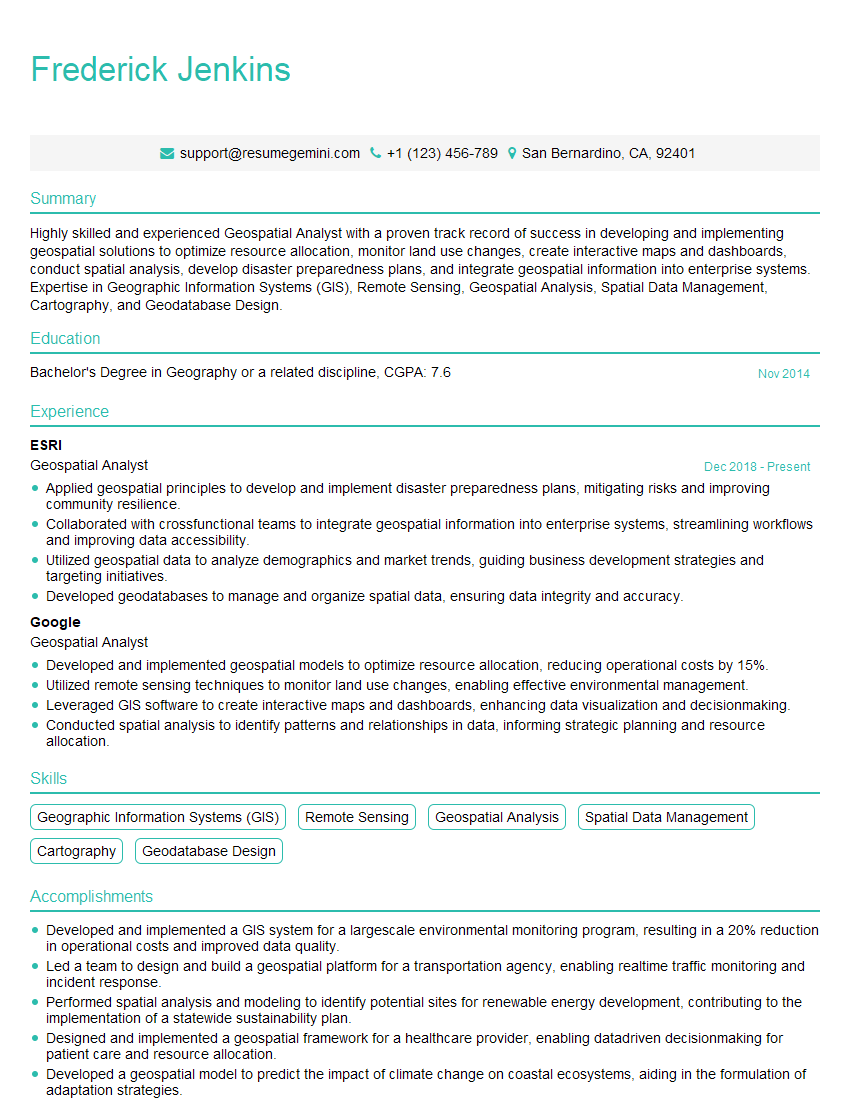
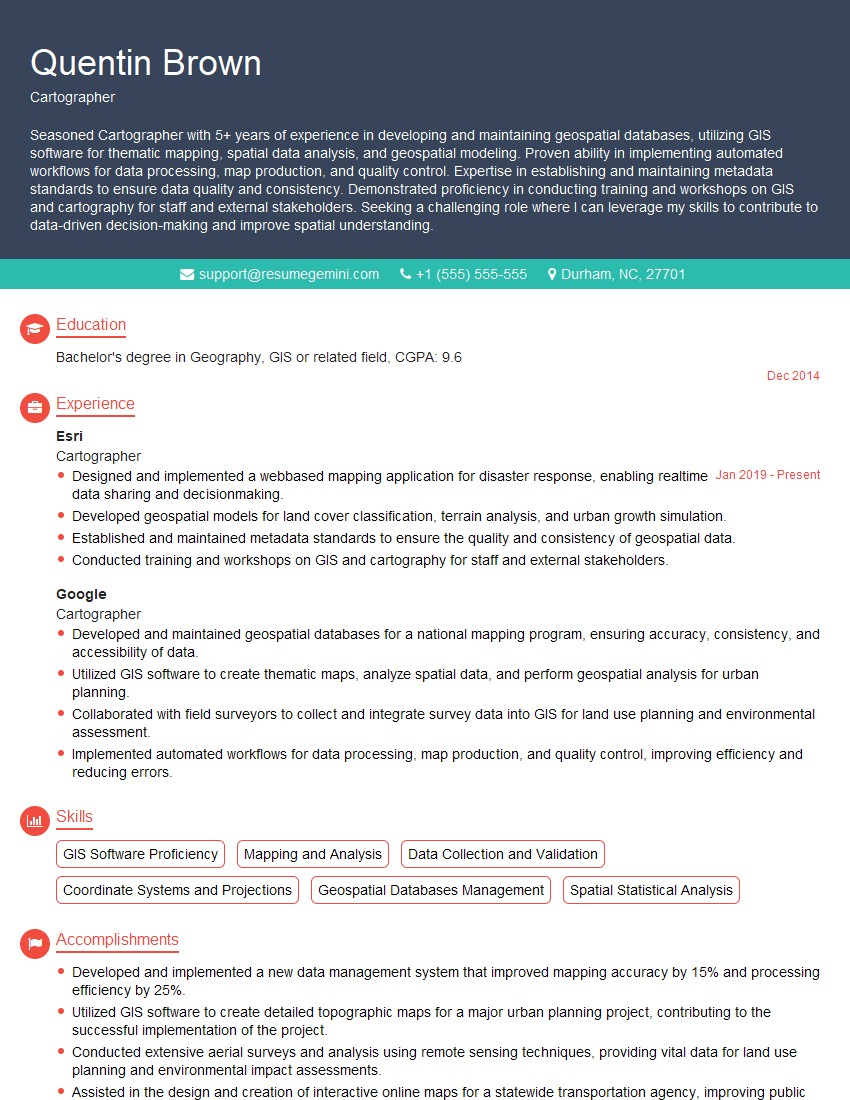
Mastering ESRI ArcGIS opens doors to exciting careers in environmental science, urban planning, and many other fields. Demonstrating proficiency in ArcGIS is highly valued by employers. To significantly boost your job prospects, create an ATS-friendly resume that showcases your skills effectively. ResumeGemini is a trusted resource that can help you build a professional and impactful resume. Examples of resumes tailored to showcasing ArcGIS expertise are available, allowing you to craft a document that truly highlights your abilities and experience. Invest time in creating a compelling resume; it’s your first impression on potential employers.
Explore more articles
Users Rating of Our Blogs
Share Your Experience
We value your feedback! Please rate our content and share your thoughts (optional).
What Readers Say About Our Blog
To the interviewgemini.com Webmaster.
Very helpful and content specific questions to help prepare me for my interview!
Thank you
To the interviewgemini.com Webmaster.
This was kind of a unique content I found around the specialized skills. Very helpful questions and good detailed answers.
Very Helpful blog, thank you Interviewgemini team.